
 01
Furniture and interior plywood · Ha Hoa, Phu Tho, Vietnam
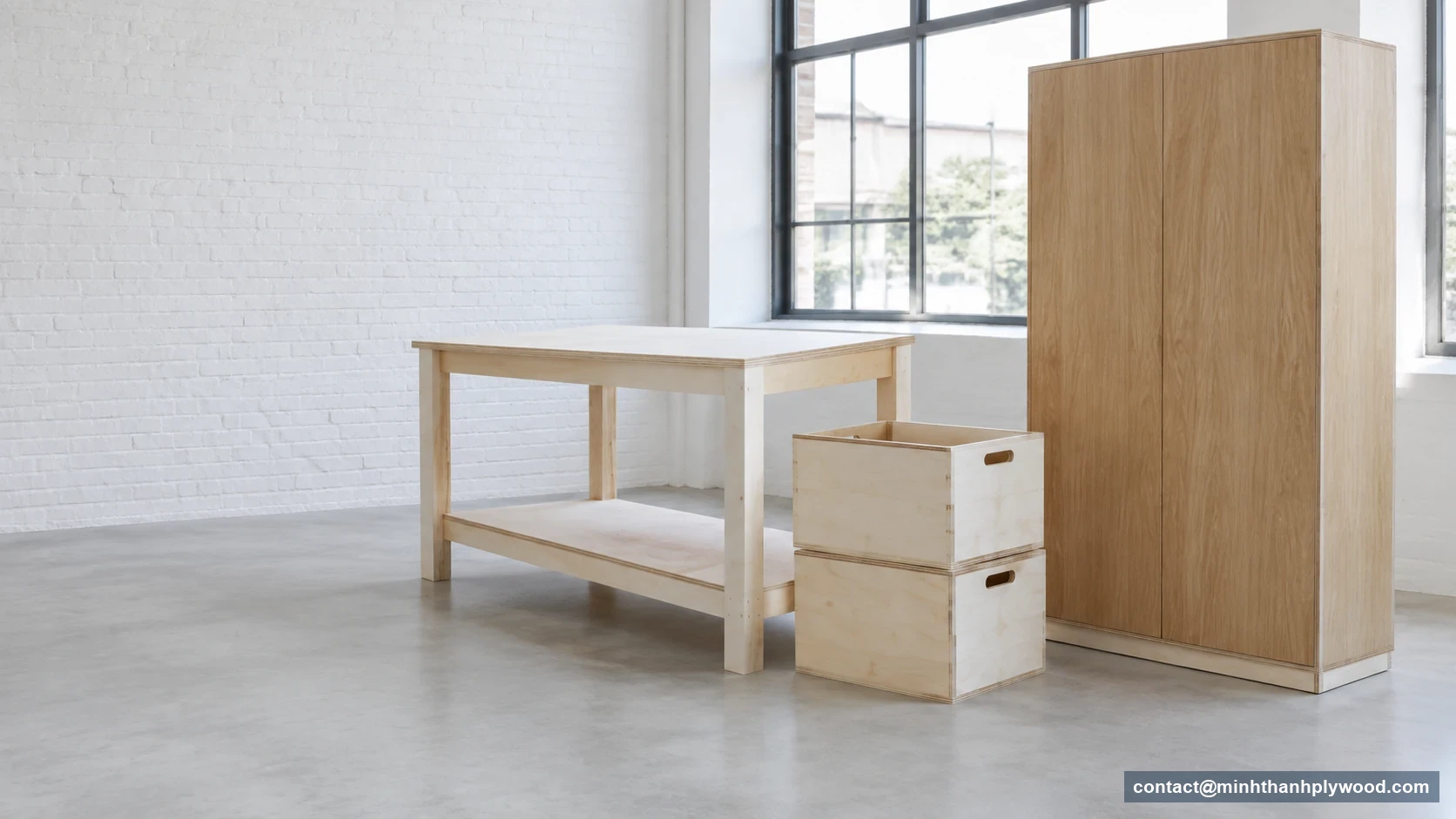
Furniture Plywood from Vietnam for Cabinets, Wardrobes and Interiors
In short
Minh Thanh Plywood manufactures furniture plywood in Ha Hoa, Vietnam: birch, poplar, EV, okoume, pine and other faces on white Styrax or Eucalyptus cores. Every panel is pressed twice, core layers are stitched both ways, both faces are sanded and polished down to ±0.2 mm, and UF glue at E0 emission is standard. Panels run 3–40 mm on 1220 × 2440 or 1250 × 2500 mm sheets.
- Faces
- Birch, poplar, EV, okoume, pine, eucalyptus, gurjan, bintangor
- Core
- White Styrax or Eucalyptus, stitched both ways
- Thickness
- 3–40 mm, tolerance down to ±0.2 mm
- Emission
- E0 standard; chamber tests 0.014–0.032 ppm
- Order
- MOQ 1×40HC, 15–45 days after deposit
Furniture and interior panels are what our factory is built for, pressed on our own lines with 50,000+ m³ of annual capacity and over 20 years of plywood making. Europe is our main market, with repeat orders into Italy, and we ship across the Americas, Asia and Africa. Each panel here links to its own product page, and the quote form is answered within hours.
Watch first
Furniture plywood explained in four minutes
The film walks through the whole choice in about four minutes. It covers face, core, glue and thickness for each furniture part, then our checks, packing and the 40HC load, with real production clips of the panels themselves.
The furniture range
Our furniture plywood range: eight faces, two cores
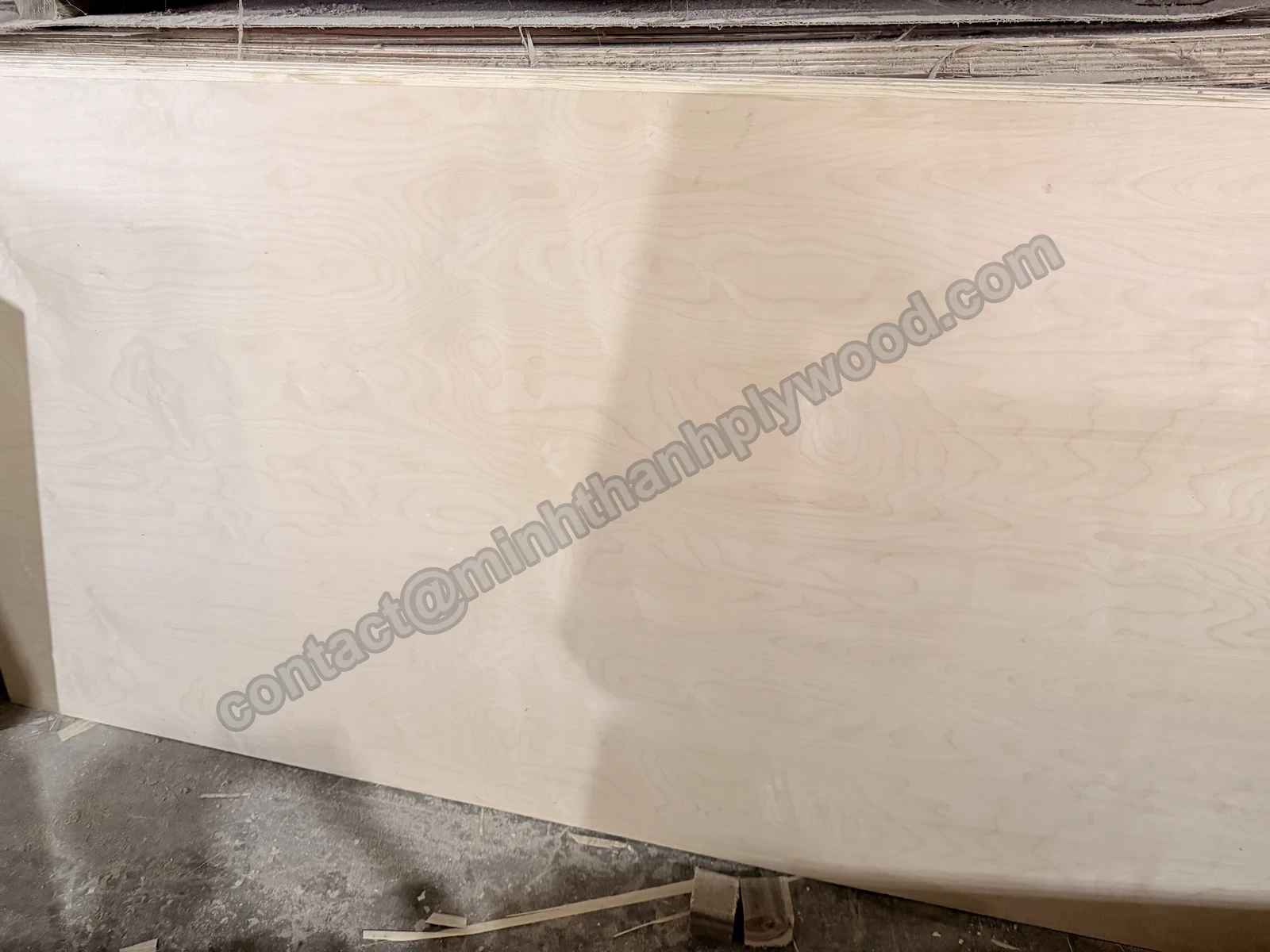
Our furniture plywood comes with eight faces: birch, poplar, EV, okoume, pine, eucalyptus, gurjan and bintangor. Every face is pressed on the same two cores, white Styrax or Eucalyptus, and thin 3–6 mm panels and cut-to-size parts complete the range. The face sets the look; the core and glue set weight and room use.
01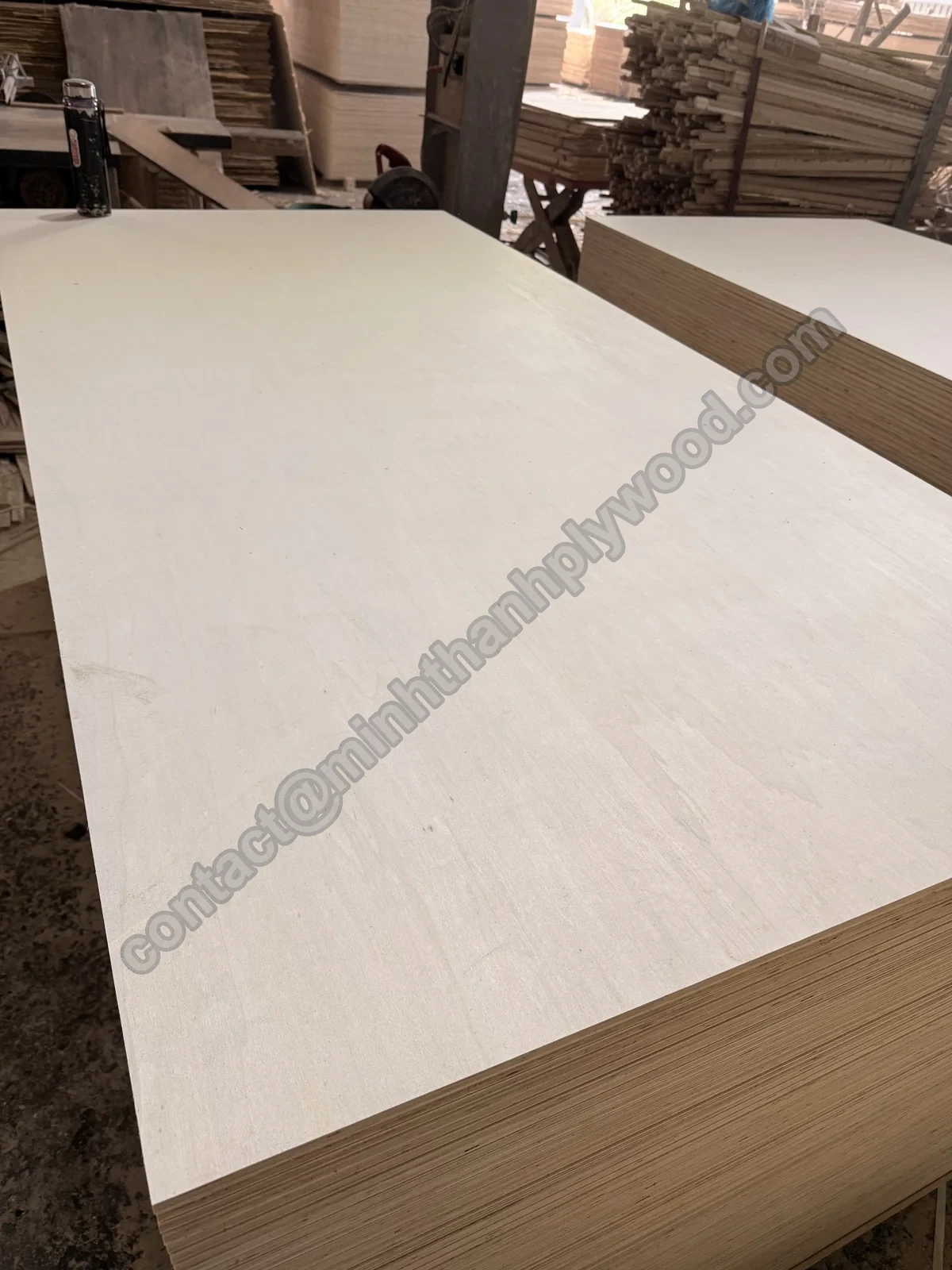 02
Poplar plywood
Plain light cream face, the usual base for paint, foil, decor paper and HPL on carcasses and doors.Poplar face and back · 3–40 mm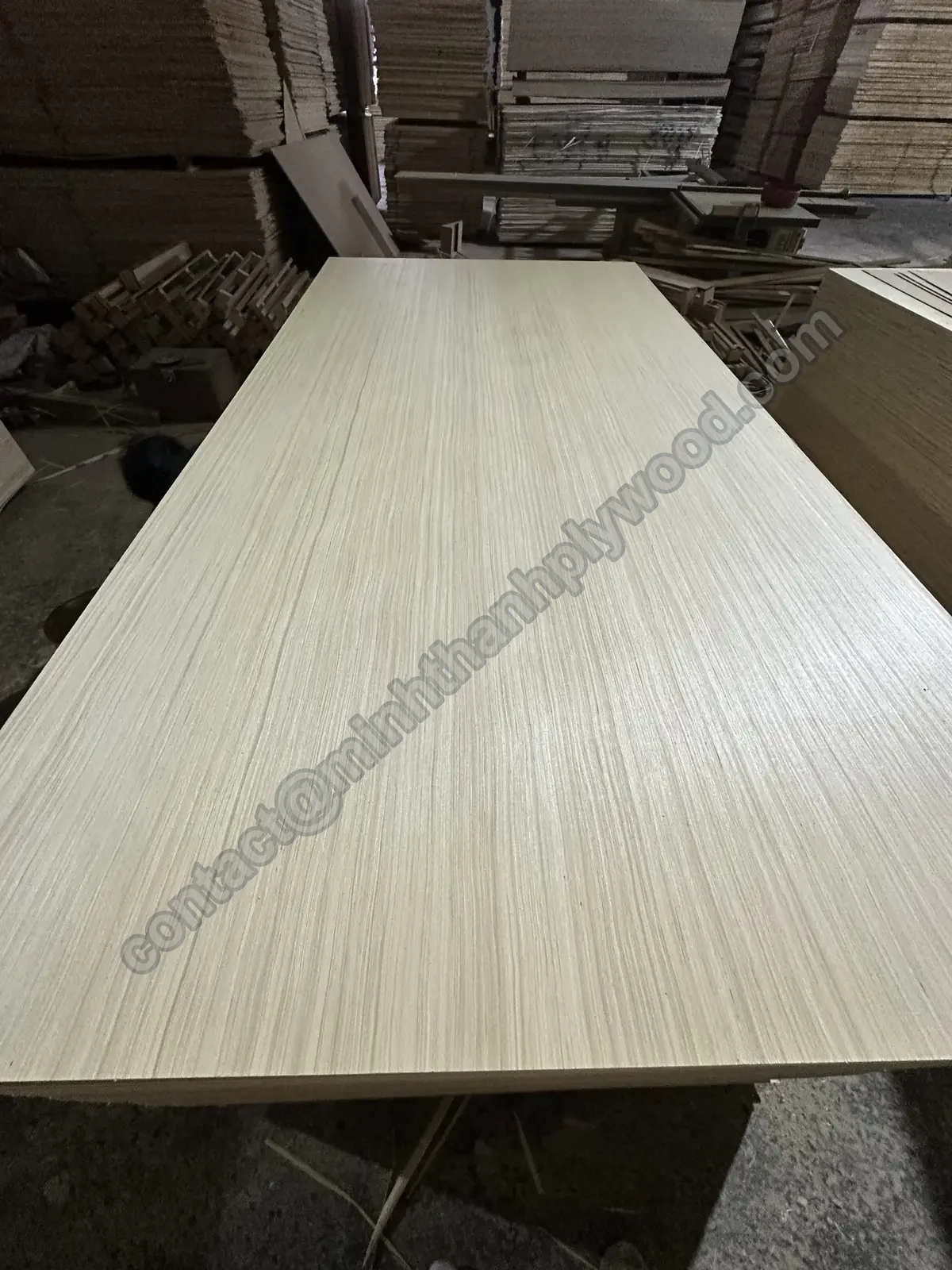 03
EV plywood
Engineered veneer with the same grain and colour on every sheet, for furniture series that must match panel to panel.Engineered veneer face · 3–40 mm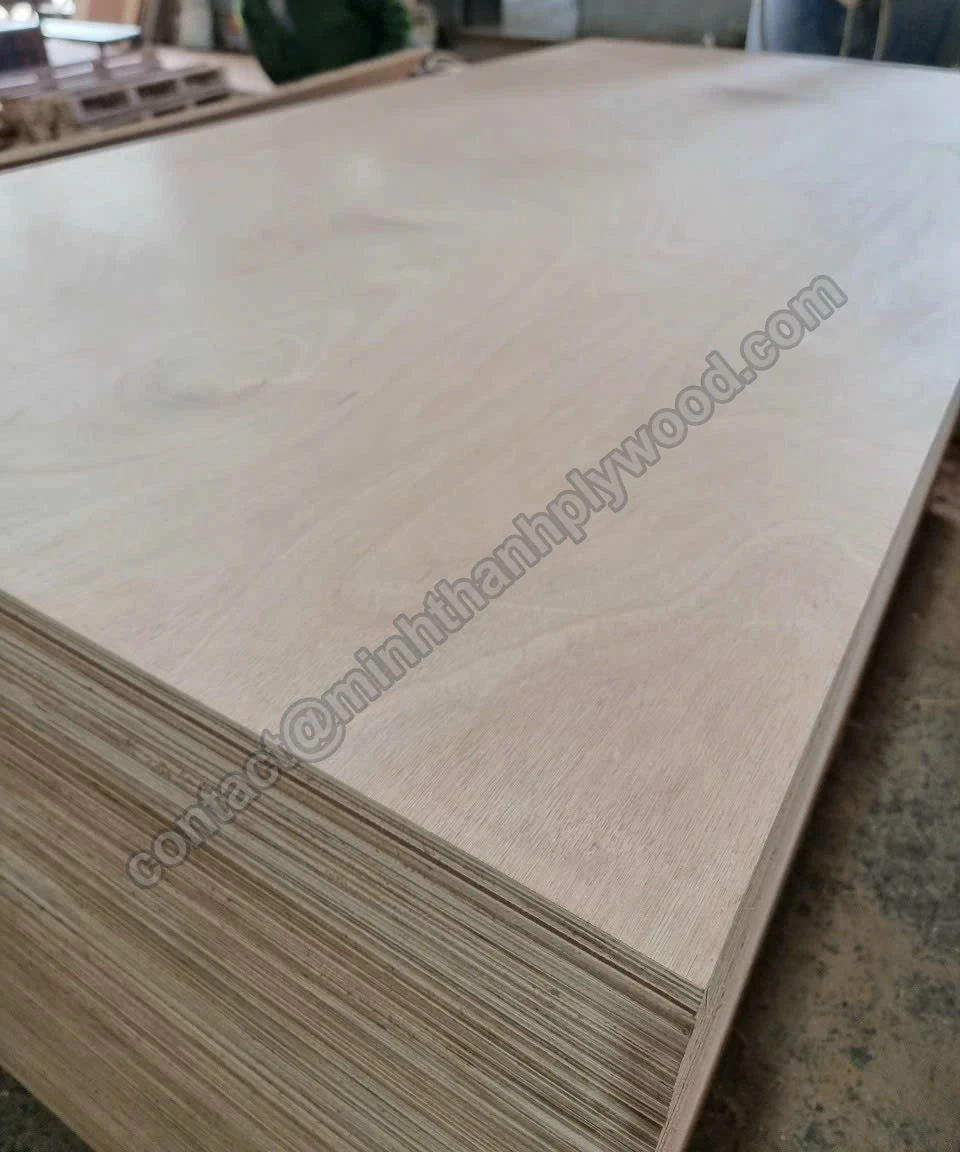 04
Okoume plywood
Soft pinkish-beige face with a gentle grain for interior panelling and decorative parts under clear finishes.Okoume face · 3–40 mm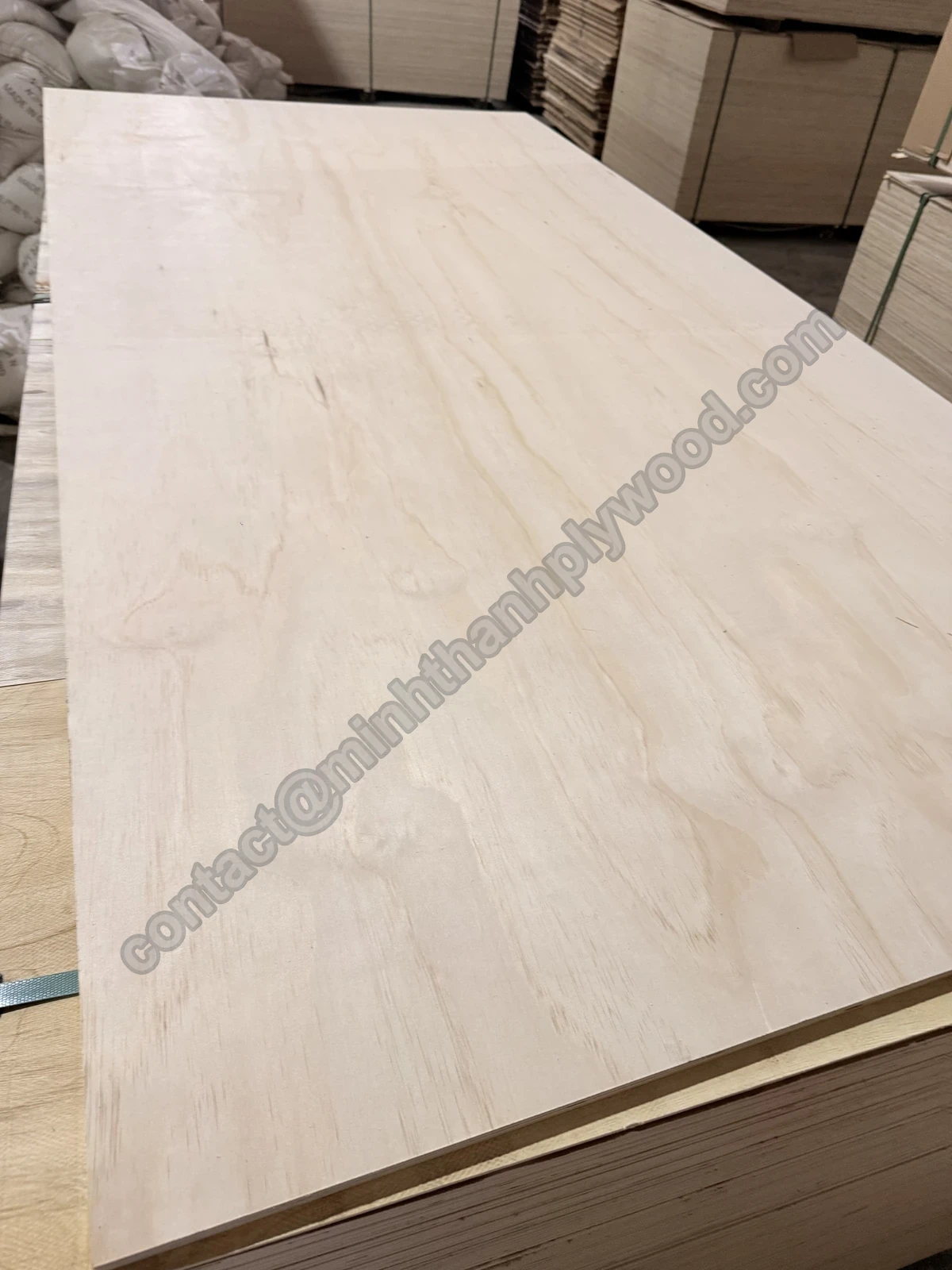 05
Pine plywood
Bold grain with natural knots for rustic and Scandinavian-style furniture, shelving and wall panels.Pine face · 3–40 mm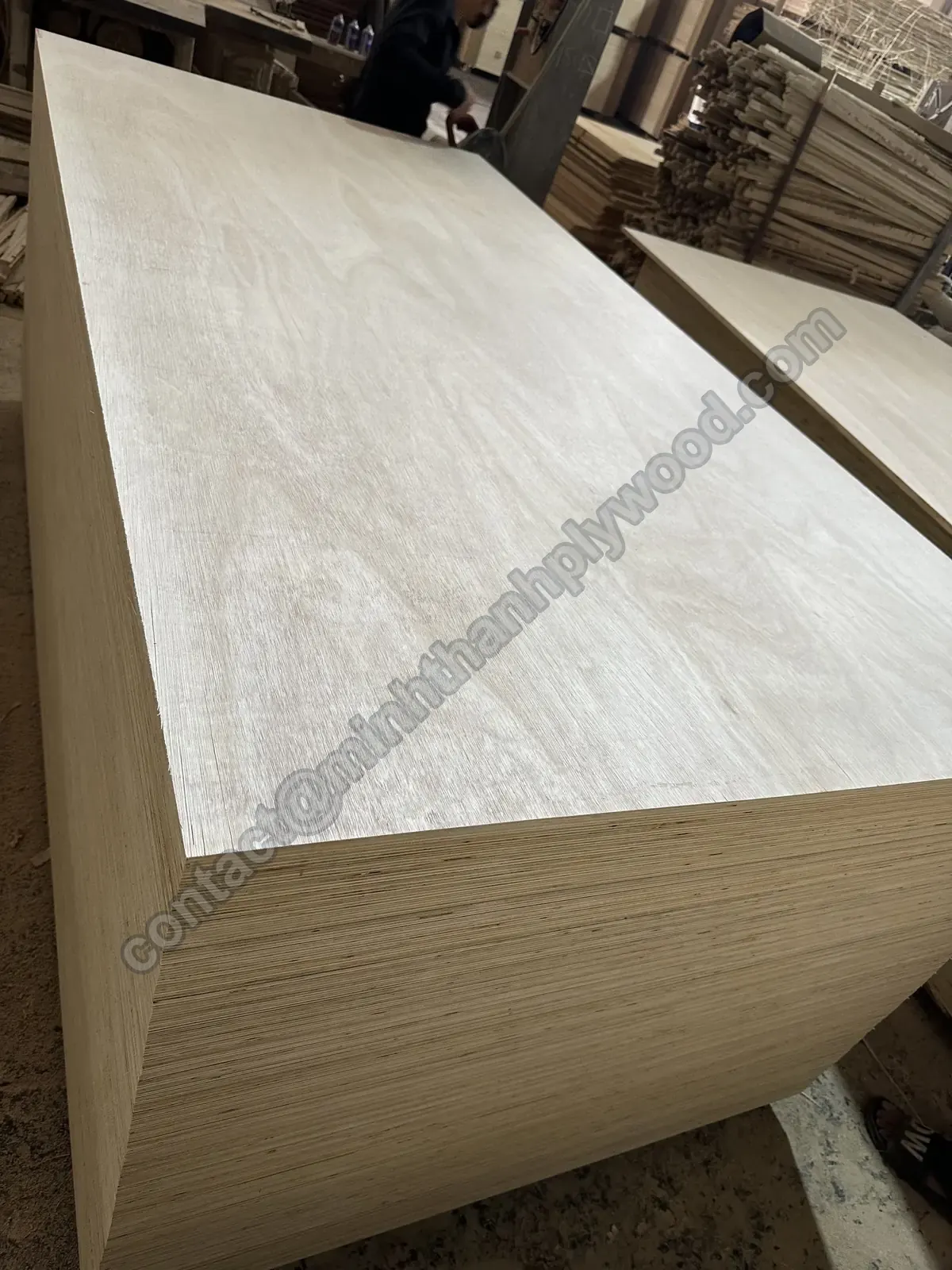 06
Eucalyptus-faced plywood
Light pinkish-brown hardwood face with a fine interlocked grain, a value face for painted, stained or laminated parts.Eucalyptus face · 3–40 mm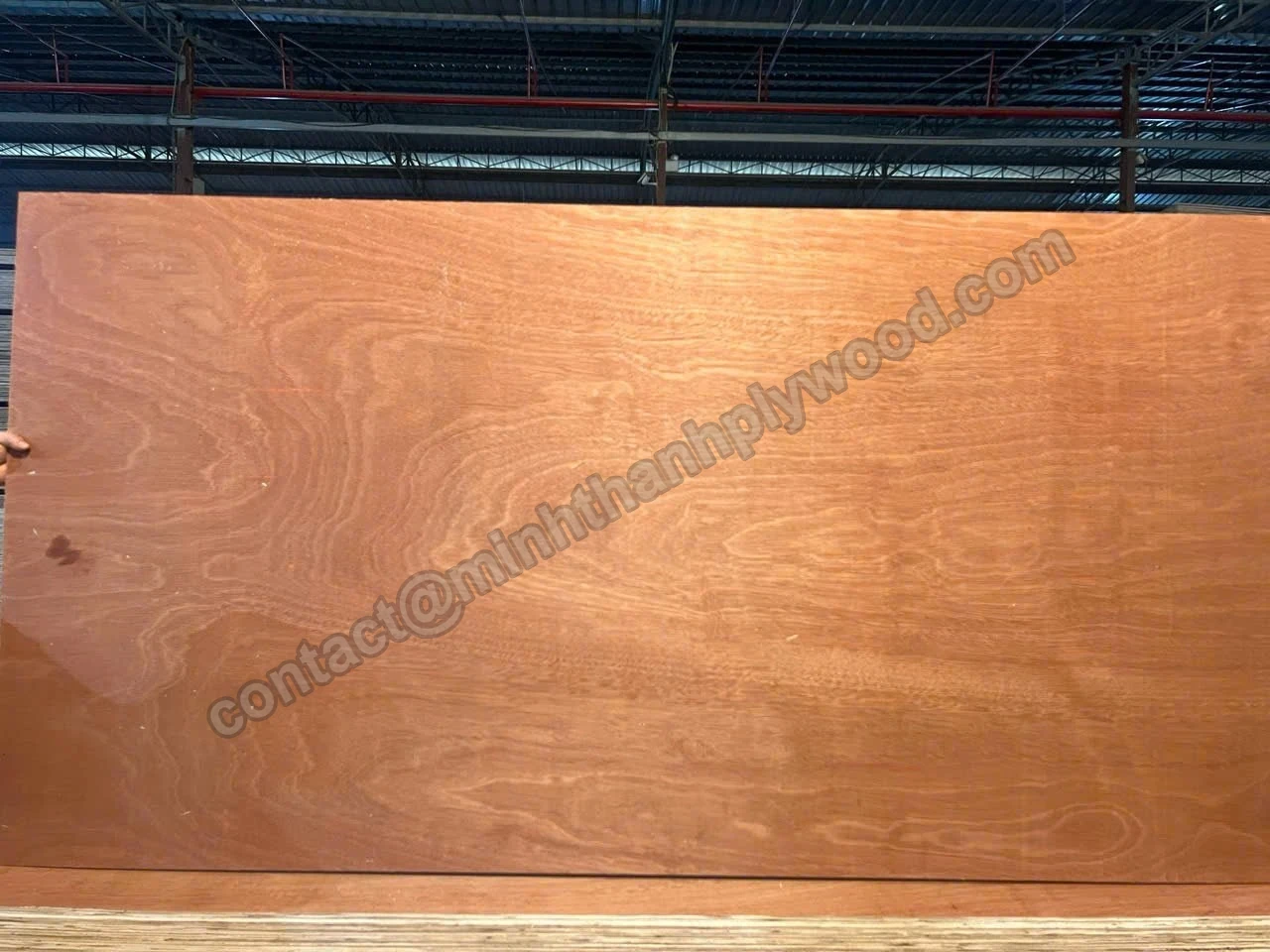 07
Gurjan plywood
Reddish-brown hardwood face with a straight grain for furniture in a darker natural tone.Gurjan face · 3–40 mm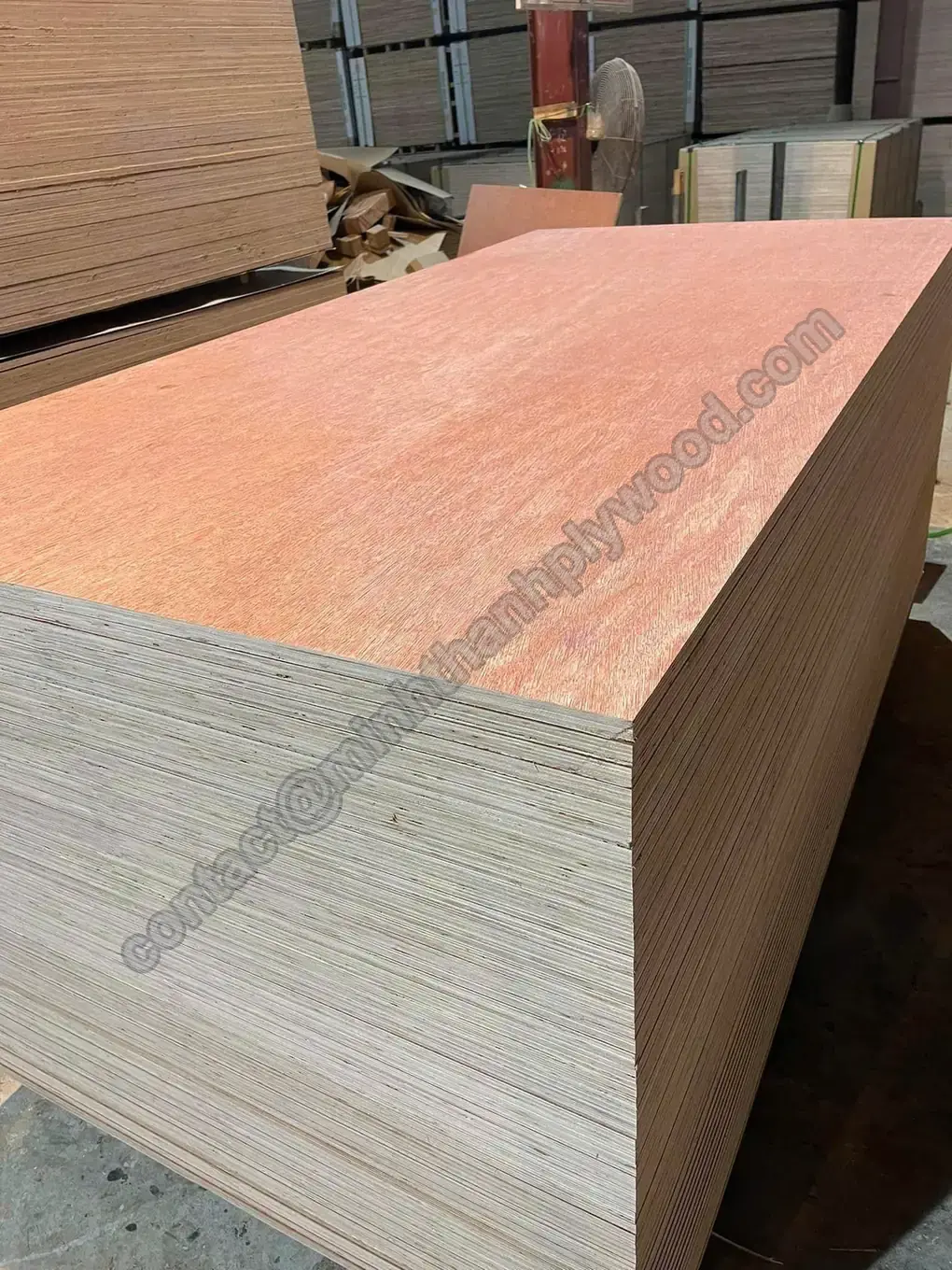 08
Bintangor plywood
Reddish hardwood face with an even texture, used under paint and stain for carcasses and joinery.Bintangor face · 3–40 mm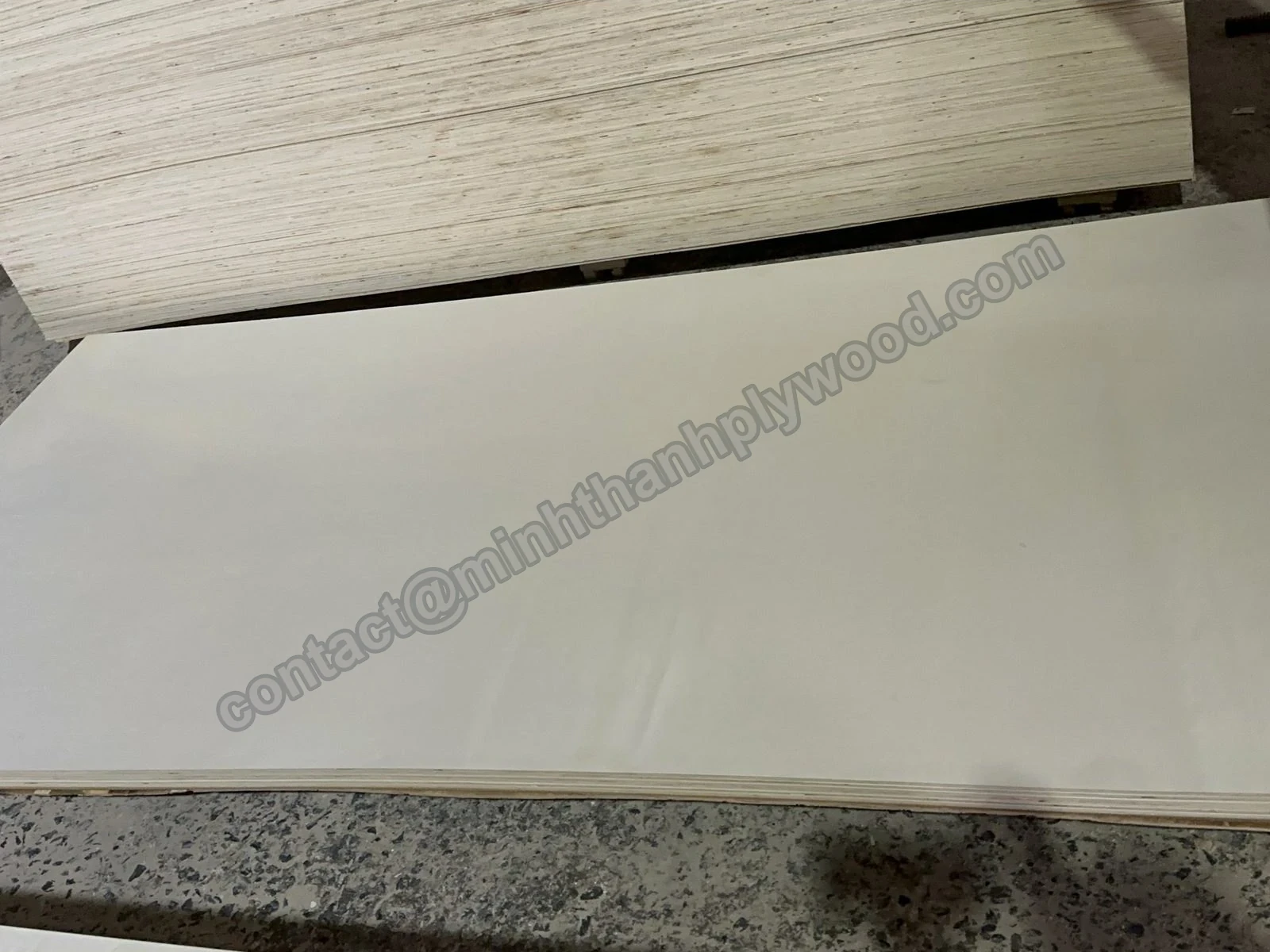 09
Thin plywood 3–6 mm
Thin panels for cabinet backs, drawer bottoms and lined parts. Always five plies, so the sheet lies flat and even.3–6 mm · always 5 plies10
Cut-to-size plywood
One sheet cut into 4, 6 or 8 pieces to your drawing, shipped regularly to Italy and other European markets.
Any furniture face · cut from 1220 × 2440 or 1250 × 2500 mm
Sapele is pressed on request for a dark, striped hardwood face. Packing, film-faced, anti-slip and exterior panels serve other uses and sit in our commercial plywood and construction plywood groups.
Real sheets
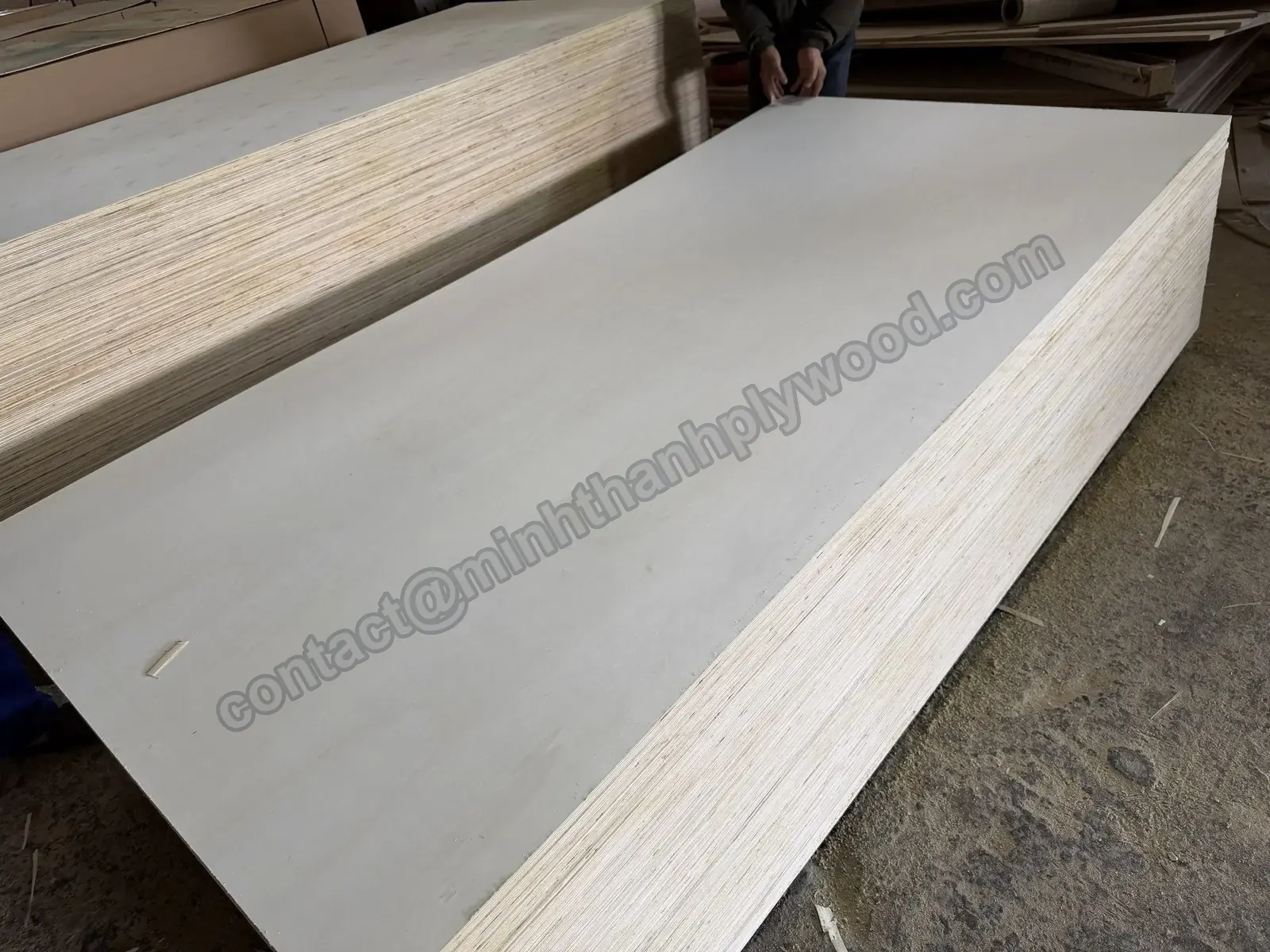
Real furniture plywood from our own production
These clips show full production sheets of two furniture faces. Okoume sheets are checked one by one on the pack, and a bintangor face is checked by hand before grading. Before a container is closed, you receive the same footage of your own order: sheets turned over, the stack edge and caliper readings.
We send clips from the press hall, sanding line and grading table on request, and buyers or their inspectors are welcome at the factory. With 50,000+ m³ a year, a furniture programme runs month after month on one specification.
Face grade is fixed by a sample: the sheet you approve becomes the grading standard for the order. Birch faces are graded D+, D and E in Vietnam and quoted as face/back pairs such as D+/D or D/E, a ladder comparable to the European birch grades. Face and back are graded separately, and a hidden back can be one step lower. Read how we grade face veneers before you choose.
How to choose
How to choose furniture grade plywood for each job
Start from the furniture part and the room it goes into. The finish decides the face, shipping weight and hardware decide the core, the room decides the glue, and the part decides the thickness. Furniture grade plywood is that combination written down, with a sanded face and a tight thickness tolerance.
| What you need | Face | Core | Glue |
|---|---|---|---|
| Clear lacquer or oil on a pale natural face | Birch | Styrax | UF, E0 emission |
| Paint, foil, decor paper or HPL | Poplar or eucalyptus | Styrax | UF, E0 emission |
| Identical grain across a furniture series | EV | Styrax | UF, E0 emission |
| Warm, light natural face for panelling | Okoume | Styrax | UF, E0 emission |
| Rustic look with knots | Pine | Styrax | UF, E0 emission |
| Darker reddish natural wood | Gurjan or bintangor | Styrax or Eucalyptus | UF, E0 emission |
| Kitchen and bathroom cabinets | Any face above | Styrax or Eucalyptus | Melamine-fortified MR |
| Heavier parts or a minimum density on the drawing | Any face above | Eucalyptus | To the room |
| Furniture part | Usual thickness | Note |
|---|---|---|
| Cabinet and wardrobe backs | 3–6 mm | Thin panels are always five plies |
| Drawer bottoms | 4–6 mm | 6 mm for wide drawers |
| Drawer sides and fronts | 9–15 mm | Fronts often match the carcass |
| Doors | 15–18 mm | 18 mm for tall doors |
| Carcass sides, tops and bases | 15–18 mm | 18 mm is the common standard |
| Shelves | 15–25 mm | Thicker for long spans |
| Tabletops and worktops | 18–40 mm | Pressed in one piece |
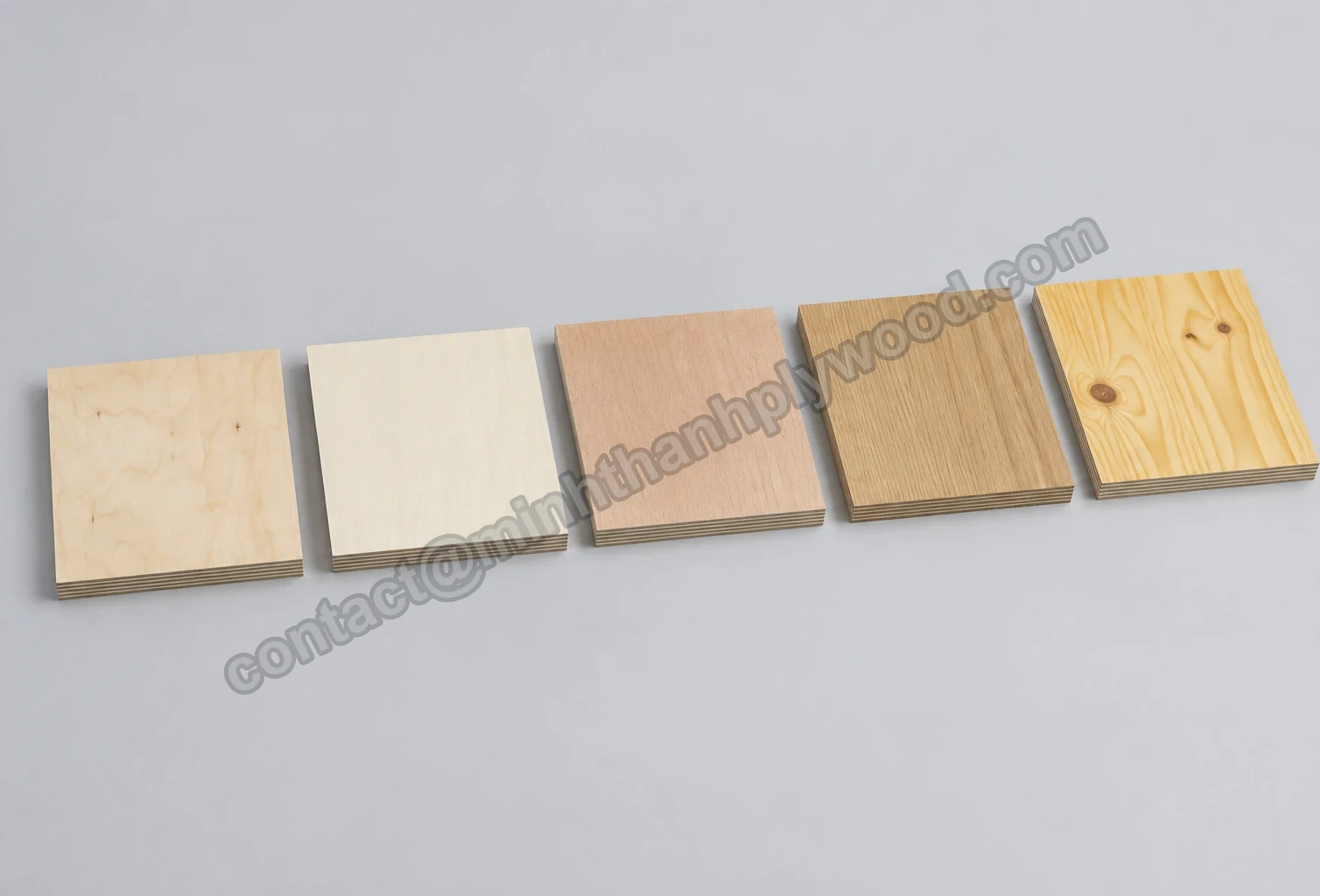
No international standard defines furniture grade plywood. Buyers use the term for a sound graded face and a core of grade A veneers with stitched layers. They also mean sanded faces at a furniture tolerance and glue chosen for indoor air. Our furniture panels are built that way as standard.
Weight counts in the container and on the assembly line. A Styrax core keeps an 18 mm sheet near 26.8 kg, and many European furniture buyers choose it for the lighter sheet and clean face.
Price follows the specification. Face species and grade move it most: an imported birch face costs more than a poplar or eucalyptus face. Core species, glue, tolerance, the share of thin sheets and order volume come next. When two quotes differ, compare them line by line on the specification table. Our guides on the best plywood for furniture and on plywood thickness for furniture go deeper.
Specification
Furniture plywood specifications by face
Every furniture face is pressed on a white Styrax or Eucalyptus core, 3–40 mm thick. Both faces are sanded and polished to a tolerance down to ±0.2 mm. The table shows the finish each face takes best; the construction lines below apply to all of them.
| Core | White Styrax (about 500 kg/m³) or Eucalyptus (650–750 kg/m³), grade A core veneers |
|---|---|
| Core joining | Stitched horizontally and vertically; all plies stitched on request |
| Pressing | Pressed twice: the core board is pressed and calibrated, then face and back are pressed on |
| Plies | 3–6 mm: always 5 plies; 18 mm: 11–13 plies, most often 11 |
| Glue for dry interiors | UF glue at E0 emission, standard on furniture and interior panels; E1 to order |
| Glue for humid rooms and outdoor parts | Melamine-fortified MR or phenolic WBP, made to order |
| Thickness tolerance | Down to ±0.2 mm on sanded furniture panels |
| Length and width tolerance | ±2 mm |
| Sheet sizes | 1220 × 2440 mm and 1250 × 2500 mm; custom 1220 × 2500 mm, 1220 × 2280 mm |
| Cut to size | One sheet cut into 4, 6 or 8 pieces to your drawing |
| Surface | Both faces sanded and polished, UV-ready for your own UV coating |
| Face | Finishes it takes best |
|---|---|
| Birch | Clear lacquer, oil, UV coating |
| Poplar | Paint, foil, decor paper, HPL |
| EV | Clear lacquer, UV coating |
| Okoume | Clear or tinted lacquer, paint |
| Pine | Clear lacquer, oil, wax |
| Eucalyptus | Paint, stain, laminate |
| Gurjan | Stain, clear lacquer |
| Bintangor | Paint, stain |
A calibrated panel saves machine time. At ±0.2–0.3 mm, router depth, dowel holes and edge banding stay true from the first sheet to the last. Parts from two bundles fit the same jig. Commercial plywood at ±0.5 mm suits hidden parts; CNC furniture lines run on calibrated furniture panels.
Both faces leave the sanding line polished and UV-ready, so a furniture plant can run the panels straight onto its own UV roller line. The same surface takes paint, lacquer, stain, HPL and decor paper. Order a face sample in your finish and judge the result on your own line.
Compare grades
Furniture grade vs commercial and packing plywood
Furniture grade plywood has a grade A, stitched core and faces sanded and polished on both sides. Its thickness tolerance is ±0.2–0.3 mm. Commercial plywood has an AB core, light or no sanding and ±0.5 mm. Packing plywood is built for crates and pallets. The three can share a face species; the construction behind it sets the price.
| Furniture grade | Commercial | Packing | |
|---|---|---|---|
| Core veneers | Grade A, stitched both ways | Grade AB, laid loose or jointed | Grade AB, laid loose |
| Surface | Both faces sanded and polished, UV-ready | Unsanded or lightly sanded | Unsanded |
| Thickness tolerance | ±0.2–0.3 mm | ±0.5 mm | ±0.5–1.0 mm |
| Face | Graded to your approved sample | Commercial face grades | Low face grades |
| Glue for dry rooms | E0 standard | Specified per order | Specified per order |
| Typical use | Cabinets, wardrobes, CNC parts, visible interiors | General joinery, hidden furniture parts | Crates, pallets, boxes |
| Price level | Highest of the three | Middle | Lowest |
A cost-effective commercial panel is a sound buy for hidden carcass parts and fit-out work. A visible face, a CNC line or an emission limit calls for furniture grade. Many plants buy both and specify each by part, which lowers material cost without changing what the customer sees.
Birch-faced and Baltic all-birch plywood answer different briefs. Our birch-faced panel carries imported birch on both faces over a Styrax or Eucalyptus core, giving the birch look at lower cost and weight. All-birch has birch in every ply and stays the choice where the layered birch edge is on show. Our guide on Styrax vs Eucalyptus plywood core compares the two cores in detail.
Applications
Interior plywood by application: kitchens, wardrobes, offices and shops
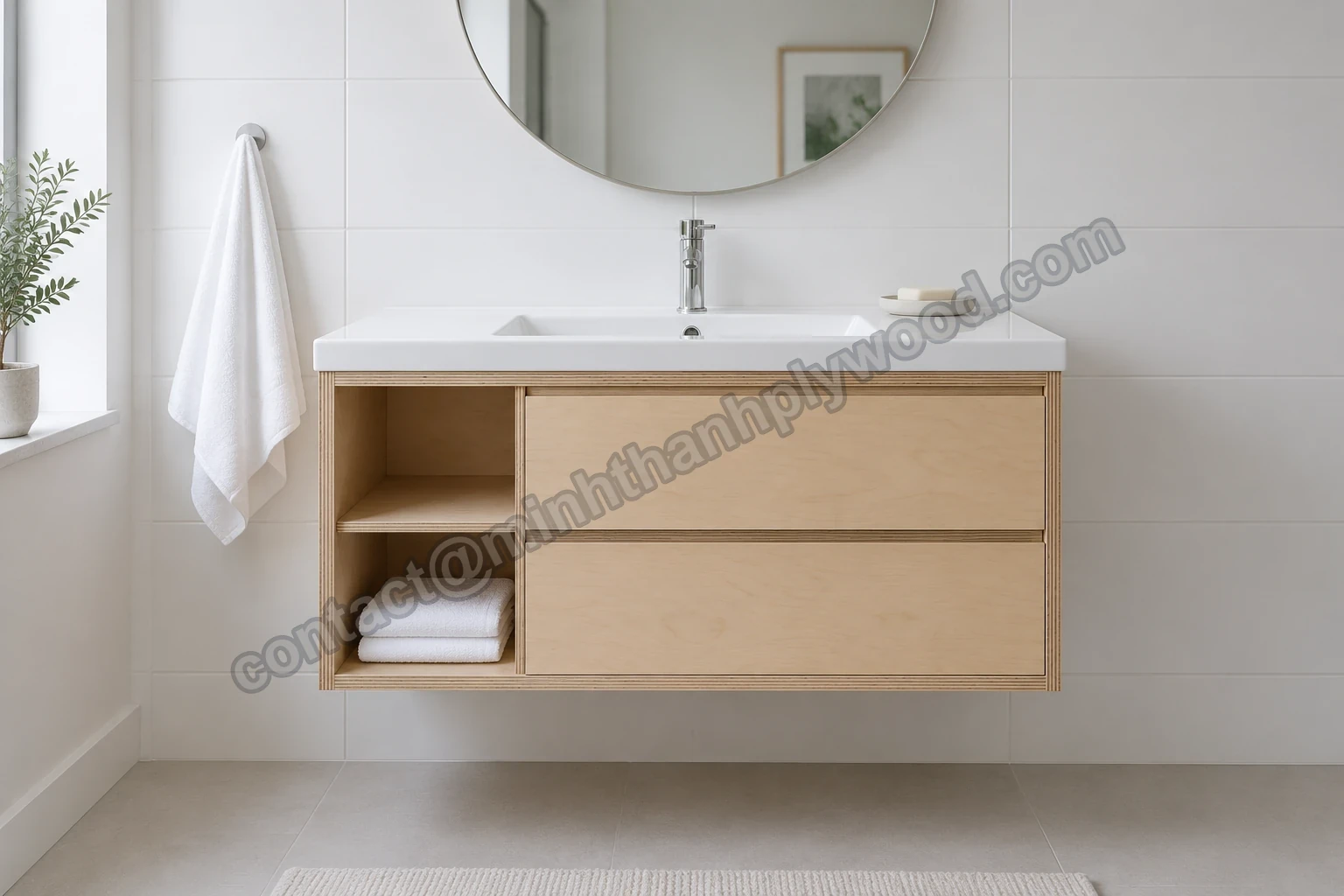
Our interior plywood goes into kitchen and bathroom cabinets, wardrobes, office furniture and retail fixtures. It also makes tables, beds and wall panelling. Each use sets its own face, core, glue and thickness; these are the configurations furniture buyers order most often.
01
Kitchen and bathroom cabinets
Carcasses and shelves in 15–18 mm, backs in 3–6 mm, with melamine-fortified MR glue for the humid room. Poplar suits laminated or painted fronts; birch and EV suit clear-coated doors. Seal cut edges near sinks.
02
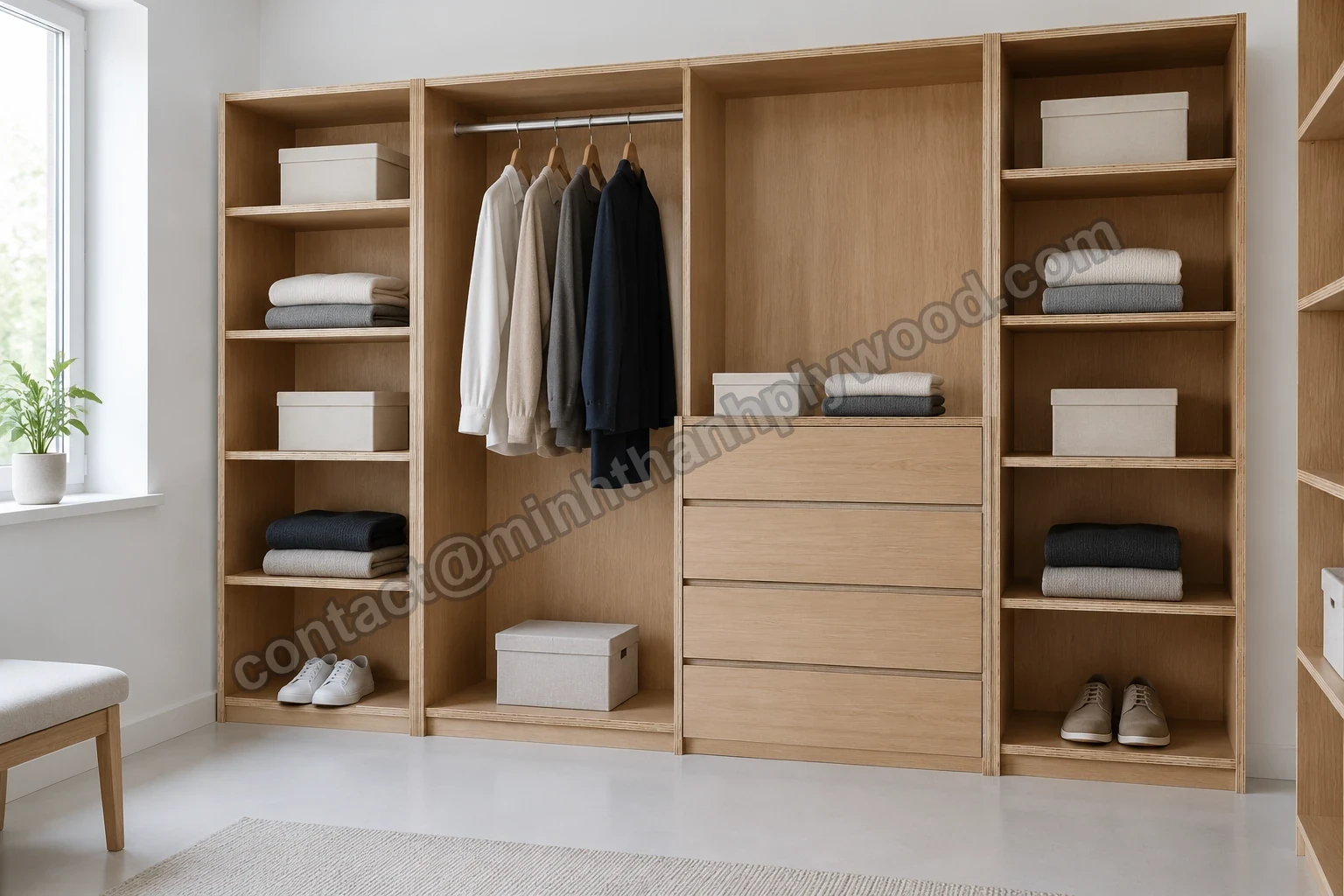
Wardrobes and bedroom furniture
Sides, tops and shelves in 15–18 mm on a Styrax core keep large units light to ship and lift. UF glue at E0 emission suits the bedroom, and 3–4 mm backs slide into grooves.
03
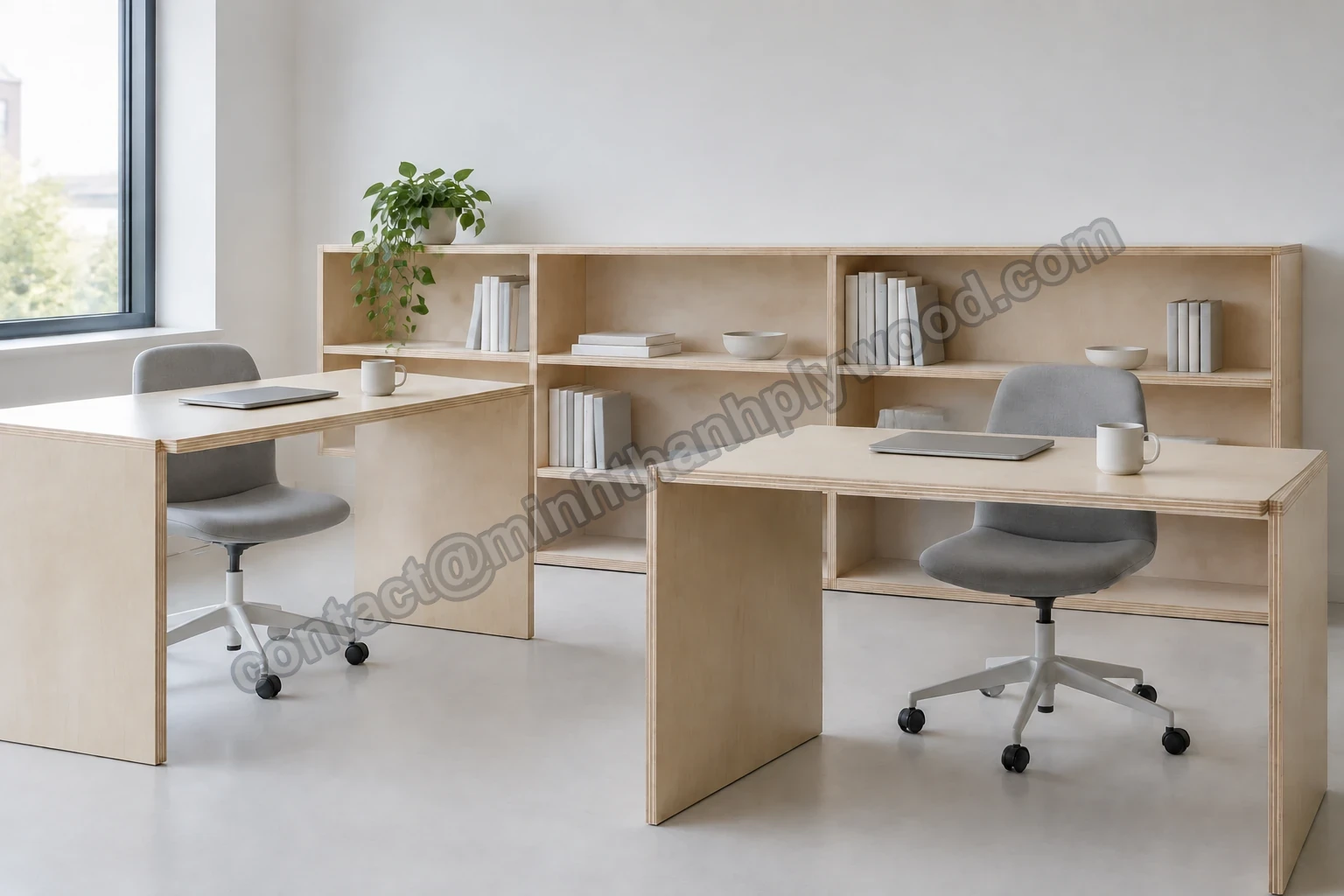
Office furniture
Desks and storage walls repeat across hundreds of pieces. EV gives the same grain on every panel, and a tolerance down to ±0.2 mm keeps CNC connector holes in line. Desktops in 18–25 mm.
04
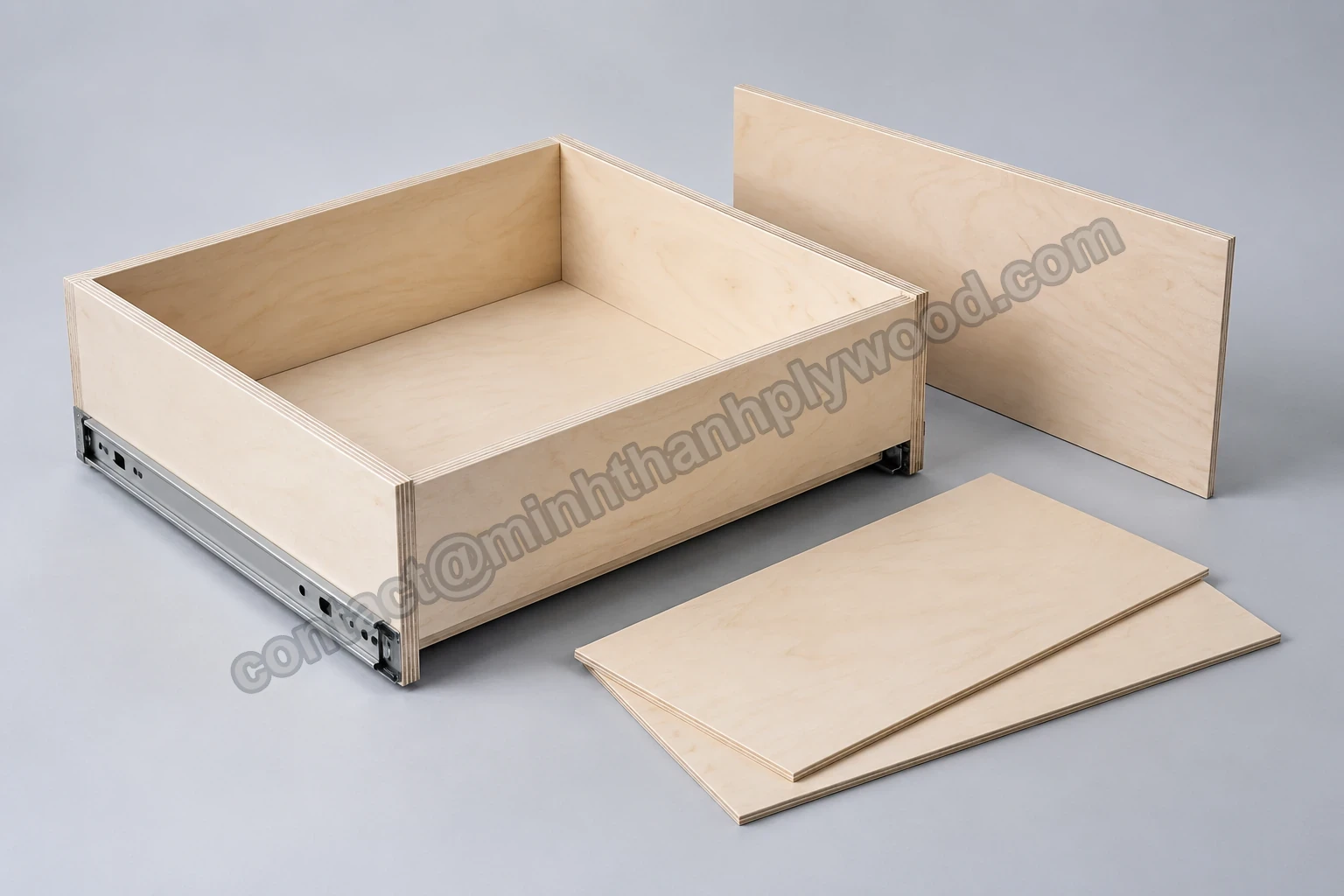
Drawer boxes and cabinet backs
Drawer sides in 9–15 mm with clean layered corners, drawer bottoms in 4–6 mm and cabinet backs in 3–6 mm. Thin panels are always five plies, so they lie flat in the groove and take paint or foil evenly.
05
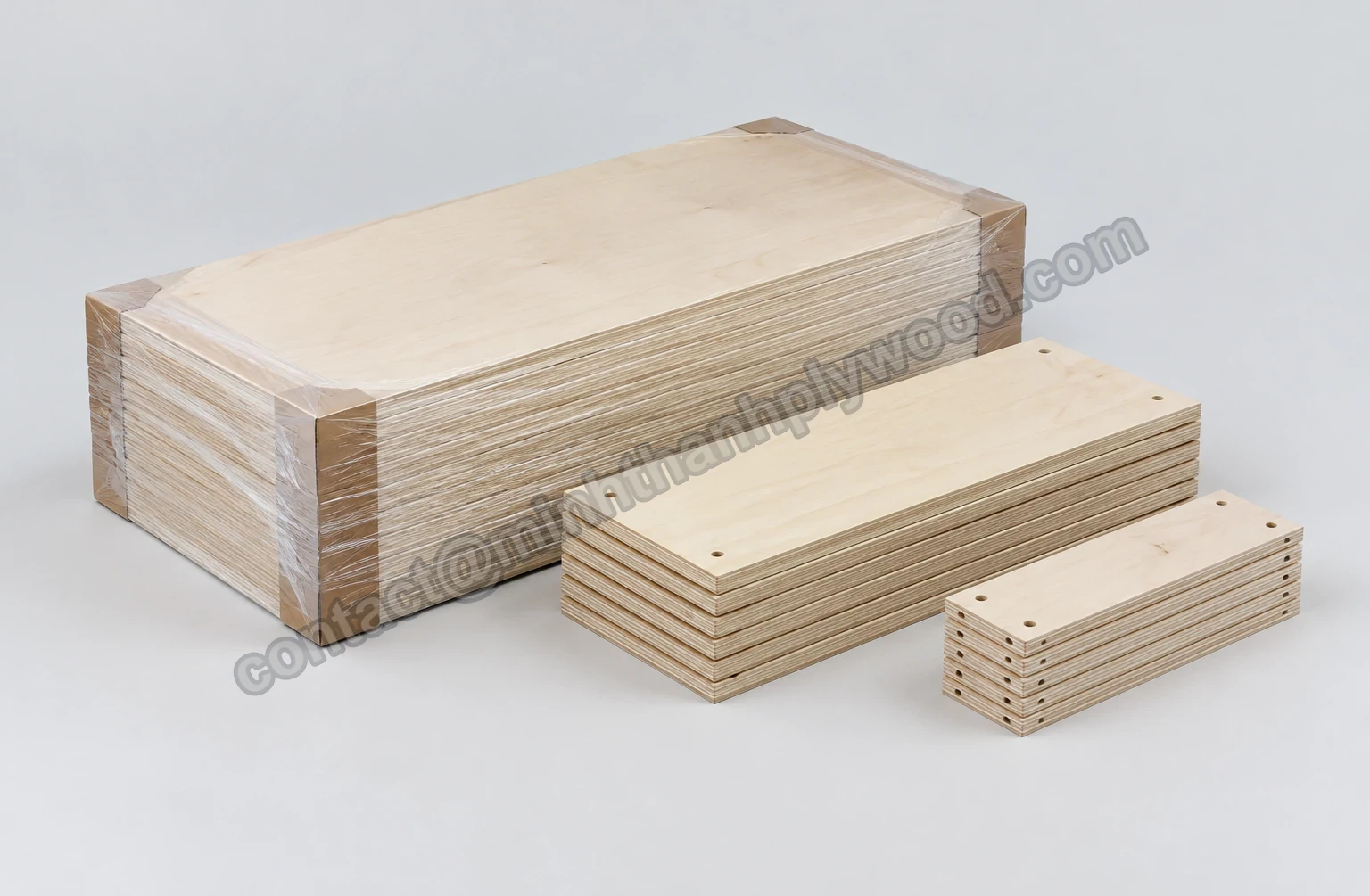
Flat-pack and CNC parts
Flat-pack and CNC production gain most from tight tolerance. Send your nesting layout and we quote cut-to-size blanks in place of full sheets, wrapped and packed by part size.
06
Retail fixtures and shop fitting
Display units, counters and shelving for shops, hotels and showrooms. Ask for all plies stitched when routed edges stay visible; birch and okoume give a natural face under clear lacquer.
07
Tables, beds and frames
Tabletops in 18–40 mm, bed bases in 12–18 mm. Eucalyptus where the drawing sets a denser panel, Styrax where the piece must stay light, pine faces for rustic tables.
08
Wall panelling and interior joinery
Wall and ceiling panels, built-in shelving and door linings in 6–18 mm. Okoume, pine and birch give a natural surface; poplar takes paint. Panels arrive sanded and UV-ready for the coating line.
Core, glue and emission
Which core and glue does furniture plywood need?
For dry-room furniture, order a white Styrax core with UF glue at E0 emission, our standard build and the lightest panel. Choose a Eucalyptus core when the drawing calls for a denser panel. Kitchens, bathrooms and humid rooms take melamine-fortified MR glue, and outdoor parts take phenolic WBP glue, each with its emission class stated on the quotation.
| Choice | Option | When to order it, and what you get |
|---|---|---|
| Core | White Styrax | About 500 kg/m³; an 18 mm sheet weighs about 26.8 kg. Pale, even edge; up to 18 bundles in a 40HC |
| Core | Eucalyptus | 650–750 kg/m³; an 18 mm sheet weighs about 34.8–40.2 kg. For a heavier panel or a minimum density on the drawing |
| Glue | UF (standard) | Bedrooms, living rooms, offices and shops: wardrobes, cabinets, shelving and every dry-room part |
| Emission | E0 (standard) or E1 | E0 on every standard furniture panel; E1 where that is the class your market specifies |
| Glue | Melamine-fortified MR | Kitchens, bathrooms, humid rooms and 12-hour boil specifications; emission class stated with the quotation |
| Glue | Phenolic WBP | Outdoor furniture parts with sealed edges; emission class stated with the quotation |
| Emission | Chamber tests | Six third-party tests to ASTM D6007 (three by Shanghai Hongjun, three by ICTT Vietnam) between April 2025 and June 2026, on 9, 15 and 18 mm E0 panels: averages of 0.014–0.032 ppm against the 0.05 ppm CARB Phase 2 limit |
| Emission | Routine testing | E0 emission tested every 3 months |
Our cores are laid from grade A veneers of plantation timber grown around Ha Hoa, 1.4–2.0 mm thick before pressing. Layers are stitched horizontally and vertically so joints stay closed in the press, and every ply is stitched when routed edges stay exposed.
Ply count follows thickness. Panels of 3–6 mm are always five plies: a 3 mm panel has one core veneer, two cross-bands and two faces. Panels of 4, 5 and 6 mm have three core veneers and two faces, and an 18 mm panel carries 11–13 plies, most often 11.
Glue type and emission class are two separate lines on the order. The glue sets how the bond behaves in moisture; the emission class sets the formaldehyde a panel gives off indoors. Our standard interior glue holds a boil test of about six hours on the sample, and a 12-hour boil specification calls for melamine-fortified glue.
Our furniture panels meet the emission requirements European and US furniture buyers set. CARB P2 and TSCA Title VI certification under mill no. 23024 is the proof European buyers accept, and the US limit for veneer-core hardwood plywood is 0.05 ppm. EU furniture follows REACH Annex XVII entry 77 from 6 August 2026. Its limit is 0.062 mg/m³ in the regulation's chamber test, set by Regulation (EU) 2023/1464 (REACH formaldehyde, entry 77). When your market asks for a report to a named method such as EN 717-1, SGS tests your panels to it on request.
Production and quality control
How furniture plywood is made and checked
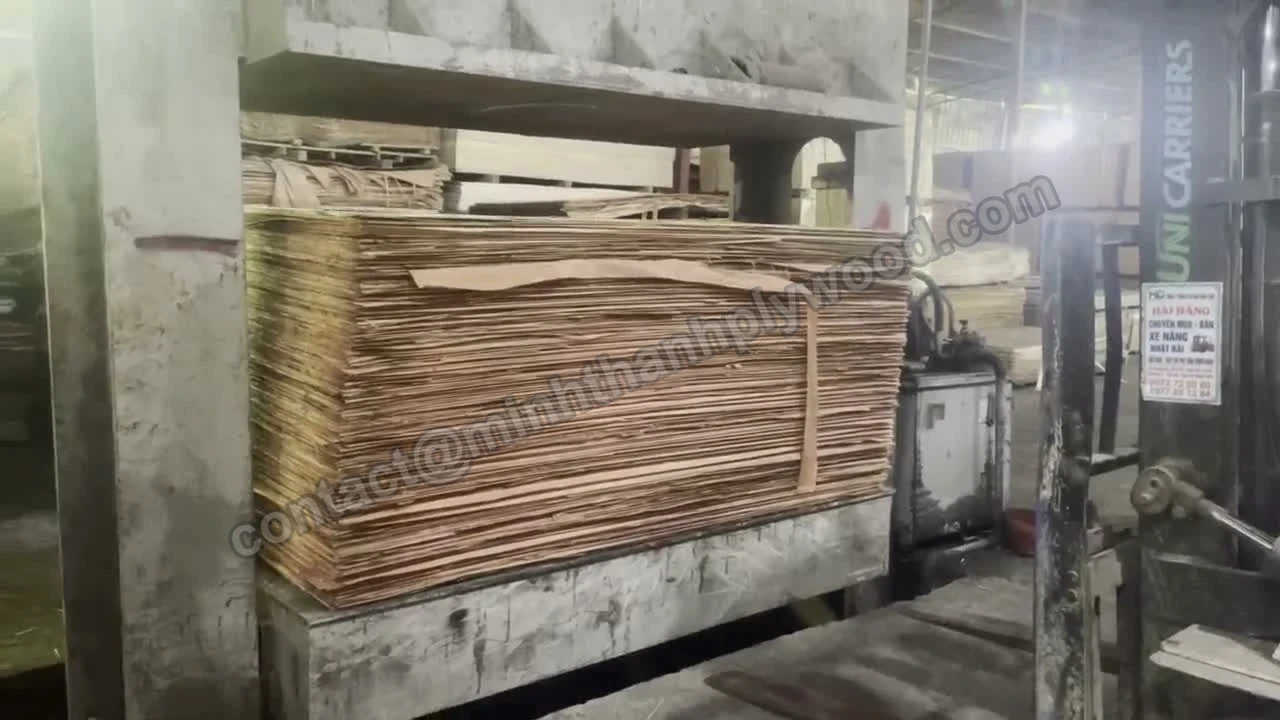
Furniture plywood is made in two pressings. A stitched core board is pressed and calibrated first, then the faces are laid on and pressed again. Checks run at every stage from veneer drying to the closed container, and each order is graded against the sample you approved.
- Approve the sample
free samples in your face, core, glue and thickness; the approved sheet becomes the grading standard.
- Peel and dry
core veneers are peeled from plantation logs and dried before lay-up.
- Lay up the core
grade A veneers are laid crosswise and stitched horizontally and vertically.
- First press
the core board is hot-pressed at about 110–120 °C for MR glue or 130–145 °C for phenolic WBP.
- Calibrate
the core board is sanded level so the face veneer lies on an even base.
- Face and press again
face and back veneers go on and the panel is pressed a second time.
- Sand, polish and grade
both faces are sanded and polished, then graded sheet by sheet against your sample.
- Measure and film
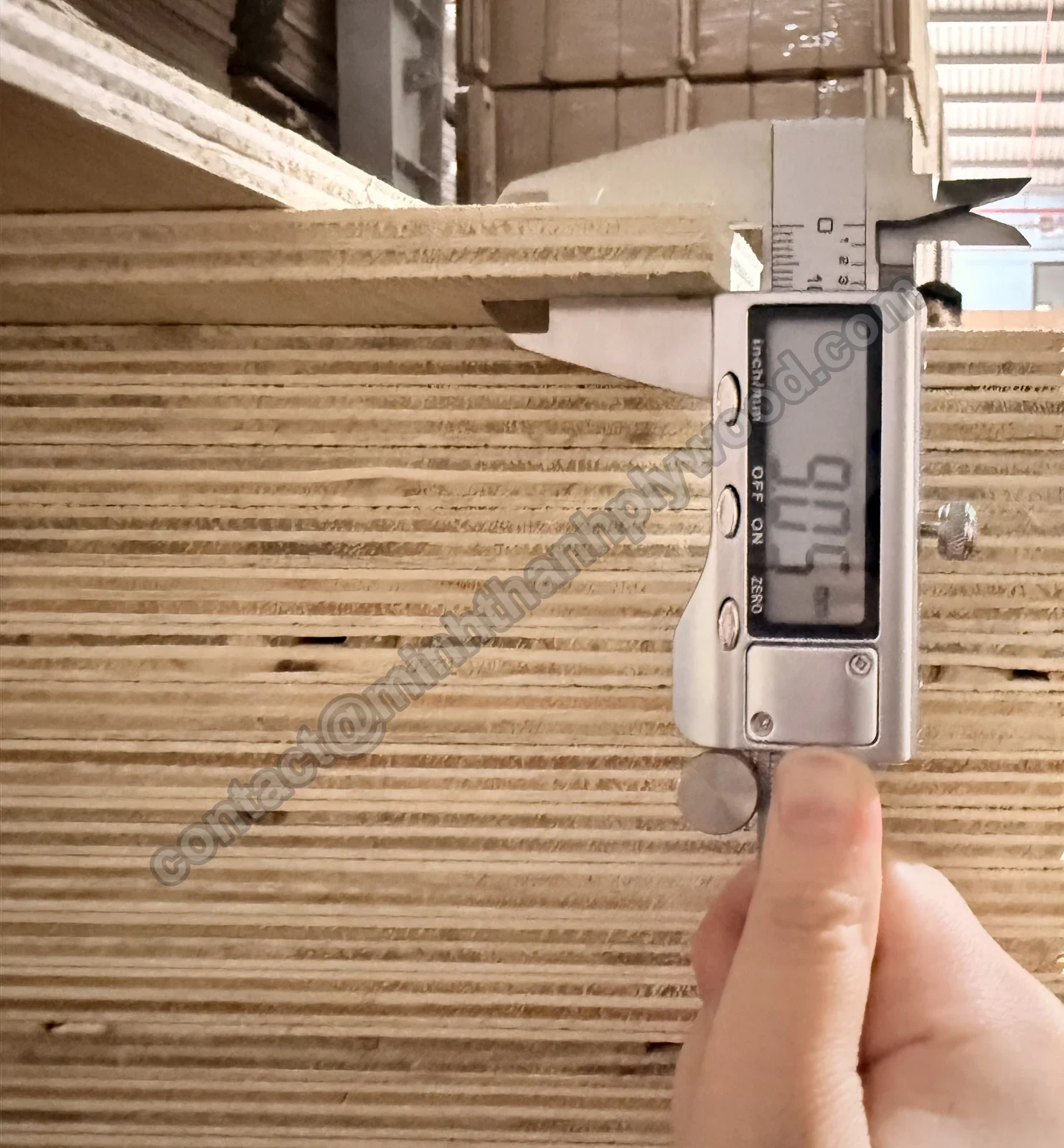
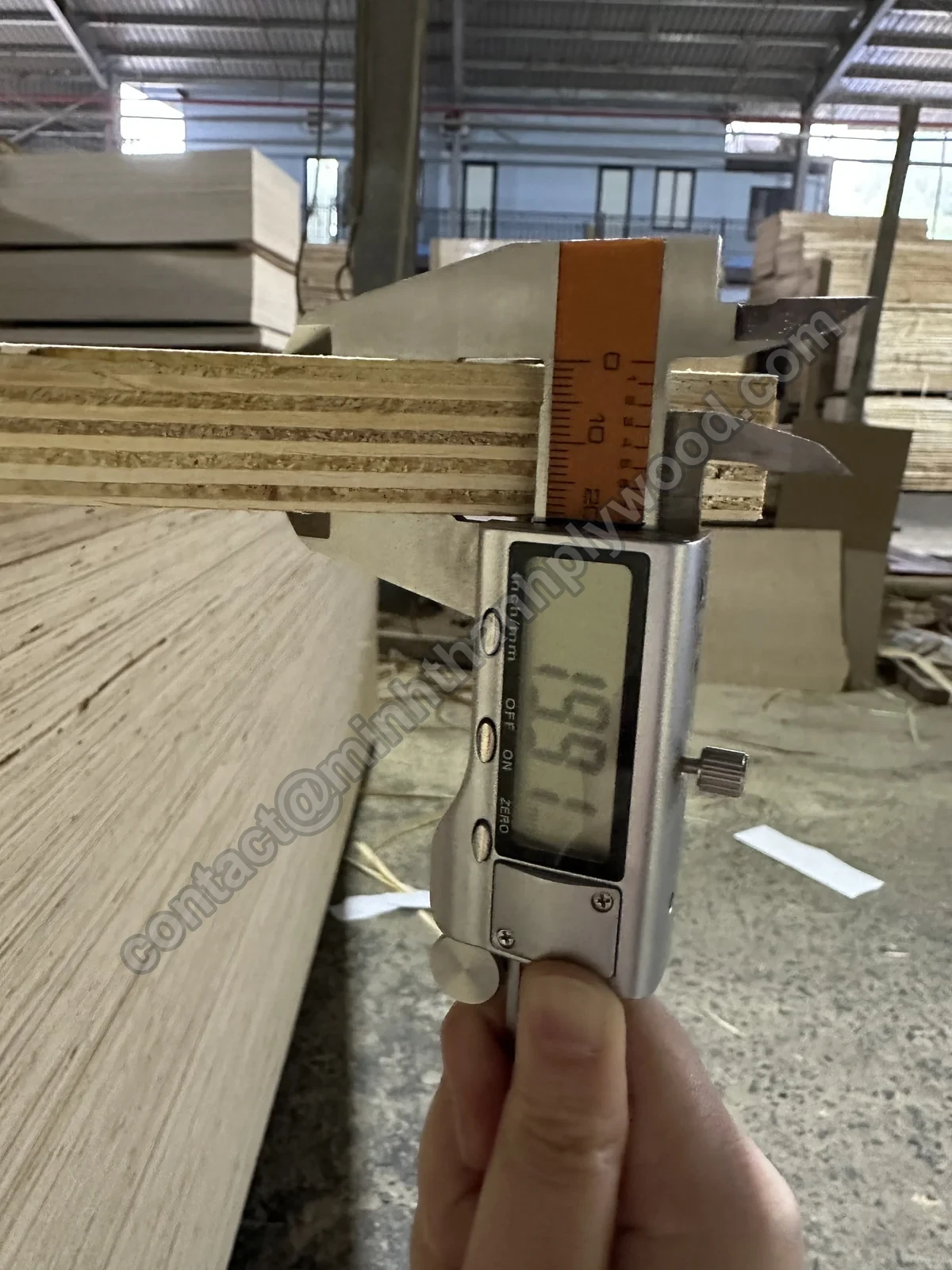
caliper readings from each bundle, edge checks, and clips of your sheets sent before loading.
Agree four lines in writing before production: face and back grade against the approved sample, thickness tolerance, core species and glue. We grade, measure and film those lines as part of our plywood quality control, and your inspector or a third-party company can check them before loading.
On arrival, weigh one 18 mm sheet of 1220 × 2440 mm: about 26.8 kg points to a Styrax core, about 34.8–40.2 kg to Eucalyptus. Then read thickness with a caliper on sheets from several bundles and look along the bundle edges for even layers and closed joints.
Certificates and documents
Furniture plywood certificates and test reports
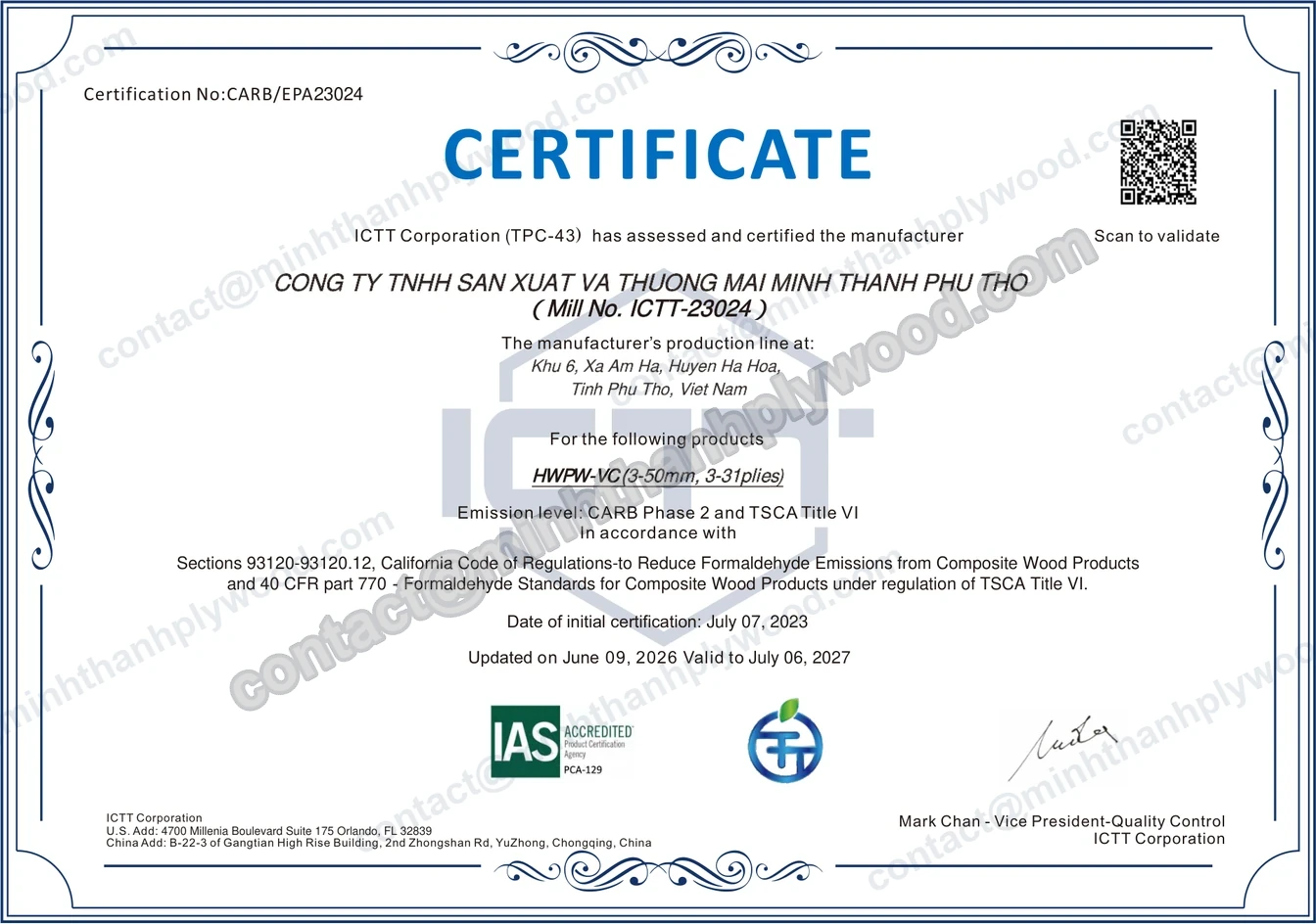
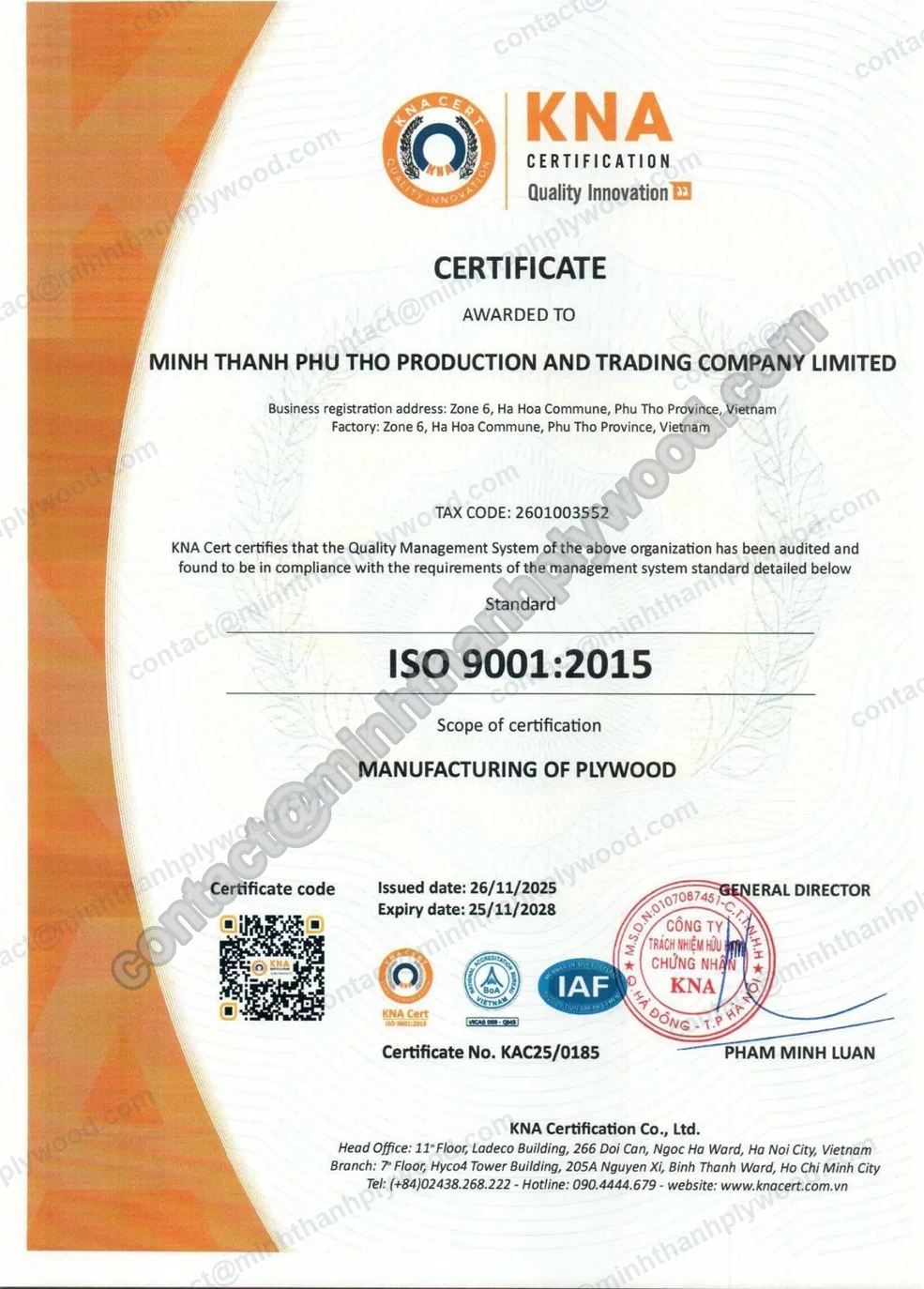
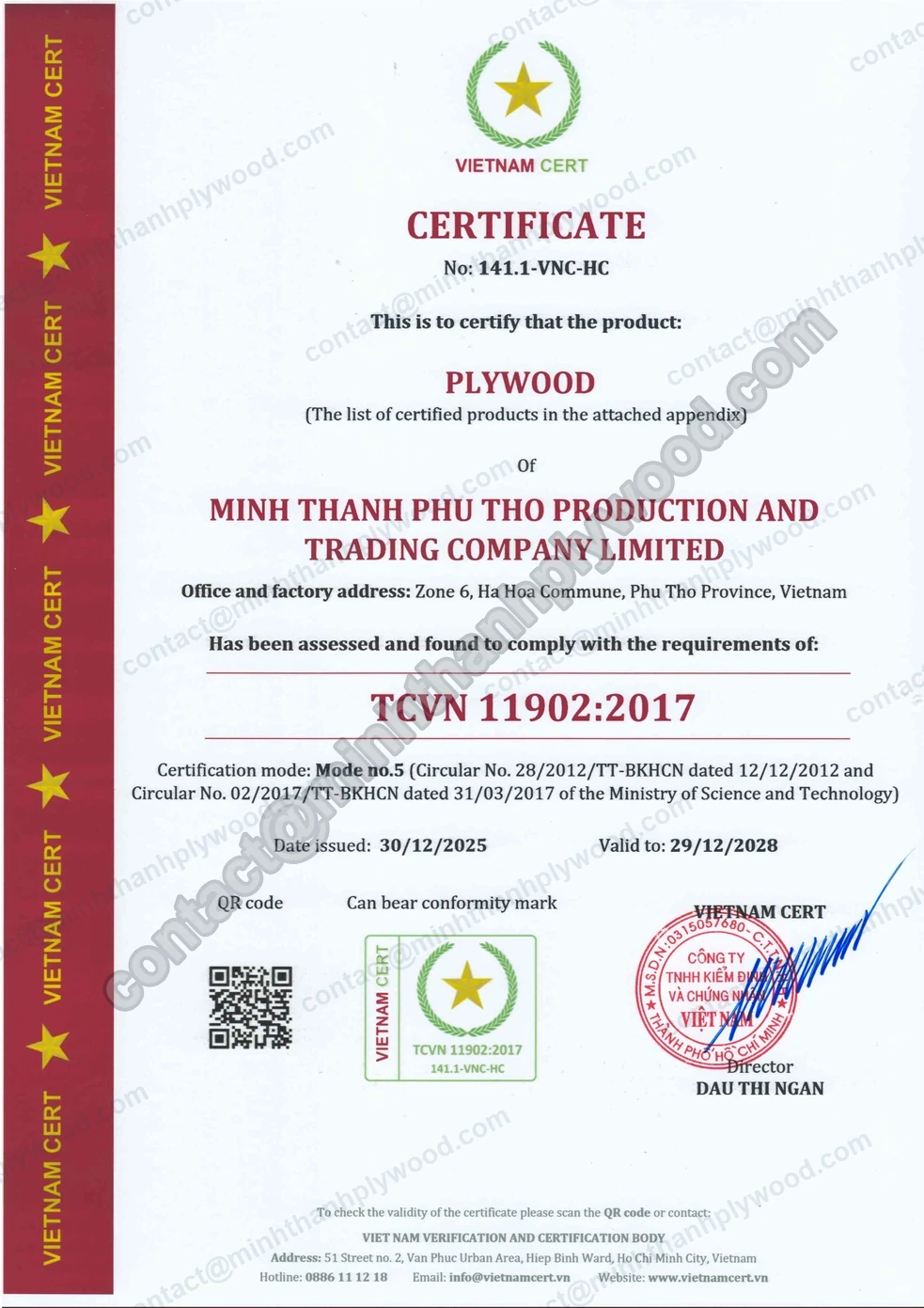
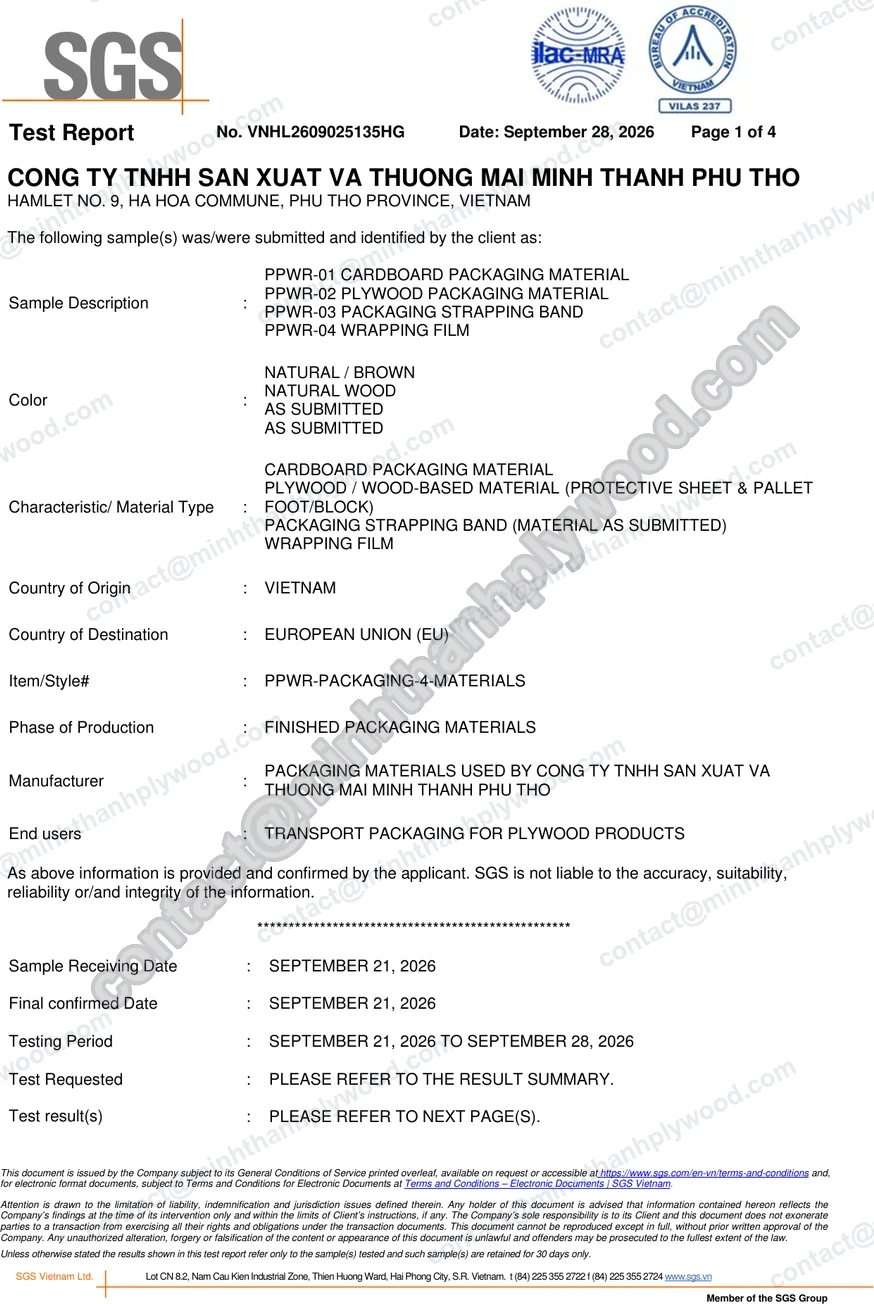
Minh Thanh Plywood holds CARB P2 / TSCA Title VI certification as ICTT mill no. 23024, ISO 9001:2015 and TCVN 11902:2017. E0 panels are chamber-tested to ASTM D6007. Packaging passed an SGS test under the EU PPWR, and we supply the EUDR compliance dossier with EU orders. FSC and CE are available*.
SGS, September 2026
PPWR packaging test
Regulation (EU) 2025/40: lead, cadmium, mercury and hexavalent chromium not detected in all four packaging materials; pass against 100 mg/kg
View document →ASTM D6007; Shanghai Hongjun and ICTT Vietnam
Formaldehyde test reports
Six chamber tests on 9, 15 and 18 mm E0 panels, April 2025 to June 2026: 0.014–0.032 ppm; E0 tested every 3 months
View document →Per order
EUDR dossier
EUDR compliance dossier: origin records and geolocation files with your order
View document →Available*
FSC
FSC-certified furniture plywood on request
Available*
CE (EN 13986)
For panels placed on the EU market as construction products
US buyers check CARB P2 and TSCA Title VI by the mill number. Ours, 23024, is on the certificate issued by ICTT, one of the third-party certifiers recognised by the US EPA. European furniture buyers accept the same certificate as emission proof. The certificate and the latest chamber report travel with the quotation.
For EU orders we supply the EUDR compliance dossier (origin records and geolocation files) for your due diligence statement under Regulation (EU) 2023/1115 (EUDR). Vietnam is classed as low risk under Implementing Regulation (EU) 2025/1093. Our EUDR traceability documents and the PPWR packaging test are open to read.
*Supplied directly or through qualified partner mills.
Packing and loading
Furniture plywood packing and 40HC loading
A 40HC carries up to 18 bundles of Styrax-core furniture plywood, about 53–54 m³. The heavier Eucalyptus core loads up to 15 bundles, about 43 m³. Each bundle stands about 1,000 mm high, so the sheets in a bundle equal 1,000 divided by the thickness in millimetres.
| Thickness (mm) | Sheets per bundle | Styrax core: sheets per 40HC (18 bundles) | Eucalyptus core: sheets per 40HC (15 bundles) |
|---|---|---|---|
| 3 | 333 | 5,994 | 4,815 |
| 4 | 250 | 4,500 | 3,615 |
| 6 | 166 | 2,988 | 2,400 |
| 9 | 111 | 1,998 | 1,605 |
| 12 | 83 | 1,494 | 1,200 |
| 15 | 66 | 1,188 | 960 |
| 18 | 55 | 990 | 795 |
| 25 | 40 | 720 | 570 |
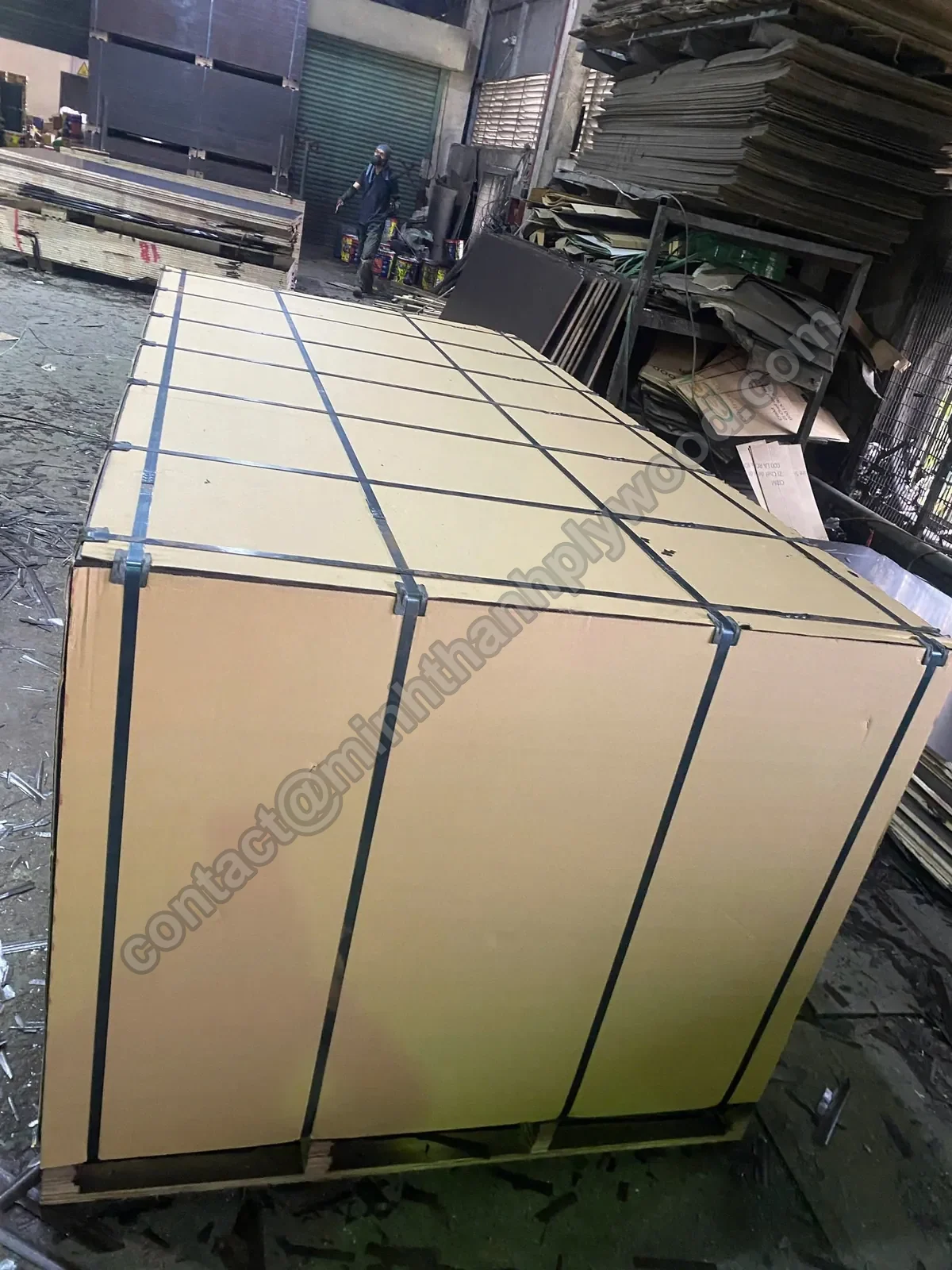
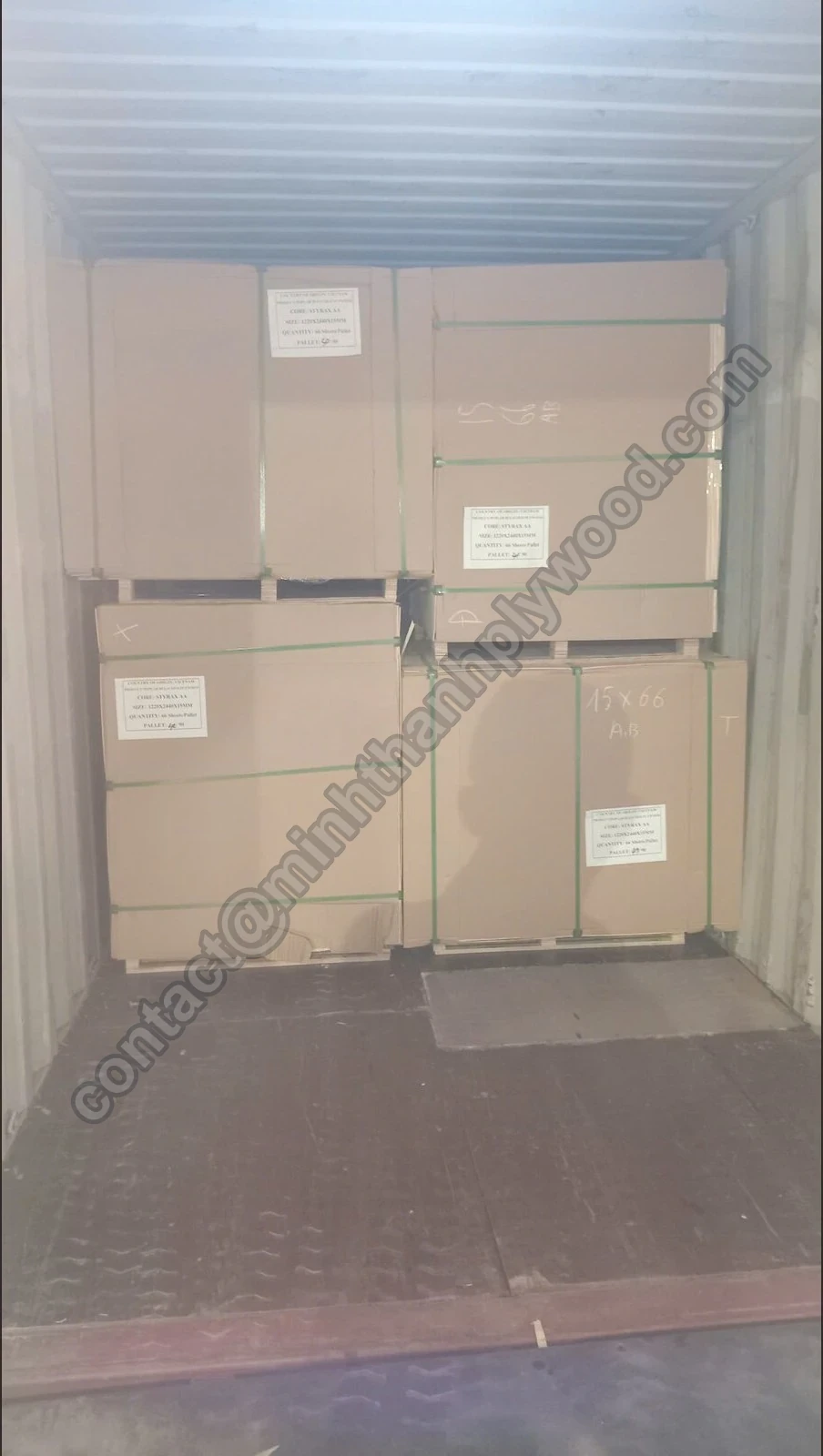
The table is for 1220 × 2440 mm sheets. Eighteen bundles load as 16 lying flat, four by four, plus two standing at the door end. Mixed faces and thicknesses load in one container by agreement; plan the mix in the plywood packing calculator.
Each bundle sits on plywood pallet blocks, with cardboard on faces and corners, wrapping film against dust and moisture, and strapping band around the stack. Bundles are marked with thickness, face, grade and glue; export pallets, your own labels and edge stamping are available on order. Our export packing and container loading pages show each step.
Calculated from a 1,000 mm bundle height and the bundle limits per core. Eucalyptus at 650 kg/m³ stays within 28,000 kg of panels, so its bundles hold a few sheets fewer.
Trade terms
MOQ, lead time, payment and samples for furniture plywood
The minimum order for furniture plywood is one 40HC container. Production takes 15–45 days after the deposit. Payment is 30% deposit and 70% against the scanned B/L, and we ship FOB Hai Phong, CFR or CIF. Mixed loads are welcome by agreement, and samples are free.
| MOQ | 1×40HC; mixed faces, thicknesses and cut-to-size parts by agreement |
|---|---|
| Production time | 15–45 days after deposit, by quantity and specification |
| Payment | 30% deposit, 70% against scanned B/L; T/T or irrevocable L/C at sight |
| Incoterms | FOB Hai Phong, CFR or CIF |
| Samples | Free samples |
| Documents | Commercial invoice, packing list, bill of lading, certificate of origin, insurance on CIF; CARB/TSCA certificate, test reports and the EUDR dossier as ordered |
| Replies | Within hours, Monday–Friday, 08:00–17:00 Vietnam time (UTC+7) |
Production time runs from the deposit to cargo ready at the factory; sea transit from Hai Phong comes on top. On CFR and CIF terms we book the vessel and quote the route with the price. Our trade terms page sets out payment, documents and Incoterms in full.
Give us your arrival date and we plan production backwards from it, or split a programme into monthly containers.
FAQ
Furniture plywood questions from buyers
Short answers to the questions furniture makers and importers send us most often.
What is furniture grade plywood?
Furniture grade plywood is plywood specified for furniture use. It means a graded face, a solid core with closed joints, sanded faces at about ±0.2–0.3 mm and glue fit for indoor air. Ours add stitched Styrax or Eucalyptus cores and UF glue at E0 emission as standard.
What is the best plywood for furniture?
For clear-coated furniture, a birch or EV face on a Styrax core is the usual pick. For painted or laminated furniture, poplar or eucalyptus faces cost less, and the paint or laminate covers the face. In kitchens, keep the face and order melamine-fortified glue.
Which plywood core is best for furniture-grade export?
White Styrax is the export favourite: light at about 500 kg/m³, pale at the edge, and up to 18 bundles fit a 40HC. Eucalyptus, at 650–750 kg/m³, suits buyers who want a heavier, denser panel. Both take every face in our range.
What glue should furniture plywood use for kitchens and bathrooms?
Melamine-fortified MR glue, which passes a 12-hour boil test on the sample. Phenolic WBP glue is for parts that live outdoors. Seal cut edges near sinks, showers and dishwashers.
What thickness should I use for wardrobe parts?
Most wardrobes use 18 mm for sides, tops and bases, 15–18 mm for shelves and doors, and 3–4 mm backs set in grooves. Drawer sides run 9–12 mm and drawer bottoms 4–6 mm.
Can I order furniture plywood cut to size?
Yes. We cut one sheet into 4, 6 or 8 pieces to your drawing and pack each part size separately. European buyers, Italy above all, order cut-to-size parts from us regularly.
Does your furniture plywood meet US formaldehyde rules?
Yes. Our hardwood plywood is certified to CARB P2 and TSCA Title VI under ICTT mill no. 23024, for veneer-core panels of 3–50 mm. We send the certificate and the latest chamber test report with every US quotation.
Does your furniture plywood meet European standards?
Yes. Our furniture panels are made for European buyers and meet the emission and quality requirements they set. CARB P2 / TSCA Title VI certification under ICTT mill no. 23024 is the emission proof they accept, and six ASTM D6007 chamber tests averaged 0.014–0.032 ppm. When you need a report to EN 717-1 or another method, SGS tests your panels to it on request.
Is birch-faced plywood the same as Baltic birch?
No. Birch-faced plywood has birch veneer on the face and back over another core; ours uses white Styrax or Eucalyptus. Baltic birch has birch in every ply.
Do you export furniture plywood to Latin America?
Yes. We export across the Americas as well as Europe, Asia and Africa. For Mexico and other Latin American markets we quote CFR or CIF to your port, with full export documents.
Who makes good furniture plywood in Vietnam for a kitchen cabinet manufacturer?
Choose a manufacturer with its own presses and the proof to show for it. Ask for four things before price, starting with the mill's own CARB P2 number and a chamber test report with method and dates. Then ask for a clip of real sheets turned over with a caliper reading, and the core species written on the proforma. We send all four the same day.
What is the MOQ and lead time for furniture plywood?
One 40HC container, which can mix faces, thicknesses and cut-to-size parts by agreement. Production takes 15–45 days after the deposit, and sea transit is added by route.
Request a quote
Get a furniture plywood quotation
List the furniture parts, then the face, core, glue, thickness, sheet size and quantity for each. Lisa replies within hours with a quotation and a sample offer. Attach up to 3 drawings, cutting lists or specification files.
No full specification yet? Give us the application and destination market, and we advise the rest. That covers core, glue and emission class, face and back grade, thickness, size or cut-to-size parts, packing, quantity and port. Email [email protected] or WhatsApp Lisa on +84 988 586 601, contact the sales team, or download the furniture plywood catalogue. Free samples.
[email protected]