
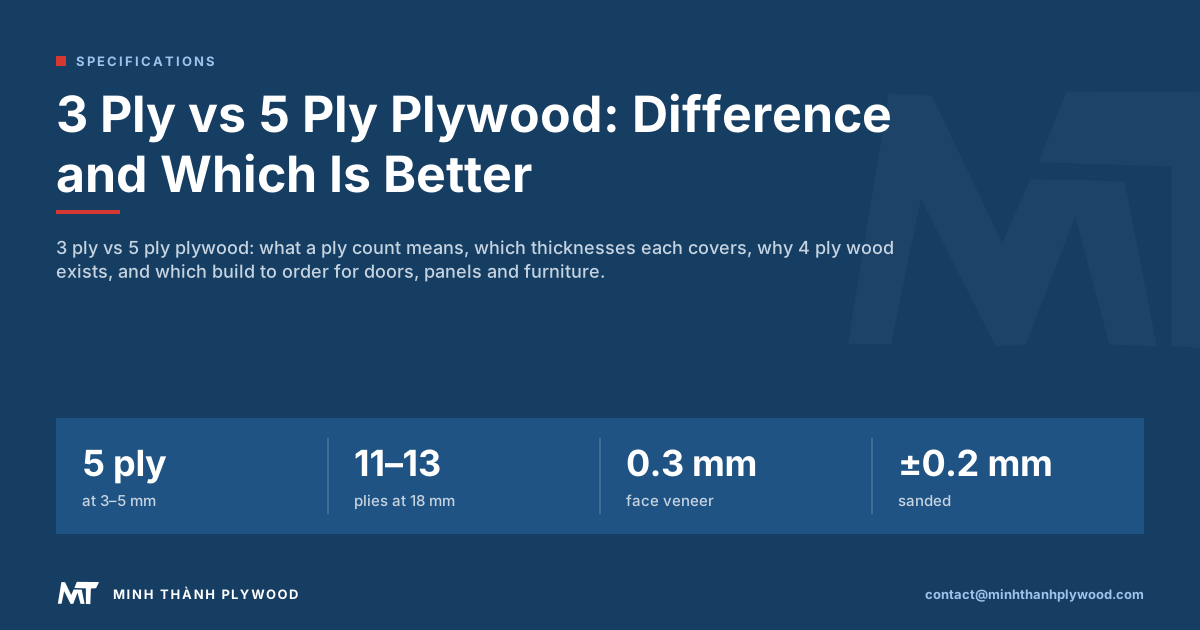
The difference between 3 ply and 5 ply plywood is the number of veneer layers glued cross-grain: three layers or five. At the same thickness, 5 ply has thinner layers and more glue lines, so it stays flatter, holds screws better at the edges and resists splitting. Minh Thanh Plywood builds every thin panel from 3 to 5 mm as 5 ply.
What is the difference between 3 ply and 5 ply plywood?
3 ply plywood has three veneer layers glued cross-grain; 5 ply plywood has five. The layer count changes how the panel behaves at the same thickness: more layers mean thinner veneers, more glue lines and strength that is more even along and across the sheet.
A ply is one sheet of rotary-cut or sliced veneer. In a 3 ply panel the face and back run along the sheet and one core runs across it. In a 5 ply panel two cross-bands sit between the face, the core and the back, so the grain changes direction four times instead of twice.
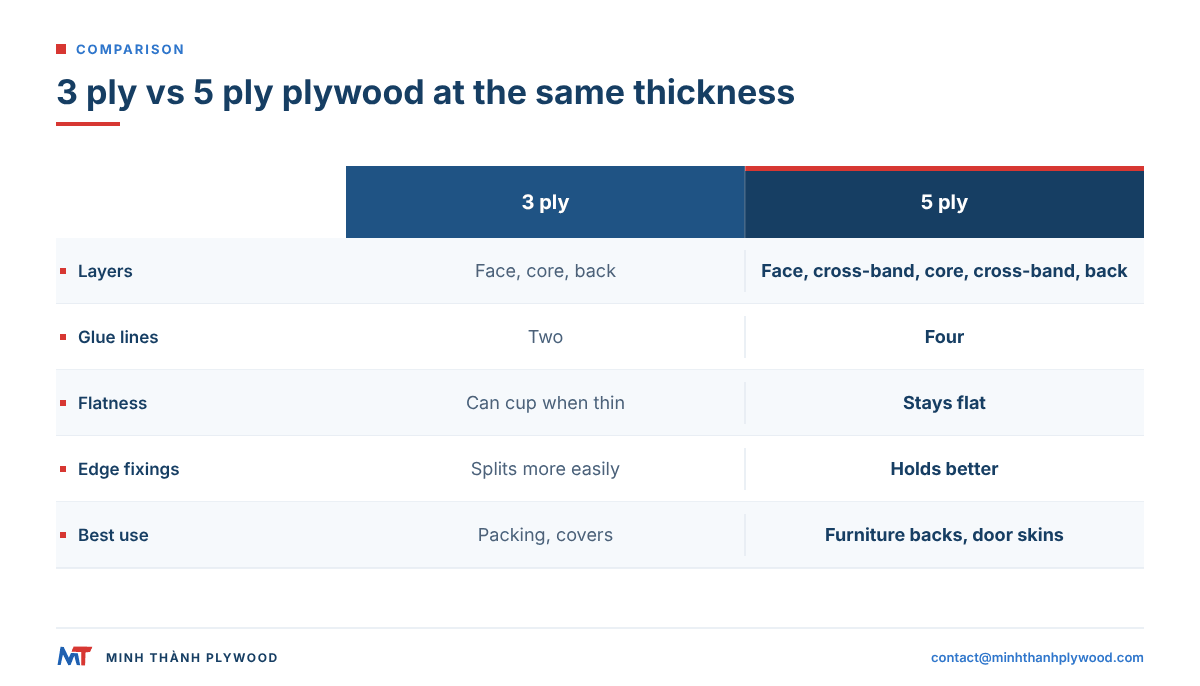
| Property | 3 ply plywood | 5 ply plywood |
|---|---|---|
| Veneer layers | Three: face, core, back | Five: face, cross-band, core, cross-band, back |
| Glue lines | Two | Four |
| Grain changes through the thickness | Two | Four |
| Flatness of a thin sheet | Can cup or twist as moisture changes | Stays flat; the extra cross-bands lock the face |
| Strength along vs across the sheet | Strong one way, weaker the other | More even in both directions |
| Screw and nail holding near edges | Splits more easily along the grain | Better: every fixing crosses several glue lines |
| Typical thickness range | Very thin sheets, cheap packing panels, formwork boards | 3–5 mm furniture and door-skin panels, and the outer layers of thicker builds |
| Price at the same thickness | Lower: fewer veneers to lay up | Higher: more veneers and pressing labour |
| Best use | Light backs, drawer bottoms in low-cost furniture, temporary covers | Furniture backs and drawer bottoms that must stay flat, door skins, curved and laminated parts |
3 ply vs 5 ply plywood: which is better?
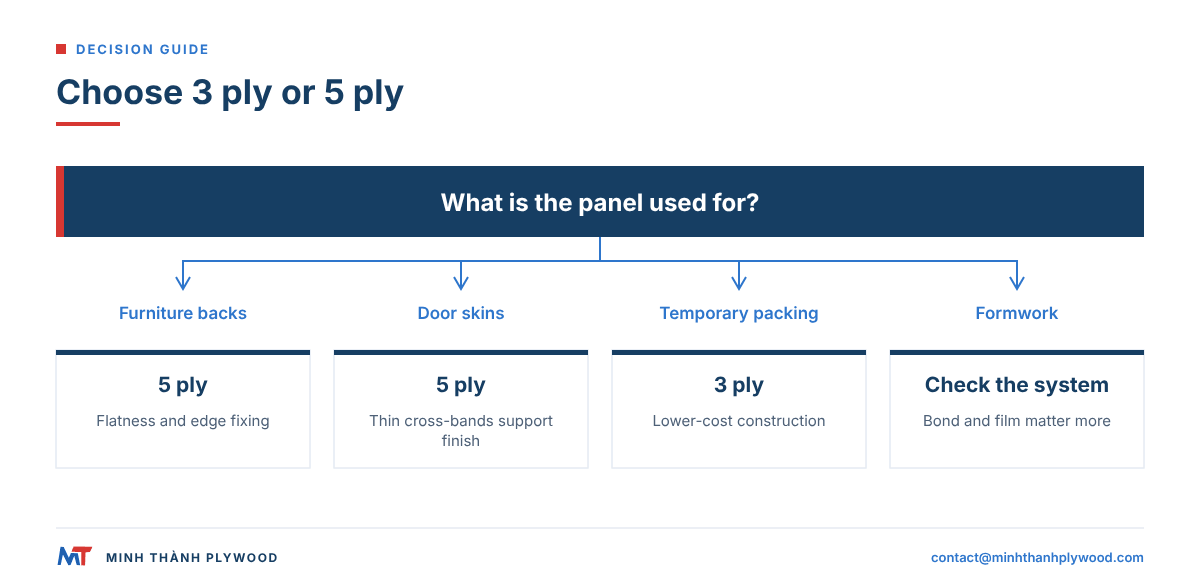
5 ply plywood is better for any panel that must stay flat, take screws or carry a finish; 3 ply plywood is enough for low-cost covers, packing and temporary work. The choice depends on the use, not on a rule that more plies always win.
Verdict by use:
- Furniture backs and drawer bottoms you can see: 5 ply. A 3 ply sheet of 3 or 4 mm can cup between fixings, and the bow shows through a painted back.
- Door skins and laminated curved parts: 5 ply. The thin cross-bands bend evenly and the face does not crack along the grain.
- Packing lids, crate panels and protection boards: 3 ply is fine, and cheaper per sheet.
- Formwork and site boards: the build follows the formwork system; glue type and film weight matter more than the count.
- Panels from 9 mm upwards: compare 7, 9 or 11 ply, never 3 against 5. The thicker the panel, the more plies a good build carries.
How many plies does each plywood thickness have?
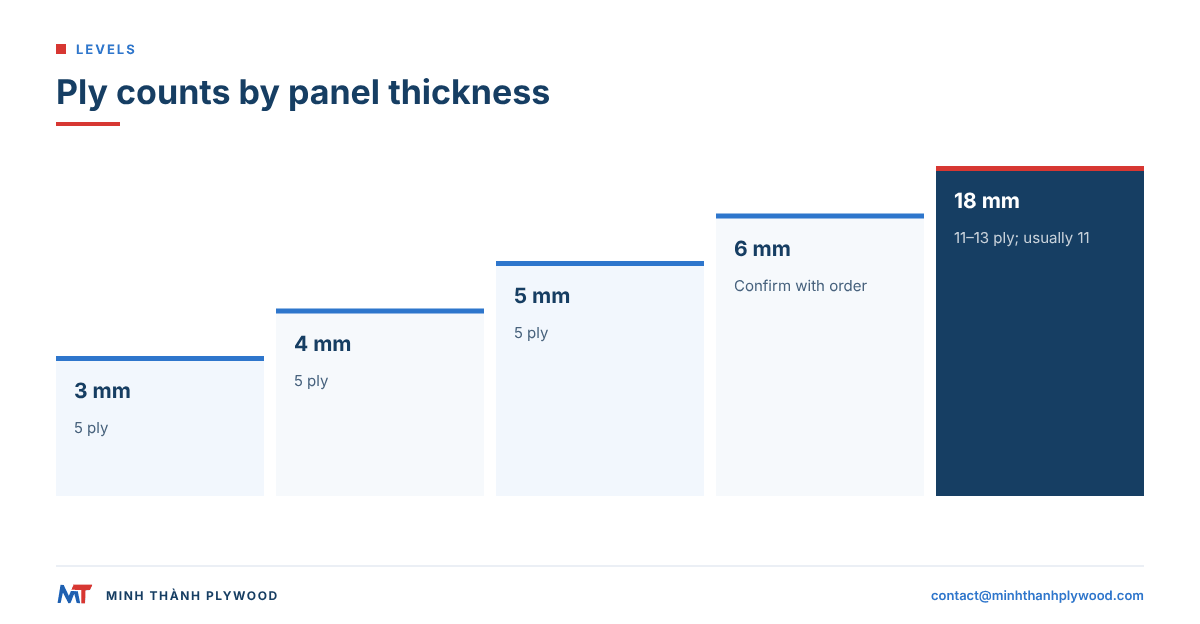
The ply count rises with thickness: 3 to 5 mm furniture plywood is 5 ply at Minh Thanh Plywood, and 18 mm panels carry 11–13 plies, most often 11. The table shows our production builds.
| Panel thickness | Plies in our build | How the layers are laid |
|---|---|---|
| 3 mm | 5 ply | One core veneer, two cross-band veneers, two face veneers |
| 4 mm | 5 ply | Three core veneers and two faces; for a 4 mm furniture panel, three 1.3 mm Styrax core veneers |
| 5 mm | 5 ply | Three core veneers and two faces, core veneer thickness adjusted to the panel |
| 6 mm | Confirmed with the order | Ply count and lay-up stated on the proforma |
| 18 mm | 11–13 plies, most often 11 | Face and back over cross-laid core veneers, core stitched both ways |
Face veneers are 0.2–0.5 mm thick, and European furniture buyers usually ask for 0.3 mm. Core veneers in thicker panels are usually 1.4–2.0 mm. That is why an 18 mm panel lands at 11 plies or more: the core veneers simply stack up to the thickness.
Thin plywood from 3 to 5 mm is always 5 ply in our production, even at 3 mm, where many mills make 3 ply. Premium thin veneer is scarce, so 4 mm can take longer to make; we keep the 5 ply standard instead of switching to a faster 3 ply build.
What is 3 ply wood, and what is it used for?
3 ply wood is the simplest plywood: a face veneer, one core veneer turned at right angles and a back veneer, glued under heat and pressure. It is light and cheap, and it suits uses where flatness and edge strength matter less than cost.
Typical uses of 3 ply wood:
- protection boards and covers in packing and shipping;
- light drawer bottoms and backs in low-cost furniture;
- model making and craft work at 1 to 3 mm;
- some formwork boards made as thick three-layer panels from solid wood lamellas, which are a different product from veneer plywood.
The weak point of a thin 3 ply sheet is the single core. When it has a gap or a split, the face above it has nothing to bridge it, and the panel can dent or crack along that line. A 3 ply sheet also bends easily along the face grain and stiffly across it, so it tends to cup when one side dries faster.
What is 5 ply plywood?
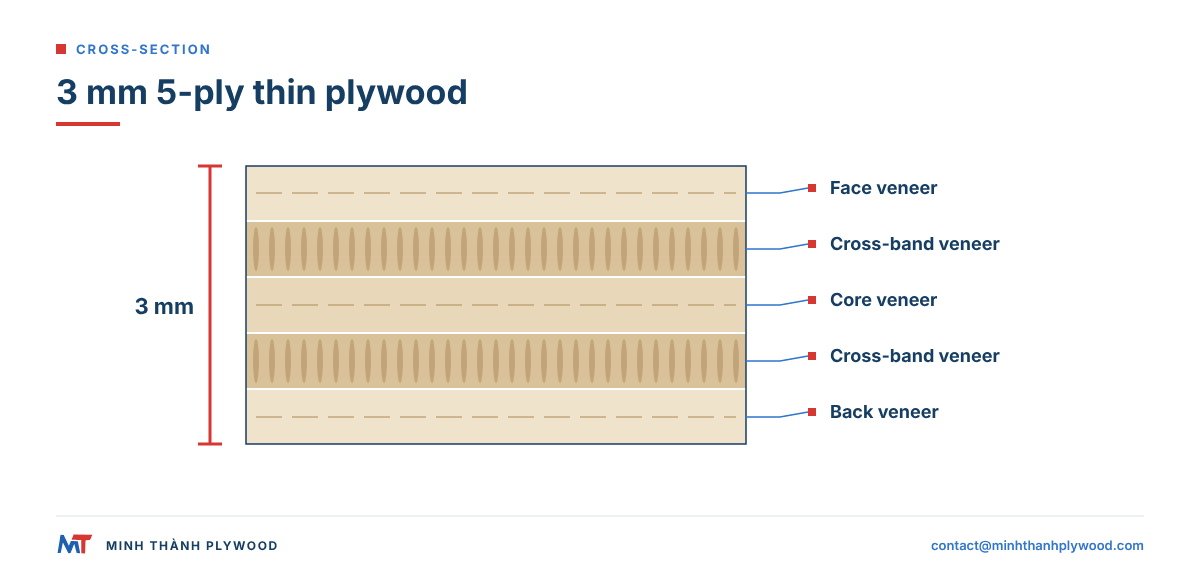
5 ply plywood is a panel of five wood veneers with the grain of each one at right angles to the next: face, cross-band, core, cross-band and back. It is the standard build for good thin furniture plywood.
The two cross-bands do the work. They sit right under the face and back, so the decorative veneer is held by a layer running the other way. That keeps a 0.3 mm face from checking and keeps the sheet flat after sanding. It also means a screw or a staple near the edge passes through four glue lines, not two.
At Minh Thanh Plywood the 3 mm build is one core veneer, two cross-band veneers and two face veneers. From 4 to 5 mm the build is three core veneers and two faces, with the core veneer thickness adjusted to the panel. Both builds are 5 ply. Faces include birch, poplar, EV (engineered veneer), okoume and pine, on a white Styrax or a Eucalyptus core.
Is 4 ply wood a real plywood build?
Yes. 4 ply wood is plywood with four veneers in which the two centre veneers run in the same direction and act as one thick core. It behaves like a 3 ply panel of the same thickness, because the grain still changes direction only twice.
Plywood normally has an odd number of plies, so the face and back grain run the same way and the panel stays balanced around its centre. A 4 ply panel keeps that balance by pairing the middle veneers. Mills use it when two thin core veneers are easier to source than one thick one.
Is 3 ply or 4 ply better? For flatness they are close; if the part must stay flat or take screws near the edge, go to 5 ply instead of choosing between them.
The phrase “4 plywood” is also used for 4 mm plywood. In our production a 4 mm panel is 5 ply: three 1.3 mm Styrax core veneers and two faces.
Can I use 4 ply instead of 3 ply?
Yes, in most cases. A 4 ply panel of the same thickness carries the same loads as 3 ply, because its two centre veneers run in one direction and work as one thick core. Check that the thickness, glue and face grade match the order. If the part must stay flat or take screws near the edge, order 5 ply instead.
Why do more plies make plywood more stable?
More plies make plywood more stable because each cross-laid veneer resists the swelling and shrinking of its neighbours. With more, thinner layers, the movement of any single veneer is smaller and is held by more glue lines.
Wood moves far more across the grain than along it. In a 3 ply sheet the single core must hold two faces that both want to move the same way. In a 5 ply sheet two cross-bands share that job, and the stress at each glue line is lower. The result is a panel that stays flat through humid transport and dry heated rooms.
Stability also depends on moisture. Our veneers and finished panels are dried to 8–12 % moisture content at dispatch, the normal range for furniture plywood, so the panel starts close to the conditions of an indoor workshop.
Does more plies mean stronger plywood?
More plies do not always mean stronger plywood. Bending strength comes mainly from the thickness and the outer layers; more plies make strength more even along and across the sheet and improve stability, edge screw holding and resistance to splitting.
Three things matter more than the count alone:
- Core quality. Many plies with gaps, overlaps or loose joints are weaker than fewer plies laid tight. Our core layers are stitched both horizontally and vertically.
- Glue line quality. Each extra layer is one more glue line that must bond fully. Furniture-grade panels are pressed twice as standard: the core board is pressed and calibrated, then face and back are pressed on.
- Thickness tolerance. A panel that is thick at one end and thin at the other is weak at the thin end. Sanded furniture panels hold ±0.2–0.3 mm, down to ±0.2 mm.
5 ply vs 7 ply plywood: which is better for doors?
For door blanks and solid door panels of 12 mm and more, 7 ply or more is better than 5 ply, because a tall panel needs more cross-layers to stay straight. For door skins of 3 to 5 mm, 5 ply is the right build and the normal one.
A flush door is usually two thin skins over a frame. The skin must be flat and must take paint or veneer without showing the core, so a 5 ply skin with a smooth sanded face is the right choice. A solid plywood door or a cabinet door cut from one panel is different: a tall, narrow part moves more, and a build with more plies keeps it from bowing.
How do ply count and veneer thickness change the face finish?
The ply count changes the finish because the layer under the face decides whether the face stays smooth. In a 5 ply panel a thin cross-band sits under the face, so core joints and gaps do not telegraph through paint or lacquer.
For a 3 mm 3 ply sheet, the core is often thick and coarse, and its grain can show through a thin face after sanding or under a high-gloss finish. Both faces of our panels are sanded, polished and UV-ready, to the standard customers need to apply their own UV coating. That standard is easier to hold on a 5 ply build with a thin cross-band under the face.
What does a 3 ply or 5 ply panel weigh?
Weight follows the core species and thickness, not the ply count: two panels of the same core and thickness weigh almost the same whether they are 3 ply or 5 ply. Panel weight = density × volume.
For reference, a 1220 × 2440 × 18 mm sheet weighs 26.8 kg on a Styrax core (500 kg/m³), 31.1 kg on Acacia (580 kg/m³) and 34.8 kg on Eucalyptus (650 kg/m³). A thin 4 mm sheet of the same size on Styrax weighs about 6 kg, a little over a fifth of the 18 mm figure. Ply count adds only the extra glue in the extra glue lines.
Is 5/8 plywood bigger than 3/4 plywood?
No: 5/8 inch plywood is thinner than 3/4 inch plywood. 5/8 inch is about 15.9 mm and 3/4 inch is about 19 mm, and in metric orders the nearest panels are 15 or 16 mm and 18 mm.
Inch names describe the nominal thickness. Sanded panels sold as 3/4 in the US often measure 23/32 inch, and 5/8 panels 19/32 inch. When you import metric plywood, order the millimetre thickness you need and its tolerance, for example 18 mm ±0.2 mm for a sanded furniture panel, instead of an inch name.
How should you write the ply count on a plywood order?
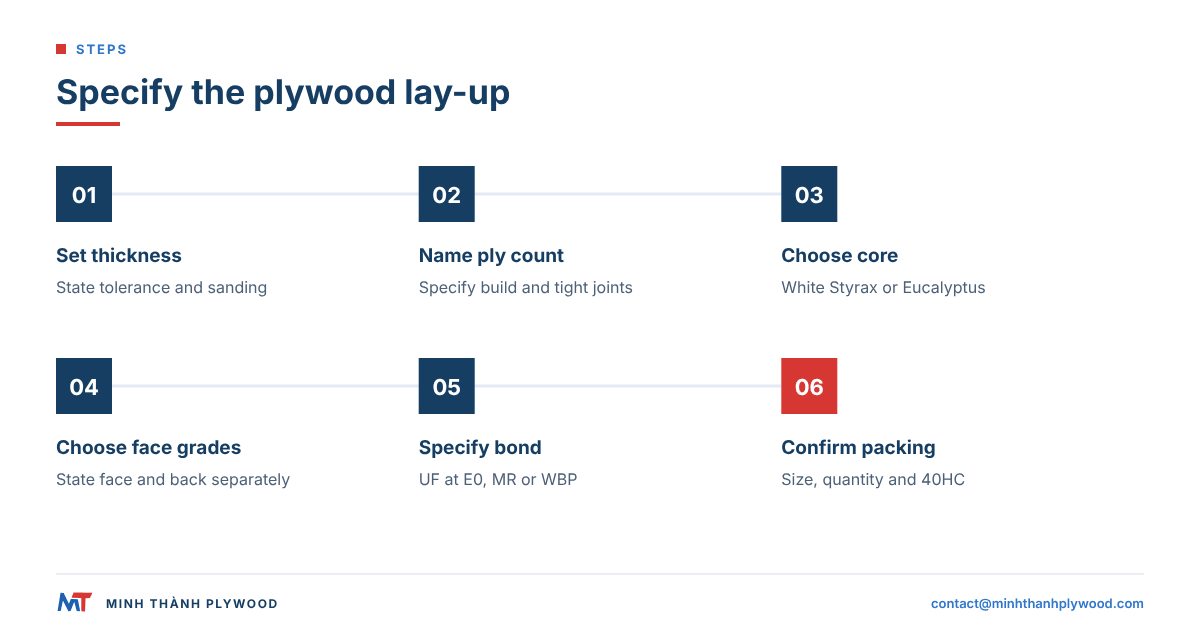
Write the ply count together with the thickness, core, face and glue, because a ply count alone does not define the panel. “5 ply” with no thickness can mean a 3 mm skin or a 9 mm board.
Spec lines that remove doubt:
- Thickness and tolerance: 4 mm ±0.2 mm, sanded.
- Build: 5 ply, core veneers laid tight, no overlaps.
- Core species: white Styrax or Eucalyptus.
- Face and back grade: for example birch D/E, poplar A/B, pine A/B.
- Glue and emission: UF glue at E0 emission for furniture and interior panels; MR or phenolic (WBP) bonds to the order.
- Size and packing: 1220 × 2440 mm, 1250 × 2500 mm or a custom size, packed for a 40HC.
For the conditions of use, BS EN 636 covers plywood for dry, humid or exterior conditions, and BS EN 314-2 sets the bonding-quality requirements for the glue line.
What should you order from Minh Thanh Plywood?
Order 5 ply for every thin panel from 3 to 5 mm and 11–13 plies for 18 mm furniture plywood: those are our standard builds, made for European furniture buyers. Free samples let you count the plies and check the face before the order.
Our factory is built for top-grade furniture and interior plywood, with Europe as its main market. Thin panels are a dedicated product line: always 5 ply, with faces from more than ten veneers. For US orders, the rule is 40 CFR 770.10, which sets 0.05 ppm of formaldehyde for veneer-core hardwood plywood. Our panels for US orders carry CARB P2 / TSCA Title VI certification, ICTT mill no. 23024.
Orders start at one 40HC with mixed specifications by agreement; production is 15–45 days after the 30% deposit. For the full thickness range, read the plywood thickness guide or see thin plywood 3 to 6 mm.
Buyer questions, answered
What is the difference between 3-ply and 5-ply plywood?
3-ply plywood has three veneer layers, 5-ply has five. At the same thickness the 5-ply panel has thinner veneers and four glue lines instead of two, which makes it flatter, more even in strength across both directions and better at holding fixings near the edge.
Is 3 ply or 4 ply plywood better?
For a flat panel, 3 ply is usually the cleaner build, because 4 ply pairs two middle veneers with the same grain and acts like a thick 3 ply. A 5 ply panel of the same thickness beats both on flatness and screw holding.
Can I use 4 ply instead of 3 ply?
Yes, in most cases. A 4 ply panel of the same thickness carries the same loads as 3 ply, because its two centre veneers run in one direction and work as one thick core. Check the thickness and glue, not the layer count alone.
What is 5 ply plywood?
5 ply plywood is a panel of five wood veneers glued with the grain of each layer at right angles to the next: a face, a cross-band, a core, a second cross-band and a back. It is the normal build for thin furniture plywood from 3 to 5 mm.
Is 5 ply or 7 ply better for doors?
For a solid door skin or a door blank of 12 mm and up, 7 ply or more is better, because more cross-layers keep a tall panel straight. For thin door skins of 3 to 5 mm, 5 ply is the right build.
Is 5/8 plywood bigger than 3/4 plywood?
No. 5/8 inch plywood is about 15.9 mm thick and 3/4 inch plywood is about 19 mm, so 3/4 is the thicker sheet. In metric orders the nearest panels are 15 or 16 mm and 18 mm.
How many plies does 18 mm plywood have?
18 mm furniture plywood from Minh Thanh Plywood is built with 11–13 plies, most often 11. More plies at the same thickness mean thinner core veneers and a flatter panel.
Why is plywood made with an odd number of plies?
An odd number puts the face and back grain in the same direction, so the panel is balanced around its centre and does not cup. Even counts work only when the two centre plies share one direction.
Is 3 mm plywood 3 ply or 5 ply?
Both exist. Minh Thanh Plywood makes 3 mm plywood as 5 ply: one core veneer, two cross-band veneers and two face veneers, so the thin sheet stays flat and does not split along the grain.
Does more plies always mean stronger plywood?
Not always. Strength in bending comes mainly from thickness and the wood species of the outer layers. More plies make strength more even in both directions and the panel more stable, but thin core veneers with gaps can cancel that gain.