
Quality control · Ha Hoa, Vietnam
Plywood quality control at eight checkpoints
In short
Minh Thanh Plywood runs plywood quality control at eight checkpoints, from core veneer intake to the sealed container. Furniture panels are pressed twice and sanded to a thickness tolerance down to ±0.2 mm, panels from every pack are measured with a digital caliper, and every shipment is photographed and filmed before it leaves Ha Hoa, Vietnam.
Watch the film
Plywood quality control: eight checkpoints from veneer to container
The 2:26 film shows all eight plywood quality control checkpoints at our plant with real factory footage: veneer intake, lay-up, hot pressing, calibrated sanding, the caliper check, face and edge grading, bond and emission tests, and the packing and loading record. It closes with the certificates and the photo record you receive before the container is sealed.
Chapter 1 sets the eight checkpoints against the order. Chapter 2 follows the line: laid-up panels into the hot press, face repairs and edge filling before sanding, then calibrated sanding to final thickness.
Chapter 3 is the caliper check and the tolerance for each product line. Chapter 4 shows the boil test on production samples and the chamber emission results. Chapter 5 shows the certificates and the shipment record sent before sealing.
Certified and tested
Plywood quality control backed by real certificates.
Our checks run inside a certified quality system: ISO 9001:2015 (KAC25/0185), CARB P2 / TSCA Title VI (ICTT mill no. 23024) and TCVN 11902:2017. These are the English originals; full copies go to buyers by email.
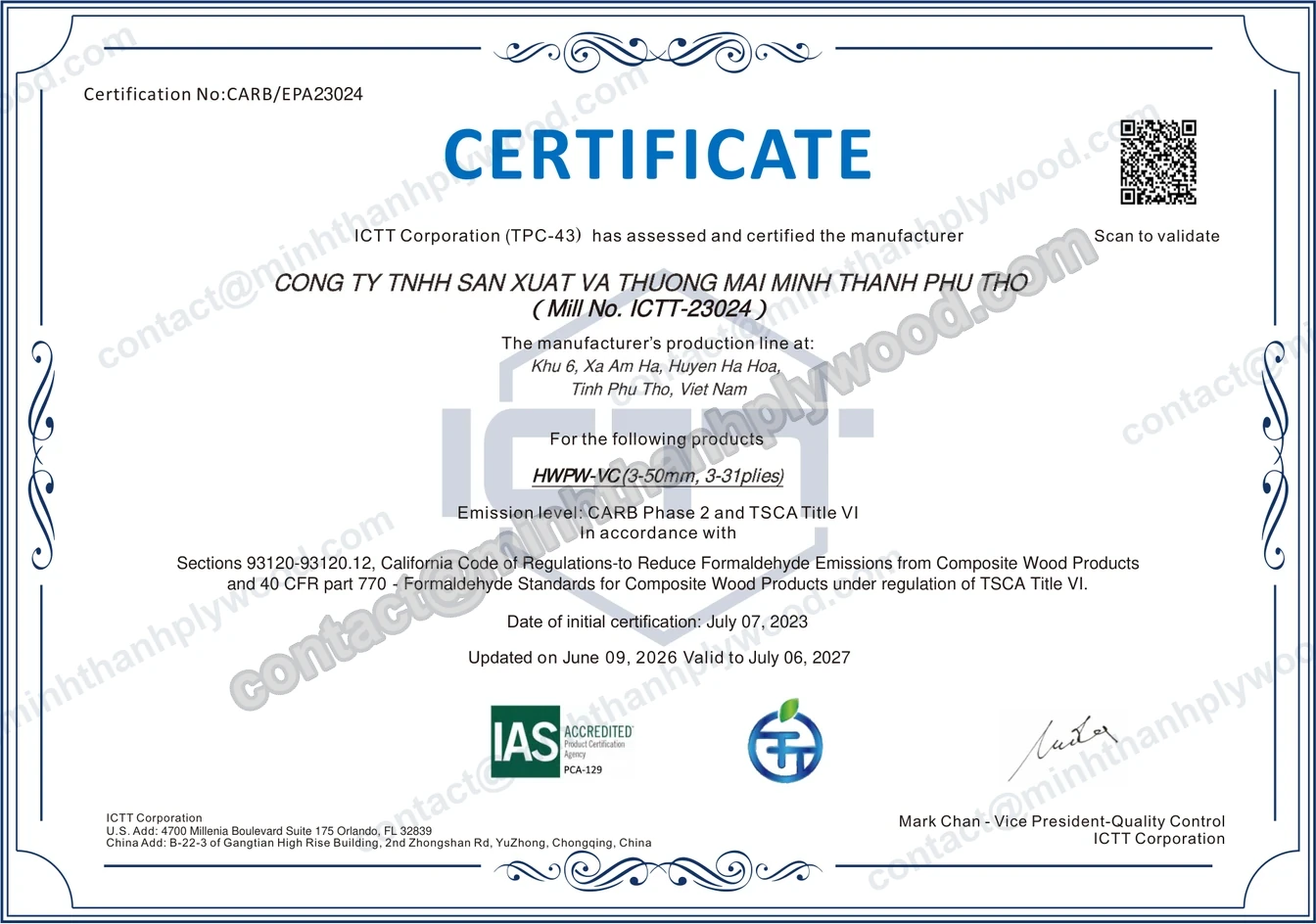 CARB P2 / TSCA Title VIICTT mill no. 23024 · hardwood plywood, 3–50 mm
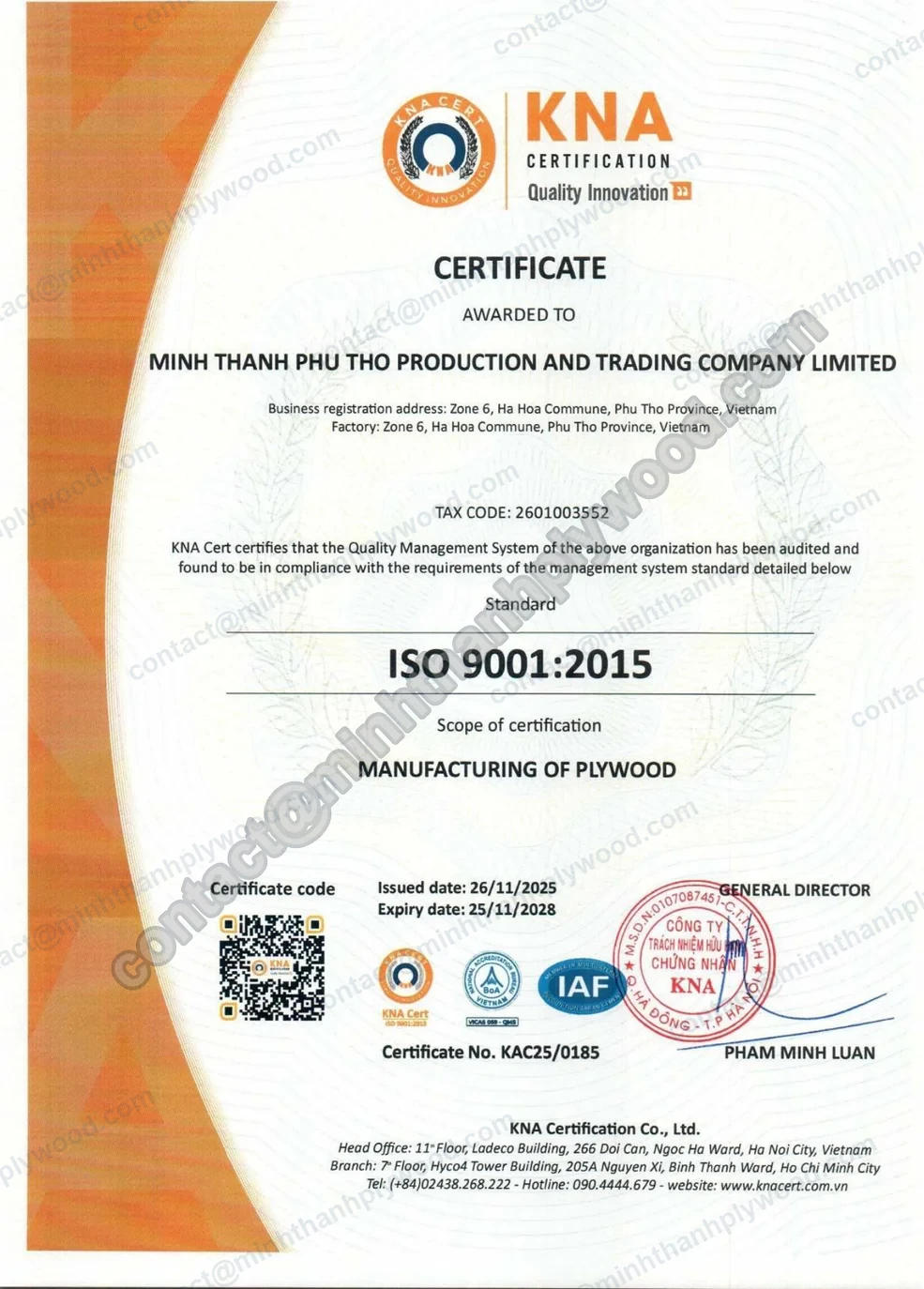 ISO 9001:2015Quality management system for plywood manufacturing · KAC25/0185
 TCVN 11902:2017Certification for veneer-faced plywood
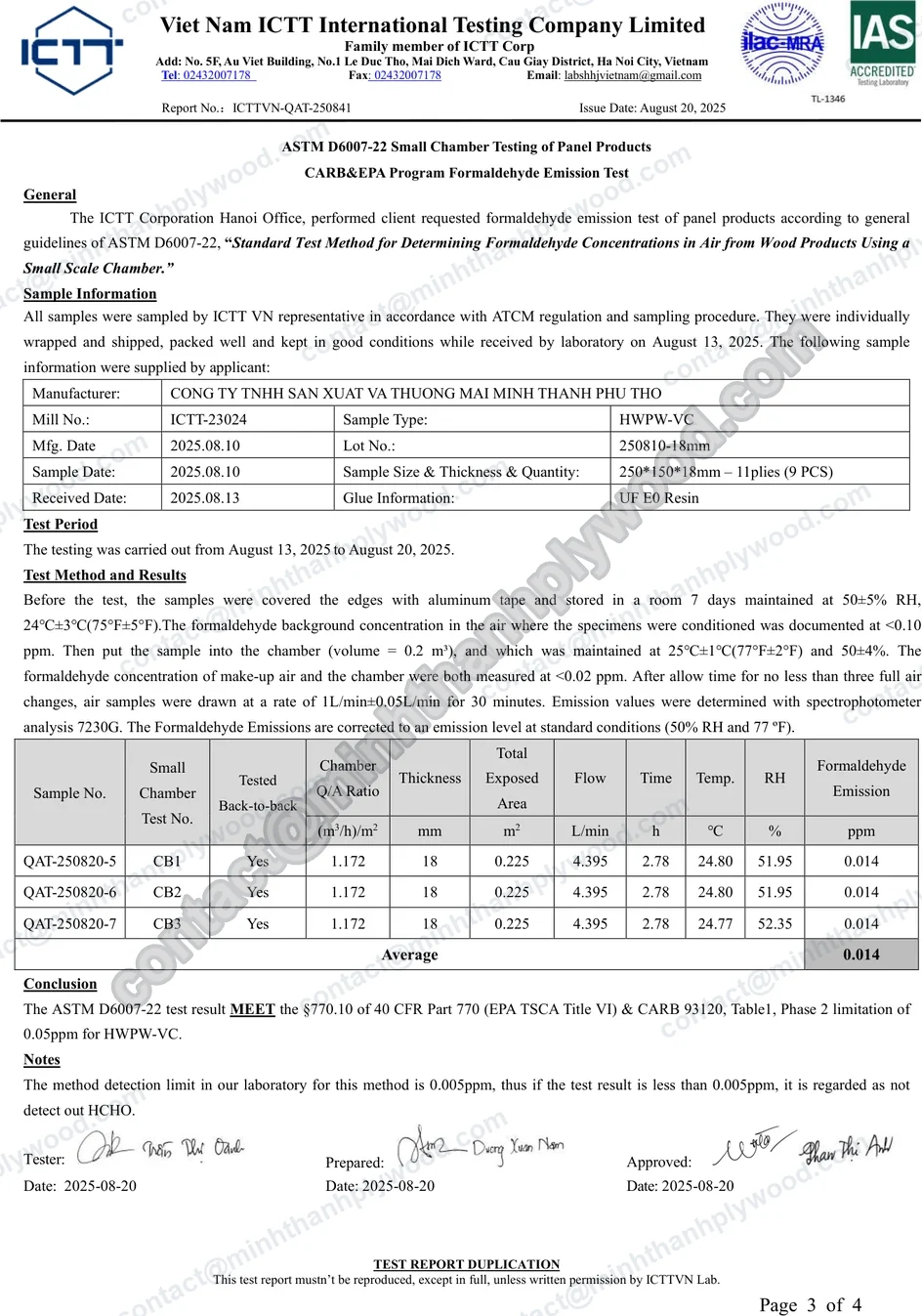 E0 emission testASTM D6007 chamber, ICTT · repeated every 3 months
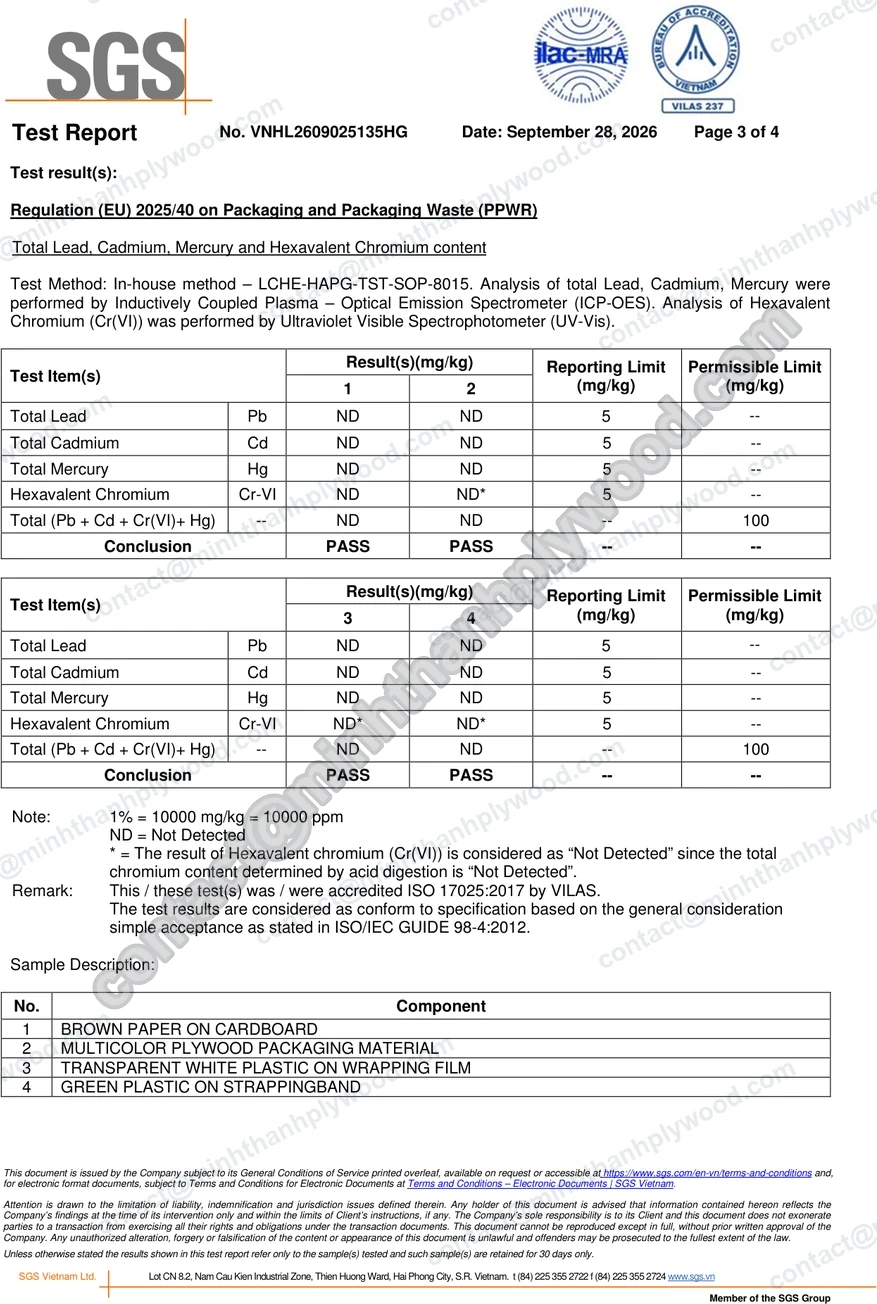 PPWR packaging testSGS, September 2026 · heavy metals not detected
What is plywood inspection?
Plywood inspection stages, and who runs each one.
Plywood inspection runs at five stages: our own eight checkpoints on every order, your inspector during production, a pre-shipment inspection, a loading check and a final document review. Our checkpoints are fixed; the buyer and third-party stages are yours to book.
In shortPlywood inspection checks panels against the agreed specification: thickness, size, face grade, core, glue bond, emission and packing. In-process checks at each production step stop a defect before the next step adds cost; a final inspection by the buyer or an agency such as SGS, Intertek or Bureau Veritas then confirms the finished packs before loading.
| Stage | When | Who | What is checked |
|---|---|---|---|
| Factory checkpoints | Veneer intake to packing | Our QC team | The eight checkpoints on this page, on every order |
| During production | Once lay-up and pressing start | Your inspector or agency | Core, joining, glue and first sanded panels against the sample |
| Pre-shipment inspection | Packing finished, before loading | Your inspector or agency | Random panels from finished packs: thickness, size, faces, edges, bond, count |
| Container loading check | During loading | Your inspector or agency; always filmed by us | Pack count, labels, straps and the loaded container before sealing |
| Document review | After loading | You | Draft invoice, packing list, B/L and certificates before release |
Your own inspector or any agency you appoint is welcome at the plant. Give us the date with the order and we plan production and loading around it; our measurement records are open to the inspector.
By product line
What plywood quality control checks on each product line.
Each product line has its own inspection limits: sanded furniture panels ±0.2–0.3 mm, commercial and film-faced plywood ±0.5 mm, packing plywood ±0.5–1.0 mm, and ±2 mm on length and width for all. We agree the line with the order, then check every pack to that line.
| Item | Furniture & interior | Commercial | Packing | Film-faced |
|---|---|---|---|---|
| Core | A-grade Styrax or Eucalyptus | AB-grade core | AB-grade core, laid loose | Acacia or Eucalyptus core |
| Core joining | Stitched both ways, outer 2–4 layers; all on request | Laid or jointed | Laid loose | To film grade |
| Face preparation | Sanded and polished, UV-ready | Light sanding or unsanded | Unsanded | Film 120–135 g/m², premium from 135 |
| Glue and emission | E0 standard; E1, MR or WBP to order | To order | To order | Melamine or phenolic (WBP) |
| Thickness tolerance | ±0.2–0.3 mm | ±0.5 mm | ±0.5–1.0 mm | ±0.5 mm |
| Length and width | ±2 mm | ±2 mm | ±2 mm | ±2 mm |
| Focus of inspection | Face grade, flatness, thickness, emission | Thickness, bond, face | Bond, size, count | Film coverage, edge sealing, bond |
Film-faced reuse with proper handling, release agent and edge sealing: about 12–15 pours with melamine glue and up to about 25 with phenolic glue.
How we inspect plywood
Eight checkpoints from veneer to container.
Our plywood quality control runs at eight checkpoints, each with its own check list. A panel that fails a checkpoint does not move on to the next step.
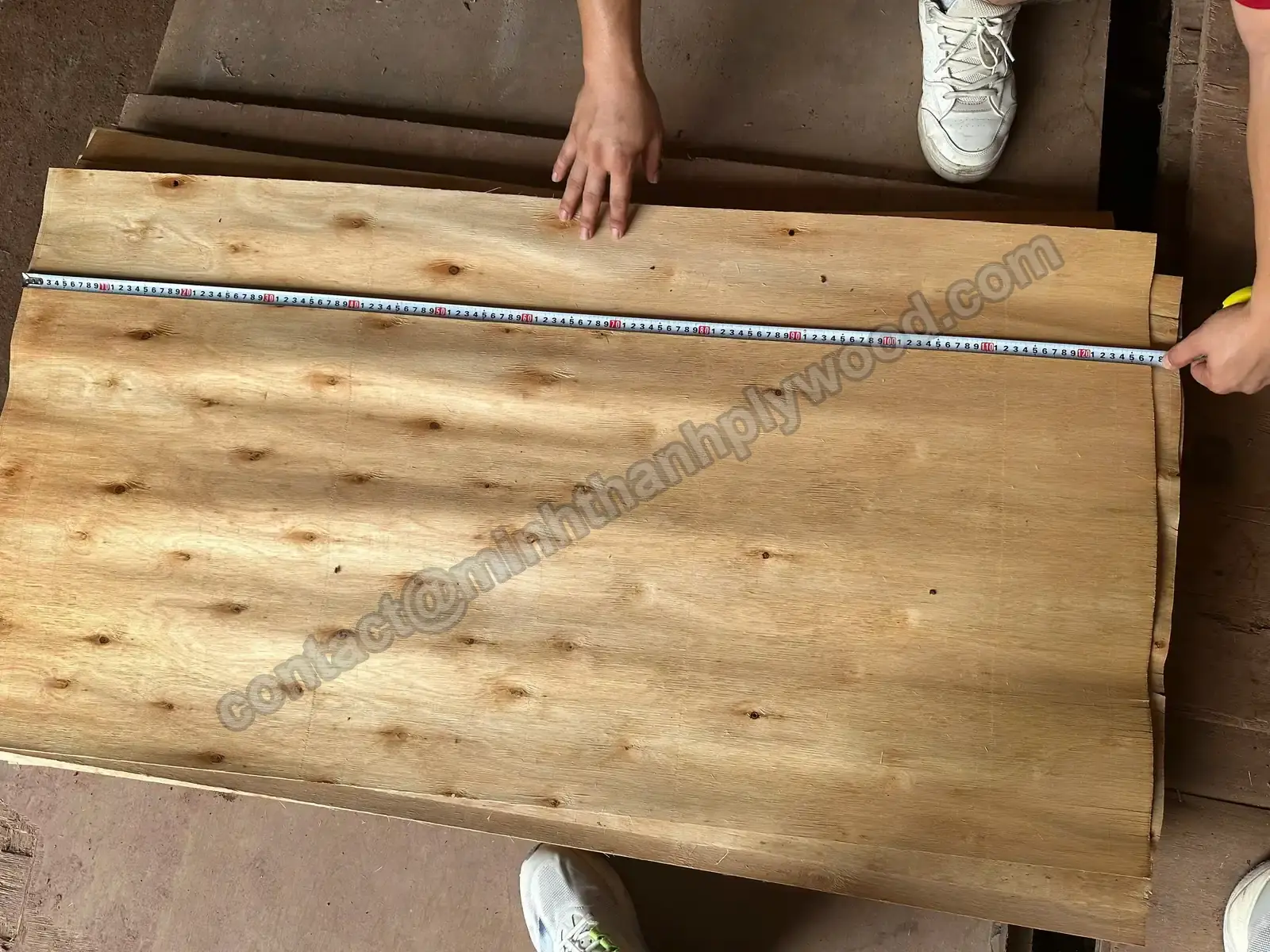
Core veneer measured with a tape before sorting. 01Veneer intake and sorting
Core veneer comes from plantations around Ha Hoa. Sheets are dried, measured and sorted: splits, holes, soft wood and damp sheets are taken out before lay-up, because wet or uneven veneer is the first cause of blisters and thickness drift. Face veneer is matched to the sample you approved.
- Core veneer 1.4–2.0 mm thick, face veneer 0.2–0.5 mm
- Veneer dried and checked with a moisture meter before lay-up
- Face veneer matched to your approved sample
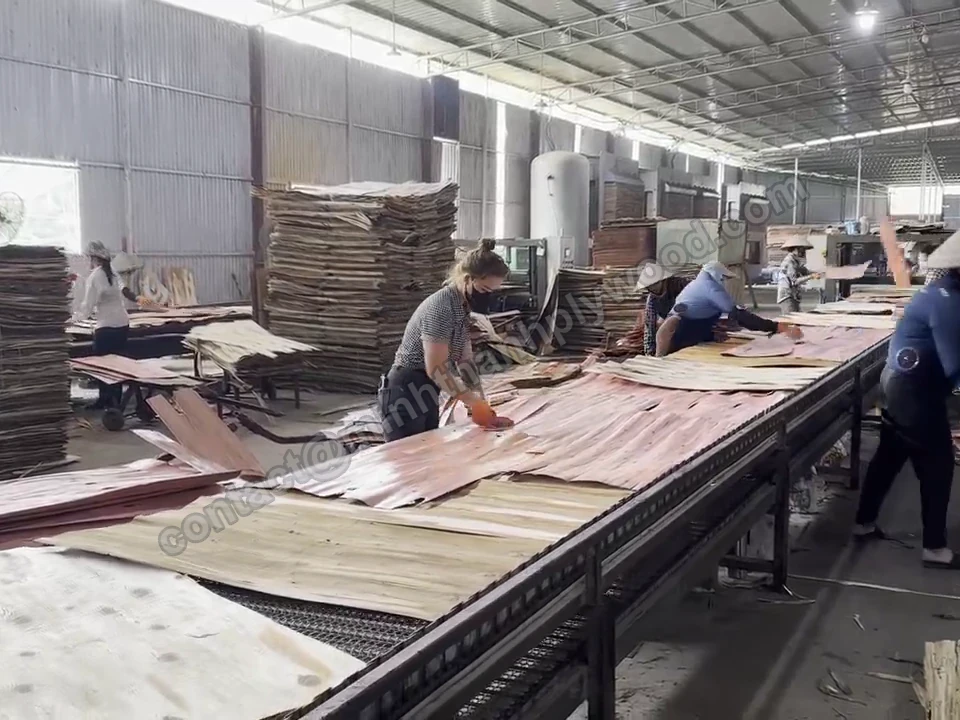
Core veneer laid up by hand on the line. 02Lay-up and stitched cores
Cores are laid by hand on the lay-up line. Gaps and overlaps are fixed before the glue, so nothing telegraphs through the face later. Ply count follows the thickness: an 18 mm furniture panel is usually 11 plies, and thin 3–6 mm panels are always 5 plies.
- No open gaps or overlaps in the core
- Outer 2–4 core layers stitched horizontally and vertically; all layers on request
- Ply count matched to thickness, most often 11 plies for 18 mm
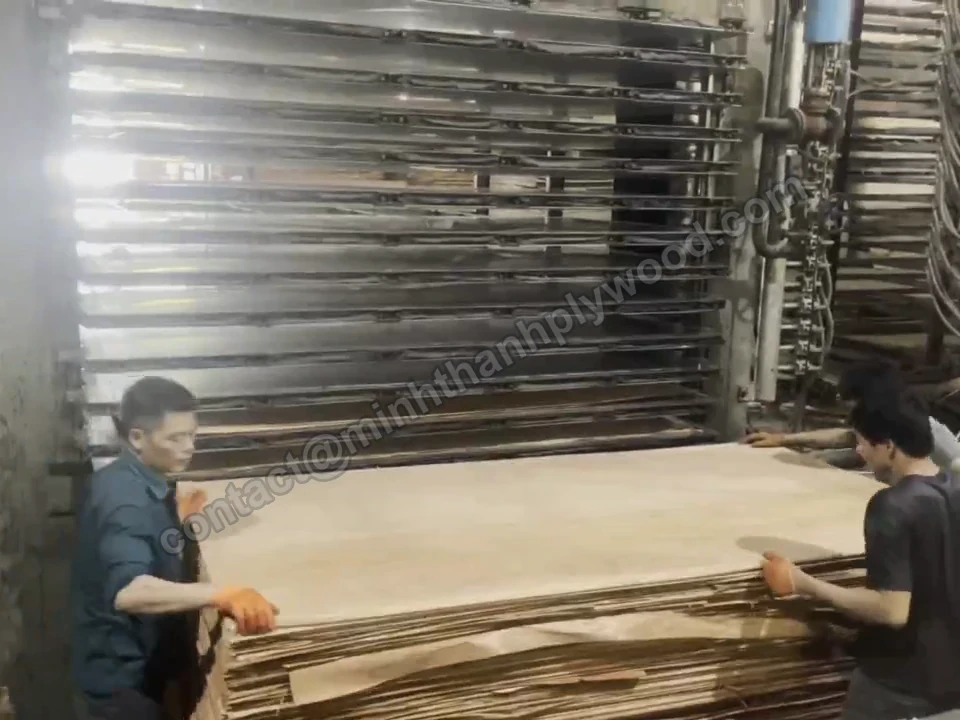
Laid-up panels loaded into the hot press. 03Glue and hot pressing
Furniture panels are pressed twice: the core board is pressed and calibrated first, then the face and back are pressed on. Glue is mixed to your order, E0 as standard; E1, melamine-fortified (MR) or phenolic (WBP) when you specify it. Press temperature follows the glue: about 110–120 °C for MR-type glue and 130–145 °C for WBP.
- Core board pressed and calibrated before faces go on
- Glue type and emission class as ordered; temperature set by glue system
- Bond tested on samples after pressing (checkpoint 07)
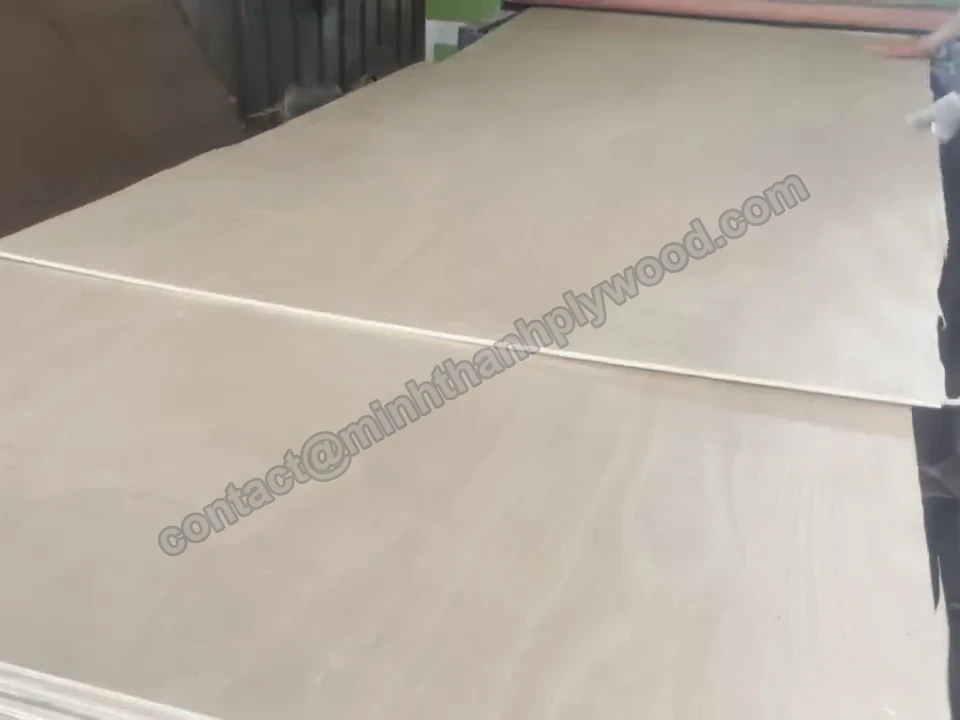
Sanded panels at the outfeed of the sanding line. 04Calibrated sanding
Pressed panels run through calibrating and finishing sanders. This is where furniture panels reach their final thickness and a smooth face for lacquer, paint, foil or your own UV coating. Commercial and packing panels get light sanding or none, which is why their tolerance is wider.
- Thickness calibrated before finish sanding
- Both faces sanded and polished
- Faces prepared UV-ready
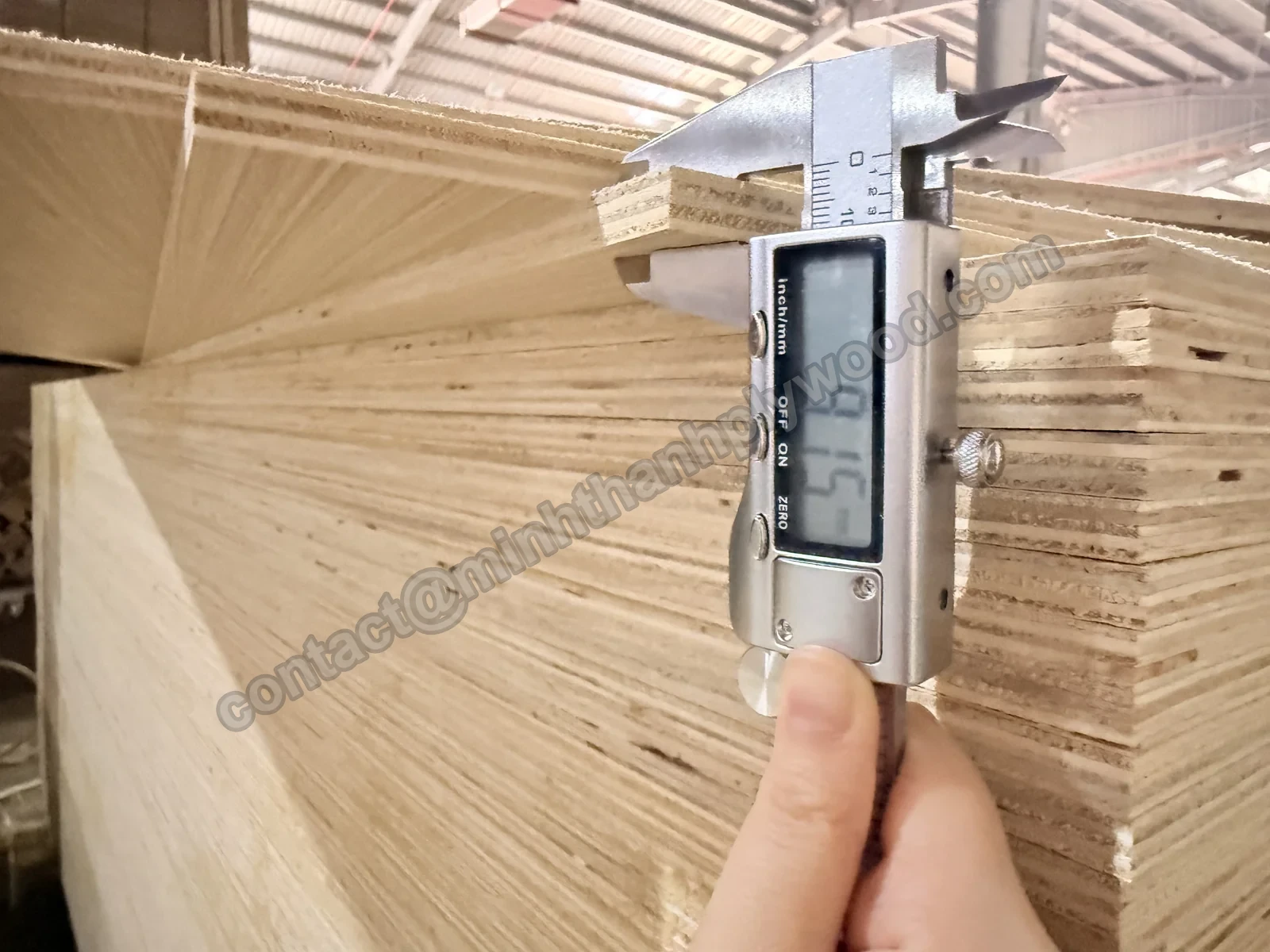
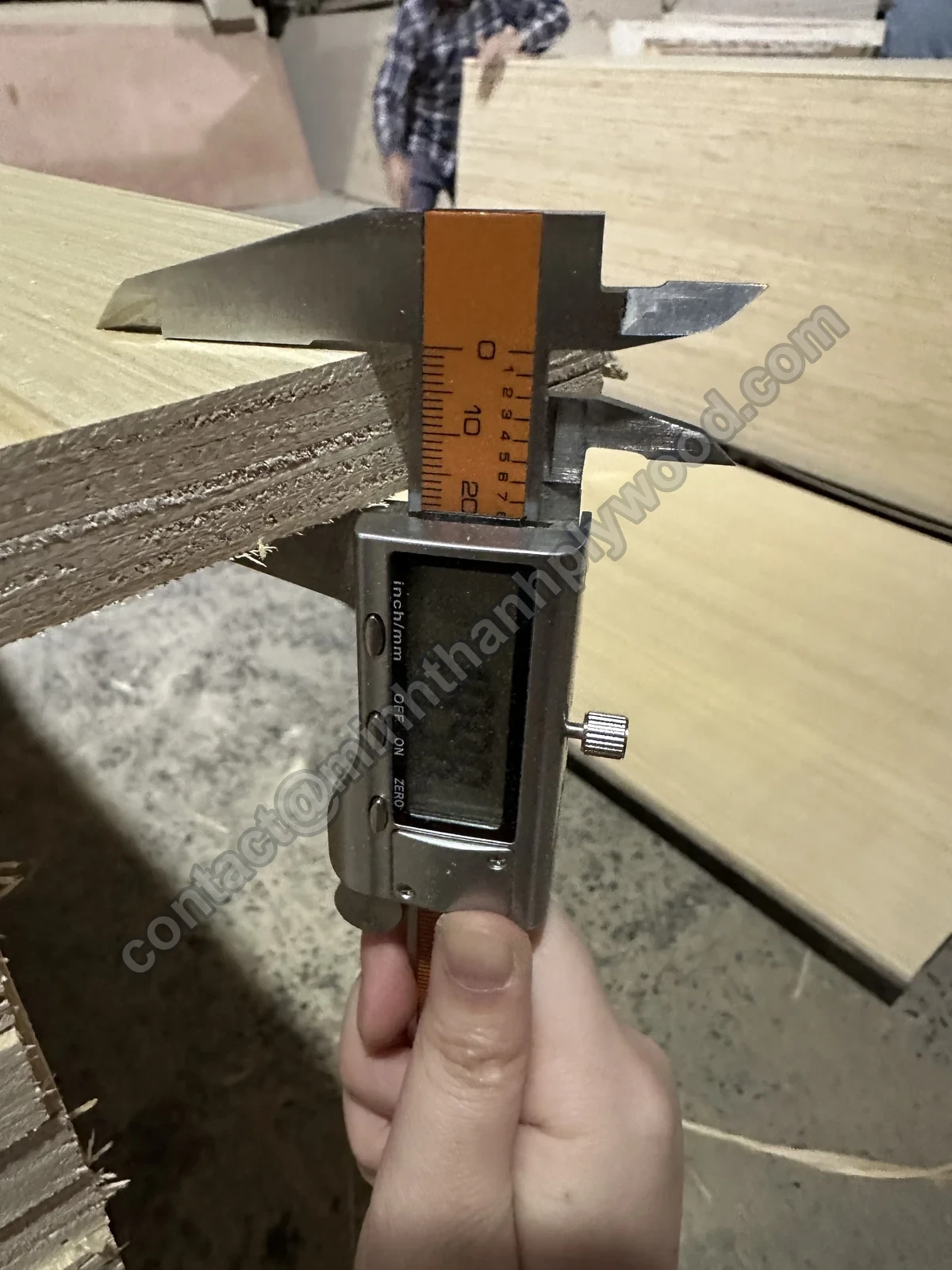
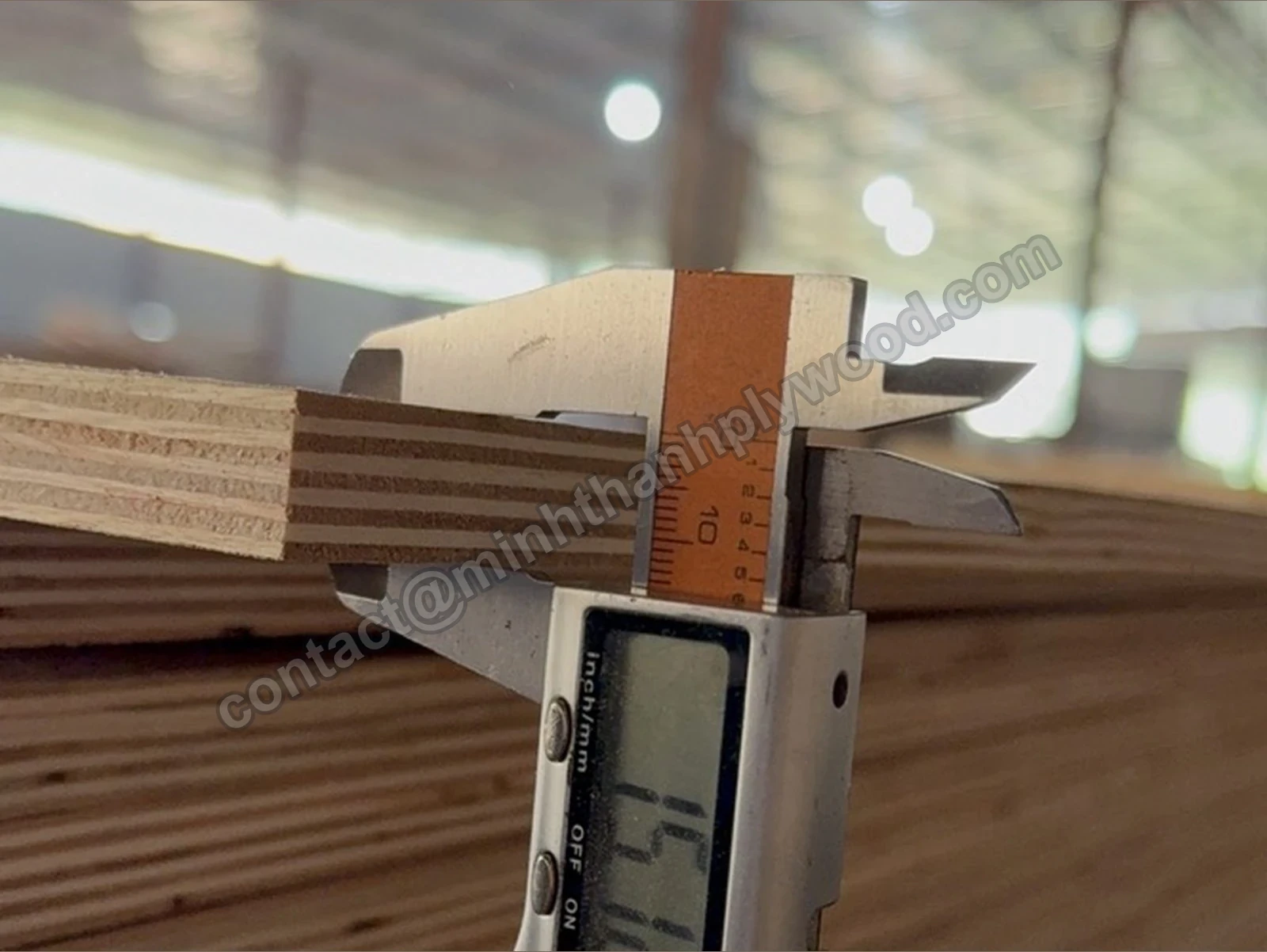
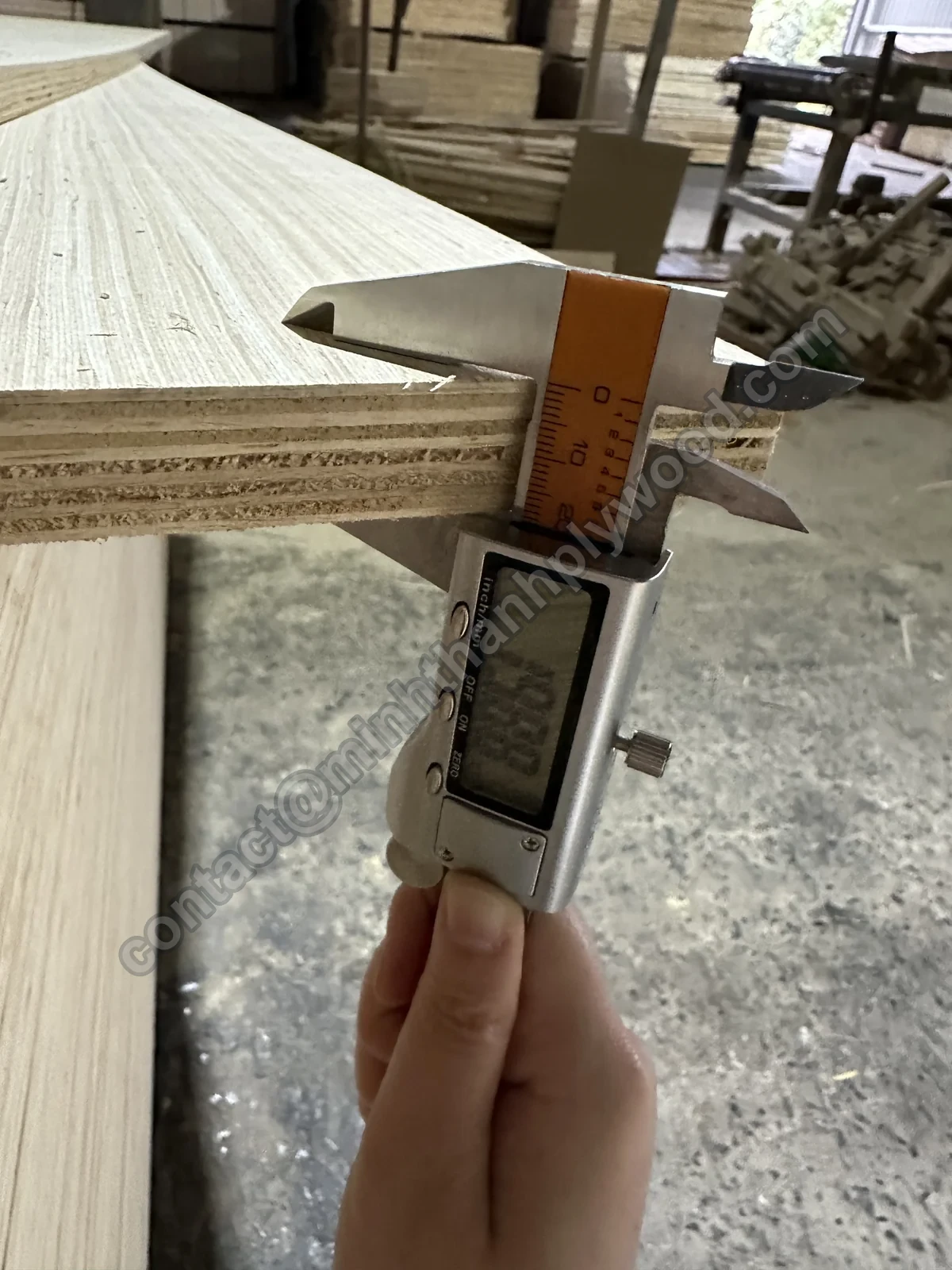
Digital caliper on a 9 mm panel: 9.15 mm. 05Plywood thickness check
We measure panels from every pack with a digital caliper at several points along the edges. Panels outside the agreed tolerance do not go into your order, and the readings are photographed for your shipment record.
- Readings on panels from every pack
- Tolerance agreed per product line before production
- Readings sent to you with the shipment photos
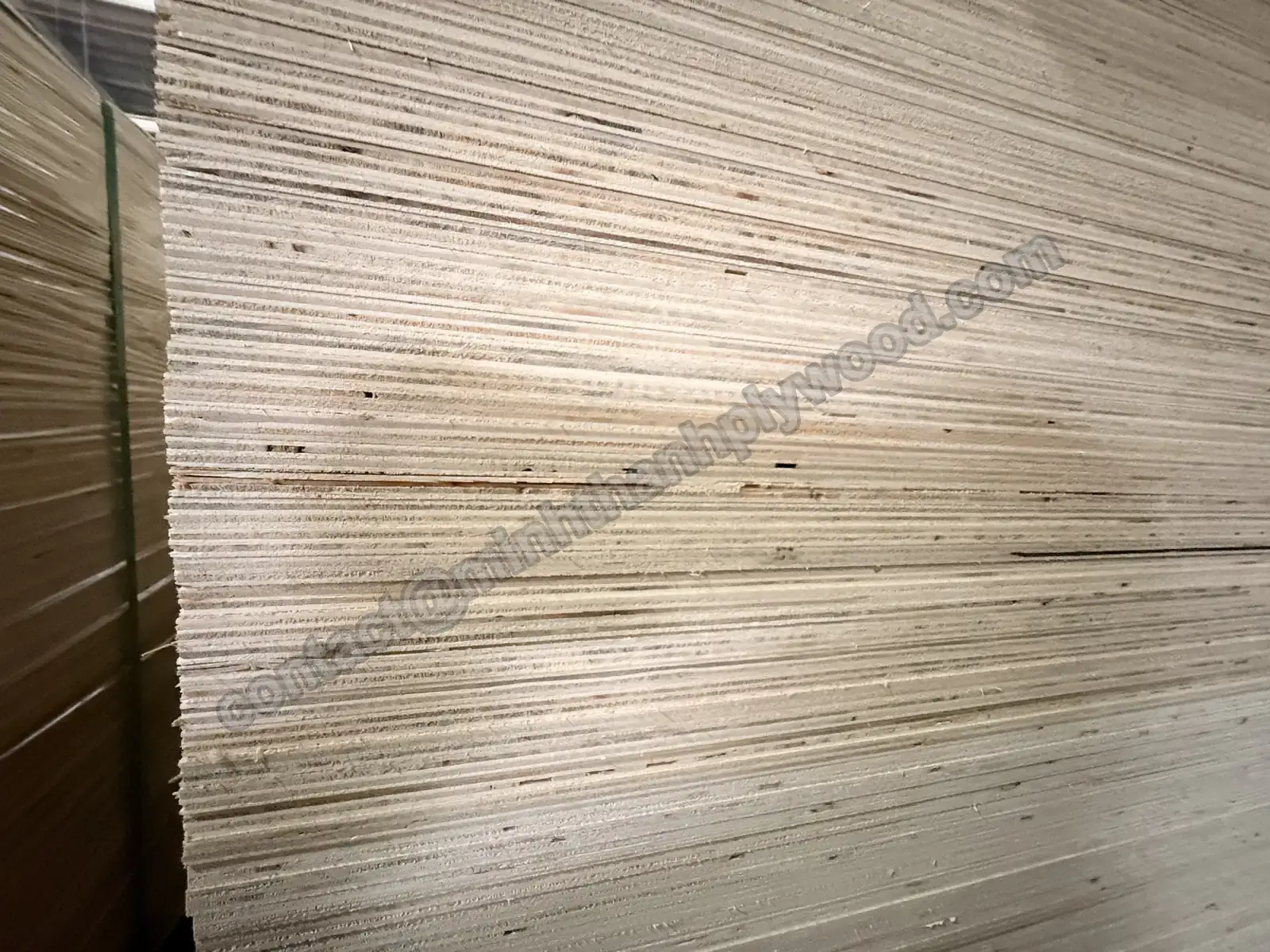
Panel edges checked for gaps and delamination. 06Face and edge grading
Each face is graded against your approved sample for colour, grain, knots and repairs. Edges are checked for core gaps, overlaps and delamination, and panels are checked for flatness and square corners before packing.
- Face grade set by approved sample, e.g. birch D+/D/E factory grades
- Edges free of open gaps and delamination; panels flat and square
- Length and width within ±2 mm
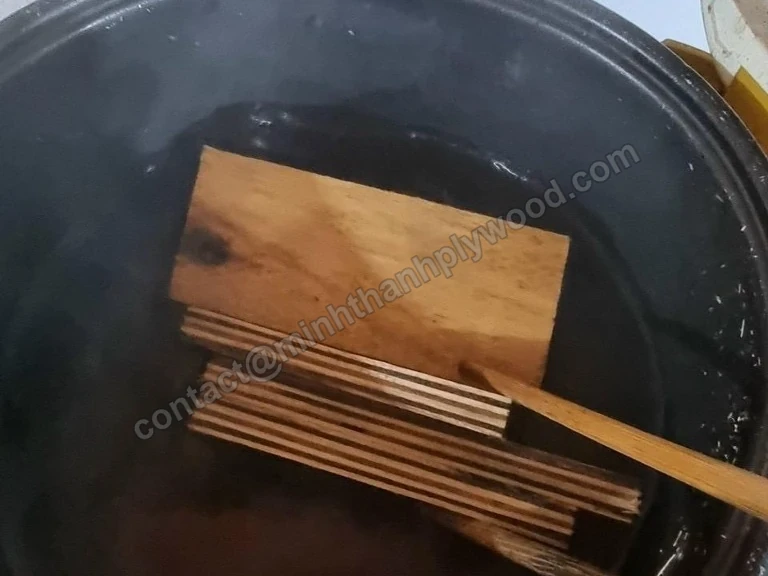
Production samples in a boiling-water bond test. 07Bond and emission tests
Samples cut from production go into boiling water. E0 glue holds for about 6 hours; melamine-fortified glue for outdoor use holds for about 12 hours. The boil test checks the bond, not emission: a third-party lab tests formaldehyde emission every 3 months.
- Boil test on production samples
- E0 emission tested every 3 months
- Six chamber tests (ASTM D6007, ICTT), April 2025–June 2026: 0.014–0.032 ppm against the 0.05 ppm CARB P2 limit
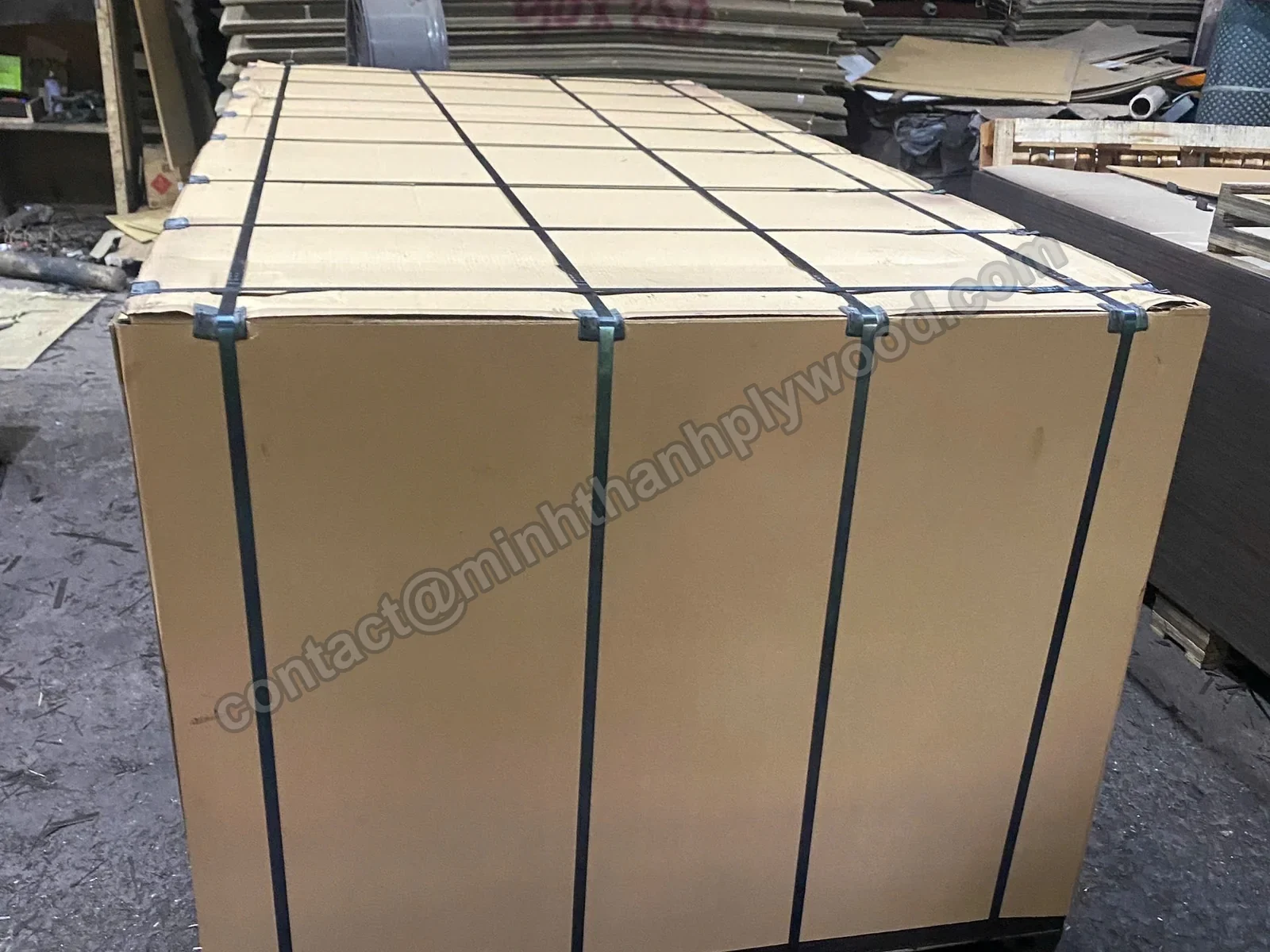
Export pack: cardboard cover and steel straps on a pallet. 08Packing and loading record
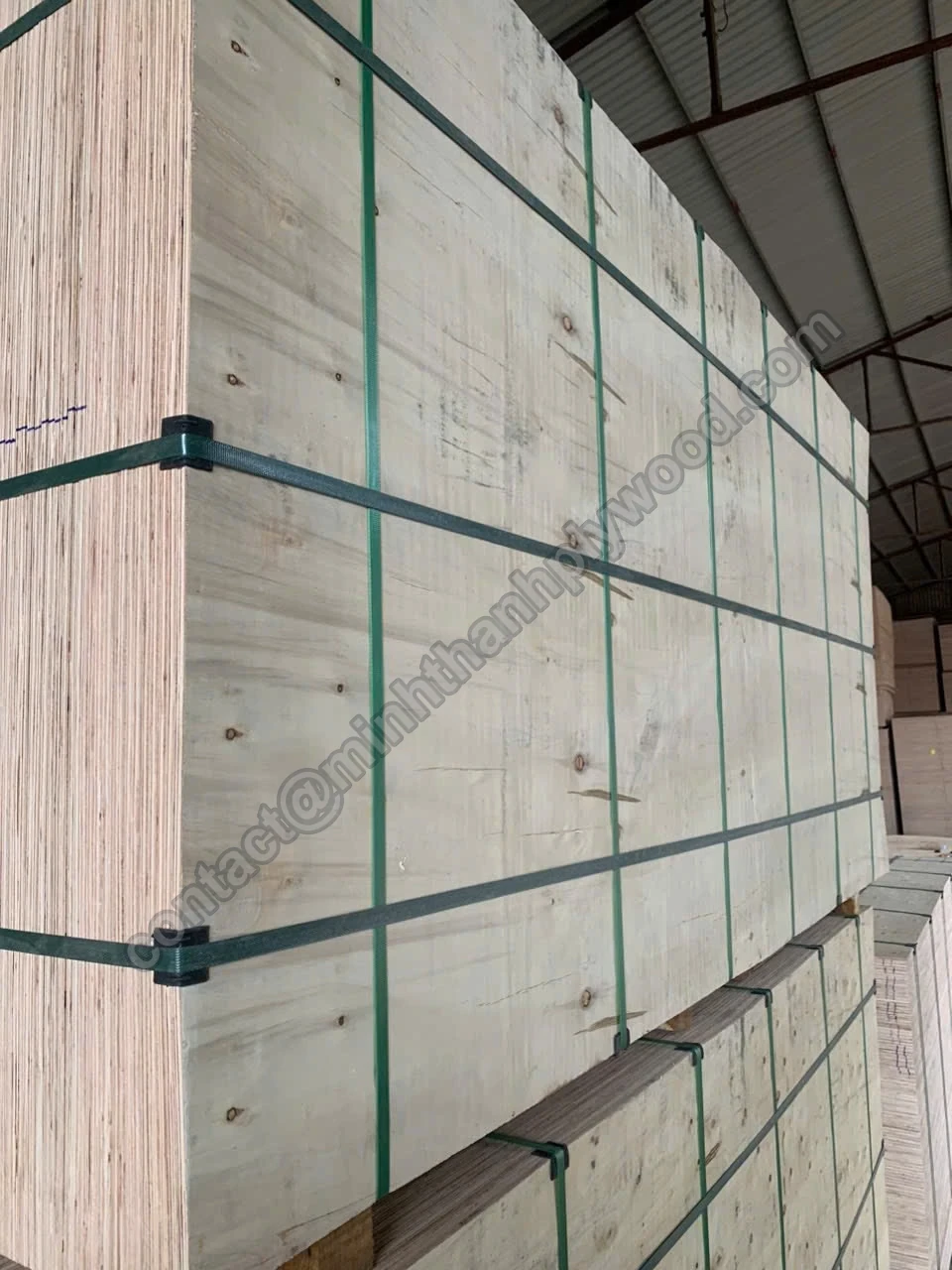
Packs are counted against the packing list, wrapped, strapped and labelled. Loading is photographed and filmed, and the record goes to you before the container is sealed.
- Sheets per pack checked against the packing list
- Cardboard, corner guards and steel straps
- Photos and video of the loaded container
Real QC videos
Watch plywood quality control on the line.
Six unedited clips from the production floor show plywood quality control as it happens, each matched to a checkpoint above: caliper check, hot press, face lay-up, face repair, edge filling and calibrated sanding.
Defects we stop
Common plywood defects and where our inspection catches them.
Eight defects cause most plywood claims: core gaps, delamination, thickness variation, telegraphing, open face defects, warping, damaged edges and emission above the order. Each has a known cause, a prevention step and a checkpoint that catches it.
| Defect | Usual cause | How we prevent it | Checkpoint |
|---|---|---|---|
| Core gaps and overlaps | Loose or rushed lay-up | Hand lay-up; outer core layers stitched both ways | 02 · 06 |
| Delamination and blisters | Low glue spread, wrong press temperature, wet veneer | Glue mixed to order; press temperature set by glue; boil test | 03 · 07 |
| Thickness variation | Uneven veneer, press pressure, sanding | Veneer measured on arrival; calibrating sander; caliper on every pack | 01 · 04 · 05 |
| Telegraphing on the face | Core gaps showing through thin faces | Stitched cores; calibrated sanding before the face is finished | 02 · 04 |
| Splits, open knots, patches | Face veneer grade | Faces graded against your approved sample; repairs filled before sanding | 01 · 06 |
| Warping and out-of-square panels | Damp veneer, unbalanced lay-up, uneven trimming | Dried veneer; balanced cross-banded construction; panels checked flat and square before packing | 01 · 02 · 06 |
| Damaged edges and corners | Handling and transport | Cardboard cover, corner guards, steel straps, pallets | 08 |
| Emission above the order | Glue system | E0 glue as standard; third-party chamber test every 3 months | 03 · 07 |
Panels that fail a check never go into your container: a repairable face is filled and re-sanded, a panel outside tolerance moves to a lower-grade line, and anything with a bond defect is scrapped. If a deviation reaches a buyer, we trace it to the checkpoint, fix the cause on the line and send you the corrective action in writing.
Tolerances and limits
Plywood thickness tolerance and inspection limits.
Our sanded furniture panels hold ±0.2–0.3 mm, much tighter than the EN 315 allowance for sanded plywood from 6 mm up. Every number below carries its product line or method, the way it appears in the quotation.
| Furniture & interior, sanded | ±0.2–0.3 mm, down to ±0.2 mm |
|---|---|
| EN 315:2000 allowance, sanded (reference) | +(0.2 + 0.03 × t) / −(0.4 + 0.03 × t) mm on nominal; at 18 mm: +0.74 / −0.94 mm; 0.6 mm within one panel |
| Commercial plywood | ±0.5 mm |
| Film-faced plywood | ±0.5 mm |
| Packing plywood | ±0.5–1.0 mm |
| Length and width | ±2 mm |
| Veneer moisture | Veneer dried before lay-up and checked with a moisture meter |
| Glue bond (boil test) | Boil test on samples, not an emission test: E0 glue about 6 h; melamine-fortified about 12 h |
| Formaldehyde emission | E0 standard for furniture panels, tested every 3 months (ASTM D6007 chamber, ICTT); CARB P2 / TSCA Title VI certified |
| Face grade | Set by your approved sample |
| Core | Outer 2–4 layers stitched both ways, all on request; 18 mm: 11–13 plies, most often 11 |
The tolerance for your panels is written into the quotation, before production starts.
Sources: EN 315:2000 plywood tolerances (CEN) · ISO 9001 quality management (ISO) · CARB composite wood products (ATCM) · US EPA TSCA Title VI formaldehyde standards · ASTM D6007 small-chamber method · Regulation (EU) 2025/40 on packaging (EUR-Lex) · Regulation (EU) 2023/1115, EUDR (EUR-Lex)
Plywood thickness tolerance explained
What ±0.2 mm means, and how to check it yourself.
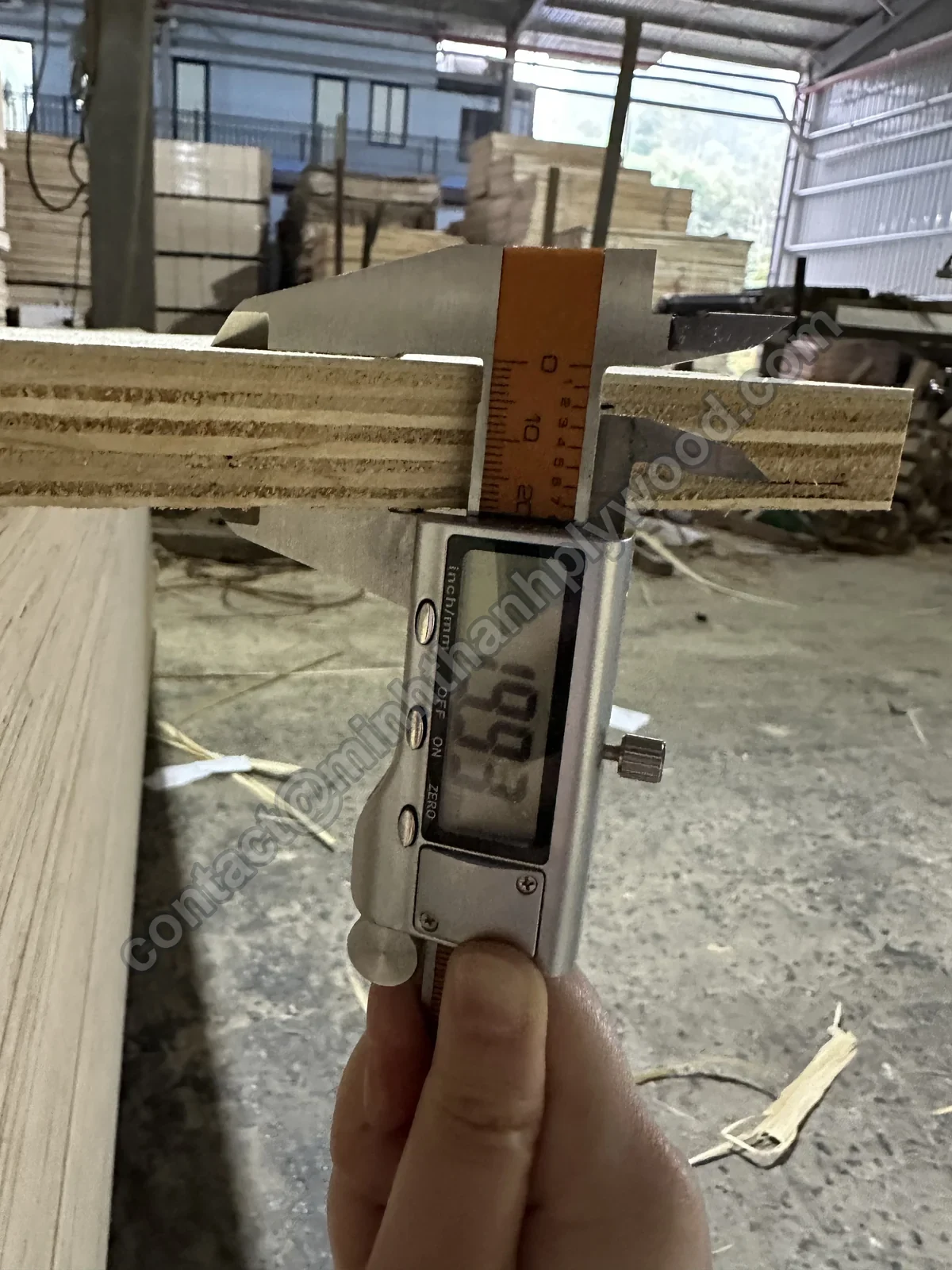
Plywood thickness tolerance is the allowed difference between the nominal thickness on the label and the thickness a caliper reads on the panel. Our furniture line holds ±0.2–0.3 mm; you check it with a digital caliper at five points on panels from several packs.
There are two numbers to agree. Tolerance between panels compares each panel with the nominal thickness. Variation within one panel compares readings at different points of the same sheet; EN 315 allows sanded panels up to 0.6 mm within one panel.
Nominal is the thickness on the label; actual is what the caliper reads. We quote and inspect against nominal plus the tolerance for your line, so an 18 mm furniture panel reads within 17.7–18.3 mm, and the 9 mm panel in checkpoint 05 read 9.15 mm.
Ordering in inches? US 3/4″ panels are sold as 23/32″, about 18 mm; 1/2″ is about 12 mm and 1/4″ about 6 mm. Name the imperial size and we work to the metric equivalent and tolerance.
Thickness variation starts early. Uneven or damp veneer, uneven glue spread and press settings all add to it. Double pressing and calibrated sanding take the panel to its final thickness, which is why sanded furniture panels hold far tighter limits than unsanded lines.
Tighter is not always better value. CNC parts, edge-banding and drawer boxes need ±0.2–0.3 mm. Crates and pallets work well at ±0.5–1.0 mm and cost less. Tell us the end use and we set the tolerance in the quotation.
On arrival, check before you unload. Photograph the container and the pack labels, look for crushed corners or water marks, count the packs against the packing list, then measure panels from several packs the same way we did. Compare your readings with the records we sent before sealing.
How to check plywood thickness tolerance
Use a digital caliper and panels from several packs.
- Pick panels from different packs. Take at least one panel from the top, middle and bottom of several packs.
- Measure at several points. Read the caliper at the four corners and the middle of each long edge, at least 25 mm in from the edge.
- Compare with the agreed line. Check every reading against the tolerance for the product line, not against the nominal thickness alone.
- Check variation within each panel. Subtract the lowest reading from the highest on the same panel.
- Record and share. Photograph the caliper on each reading. We send the same record from our own check before loading.
| Nominal thickness | Plies | Furniture, sanded | Commercial | Packing | EN 315 sanded, max over nominal | EN 315 sanded, max under nominal |
|---|---|---|---|---|---|---|
| 3 mm | 5 | ±0.2–0.3 mm | ±0.5 mm | ±0.5–1.0 mm | 0.29 mm | 0.49 mm |
| 4 mm | 5 | ±0.2–0.3 mm | ±0.5 mm | ±0.5–1.0 mm | 0.32 mm | 0.52 mm |
| 5 mm | 5 | ±0.2–0.3 mm | ±0.5 mm | ±0.5–1.0 mm | 0.35 mm | 0.55 mm |
| 6 mm | 5 | ±0.2–0.3 mm | ±0.5 mm | ±0.5–1.0 mm | 0.38 mm | 0.58 mm |
| 9 mm | By construction | ±0.2–0.3 mm | ±0.5 mm | ±0.5–1.0 mm | 0.47 mm | 0.67 mm |
| 12 mm | By construction | ±0.2–0.3 mm | ±0.5 mm | ±0.5–1.0 mm | 0.56 mm | 0.76 mm |
| 15 mm | By construction | ±0.2–0.3 mm | ±0.5 mm | ±0.5–1.0 mm | 0.65 mm | 0.85 mm |
| 18 mm | 11–13, most often 11 | ±0.2–0.3 mm | ±0.5 mm | ±0.5–1.0 mm | 0.74 mm | 0.94 mm |
| 21 mm | By construction | ±0.2–0.3 mm | ±0.5 mm | ±0.5–1.0 mm | 0.83 mm | 1.03 mm |
| 25 mm | By construction | ±0.2–0.3 mm | ±0.5 mm | ±0.5–1.0 mm | 0.95 mm | 1.15 mm |
| 30 mm | By construction | ±0.2–0.3 mm | ±0.5 mm | ±0.5–1.0 mm | 1.10 mm | 1.30 mm |
| 40 mm | By construction | ±0.2–0.3 mm | ±0.5 mm | ±0.5–1.0 mm | 1.40 mm | 1.60 mm |
Before loading
Plywood inspection: every shipment photographed and filmed.
Every shipment is photographed and filmed before the container is sealed, and the record reaches you by email or WhatsApp. It is the same record we use to release the shipment: readings, faces and edges, packs, and the container during loading.
- Caliper readings on panels from every pack
- Faces and backs of sample panels, plus close-ups of the edges
- Pack count against the packing list, labels, straps, corner guards and pallets
- The container during loading and fully loaded, before sealing
- Your own inspector or a third-party agency is welcome before loading
Have your own checklist? Send it with the order and we work to it.
Documents with every order
Inspection records and shipping documents you receive.
You receive the QC photo and video record before the container is sealed, then draft shipping documents for approval after loading. Every document carries the same order details as the packing labels, so each record ties back to your container.
QC photo and video record
Caliper readings, faces and edges of sample panels, packs and the loaded container, sent before the container is sealed.
Commercial invoice and packing list
Pack-by-pack sheet count, thickness, size and volume, matched to the packing labels.
Bill of lading
Scanned B/L released after loading; the 70% balance is due against the scan.
Certificate of origin
C/O for your market, with EUR.1 for shipments to the European Union.
Phytosanitary and fumigation
Plant health certificate and fumigation certificate where the destination requires them.
Compliance files for your market
CARB P2 / TSCA Title VI, E0 test reports, the SGS packaging test, and the EUDR compliance dossier (origin records and geolocation files).
Insurance certificate on CIF shipments. Need a specific document? Name it in your enquiry.
Capacity
High-grade furniture plywood at 50,000+ m³ a year.
Minh Thanh makes 50,000+ m³ of plywood a year, and the same eight checkpoints run on every container, from the first order to the repeat ones. Cores come from plantations around Ha Hoa, and our team has made plywood for over 20 years.
About the factoryBefore you order
Specify a QC-ready plywood order in six lines.
Six lines in your specification give our plywood quality control and your inspector the same numbers to check against. Most quality disputes start where one of these lines was left vague.
- 01
End use
Furniture, cabinets, packing, formwork or flooring; indoor or outdoor.
- 02
Core and joining
Styrax or Eucalyptus core; stitched or not, and how many layers.
- 03
Glue and emission
E0 or E1, CARB P2 / TSCA if needed, and any boil-test requirement.
- 04
Faces
Face and back species, grade by approved sample, sanded or polished, UV-ready.
- 05
Panel
Thickness, size, thickness tolerance by line, cut-to-size if needed.
- 06
Packing and inspection
Pack type, labels, quantity, port, documents, and your own inspection points.
Questions buyers ask
Plywood quality control FAQ.
Direct answers to the questions buyers ask most about plywood quality control, inspection and thickness tolerance.
What thickness tolerance do you hold?
Sanded furniture and interior panels are held to ±0.2–0.3 mm, down to ±0.2 mm. Commercial and film-faced plywood is ±0.5 mm and packing plywood ±0.5–1.0 mm. Length and width are ±2 mm. The tolerance for your panels is written into the quotation.
How can I check plywood thickness tolerance myself?
Measure several points on each sheet, at the edges and corners, on panels from different packs. Compare every reading with the tolerance agreed for your product line, not with the nominal thickness alone. A 9 mm panel reading 9.15 mm is inside ±0.2 mm.
What should I write into my order?
Nominal thickness, tolerance by product line, face species and grade, core, glue type and emission class. We repeat these in the quotation so both sides check against the same numbers.
How do you keep panels dry and flat?
Veneer is dried and checked with a moisture meter before lay-up, and panels are built with balanced cross-banded construction. Finished packs are wrapped, covered with cardboard and strapped on pallets, so they arrive flat.
Do I need ±0.2 mm for every use?
No. CNC parts, edge-banding and furniture assembly benefit from ±0.2–0.3 mm. Packing and general construction work well at ±0.5–1.0 mm, and the looser line costs less. Tell us the end use and we suggest the tolerance.
What do I receive before the container is loaded?
Photos and video by email or WhatsApp: caliper readings, faces and edges of sample panels, the packs with labels and straps, and the container during and after loading.
Can my inspector or a third-party agency check the goods?
Yes. Your own inspector or an agency you appoint is welcome at the factory before loading. Tell us the date when you confirm the order and we plan the loading around it.
How do you control face quality?
Face veneer is matched to the sample you approve, and every face is graded against it for colour, grain, knots and repairs. For birch we use factory face grades D+, D and E, fixed by the approved sample.
Does a 72-hour boil test prove marine plywood?
No. Boiling tests the glue bond on samples, not emission. The 72-hour boil is a traditional test (IS 710, BS WBP); on its own it does not prove marine grade or an exterior bond class. Our E0 glue holds a boil of about 6 hours and melamine-fortified glue about 12 hours.
How do I know the core is what I ordered?
Look at the panel edges: the core species, ply count and joints show on every cut edge. We build every container to the approved sample, not only the first order, and the edge photos are part of the shipment record.
How often is formaldehyde emission tested?
E0 emission is tested by a third-party lab every 3 months. Six chamber tests (ASTM D6007, ICTT) between April 2025 and June 2026 on 9, 15 and 18 mm panels averaged 0.014–0.032 ppm, against the CARB Phase 2 limit of 0.05 ppm.
What happens to panels that fail a check?
They do not go into your order. Panels with a repairable face defect are filled and re-sanded; panels outside tolerance are moved to a lower-grade line, so your container carries only panels that meet the agreed specification.
Is your quality system certified?
Yes. We hold ISO 9001:2015 for plywood manufacturing (KAC25/0185), CARB P2 / TSCA Title VI certification (ICTT mill no. 23024) and TCVN 11902:2017 certification for veneer-faced plywood.
Why do two quotes for the same plywood differ?
The two offers are not the same construction. The difference comes from core grade, joining method, face preparation, adhesive system and tolerance. Compare those five points, not only the product name.
Can you supply other test reports?
Yes. Bending strength and stiffness, bond quality and emission to the buyer's method are tested through SGS on request. Name the tests and the standard in your enquiry and the reports go with the order.
Get a quotation
Send your specification and the checks you need.
Tell us the end use, face, core, glue, thickness, size and quantity, plus the tolerance your line needs and any inspection points. Lisa replies within hours by email or WhatsApp. Free samples.
[email protected]