
A
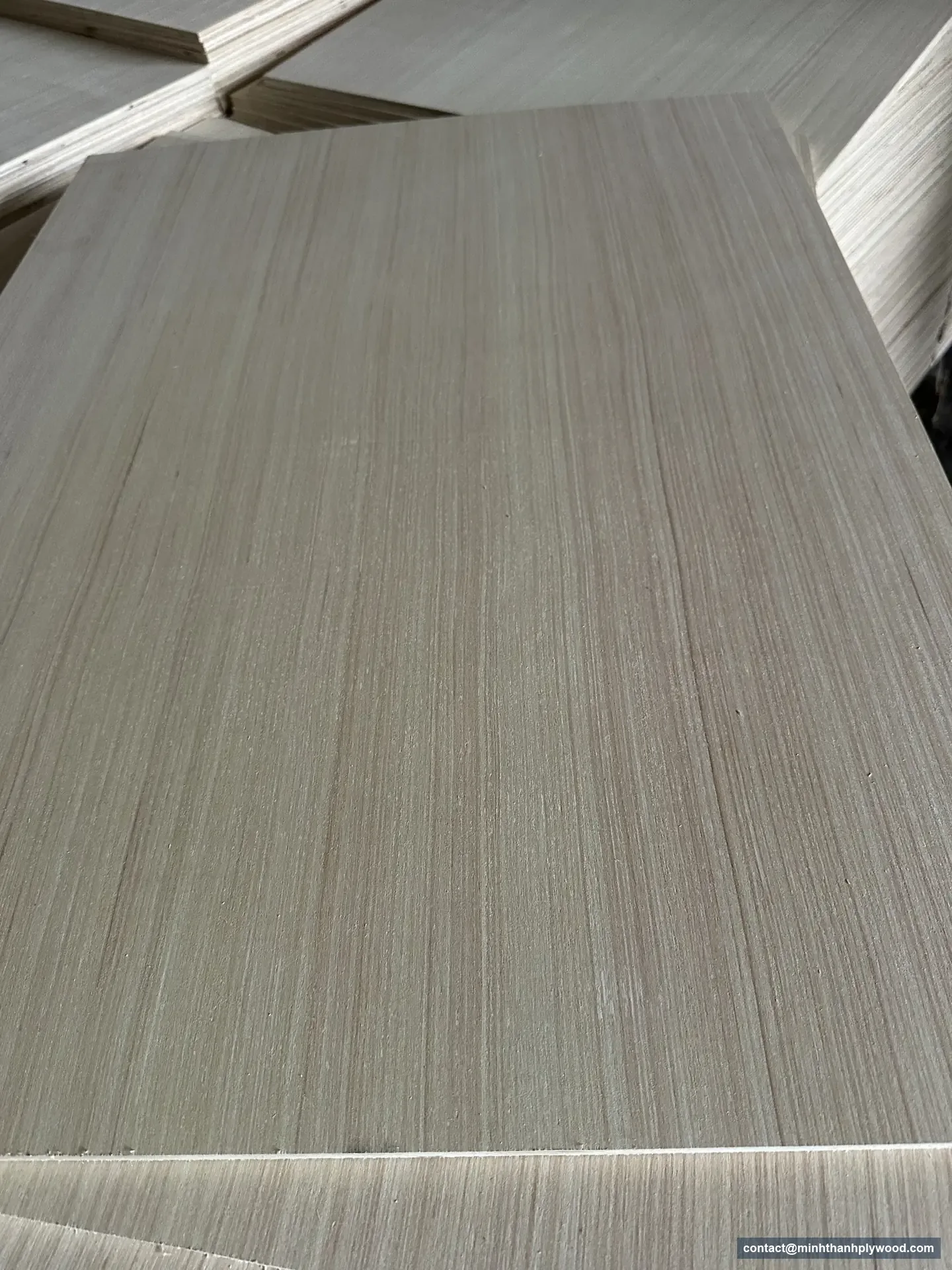
Cleanest face: even tone and straight, regular grain lines across the sheet, no visible joints or marks, ready for clear lacquer.
Application brief
Doors, cabinet fronts, wall panelling and shop fittings seen up close.
Engineered veneer plywood · Ha Hoa, Phu Tho, Vietnam
In short
EV plywood from Vietnam is a panel with an engineered veneer face: plantation wood that is peeled, dyed, glued into a block and re-sliced, so colour and grain match from sheet to sheet. Minh Thanh Plywood presses it on white Styrax or Eucalyptus cores, stitched both ways, sanded to ±0.2 mm, with UF glue at E0 emission as standard. Thickness 3–40 mm.
Minh Thanh Plywood presses EV faces on its own lines in Ha Hoa, Phu Tho, with 50,000+ m³ of annual capacity and over 20 years of plywood making. EV is among the faces we press most, and the factory is built for top-grade furniture and interior plywood with Europe as its main market. Buyers also search for it as recon veneer, recomposed veneer, compensato EV or contreplaqué EV.
Watch first
This film walks through the whole page: what engineered veneer is and how it is made, how it differs from natural veneer, the patterns and cores, grades, glue and emission tests, handling, packing and how to order.
Real sheets
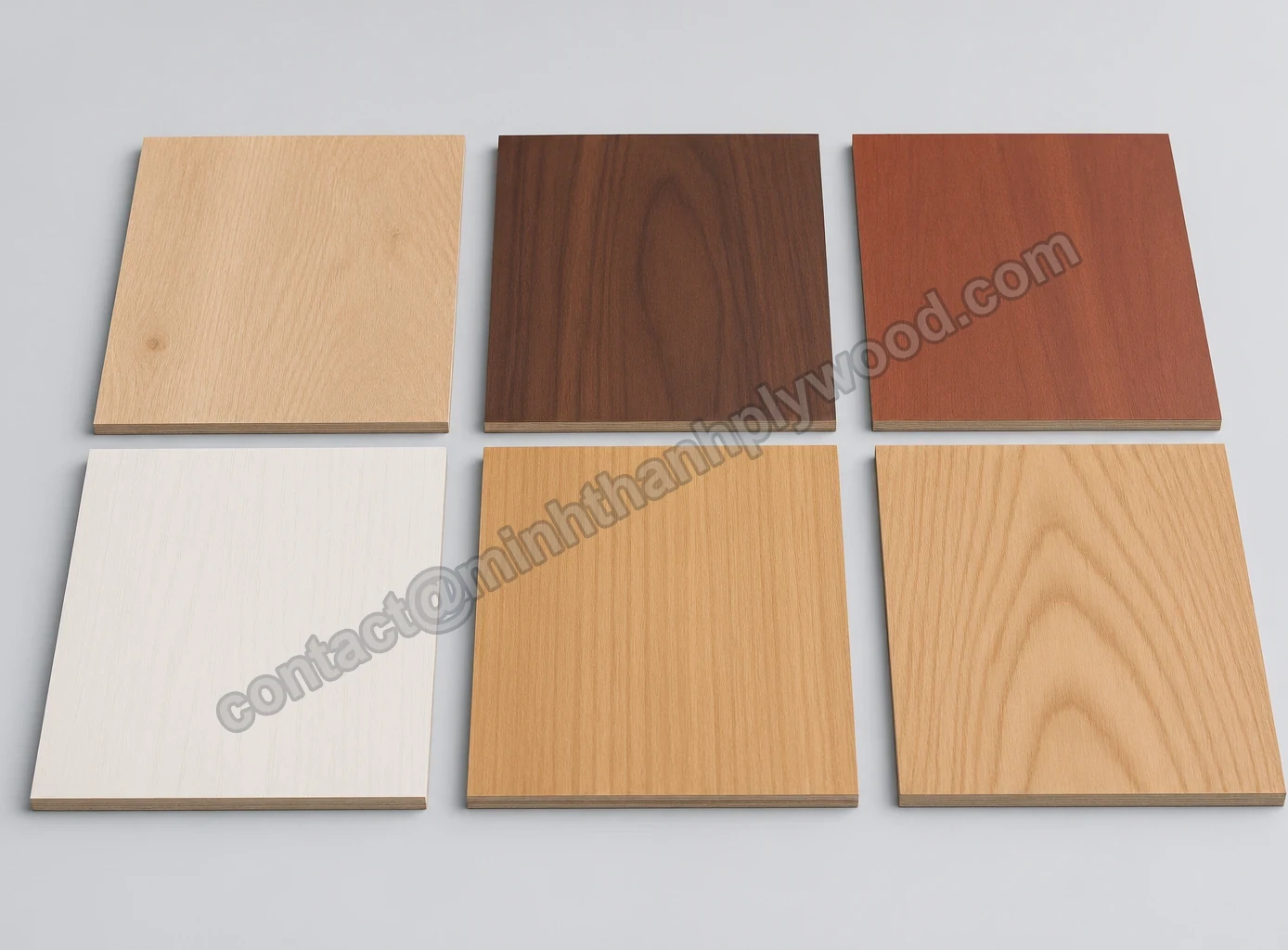
EV faces come in straight grain, crown and oak-look patterns, in pale, walnut, red and white colours, and you choose one from a sample sheet before production. These are photos and a clip of full production sheets, the same proof we send before a container is closed.
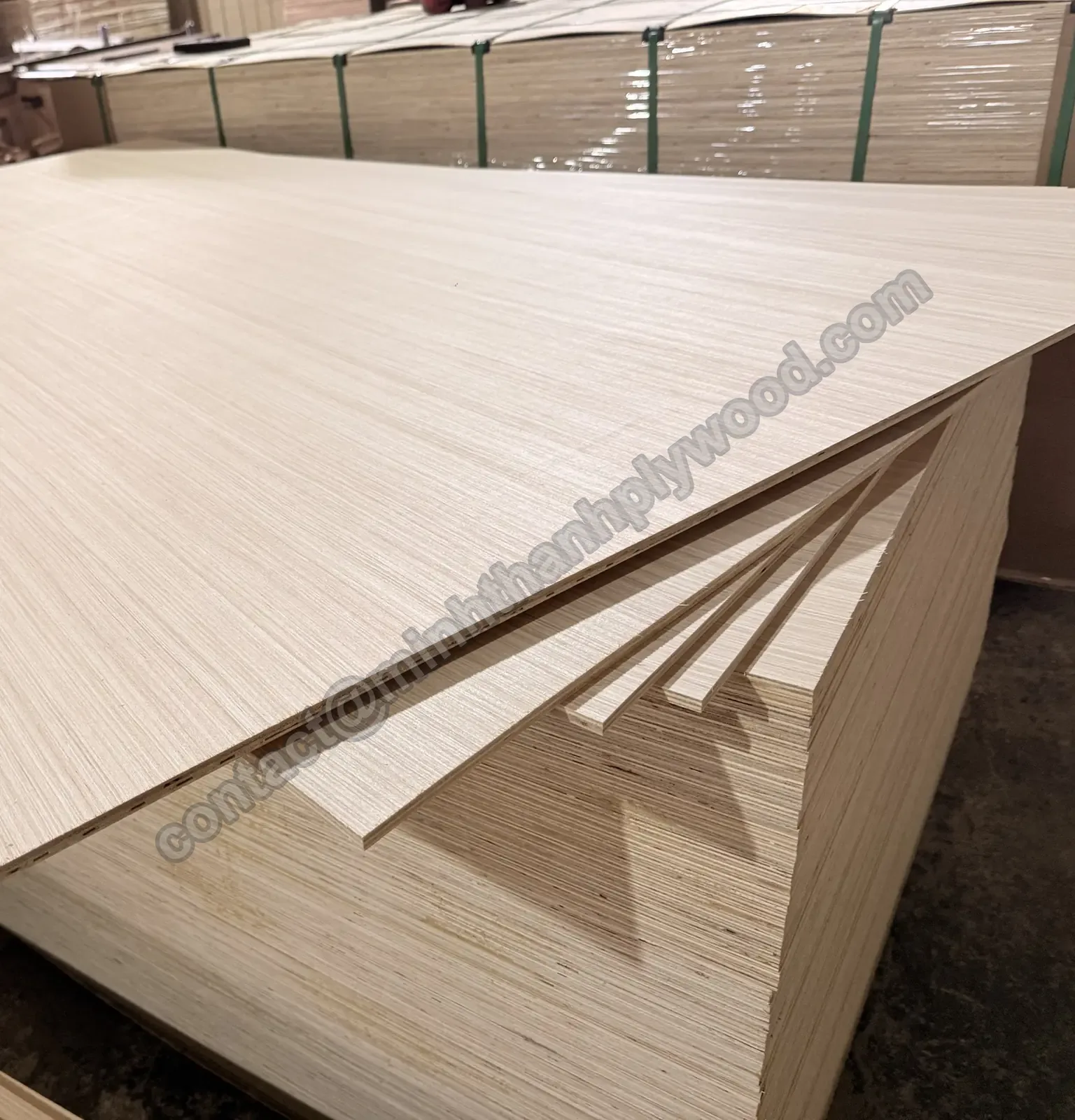
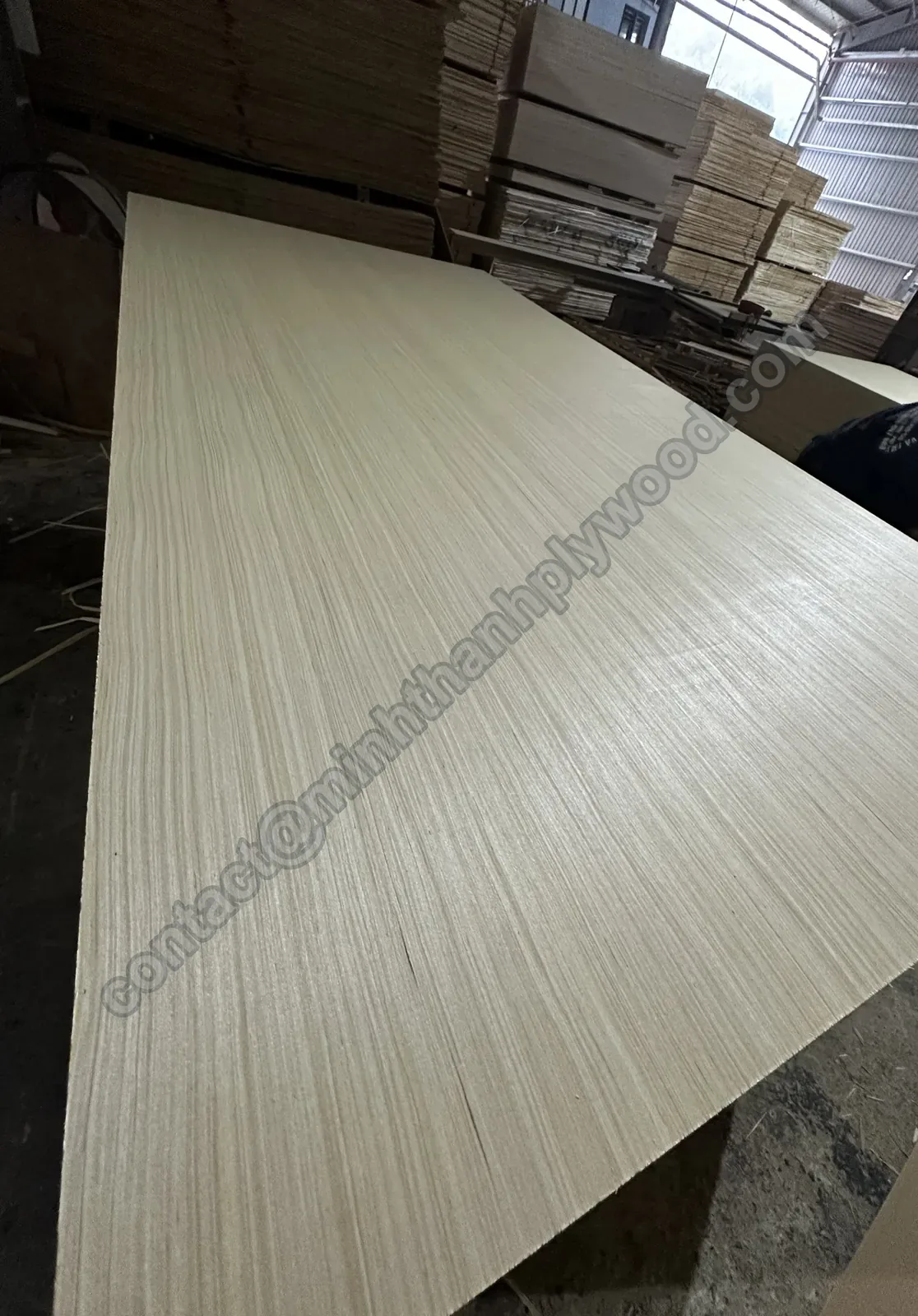
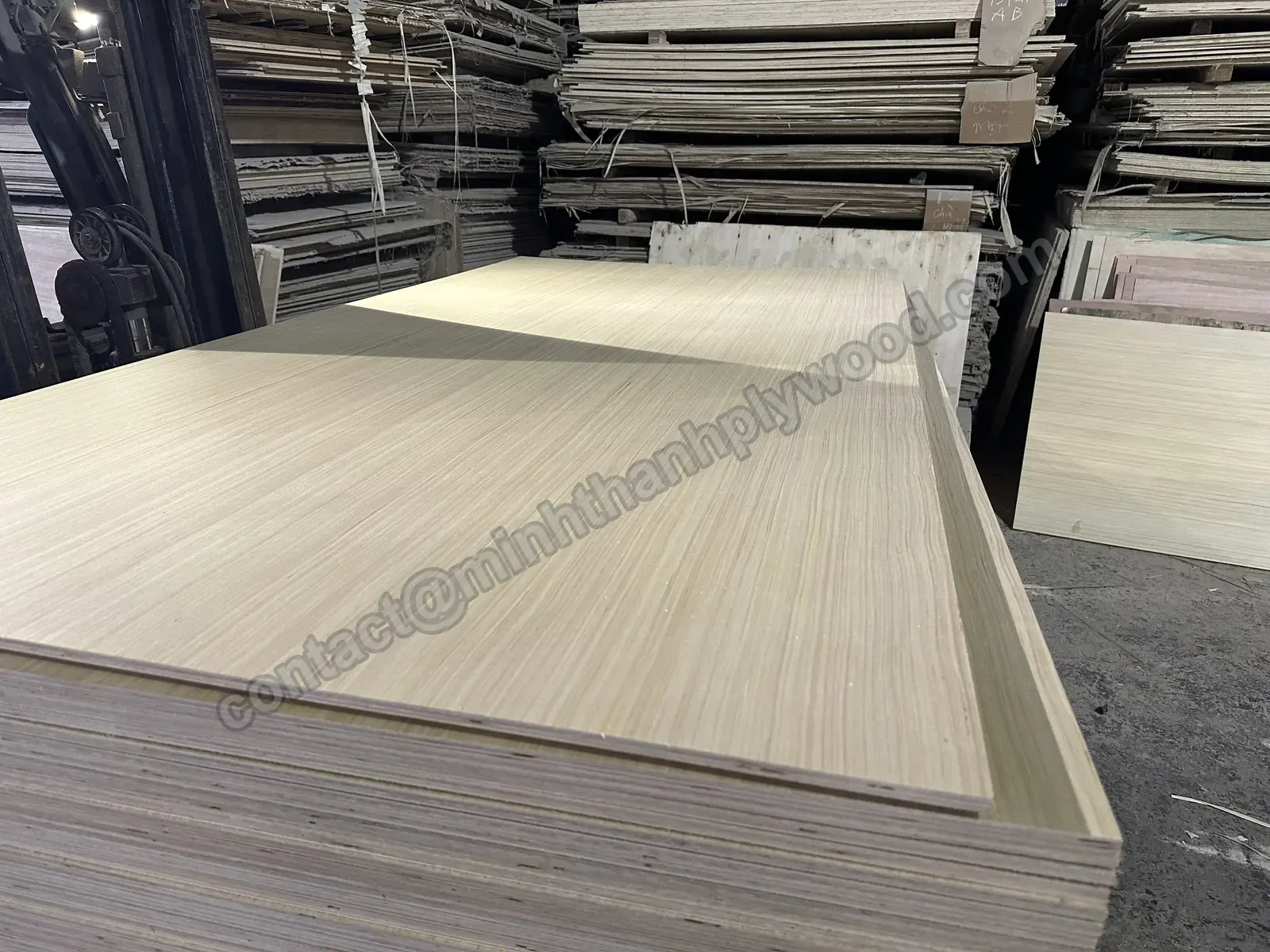
Straight grain gives fine parallel lines that read as a calm, modern surface on doors and cabinet fronts. Crown (cathedral) EV copies the arched figure of flat-sawn timber for a warmer, more traditional look. Colour is set when the veneer is dyed. A light oak look, a walnut look, a white or a red EV is a choice made at the veneer stage, and it holds across the whole order.
Pick the pattern from a physical sample. A screen shows colour differently on every monitor, and the approved sample sheet becomes the reference every production sheet is checked against. Free samples are available in your thickness and core.
Specification
Our EV plywood is an engineered veneer face and back over a stitched Styrax or Eucalyptus core, 3–40 mm thick. UF glue at E0 emission is standard, and the sanded, polished surface is held to ±0.2 mm. Each line below is a field on the quotation and can be changed on your order.
| Face veneer | Engineered (EV, recon) veneer, 0.2–0.5 mm before pressing; 0.3 mm is the usual European furniture choice |
|---|---|
| Pattern and colour | Straight grain, crown and oak-look patterns in pale, walnut, red and white colours, matched to your approved sample |
| Back veneer | EV, same grade as the face or one grade lower for hidden backs (A/A, A/B, B/B) |
| Core | White Styrax or Eucalyptus plantation timber, grade A core veneers |
| Core joining | Stitched horizontally and vertically; outer plies stitched as standard, all plies on request |
| Plies | 3–6 mm: always 5 plies; 18 mm: 11–13 plies, most often 11; other thicknesses stated on the proforma |
| Panel density | Styrax core about 500 kg/m³; Eucalyptus core 650–750 kg/m³ |
| Pressing | Pressed twice: core board pressed and calibrated first, then face and back pressed on |
| Glue | UF glue at E0 emission as standard for furniture and interior panels; E1, MR/melamine-fortified and phenolic (WBP) made to your specification |
| Emission | E0, chamber-tested to ASTM D6007 every 3 months, below the CARB Phase 2 limit; meets the requirements European and US furniture buyers ask for |
| Thickness | 3–40 mm |
| Thickness tolerance | Down to ±0.2 mm on sanded furniture panels |
| Length and width tolerance | ±2 mm |
| Sheet sizes | 1220 × 2440 mm and 1250 × 2500 mm; custom 1220 × 2500 mm, 1220 × 2280 mm |
| Cut to size | One panel cut into 4, 6 or 8 pieces |
| Surface | Both faces sanded and polished, UV-ready for your own UV, lacquer, paint or laminate line |
| Moisture | 8–12 % at dispatch; veneers kiln-dried before lay-up |
| Certificates | CARB P2 / TSCA Title VI (ICTT mill no. 23024), ISO 9001:2015, TCVN 11902:2017; FSC and CE available* |
The EV face is only 0.2–0.5 mm thick, so the core, not the face, sets the weight, the strength and the screw-holding of the panel. Two EV panels of the same pattern behave very differently on Styrax and on Eucalyptus; the face looks identical on both.
Both faces leave our line sanded and polished and UV-ready, so a furniture plant can run its own UV, lacquer, paint or laminate line straight from the pack. The surface is flat enough to take a thin coating without showing the core.
*Supplied directly or through qualified partner mills.
Face grades
EV faces are graded A and B, and face and back are quoted as a pair: A/A, A/B or B/B. Grade A is the cleanest, most even face; grade B allows a slight tone change and the occasional small mark. Both grades are sanded, polished and uniform in pattern from sheet to sheet.
A
Cleanest face: even tone and straight, regular grain lines across the sheet, no visible joints or marks, ready for clear lacquer.
Application brief
Doors, cabinet fronts, wall panelling and shop fittings seen up close.
B
Even pattern with a slight tone change and the occasional small mark; surface sound and sanded.
Application brief
Cabinet carcasses, shelving, drawer parts, and faces under paint, foil or laminate.
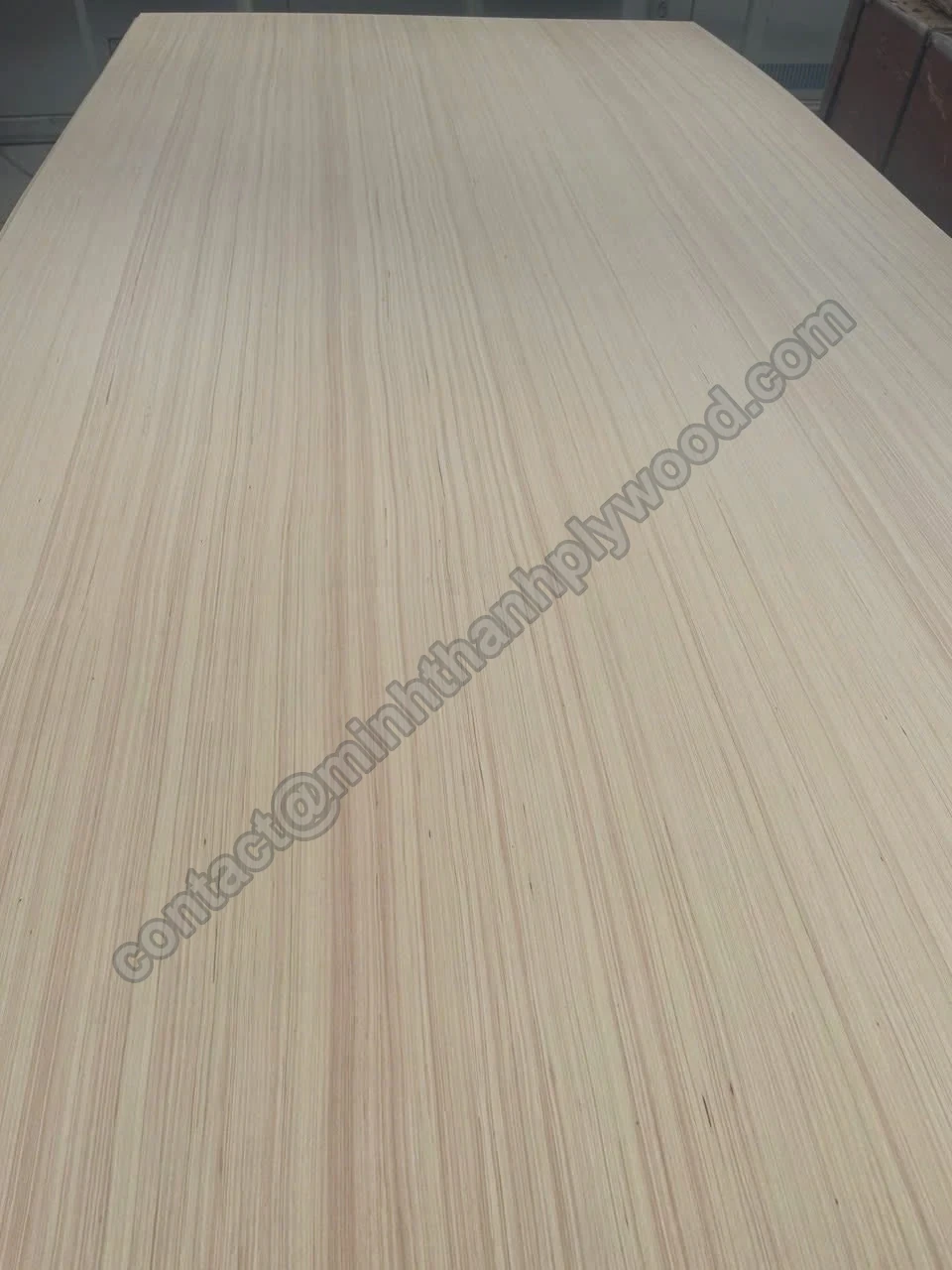
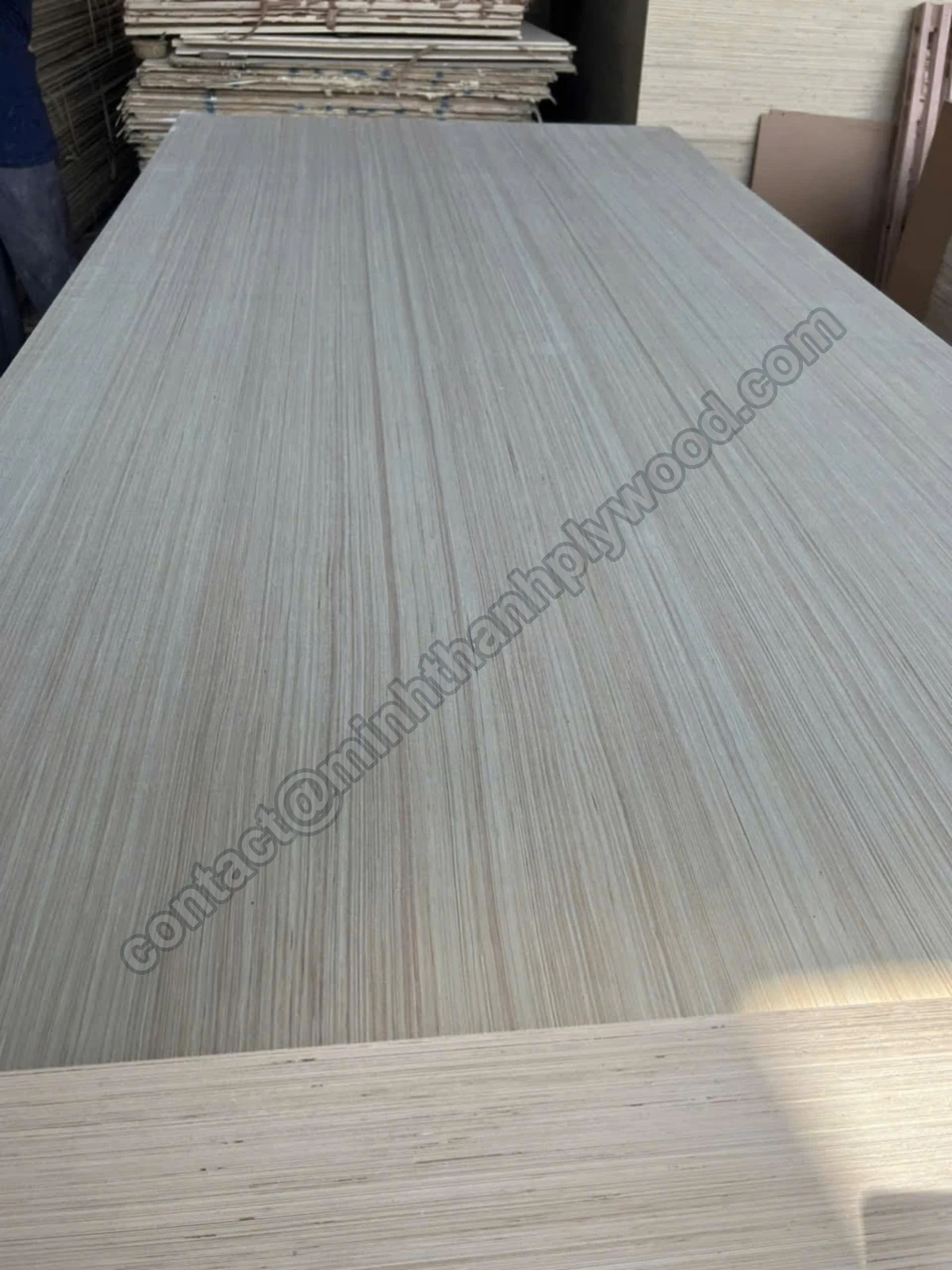
Because engineered veneer is made, not cut from one tree, the grade says little about knots; it says how clean and how even the face is. Grade A is chosen for visible fronts, doors and wall panels seen up close. Grade B suits carcass sides, shelves and any part under a pigmented or foil finish.
Order the pair, approve a sample, and every production sheet is graded against that sample, face and back separately. A hidden back graded one step below the face saves cost on every sheet, so A/B is the usual pair for cabinets and B/B for internal parts.
Core and construction
Pick white Styrax for a light EV panel with a pale edge and the most sheets in a container; pick Eucalyptus when your drawing asks for weight and density. A Styrax-core EV sheet sits near 500 kg/m³, a Eucalyptus-core one at 650–750 kg/m³. Many European furniture buyers choose Styrax.
| White Styrax core | Eucalyptus core | |
|---|---|---|
| Density | About 500 kg/m³ | 650–750 kg/m³ |
| 18 mm sheet, 1220 × 2440 mm | About 26.8 kg | About 34.8–40.2 kg |
| 12 mm sheet, 1220 × 2440 mm | About 17.9 kg | About 23.2–26.8 kg |
| 9 mm sheet, 1220 × 2440 mm | About 13.4 kg | About 17.4–20.1 kg |
| Edge look | Pale, even layers under the EV face | Pinkish-brown layers, darker than the face |
| Container load | Up to 18 bundles, 53–54 m³ per 40HC | Up to 15 bundles, about 43 m³ by volume |
| Best for | Furniture, flat-pack, CNC parts, loads where freight per sheet counts | Heavier furniture parts and buyers who specify a minimum panel density |
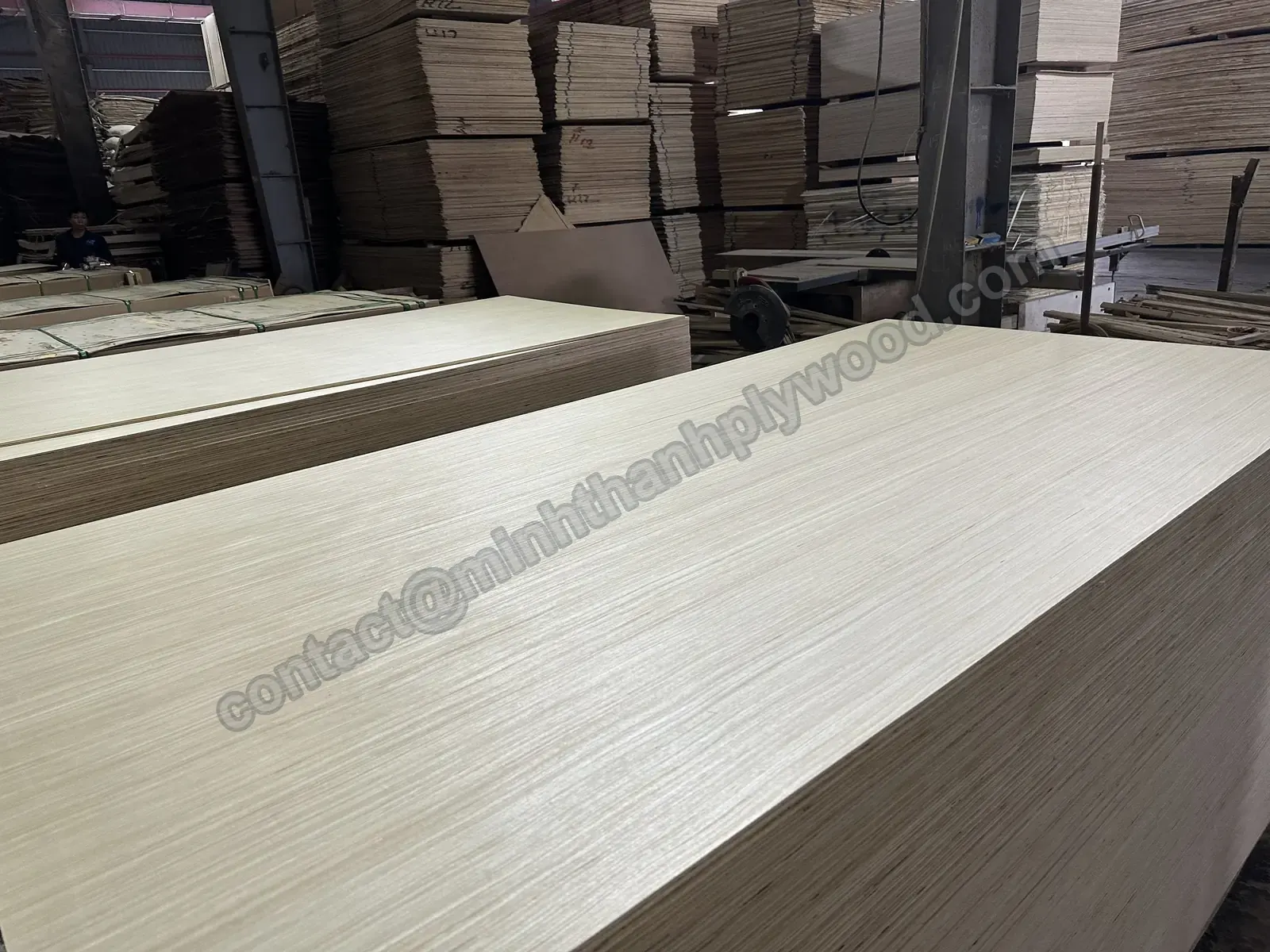
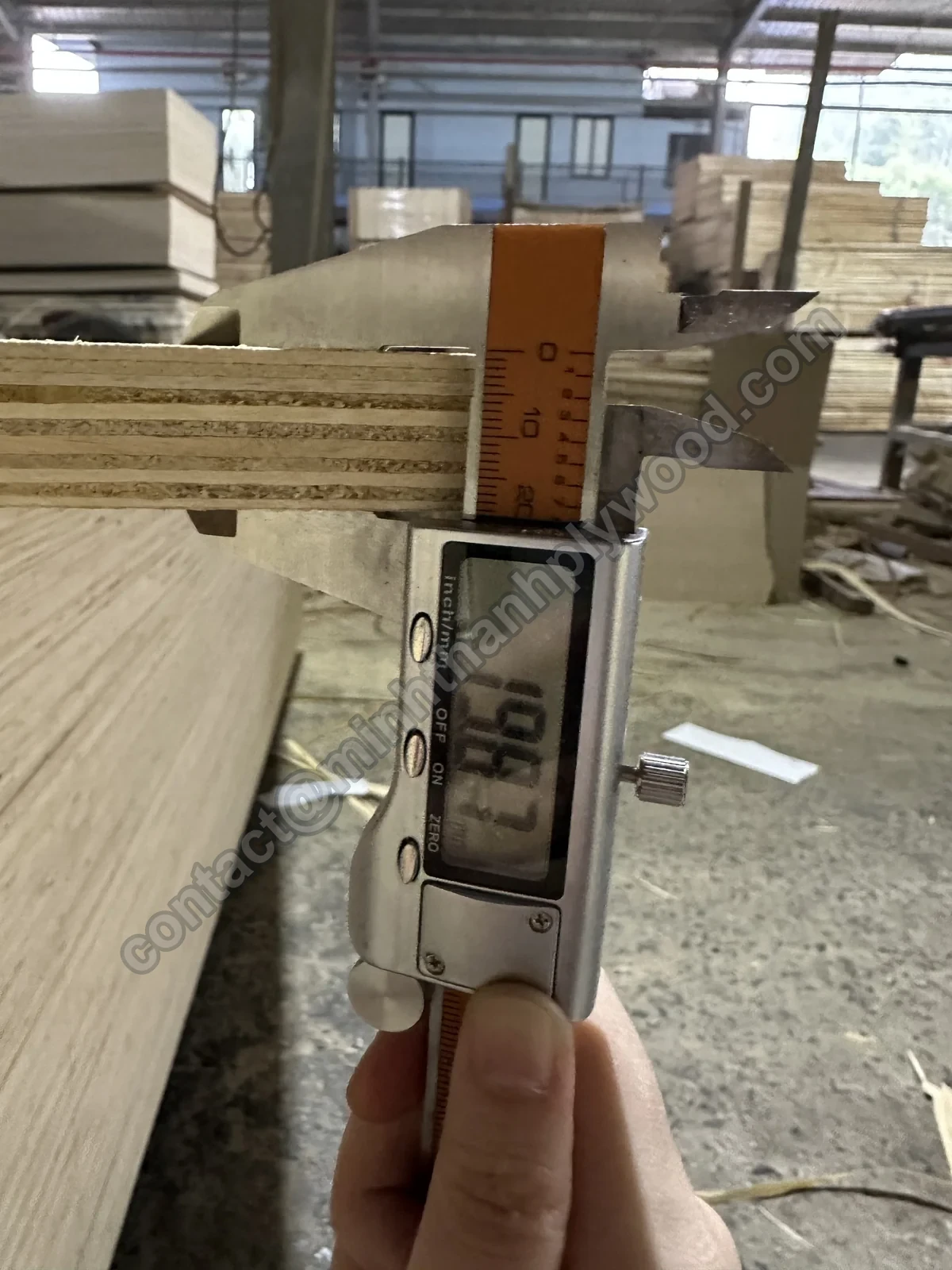
Two EV quotations with the same face can hide two very different panels, and the difference sits under the 0.3 mm veneer. Our cores are built from grade A veneers, stitched in both directions so no gap opens when the press closes. Stitching on the outer plies comes as standard, and a fully stitched core is made for CNC parts and edges left on show.
Thickness decides the ply count. From 3 to 6 mm an EV panel always has five plies. At 3 mm that means one core veneer, two cross-bands and the two faces; at 4, 5 and 6 mm it is three core veneers plus the faces. At 18 mm expect 11–13 plies, and 11 is what most orders get. On 9 mm and thicker panels each core veneer is usually 1.4–2.0 mm before pressing; 3–6 mm panels use thinner core veneers sized to fit five plies.
A 0.3 mm face is thin, so any step in the core shows through it. That is why our furniture-grade panels are pressed twice as standard. The first pressing turns peeled, dried and cross-laid plantation veneers into a core board. Sanding then calibrates that board, the EV face and back go on, and a second pressing bonds them at roughly 110–120 °C with MR glue or 130–145 °C with phenolic WBP.
Under the EV face, the first core ply runs across the grain of the face, as in every plywood. The core board is already flat and calibrated. The straight lines of the face stay straight and do not pick up the texture of the plies below, even under a gloss UV coat.
Weights per sheet: core density multiplied by the sheet volume.
Related: Thin panels of 3–6 mm, choose Eucalyptus.
Glue and emission
The EV face does not keep water out; the glue line does. For furniture, cabinets and other dry rooms we use our standard UF glue at E0 emission. Kitchens and bathrooms get melamine-fortified MR glue, and outdoor parts phenolic WBP glue, with the panel edges sealed after cutting.
| Glue | Use it for | Emission |
|---|---|---|
| UF (standard), at E0 emission | Furniture, cabinets, wardrobes, wall panels, dry interiors | E0; ASTM D6007 chamber tests 0.014–0.032 ppm, April 2025 – June 2026 |
| E1 | Interior furniture where E1 is the specified class | E1 |
| MR / melamine-fortified | Kitchens, bathrooms, humid interiors, 12-hour boil specifications | Made to the emission class you specify |
| Phenolic WBP | Exterior exposure, vehicle and outdoor parts with sealed edges | Made to the emission class you specify |
On an EV order, glue and formaldehyde class are written as two lines. One tells us how the bond must survive moisture, the other how much formaldehyde the finished panel may release. A typical pair reads "glue: UF interior, emission: CARB P2"; a kitchen order might read "glue: MR" with the emission class your market requires.
On the sample, our standard interior bond survives about six hours of boiling. Ask for melamine-fortified glue when your specification calls for 12 hours, and for phenolic WBP when the panel will live outdoors. Boiling tests the bond only; whichever water-resistant glue you choose is still made to the emission class you name.
The emission numbers quoted here are chamber results, not glue data sheets. Between April 2025 and June 2026 Shanghai Hongjun and ICTT Vietnam tested our 9, 15 and 18 mm panels six times to ASTM D6007, with averages of 0.014–0.032 ppm. Veneer-core hardwood plywood may release up to 0.05 ppm under CARB Phase 2 and TSCA Title VI. E0 testing repeats every 3 months. The CARB composite wood products programme and the EPA TSCA Title VI rule set the limit and accept this test method.
EV panels for European furniture lines are pressed to the emission rules those buyers work under, including REACH entry 77, which covers furniture and wood-based articles from 6 August 2026. Our CARB P2 / TSCA Title VI certificate and the chamber reports are the proof importers in Europe take. If your customer wants a figure measured by a European method such as EN 717-1, SGS runs that test on our panels on request.
Drawings that name a service class get the matching glue: EN 636-1 dry interior, EN 636-2 humid interior, EN 636-3 exterior.
Related: how much formaldehyde the panel gives off, CARB Phase 2 and TSCA Title VI limit, hardwood plywood with a veneer core.
Sizes and cutting
Most EV plywood leaves the mill as 1250 × 2500 mm sheets for European lines or 1220 × 2440 mm for buyers who work in feet, in any thickness from 3 to 40 mm. Custom formats such as 1220 × 2500 mm and 1220 × 2280 mm are pressed to order, and a panel can be cut into 4, 6 or 8 pieces for your line.
| Standard sheets | Both standard formats in any thickness from 3 to 40 mm |
|---|---|
| Custom formats | Pressed to your size up to the European format |
| Tolerance by dimension | Thickness down to ±0.2 mm on sanded furniture panels; length and width ±2 mm |
| Cut to size | One panel cut into 4, 6 or 8 pieces, packed by part, with the pattern, grade and tolerance of the full sheet |
Italian and other European furniture plants take regular cut-to-size EV loads from us. We press and sand the full sheet first and cut afterwards, so each piece keeps the sheet's pattern, grade and tolerance, and the parts are packed and labelled by part number.
Pick thickness by the part. 3–6 mm covers drawer bottoms, cabinet backs and bending parts. 9–12 mm suits drawer sides and light shelving. 15–18 mm is the carcass and door thickness for most furniture. 21–25 mm and above takes worktops, heavy shelves and fixtures. For a matched run, cut every part from sheets of one production lot so the pattern direction follows the same line on each door.
Related: cut one panel into 4, 6 or 8 pieces.
Applications
EV plywood is used where many parts must match: kitchen and wardrobe runs, wall panelling, interior doors, sideboards and retail fit-out. The face looks the same on every sheet, so a hundred doors from one order read as one set.
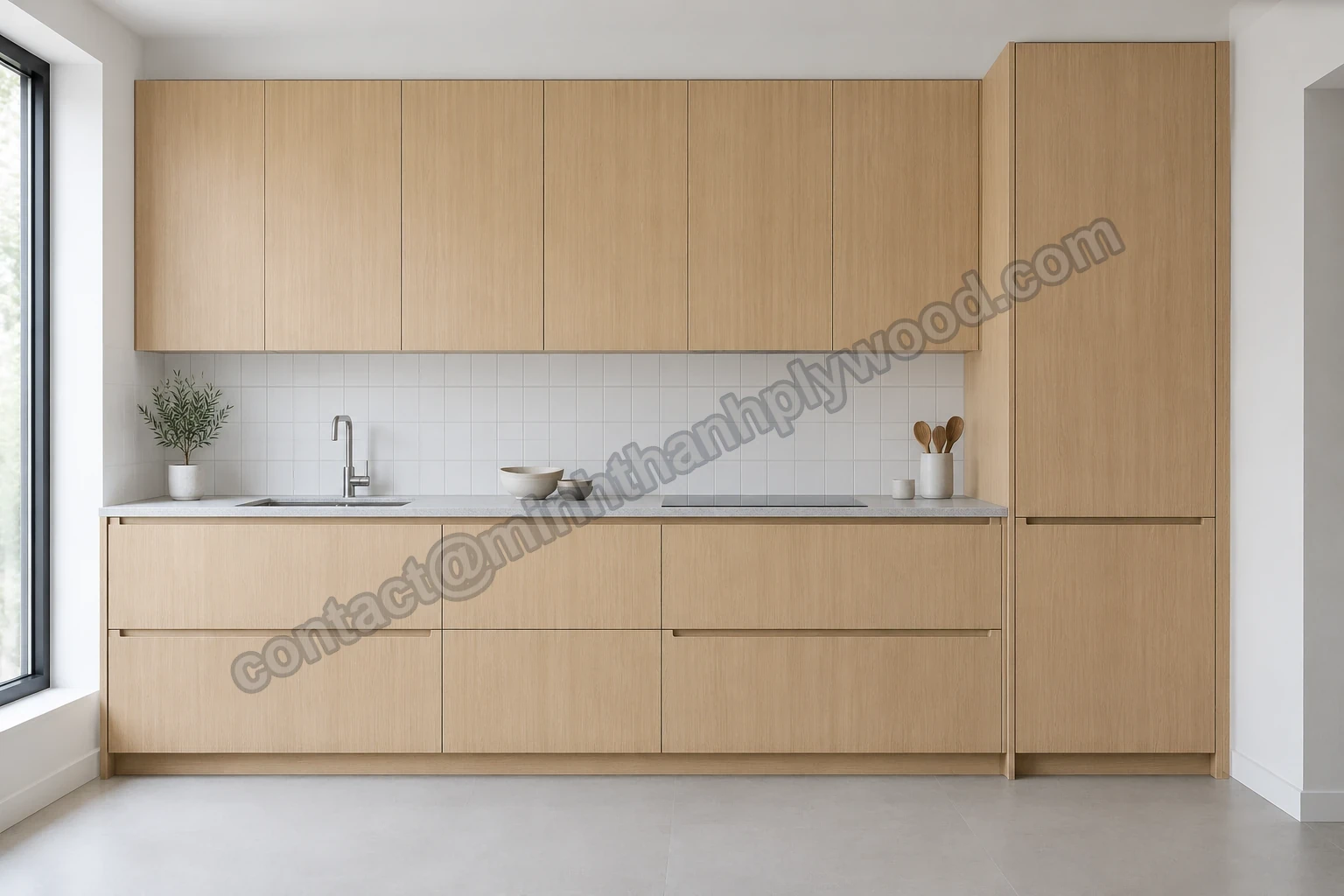
EV plywood suits cabinet runs that must match door to door. Use 15–18 mm for carcasses and doors, grade A faces on visible fronts, grade B inside, and melamine-fortified glue in kitchens. The ±0.2 mm tolerance keeps hinge and runner holes in line.
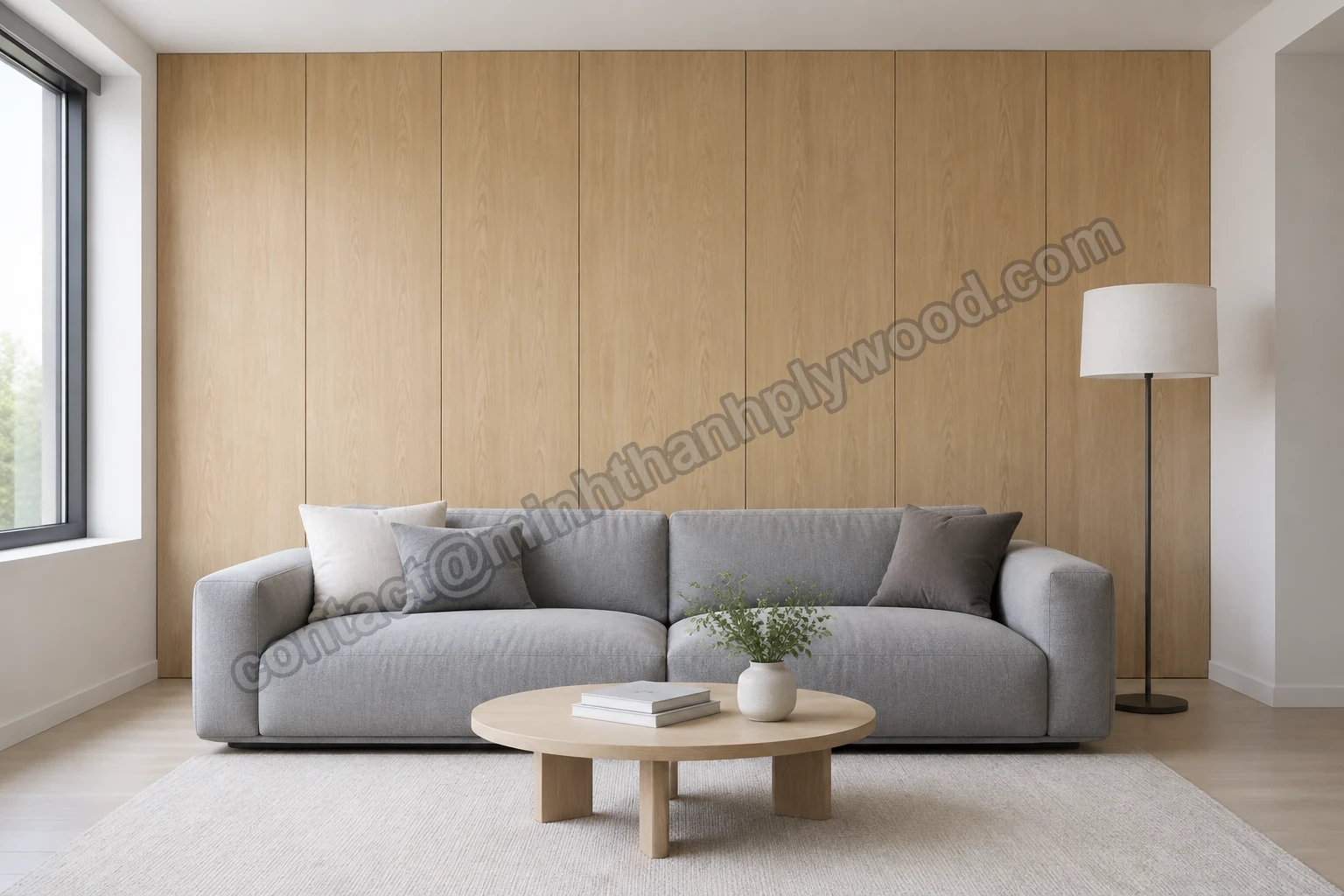
Large wall areas show every colour shift. EV plywood gives one tone and one grain direction across the whole wall, so panels placed side by side read as a single surface. 9–12 mm sheets on battens or 15 mm sheets fixed to the wall are typical.
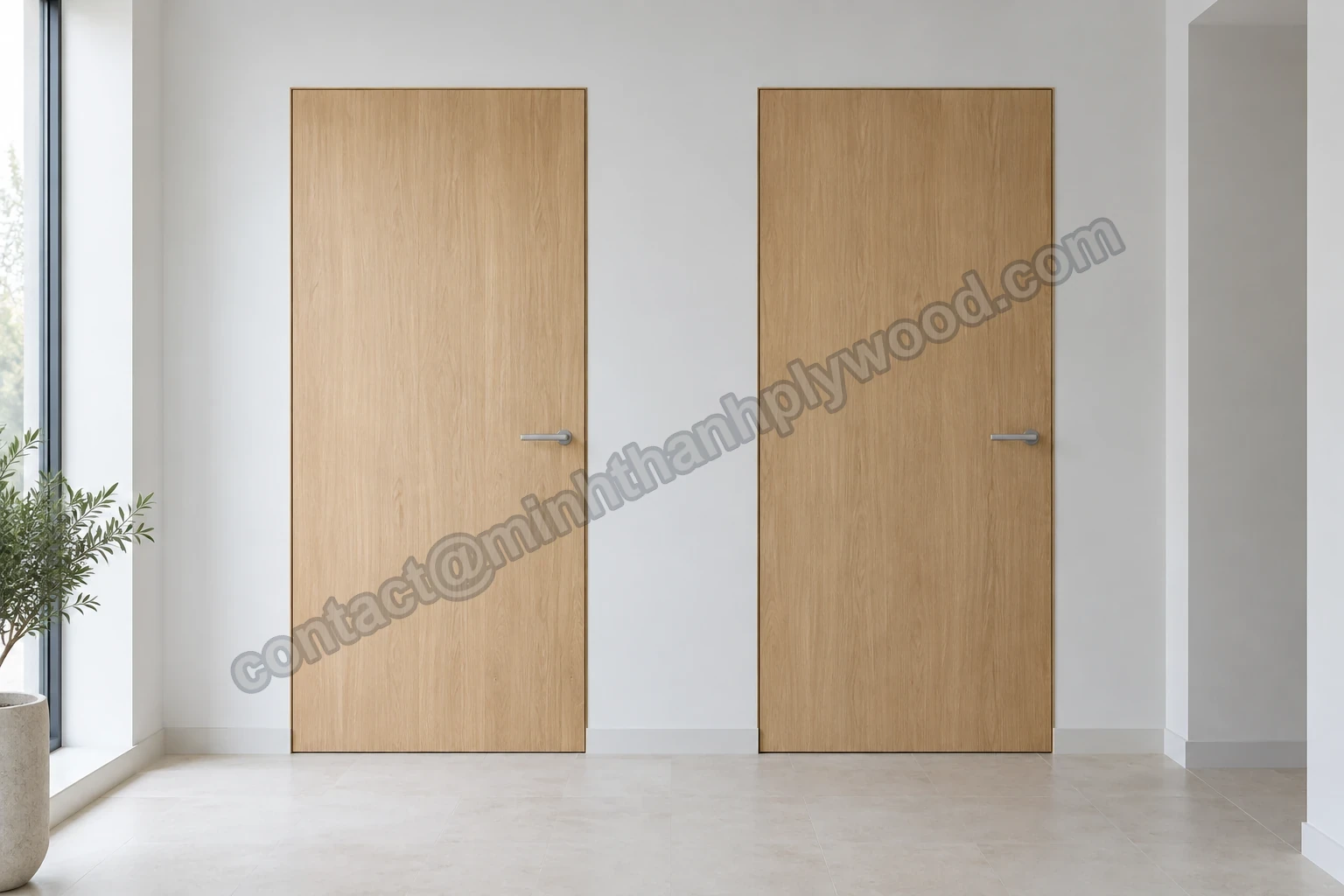
A pair of doors, or a hall of them, must look the same. EV faces are pressed to one approved sample, 18–40 mm thick over a Styrax or Eucalyptus core, and arrive sanded and UV-ready for the buyer's own door line.
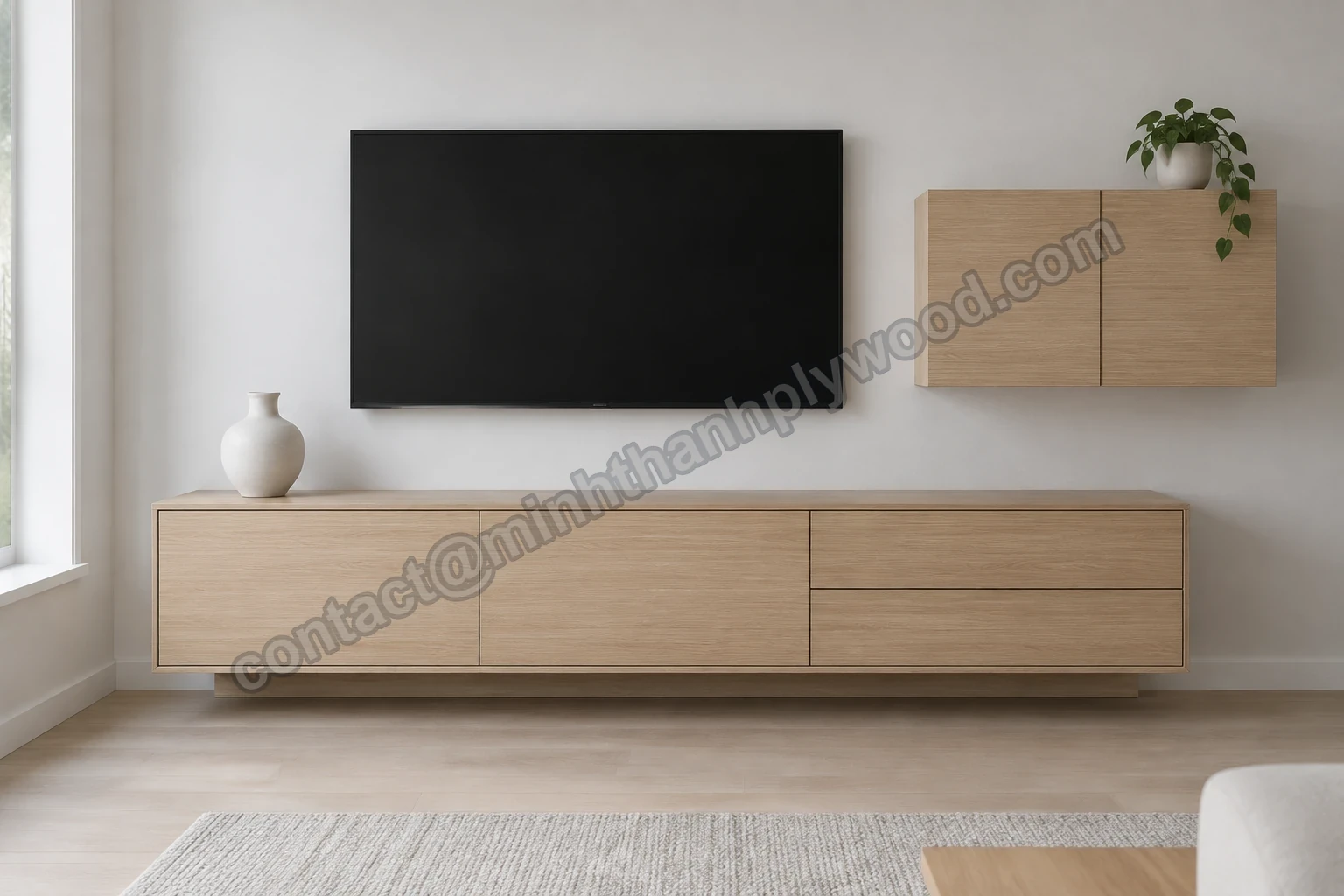
Furniture sets are sold by the matching look. EV panels cut from the same lot give a sideboard, a TV unit and a shelf wall the same tone, with a pale Styrax edge that takes edge banding in the face colour.
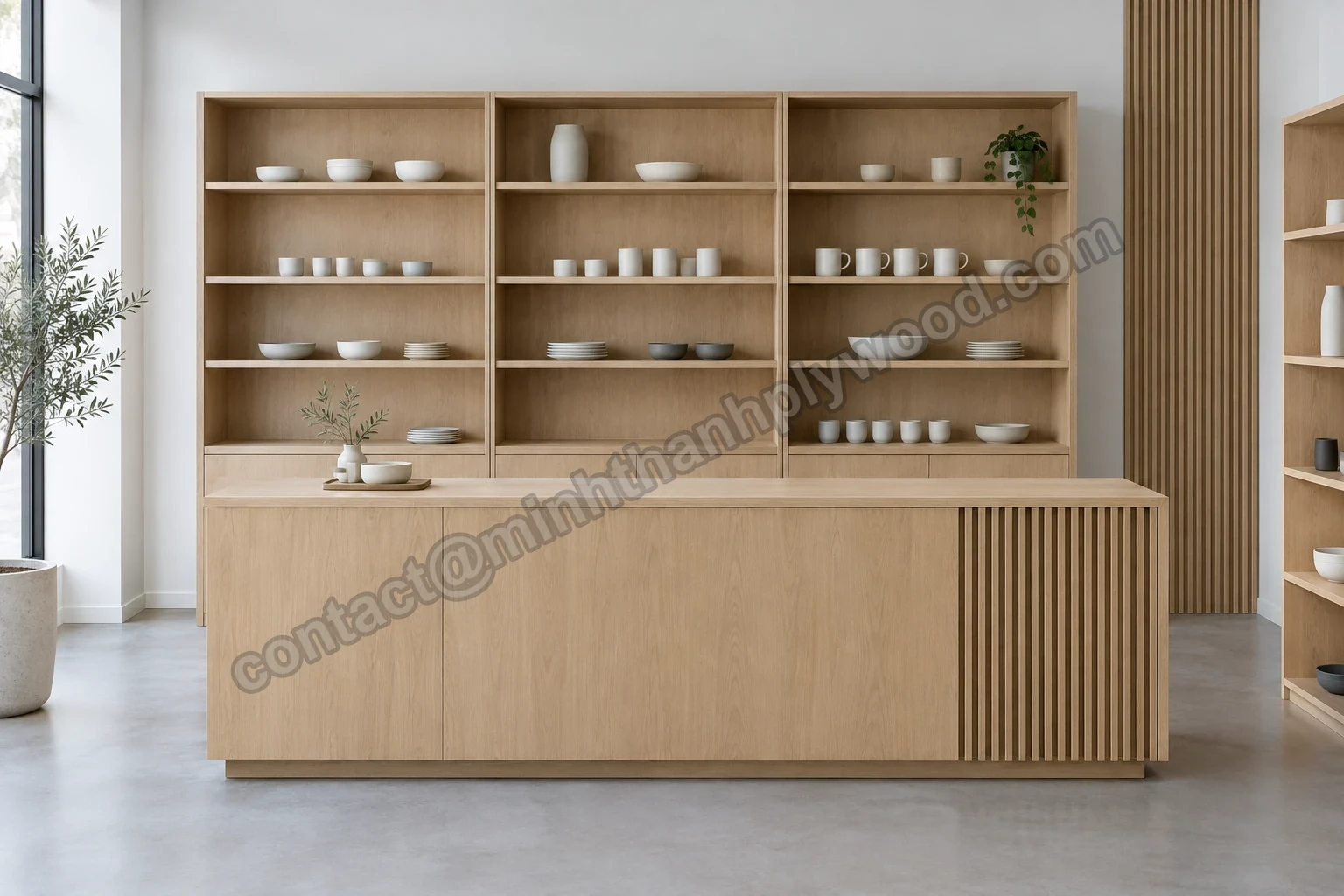
Shop fittings are built by the hundred, in several sites, over months. A fixed EV pattern and colour holds across repeat orders, and cut-to-size parts arrive packed by part number for fast fitting.
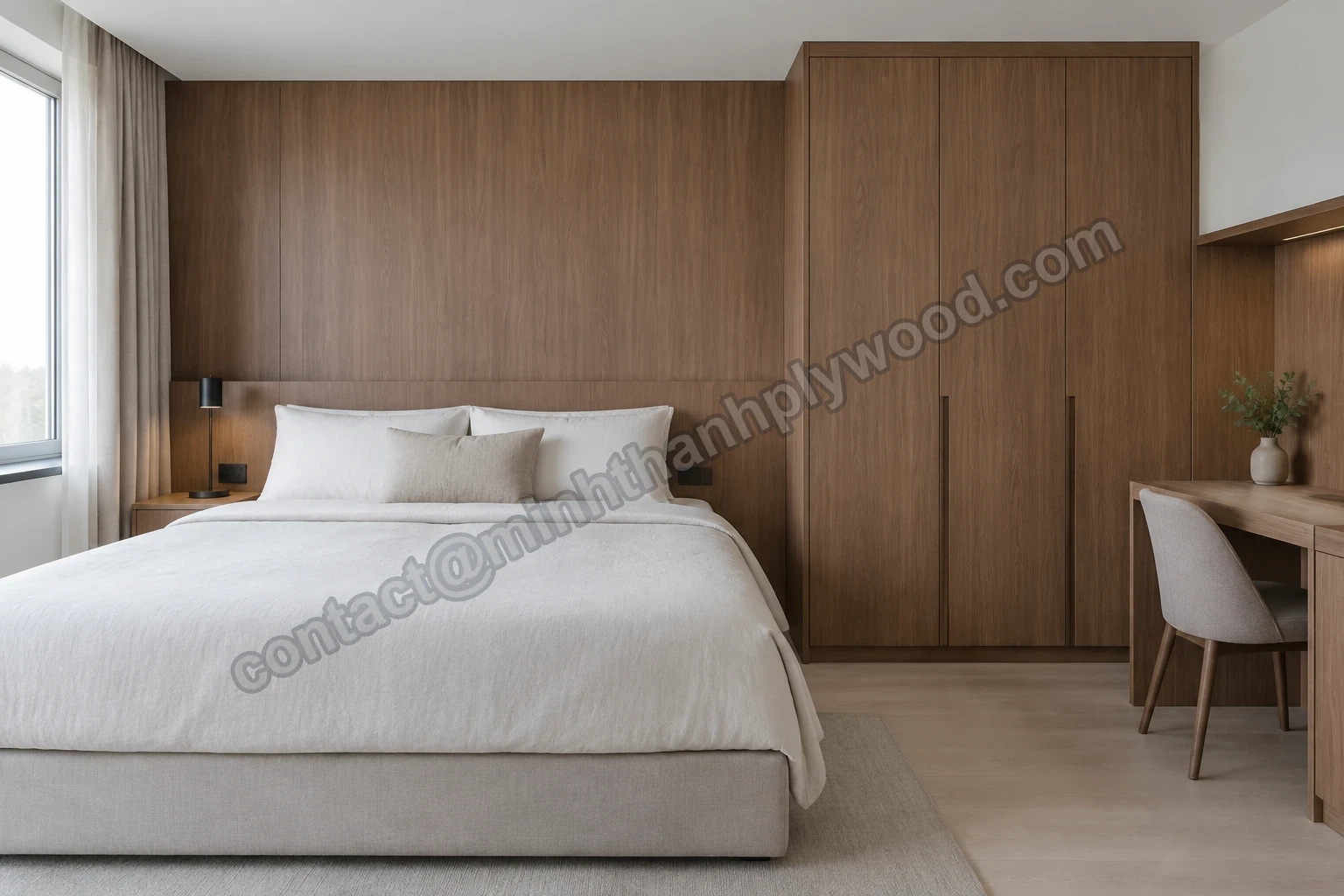
Corridors, reception counters and meeting-room walls use long runs of one colour. EV plywood with a UV or lacquer finish gives an even, repeatable surface, and the UF glue at E0 emission meets the emission requirements European and US buyers ask for.
Finishing and handling decide the result on a thin face. Keep sheets flat on pallets, wrapped and dry, and let them settle in the workshop before coating. Sand lightly: the face is 0.2–0.5 mm, and heavy sanding goes through it. Wipe away dust, seal moisture marks before they dry on the face, and test the lacquer or UV coat on an offcut first.
Compare
EV plywood gives the same colour and grain on every sheet, with no knots, mineral streaks or sheet matching, and natural veneer gives the unique figure of one tree. Pick EV for matched runs and repeat orders, and natural veneer when the figure itself is the design.
| EV (engineered veneer) | Birch-faced | Poplar-faced | Okoume-faced | |
|---|---|---|---|---|
| Face source | Plantation wood peeled, dyed, glued into a block and re-sliced | Imported birch, rotary cut | Poplar, rotary cut | Okoume, rotary cut |
| Colour and grain | Set once: the same on every sheet | Pale cream, flowing figure, varies | Plain cream, very light grain | Pinkish-beige, soft ribbon figure |
| Knots and streaks | None | Pin knots and patches by grade | Light mineral marks possible | Few |
| Sheet matching | Not needed | Sorted by grade | Sorted by grade | Sorted by grade |
| Colour range | Light oak, walnut, red, white and more | Pale cream only | Cream only | Pinkish only |
| Core and weight | Styrax about 500 kg/m³ or Eucalyptus 650–750 kg/m³ | Same cores | Same cores | Same cores |
| Best for | Matched runs, repeat orders, modern fronts | Clear-lacquered light interiors | Painted and foil parts | Warm-toned furniture |
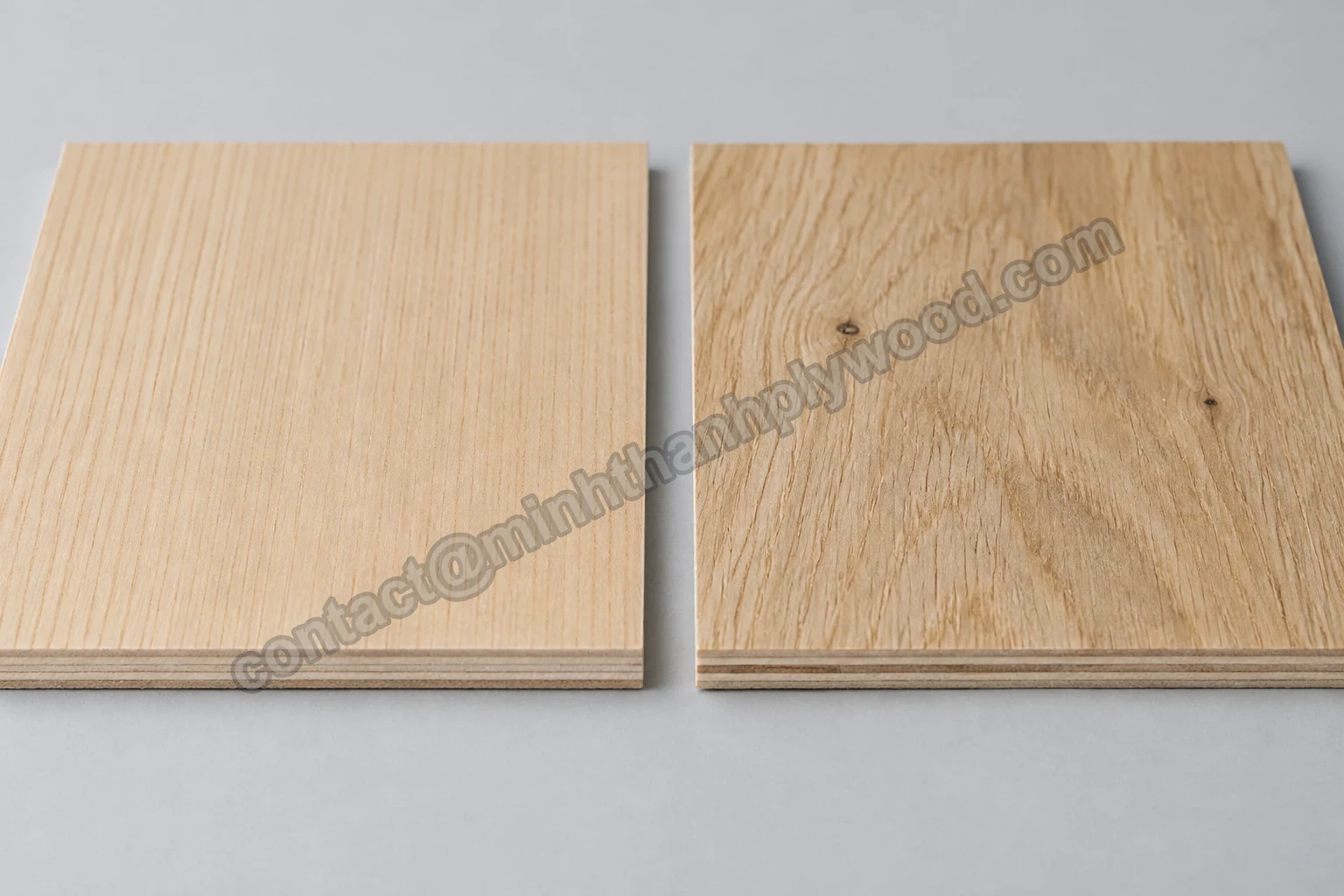
Natural veneer is sliced from a log, so each sheet carries the colour shifts, streaks and figure of that tree. Cabinet makers sort and book-match sheets by hand to hide the variation. Recon veneer plywood, the trade name for the same engineered veneer, moves that work to the veneer maker: the colour and grain are set once, and the sheets arrive ready to use.
EV plywood is made from fast-growing plantation timber that is peeled, dyed, laminated in a controlled grain direction into a block and sliced again. The slicing uses the same equipment as natural veneer, which is why the face is real wood fibre and takes lacquer, UV coating, stain and laminate like any wood veneer.
Compared with birch-faced plywood, EV is more uniform and gives you colours birch does not have. Poplar is plainer and cream. Okoume is warmer, pinkish and figured. All four are pressed on the same Vietnamese cores, so weight, size and loading are the same; the face is the choice.
Buyers also ask for this panel as compensato EV in Italy, contreplaqué EV in France and Belgium, recomposed or reconstituted veneer plywood, and recon veneer plywood. The product is the same: engineered veneer over a plywood core.
Quality control
We grade every EV order against the sample you signed off: the pattern and colour of each sheet, caliper thickness, flatness, the edge and core, and the number of bundles. Photos and phone clips of your own sheets reach you before the doors close, and your inspector is welcome at the mill.
free samples in your thickness, EV pattern and core; once you approve one, it is the standard every sheet is graded to.
every sanded sheet is compared with the approved sample for colour and grain direction, face and back separately.
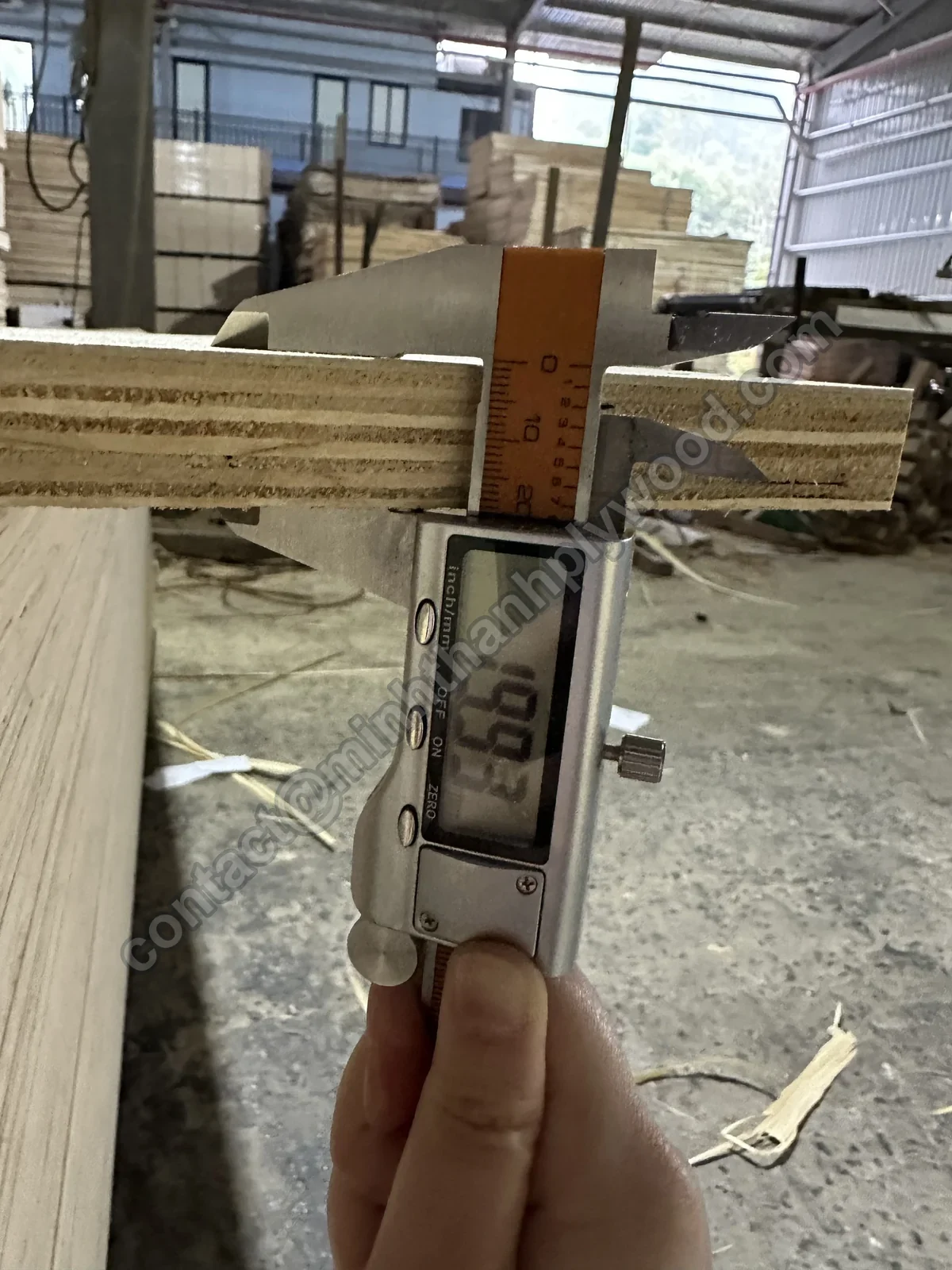
several points on sheets from every bundle are read with a digital caliper against the ±0.2 mm furniture tolerance.
at the sheet edge we look for stitched core layers, closed joints and a glue line of even thickness.
if you ask, a production sheet goes on the scale on camera, so the core can be read from its density, 500 or 650–750 kg/m³.
we turn sheets over on camera and film the stack edge and the caliper display, then send you the clips before loading.
each bundle is counted, marked and photographed inside the container, and a third-party inspector can attend.
When the container is opened, three quick checks confirm you got the panel you bought. An 18 mm sheet of 1220 × 2440 mm weighs about 26.8 kg on a Styrax core and 34.8–40.2 kg on Eucalyptus, so one bathroom scale tells you the core. A caliper on a handful of sheets confirms thickness. A look along the edge of a few bundles shows whether the layers are even and the joints closed.
Choosing an EV plywood manufacturer in Vietnam comes down to proof you can hold. Five items settle it: the mill's own CARB P2 number, an emission report with test method and dates, a clip of real sheets being turned, a photo of the edge and a caliper reading. We send all five within hours of your request.
Related: checked against the sample you approved.
Certificates and documents
Minh Thanh Plywood holds CARB P2 / TSCA Title VI certification as ICTT mill no. 23024, ISO 9001:2015 and TCVN 11902:2017. We supply the EUDR compliance dossier (origin records and geolocation files) and an SGS packaging test under the EU PPWR. FSC and CE are available*.
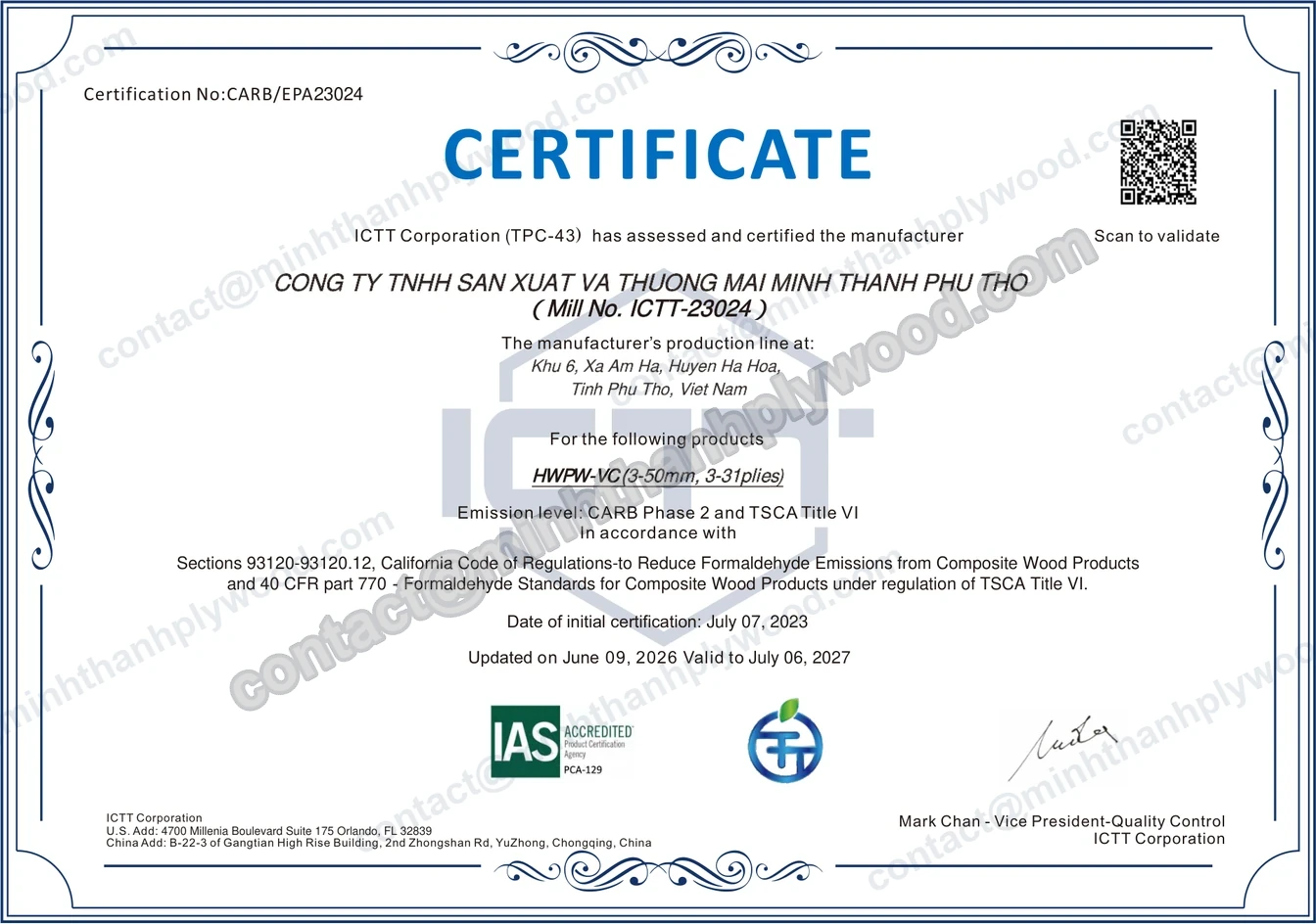
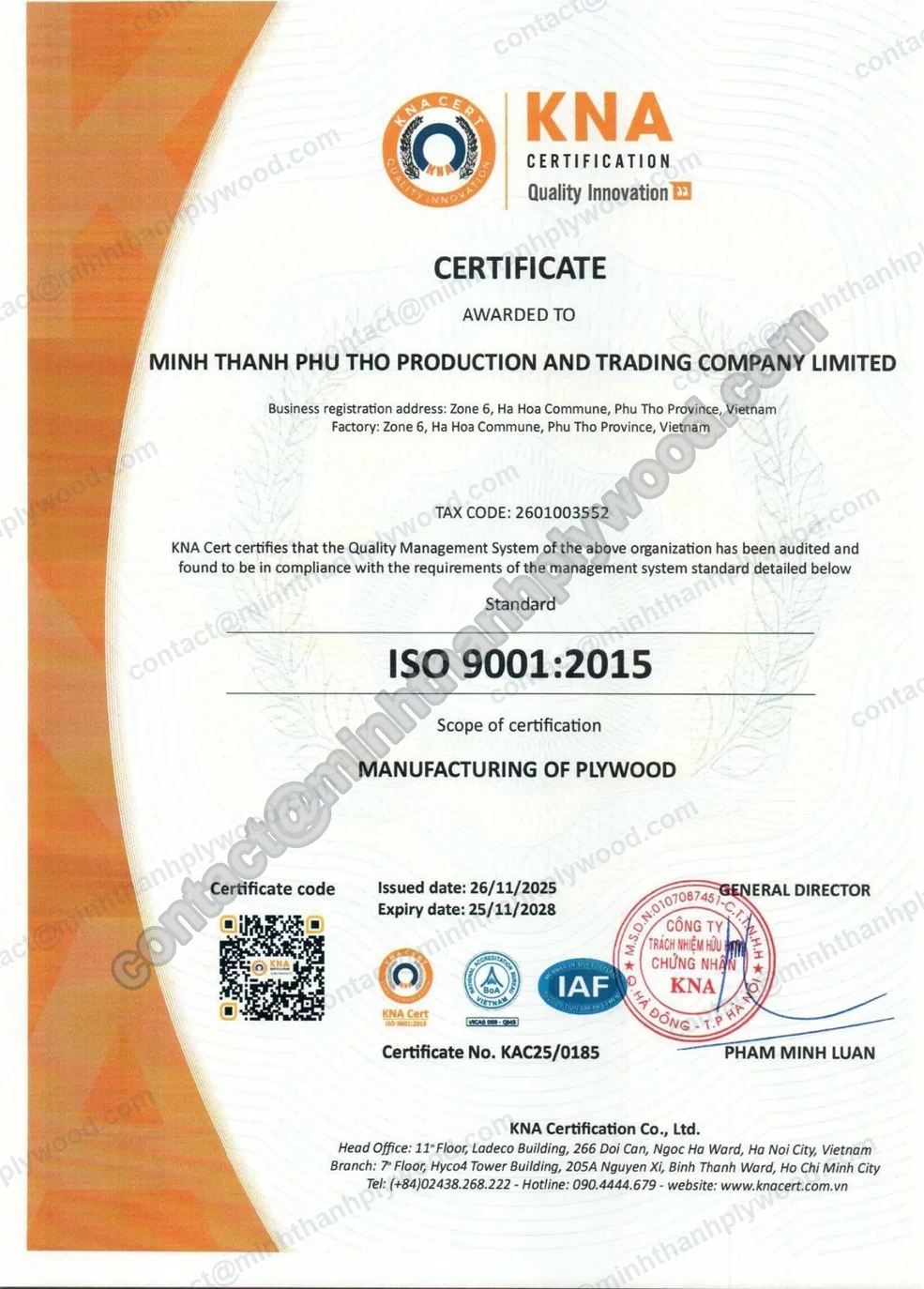
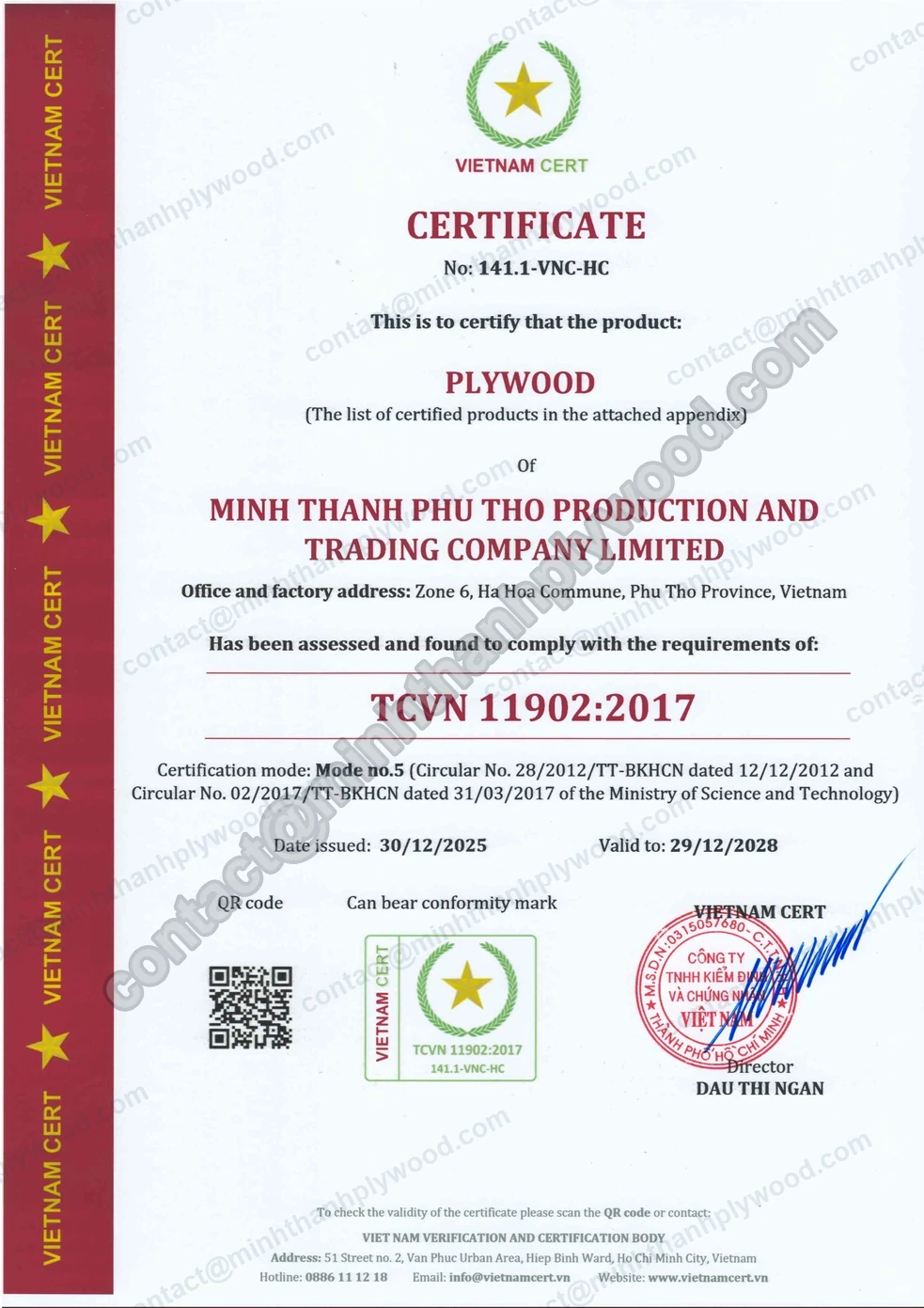
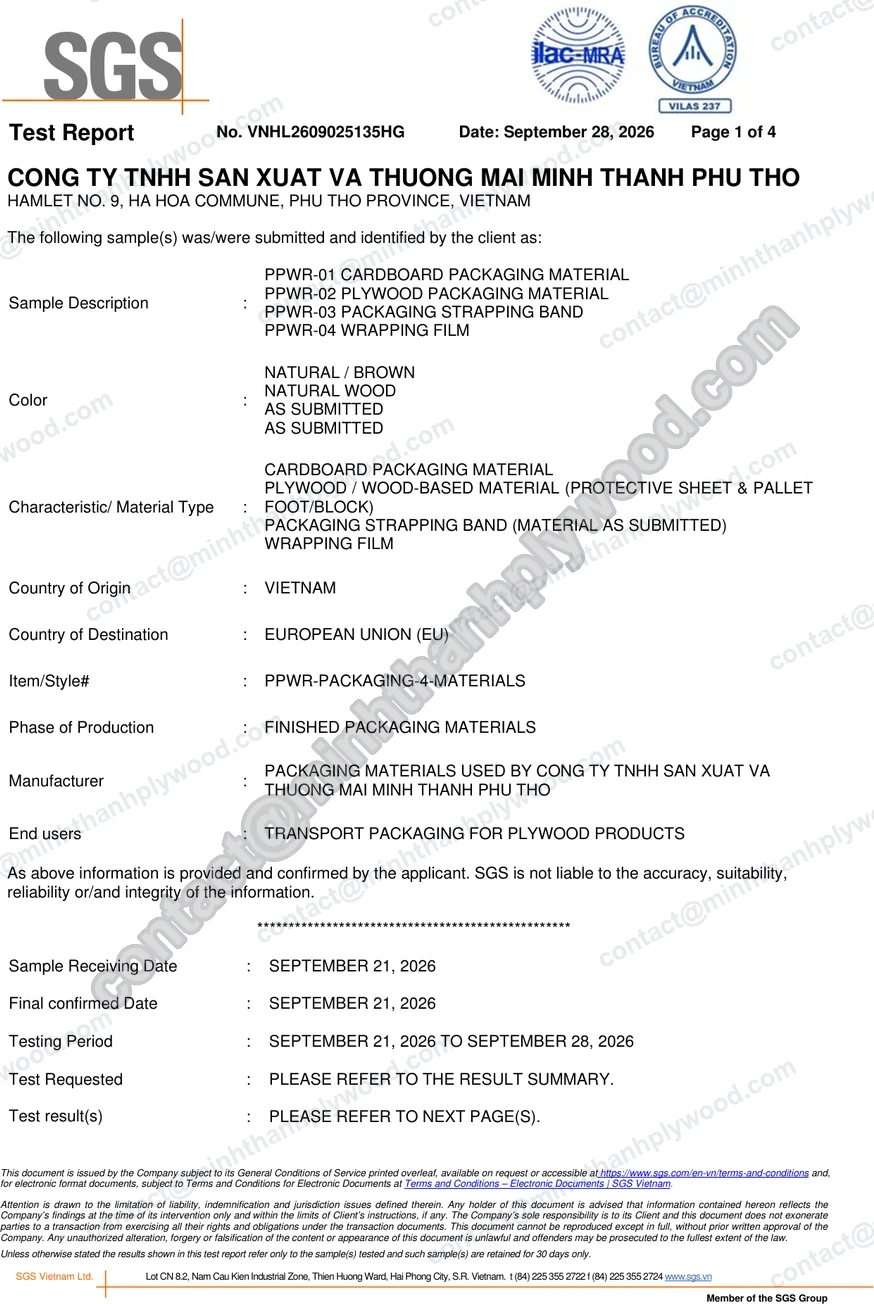
SGS, September 2026
Regulation (EU) 2025/40: lead, cadmium, mercury and hexavalent chromium not detected in all four packaging materials; pass against 100 mg/kg
View document →ASTM D6007; Shanghai Hongjun and ICTT Vietnam
E0 tested every 3 months; 0.014–0.032 ppm on 9, 15 and 18 mm panels
View document →Per order
EUDR compliance dossier: origin records and geolocation files with your order
View document →Available*
FSC-certified EV plywood on request
Available*
For panels placed on the EU market as construction products
Check a CARB or TSCA claim by the mill number. Our number, 23024, appears on the certificate issued by ICTT, and the US EPA lists the third-party certifiers recognised under TSCA Title VI. ISO and TCVN certificates carry their numbers as shown.
The cores are Vietnamese plantation timber grown around Ha Hoa. We supply the EUDR dossier with every EU order, ready for your due diligence statement. Vietnam is classed as low risk under Implementing Regulation (EU) 2025/1093.
EUDR applies from 30 December 2026 to plywood importers. There is no EUDR certificate: the importer files the due diligence statement, and our dossier gives the origin records and geolocation behind it.
*Supplied directly or through qualified partner mills.
Packing and loading
Up to 18 bundles of Styrax-core EV plywood fit a 40HC, about 53–54 m³; the heavier Eucalyptus core stops at 15 bundles. A bundle is roughly 1,000 mm tall, so divide 1,000 by the thickness to get sheets per bundle: 55 sheets of 18 mm, or 990 sheets for the container.
| Thickness (mm) | Sheets per bundle | Styrax core: sheets per 40HC (18 bundles) | Eucalyptus core: sheets per 40HC (15 bundles) |
|---|---|---|---|
| 4 | 250 | 4,500 | 3,615 |
| 6 | 166 | 2,988 | 2,400 |
| 9 | 111 | 1,998 | 1,605 |
| 12 | 83 | 1,494 | 1,200 |
| 15 | 66 | 1,188 | 960 |
| 18 | 55 | 990 | 795 |
| 25 | 40 | 720 | 570 |
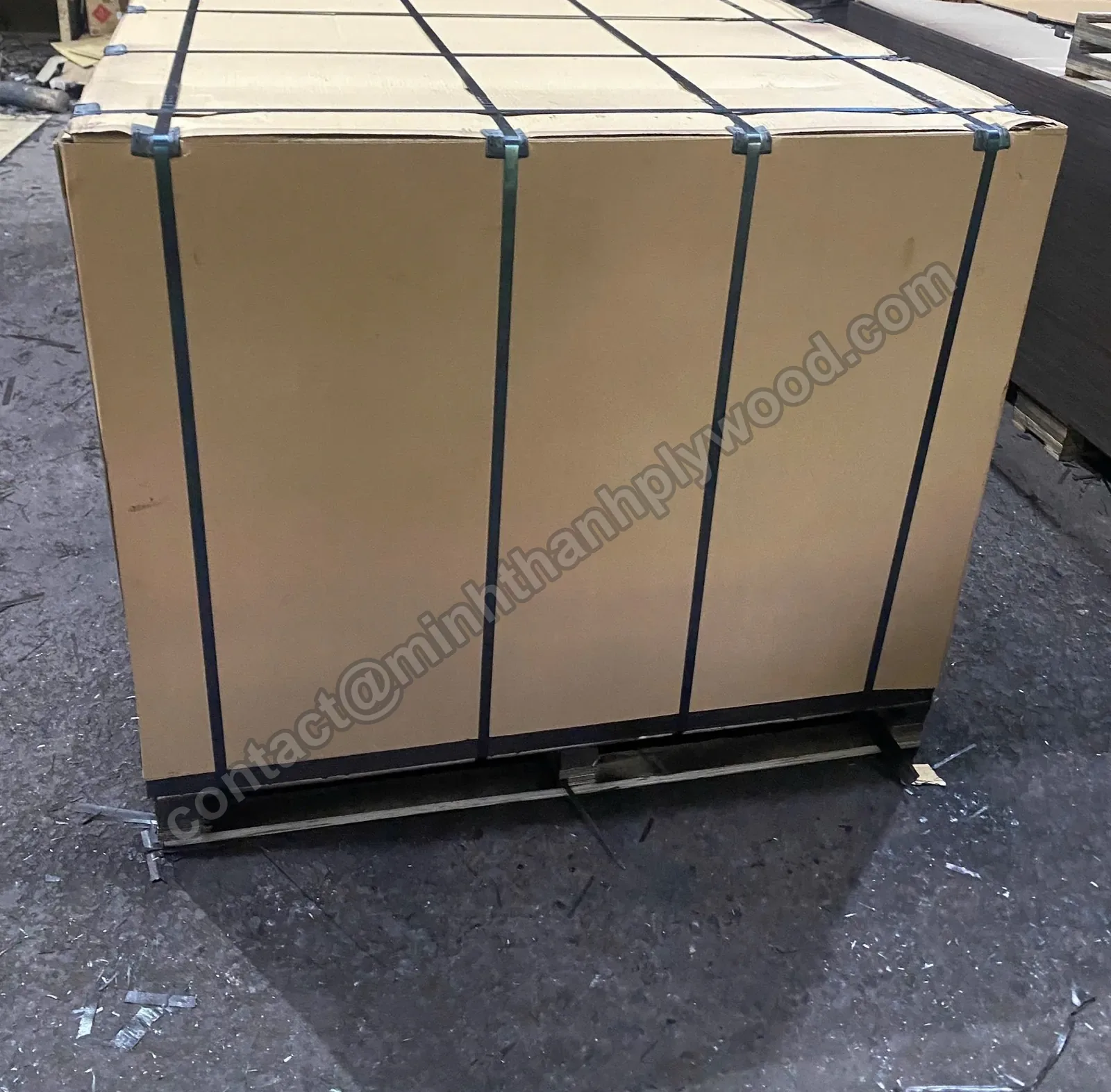
All figures in the table assume 1220 × 2440 mm sheets. In the container, 16 bundles lie flat in a four-by-four block and the last two stand upright by the doors. We do not go beyond that: bundle feet crack under extra weight, and an overpacked box has to be emptied by hand at your end.
With a Eucalyptus core, weight fills the container before space does, so 15 bundles take up about 43 m³. Several thicknesses and EV patterns can share a container; each gets its own bundles and its own marks.
Bundles are wrapped against dust and damp, strapped, given corner guards and marked with thickness, grade, EV pattern and glue. The wrap keeps the thin EV face clean until your line opens it. On order we fit export pallets, print your own labels or stamp the panel edges. To mix thicknesses in one load, try our packing calculator.
Based on 1,000 mm bundles and the bundle limit for each core. Eucalyptus at 650 kg/m³ stays within 28,000 kg of panels, so its bundles hold a few sheets fewer.
Related: Eighteen bundles load as 16 lying flat.
Trade terms
The minimum order for EV plywood is one 40HC container, production takes 15–45 days after the deposit, and payment is 30% deposit with 70% against the scanned B/L. We ship FOB Hai Phong, CFR or CIF, accept mixed loads by agreement and send free samples.
| MOQ | 1×40HC; mixed thicknesses, grades and patterns by agreement |
|---|---|
| Production time | 15–45 days after deposit, by quantity and specification |
| Payment | 30% deposit, 70% against scanned B/L; T/T or irrevocable L/C at sight |
| Incoterms | FOB Hai Phong, CFR or CIF |
| Samples | Free samples |
| Documents | Commercial invoice, packing list, bill of lading, certificate of origin, insurance on CIF, plus CARB/TSCA, test reports and the EUDR compliance dossier |
| Replies | Within hours, Monday–Friday, Vietnam time (UTC+7) |
Production time runs from the deposit to cargo ready at the factory. Sea transit from Hai Phong is added on top and depends on the destination port and the carrier. On CFR and CIF terms we book the vessel and quote the route with the price.
Colour is fixed at the veneer stage, so send the approved sample and the quantity of each pattern early. Tell us your required arrival date and we plan production backwards from it.
How to order
You send the specification lines, approve the price and a sample, pay the deposit; we then press, inspect and load. A first EV order usually takes the 15–45 days of production plus however long the sample takes to agree.
the application, EV pattern and colour, core, glue and emission class, face and back grade, thickness, sheet size, packing, quantity and the port you ship to.
a price per m³ for each thickness on FOB Hai Phong, CFR or CIF terms, with every spec line written back to you for checking.
free EV samples in your pattern and core; the one you approve is the standard production is graded against.
confirm the proforma and pay 30% by T/T, or open an irrevocable L/C at sight.
15–45 days, with photos, clips and caliper readings of your own sheets before loading.
photos of the loaded container and draft documents for you to approve, then the scanned B/L once the 70% balance is paid.
Write these lines on the purchase order so the panel that arrives is the panel you priced. Name the EV pattern and colour with a sample reference, and the face and back grade, for example A/B. Name the core species, Styrax or Eucalyptus, never just "hardwood". Add core stitching, glue type, emission class and test method. Finish with thickness and tolerance, sheet size, UV-ready faces if you coat, certificates, packing and labels.
FAQ
Short answers to the questions importers ask most about EV plywood from Vietnam: what engineered veneer is, how it is made, how it compares with natural veneer, which core and glue to choose, and how to order.
EV plywood is plywood with an engineered veneer (EV) face and back over a plywood core. The face is real wood fibre from plantation timber that is peeled, dyed, glued into a block and re-sliced, so colour and grain are the same on every sheet. Minh Thanh Plywood presses EV on white Styrax or Eucalyptus cores, 3–40 mm thick.
Engineered veneer plywood is another name for EV plywood: a plywood panel faced with engineered, or recon, veneer. The veneer is built to a fixed colour and grain pattern, then pressed on a stitched Styrax or Eucalyptus core, sanded and polished. It is used for furniture, cabinets, doors and wall panels where sheets must match.
Engineered veneer is a decorative wood veneer made in a controlled process instead of being sliced straight from one tree. Fast-growing plantation wood is peeled into thin sheets, dyed to the target colour, glued into a block with the grain laid in one direction, and sliced into face veneer 0.2–0.5 mm thick. It is also called recon, reconstituted or recomposed veneer.
Engineered veneer is made in four steps. Peel plantation logs into thin sheets, and dye the sheets to the colour. Glue and press them into a block with the grain aligned, then slice the block across the layers. The slices carry a fixed pattern, such as straight grain or crown. We then press the veneer onto our own cores in a second pressing.
Choose engineered veneer when many parts must match, because colour and grain are identical sheet to sheet and there are no knots or mineral streaks to sort. Choose natural veneer when the figure of the tree is the design. EV also saves the hand matching that natural sheets need on a long run of doors or cabinets.
Recon veneer plywood is the same product as EV plywood. Recon is short for reconstituted: the veneer is rebuilt from peeled plantation wood into a block and re-sliced. Buyers use EV, engineered veneer, recon veneer and recomposed veneer for the same panel, and our quotation names the pattern, colour, core and grade whichever term you use.
Minh Thanh Plywood is one of the engineered veneer plywood manufacturers in Vietnam that presses EV on its own lines, in Ha Hoa, Phu Tho, with 50,000+ m³ of annual capacity. We supply factory-direct with CARB P2 / TSCA Title VI certification (ICTT mill no. 23024), ISO 9001:2015, real production photos and clips, and a minimum order of one 40HC.
You can buy EV plywood, known in Italy as compensato EV or recomposed veneer, directly from Minh Thanh Plywood in Vietnam. We ship regularly to Italy and other European markets, in 1250 × 2500 mm or 1220 × 2440 mm sheets, cut to size if you need. Send the door or furniture specification and we quote FOB, CFR or CIF.
Compensato EV is the Italian, and contreplaqué EV the French, name for EV plywood: plywood faced with engineered or recomposed veneer. The panel is identical to the one sold as EV plywood in English. We write the quotation in English with the pattern, colour, core, glue and grade lines, and ship to European buyers.
White Styrax is the best core for most furniture: about 500 kg/m³, a pale edge and up to 18 bundles per 40HC. Choose Eucalyptus, 650–750 kg/m³, when your specification asks for a heavier, denser panel. Both cores are stitched horizontally and vertically, and the EV face looks the same on either.
The EV face is 0.2–0.5 mm thick before pressing, and 0.3 mm is the usual European furniture choice. Our panels leave the line sanded and polished, so most buyers coat them directly. If you must sand, sand lightly with a fine grit and test an offcut first, because heavy sanding goes through a face this thin.
No plywood is waterproof by its face; water resistance comes from the glue. Use our standard UF glue at E0 emission for dry interiors and furniture, melamine-fortified MR glue for kitchens and humid rooms, and phenolic WBP glue for exterior exposure with sealed edges. Glue type and emission class are two separate lines on the order.
Yes. Our EV panels meet the emission and quality requirements European furniture buyers ask for, and CARB P2 / TSCA Title VI certification (ICTT mill no. 23024) is the proof. Six third-party chamber tests to ASTM D6007 averaged 0.014–0.032 ppm against the 0.05 ppm limit. SGS tests to EN 717-1 or your own method on request.
The minimum order is one 40HC container, and production takes 15–45 days after the 30% deposit. The balance, 70%, is paid against the scanned B/L by T/T or irrevocable L/C at sight. Mixed thicknesses, grades and patterns load in one container by agreement, and samples are free.
Yes, send a sample or a reference and we quote the closest EV pattern and colour in our range, then send a sample for your approval. Straight grain, crown and oak-look patterns in pale, walnut, red and white colours are the usual choices. The approved sheet becomes the standard for the whole order.
Request a quote
Tell us the application, pattern and colour, core, glue, face grade, thickness, size and quantity, and Lisa replies within hours with a quotation and sample offer. Attach up to 3 drawings or specification files.
Start with the application and we can advise the rest: pattern and colour, core, glue and emission class, face and back grade, thickness and sheet size, packing, quantity and your destination port. Email [email protected] or WhatsApp Lisa on +84 988 586 601. Free samples. Download the plywood catalogue or contact the sales team.
[email protected]