
For furniture grade export plywood, the best core is a cross-laminated hardwood veneer core, double pressed and calibrated: white Styrax for light, flat carcasses and lacquered parts, Eucalyptus where screws and hinges carry load. MDF core suits painted doors only. Minh Thanh Plywood, a furniture plywood manufacturer in Phu Tho, Vietnam, builds its export panels on these two cores and makes Acacia and Pine cores on order.
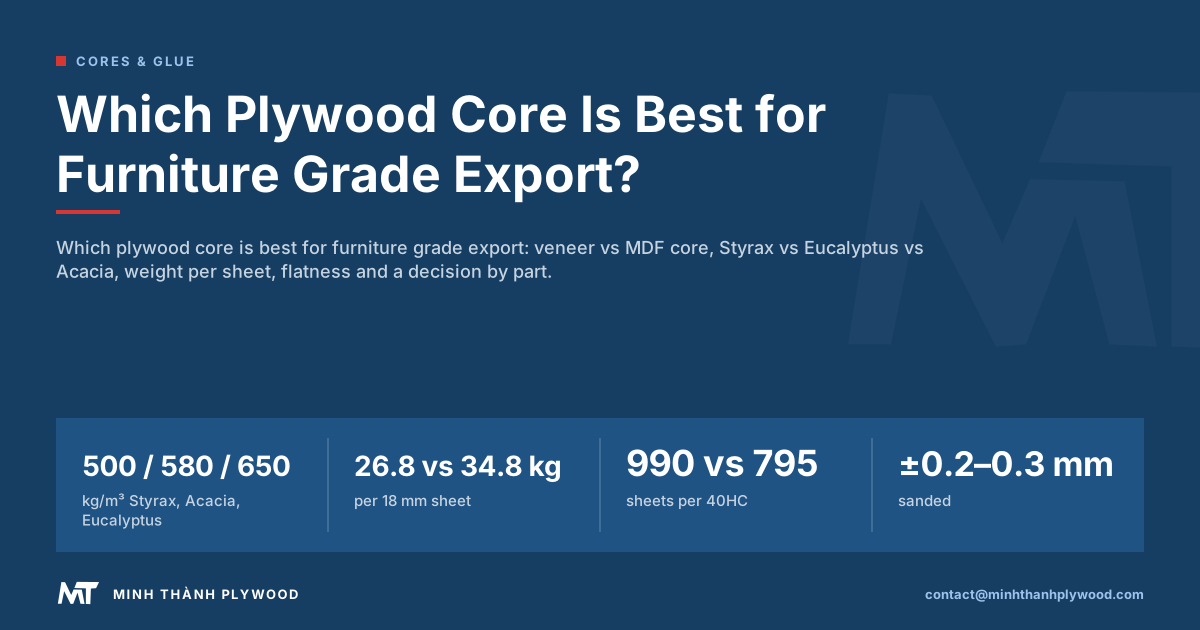
Which plywood core is best for furniture grade export? The short answer
The best core for furniture grade export plywood is a hardwood veneer core that is cross-laminated, stitched and double pressed, then chosen by species for the part it goes into. The face decides the look; the core decides weight, flatness, screw holding and how the panel finishes.
| Furniture need | Best core | Why |
|---|---|---|
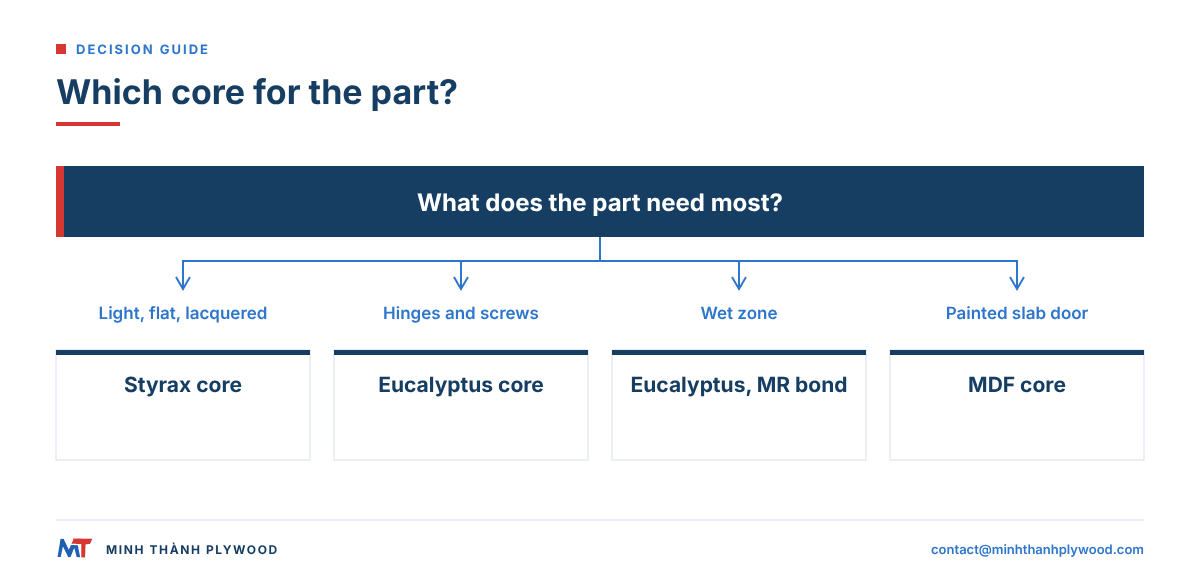
| Light, flat carcasses, lacquer or UV finish | White Styrax veneer core | Lightest, palest, most even veneer |
| Hinges, drawer slides, heavy hardware | Eucalyptus veneer core | Densest, best screw holding |
| Between the two on weight and strength | Acacia veneer core (on order) | Medium density |
| Painted slab doors only | MDF core | Flattest paint surface, weak at edge screws |
Minh Thanh Plywood builds export furniture panels on white Styrax or Eucalyptus cores as standard, and Acacia and Pine cores on order. The rest of this guide shows how to pick between them part by part.
What is the core of plywood and why does it decide furniture quality?
The core is every layer between the face and back veneers, and it is most of the panel’s volume. Hinge cups, drawer-slide screws, shelf pins and connector bolts all bite into the core, not the face.
That is why a premium face over a weak core still fails in furniture. A buyer can approve a perfect face and receive a panel that warps on the CNC table, telegraphs core gaps through lacquer or strips its hinge screws. The core also sets the weight of every sheet, and the weight decides how much panel volume fits in a container.
Three things define a core on an order:
- Construction: veneer, combination, MDF, particleboard or lumber strips.
- Species: for veneer cores, the plantation hardwood used.
- Build quality: ply count, gaps and overlaps, stitching, pressing and calibration.
Plywood core types compared: veneer, combi, MDF, particleboard and lumber
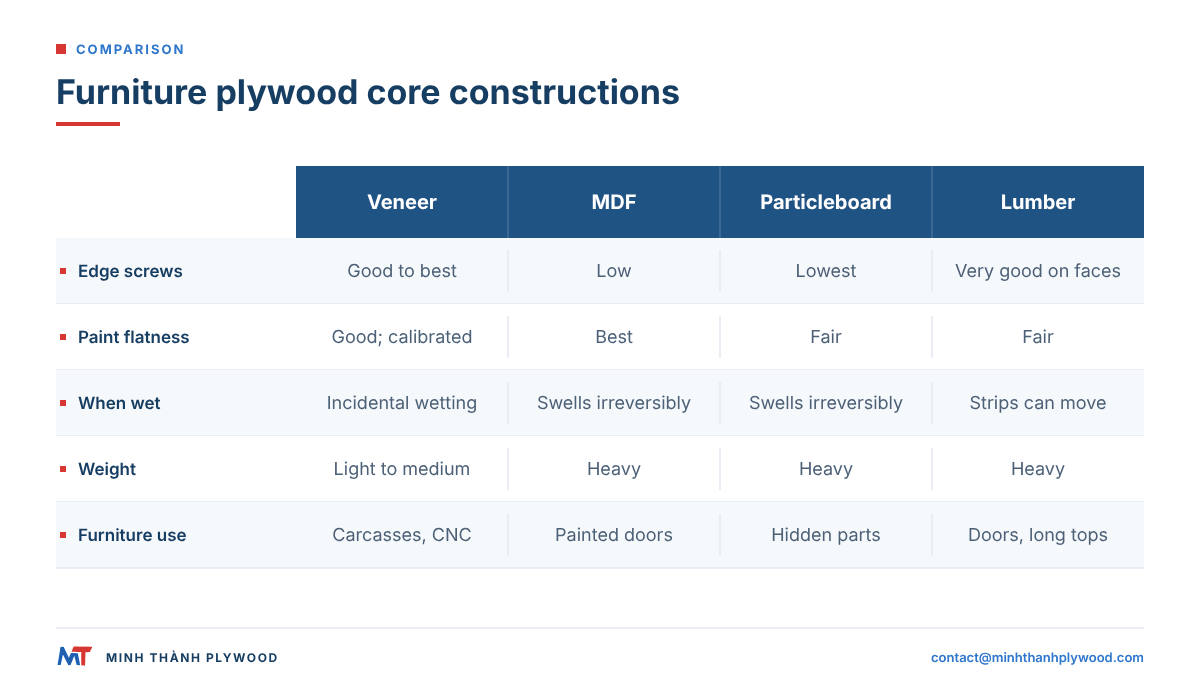
Veneer core is the furniture standard; the other constructions each fit a narrower use. The comparison below is for 18 mm panels used in furniture.
| Core type | Build | Screw holding at edge | Flatness for paint | Wet behaviour | Weight | Best furniture use |
|---|---|---|---|---|---|---|
| Hardwood veneer core | Cross-laminated veneers | Good to best | Good, very good when calibrated | Tolerates incidental wetting | Light to medium | Carcasses, shelves, drawers, CNC parts |
| Combination core | Veneers with an MDF or other layer under the faces | Good | Very good | Depends on bond and layers | Medium | Lacquered panels needing a smooth substrate |
| MDF core | Fibre core under veneer faces | Low | Best | Swells irreversibly | Heavy | Painted slab doors |
| Particleboard core | Chips and resin | Lowest | Fair | Swells irreversibly | Heavy | Low-cost hidden parts |
| Lumber core (blockboard) | Solid strips, veneer skins | Very good on faces | Fair | Strips can move | Heavy | Doors, long tops |
For cabinets, read the table as a decision by part rather than a ranking. A full container of one core is rarely the best plan for a whole furniture programme.
Best core for furniture plywood by species: Styrax, Eucalyptus and Acacia
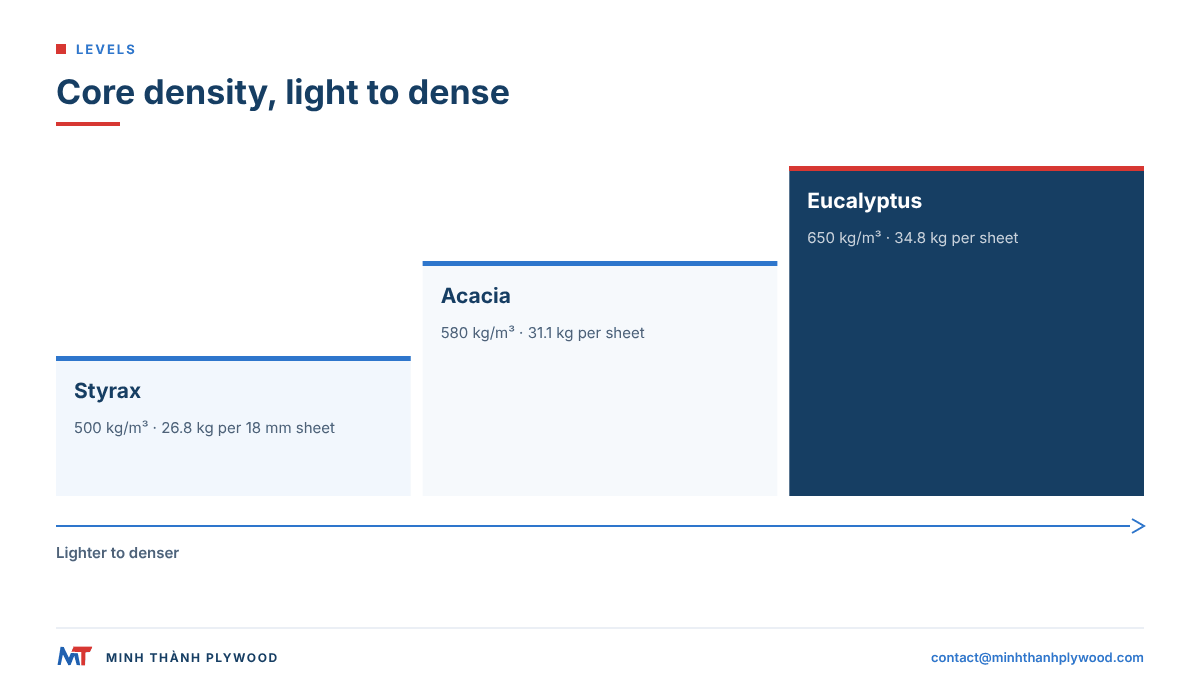
The best core for furniture plywood among Vietnamese plantation hardwoods is Styrax for weight and finish, Eucalyptus for strength, and Acacia between them. Density is the number that separates them, and it carries straight through to sheet weight and container load.
| Core species | Reference density | 18 mm sheet, 1220 × 2440 mm | Sheets per 40HC at 18 mm | Character in furniture |
|---|---|---|---|---|
| White Styrax | 500 kg/m³ | 26.8 kg | 990 sheets | Pale, even, lightest; presses flat; clean edge |
| Acacia (on order) | 580 kg/m³ | 31.1 kg | 880 sheets | Medium weight, firm |
| Rubberwood (other mills) | about 595 kg/m³ | about 31.9 kg | not planned by us | Medium-dense plantation hardwood, pale, firm screw holding |
| Eucalyptus | 650 kg/m³ | 34.8 kg | 795 sheets | Dense, hard; best screw holding |
Rubberwood (Hevea brasiliensis) is the core several other Vietnamese mills lead with. It is a plantation hardwood harvested at the end of a tree’s latex-tapping life, medium-dense at about 595 kg/m³ and a Janka hardness of 960 lbf (The Wood Database, read 21 October 2026), so it sits just above Acacia on weight. We standardise on Styrax and Eucalyptus because they cover the two jobs that matter, a light flat carcass and a dense hardware-bearing part, with a supply we press ourselves.
A buyer who wants a rubberwood-core quote can ask for it as a separate line and compare sheet weights. Which core is the lowest-impact choice? All of these are plantation hardwoods; what counts for a buyer is the origin record, and we supply the EUDR dossier with geolocation files for EU orders.
Sheet weight is density × volume: one 1220 × 2440 × 18 mm sheet holds 0.0536 m³, so a Styrax core gives about 26.8 kg and a Eucalyptus core about 34.8 kg. All cores are dried to 8–12 % moisture content at dispatch, the normal range for furniture plywood.
Veneer core plywood for cabinets: why it is the default
Veneer core plywood for cabinets is the default because it holds screws at the edge, stays stable across humidity changes and weighs less than fibre cores. Each veneer runs across its neighbour, so stresses spread through the stack instead of pulling the panel out of flat.
For cabinet boxes, this gives the builder:
- Edge screw holding for confirmat screws, cam fittings and drawer slides, which fibre cores lose.
- Clean machined edges for edge banding and visible plywood edges.
- Lighter boxes that are easier to handle, assemble and ship flat-packed.
- Tolerance to incidental wetting: a splash at a sink base dries out of veneer core, where fibre cores swell.
Styrax suits carcasses that are banded and lacquered; Eucalyptus suits sink bases, tall units and doors hung on heavy hinges.
MDF core plywood for cabinets: where it fits and where it fails
MDF core plywood for cabinets fits painted slab doors and routed door profiles, where its grain-free surface paints without telegraphing. It fails in carcasses: it holds edge screws poorly and swells irreversibly once wet.
Use MDF core where:
- The face is painted and must stay dead flat with no grain or core pattern showing.
- Profiles are routed into the face, and the router must cut a uniform material.
- The part carries no edge fixings that take load.
Avoid it in sink bases, drawer boxes and shelves that span. Where a buyer wants the paint surface without losing veneer core in the box, the usual plan is MDF-faced doors on veneer-core carcasses. Our broader plywood or MDF comparison covers the board-level choice.
Best core plywood for moisture resistant cabinets
The best core plywood for moisture resistant cabinets is a dense hardwood veneer core bonded with an MR / melamine-fortified glue, with faces finished and edges sealed. Moisture resistance comes from the bond and the finish first; the core species decides how well the panel recovers from incidental wetting.
| Layer | What to specify for wet-zone cabinets |
|---|---|
| Core | Eucalyptus veneer core, gap-free, stitched |
| Bond | MR / melamine-fortified, pressed at 110–120 °C |
| Exterior-grade option | Phenolic WBP, pressed at 130–145 °C |
| Emission | E0 or the class your market requires, quoted separately from the bond |
| Faces | Laminate, lacquer or UV coating applied by the buyer |
| Edges | Banded or sealed before installation |
UF glue at E0 emission remains the standard for dry furniture and interiors. Glue type and emission class are two separate lines on the order: UF, MR and WBP name the bond, while E0 and E1 name the emission level.
Which core for which furniture part? A decision matrix
The right core changes with the part. This matrix is how we match core to use for export furniture programmes.
| Furniture part | Recommended core | Construction notes |
|---|---|---|
| Carcass sides and tops, banded | Styrax | Double pressed, 11–13 plies at 18 mm |
| Sink base and wet-zone units | Eucalyptus | MR bond, sealed edges |
| Doors on heavy hinges | Eucalyptus | Dense core for hinge cups |
| Mid-weight option, quoted on request | Acacia or rubberwood | Between Styrax and Eucalyptus on weight |
| Painted slab doors | MDF core or MDF-faced | Paint surface, no edge load |
| Drawer sides and boxes | Styrax or Eucalyptus | Thin plywood, 5-ply at 3–5 mm |
| Shelves that span | Eucalyptus | Stiffer per thickness |
| CNC-routed parts | Styrax | Gap-free, stitched core, clean tool path |
| Lacquered or UV-coated faces | Styrax | Even core does not telegraph |
| Backs and bases | Styrax thin plywood | Light, low cost per sheet |
Thin drawer and back panels follow their own build: our thin plywood of 3–5 mm is always 5-ply (6 mm ply count is set per order), and a 4 mm furniture panel takes three 1.3 mm Styrax core veneers under two faces.
How does the core change flatness and thickness tolerance?
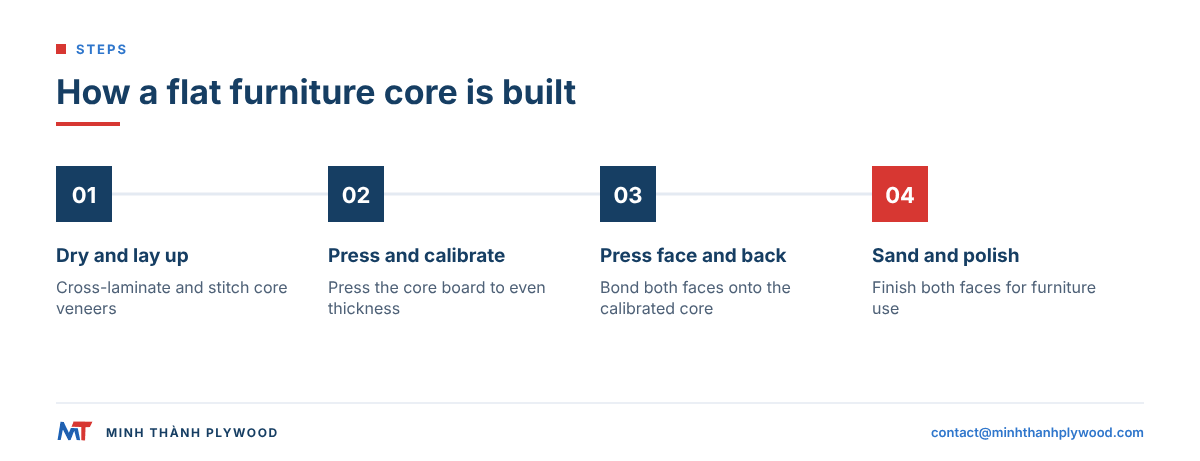
The core decides flatness because the faces copy whatever surface sits under them. A core with even veneers, pressed and calibrated before the faces go on, gives a flat panel with a tight tolerance.
That is why furniture-grade panels at Minh Thanh Plywood are pressed twice as standard:
- Lay up the core from dried veneers, cross-laminated, with core layers stitched both horizontally and vertically.
- Press the core board and calibrate it to an even thickness.
- Press face and back onto the calibrated core.
- Sand and polish both faces.
The result is a thickness tolerance of ±0.2–0.3 mm on sanded furniture panels, down to ±0.2 mm, against ±0.5 mm for commercial and film-faced panels. Length and width hold ±2 mm. For CNC programmes and hinge boring, that tolerance is what keeps tool depths right sheet after sheet.
Ply count, core gaps and stitched cores
Ply count, core gaps and stitching are the three build checks that separate a furniture core from a commercial one. None shows on a face, and all three show up in use.
- Ply count. At 18 mm, furniture panels usually carry 11–13 plies. Thinner, more numerous veneers resist warping and machine cleaner than a few thick ones.
- Core gaps and overlaps. A gap is a hollow where a screw has nothing to bite and where lacquer sinks; an overlap is a ridge that telegraphs through the face. A furniture core is laid with neither.
- Stitched core layers. Joining core veneers across and along the sheet keeps each layer whole during lay-up, so gaps do not open in the press.
A cut edge on a sample shows all three at once: count the plies, look for dark voids, and check that glue lines run thin and even.
How does core species change weight and container load?
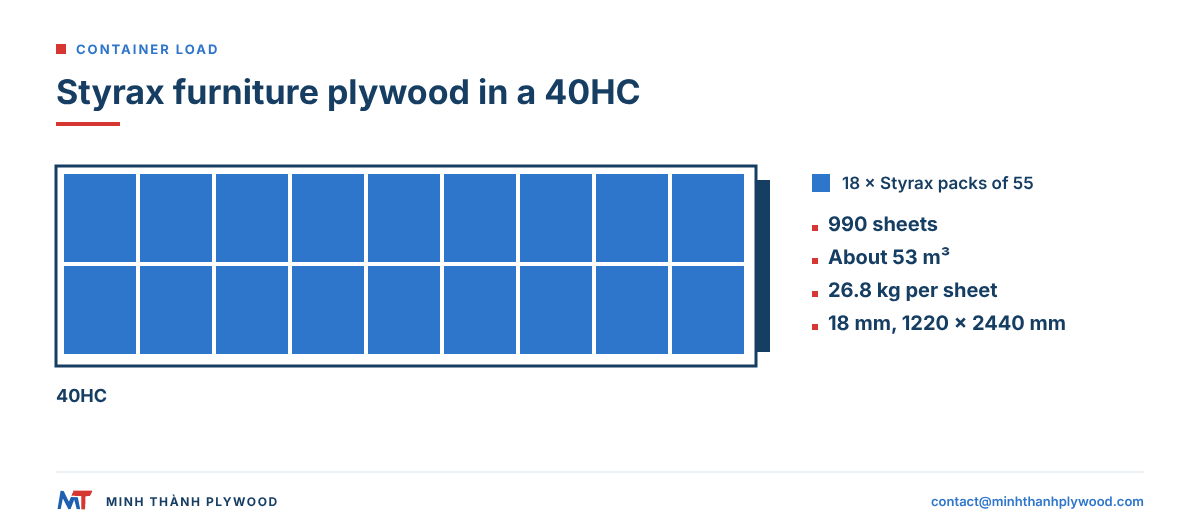
Core species changes sheet weight, and with dense cores a 40HC container reaches its weight limit before it is full. Our 40HC plan for 1220 × 2440 mm panels uses a planning payload of 28,000 kg unless the booking is lower.
| Core at 18 mm | Packs per 40HC | Sheets per 40HC | Volume | Weight per sheet |
|---|---|---|---|---|
| Styrax | 18 × 55 sheets | 990 sheets | about 53 m³ | 26.8 kg |
| Acacia | 16 × 55 sheets | 880 sheets | about 47 m³ | 31.1 kg |
| Eucalyptus | 15 × 53 sheets | 795 sheets | about 43 m³ | 34.8 kg |
A Styrax core ships about 10 m³ more panel per container than Eucalyptus at 18 mm. On a long programme, that difference lowers freight per cubic metre and is often why buyers move carcasses to Styrax and keep Eucalyptus for the parts that need it.
Which core goes with which face?
Faces are chosen for the look the buyer orders, and the core is chosen for the part; the two combine freely. These are the pairings we press most for export furniture.
| Face | Typical core | Face grades | Common use |
|---|---|---|---|
| Birch | Styrax or Eucalyptus | D+/D, D/E | Visible-edge furniture, cabinets |
| Poplar | Styrax | A/A, A/B, B/B | Carcasses, painted and laminated parts |
| EV (engineered veneer) | Styrax | To the approved sample | Decorative fronts, lacquer |
| Okoume | Styrax or Eucalyptus | To the approved sample | Interior panels, doors |
| Pine | Styrax, or Pine core on order | A/A, A/B, B/B | Pine-look furniture |
| Eucalyptus | Eucalyptus | A/A, A/B, B/B | Dense, hard-wearing parts |
Birch grades follow the Vietnamese names D+, D and E, quoted as face/back pairs and comparable to the European birch ladder: D+ about B, D about BB, E about CP/C. Every face is matched to the buyer’s approved sample. See the birch-faced plywood page and poplar plywood page for full specifications.
Emission, glue and the core: what export buyers ask for
Export furniture buyers ask for a low-emission bond in the core as standard, and the proof is certification plus chamber tests. Minh Thanh Plywood holds CARB P2 / TSCA Title VI certification (ICTT mill no. 23024) for hardwood plywood with a veneer core, 3–50 mm.
Six ASTM D6007 chamber tests between April 2025 and June 2026 on 9, 15 and 18 mm panels averaged 0.014–0.032 ppm. Three tests were run by Shanghai Hongjun and three by ICTT Vietnam. These are sample results with the method stated. The limit for veneer-core hardwood plywood is 0.05 ppm under 40 CFR 770.10.
Buying for the UK. A British importer places furniture panels on the market under the UK Timber Regulation, which asks for due diligence on legal harvest; we supply the species and origin records for that file. EN 717-1 emission testing, the European chamber method, is arranged through SGS on request, so a UK buyer can ask for it against the order.
For European buyers, panels meet the emission and quality requirements furniture buyers there ask for, and third-party testing to the buyer’s method, such as EN 717-1, is arranged through SGS on request. From 6 August 2026 the EU limits furniture and wood-based articles to 0.062 mg/m³ of formaldehyde under Regulation (EU) 2023/1464.
Which core suits lacquer, UV coating and laminate?
A light, even core suits lacquer and UV coating best, because the face is thin and copies any ridge, gap or hard spot beneath it. Laminate and melamine papers are more forgiving, but they still show core overlaps under raking light.
- Lacquer and stain: Styrax core, double pressed, sanded and polished faces. The pale core keeps the panel edge light when it is left visible.
- UV coating on the buyer’s line: both faces of our furniture panels are UV-ready, sanded to the standard customers need to apply their own UV coating; Styrax keeps weight low for the line’s handling.
- Laminate, HPL or melamine: Styrax or Eucalyptus core; Eucalyptus where the laminated part takes hinges or screws.
- Paint: veneer core with a smooth face for most parts; MDF core or MDF-faced panels only where a dead-flat painted face matters more than edge strength.
In every case, the calibration of the core before the faces go on is what stops the finish showing the build underneath.
How do you check core quality on samples?
Check core quality on the sample from the cut edge, the scale and the caliper before approving the order. Five checks take ten minutes:
- Cut a fresh edge and count the plies against the order.
- Look for voids and overlaps along the cut, under good light.
- Weigh a full sheet and compare with density × volume: a Styrax 18 mm sheet should be close to 26.8 kg.
- Caliper the thickness at corners and mid-edges against the written tolerance.
- Test a screw and a hinge cup in the edge and face where the part takes hardware.
A note on thickness for buyers comparing with UK or US stock: a sheet sold as 3/4 in is usually 23/32 in, about 18.3 mm, and UK stock is sold as 18 mm. Our 18 mm furniture panel is measured and quoted in millimetres with the ±0.2–0.3 mm tolerance above, so write the thickness in mm on the order and not the nominal inch size.
Free samples are available, so the approved sample can be pressed on the same core as the order.
What should you write on the order for the core?
Write the core as its own lines on the order, separate from the face, so the build cannot drift. A complete core specification reads like this:
- Core species and construction: Styrax veneer core, stitched, gap-free.
- Ply count at thickness: 11–13 plies at 18 mm.
- Pressing: double pressed, core calibrated.
- Glue and emission: UF glue at E0 emission (or MR / WBP), emission class stated separately.
- Thickness and tolerance: 18 mm, ±0.2–0.3 mm; length and width ±2 mm.
- Moisture: 8–12 % at dispatch.
- Face and back: species and grade pair, against the approved sample.
- Size and packing: 1220 × 2440 mm or 1250 × 2500 mm, packs and sheets per 40HC.
Orders start at one 40HC with mixed specifications by agreement, and production runs 15–45 days after the 30% deposit. Send your part list to contact@minhthanhplywood.com or WhatsApp Lisa on +84 988 586 601, and we recommend a core for boxes, doors and backs separately. Start with the furniture plywood page or our guide to the best plywood for furniture.
Buyer questions, answered
What is the best core for furniture plywood?
A cross-laminated hardwood veneer core, double pressed and calibrated. White Styrax gives the lightest, flattest panel for carcasses and lacquered parts; Eucalyptus gives a denser core for hinge and screw loads.
Is veneer core or MDF core better for cabinet boxes?
Veneer core. It holds screws at the edge, tolerates incidental moisture and is lighter. MDF core is flatter for paint but weak at edge screws and it swells when wet, so it belongs on painted doors.
Is Styrax a good plywood core?
Yes. Styrax is a light, pale, even plantation hardwood. At 500 kg/m³ an 18 mm Styrax-core sheet weighs about 26.8 kg, and the even veneer presses flat, which suits lacquer and UV finishing.
Is Eucalyptus or Acacia core better for furniture?
Eucalyptus is denser, at 650 kg/m³, and gives the best screw holding of the three; Acacia sits between Styrax and Eucalyptus at 580 kg/m³. Choose by hardware load and by weight per container.
What is the best core plywood for moisture resistant cabinets?
A dense hardwood veneer core with an MR / melamine-fortified bond, sealed edges and a laminated or lacquered face. The bond protects the glue line; the core species alone does not make a cabinet moisture resistant.
Does the core affect how flat plywood is?
Yes. A core of even veneers, pressed and calibrated before the faces go on, gives a flat panel with a tight thickness tolerance. Minh Thanh sanded furniture panels hold ±0.2–0.3 mm.
How many plies should 18 mm furniture plywood have?
Most furniture panels at 18 mm carry 11–13 plies. More, thinner plies give a more stable panel and a cleaner machined edge.
Why does core species change how much plywood fits in a container?
Containers fill by weight before volume with dense cores. At 18 mm our 40HC plan carries 990 Styrax-core sheets, 880 Acacia-core sheets or 795 Eucalyptus-core sheets.
Which core is the lowest-impact choice?
Styrax, Eucalyptus, Acacia and rubberwood are all grown on plantations, so none is taken from natural forest. For a buyer the proof is the origin record: we supply the EUDR dossier with geolocation files for EU orders.
Can birch-faced plywood have a hardwood core?
Yes. Birch faces over a Styrax or Eucalyptus core give the birch look at a lower weight and cost. Specify face, back and core as separate lines so the build is clear.
What should I write on the order for the core?
Write the core species, construction, ply count at the thickness, glue and emission class, pressing and tolerance. For example: Styrax veneer core, 11–13 plies, double pressed, UF glue at E0 emission, ±0.2–0.3 mm.
Which core is best for CNC-machined furniture parts?
A tight, gap-free veneer core with stitched core layers. Styrax machines cleanly with little tear-out, and Eucalyptus holds fittings better where the part takes hardware.