
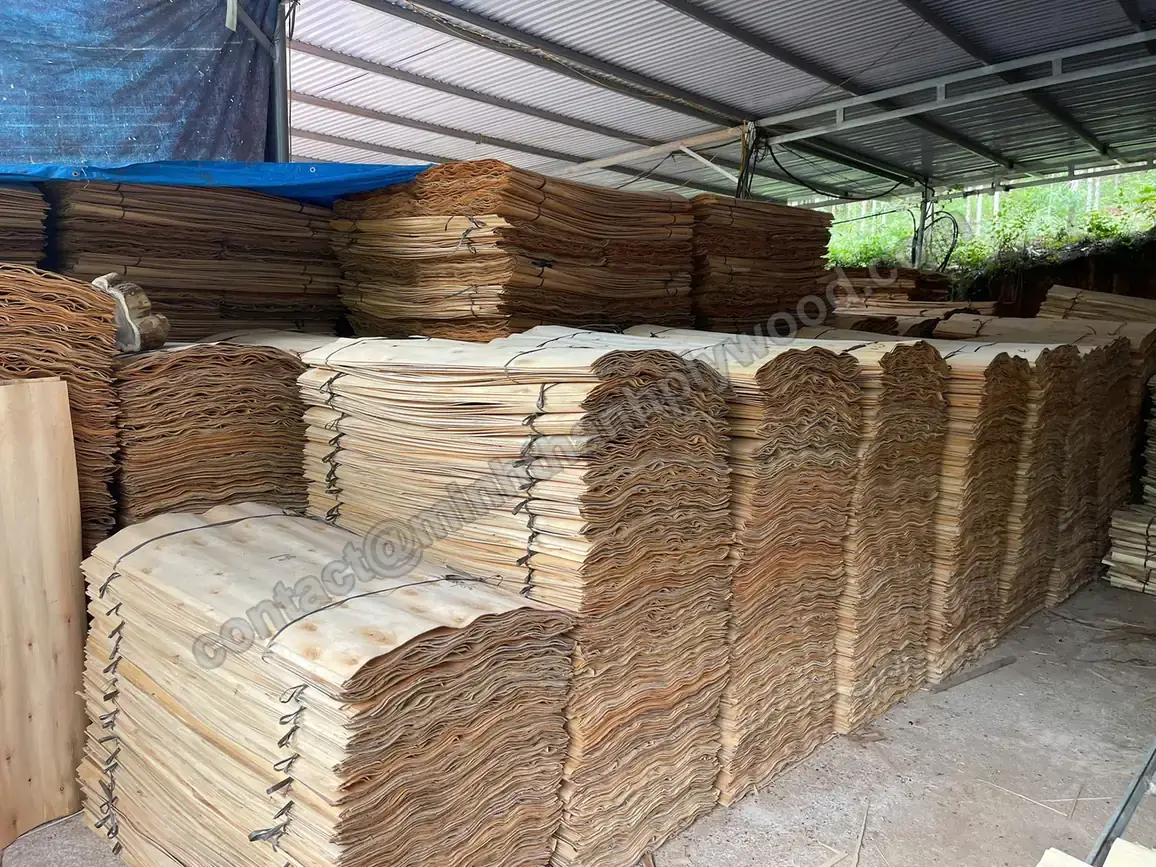
In short, acacia plywood is plywood with Acacia veneer in the core, the faces or both; most export panels use Acacia as the core under a birch, poplar or EV face. At about 580 kg/m³ it sits between Styrax and Eucalyptus. Minh Thanh Plywood makes Acacia cores on order: 31.1 kg per 18 mm sheet, 880 sheets per 40HC.
What does the Acacia name tell a plywood buyer?
The Acacia name identifies wood used somewhere in the panel, but a useful specification says whether it is the face, the core or both. An importer comparing two offers called acacia plywood can otherwise be comparing different products without noticing. The layered edge and the supplier’s construction record are the starting points.
A decorative Acacia face is selected for what the customer sees after finishing. Acacia core veneers sit inside the panel and contribute to its construction. A birch face over an Acacia core has a birch appearance; it does not reveal the core’s grain or colour in the broad surface. The back needs its own description as well.
Use the botanical species stated in the material record when origin documentation or a technical programme needs it. A trade name is convenient for conversation but can group different timber sources.
This distinction also separates plywood from solid Acacia furniture boards and edge-glued panels. Veneer plywood is assembled from bonded layers, normally cross-oriented for the intended construction. A solid wood panel follows a different manufacturing route and requires different movement allowances, joinery and finishing decisions.
How should the face and core be written on the order?
Write face, core and back as separate fields, with a sample reference for the visible surfaces. The buyer can then change a core requirement without accidentally changing the finish programme. At Minh Thanh, standard furniture cores are white Styrax or Eucalyptus; Acacia cores are made on order.
| Order field | What to record | Why the field matters |
|---|---|---|
| Face | Species, appearance grade, selected sample | Defines the visible finish substrate |
| Core | Acacia requirement and agreed veneer construction | Defines the internal material choice |
| Back | Species and appearance grade | Records reverse appearance and construction |
| Bond | Resin system and required service performance | Connects the glue choice to exposure |
| Emission | Named requirement, test method and order documents | Keeps emission separate from glue chemistry |
| Finished panel | Dimensions, tolerance and sanding condition | Fits machining and furniture assembly |
A shorthand such as “Acacia furniture ply” leaves too much room for interpretation. Replace it with the actual configuration: selected decorative face/back, Acacia core, the required bond and finished dimensions. The quotation then identifies a panel that a purchasing team can compare and an inspector can recognise.
For a programme using several faces, keep the core requirement consistent across its material records. Record the alternative faces explicitly. A colour sample alone cannot lock the hidden construction, and a cross-section sample alone cannot lock a furniture finish.
Where does Acacia-core plywood fit in furniture?
Acacia-core plywood is a candidate for furniture when the chosen construction meets the component’s machining, assembly and finish needs. Start with cabinet bodies, drawer parts, supported shelves or upholstered furniture components, then specify the requirements of each part. A species name cannot replace the component drawing.
A cabinet side primarily needs dimensional fit, suitable hardware fixing and the selected visible face. A drawer bottom introduces different support and loading conditions. A wardrobe front asks for appearance and completed-component flatness after finishing. Grouping all these pieces under one general thickness and core description can create unnecessary material cost or poor fit.
For a visible birch finish, inspect the birch face independently of the Acacia core. For an engineered veneer finish, compare colour and grain against the programme sample. For a painted part, evaluate the coating preparation and edge treatment rather than buying a decorative grade the finished paint will conceal.
Minh Thanh’s furniture plywood range starts from these component requirements. Double pressing is standard: the core board is pressed and calibrated before the face and back are pressed on. That sequence gives the buyer a specific manufacturing process to include alongside the selected core in the material record.
How do we make, check and ship Acacia-core plywood?
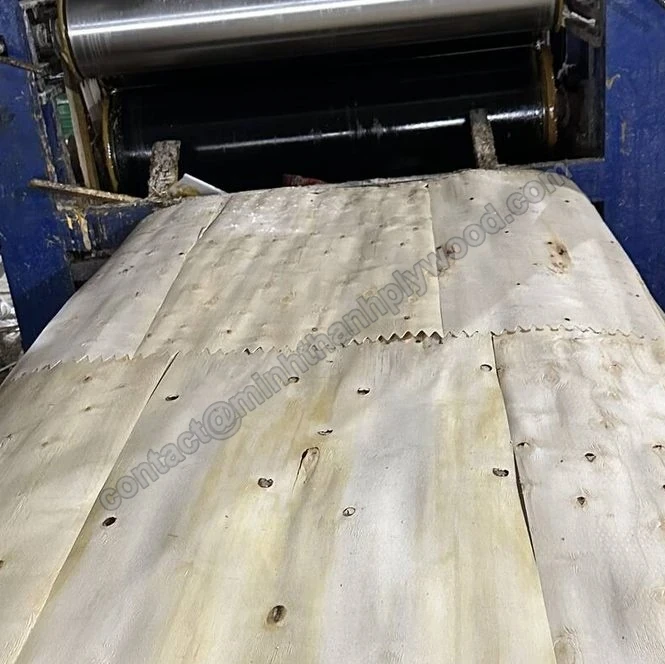
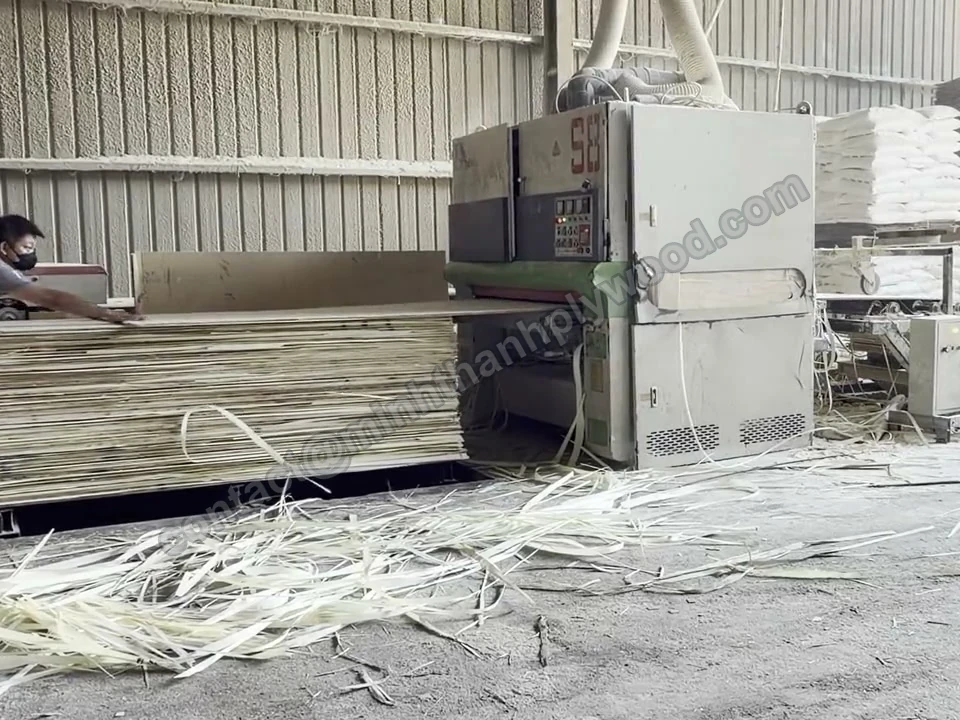
Plantation-grown Acacia core veneer is dried, graded and stitched horizontally and vertically in our Ha Hoa factory. The core board is pressed and calibrated, then the face and back are pressed on, and the panel is sanded to ±0.2–0.3 mm, down to ±0.2 mm, at 8–12% moisture.
- Sample: we send a free sample of your face/core build; cut, route, fit your hardware and finish it on your own line.
- Order: core, face/back pair, bond, thickness and size on separate lines, with the approved sample as the reference.
- Checks: a digital caliper on every pack and photos and video of faces, edges and packs before the container is sealed.
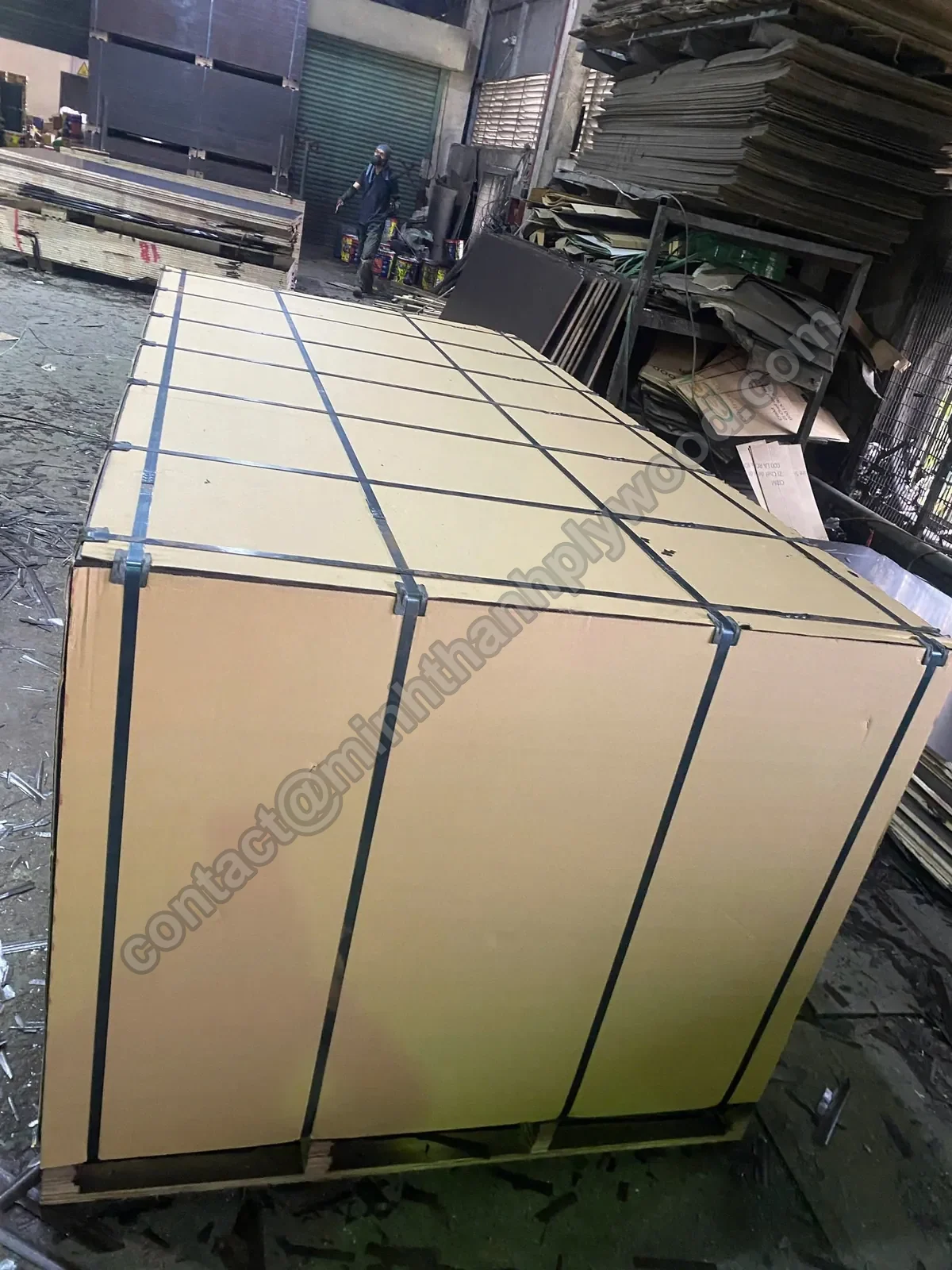
- Packing: cardboard covers, corner guards, steel straps and pallets, with pack labels that name core, face and thickness.
- Loading: 16 packs of 18 mm Acacia-core sheets, 880 sheets per 40HC on a 28,000 kg planning payload.
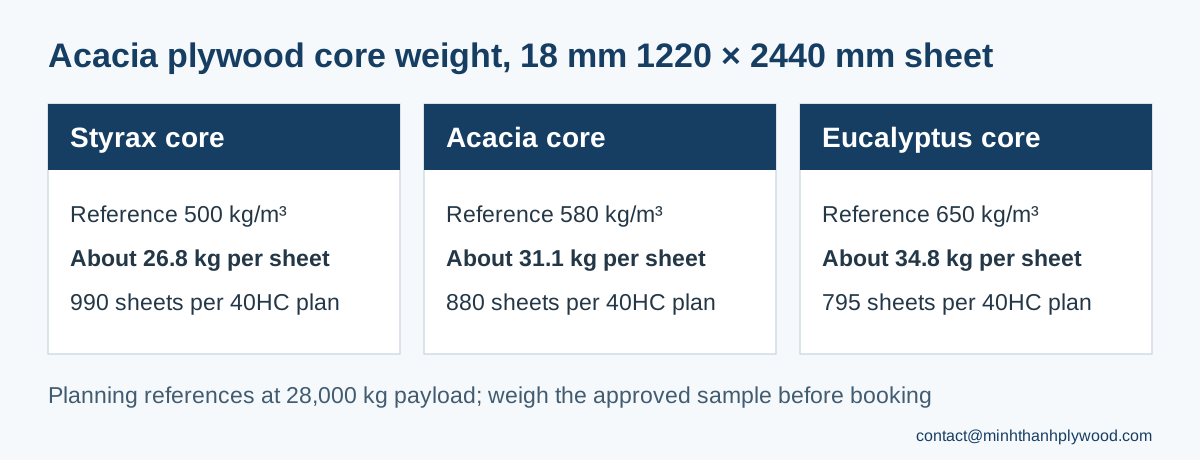
Core species changes sheet weight, so it changes how many sheets a weight-limited container plan carries.
Which face grades should furniture buyers request?
Choose the face grade for the finished part’s visibility, then specify the Acacia core independently. A two-sided display panel needs a different face/back pair from a cabinet side whose reverse is concealed. A clear coating reveals grain, repairs and colour differences that an opaque finish covers.
For Minh Thanh birch faces, the Vietnam grade ladder is E, D and D+ from lower to higher appearance selection. The individual grades are comparable to European CP/C, BB and B respectively, with the buyer’s approved sample defining the finish expectation. A D+/D pair therefore describes a selected front and a different reverse; it does not say that the core is birch.
Check the entire visible part after nesting, especially when doors or matched fronts will sit beside one another. The acceptable location of a repaired feature can matter as much as its presence. Put visible-face zones and grain orientation on the drawing so cutting does not turn an acceptable full sheet into an unsuitable furniture front.
The veneer grading guide explains the sorting stage. For Acacia-core orders, use that stage to discuss the chosen face material and the core sheet preparation as two separate quality requirements. Neither description should disappear into a generic “premium” label.
How do Acacia, Styrax and Eucalyptus cores compare?
Acacia sits between Styrax and Eucalyptus: heavier and firmer than white Styrax, lighter than Eucalyptus. The table uses our planning densities and the 40HC plan at 28,000 kg payload.
| Core | Planning density | 18 mm 1220 × 2440 mm sheet | 40HC plan, 18 mm | Typical use at Minh Thanh |
|---|---|---|---|---|
| White Styrax | 500 kg/m³ | 26.8 kg | 990 sheets, about 53 m³ | Standard furniture core, the light choice European furniture buyers favour |
| Acacia | 580 kg/m³ | 31.1 kg | 880 sheets, about 47 m³ | Furniture cores on order; commercial, packing and film-faced plywood |
| Eucalyptus | 650–750 kg/m³ | 34.8 kg at 650 kg/m³ | 795 sheets, about 43 m³ | Standard furniture core; commercial and film-faced plywood |
Minh Thanh’s standard furniture cores are Styrax and Eucalyptus, with Acacia made on order. Keep the decorative face and finish identical, then run the component through the same cutting and assembly route for each core. The plywood packing calculator gives the sheet counts for other thicknesses.
Is acacia plywood water resistant?
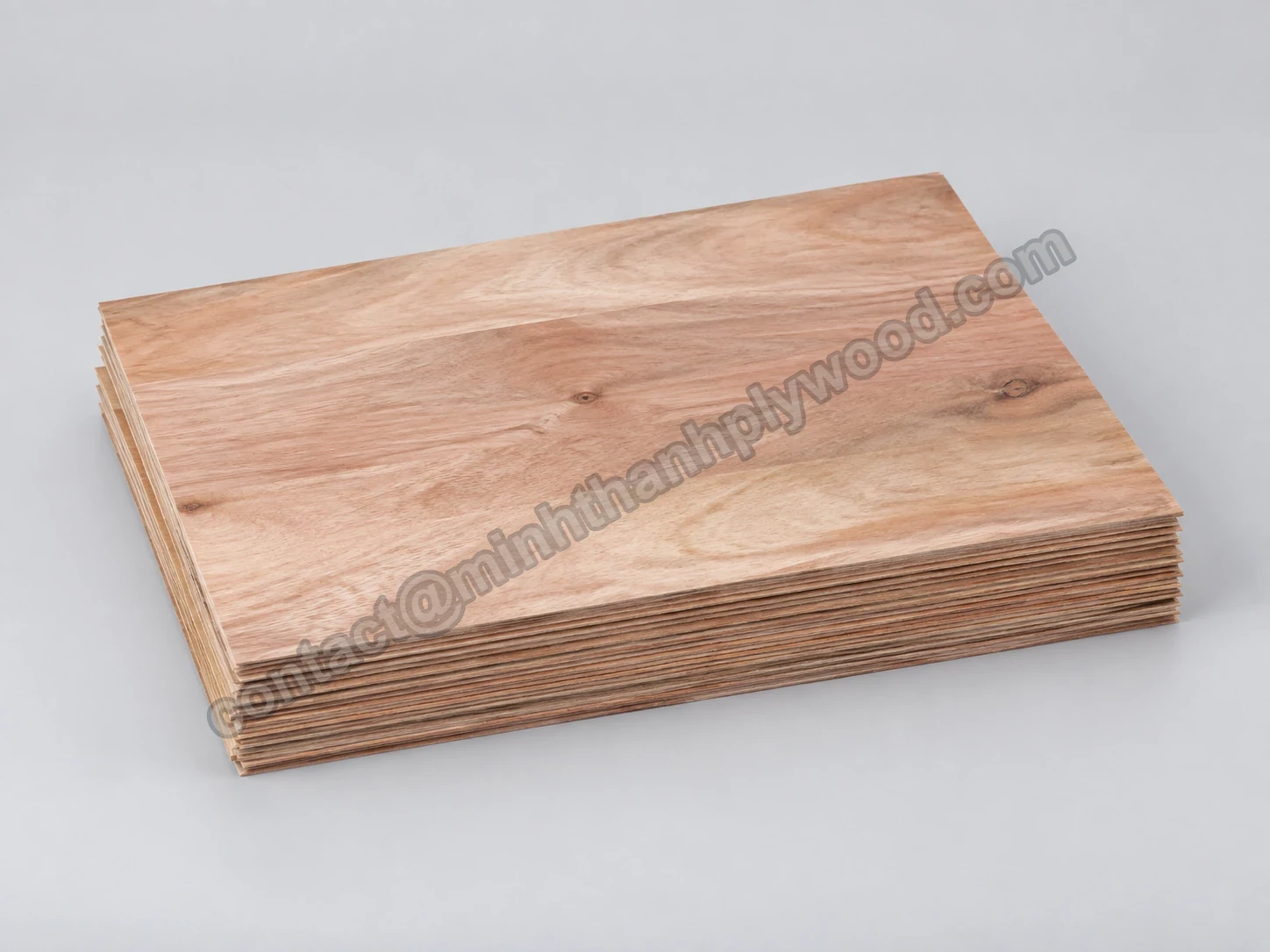
Acacia plywood is water resistant when it is bonded with melamine-fortified (MR) or phenolic (WBP) glue; with UF glue it is an interior panel. The species does not decide this, the glue does, and every plywood still takes up moisture through faces and edges. Surface coatings, protected edges and drainage details perform different jobs from the adhesive joining the veneers.
Minh Thanh’s standard furniture and interior panels use UF glue at E0 emission. Melamine-fortified and phenolic bonds are made to the customer’s specification. Write the intended service next to the bond requirement so an interior cabinet order and a moisture-exposed project cannot be mistaken for the same product.
The APA moisture exposure guidance, consulted 8 October 2026, explains that bond classifications are chosen for exposure conditions; we pick MR or WBP glue the same way.
For a finished cabinet or project part, include cuts and drilled holes in the protection plan. A coated broad face leaves an unfinished edge or fixing hole as a separate detail. Do not approve the material from a water-resistant face alone while leaving the actual component’s vulnerable surfaces untreated.
Can it be used for flooring, vehicle floors or formwork?
These applications need a panel and surface system designed for their loads, exposure and wear. An Acacia core can be one material choice within that system, but the wood name does not establish a floor rating, a formwork reuse count or a vehicle load capacity.
For a flooring component, identify whether plywood is a concealed substrate or the walking surface. The substrate needs support and fastening information; the wearing surface also needs a finish and wear specification. A decorative veneer selected for furniture appearance is a different purchasing decision from a tested commercial flooring surface.
Vehicle floors introduce local wheel loads, fixing details and edge exposure. Formwork introduces concrete pressure, support spacing, release agents and repeated handling. Specify the relevant performance documentation and design before selecting a species.
Minh Thanh also makes construction and exterior plywood. Acacia and Eucalyptus cores are the cores we use for film-faced and commercial panels, so name the application and we quote the matching face, bond and build.
How do thickness and moisture affect the order?
Use finished thickness and the agreed conditioning state to set machining clearances. A nominal panel description is insufficient for a tight groove or fitted furniture joint. Thickness should be checked at representative positions, especially where the component requires a close fit.
Minh Thanh furniture panels are offered from 3–40 mm, with tight thickness tolerance down to ±0.2 mm. Record the tolerance applicable to the selected order in the specification. Buying a material family with a general tolerance claim is different from fixing a finished thickness range for a machining programme.
Veneers and finished panels are dried to 8–12% moisture at dispatch. Store panels flat on aligned supports, protect them from water and allow the material to settle into the production environment before final machining. The USDA Wood Handbook, 2021 edition, provides the engineering background on moisture, wood movement and wood composites; consulted 8 October 2026.
The incoming inspection should retain panel identity, measurement locations and the instrument used. When a groove is too tight, compare actual panel measurements with the cutter and drawing before blaming the species. This gives both factory and buyer a practical record for solving the fit problem.
What emission and origin information belongs with the panel?
Keep emission performance and material origin connected to the selected panel construction. Acacia itself is not an emission class, and a resin name is not a finished-panel test result. The order record should identify the glue system and the buyer’s required documents separately.
Minh Thanh holds CARB P2 / TSCA Title VI certification for hardwood plywood veneer core. Its standard furniture description is UF glue at E0 emission. The EPA regulated-stakeholder guidance, consulted 8 October 2026, explains the testing and certification framework for regulated composite wood products.
For the core enquiry, provide the species information the importer needs and preserve the connection between origin records and the material delivered. We record the imported face species and the plantation core separately, so your file shows each layer’s origin.
Minh Thanh supplies the EUDR compliance dossier with orders. The quality page brings the factory’s certificates and testing information together. Keep this evidence alongside the practical finish and machining requirements so a purchasing team can review both the material and its documentation without confusing their purposes.
What should you send for an Acacia-core quotation?
Send a defined component requirement and a complete panel description to obtain a comparable quotation. Acacia is one core choice within that description. The strongest enquiry explains what the panel has to become after cutting, finishing and assembly.
Include application, Acacia core requirement, selected face/back species and grade, bond service, emission requirement, finished thickness and tolerance, sheet dimensions, quantity and delivery destination. Add drawings for cut pieces, grain direction and the locations where the edges remain visible. Name the finishing system and fittings if they affect sample approval.
For Minh Thanh, Styrax or Eucalyptus remains the standard furniture-core baseline, and Acacia is made on order. Use the catalogue to select the face and format, then send the intended Acacia construction through the quotation page. The factory can prepare free samples around that specification.
A successful core decision leaves the buyer with an accepted material record, a repeatable component trial and clear packing identification. Those are the details that turn the words “acacia plywood” into an order the workshop can use.
Buyer questions, answered
What is acacia plywood?
Acacia plywood contains Acacia veneer in its core, faces or both. A purchase specification should identify each layer's role, since an Acacia core can sit beneath a different decorative face.
Is an Acacia core the same as an Acacia face?
No. The core forms the internal panel construction; the face provides the visible wood surface. Specify the face/back separately from the Acacia core.
Does Minh Thanh make Acacia-core plywood?
Yes. Minh Thanh makes Acacia cores on order; standard furniture cores are Styrax or Eucalyptus. A 40HC carries 880 sheets of 18 mm Acacia-core plywood.
Is acacia plywood waterproof?
Acacia plywood is water resistant when it is bonded with melamine-fortified (MR) or phenolic (WBP) glue; with UF glue it is for dry interiors. No plywood is waterproof, so seal edges and holes in wet areas.
Can acacia plywood be used for cabinets?
Yes. Acacia-core plywood at about 580 kg/m³ makes firm cabinet sides and frames; Minh Thanh makes it on order under birch, poplar or EV faces, double pressed and sanded to ±0.2–0.3 mm.
Does Acacia make plywood scratch resistant?
No. Scratch resistance comes from the face veneer and its coating; the Acacia core sits underneath.
How do I compare Acacia, Styrax and Eucalyptus cores?
Styrax is the lightest at 500 kg/m³, Acacia about 580 kg/m³ and Eucalyptus 650–750 kg/m³. An 18 mm 1220 × 2440 mm sheet weighs 26.8, 31.1 and 34.8 kg respectively, and a 40HC carries 990, 880 or 795 sheets.
Can I order an Acacia core with a birch face?
Yes. Write Acacia core and the birch face/back pair, such as D+/D, as separate order lines; we send a free sample of that build.
Does an Acacia-core label prove structural suitability?
No. Structural use comes from a rated panel and its design values; the species name alone gives no load or span.
What should an Acacia-core RFQ include?
Include application, face/back species and grade, Acacia core requirement, bond and emission specification, finished dimensions, component drawings, packing, quantity and delivery destination.