
Eucalyptus core plywood is plywood whose inner veneers are peeled from plantation eucalyptus: a hard, dense core of about 650 kg/m³ that gives firm screw holding and a heavy, stiff panel. Minh Thanh Plywood uses eucalyptus as one of its two standard furniture cores, beside white styrax, and makes acacia cores on order.
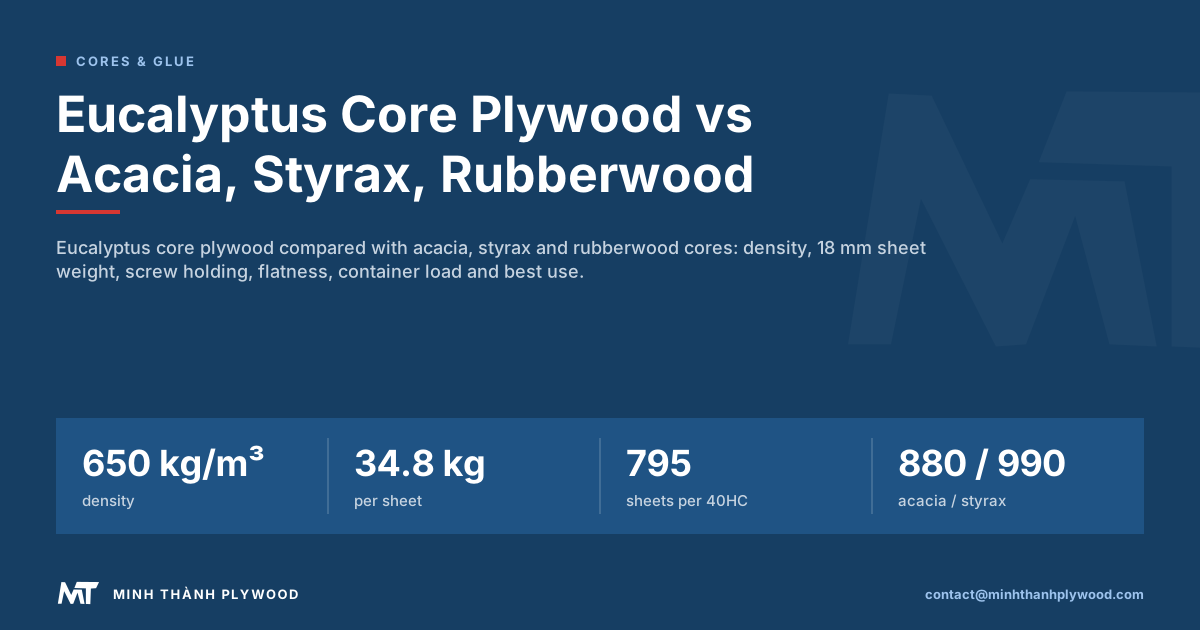
Eucalyptus core plywood is plywood built on core veneers peeled from plantation eucalyptus, a dense hardwood that gives a stiff, heavy panel with firm screw holding and a hard edge. In Vietnam it is one of four core species buyers meet, next to acacia, white styrax and, in the south, rubberwood; the right one depends on whether the panel must be hard, light or cheap to ship.
This guide puts the four cores side by side, with the weight of an 18 mm sheet and the container load for each, and answers the construction and furniture questions buyers ask. It is written by Minh Thanh Plywood, which uses eucalyptus and styrax as its standard furniture cores.
What is eucalyptus core plywood?
Eucalyptus core plywood is a cross-laminated panel whose inner layers are eucalyptus veneer, with face and back veneers of any species. The face gives the product its name (birch plywood, poplar plywood, eucalyptus plywood); the core decides weight, hardness and screw holding.
Eucalyptus is a fast-growing plantation hardwood in Vietnam. Its veneer is pink to light brown, hard and dense. At Minh Thanh, eucalyptus is one of the two standard furniture cores, with white styrax the other, and it is also a common core for commercial and film-faced plywood across the country.
Eucalyptus core plywood from Vietnam: how it is built
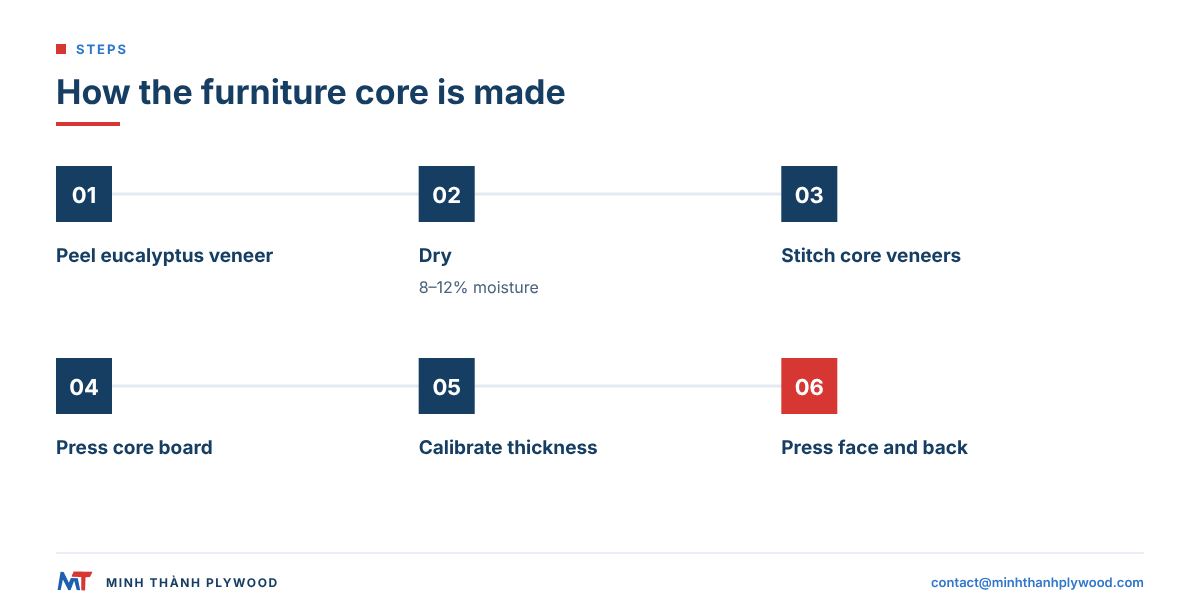
Eucalyptus core plywood from Vietnam is built from rotary-peeled eucalyptus veneers, dried to 8–12 % moisture content, glued, cross-laid and pressed. For furniture grade, Minh Thanh adds three steps that decide quality:
- Stitched core. Core layers are stitched horizontally and vertically, so pieces stay closed in the press.
- First press and calibration. The core board is pressed and sanded to an even thickness.
- Second press. The face and back are pressed onto the calibrated core.
An 18 mm panel usually has 11 to 13 plies, most often 11. Glue is UF at E0 emission for furniture and interior panels, or a melamine-fortified or phenolic (WBP) bond to the buyer’s specification. Sanded furniture panels are held to ±0.2–0.3 mm, down to ±0.2 mm.
Eucalyptus vs acacia vs styrax vs rubberwood cores compared
Eucalyptus is the hardest and heaviest of the three main Vietnamese cores, styrax the lightest and acacia sits between them; rubberwood is a niche core outside Minh Thanh’s range. The figures are Minh Thanh’s planning densities and the weights they give for an 18 mm, 1220 × 2440 mm sheet:
| Metric | Eucalyptus | Acacia | White Styrax | Rubberwood |
|---|---|---|---|---|
| Reference density | 650 kg/m³ (650–750 in practice) | 580 kg/m³ | 500 kg/m³ | Not made at Minh Thanh |
| 18 mm sheet weight | about 34.8 kg | about 31.1 kg | about 26.8 kg | — |
| Sheets per 40HC, 18 mm | 795 | 880 | 990 | — |
| Screw holding | Firmest | Firm | Good | Firm |
| Surface hardness | Highest | Medium | Lower | Medium |
| Colour under thin faces | Pink to brown | Light brown | White to cream | Pale |
| Minh Thanh range | Standard furniture core | On order | Standard furniture core | Not offered |
| Best use | Furniture, shelving, film-faced and exterior builds | Commercial, film-faced, anti-slip, packing | Light furniture, cabinets, painted and UV-coated panels | Niche southern supply |
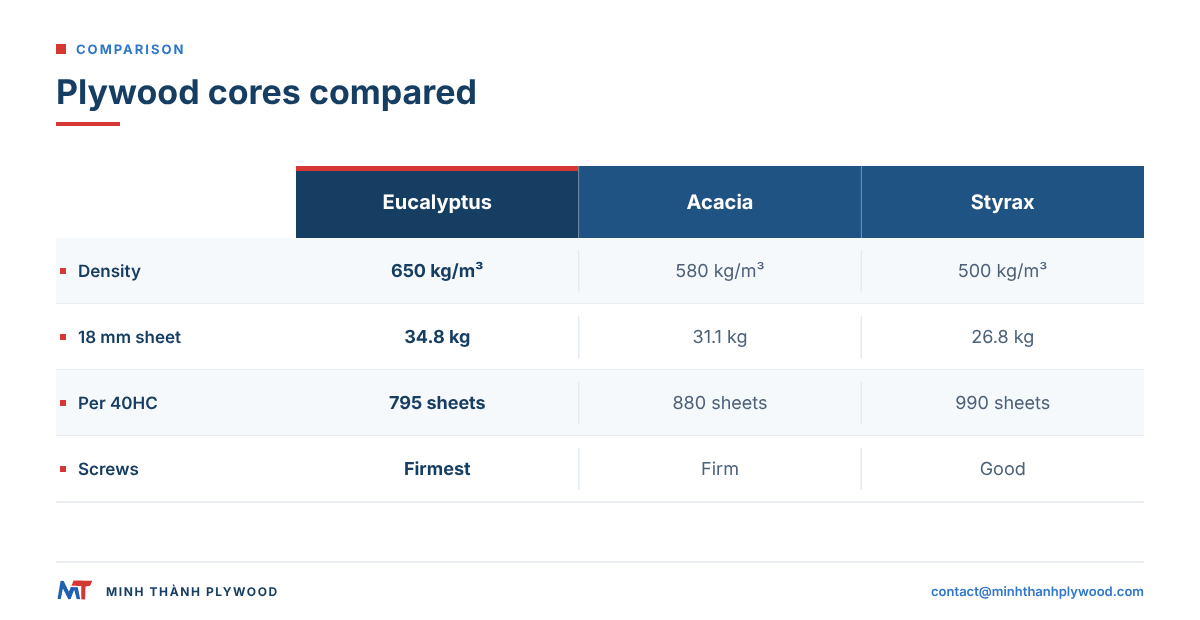
Real sheets are weighed before a container load is fixed, because density changes with build and order. The table also explains price differences between quotations: two 18 mm panels with the same face can differ by several kilograms per sheet, and a buyer comparing offers should compare the core species and the sheets per container, not only the price per cubic metre.
Eucalyptus core plywood sizes, grades and UK specification
Eucalyptus core plywood is sold in the UK as 1220 × 2440 mm sheets from 3.6 mm to 25 mm, graded B/BB or BB/CC, at E1 emission, and Minh Thanh builds the same sizes on a eucalyptus core. A UK merchant such as Sheet Materials Wholesale lists nine eucalyptus sheets in that range, with 3.6 mm at £7.99 ex VAT (Sheet Materials Wholesale, checked October 2026). The table gives the same sizes with the weight and container load of a eucalyptus core at 650 kg/m³.
| Thickness | Sheet weight | Sheets per pack | Sheets per 40HC | Illustrative calculation at US$350/m³ (GBP) |
|---|---|---|---|---|
| 3.6 mm | 7.0 kg | 267 | 4,005 | US$3.75 (£2.81) |
| 5.5 mm | 10.6 kg | 175 | 2,625 | US$5.73 (£4.29) |
| 9 mm | 17.4 kg | 107 | 1,605 | US$9.38 (£7.01) |
| 12 mm | 23.2 kg | 80 | 1,200 | US$12.50 (£9.35) |
| 15 mm | 29.0 kg | 64 | 960 | US$15.63 (£11.69) |
| 18 mm | 34.8 kg | 53 | 795 | US$18.75 (£14.03) |
| 25 mm | 48.4 kg | 38 | 570 | US$26.05 (£19.48) |
All sheets are 1220 × 2440 mm. The last column illustrates sheet volume multiplied by an assumed US$350/m³, converted at an assumed £1 = US$1.337; it is not an offer for every panel construction. The confirmed quotation specifies the face, core, glue and delivery term. Add freight, taxes or other charges only where that quotation excludes them.
Face grades in UK terms: British merchants write B/BB and BB/CC, while Minh Thanh quotes eucalyptus faces as A/A, A/B and B/B matched to the approved sample. Send the UK grade you sell and a sample of it, and the faces are matched to the sample, not to a letter.
The compliance line a UK buyer sees on a trade listing, for example one eucalyptus sheet listed with “B/BB E1 CE2+ EN636-3 EN314-2 Class 3, FSC”, has five parts:
- EN 636 and EN 314-2: EN 636 specifies plywood for dry, humid or exterior conditions; EN 314-2 specifies bonding-quality classes. Request the declared service and bond classes with supporting evidence, rather than inferring them from the resin name; see BWP, BWR and MR grades.
- E1 or E0: specify the emission requirement together with its test method; E0 has no single worldwide threshold. Minh Thanh uses UF glue at E0 emission for furniture and interior panels and arranges EN 717-1 testing through SGS on request.
- CE2+ or UKCA: the declaration of performance a structural panel needs under BS EN 13986. Plain furniture panels do not need it; structural use in Britain does, so state it in the enquiry.
- FSC: a chain-of-custody claim that is quoted per order, never assumed.
- UK Timber Regulation: due diligence on origin. Minh Thanh supplies origin records and geolocation files with orders, the same dossier built for the EUDR.
BSI lists BS EN 636:2012+A1:2015 for plywood in dry, humid or exterior conditions and BS EN 314-2:1993 for bonding quality.
Acacia vs eucalyptus core: which is better?
Eucalyptus is better where hardness and screw holding matter; acacia is better where weight and sheets per container matter. The difference is 70 kg/m³ in planning density, which is 3.7 kg on every 18 mm sheet and 85 fewer sheets in a 40HC.
- Choose eucalyptus for furniture carcasses, shelving, drawer fronts, worktops and panels with many fixings; for exterior and film-faced builds that take rough site handling.
- Choose acacia for commercial plywood, film-faced and anti-slip panels, packing and any order shipped on freight cost per sheet.
Film-faced and anti-slip plywood in Vietnam use only acacia or eucalyptus cores, because both take the phenolic film and the pressure of the press well. The acacia plywood guide covers the acacia side in detail.
Eucalyptus vs rubberwood vs acacia core
Eucalyptus, rubberwood and acacia are all hardwood cores, and in Vietnam rubberwood is the odd one out: a niche core from the south, costlier than the plantation cores of the north. Minh Thanh does not make it.
A buyer who has specified rubberwood elsewhere gets the closest match from a eucalyptus core when hardness is the reason, or from a styrax core when a pale core under thin faces is the reason. Both are standard at Minh Thanh, stitched and pressed twice, which is where the flatness of a furniture panel comes from rather than from the species alone.
Eucalyptus core density and the weight of an 18 mm sheet
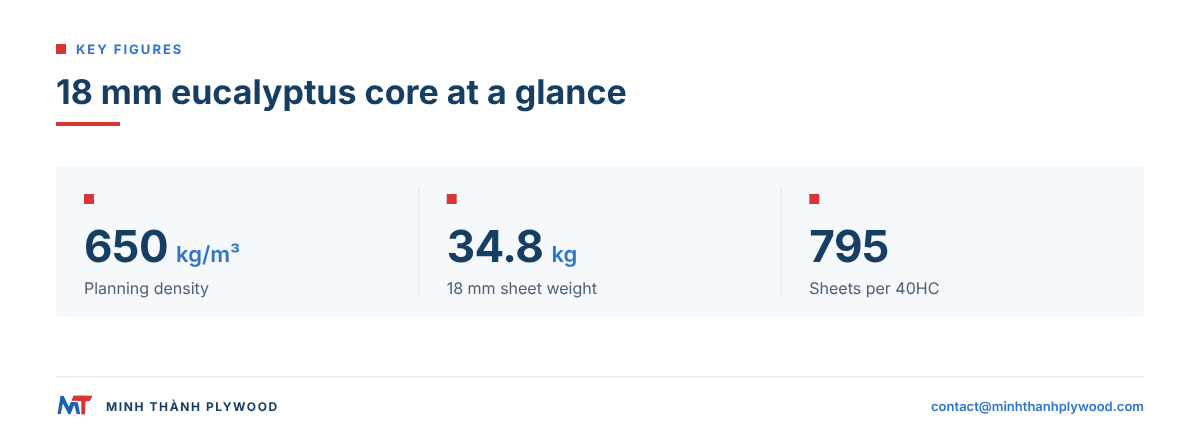
Eucalyptus core density is planned at 650 kg/m³, and real eucalyptus-core sheets weigh in at 650–750 kg/m³ depending on the build. Sheet weight is volume × density:
- 1220 × 2440 × 18 mm = about 0.0536 m³ per sheet.
- × 650 kg/m³ = about 34.8 kg per sheet.
The same sheet weighs about 31.1 kg on acacia and 26.8 kg on styrax. On a site or in a furniture plant, the roughly 8 kg difference per sheet affects handling and should be included in the handling plan. The plywood weight calculator gives other thicknesses and cores.
Is Vietnamese eucalyptus plywood strong enough for construction?
Vietnamese eucalyptus plywood can suit construction when the complete panel’s mechanical properties, bond and intended exposure meet the design. Eucalyptus is one of the two cores used for film-faced formwork and anti-slip plywood in Vietnam; the species alone does not establish a load rating.
For structural construction use in the UK, specify the panel’s declared EN 636 service conditions and mechanical properties, its EN 314-2 bond class, and the applicable conformity marking and declaration of performance. Specify:
- Bond: phenolic (WBP) or melamine-fortified, never interior UF glue.
- Face: phenolic film for film-faced plywood, or utility C/D faces for exterior plywood used as stair treads, sheathing and temporary structures.
- Thickness tolerance: ±0.5 mm for commercial and film-faced panels.
- Testing: where strength values must be documented, third-party testing to the buyer’s method through SGS on request.
For furniture, the same core with UF glue at E0 emission gives a hard, stiff panel for shelving and carcasses.
Can eucalyptus wood be used for furniture?
Eucalyptus wood is used for furniture both as a core and as a face. As a core, it is one of Minh Thanh’s two standard furniture cores: it holds screws, cam fittings and hinges firmly, and its hardness resists dents along the edges.
As a face, eucalyptus veneer is pressed on eucalyptus or styrax cores and quoted as face/back grades A/A, A/B and B/B, matched to the approved sample: A/A for two visible faces, A/B for one visible face, B/B for painted or overlaid panels. Both faces are sanded, polished and UV-ready, so a furniture plant can apply its own UV coating.
Which core should you choose for furniture plywood?
For furniture plywood, choose eucalyptus for hardness and fixings, styrax for low weight and a white core, and acacia only for commercial grades. Poplar and birch cores are not made in Vietnam; styrax is the Vietnamese match for a white poplar core, and a birch-faced panel on a Vietnamese core is the match for a birch look.
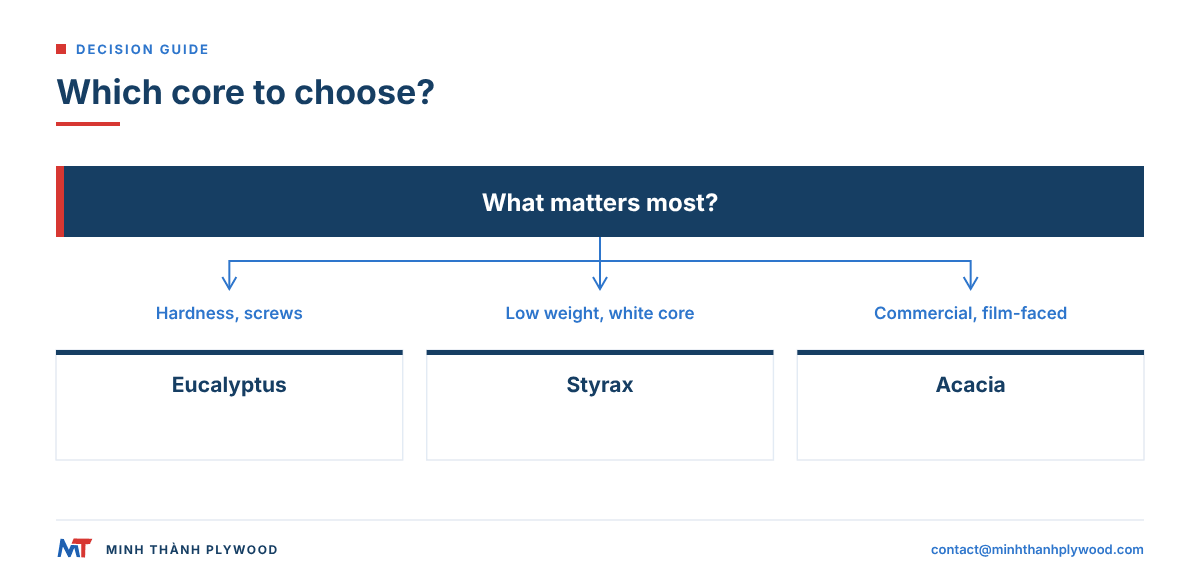
Many European furniture buyers choose the styrax core because it is light and gives an even bed under thin faces; buyers of shelving, beds and kitchen carcasses often prefer eucalyptus for screw holding. The poplar core plywood guide and best plywood for furniture cover the other options.
How the core changes the container load and freight per sheet
A heavier core fills the container’s payload before it fills the space, so eucalyptus loads fewer sheets than styrax or acacia. Minh Thanh’s 40HC plan for 18 mm, 1220 × 2440 mm, packs about one metre high and a planning payload of 28,000 kg:
| Core | Packs | Sheets per pack | Sheets per 40HC | Volume | Sheet weight |
|---|---|---|---|---|---|
| Eucalyptus | 15 | 53 | 795 | about 43 m³ | 34.8 kg |
| Acacia | 16 | 55 | 880 | about 47 m³ | 31.1 kg |
| Styrax | 18 (16 lying + 2 upright) | 55 | 990 | about 53 m³ | 26.8 kg |
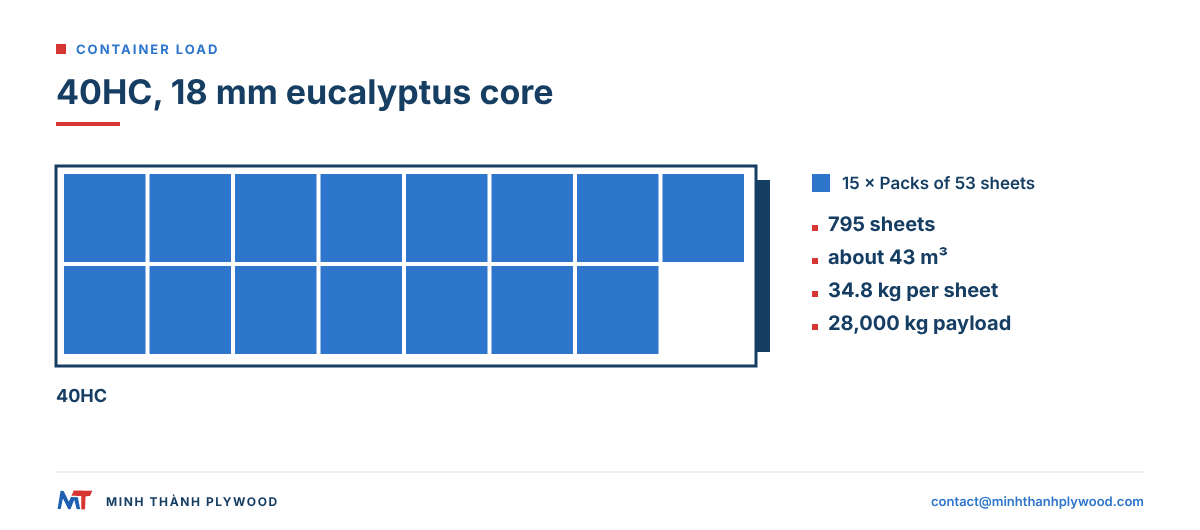
Weight is calculated from size × density, plus packing, and capped by the booking: when a carrier books less than 28,000 kg, fewer sheets go in. Freight per sheet on eucalyptus is therefore higher than on styrax, which belongs in the landed cost when cores are compared.
Eucalyptus core plywood supplier in Vietnam: what to check
A eucalyptus core plywood supplier in Vietnam should show the build, the documents and the panel before the order. Check these with Minh Thanh or any mill:
- Core build: stitched core, pressed twice for furniture grade, ply count for the thickness.
- Moisture: veneers and panels at 8–12 % moisture content at dispatch.
- Tolerance: ±0.2–0.3 mm on sanded furniture panels, ±0.5 mm on commercial and film-faced.
- Emission: CARB P2 / TSCA Title VI certification (ICTT mill no. 23024) and chamber tests: six ASTM D6007 tests between April 2025 and June 2026 on 9, 15 and 18 mm panels averaged 0.014–0.032 ppm. The limit for hardwood plywood made with a veneer core or a composite core is 0.05 ppm under EPA’s emission-limit guidance.
- Origin: the EUDR compliance dossier, with origin records and geolocation files, for EU orders.
- Proof: photos and video of every shipment before loading, and a free sample of the specified build.
Minh Thanh is in Ha Hoa, Phu Tho, close to the plantations that supply core timber, with a capacity of 50,000+ m³ per year.
What this means for your order
Name the core species, the build and the bond in the request, and price comparisons between mills become fair. Order terms at Minh Thanh: MOQ 1×40HC with mixed specifications by agreement, production 15–45 days after the 30% deposit, 70% against the scanned B/L or irrevocable L/C at sight, FOB Hai Phong, CFR or CIF. Indicative starting price, October 2026: furniture and interior plywood from US$350/m³.
The specification line for a eucalyptus-core furniture panel:
18 mm × 1220 × 2440 mm; face/back: eucalyptus A/B; core: eucalyptus, stitched, pressed twice; UF glue at E0 emission, CARB P2 / TSCA Title VI; thickness ±0.2 mm; sanded, polished, UV-ready; 1×40HC CIF your port.
Minh Thanh sends free samples and replies within hours: contact@minhthanhplywood.com or WhatsApp +84 988 586 601.
Buyer questions, answered
What is eucalyptus core plywood?
It is plywood whose core veneers are peeled from plantation eucalyptus, with a face veneer chosen for the look. The eucalyptus core is hard and dense, about 650 kg/m³, and gives firm screw holding.
What is the density of eucalyptus core plywood?
Minh Thanh plans eucalyptus-core panels at 650 kg/m³, and real sheets weigh in at 650–750 kg/m³ depending on build. An 18 mm sheet of 1220 × 2440 mm weighs about 34.8 kg at the planning density.
Eucalyptus core vs acacia core: which is better?
Eucalyptus is harder and heavier, at 650 kg/m³ against 580 kg/m³ for acacia, so it holds screws and edges better. Acacia is lighter and loads more sheets per container. Choose eucalyptus for furniture and shelving, acacia for commercial and film-faced panels.
Is Vietnamese eucalyptus plywood strong enough for construction?
Eucalyptus-core panels can be used in construction when the complete panel has the required strength, bond and service classification. Film-faced and exterior panels use eucalyptus or acacia cores, but the designer still needs evidence for the specified construction and support arrangement.
Can eucalyptus wood be used for furniture?
Yes. Eucalyptus is one of Minh Thanh's two standard furniture cores, stitched and pressed twice, and eucalyptus-faced panels are made in face/back grades A/A, A/B and B/B.
Is eucalyptus core heavier than styrax?
Yes. At 18 mm, a 1220 × 2440 mm sheet weighs about 34.8 kg on eucalyptus and 26.8 kg on white styrax. A 40HC takes 795 eucalyptus-core sheets against 990 on styrax.
Does Minh Thanh make rubberwood core plywood?
No. Rubberwood is a niche, costlier core grown in the south of Vietnam. Minh Thanh's standard furniture cores are styrax and eucalyptus, with acacia and pine on order.
Which core is best for furniture plywood: eucalyptus, acacia, poplar or birch?
For hardness and screw holding, eucalyptus; for light, white panels, styrax, the Vietnamese match for poplar; for full birch, a Baltic panel. Acacia suits commercial and film-faced builds better than fine furniture.
Is eucalyptus core plywood flat?
It stays flat when it is pressed twice and dried properly. Minh Thanh calibrates the core board before pressing the faces and dries veneers and panels to 8–12 % moisture content.
How many sheets of 18 mm eucalyptus core plywood fit in a 40HC?
About 795 sheets of 1220 × 2440 mm: 15 packs of 53 sheets, about 43 m³, capped by the 28,000 kg planning payload. A lower booking cap reduces the count.