
Plywood packing calculator
Plywood container loading calculator
One 40HC carries about 990 sheets of 18 mm plywood with our white Styrax core: 55 sheets per pack × 18 packs, about 53 m³. Minh Thanh Plywood loads every container at the factory to this plan. Pick a size, thickness and core below to see plywood sheets per container, per pack, the m³ and the weight, then send the result with your quote request.
Updated 6 October 2026 · prepared by the export team that plans and films every load
Watch the count
How many plywood sheets fit in a 40HC container?
The film walks through the count we use for every quote. Sheets per pack come from the stack height, packs per container from the core weight, and the payload sets the last limit. It ends with the 18 mm numbers for each core.
Read the film transcript
How many plywood sheets fit in one 40HC? With 18 mm Styrax core, about 990. Here is the whole count, in under three minutes. Step one: sheets per pack.
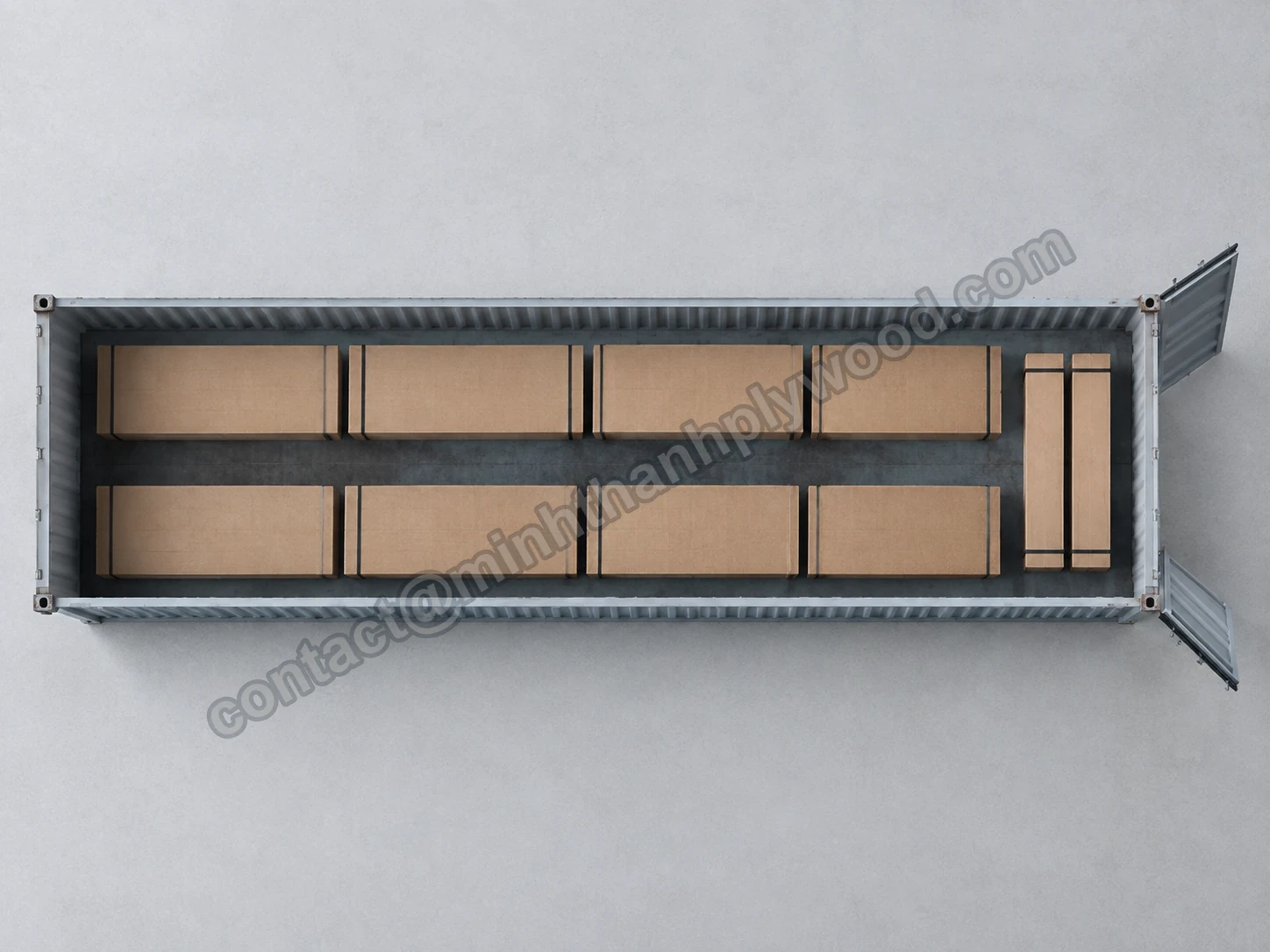
Divide the stack height by the sheet thickness, and round down. 1,000 mm ÷ 18 mm gives 55 sheets. Step two: packs per container. With our light Styrax core, one 40HC takes 18 packs. 16 lie on their side, two wide and two high, and 2 stand upright at the door. Acacia core, shown for comparison, stops at 16 packs.
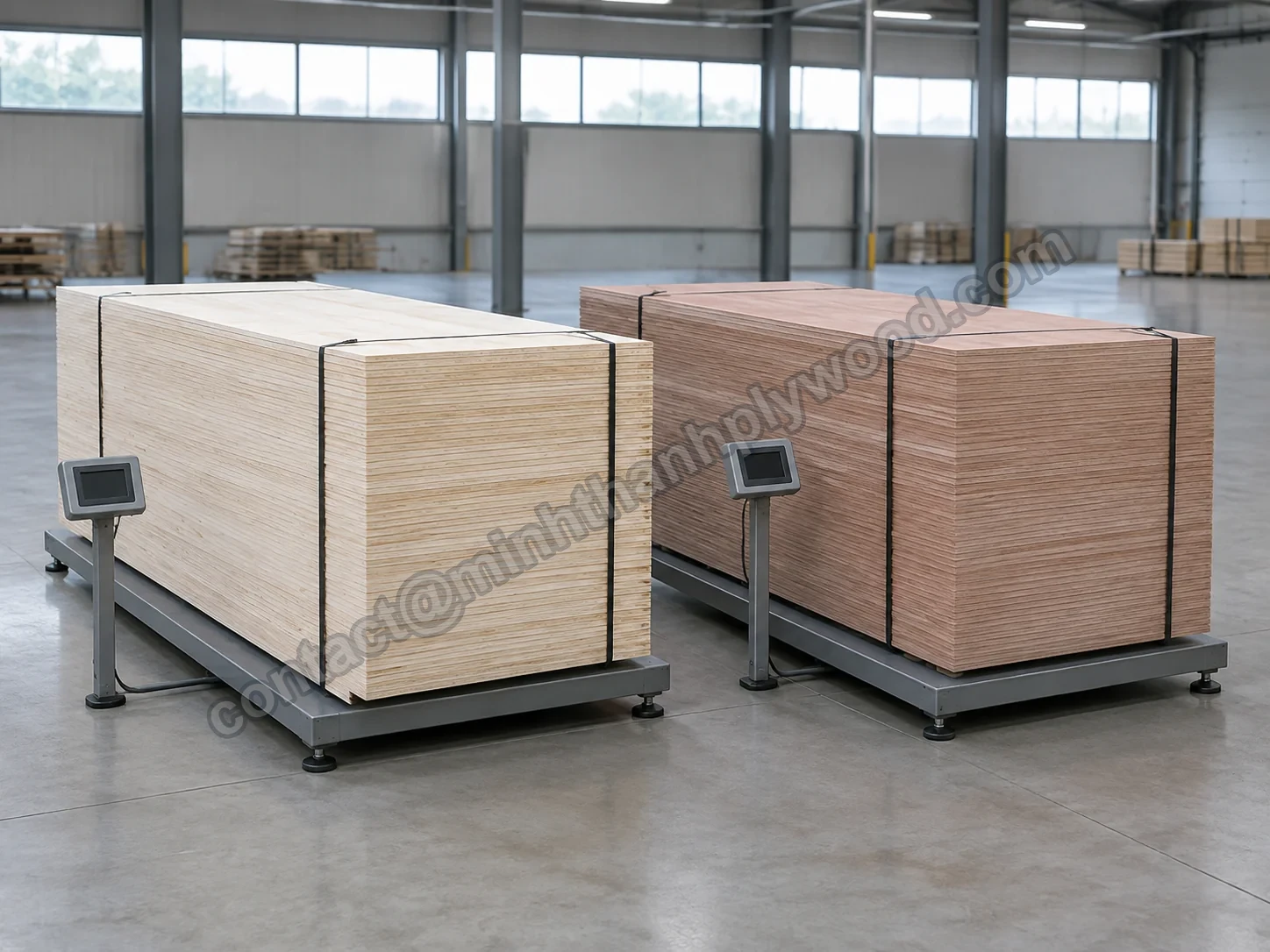
Eucalyptus, at 15. Why fewer packs with a denser core? Payload. Styrax about 500 kg/m³, Acacia 580, Eucalyptus 650.
We plan to 28,000 kg of cargo, unless your booking gives a lower figure. Denser cores reach it before the container is full. At 18 mm, 1220 × 2440 mm: Styrax loads 990 sheets, about 53 m³. Acacia: 880, about 47 m³.
Eucalyptus: 795, about 43 m³. One sheet weighs its volume times the core density. An 18 mm sheet is 0.0536 m³. 26.8 kg with Styrax, 31.1 kg with Acacia, 34.8 kg with Eucalyptus.
So why book a 40HC? A 40GP is 2.39 m inside: too low for two layers on their side. The 40HC gives 2.70 m, and a door of 2.58 m. So 2 packs stand on end at the door: the difference between 16 and 18 packs.
A 20GP is half the length. More than 18? No. Extra packs crush the pack bearers, and the importer ends up unloading sheet by sheet.
Our planned count is the count that unloads by forklift at your warehouse. Most containers carry 1 or 2 products; up to 6, by agreement. One specification per pack: heavy packs below, light ones on top. Then the total weight is checked against your payload.
Timber bearers, cover boards top and bottom, then cardboard or plastic film. Corner guards, steel or PET straps, and a label on two sides with the sheet count and pack number. We declare the verified gross mass (VGM) from the weighed load. The packing list, invoice and bill of lading show the same sheet count, m³ and weight.
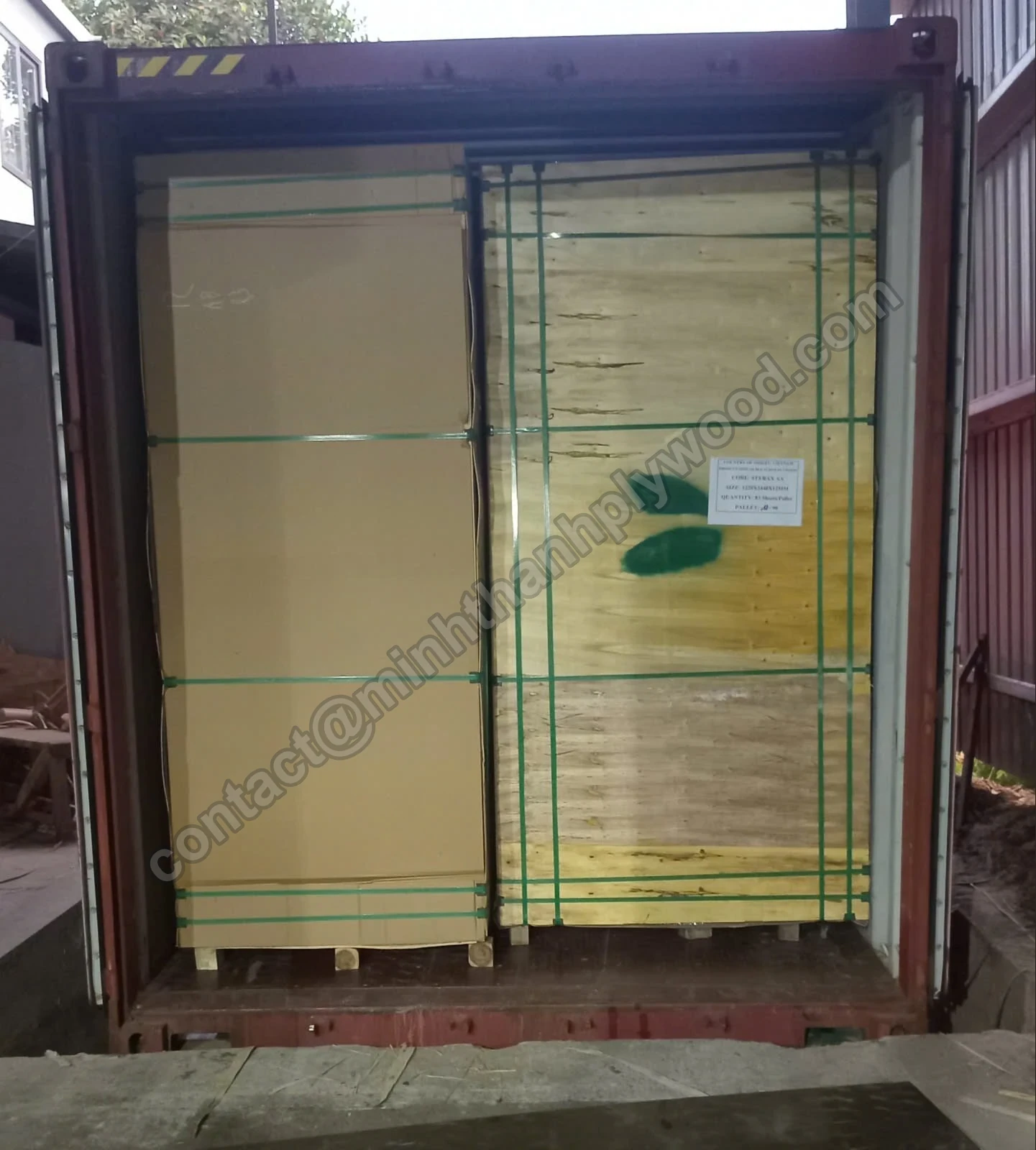
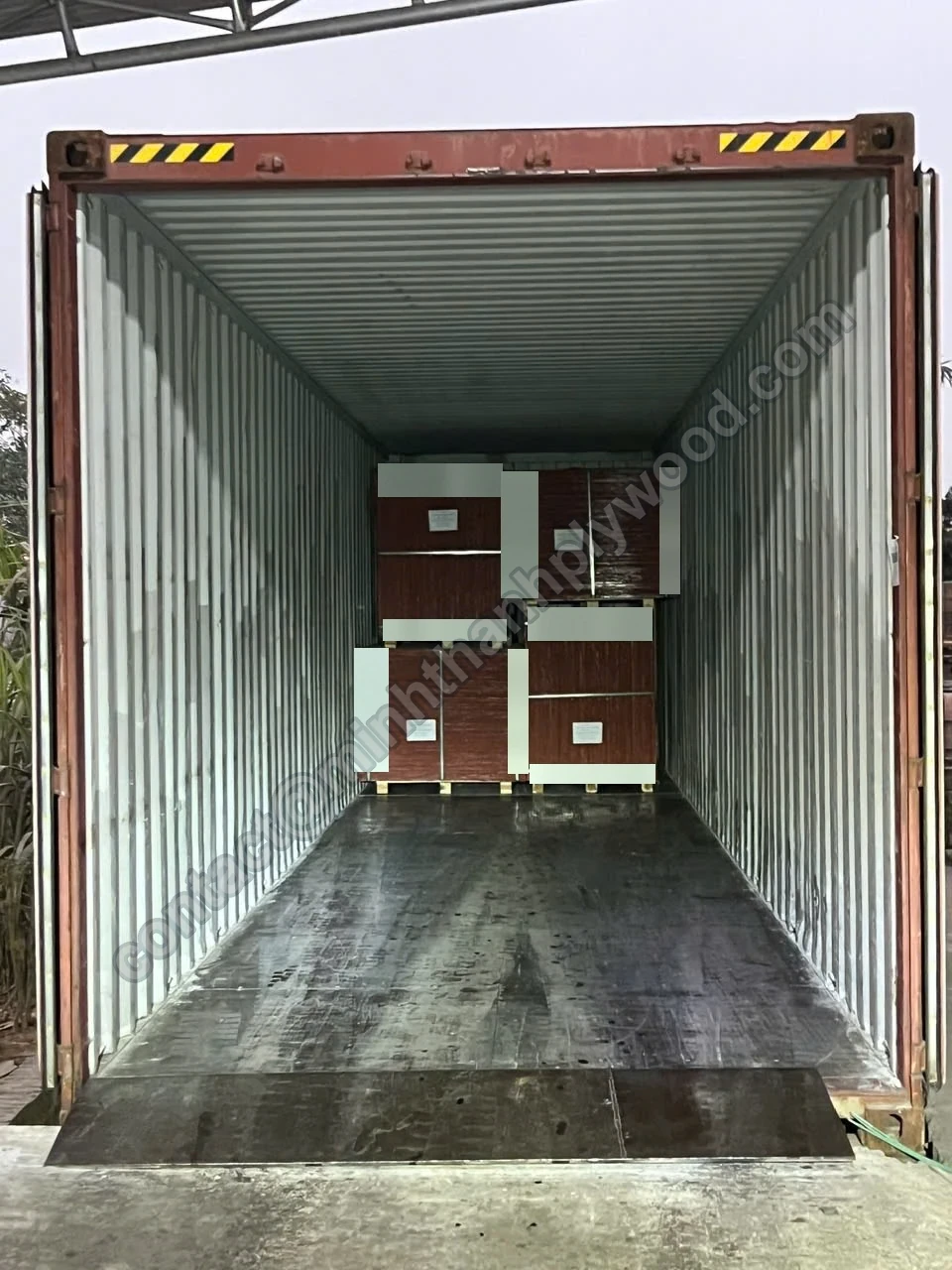
Every container is photographed and filmed during loading and before sealing. You get the photos and the film by email or WhatsApp, the same day. Now plan your own load: enter the size, thickness, core and payload in the calculator. Then send the result with your quote request.
Plywood packing calculator
Work out your own load in four steps
The calculator opens on the most common European order: 18 mm, 1220 × 2440 mm, Styrax core, 18 packs. It shows 990 sheets, 53 m³ and the panel weight before you touch a field.
- Choose the sheet size. 1220 × 2440 mm or 1250 × 2500 mm. Other sizes go in the width and length fields.
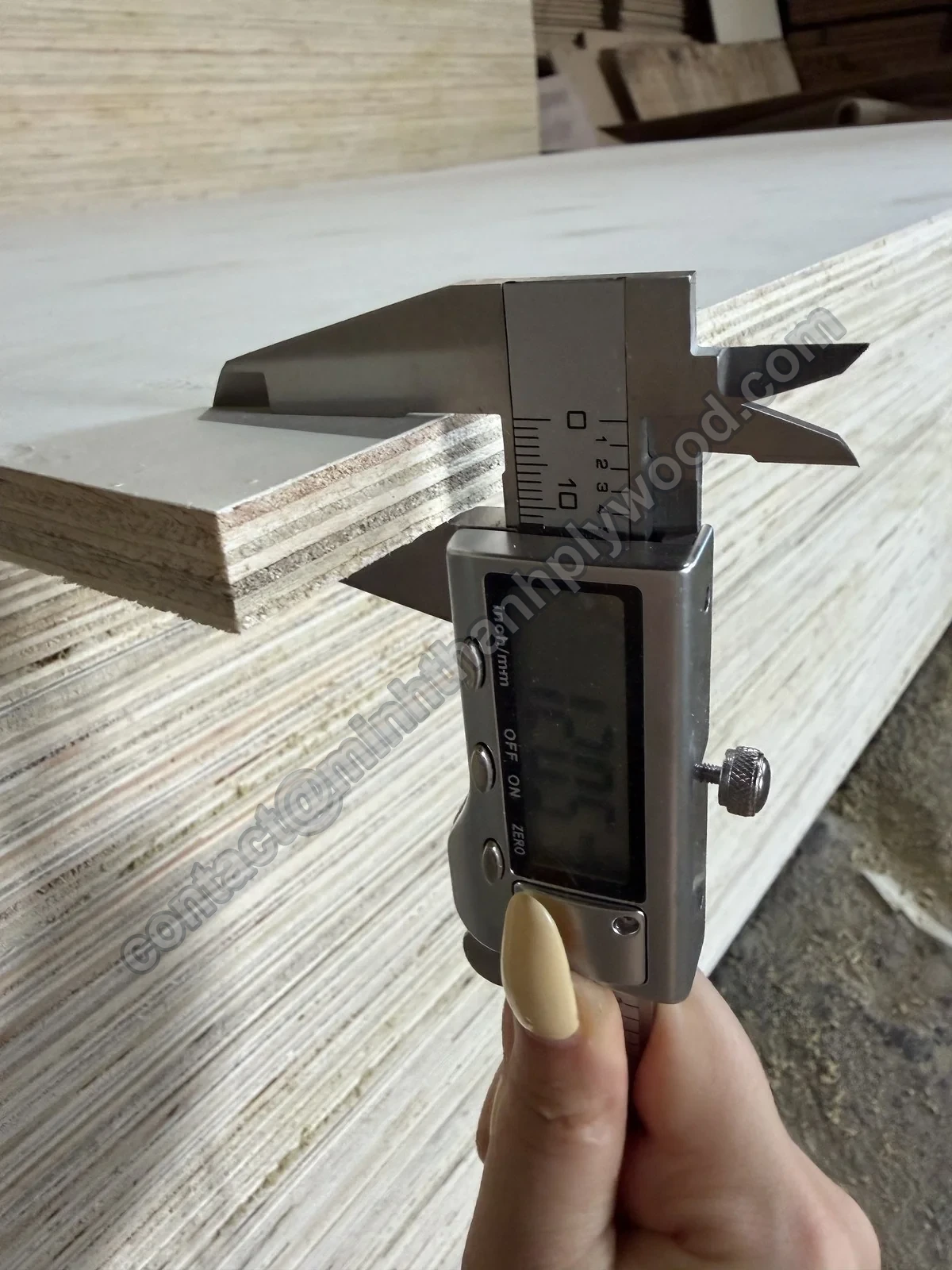
- Choose the thickness. Sheets per pack update at once: the usable stack height divided by the thickness, rounded down.
- Choose the core. Styrax, Acacia or Eucalyptus sets the density and the number of packs per 40HC.
- Add your order and payload. Enter the sheets you need and the payload in your booking. The result shows how many 40HC loads that is and carries into the quote form.
Loading estimate
Sheets
- Panel volume per sheet (m³)
- —
- Sheets per m³
- —
- Panel weight per sheet (kg)
- —
Pallets
18—
Volume
53.0m³ of panel
Weight
26,523kg, panels only
- Sheets requested for the order
- —
- 40HC loads (last container part-filled)
- —
What limits this load
The estimate will appear when the calculator is ready.
The final loading plan comes from the actual packs at Hai Phong; we photograph and film every container.
| Requested | Payload-constrained | |
|---|---|---|
| Total sheets | — | — |
| Pallets | — | — |
| Sheets per pallet | — | — |
| Used panel stack (mm) | — | — |
| Panel volume (m³) | — | — |
| Panel-only weight (kg) | — | — |
| Cargo incl. packing (kg) | — | — |
| Payload remaining (kg) | — | — |
| Payload status | — | — |
Assumptions behind the number
- Reference
- —
- Total packing mass
- —
- Cargo payload basis
- —
Review the full estimate text
The result panel gives four numbers for the whole container: sheets, packs, m³ and panel weight. Under them sit the volume, weight and count per m³ of a single sheet. A second column shows the payload-trimmed plan once you enter a packing weight and a payload.
Send the result with one click. The quote button carries the size, thickness, core, sheet count and m³ into the request form, so the export team starts from your numbers. The copy button puts the full plan on your clipboard for your forwarder.
Use it for a forecast as well as a single order. Run the thicknesses of a year's programme one by one and note the sheets per 40HC for each. The total tells you how many containers a season needs and how many sheets each delivery brings to the workshop.
Plywood sheets per container
Plywood sheets per container: every thickness, core and size
At 18 mm and 1220 × 2440 mm a 40HC carries 990 sheets with Styrax core, 880 with Acacia core and 795 with Eucalyptus core. The light core fills the space; the heavy core reaches the payload first. The tables below give the count for our two cores at every thickness from 3 to 40 mm.
| Core | Sheet size (mm) | Density (kg/m³) | Stack (mm) | Packs | Sheets / pack | Sheets / 40HC | m³ | Panels (t) | What fills first |
|---|---|---|---|---|---|---|---|---|---|
| Styrax | 1220 × 2440 | 500 | 1,000 | 18 | 55 | 990 | 53.0 | 26.5 | Space |
| Acacia (for comparison) | 1220 × 2440 | 580 | 1,000 | 16 | 55 | 880 | 47.2 | 27.3 | Payload (fewer packs) |
| Eucalyptus | 1220 × 2440 | 650 | 1,000 | 15 | 53 | 795 | 42.6 | 27.7 | Payload |
| Styrax | 1250 × 2500 | 500 | 970 | 18 | 53 | 954 | 53.7 | 26.8 | Space |
| Acacia (for comparison) | 1250 × 2500 | 580 | 970 | 16 | 53 | 848 | 47.7 | 27.7 | Payload (fewer packs) |
| Eucalyptus | 1250 × 2500 | 650 | 900 | 15 | 50 | 750 | 42.2 | 27.4 | Payload (fewer packs) |
Core density decides how far a 40HC fills. Styrax at 500 kg/m³ lets us load all 18 packs, about 53 m³, and the panels stay near 26.5 t. Acacia at 580 kg/m³ stops at 16 packs and about 47 m³. Eucalyptus at 650 kg/m³ stops at 15 packs and about 43 m³.
A load is volume-limited when the packs fill the box before the scale reaches the payload, and weight-limited when the scale gets there first. Only Styrax fills the full 16 + 2 plan. Acacia and Eucalyptus drop packs to stay inside 28,000 kg, and a 1220 × 2440 mm Eucalyptus load also trims each pack to 53 sheets of 18 mm instead of 55.
Our Eucalyptus-core panels run 650–750 kg/m³. The tables use 650 kg/m³, the light end. A panel at 750 kg/m³ fills a 28,000 kg payload at about 37 m³, so we weigh real panels before we fix a heavy-core plan.
The 1250 × 2500 mm size holds about 5 % more board per sheet than 1220 × 2440 mm. Packs of the larger size run a little lower, so each pack carries two sheets fewer at 18 mm: 53 instead of 55. A Styrax 40HC of 1250 × 2500 mm still carries 954 sheets and about 54 m³.
Thin panels pack the same volume as thick ones. A 40HC of 9 mm Styrax plywood holds 1,998 sheets, about twice the 18 mm count, and still about 53 m³. That is why freight per m³ stays flat across thicknesses while freight per sheet halves at 9 mm.
Thickness choice also shapes the load. A programme split between 15 mm and 18 mm panels fills the box the same way, since the m³ hardly moves. A programme of 3 to 6 mm panels carries thousands of sheets per container, so the order count, not the container, usually sets how many loads you book. Run each thickness in the calculator and plan the year in whole containers.
Mixed-core panels sit between the rows. A Styrax core with Eucalyptus crossbands loads more packs than full Eucalyptus and fewer than full Styrax. Enter the agreed density in the plywood packing calculator to see the exact count.
1220 × 2440 mm panels
| Thickness | Sheets / pack | Sheets / 40HC | m³ | Panels (t) |
|---|---|---|---|---|
| 3 mm | 333 | 5,994 | 53.5 | 26.8 |
| 4 mm | 250 | 4,500 | 53.6 | 26.8 |
| 5 mm | 200 | 3,600 | 53.6 | 26.8 |
| 6 mm | 166 | 2,988 | 53.4 | 26.7 |
| 8 mm | 125 | 2,250 | 53.6 | 26.8 |
| 9 mm | 111 | 1,998 | 53.5 | 26.8 |
| 10 mm | 100 | 1,800 | 53.6 | 26.8 |
| 11 mm | 90 | 1,620 | 53.0 | 26.5 |
| 12 mm | 83 | 1,494 | 53.4 | 26.7 |
| 14 mm | 71 | 1,278 | 53.3 | 26.6 |
| 15 mm | 66 | 1,188 | 53.0 | 26.5 |
| 16 mm | 62 | 1,116 | 53.2 | 26.6 |
| 17 mm | 58 | 1,044 | 52.8 | 26.4 |
| 18 mm | 55 | 990 | 53.0 | 26.5 |
| 20 mm | 50 | 900 | 53.6 | 26.8 |
| 21 mm | 47 | 846 | 52.9 | 26.4 |
| 25 mm | 40 | 720 | 53.6 | 26.8 |
| 30 mm | 33 | 594 | 53.0 | 26.5 |
| 35 mm | 28 | 504 | 52.5 | 26.3 |
| 40 mm | 25 | 450 | 53.6 | 26.8 |
| Thickness | Sheets / pack | Sheets / 40HC | m³ | Panels (t) |
|---|---|---|---|---|
| 3 mm | 321 | 4,815 * | 43.0 | 27.9 |
| 4 mm | 241 | 3,615 * | 43.0 | 28.0 |
| 5 mm | 192 | 2,880 * | 42.9 | 27.9 |
| 6 mm | 160 | 2,400 * | 42.9 | 27.9 |
| 8 mm | 120 | 1,800 * | 42.9 | 27.9 |
| 9 mm | 107 | 1,605 * | 43.0 | 27.9 |
| 10 mm | 96 | 1,440 * | 42.9 | 27.9 |
| 11 mm | 87 | 1,305 * | 42.7 | 27.8 |
| 12 mm | 80 | 1,200 * | 42.9 | 27.9 |
| 14 mm | 68 | 1,020 * | 42.5 | 27.6 |
| 15 mm | 64 | 960 * | 42.9 | 27.9 |
| 16 mm | 60 | 900 * | 42.9 | 27.9 |
| 17 mm | 56 | 840 * | 42.5 | 27.6 |
| 18 mm | 53 | 795 * | 42.6 | 27.7 |
| 20 mm | 48 | 720 * | 42.9 | 27.9 |
| 21 mm | 45 | 675 * | 42.2 | 27.4 |
| 25 mm | 38 | 570 * | 42.4 | 27.6 |
| 30 mm | 32 | 480 * | 42.9 | 27.9 |
| 35 mm | 27 | 405 * | 42.2 | 27.4 |
| 40 mm | 24 | 360 * | 42.9 | 27.9 |
1250 × 2500 mm panels
| Thickness | Sheets / pack | Sheets / 40HC | m³ | Panels (t) |
|---|---|---|---|---|
| 3 mm | 323 | 5,814 | 54.5 | 27.3 |
| 4 mm | 242 | 4,356 | 54.5 | 27.2 |
| 5 mm | 194 | 3,492 | 54.6 | 27.3 |
| 6 mm | 161 | 2,898 | 54.3 | 27.2 |
| 8 mm | 121 | 2,178 | 54.5 | 27.2 |
| 9 mm | 107 | 1,926 | 54.2 | 27.1 |
| 10 mm | 97 | 1,746 | 54.6 | 27.3 |
| 11 mm | 88 | 1,584 | 54.5 | 27.2 |
| 12 mm | 80 | 1,440 | 54.0 | 27.0 |
| 14 mm | 69 | 1,242 | 54.3 | 27.2 |
| 15 mm | 64 | 1,152 | 54.0 | 27.0 |
| 16 mm | 60 | 1,080 | 54.0 | 27.0 |
| 17 mm | 57 | 1,026 | 54.5 | 27.3 |
| 18 mm | 53 | 954 | 53.7 | 26.8 |
| 20 mm | 48 | 864 | 54.0 | 27.0 |
| 21 mm | 46 | 828 | 54.3 | 27.2 |
| 25 mm | 38 | 684 | 53.4 | 26.7 |
| 30 mm | 32 | 576 | 54.0 | 27.0 |
| 35 mm | 27 | 486 | 53.2 | 26.6 |
| 40 mm | 24 | 432 | 54.0 | 27.0 |
| Thickness | Sheets / pack | Sheets / 40HC | m³ | Panels (t) |
|---|---|---|---|---|
| 3 mm | 300 | 4,500 | 42.2 | 27.4 |
| 4 mm | 225 | 3,375 | 42.2 | 27.4 |
| 5 mm | 180 | 2,700 | 42.2 | 27.4 |
| 6 mm | 150 | 2,250 | 42.2 | 27.4 |
| 8 mm | 112 | 1,680 | 42.0 | 27.3 |
| 9 mm | 100 | 1,500 | 42.2 | 27.4 |
| 10 mm | 90 | 1,350 | 42.2 | 27.4 |
| 11 mm | 81 | 1,215 | 41.8 | 27.1 |
| 12 mm | 75 | 1,125 | 42.2 | 27.4 |
| 14 mm | 64 | 960 | 42.0 | 27.3 |
| 15 mm | 60 | 900 | 42.2 | 27.4 |
| 16 mm | 56 | 840 | 42.0 | 27.3 |
| 17 mm | 52 | 780 | 41.4 | 26.9 |
| 18 mm | 50 | 750 | 42.2 | 27.4 |
| 20 mm | 45 | 675 | 42.2 | 27.4 |
| 21 mm | 42 | 630 | 41.3 | 26.9 |
| 25 mm | 36 | 540 | 42.2 | 27.4 |
| 30 mm | 30 | 450 | 42.2 | 27.4 |
| 35 mm | 25 | 375 | 41.0 | 26.7 |
| 40 mm | 22 | 330 | 41.3 | 26.8 |
* The panels alone would pass a 28,000 kg payload here, so every pack carries fewer sheets. Planning stack heights: 1,000 mm (1220 × 2440), 970 mm (Styrax and Acacia, 1250 × 2500) and 900 mm (Eucalyptus, 1250 × 2500). Densities: Styrax 500, Acacia 580, Eucalyptus 650 kg/m³. Packing weight is not included.
Plywood sheet weight
How much does one plywood sheet weigh?
An 18 mm sheet of 1220 × 2440 mm weighs about 26.8 kg with a Styrax core, 31.1 kg with Acacia and 34.8 kg with Eucalyptus. Sheet weight is the sheet volume times the core density.
The formula has two steps. First find the volume of one sheet in cubic metres: width × length × thickness, all in metres. Then multiply by the panel density in kg/m³. The result is the weight of the bare panel at its dispatch moisture of 8–12 %.
Each extra millimetre adds about 1.5 kg to a 1220 × 2440 mm Styrax sheet and about 1.9 kg to a Eucalyptus sheet. A buyer who moves from 18 mm to 15 mm saves about 4.5 kg per Styrax sheet. The 40HC still carries the same m³, so the count rises to 1,188 sheets.
CBM, or cubic metres, is how plywood is priced and shipped. One 18 mm sheet of 1220 × 2440 mm is 0.0536 m³, so one m³ holds about 18.7 sheets. Multiply by the sheet count to get the m³ on the packing list.
A 1250 × 2500 mm sheet holds 3.125 m² of face against 2.977 m² for 1220 × 2440 mm. At 18 mm the larger sheet weighs about 28.1 kg with Styrax core and 36.6 kg with Eucalyptus. Packs of the larger size carry two sheets fewer, so the pack weight stays close.
- Sheet volume: 1.22 m × 2.44 m × 0.018 m = 0.0536 m³.
- Styrax core: 0.0536 m³ × 500 kg/m³ = 26.8 kg per sheet.
- Eucalyptus core: 0.0536 m³ × 650 kg/m³ = 34.8 kg per sheet.
- One 40HC of 18 mm Styrax: 990 sheets × 0.0536 m³ = 53 m³, and 990 × 26.8 kg = about 26.5 t of panels.
| Thickness | m³ / sheet | Sheets / m³ | Styrax kg / sheet | Eucalyptus kg / sheet |
|---|---|---|---|---|
| 3 mm | 0.0089 | 112.0 | 4.5 | 5.8 |
| 4 mm | 0.0119 | 84.0 | 6.0 | 7.7 |
| 5 mm | 0.0149 | 67.2 | 7.4 | 9.7 |
| 6 mm | 0.0179 | 56.0 | 8.9 | 11.6 |
| 8 mm | 0.0238 | 42.0 | 11.9 | 15.5 |
| 9 mm | 0.0268 | 37.3 | 13.4 | 17.4 |
| 10 mm | 0.0298 | 33.6 | 14.9 | 19.3 |
| 12 mm | 0.0357 | 28.0 | 17.9 | 23.2 |
| 15 mm | 0.0447 | 22.4 | 22.3 | 29.0 |
| 18 mm | 0.0536 | 18.7 | 26.8 | 34.8 |
| 21 mm | 0.0625 | 16.0 | 31.3 | 40.6 |
| 25 mm | 0.0744 | 13.4 | 37.2 | 48.4 |
| 30 mm | 0.0893 | 11.2 | 44.7 | 58.0 |
| 35 mm | 0.1042 | 9.6 | 52.1 | 67.7 |
| 40 mm | 0.1191 | 8.4 | 59.5 | 77.4 |
Weights are bare panels at the planning densities. A full pack weighs the sheet weight times the sheets per pack: 55 × 26.8 kg, about 1.5 t for 18 mm Styrax. Pallet bases, cardboard and straps come on top.
Which container to book
20GP, 40GP or 40HC: which container should you book for plywood?
Book a 40HC for plywood. Its 2.70 m inside height takes two layers of packs plus upright packs at the door, so it carries about 53 m³ of 18 mm Styrax-core panels. A 40GP is the same length but 2.39 m high, and a 20GP is half the length.
| Container | Inside L × W × H | Door W × H | Tare | Payload | Capacity |
|---|---|---|---|---|---|
| 20GP (20 ft standard) | 5.90 × 2.35 × 2.39 m | 2.34 × 2.28 m | 2,300 kg | 25,000 kg | 33.2 m³ |
| 40GP (40 ft standard) | 12.03 × 2.35 × 2.39 m | 2.34 × 2.28 m | 3,750 kg | 27,600 kg | 67.7 m³ |
| 40HC (40 ft high cube) | 12.03 × 2.35 × 2.70 m | 2.34 × 2.58 m | 3,940 kg | 28,560 kg | 76.4 m³ |
Why the 40HC wins for plywood
Plywood is dense cargo, but a low box runs out of height before it runs out of payload. In a 40GP the 2.39 m inside height cannot take two layers of packs turned on their side, so the same length carries fewer packs. In a 40HC the extra 0.31 m lets two layers sit with clearance for the forklift clamp.
The door height matters as much as the inside height. A 1220 × 2440 mm pack standing on end is at least 2.44 m tall. It passes the 2.58 m door of a 40HC and does not pass the 2.28 m door of a 40GP. Those two upright packs at the door are the difference between 16 and 18 packs.
Our minimum order is 1×40HC, and every quote is planned on that box. A 20GP carries about half the load at more than half the freight. We plan a 20GP only when a destination port or a site road cannot take a 40 ft unit.
Freight cost per sheet
Ocean freight is charged per container, not per sheet. The cost per sheet is the container rate divided by the sheets inside. The same rate spread over 990 sheets of 18 mm Styrax plywood costs 20 % less per sheet than over 795 sheets of Eucalyptus plywood.
That is why the core you choose changes the landed cost of a European furniture order. A buyer moving from Acacia to Styrax core gains 110 sheets per 40HC at 18 mm and a lighter panel for the workshop. Check the cost per sheet with the plywood MOQ and trade terms you use.
A container loaded to its payload lowers the cost per m³ as well. A 40HC that leaves with two packs missing pays the same freight for about 6 m³ less board. We size orders in whole containers so no space is paid for twice.
Inland freight follows the same arithmetic. The haulage from your port to the warehouse is charged per container, so a full 40HC spreads that cost over the most sheets as well.
Booking the container
Ask your forwarder for a 40HC in good grade, dry and clean, with the payload the line allows on your route. Give us that payload with the order. We plan the load to it and declare the weight it comes to.
If your haulier at destination caps the road weight, give us that figure too. A cap below the panel weight of a full Styrax load, for example 26 t per 40HC, means we lower every pack by the same few sheets. The calculator shows that plan before you book.
Plywood container loading
How do plywood packs sit inside a 40HC?
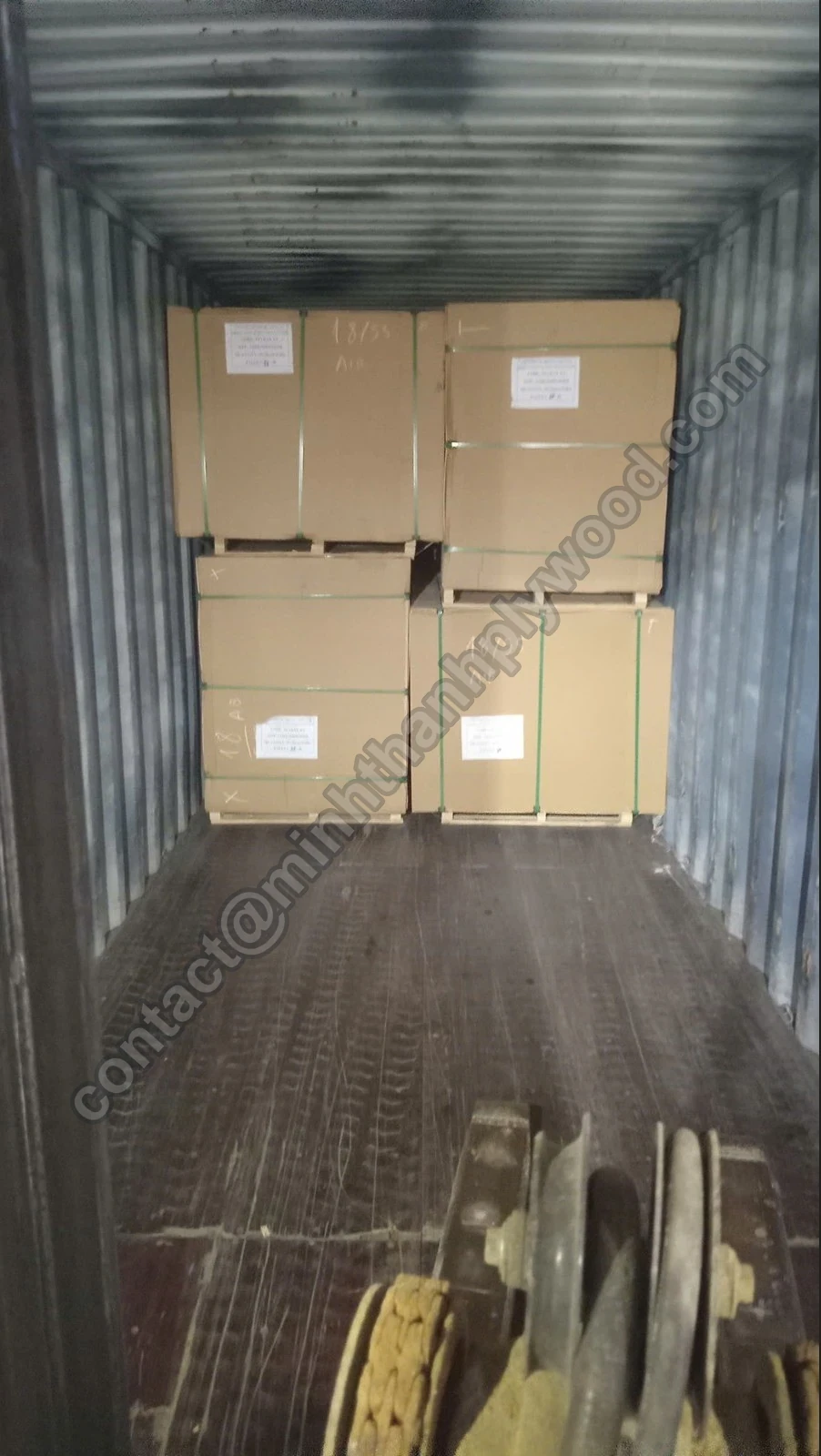
A Styrax-core 40HC takes 16 packs lying on their side in four rows of four, two wide and two high, plus 2 packs standing upright at the door end. Acacia loads stop at 16 packs and Eucalyptus at 15, with the upright packs left out first.
The 16 + 2 plan
A 40HC is 2.35 m wide inside, so two 1,220 mm-wide packs cannot lie flat side by side. The lying packs go in with the 1,000 mm stack across the width instead: two packs take about 2.0 m. Four of these pairs fill 9.76 m of the 12.03 m length.
The second layer sits on the first, and the 2.70 m height gives room for both. The last 2.3 m at the door takes two packs standing on end, side by side. These packs close the load and keep the rows from sliding toward the doors.
For 1250 × 2500 mm panels the four pairs fill 10.0 m, and the two upright packs still fit the remaining length. That is why both standard sizes load 18 Styrax packs.
Why packs stop at about 1,000 mm
The stack height is set by three things: the forklift, the pack and the roof. A pack of about 1,000 mm, about 1.5 t of 18 mm Styrax panels, is what a standard clamp lifts safely. A taller, heavier pack bends its bearers and sways on the forks.
Two layers of packs on their side stand about 2.44 m plus bearers, which leaves clearance under the 2.70 m roof for the clamp to place and release the top pack. The 1250 × 2500 mm size uses 970 mm, and 900 mm with Eucalyptus core, for the same reason.
We never force extra packs into a 40HC. A load pushed past the plan crushes the pack bearers, and the importer ends up unloading sheet by sheet. Our planned count is the count that unloads by forklift at your warehouse.
Mixed thicknesses or cores in one container
Most of our containers carry one or two products. Up to six products in one 40HC is possible by agreement. Each pack holds one thickness and one specification, so a mixed load is a mix of whole packs.
We plan a mixed load pack by pack. Thick and heavy packs go on the bottom layer, thin and light packs on top, and the weight is checked against the payload at the end. A mixed container of Styrax and Eucalyptus packs lands between the two single-core counts.
- List the specifications with sheets per line.
- We turn each line into whole packs at its own stack height.
- We place the packs on the 16 + 2 plan and add up m³ and weight.
- You receive the plan with the quotation, pack by pack.
Sizing the order in containers
Divide the sheets you need by the sheets per 40HC for your specification, then round up. An order of 2,000 sheets of 18 mm Styrax plywood is two full containers plus 20 sheets. Most buyers move the last 20 sheets into the next order, or take a thinner panel to fill the box.
The calculator does this division for you. Enter the sheets in step 4 and it shows the number of 40HC loads, with the partial load flagged for planning.
Repeat orders on the same plan
A buyer who orders the same specification every month gets the same load every month. The pack size, the label layout and the 16 + 2 plan stay fixed, so your warehouse knows what arrives and where it goes.
When the specification changes, we send the new plan with the quotation before production starts. A change in thickness changes the sheets per pack; a change in core changes the packs per container. Neither surprises you on arrival.
Loading day, step by step
- The empty 40HC arrives at the factory in Ha Hoa and is checked inside and out.
- Packs come from the warehouse in loading order, labels outward, and are counted against the packing plan.
- The forklift clamp places the bottom layer from the front wall toward the doors, then the top layer.
- The two upright packs go in last at the door end, and gaps are blocked with timber.
- We photograph and film the full load, close the doors and fix the seal, then record the seal number on the packing list.
Container checks and load securing
Each empty container is checked before the first pack goes in: dry floor, no holes in the roof, no nails, doors that seal. A wet floor or a pinhole leak marks the bottom sheets in a month at sea, so a doubtful box goes back to the yard.
Packs go in by forklift clamp in the planned order, tight against the front wall and against each other. Gaps are packed with timber so the load cannot shift on the road to Hai Phong or in rough seas. Every container is photographed and filmed during loading and before sealing, and you receive the photos and video by email or WhatsApp.
Unloading at your warehouse
Check the seal number against the packing list before the doors open. The two upright packs come out first with a forklift clamp, then the top layer, then the bottom layer from the doors back to the front wall.
Keep the packs flat on their bearers, indoors and off the floor, until the panels are used. A pack that stands on end in a damp yard takes up moisture at the bottom edge. Compare the pack labels and the photos we sent with the packing list, and you have checked the load before the first strap is cut.
A forklift with a sheet clamp or long forks takes each pack in one lift. A full 40HC unloads with one forklift and a clear bay at the dock, pack by pack.
Export packing
How is each plywood pack built for export?
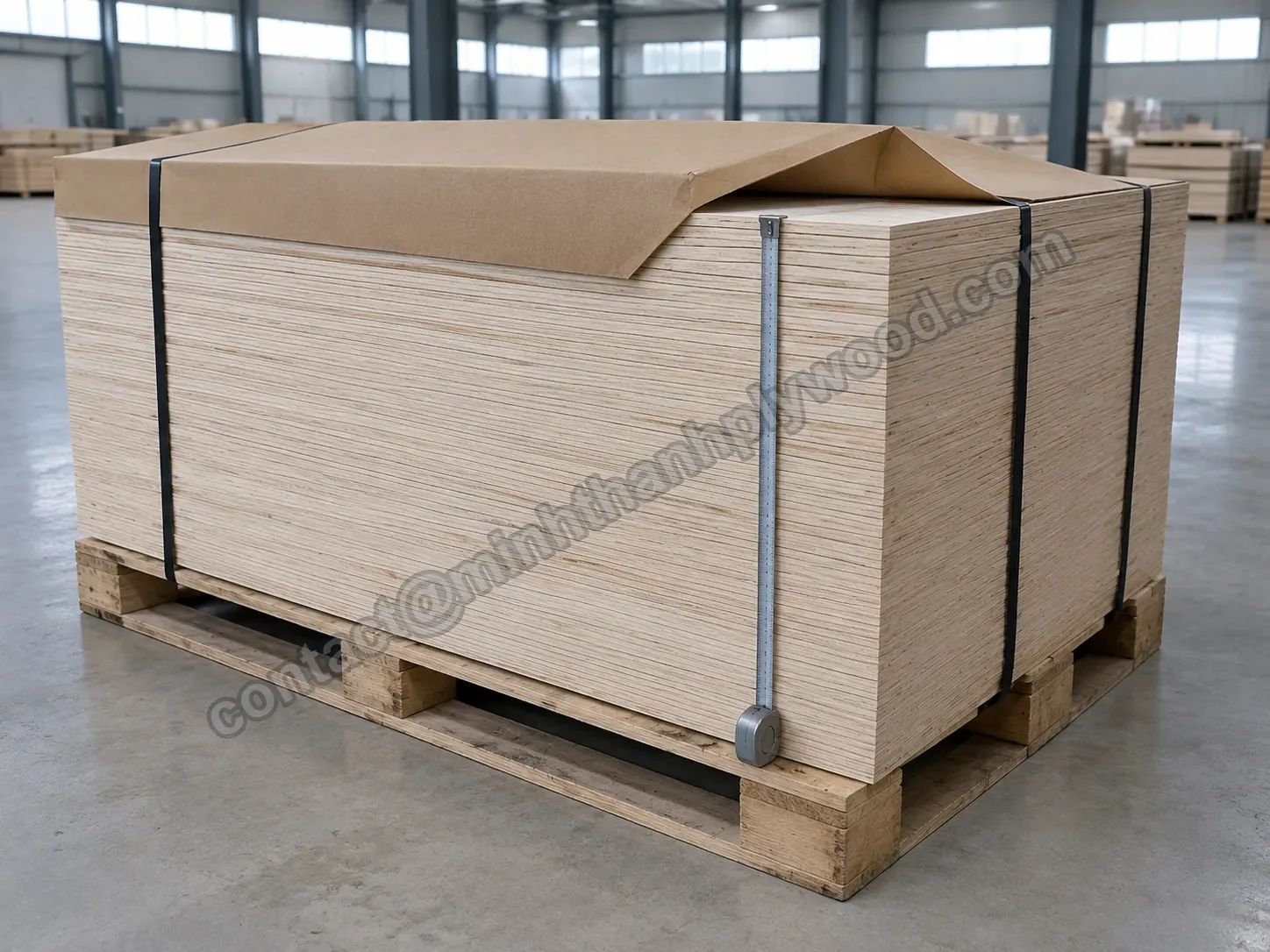
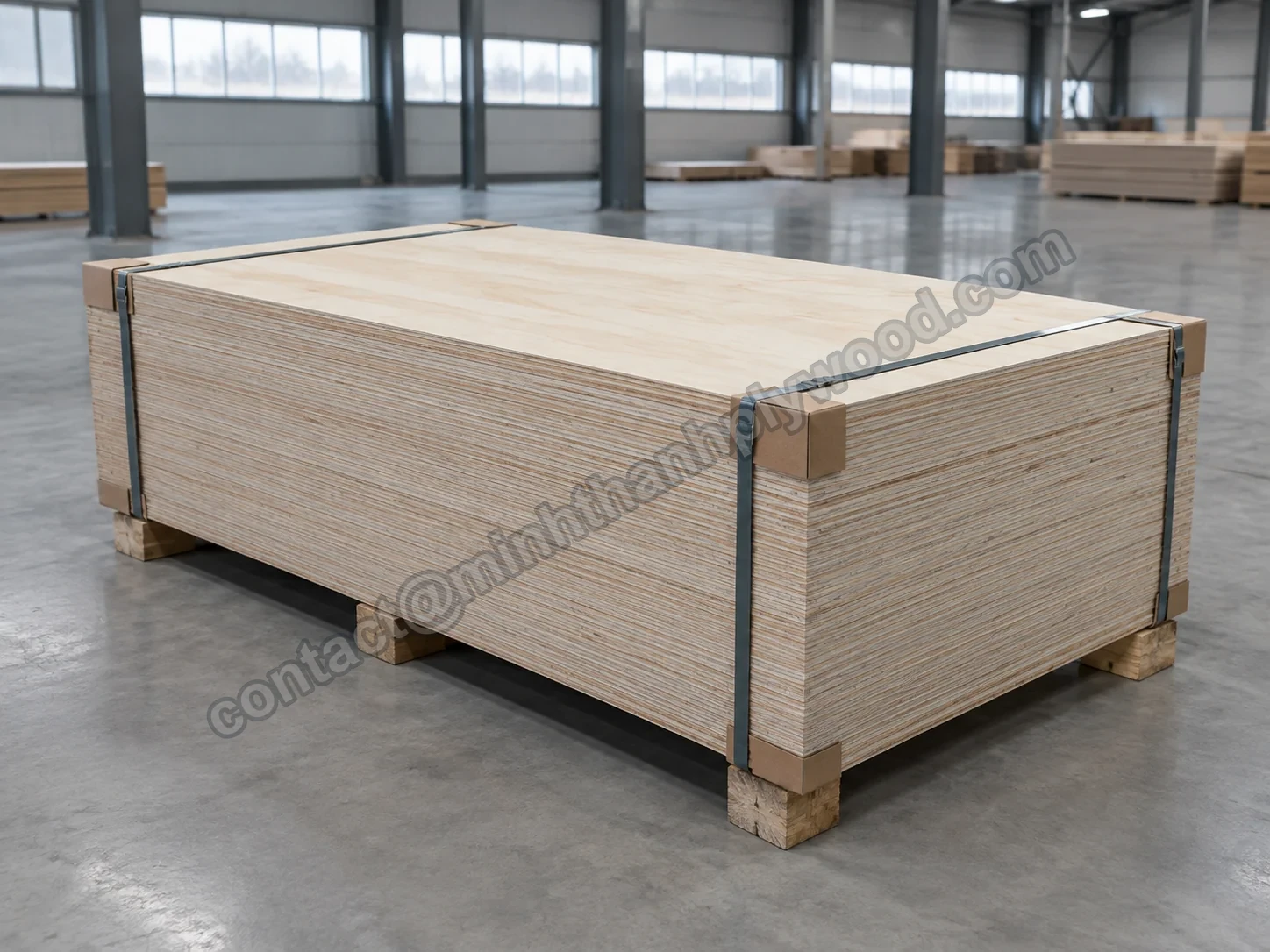
Every pack sits on a timber pallet base, is covered with cardboard or plastic film, guarded at the corners and tied with steel or PET straps. A label on two sides gives the specification, sheet count and pack number that the packing list repeats.
The pack, from the bottom up
- Pallet base: timber or plywood bearers under the full length, so the forklift clamp and the container floor never touch a sheet.
- Bottom and top cover boards: a sheet of packing plywood or hardboard that takes the strap pressure off the faces.
- Cardboard or plastic film around the stack against dust, scuffs and moisture on the way to the port.
- Corner guards on every strapped edge, so straps do not cut into the top and bottom sheets.
- Steel or PET straps across the length and the width, tensioned after the corner guards are on.
- Labels on two sides: product, size, thickness, grade, sheet count and pack number. Your own label or edge print on request.
Thin and faced panels
Thin panels from 3 to 6 mm pack in the hundreds: a 1,000 mm stack holds 333 sheets of 3 mm. They sit on a full plywood cover board top and bottom, so the straps press on the board and the stack stays flat. Faced panels for furniture travel face to face where the order asks for it, so the best faces never touch a strap or a bearer.
Packing options on request
Export pallets, your own pack labels and printed or stamped panel edges are available on any order. Tell us with the specification, and the label text, barcode or edge mark goes on the pack plan before production. Your warehouse then books in each pack by scanning the label, without opening the cover.
Weight that packing and moisture add
The pallet base, cover boards, cardboard and straps add weight that the panel tables leave out. Enter the total packing weight for the load in the calculator, and it cuts sheets per pack until panels and packing fit your payload together.
Moisture adds weight too. Our panels leave at 8–12 % moisture content. A panel at 12 % weighs about 4 % more than the same panel at 8 %, so a heavy-core plan keeps that margin under the payload.
Verified gross mass (VGM)
Under the IMO SOLAS rules on verified gross mass, in force since 1 July 2016, no packed container is loaded on a ship without a declared gross mass. The gross mass is cargo, packing and container tare together.
We declare the VGM from the weighed load. Because we plan to the payload in your booking, the declared mass never surprises the carrier. Road limits in some destination countries are lower than the container payload, so tell us any cap your haulier sets, such as 26 t per 40HC, and we plan to it.
Documents that match the load
The packing list, commercial invoice and bill of lading must show the same sheet count, m³ and weight. We build the packing list from the pack labels, pack by pack, so the three documents agree. You get the drafts to check after loading, before the B/L is issued.
Certificate copies and test reports travel with the documents when the order needs them; our certificates and test reports page lists what we hold.
Proof from our own loading
Every container leaves with a photo set and a short film: packs in place, labels readable, doors closed, seal fixed. You receive them the day of loading, before the vessel sails. Buyers use them to check the pack count and the condition of the cover sheets against the packing list.
The packs are our furniture panels in cardboard covers, strapped on bearers, loaded by forklift clamp two high.
How the numbers work
How does the plywood container loading calculator count?
Sheets per pack are the usable stack height divided by the thickness, rounded down. Sheets per container are sheets per pack times packs. Volume comes from the sheet size and count, weight from the density, and the payload trims every pack equally when the load is too heavy.
The formulas
- Sheets per pack = stack height ÷ thickness, rounded down. 1,000 mm ÷ 18 mm = 55 sheets.
- Sheets per container = sheets per pack × packs. 55 × 18 = 990 sheets.
- m³ = width × length × thickness × sheets, in metres. 1.22 × 2.44 × 0.018 × 990 = 53 m³.
- Panel weight = m³ × density. 53 m³ × 500 kg/m³ = about 26.5 t.
- Payload check: panel weight + packing weight against your payload. Over the limit, every pack loses the same number of sheets until the load fits.
The inputs behind the tables
Stack heights and pack counts for Styrax and Eucalyptus come from our own 40HC loads for each size. Densities are planning values: Styrax 500 and Eucalyptus 650 kg/m³, with Acacia at 580 kg/m³ for comparison. The tables count panels against 28,000 kg. Pallets, covers and straps come on top, so enter your packing weight and the calculator trims every pack until panels plus packing fit your booking.
Acacia is shown for comparison because many Vietnamese mills use it. Our own furniture panels are built on Styrax and Eucalyptus cores.
Why these numbers differ from generic calculators
Generic tools divide the container volume by the sheet volume and stop there. That answer ignores the pack, the bearers, the forklift clamp and the door. Our tables start from the packs we really load: the stack height for each core and size, and the pack count that unloads by forklift.
The result is lower than a pure volume answer and higher than a cautious guess. It is the count a buyer can plan a warehouse, a production run and a cash flow on.
How we check the plan before production
With the order confirmed, the export team turns your quantities into a pack list: thickness, sheets per pack, pack count and weight per pack. You see that list with the proforma invoice. If a line leaves a part pack, we propose the top-up or the split before the first sheet is pressed.
Worked example: a two-product order
A furniture buyer needs 600 sheets of 18 mm Styrax-core plywood and 600 sheets of 12 mm, both 1220 × 2440 mm. At 55 sheets per pack the 18 mm line makes 10 full packs and one pack of 50. At 83 sheets per pack the 12 mm line makes 7 full packs and one pack of 19.
That is 19 packs, one more than the 18 a Styrax 40HC takes. We suggest topping up to a clean plan instead: 10 packs of 18 mm (550 sheets) and 8 packs of 12 mm (664 sheets). The container then carries 18 packs, about 53 m³, and stays inside the payload.
The same logic works for any mix. Give us the sheets per line, and we return whole packs and a load that fits.
Where the reference numbers stop
The tables count equal packs of one specification. Mixed loads, packing weight and a lower payload from your booking change the answer, and the calculator takes all three. The final count is the one on your packing list, built from the packs that went into your container.
FAQ
Plywood container loading questions
Short answers with numbers. The tables above give every thickness.
How many sheets of plywood are in a 40ft container?
A 40ft high cube carries about 990 sheets of 18 mm, 1220 × 2440 mm plywood with a Styrax core: 18 packs of 55 sheets, about 53 m³. With Acacia core it is 880 sheets, with Eucalyptus core 795.
Does the plywood core type affect container loading?
Yes. A heavier core reaches the payload with fewer packs. At 18 mm a 40HC takes 18 packs of Styrax core, 16 of Acacia and 15 of Eucalyptus, so the light core ships about 10 m³ more per container.
Can I mix core types in one 40HC container?
Yes. Each pack holds one specification, and we plan the container pack by pack. Heavy packs go on the bottom layer, and the total weight is checked against your payload before loading.
How many sheets of plywood are in one pack?
The stack height divided by the thickness, rounded down. A 1,000 mm pack holds 55 sheets of 18 mm, 83 of 12 mm and 111 of 9 mm in 1220 × 2440 mm.
How many m³ of plywood fit in a 40HC?
About 53 m³ of Styrax-core plywood, 47 m³ of Acacia core and 43 m³ of Eucalyptus core. The m³ stays almost the same for every thickness; only the sheet count changes.
How much does an 18 mm plywood sheet weigh?
A 1220 × 2440 mm sheet of 18 mm weighs about 26.8 kg with Styrax core, 31.1 kg with Acacia and 34.8 kg with Eucalyptus. Weight is sheet volume times core density.
Can I load plywood in a 20ft container?
Yes, but a 40HC is cheaper per sheet. A 20GP is half the length and has a 2.28 m door, so packs cannot stand at the door end. Our minimum order is one 40HC.
Can you load more than 18 packs in a 40HC?
No. Extra packs forced into a 40HC crush the pallet bearers and turn unloading into hand work. We load to the plan that unloads by forklift at your warehouse.
What payload do you plan a 40HC to?
We plan to 28,000 kg of cargo unless your booking gives a lower figure. The tables count panels only; enter the packing weight in the calculator and every pack is trimmed until panels plus packing fit.
Do you send photos of my container?
Yes. Every container is photographed and filmed during loading and before sealing. You receive the photos and the film by email or WhatsApp on the day of loading.
Work with Minh Thành Plywood
Send your loading plan with the quote request
Send the size, thickness, core, face, glue, packing and destination port, or the calculator result. We reply with the price per m³, sheets per 40HC and the pack plan, usually within hours.