
A/A
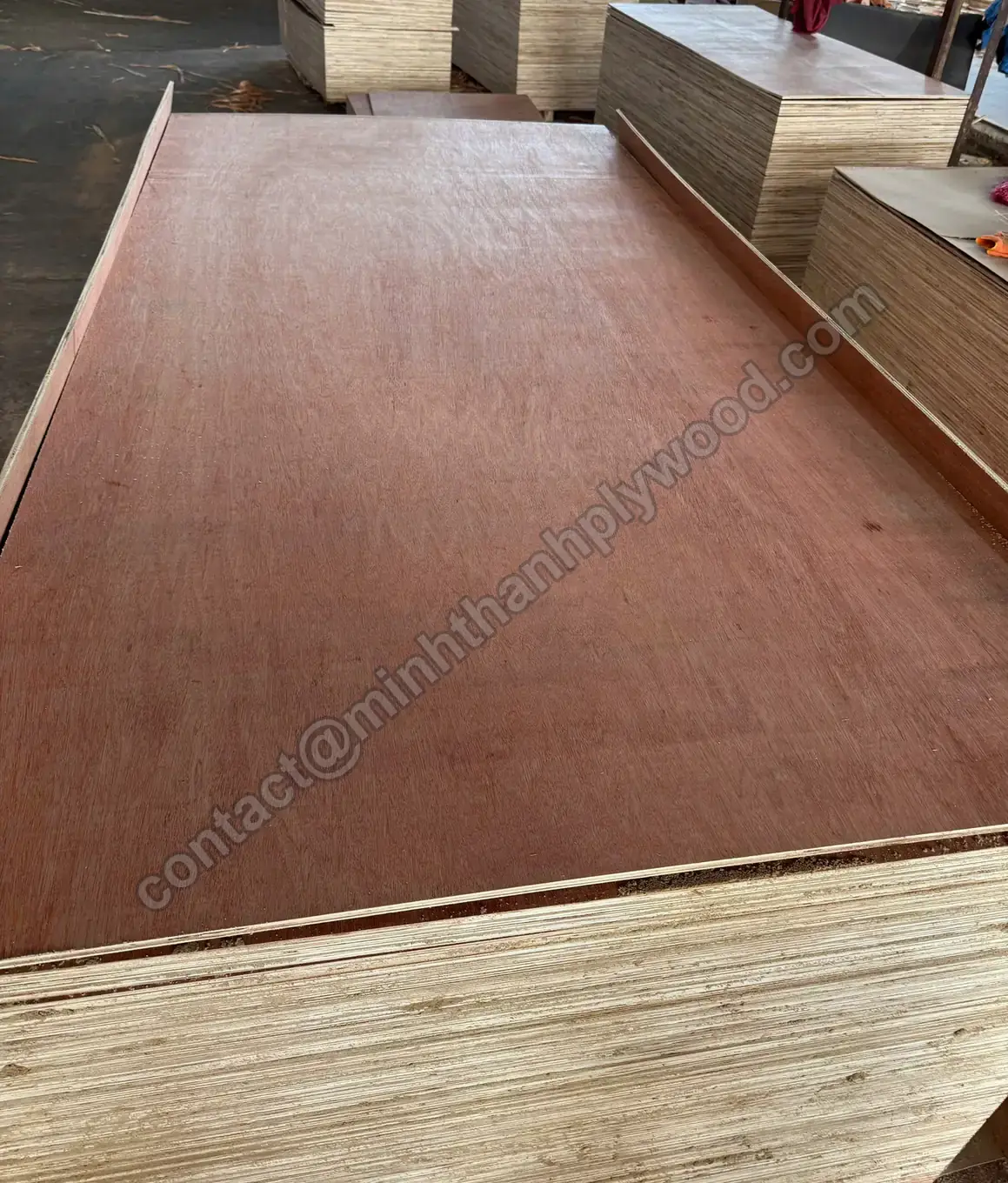
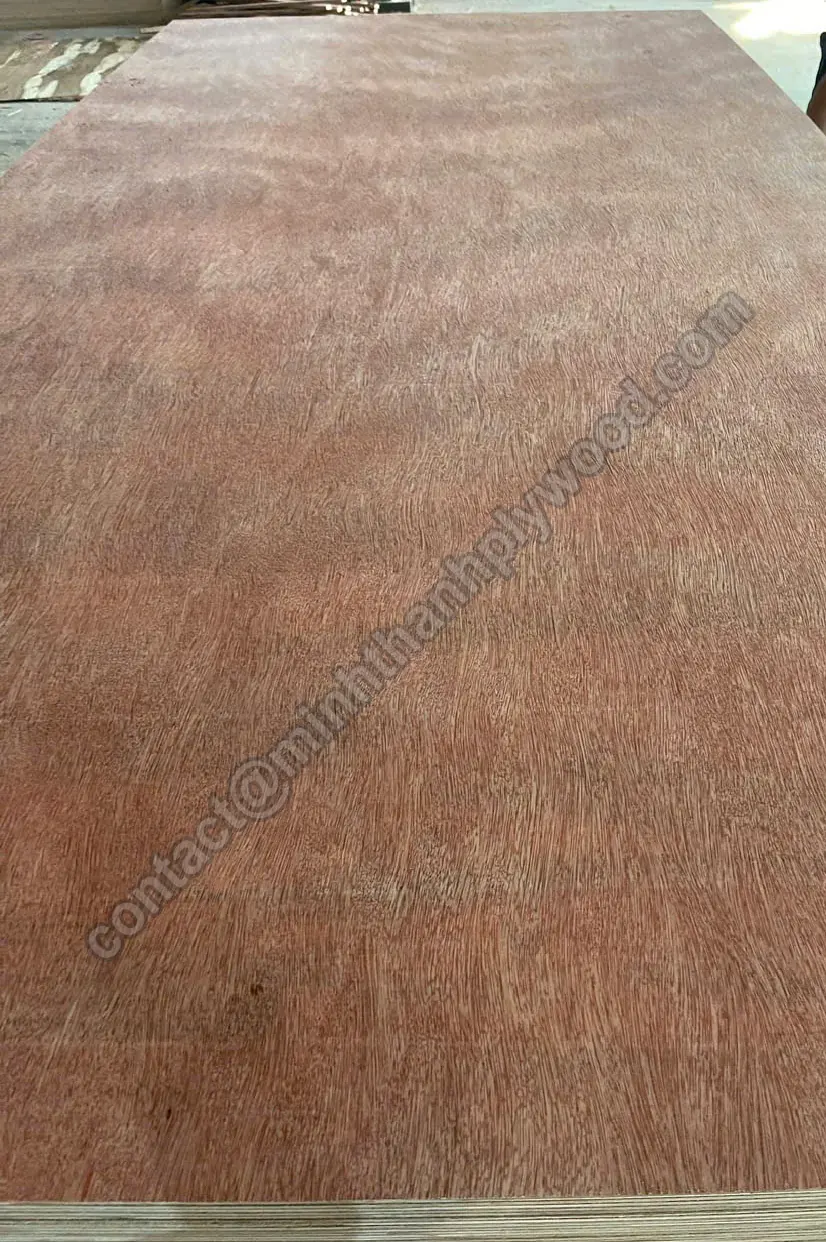
Both faces even red-brown with a soft rotary figure, no open defects, only tiny sound pin knots and close colour match across the sheet.
Application brief
Stained or clear-lacquered fronts, shop fittings and open shelving seen from both sides.
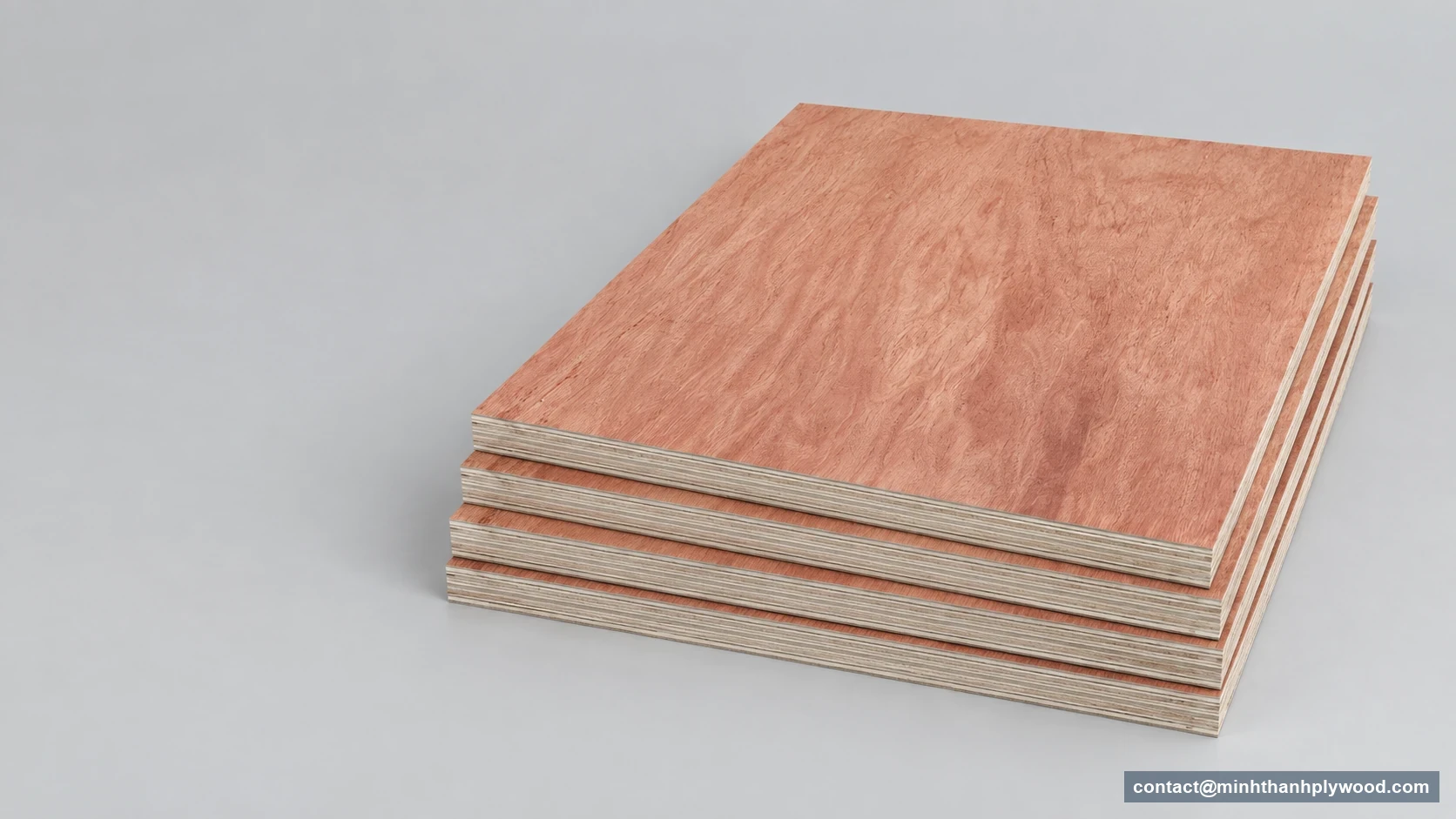
Bintangor faced plywood · Ha Hoa, Phu Tho, Vietnam
In short
Bintangor plywood from Vietnam is a bintangor-faced panel: a reddish-brown Calophyllum veneer on face and back, pressed over a stitched white Styrax or Eucalyptus core. Minh Thanh Plywood presses it to order, 3–40 mm thick, E0 as standard, both faces sanded.
Bintangor is one of the faces we press to order next to our main EV, poplar, birch, okoume and pine lines. It comes off our own lines in Ha Hoa, Phu Tho. We make 50,000+ m³ of plywood a year there, with over 20 years of plywood making behind us. Buyers use it for commercial plywood with a warm face: furniture carcasses, cabinets, shop fitting, wall panels and door skins.
Watch first
See how the red-brown face, grade pair, plantation core and adhesive work together in a bintangor panel. The film follows real sheets through handling and inspection, then explains finishing, weight-limited loading and the specification to send for a quotation.
Real sheets
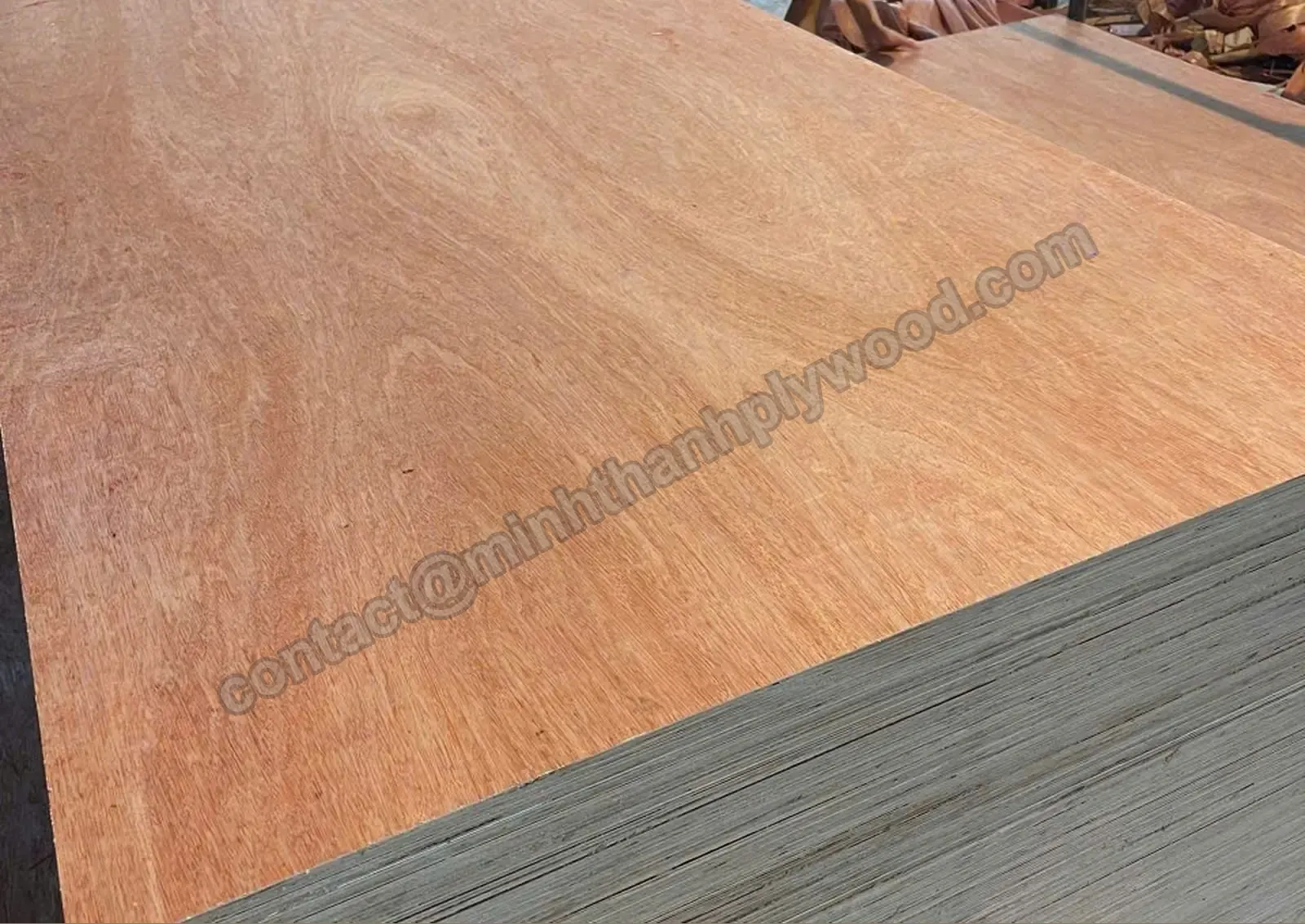
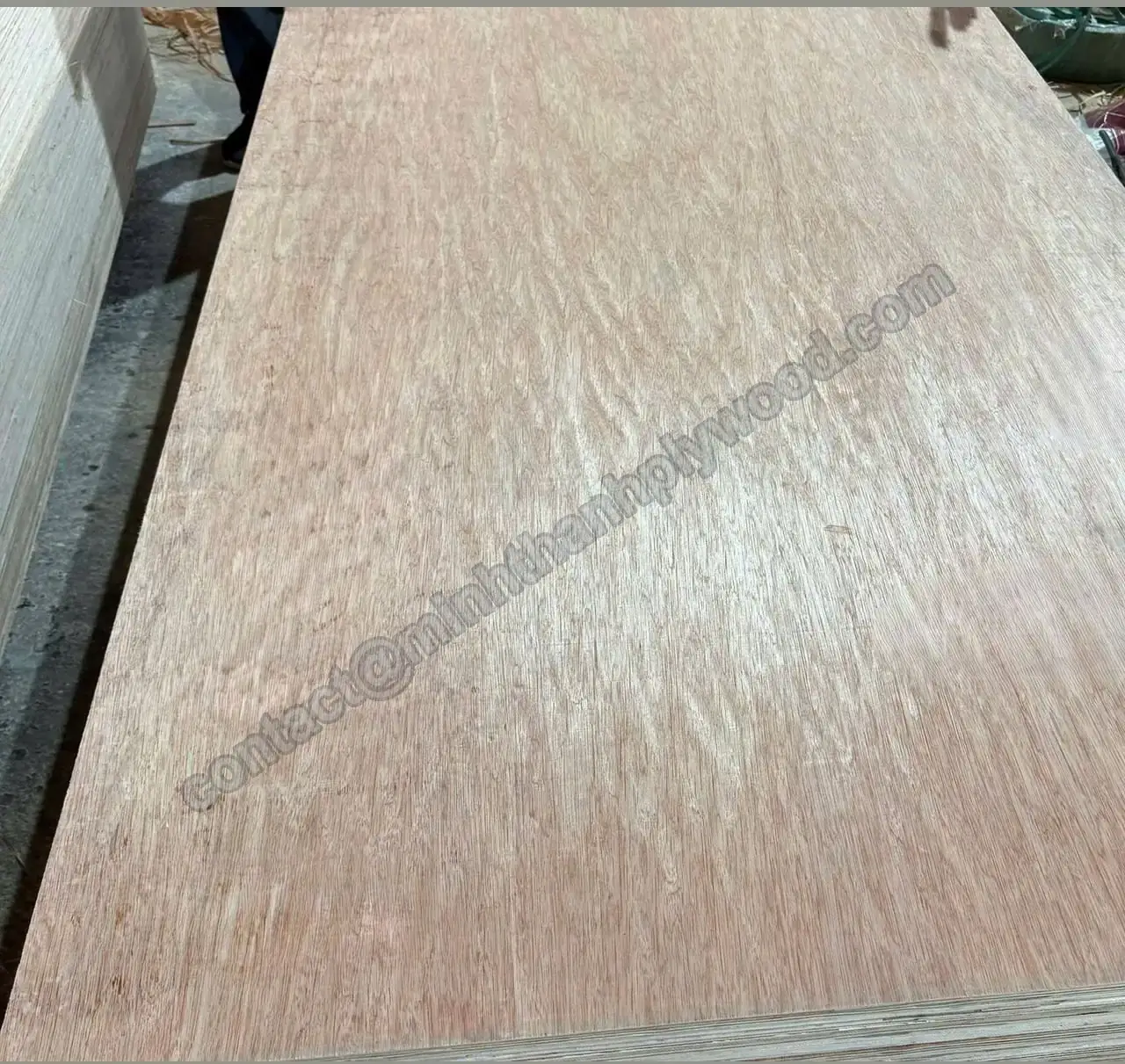
These photos show bintangor faced plywood as it comes off the line, the same kind of proof we send buyers before a container is closed. Look for the warm red-brown face from end to end, the soft rotary-cut figure, and the layered edge of the core under it.
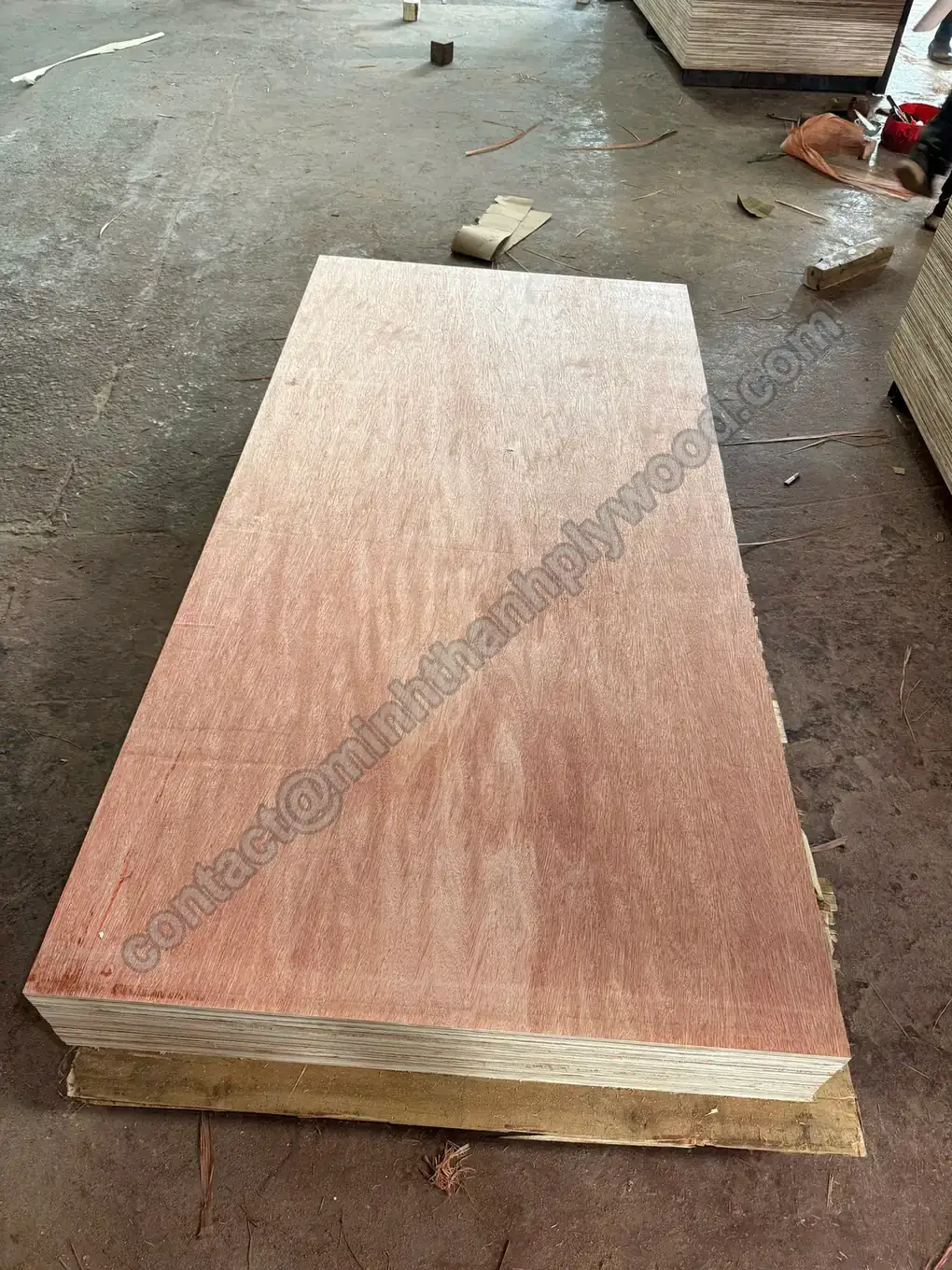
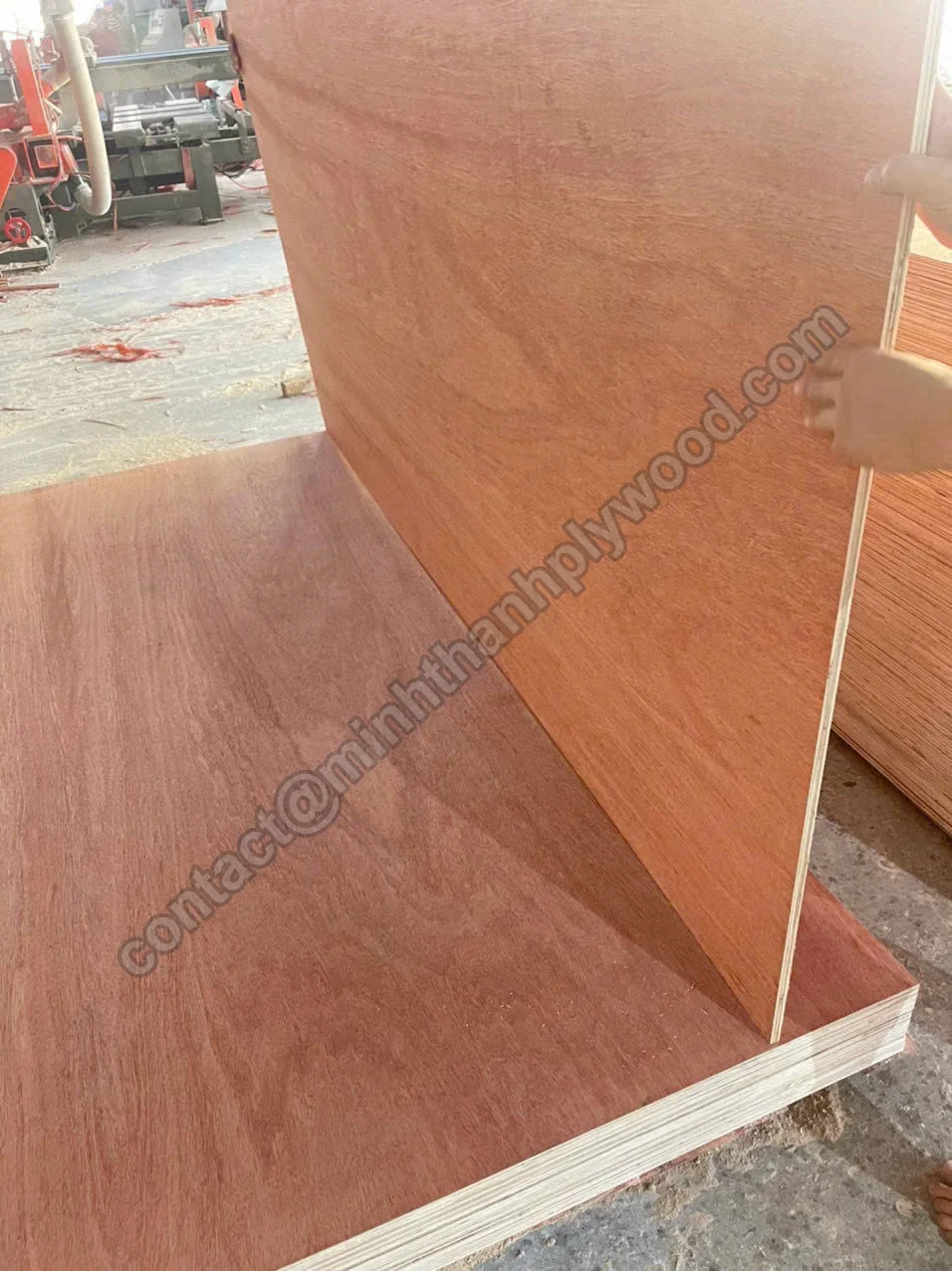
On your own order you get the same evidence before the doors are sealed. Sheets from each thickness are turned over on camera, and you see the stack edge, caliper readings and the loaded container.
Bintangor varies from log to log, from light pinkish-brown to a deeper red. We sort face veneers by tone before lay-up. Every finished sheet is then graded against the sample you approved, so a run of doors looks like one batch.
Specification
Our bintangor plywood is a bintangor face and back over a stitched white Styrax or Eucalyptus core, 3–40 mm thick. UF glue at E0 emission is standard and both faces are sanded and polished, with the thickness tolerance listed below. Every row is a line on the quotation that you can change for your order.
| Face veneer | Rotary-cut bintangor (Calophyllum), reddish-brown; held to the sample sheet you approve |
|---|---|
| Back veneer | Bintangor, paired with the face as A/A, A/B or B/B |
| Face veneer thickness | 0.2–0.5 mm before pressing |
| Core | White Styrax or Eucalyptus plantation timber, grade A core veneers |
| Core joining | Stitched horizontally and vertically; outer plies stitched as standard, all plies on request |
| Pressing | Pressed twice: core board pressed and calibrated, then face and back pressed on |
| Plies | 3–6 mm: always 5 plies; 18 mm: 11–13 plies, most often 11 |
| Panel density | Styrax core about 500 kg/m³; Eucalyptus core 650–750 kg/m³ |
| Glue | UF for dry interiors; melamine-fortified or phenolic (WBP) for water-resistant specifications |
| Emission | E0 standard; E1 to order; chamber testing every 3 months |
| Thickness | 3–40 mm |
| Thickness tolerance | Down to ±0.2 mm on sanded furniture panels |
| Length and width tolerance | ±2 mm |
| Sheet sizes | 1220 × 2440 mm and 1250 × 2500 mm; custom 1220 × 2500 mm, 1220 × 2280 mm |
| Cut to size | One panel cut into 4, 6 or 8 pieces |
| Surface | Both faces sanded and polished, UV-ready for your own UV coating, stain, paint or lamination |
| Moisture | 8–12 % at dispatch; veneers kiln-dried before lay-up |
We sand and polish both bintangor faces after the second pressing. The core board is already calibrated before the thin face veneer goes on, so final sanding prepares the red surface for finishing. Both faces leave the line UV-ready for your own coating, or ready for paint, stain, lacquer and laminate.
Write the face and the core as separate lines, for example face: bintangor A/B. Core: Eucalyptus. Glue: UF. Emission: E0. A quotation that only says "bintangor plywood" or "hardwood core" leaves the weight, the edge and the screw holding of the panel open.
Face grades
Bintangor is quoted as a face/back pair. A/A selects appearance on both sides, A/B keeps the selected A face outward over a B back, and B/B suits painted and laminated work. Each pair is held to a sample sheet you approve, with colour, patches and joints assessed separately on each face.
A/A
Both faces even red-brown with a soft rotary figure, no open defects, only tiny sound pin knots and close colour match across the sheet.
Application brief
Stained or clear-lacquered fronts, shop fittings and open shelving seen from both sides.
A/B
An A face outward over a B back that may show small sound knots, colour variation and neat patches.
Application brief
Cabinet sides, doors and carcass parts where one side is seen.
B/B
Both faces may show sound knots, colour streaks and matched patches; joints closed, no splits.
Application brief
Painted furniture, HPL, melamine-paper and foil substrates, drawer parts and backs.
Buy the face your customer sees and no more. Under paint, foil or HPL a B face does the job of an A face for less money. On stained or lacquered fronts the A face is worth it, because the red tone stays visible.
Buying BB/CC today? Send the code and a photo and we press the matching pair. Our A/A, A/B and B/B options set the appearance of both sides, so cabinet fronts, backs and hidden parts can be ordered separately within a mixed load.
Bintangor faces run from light pinkish-brown through orange-red to deep red-brown. We sort the veneers by tone before lay-up and match the natural colour range of your sample. Choose the lighter range for a softer interior finish or the deeper red range where the face is the feature. The grade pair selects knots, patches and joints; tone sorting selects the colour within that pair.
Core and construction
A white Styrax core gives a light bintangor panel, about 500 kg/m³, and the fullest container. Eucalyptus, at 650–750 kg/m³, makes a denser, heavier panel that holds screws harder. Both are Vietnamese plantation timber, and the bintangor face sits the same way on either.
| White Styrax core | Eucalyptus core | |
|---|---|---|
| Density | About 500 kg/m³ | 650–750 kg/m³ |
| 18 mm sheet, 1220 × 2440 mm | About 26.8 kg | About 34.8–40.2 kg |
| 12 mm sheet, 1220 × 2440 mm | About 17.9 kg | About 23.2–26.8 kg |
| 9 mm sheet, 1220 × 2440 mm | About 13.4 kg | About 17.4–20.1 kg |
| Edge look | Pale cream layers under the red face | Pinkish-brown layers, close to the face tone |
| Best for | Commercial and furniture carcasses, shop fitting, loads where freight per sheet counts | Heavier carcasses, hinge and fixing areas, buyers who specify a minimum density |
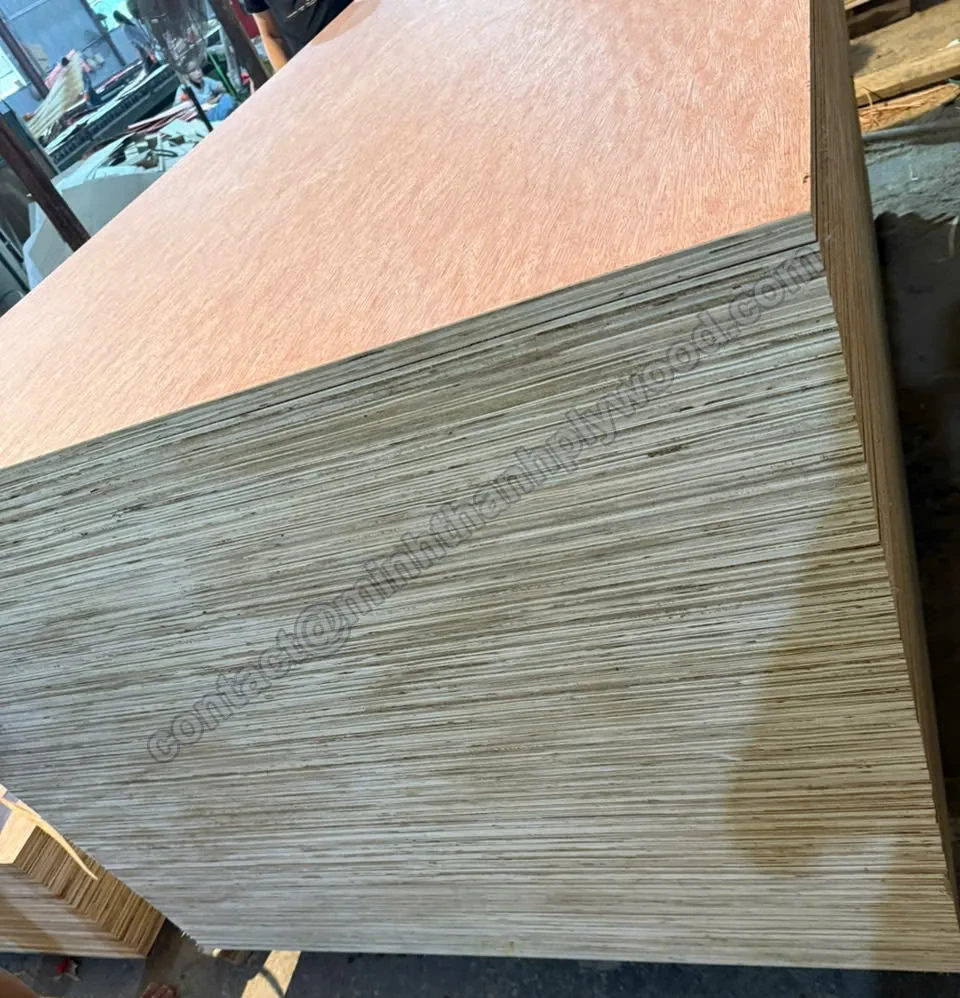
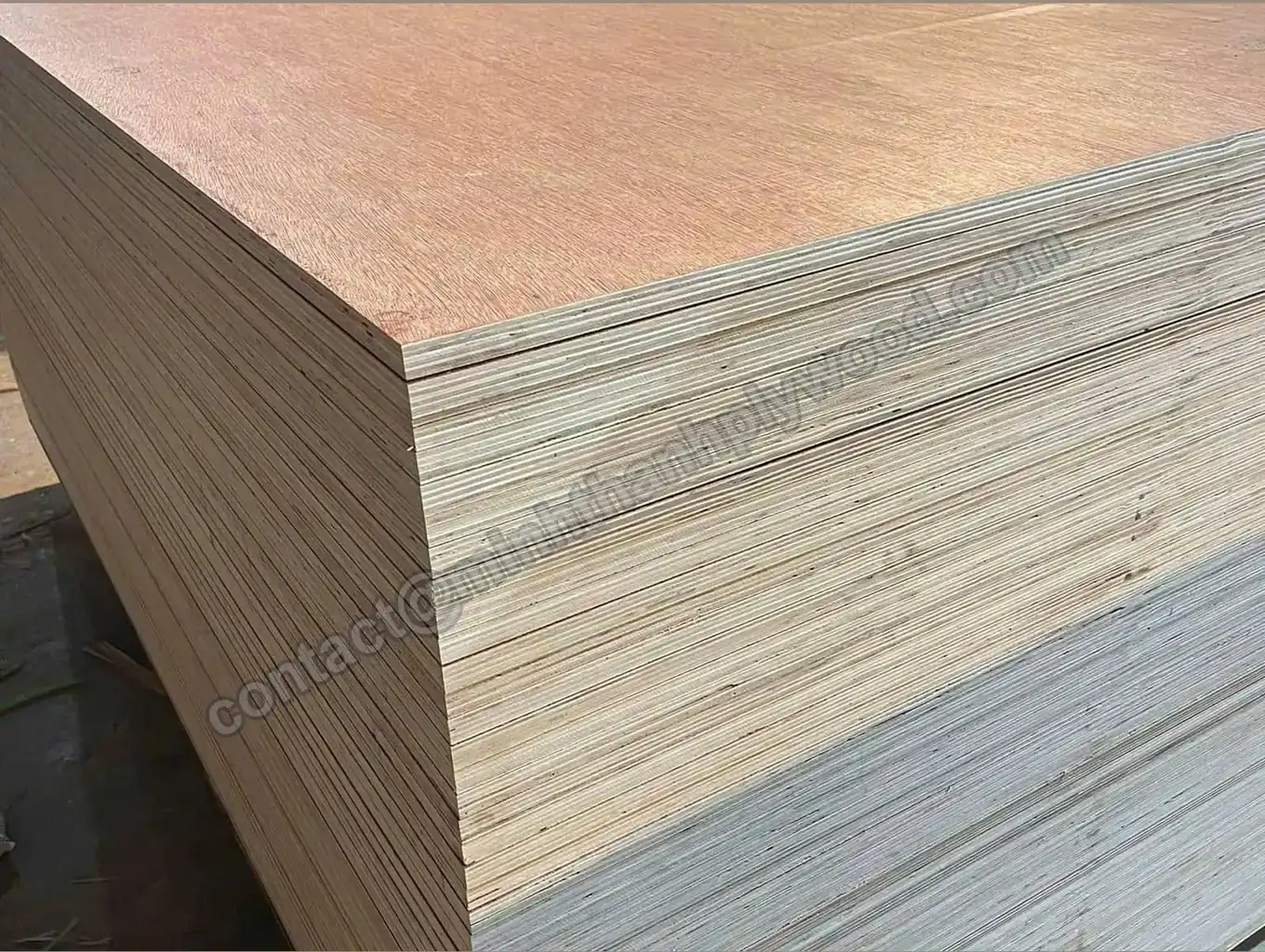
The bintangor is the face and the plantation core carries the panel. Weight, edge colour and screw holding follow the core. Pick Styrax for light carcasses and low freight per sheet. Pick Eucalyptus where the drawing sets a minimum density or the panel carries hinges and heavy fixings.
Our core veneers are grade A, laid crosswise and stitched horizontally and vertically, to keep veneer joints aligned beneath the thin red face during pressing. Outer plies are stitched as standard and every ply on request, which matters when routed or exposed edges are part of the design.
The ply count rises with thickness. Every 3–6 mm bintangor panel is five-ply. An 18 mm panel is built from 11–13 plies, usually 11. On 9 mm and thicker panels each core veneer is usually 1.4–2.0 mm before pressing. 3–6 mm panels use thinner core veneers sized to fit five plies.
Furniture-grade panels are pressed twice as standard. First the core board is hot-pressed and calibrated by sanding. Then the bintangor face and back go on and the panel is pressed again, at about 110–120 °C for MR glue and 130–145 °C for phenolic WBP. The calibrated core keeps a stained face flat, with no ripples.
In the thin bintangor range, five-ply means two different lay-ups. A 3 mm sheet has one central core veneer, two cross-band veneers and two face veneers. At 4, 5 and 6 mm, three core veneers sit between the two faces. We adjust the core veneer thickness to the finished panel; the face/back pair still selects the appearance on each side.
Our 4 mm furniture construction uses three thin Styrax core veneers, with 1.3 mm core veneer as a production example before compression and sanding. Good thin veneer is scarce, so this thickness can take longer to produce. We keep the five-ply construction and the face quality instead of lowering the standard to shorten the run. See our thin-plywood range for door skins and cabinet backs.
Sheet weights: core density multiplied by the sheet volume.
Glue and emission
Bintangor panels can be made for humid interiors or exterior fittings with the appropriate water-resistant bond and sealed edges. The red veneer sets the appearance; the adhesive sets bond durability. Our standard dry-interior panel uses UF glue at E0 emission.
| Glue | Use it for | Emission |
|---|---|---|
| UF (standard interior bond) | Dry furniture carcasses, door skins and shop fittings | E0 standard; E1 to order |
| Melamine-fortified | Humid-service cabinetry with protected faces and sealed edges | E0 or E1 to order |
| Phenolic WBP | Exterior components with protected faces and sealed edges | E0 or E1 to order |
A bintangor purchase order separates adhesive from emission. Specify UF for dry furniture, melamine-fortified adhesive for humid-service components, or phenolic WBP for exterior exposure. Add the emission requirement on its own line. This lets the factory select the bond without changing the face pair you approved.
Six chamber tests to ASTM D6007 on 9, 15 and 18 mm panels (three by Shanghai Hongjun, three by ICTT Vietnam), April 2025–June 2026, averaged 0.014–0.032 ppm against the 0.05 ppm limit for hardwood plywood with a veneer core; we retest every 3 months.
Our panels meet the emission and quality requirements European and US furniture buyers ask for. We arrange third-party chamber testing through SGS to EN 717-1 or the method specified by the buyer. The test order identifies the face, core, panel thickness and adhesive so the report describes the bintangor construction being purchased.
For dry furniture, the standard combination is a UF bond and E0 emission. A humid-interior order changes the adhesive to melamine-fortified resin and keeps the requested E0 or E1 class as a separate specification. Exterior components use phenolic WBP. This gives the buyer a choice of bond and emission while retaining the bintangor face, selected back grade and plantation core.
Sizes and cutting
Bintangor plywood is pressed in 1220 × 2440 mm, the commercial plywood format, and in 1250 × 2500 mm for European lines. Any thickness from 3 to 40 mm is possible. Custom sizes such as 1220 × 2500 mm and 1220 × 2280 mm are pressed on request. One panel can also be cut into 4, 6 or 8 pieces.
| Standard sheets | Both standard formats in any thickness from 3 to 40 mm |
|---|---|
| Custom formats | Pressed to your size up to the European format |
| Tolerance by dimension | Use the thickness tolerance in the main specification; length and width ±2 mm |
| Cut to size | One panel cut into 4, 6 or 8 pieces, packed by part, with the face grade and tolerance of the full sheet |
| Machining | CNC routing and edge profiling; all plies stitched on request for visible edges |
| Inch references for US enquiries | 1/4 inch = 6.35 mm; 3/8 inch = 9.525 mm; 1/2 inch = 12.7 mm; 5/8 inch = 15.875 mm; 3/4 inch = 19.05 mm. These are exact unit conversions; order the finished thickness in mm. |
| Metric stock references in inches | 6 mm ≈ 0.236 inch; 9 mm ≈ 0.354 inch; 12 mm ≈ 0.472 inch; 15 mm ≈ 0.591 inch; 18 mm ≈ 0.709 inch. Metric panels and nominal inch sizes are separate order lines. |
Choose thickness by the part. 3–6 mm covers door skins, cabinet backs and drawer bottoms. 9–12 mm suits drawer sides, light shelves and display parts. 15–18 mm is the carcass and door thickness for most furniture and shop fittings. 21–25 mm and above takes worktops, heavy shelves and counters.
For cut-to-size orders we press and sand the full sheet first, then cut. Each piece keeps the face grade and tolerance of the sheet, and parts arrive packed and labelled by part number.
Bintangor machines well with sharp tooling, and the stitched core keeps routed edges tight. Seal cut edges on parts for humid rooms.
The two standard formats give different cutting areas: a 1220 × 2440 mm sheet provides 2.9768 m², while 1250 × 2500 mm provides 3.125 m². The larger format gives about 5% more face area per sheet. Our custom 1220 × 2500 mm format keeps the commercial width with the longer length; 1220 × 2280 mm shortens the sheet for a smaller component layout.
Applications
Bintangor commercial plywood is used where a panel should carry a warm, firm hardwood face. Typical parts are furniture carcasses and cabinets, shop fitting, wall panelling, door skins, and crates or displays where the face is seen. The core sets the weight and the glue sets the room.
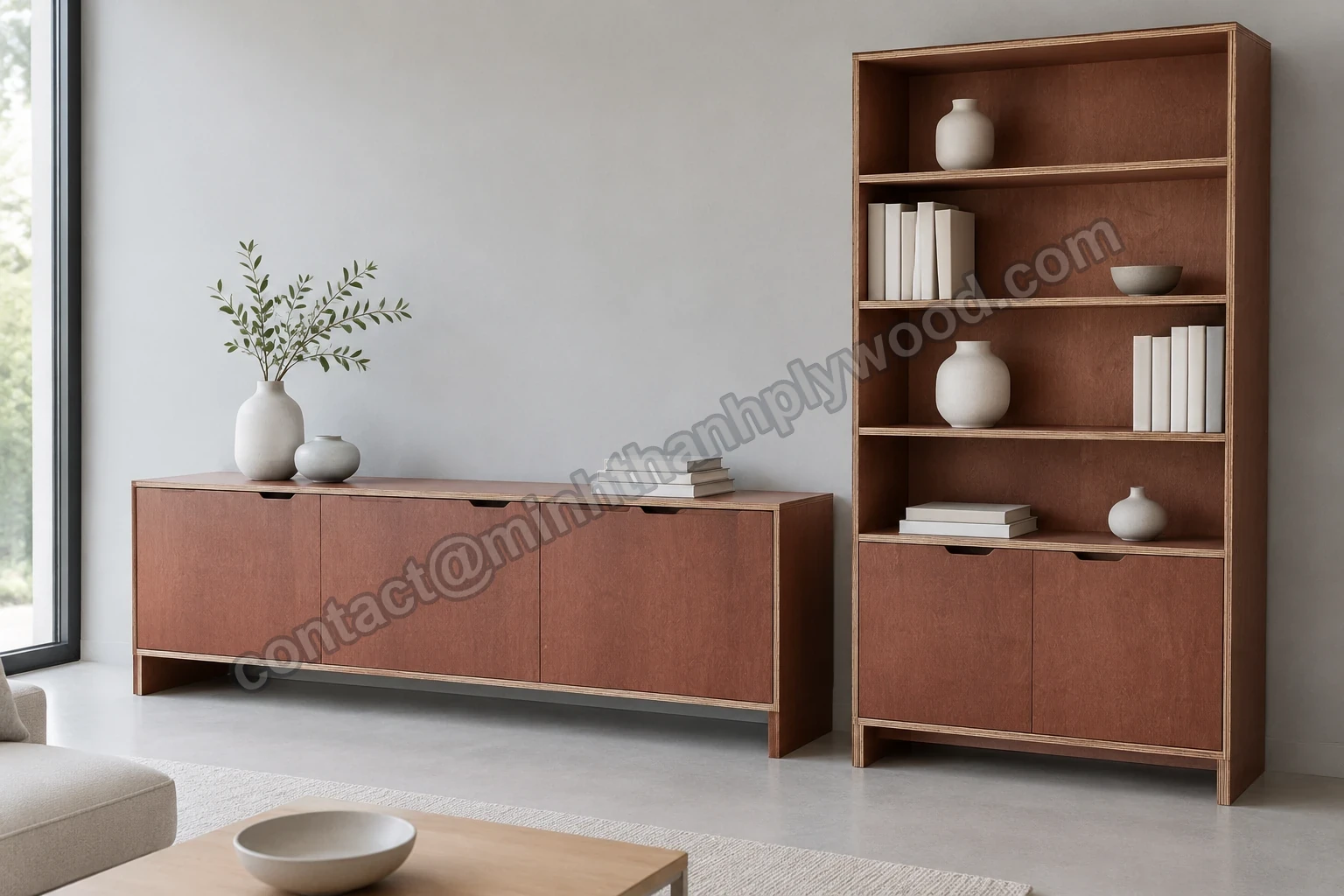
Use 15–18 mm bintangor on a Styrax core for cabinet bodies, wardrobes and sideboards that stay light to ship. Choose Eucalyptus where hinges and heavy fixings need firmer screw holding.
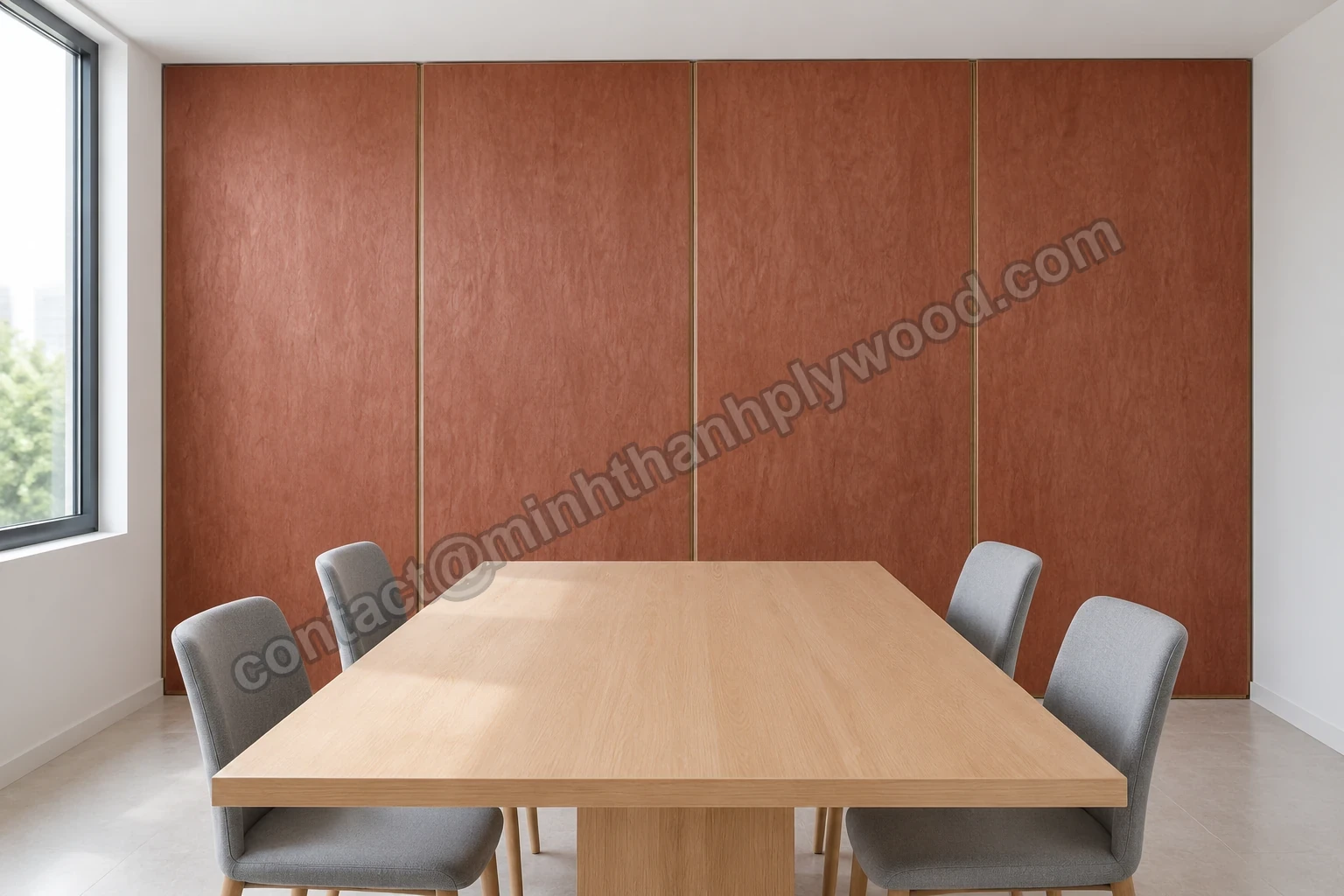
An A face under clear lacquer or a light stain gives counters, shelving and wall panels a warm red-brown wood look. It costs far less than solid hardwood.
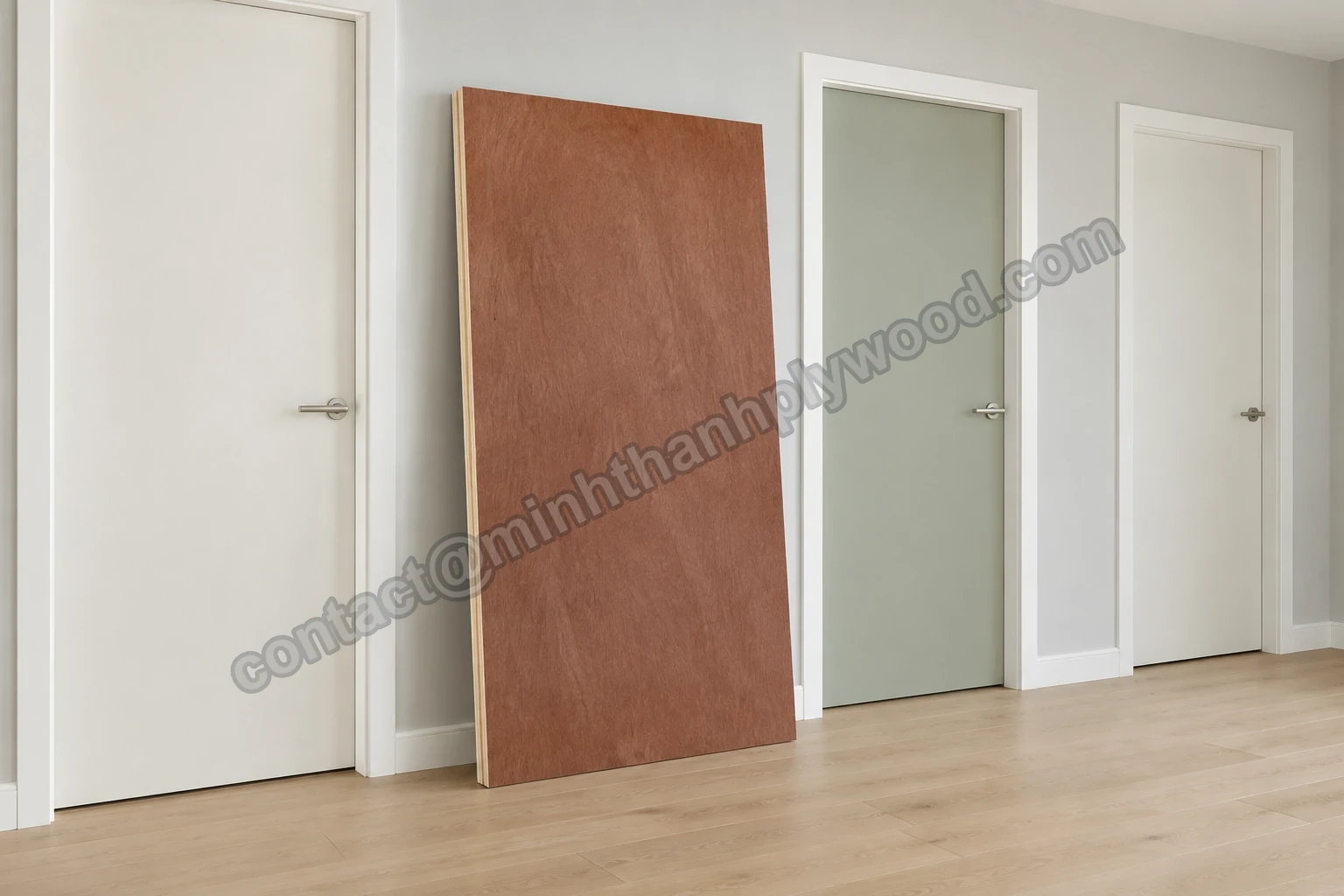
B/B faces sand to a closed surface under primer, paint, HPL or melamine paper. Thin 3–6 mm five-ply sheets make flush door skins, cabinet backs and drawer bottoms that stay flat.
For exterior fittings, choose our exterior plywood with a phenolic WBP bond. For a pale natural face under clear lacquer, birch is the alternative. Our bintangor line supplies the warm red face for furniture and shop interiors; packing plywood serves hidden crates and pallets.
Commercial bintangor faces also go into crates and display packaging that the end customer sees, where a reddish face is part of the presentation. Match the accepted repairs to a sample so that the packing function and the visible surface are both clear on the order.
A cabinet order can combine bintangor A/B fronts and sides with B/B backs on the same white Styrax core. The visible surfaces get the selected A face, while the hidden surfaces use the B grade. We bundle the grade pairs separately within the container, keeping the furniture parts together in one shipment.
For a shop counter with heavier fixings, specify a bintangor A/B face pair on the denser Eucalyptus core. For doors and open shelving seen from both sides, use A/A. Both constructions go through our core-calibration and face-pressing sequence, so the factory changes the face selection and core while keeping the sanded surface needed by the finishing line.
Compare
Importers who buy bintangor usually compare it with four other faces on the same kind of panel: okoume, gurjan (keruing), birch and poplar. The table shows what changes on the finished part.
| Bintangor face | Okoume face | Gurjan (keruing) face | Birch face | Poplar face | |
|---|---|---|---|---|---|
| Face colour | Reddish-brown, soft rotary figure | Pinkish-beige, even | Reddish to dark brown, coarse grain | Pale cream with figure | Plain pale cream |
| Face feel | Firm, closed surface after sanding | Soft, light | Hard, coarse | Hard, fine | Soft, smooth |
| Typical grades | A/A, A/B, B/B | A/A, A/B, B/B, BB/CC | A/B, B/B, BB/CC | D+, D, E | A/A, A/B, B/B |
| Best finish | Stain, clear lacquer, paint, laminate | Paint, stain, laminate | Paint or hidden use | Clear lacquer, UV | Paint, HPL, foil |
| Core (ours) | Styrax or Eucalyptus, stitched | Styrax or Eucalyptus, stitched | Styrax or Eucalyptus, stitched | Styrax or Eucalyptus, stitched | Styrax or Eucalyptus, stitched |
| Cost level | Mid | Mid | Mid | Highest: imported face | Lower |
| Best fit | Commercial furniture, shop fitting, warm wood look | Light furniture, door skins | Heavy-duty commercial parts | Visible premium fronts | Painted and laminated furniture |
Bintangor and okoume are the two classic tropical faces for commercial plywood. Okoume is softer and paler pink. Bintangor is firmer and redder, and takes stain with a deeper tone. Gurjan is darker and coarser, chosen for strength more than looks.
When the face stays natural under clear lacquer, birch is the premium choice. Poplar is the plain pale face for paint and laminate. We press all five faces on the same stitched Styrax or Eucalyptus cores, so you can change the face and keep the rest of the specification.
Quality control
A bintangor face shows colour and patches clearly, so we check what your customer will see. That means tone match, patches, open joints, sand-through and flatness, plus thickness and core. Every sheet is held to the sample you approved, and you see photos and clips of your own sheets before the container is closed.
free samples in your thickness, grade pair and core; the approved sheet becomes the standard for production.
bintangor veneers are sorted by tone before lay-up so one order keeps one colour range.
each sanded sheet is graded against the approved sample, face and back separately, for tone, patches and joints.
no sand-through and no raised grain across the face before the sheet is bundled.
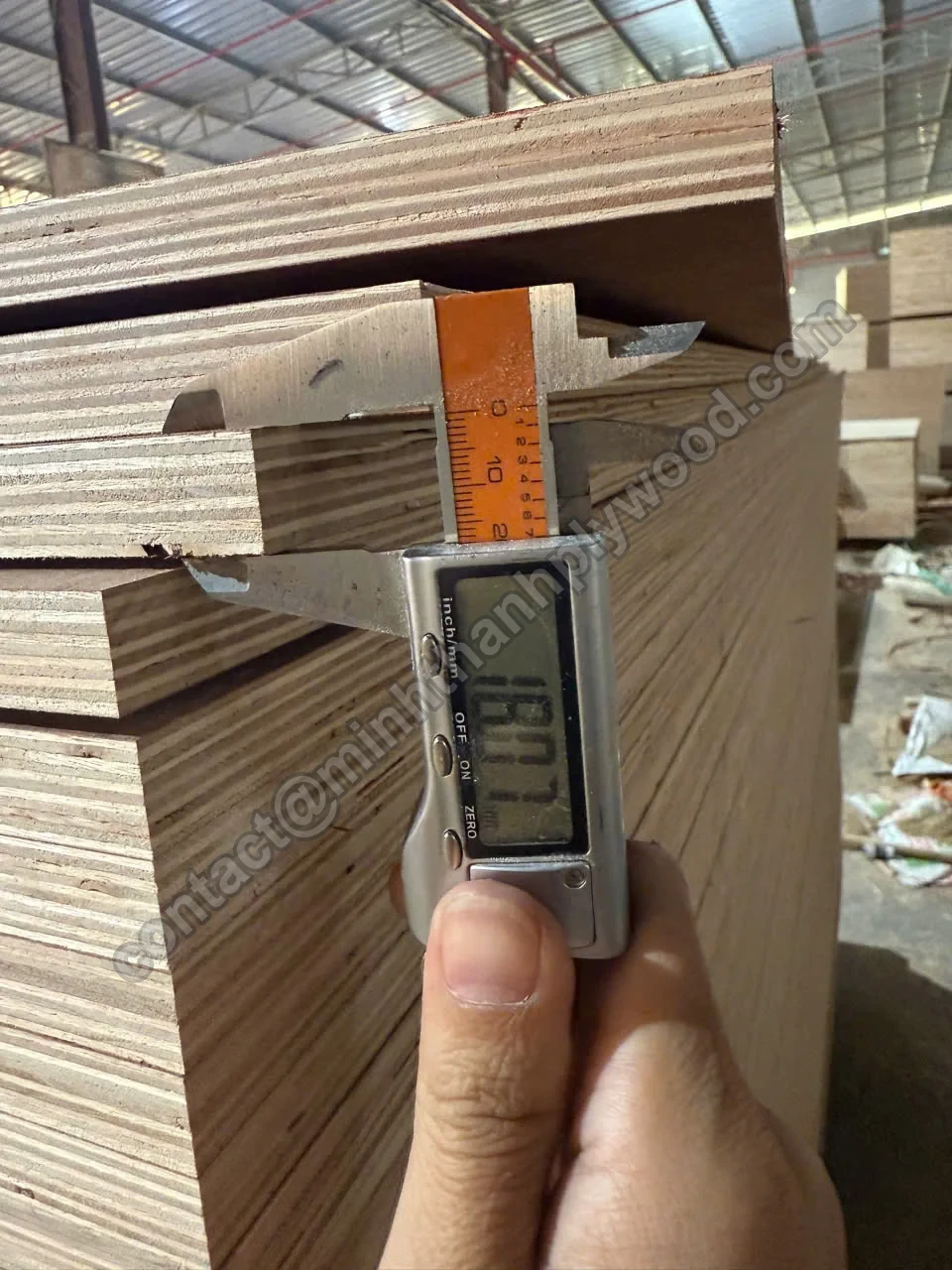
a digital caliper reads several points on sheets from each bundle against the sanded-panel tolerance on the quotation.
stitched core layers, closed joints and an even glue line along the cut edge.
sheets from each thickness are turned over on camera, with the stack edge and caliper readings, and the clips go to you before loading.
bundles are counted, marked with thickness and grade pair, and photographed in the container; third-party inspection is welcome.
When the container arrives, three checks confirm the order. One 18 mm sheet of 1220 × 2440 mm on a scale reads about 26.8 kg with a Styrax core and 34.8–40.2 kg with Eucalyptus. A caliper over several sheets confirms thickness. A look along a few bundle edges shows even layers and closed joints, and the face should match your sample in tone and grade.
Store panels flat on level bearers in a dry, covered space and keep the wrap on until use. Let them settle in the workshop for a few days before finishing. Seal knots and patches with a primer before a light paint coat, and sand along the grain with a light hand: the face veneer is thin.
Related: checked against the sample you approved.
Certificates and documents
CARB P2 / TSCA Title VI (ICTT mill 23024), ISO 9001:2015 (KAC25/0185), TCVN 11902:2017, SGS packaging evidence and FSC available*: see our quality documentation.
Factory evidence
View the current certificates and supporting reports, or request the document pack with your quotation.
View document →We supply the EUDR compliance dossier (origin records and geolocation files) with orders. For bintangor-faced panels, the order documentation identifies the face species separately from the Vietnamese plantation core. The dossier travels with the panel specification and shipment records, giving the importer the material-origin information for that order.
The shipping pack includes the commercial invoice, packing list, bill of lading, certificate of origin (EUR.1 for EU shipments), phytosanitary and fumigation certificates. Insurance is included on CIF shipments. These documents accompany the bintangor order alongside its specification, bundle quantities and container identification.
Before loading, buyers receive photos and video of their own bintangor sheets, with caliper readings for each thickness and pictures of the loaded container. US-order labels carry the producer, lot and certifier number TPC-43, plus the compliance statement; the invoice and bill of lading carry the corresponding statement. We also supply face/core species and Vietnamese harvest-origin information for the importer’s declaration.
*Supplied directly or through qualified partner mills.
Packing and loading
At 18 mm, a 40HC loading plan holds 990 Styrax-core sheets or 795 Eucalyptus-core sheets of bintangor plywood. That is about 53 m³ or 43 m³ respectively. Packs protect the red faces with cover sheets and corner guards, and each thickness and grade pair is bundled separately.
| Thickness (mm) | Sheets / full bundle | Styrax: sheets / 40HC | Eucalyptus: sheets / 40HC | Styrax volume (m³) | Eucalyptus volume (m³) |
|---|---|---|---|---|---|
| 3 | 333 | 5,994 | 4,815 | 53.5 | 43.0 |
| 4 | 250 | 4,500 | 3,615 | 53.6 | 43.0 |
| 6 | 166 | 2,988 | 2,400 | 53.4 | 42.9 |
| 9 | 111 | 1,998 | 1,605 | 53.5 | 43.0 |
| 12 | 83 | 1,494 | 1,200 | 53.4 | 42.9 |
| 15 | 66 | 1,188 | 960 | 53.0 | 42.9 |
| 18 | 55 | 990 | 795 | 53.0 | 42.6 |
| 25 | 40 | 720 | 570 | 53.6 | 42.4 |
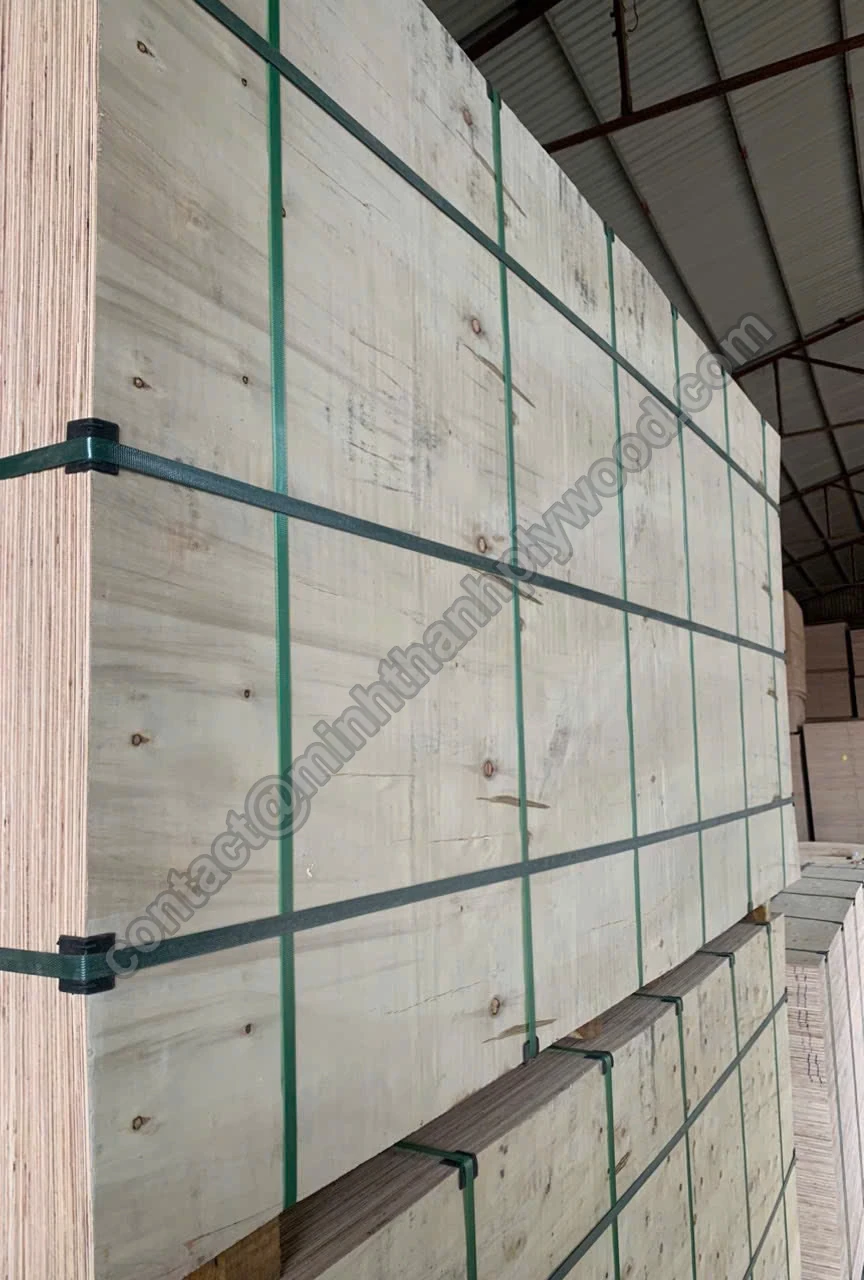
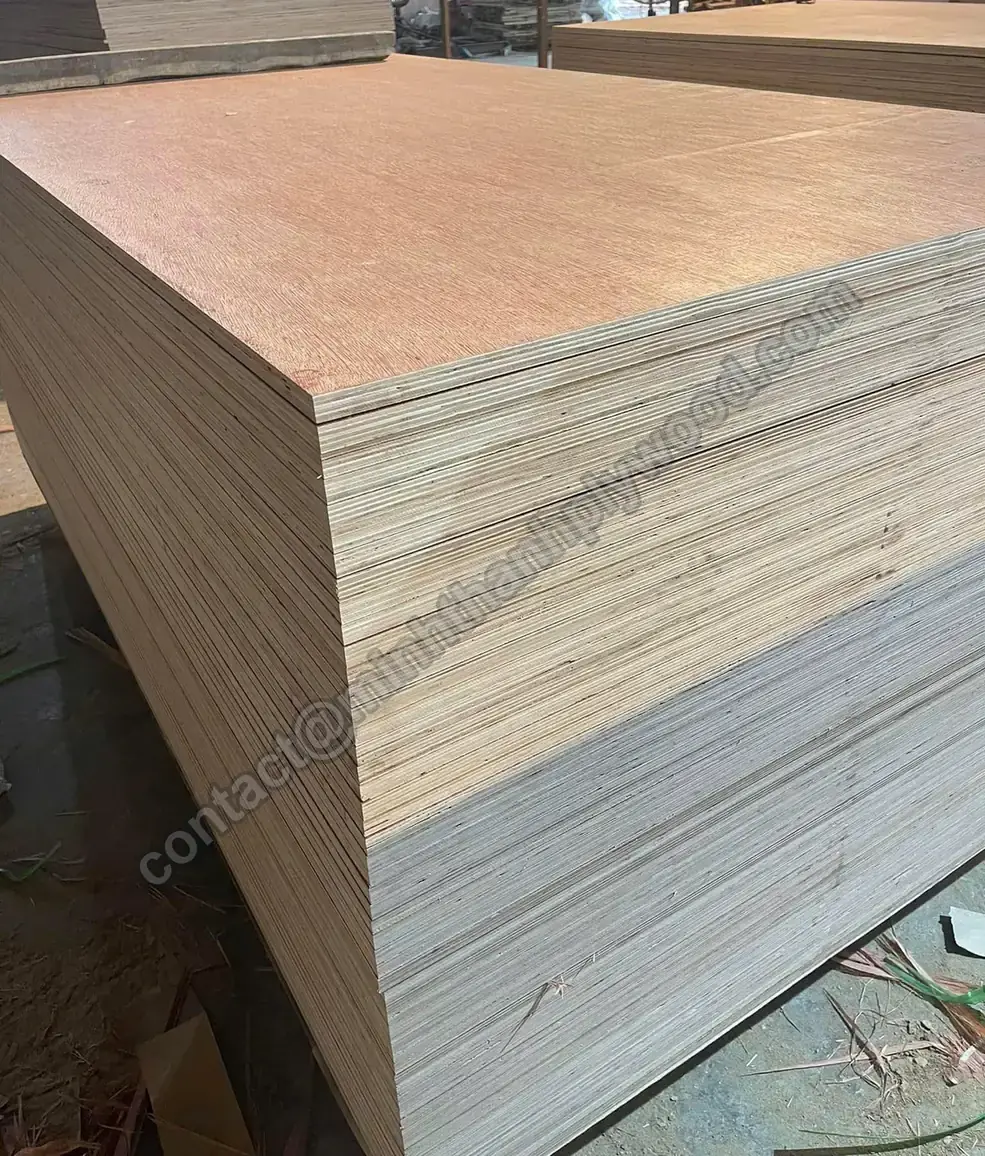
The table uses 1220 × 2440 mm sheets and bundles of about 1,000 mm height; Eucalyptus bundles carry slightly fewer sheets to stay within the weight allowance. In a mixed load, thinner backs and thicker carcass panels stay in separate marked packs, and the loading list records the sheet count for each specification.
Each bundle gets a top and bottom cover sheet, corner guards and a wrap against damp and dust. Straps go over the guards, so the red face is not dented. Bundles are marked with thickness, grade pair and glue. Export pallets, your own labels and edge stamps are available on order.
Several thicknesses and grade pairs can share one container, each bundled and marked separately. Plan a mixed load with our packing calculator.
Calculation: up to 28,000 kg of panels per 40HC; packaging is added for the payload check against your booking. Use 500 kg/m³ for Styrax and 650 kg/m³ for Eucalyptus and round the count downward. Cap by 18 Styrax or 15 Eucalyptus bundle spaces of equal height. Volume is sheet count × 1.22 × 2.44 × thickness in metres. Actual weighed packs and the booking set the dispatch load.
Trade terms
The minimum order for bintangor plywood is one 40HC container, with production scheduled after the deposit. Payment is 30% deposit with 70% against the scanned B/L. We ship FOB Hai Phong, CFR or CIF, accept mixed loads by agreement and send free samples.
| MOQ | 1×40HC; mixed thicknesses, grades and faces by agreement |
|---|---|
| Production time | 15–45 days after deposit, by quantity and specification |
| Payment | 30% deposit, 70% against scanned B/L; T/T or irrevocable L/C at sight |
| Incoterms | FOB Hai Phong, CFR or CIF |
| Samples | Free samples |
| Documents | Commercial invoice, packing list, bill of lading, certificate of origin (EUR.1 for EU shipments), phytosanitary and fumigation certificates; insurance on CIF |
| Replies | Within hours, Monday–Friday, Vietnam time (UTC+7) |
Production time runs from the deposit to cargo ready at the factory. Sea transit from Hai Phong is added on top and depends on the destination port and the carrier. On CFR and CIF terms we book the vessel and quote the route with the price.
Bintangor is pressed to order, and face veneer is bought by lot to keep one tone per order. Tell us your required arrival date and we plan veneer, production and loading backwards from it.
Indicative starting price, October 2026: commercial plywood from US$250/m³ and furniture/interior plywood from US$350/m³. The bintangor quotation identifies the face pair, core, adhesive, emission class, thickness, format, quantity and delivery term. Compare the complete configuration when evaluating the price.
How to order
Most bintangor orders start from a spec line and a photo of the panel you buy now. We quote against it and send a sample in the same grade pair and core. Once you approve it and pay the deposit, the order is pressed, checked, filmed and loaded.
application, grade pair and tone, core, glue and emission class, thickness, sheet size, packing, quantity and destination port.
price per m³ for each thickness on FOB Hai Phong, CFR or CIF, with each spec line repeated for checking.
free bintangor samples in your grade pair and core; the sheet you approve is the production standard.
confirm the proforma and pay 30% by T/T, or open an irrevocable L/C at sight.
15–45 days, with photos, clips and caliper readings of your sheets before loading.
photos of the loaded container and draft documents for approval, then the scanned B/L against the 70% balance.
Put these lines on the purchase order. Face: bintangor with the grade pair (A/A, A/B or B/B) and a sample or photo for tone. Core: Styrax or Eucalyptus, with stitching. Glue type and emission class. Thickness with tolerance and sheet size. Sanding and UV-ready faces if you coat. Certificates, packing and labels.
FAQ
Short answers to what importers ask most about bintangor plywood from Vietnam: what it is, grades, cores, emission, inspection and ordering.
Bintangor plywood is plywood faced with bintangor veneer, a reddish-brown tropical hardwood of the Calophyllum genus. The face is rotary cut, so it shows a soft, even figure with a warm red tone. Minh Thanh Plywood presses bintangor face and back over a white Styrax or Eucalyptus core, 3–40 mm thick.
Yes. Both faces are sanded and polished and leave the line UV-ready, so you can paint, stain, lacquer or laminate either side without sanding again.
Minh Thanh Plywood makes bintangor-faced panels in Ha Hoa, Phu Tho, alongside its furniture and interior plywood lines. The factory presses the face over stitched Styrax or Eucalyptus cores, then grades both sides against the approved sample. Buyers receive sheet and loading photos for their order.
Weigh one 18 mm sheet of 1220 × 2440 mm: about 26.8 kg on a Styrax core, 34.8–40.2 kg on Eucalyptus. Check several sheets with a caliper against ±0.2 mm, look along bundle edges for closed joints, and compare both faces with your approved sample.
Our bintangor face/back pairs are A/A, A/B and B/B, matched to the approved sample. If your current specification uses BB/CC, send the sample and describe the visible surface so we can match the requirement to our grade pair.
No. Both are tropical hardwood faces, but okoume is a soft pinkish-beige face and bintangor is a firmer, redder brown face. Many buyers treat them as alternatives for commercial and furniture plywood. We press both on the same Styrax and Eucalyptus cores.
White Styrax or Eucalyptus plantation timber from around Ha Hoa. Styrax gives a light panel of about 500 kg/m³ and the fullest container; Eucalyptus, 650–750 kg/m³, gives a denser, heavier panel with firmer screw holding.
Bintangor can be supplied with a water-resistant bond for humid rooms or exterior components. Choose melamine-fortified or phenolic adhesive for the exposure, protect both faces and seal cut edges; standard UF-bonded panels are for dry interiors.
E0 is standard. Six chamber tests (three by Shanghai Hongjun, three by ICTT Vietnam) to ASTM D6007 on 9, 15 and 18 mm panels (April 2025–June 2026) averaged 0.014–0.032 ppm, against the 0.05 ppm CARB Phase 2 / TSCA Title VI limit.
At 18 mm, a 40HC carries 990 Styrax-core or 795 Eucalyptus-core sheets of 1220 × 2440 mm, planned to 28,000 kg of panels and checked against your booking.
One 40HC container, with mixed thicknesses and grades by agreement. Production takes 15–45 days after the deposit. Payment is 30% deposit and 70% against the scanned B/L, or an irrevocable L/C at sight.
Yes, samples are free. Tell us the thickness, grade pair and core you want, and the sheet you approve becomes the grading standard for your order.
Request a quote
Tell us the application, core, glue, face grade, thickness, size and quantity, and Lisa replies within hours with a quotation and sample offer. Attach up to 3 drawings or specification files.
Start with the application and we advise the rest: core, glue and emission class, face and back grade, thickness and size, packing, quantity and port. Email [email protected] or WhatsApp Lisa on +84 988 586 601. Free samples.
[email protected]Related: contact the sales team, plywood catalogue.