
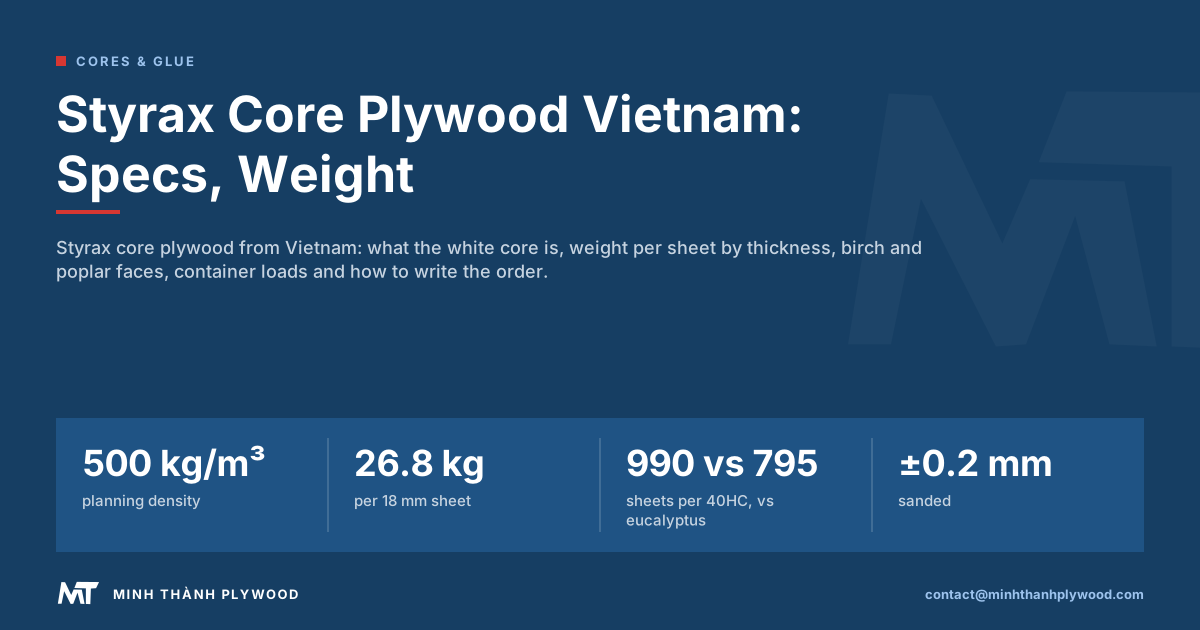
Styrax core plywood is a furniture panel whose inner veneers are Styrax, a pale, light plantation hardwood from northern Vietnam, under a face chosen for the look: birch, poplar, EV, okoume or pine. At about 500 kg/m³, an 18 mm sheet weighs about 26.8 kg. Minh Thanh Plywood presses Styrax cores twice, stitched in both directions, in Ha Hoa, Phu Tho.
What is styrax core plywood from Vietnam?
Styrax core plywood is plywood whose inner veneers are Styrax (Styrax tonkinensis), a fast-growing, pale hardwood planted in northern Vietnam, pressed under face and back veneers chosen for the look. The core decides weight, edge colour and how flat the panel stays; the face decides the appearance.
Three things set a Styrax core apart from the other cores made in Vietnam:
- Light weight. The planning density is about 500 kg/m³, against 580 kg/m³ for Acacia and 650 kg/m³ for Eucalyptus.
- A pale edge. Every core layer is light cream, so the cut edge shows no dark bands under a light face.
- An even, soft-textured veneer. It peels and lays up cleanly, which gives a smooth base for thin face veneers.
At Minh Thanh Plywood, Styrax and Eucalyptus are the two standard cores for furniture and interior plywood. Acacia and Pine cores are made on order.
Why is styrax sold as white core plywood in Vietnam?
White core plywood in Vietnam usually means a panel built entirely on Styrax veneers, so the edge reads white from face to back. Buyers in Europe use it where the edge stays visible: open shelving, drawer sides, exposed-edge furniture and lacquered or oiled cabinets.
“White core” is a description of colour, not a species. A mixed core with one dark layer can still be sold under that label, so write the species on the order: core: Styrax veneer, all layers. That line is what the mill builds to and what you check at the edge on arrival.
| Edge description | What it usually means | What to write on the order |
|---|---|---|
| Full white core | Every core veneer is Styrax | Core: Styrax, all layers |
| White core | Mostly Styrax, sometimes mixed | Core: Styrax, all layers (or name the mix) |
| Hardwood core | Eucalyptus, Acacia or a mix | Core: Eucalyptus (or Acacia), all layers |
Styrax core plywood specification
A Minh Thanh Styrax core furniture panel is built to the specification below. Each line is one decision on your order.
| Item | Styrax core furniture plywood |
|---|---|
| Core | Styrax veneer, stitched horizontally and vertically |
| Pressing | Twice: core board pressed and calibrated, then face and back pressed on |
| Planning density | About 500 kg/m³ |
| Thickness | 3–40 mm; 18 mm usually 11–13 plies |
| Thin panels | 3–5 mm, always 5-ply |
| Sheet sizes | 1220 × 2440 mm and 1250 × 2500 mm; custom sizes such as 1220 × 2500 mm and 1220 × 2280 mm |
| Faces | EV, Poplar, Birch, Okoume, Pine; Bintangor, Eucalyptus, Gurjan, Sapele on request |
| Thickness tolerance | ±0.2–0.3 mm sanded, down to ±0.2 mm |
| Length and width | ±2 mm |
| Moisture at dispatch | 8–12 % |
| Glue and emission | UF glue at E0 emission; MR or phenolic WBP to specification |
| Surface | Sanded and polished, both faces UV-ready |
The tolerance and the flatness come from the build, not the species alone. A Styrax core that is not stitched or pressed twice can still have gaps and thickness steps. Ask for both steps by name.
How much does a styrax core sheet weigh?
A 1220 × 2440 mm Styrax core sheet weighs about 1.49 kg per millimetre of thickness at 500 kg/m³: about 13.4 kg at 9 mm, 17.9 kg at 12 mm and 26.8 kg at 18 mm. The sum is sheet area (2.977 m²) × thickness × density.
| Thickness | Weight per sheet | Sheets per pack | Sheets per 40HC (18 packs) | Volume per 40HC | Illustrative sheet calculation at US$350/m³ |
|---|---|---|---|---|---|
| 3 mm | 4.5 kg | 333 sheets | 5,994 sheets | 53.5 m³ | US$3.13 |
| 6 mm | 8.9 kg | 166 sheets | 2,988 sheets | 53.4 m³ | US$6.25 |
| 9 mm | 13.4 kg | 111 sheets | 1,998 sheets | 53.5 m³ | US$9.38 |
| 12 mm | 17.9 kg | 83 sheets | 1,494 sheets | 53.4 m³ | US$12.50 |
| 15 mm | 22.3 kg | 66 sheets | 1,188 sheets | 53.0 m³ | US$15.63 |
| 18 mm | 26.8 kg | 55 sheets | 990 sheets | 53.0 m³ | US$18.75 |
| 21 mm | 31.3 kg | 47 sheets | 846 sheets | 52.9 m³ | US$21.88 |
| 25 mm | 37.2 kg | 40 sheets | 720 sheets | 53.6 m³ | US$26.05 |
The last column is sheet volume multiplied by an assumed US$350/m³, not an offer for every construction. Use the confirmed quotation for the specified face, core, glue, quantity and delivery term. Packs are about 1,000 mm high, so sheets per pack are 1,000 ÷ thickness, rounded down. The calculated panel weights are below the 28,000 kg planning payload, but packaging must fit in the remaining allowance and the booking may set a lower limit. Weigh a production sheet before you book: face species, glue and moisture move the real figure.
Styrax vs eucalyptus vs acacia core: weight and load
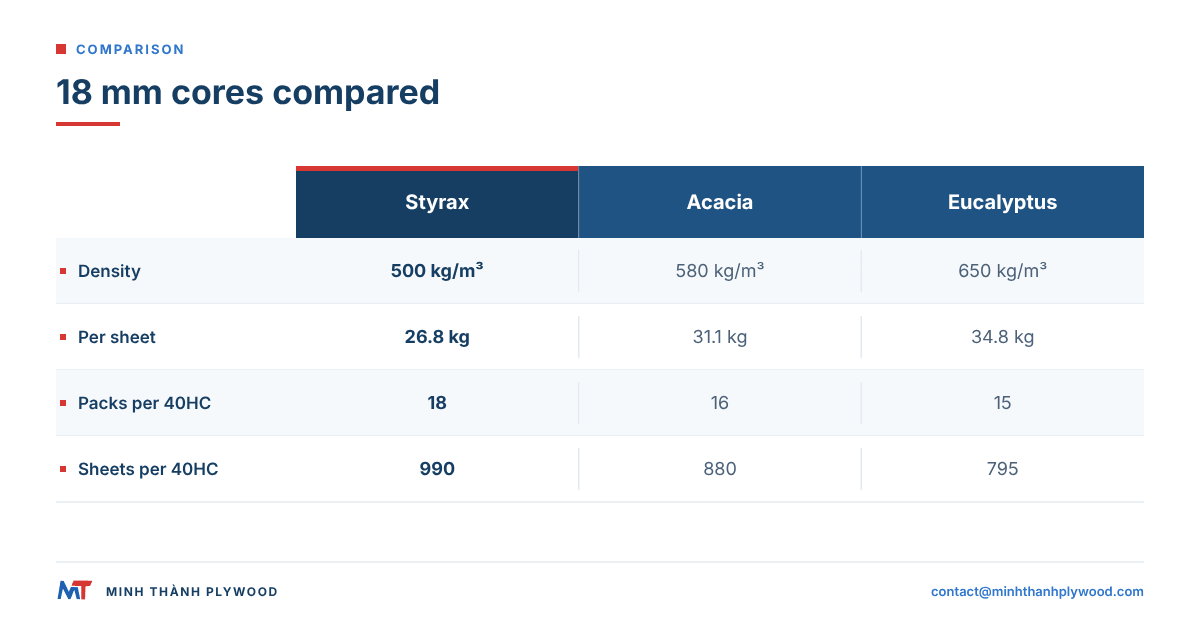
Styrax is the lightest of the three cores made in Vietnam, and the gap shows up in the container. At 18 mm, a Styrax sheet is about 8 kg lighter than a Eucalyptus sheet, and a 40HC takes 195 more sheets.
| 18 mm, 1220 × 2440 mm | Styrax core | Acacia core | Eucalyptus core |
|---|---|---|---|
| Planning density | 500 kg/m³ | 580 kg/m³ | 650 kg/m³ |
| Weight per sheet | 26.8 kg | 31.1 kg | 34.8 kg |
| Packs per 40HC | 18 (16 lying + 2 upright) | 16 | 15 |
| Sheets per 40HC | 990 sheets (55 × 18) | 880 sheets (55 × 16) | 795 sheets (53 × 15) |
| Volume per 40HC | about 53 m³ | about 47 m³ | about 43 m³ |
| Edge colour | Pale, even | Light brown | Pink to reddish brown |
The heavier cores stop earlier because of payload: Eucalyptus packs are cut to 53 sheets so the load stays inside the 28,000 kg plan. Eucalyptus measures 650–750 kg/m³ in practice, so real Eucalyptus loads can be lower still.
Weight is not the only difference. A denser core gives a harder panel that holds screws and takes point loads better, which is why Eucalyptus suits heavy shelves, worktop substrates and some flooring bases. Styrax wins where weight, edge colour and a smooth base for the face matter more.
Birch face styrax core plywood: what you get
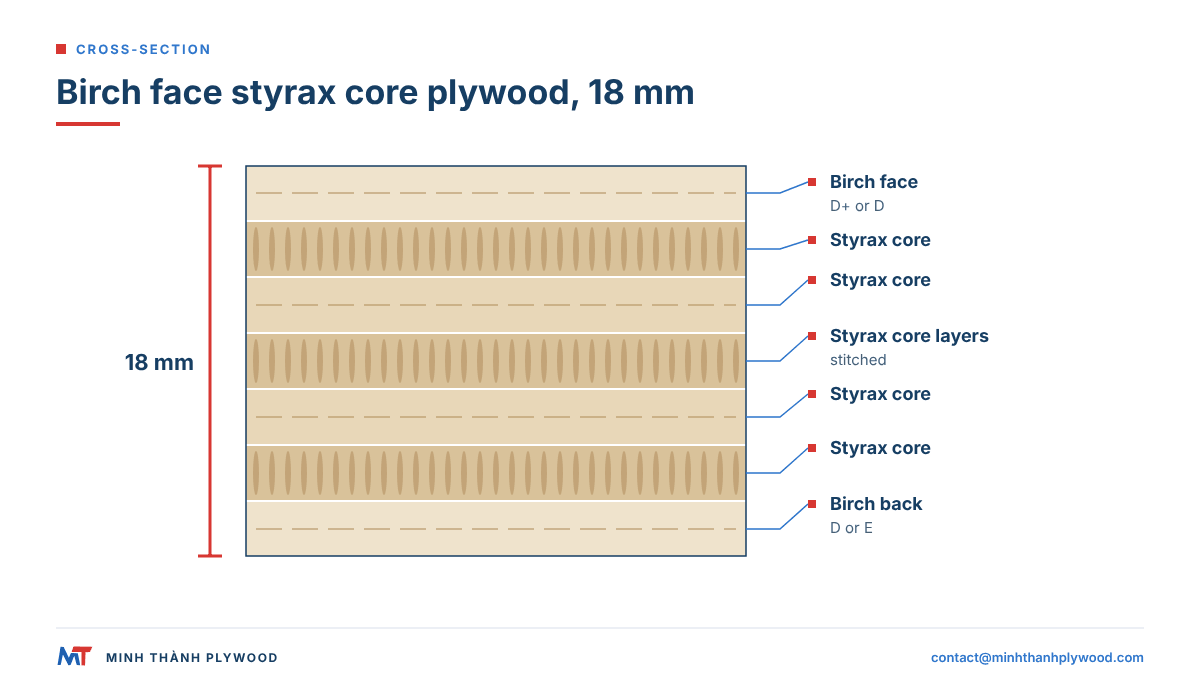
Birch face styrax core plywood is imported birch veneer pressed on both sides of a Styrax core. It gives a birch face with a pale edge at a lower weight than all-birch plywood, and it is sold as birch-faced plywood, not as all-birch.
Birch faces are graded D+, D and E in Vietnam (low to high: E, D, D+) and quoted as face/back pairs such as D+/D or D/E. The ladder is comparable to the European birch grades: D+ is about B, D is about BB and E is about CP/C, so D+/D is about B/BB. The grade you receive is the one on the approved sample.
What changes against all-birch plywood:
- Weight: lighter, because the core is Styrax at about 500 kg/m³.
- Edge: pale and even, with thin birch layers visible only at the faces.
- Price: lower, because only the faces are imported veneer.
- Use: furniture and interior parts. For structural or marine-type demands, specify the bond and the test, not the face.
Birch-faced plywood has its own product page with face grades and sizes.
Which faces suit a styrax core?
Every face Minh Thanh makes can go on a Styrax core; the pale core suits light faces best, because no dark layer shows at the edge.
| Face | Why it pairs well with Styrax | Typical use |
|---|---|---|
| EV (engineered veneer) | Even colour and grain; the flat core keeps it smooth | Cabinet doors, wardrobes, wall panels |
| Poplar | Light colour matches the core; good for paint | Painted furniture, drawer boxes |
| Birch | Birch look, lighter panel | Exposed-edge furniture, shelving |
| Okoume | Pinkish face, light panel | Interior joinery, furniture parts |
| Pine | Knotty or clear softwood look | Rustic furniture, interior panels |
For a lacquered or UV-coated finish, ask for sanded and polished faces. Both faces of Minh Thanh furniture panels are UV-ready, to the standard customers need to apply their own UV coating. EV plywood is one of our commonly produced faces on this core.
How is a styrax core built at the factory?
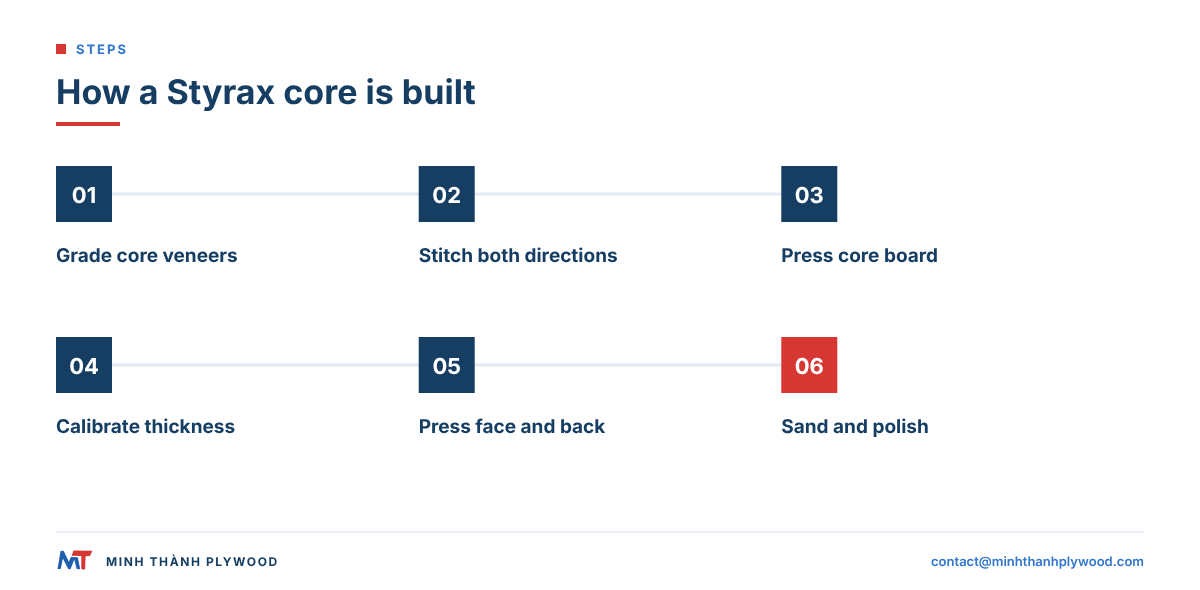
A Minh Thanh Styrax core is laid up from graded core veneers, stitched in both directions, pressed into a core board, calibrated, then pressed again with its face and back. The steps are:
- Grade the core veneers. Furniture panels use grade A core veneer; split or short sheets go to other lines.
- Stitch the core. Core layers are stitched horizontally and vertically, usually the outer 2–4 layers, and every layer when the buyer asks.
- Press the core board. The cross-banded Styrax layers are glued and hot-pressed into one board.
- Calibrate the core. The core board is sanded to an even thickness before the faces go on.
- Press the faces. Face and back veneers are pressed onto the calibrated core.
- Sand and polish. Both faces are sanded to the final thickness tolerance.
Stitching keeps core veneers from opening into gaps under the press. Pressing twice puts the faces on a flat, level board, so a thin face does not telegraph core joints. Calibrated plywood explains the calibration step in detail.
Where styrax works best, and when to choose a denser core
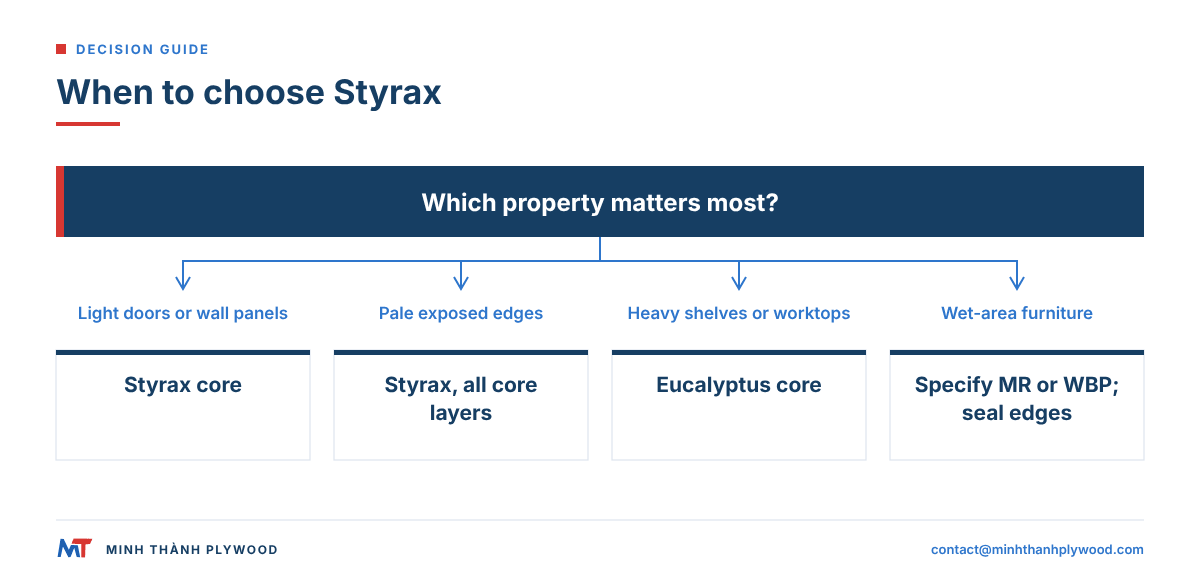
Styrax works best in interior furniture parts where a light, flat, pale panel matters more than hardness. Choose a denser Eucalyptus core when the part carries heavy point loads or many screws.
| Part or use | Styrax core | Eucalyptus core |
|---|---|---|
| Kitchen and bathroom cabinet carcasses | Yes | Yes |
| Wardrobe doors and sides | Yes, lighter doors | Possible, heavier |
| Exposed-edge shelving and furniture | Yes, pale edge | Edge shows darker layers |
| Wall panels and ceilings | Yes, lighter to fix | Possible |
| CNC-cut furniture parts | Yes, cuts cleanly | Yes |
| Heavy shelving, worktop substrates | Choose with care | Yes, harder panel |
| Flight cases, high-wear surfaces | Not first choice | Yes |
Many European furniture buyers choose a Styrax core for exactly this mix: a light panel with a good face. The panel is made for interior use; for wet areas, choose an MR or phenolic WBP bond and seal the edges.
Glue, emission and documents for a styrax core order
Styrax core furniture plywood uses UF glue at E0 emission as standard, with MR (melamine-fortified) or phenolic WBP bonds made to the buyer’s specification. Glue type and emission class are separate lines on the order.
The emission proof is the same as for every Minh Thanh furniture panel:
- CARB P2 / TSCA Title VI certification, ICTT mill no. 23024. Our certificate page provides the factory evidence. See the CARB composite wood products programme and EPA formaldehyde standards for composite wood products for the regulatory programmes.
- Six ASTM D6007 chamber tests, April 2025 to June 2026, on 9, 15 and 18 mm samples: averages of 0.014–0.032 ppm against the 0.05 ppm CARB Phase 2 limit. Three were run by Shanghai Hongjun and three by ICTT Vietnam.
- E0 emission tested every 3 months.
- Third-party testing to your own method, for example EN 717-1, through SGS on request.
- Class naming for a European or UK order. E1 is the EN 717-1 chamber class at or below 0.124 mg/m³; write the required method and limit on the order, since E0 has no single global threshold. For the service class of the bond, name EN 636 class 2 (humid) or class 3 (exterior) with the matching EN 314-2 bond class, and the mill confirms the glue that meets it.
- CE marking. If the panel goes into a building in the EU or Great Britain, the importer needs CE marking to EN 13986 (UKCA where it applies) with a declaration of performance that states the formaldehyde class. Furniture parts are not marked under it. Tell Minh Thanh the end use before you quote so the right documents are scoped.
For origin, Minh Thanh supplies the EUDR compliance dossier (origin records and geolocation files) with orders, for importers placing timber on the EU market under Regulation (EU) 2023/1115. For US orders, the species (Styrax tonkinensis for the core) and Vietnamese harvest origin go to the importer for the Lacey Act declaration.
How a styrax core changes the container plan
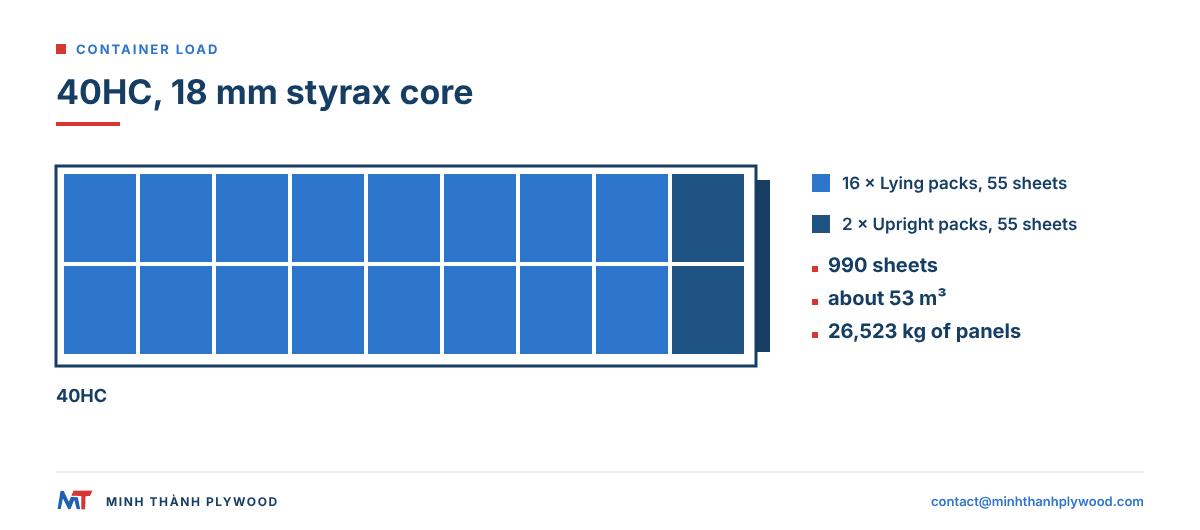
A Styrax core lets a 40HC load 18 packs instead of 15, because the panels are light enough to fill the space before the payload runs out. On 18 mm, that is 990 sheets against 795 on Eucalyptus, about 53 m³ against about 43 m³.
The 18 packs are 16 lying flat (four by four) plus 2 standing upright at the door end. For a cost per sheet or per cubic metre landed, the freight is spread over about 23 % more panel volume than a Eucalyptus load (53 ÷ 43). Check your own booking: a carrier limit below 28,000 kg lowers the sheet count.
What does styrax core plywood cost?
Furniture and interior plywood from Minh Thanh starts from US$350/m³ (indicative, October 2026). The final price for a Styrax core panel depends on the face species and grade, glue and emission class, thickness, sheet size, quantity and delivery term.
On the same Styrax core, an EV or poplar face sits near the bottom of the furniture range, while imported birch D+/D faces move the price up. Send your full specification for a firm quotation; production runs 15–45 days after the 30 % deposit.
How to specify styrax core plywood on your order
Write a Styrax core order as one line per item, with the core, face, glue and tolerance named. A complete line looks like this:
18 mm × 1220 × 2440 mm, core: Styrax veneer, all layers, stitched; face/back: birch D+/D; UF glue at E0 emission; sanded both faces, ±0.2 mm; moisture 8–12 %; 55 sheets per pack; 1×40HC, CIF your port.
Check these points before you confirm:
- Core species and layers: Styrax, all layers, if you need a white edge.
- Face and back grade: a named pair, matched to an approved sample.
- Glue type and emission class: two separate lines.
- Thickness tolerance: the number, sanded or unsanded.
- Size, packing and quantity: sheets per pack, packs per container, destination port.
Minh Thanh sends free samples of the Styrax core in your chosen face, so the edge and face can be approved before production. Send the line above, or your drawing, to [email protected] or WhatsApp +84 988 586 601; replies come within hours.
Buyer questions, answered
What is styrax plywood?
Styrax plywood is plywood whose core veneers are Styrax tonkinensis, a pale plantation hardwood grown in northern Vietnam. The face is a separate choice, so the same Styrax core can carry birch, poplar, EV, okoume or pine faces.
Why is styrax called full white core?
Styrax veneer is pale cream to near white, so a panel built entirely on Styrax veneers shows an even light edge with no dark layers. Traders call it full white core; on the order, write the species, Styrax, rather than the colour.
Is styrax the same as birch plywood?
No. Birch face styrax core plywood has imported birch faces on a Styrax core. It looks close to birch on the face and stays pale at the edge, but it is lighter than all-birch plywood and is sold as a different construction.
How much does an 18 mm styrax core sheet weigh?
At the 500 kg/m³ planning density, a 1220 × 2440 × 18 mm Styrax core sheet weighs about 26.8 kg, against about 34.8 kg on a Eucalyptus core at 650 kg/m³.
Where does styrax grow?
Styrax is planted in northern Vietnam. Minh Thanh sources Styrax for its cores from plantation timber grown around Ha Hoa, Phu Tho, close to the factory.
Is styrax planted or wild-harvested?
Styrax for plywood cores is plantation timber. Minh Thanh's cores come from locally grown plantation timber around Ha Hoa, and the EUDR compliance dossier with origin records and geolocation files is supplied with orders.
When should I choose styrax over a denser core?
Choose Styrax when weight, a pale edge and a smooth base for thin faces matter most: cabinets, wardrobes, wall panels, shop fittings and CNC parts. Choose Eucalyptus when the part needs a harder, heavier panel.
How many styrax core sheets fit in a 40HC container?
Planned on 18 packs of about 1,000 mm, a 40HC holds 990 sheets of 18 mm Styrax core plywood in 1220 × 2440 mm, about 53 m³ and 26,523 kg of panels, against 795 sheets on a Eucalyptus core.
What glue does styrax core plywood use?
Furniture panels use UF glue at E0 emission as standard. MR (melamine-fortified) or phenolic WBP bonds are made to the buyer's specification; glue type and emission class are written as two separate lines.
Is styrax core plywood good for CNC machining?
Yes, when the core is stitched, pressed twice and sanded to a tight thickness tolerance. Minh Thanh sands furniture panels to ±0.2–0.3 mm, down to ±0.2 mm, so grooves and pockets cut to a constant depth.