
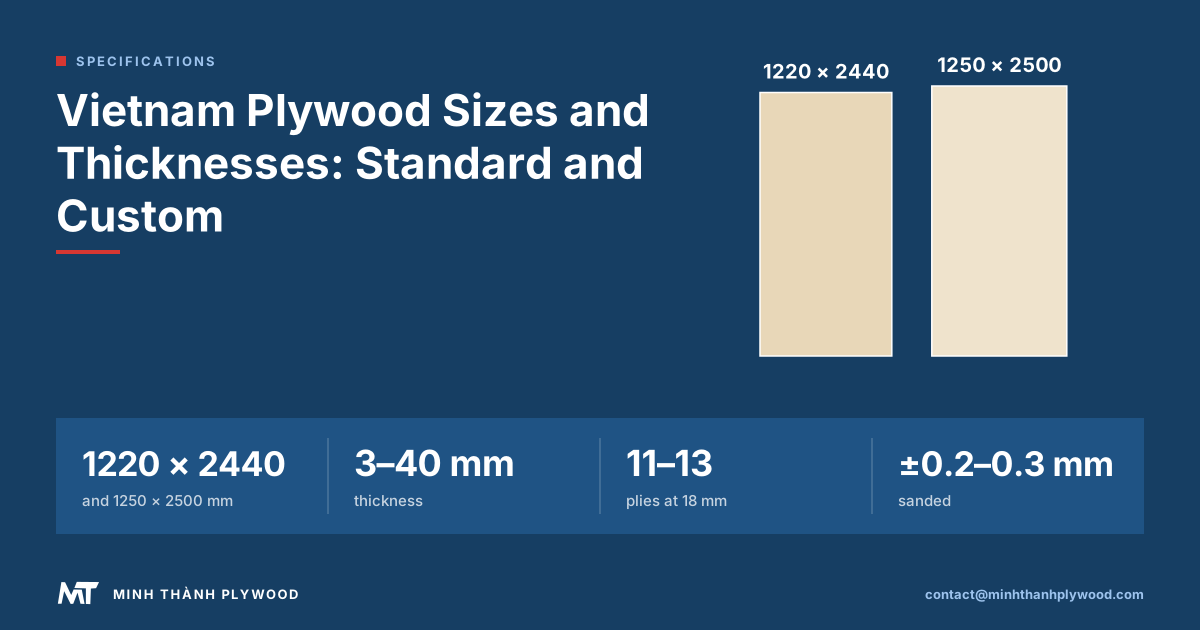
Vietnam plywood sizes start from two standard sheets, 1220 × 2440 mm and 1250 × 2500 mm, in thicknesses from 3 to 40 mm. Custom full sheets such as 1220 × 2500 and 1220 × 2280 mm, and cut-to-size panels, are made on order. Minh Thanh Plywood, a manufacturer in Ha Hoa, Phu Tho, sets out every size, ply count, tolerance and weight, and the fields to write on an order.
Vietnam plywood sizes at a glance
Vietnam plywood sizes are built around two pressed sheets: 1220 × 2440 mm, the 4 × 8 ft format traded worldwide, and 1250 × 2500 mm, the metric sheet European plants use. Every other size is either a custom full sheet pressed to order or a cut-to-size piece cut from a standard sheet.
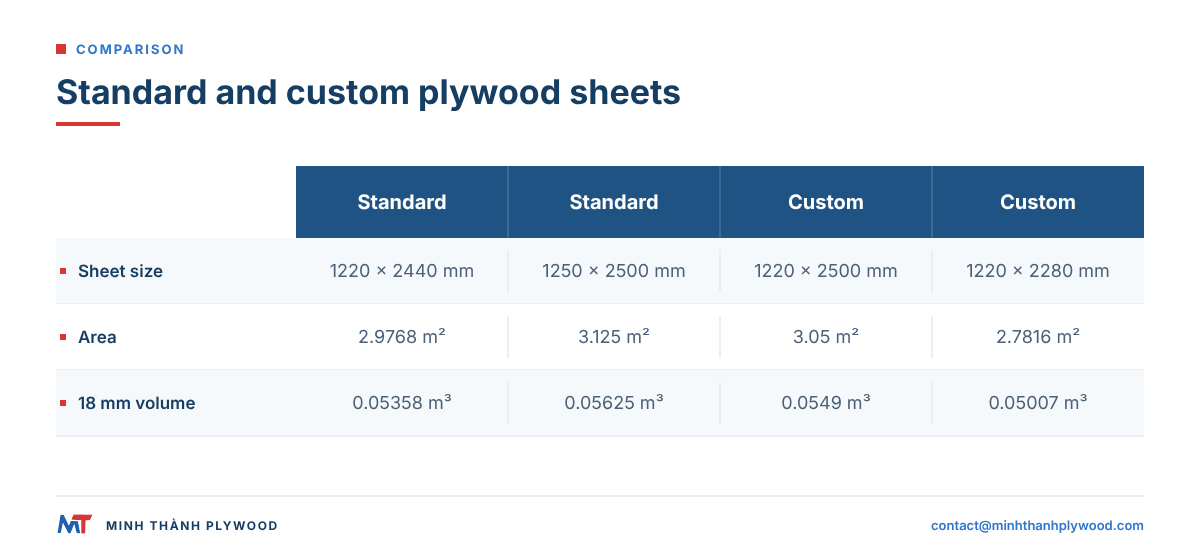
| Sheet | Feet (approx.) | Area per sheet | Volume at 18 mm | How it is made |
|---|---|---|---|---|
| 1220 × 2440 mm | 4 × 8 ft | 2.9768 m² | 0.05358 m³ | Standard sheet |
| 1250 × 2500 mm | 4.1 × 8.2 ft | 3.125 m² | 0.05625 m³ | Standard sheet |
| 1220 × 2500 mm | 4 × 8.2 ft | 3.05 m² | 0.0549 m³ | Custom full sheet |
| 1220 × 2280 mm | 4 × 7.5 ft | 2.7816 m² | 0.05007 m³ | Custom full sheet |
| 4, 6 or 8 pieces | — | Per cut list | Per cut list | Cut-to-size from a standard sheet |
Thickness runs from 3 to 40 mm. Area is width × length in metres; volume is area × thickness. The 1250 × 2500 mm sheet carries 4.98% more area than 1220 × 2440 mm, which matters only when the buyer’s parts use it.
Plywood dimensions in Vietnam: the two standard sheets
Plywood dimensions in Vietnam follow the export market, so mills keep two standard sheets ready to press: 1220 × 2440 mm and 1250 × 2500 mm. Presses, sanders and pack plans are set up for both, so neither carries a custom-size charge.
1220 × 2440 mm is the Asian and global version of the 4 × 8 ft sheet. A true 4 × 8 ft is 1219.2 × 2438.4 mm (1 ft = 304.8 mm), so the metric sheet is a fraction larger and still fits every 4 × 8 cutting list. This is the default size when an inquiry names no size: furniture plants in Asia, the Middle East, Africa and the Americas plan around it, and the 40HC pack plan is calculated on it.
1250 × 2500 mm is the metric sheet of European furniture and joinery plants. It is 30 mm wider and 60 mm longer than 1220 × 2440 mm. A buyer whose saw, CNC bed and part list are metric gets parts with clean edges on four sides instead of trimming a 4 × 8 sheet. Minh Thanh Plywood ships regularly to European buyers, with repeat orders into Italy, and both sheets are standard here.
The grain runs along the length on both sheets. Write the size as width × length, with the face grain along the second number, so that “1220 × 2440 mm” leaves no doubt about which way the face grain runs. Our pillar guide to plywood sheet sizes in millimetres and feet covers the conversions and the grain-direction rule in full.
Which custom sizes can a Vietnamese mill make?
A Vietnamese furniture mill makes custom full sheets inside its press format, such as 1220 × 2500 mm and 1220 × 2280 mm, and cut-to-size pieces from a standard sheet. A custom full sheet is pressed, calibrated and sanded at its own size, then trimmed square.
Two custom sheets come up most often:
- 1220 × 2500 mm. The 4 ft width with a metric length. Buyers order it when their parts need 2,480 mm of clean length but their saw and stacking are set for a 1220 mm width.
- 1220 × 2280 mm. A shorter sheet for parts that leave a wide offcut on a 2440 mm length. A cabinet plant that cuts three 720 mm sides from each strip pays for 160 mm less length per sheet and gets the same parts.
A custom full sheet makes sense when the buyer’s part list repeats, month after month, and leaves the same offcut on every standard sheet. A one-off job is usually cheaper as cut-to-size from a standard sheet. Our guide to cutting yield by sheet size works through cabinet, drawer and bed layouts on each sheet.
What does cut-to-size mean at a plywood mill?
Cut-to-size means the mill cuts a standard sheet into 4, 6 or 8 smaller panels, edge-trimmed and packed by size, so the buyer receives parts instead of full sheets. Minh Thanh Plywood ships cut-to-size orders regularly to Italy and other European markets.
The common cuts from a 1220 × 2440 mm sheet are simple fractions, before saw kerf:
| Cut | Pieces per sheet | Nominal piece size | Typical use |
|---|---|---|---|
| Halves across the length | 2 | 1220 × 1220 mm | Table tops, square crates |
| Quarters | 4 | 610 × 1220 mm | Shelving, cabinet sides, drawer stock |
| Sixths | 6 | 406 × 1220 mm or 610 × 813 mm | Drawer fronts, packaging panels |
| Eighths | 8 | 610 × 610 mm | Crate ends, display panels, samples |
The saw takes a few millimetres per cut, so the finished piece is slightly smaller than the nominal fraction. Send the finished size you need and the tolerance, and the cut plan is set to it. The cut-to-size plywood page lists the build options for these orders.
What plywood thickness range is available from Vietnam?
Vietnamese furniture mills make plywood from 3 to 40 mm thick, and Minh Thanh Plywood presses every thickness in that range to order. Most orders fall on a handful of common steps, chosen by the part the panel becomes.
| Thickness | Typical parts | Build notes |
|---|---|---|
| 3 mm | Drawer bottoms, cabinet backs, door skins | Always 5-ply |
| 4–6 mm | Backs, bending parts, laminating substrates, packaging | Always 5-ply (3–5 mm) |
| 9 mm | Drawer sides, light shelves, wall panels | Calibrated and sanded |
| 12 mm | Drawer boxes, cabinet backs that carry hardware, crates | Calibrated and sanded |
| 15 mm | Cabinet carcasses, wardrobe interiors | Stitched core for furniture |
| 18 mm | Carcasses, table tops, shelves, film-faced formwork | The most ordered step |
| 21–25 mm | Worktops, heavy shelving, truck and stage floors | Heavier cores where stiffness matters |
| 28–40 mm | Thick tops, jigs, special structural parts | Pressed to order |
Thicknesses between the steps, such as 8, 10, 14, 16 or 20 mm, are made the same way: the layup is planned for the target thickness and the panel is calibrated and sanded to it. Our plywood thickness guide explains nominal and actual thickness and the inch equivalents.
How many plies does plywood have at each thickness?
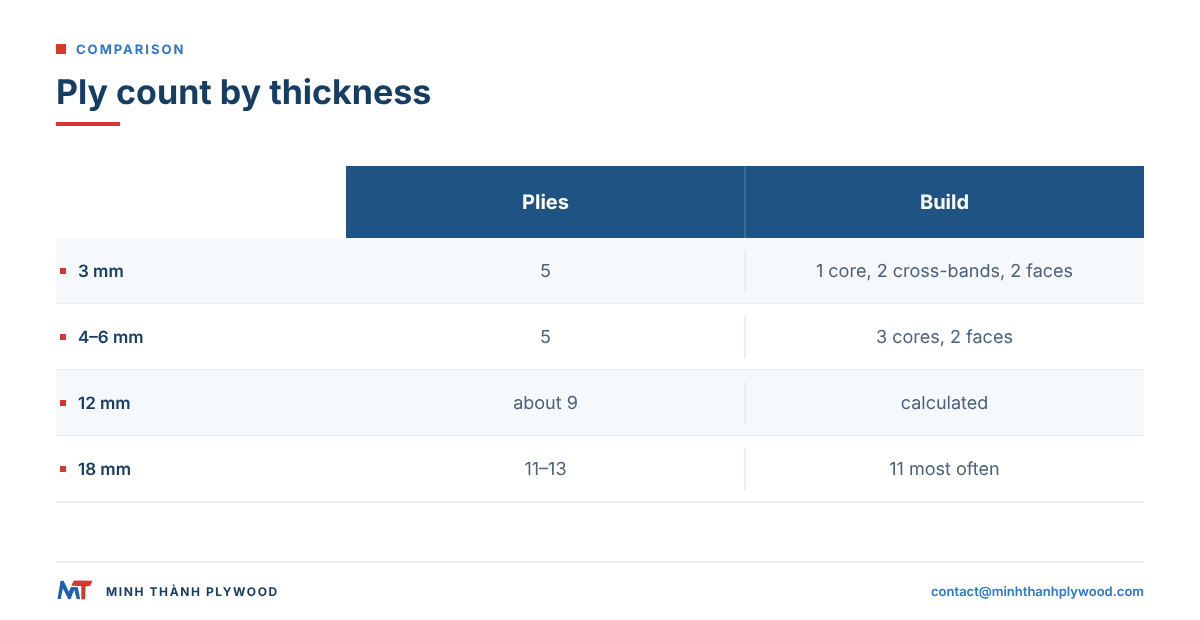
At Minh Thanh Plywood, 3–5 mm panels are always 5-ply and an 18 mm panel usually has 11–13 plies. The count follows from veneer thickness: core veneers of about 1.4–2.0 mm and face veneers of about 0.2–0.5 mm.
| Panel thickness | Typical ply count | How it is built |
|---|---|---|
| 3 mm | 5 plies | One core veneer, two cross-band veneers, two faces |
| 4 and 5 mm | 5 plies | Three core veneers and two faces, core veneer adjusted to the panel |
| 9 mm | About 7 plies | Five core veneers and two faces (calculated) |
| 12 mm | About 9 plies | Seven core veneers and two faces (calculated) |
| 15 mm | About 9–11 plies | Calculated from 1.4–2.0 mm core veneers |
| 18 mm | 11–13 plies | 11 plies most often |
| 21 mm | About 13–15 plies | Calculated |
| 25 mm | About 15–17 plies | Calculated |
The rows marked “calculated” divide the thickness, less two faces, by the 1.4–2.0 mm core veneer and round to the odd count that fits. A 4 mm furniture panel, for example, uses three 1.3 mm Styrax core veneers under two faces. More plies at the same thickness give a flatter, more even panel and steadier screw holding at the edge, which is why furniture buyers ask for the count.
Which sizes and thicknesses are standard, and which are made to order?
At a Vietnamese furniture mill every panel is pressed for its order, so “standard” means the press, sander and pack plan are already set for it, and “custom” means the mill sets them for this order. Standard sizes are 1220 × 2440 and 1250 × 2500 mm; common thickness steps are 3, 5, 6, 9, 12, 15, 18 and 25 mm.
| Specification | Standard | Made to order |
|---|---|---|
| Sheet size | 1220 × 2440 mm, 1250 × 2500 mm | 1220 × 2500 mm, 1220 × 2280 mm, other sizes inside the press format |
| Cut-to-size | — | 4, 6 or 8 pieces per sheet, or the buyer’s cut list |
| Thickness | 3, 5, 6, 9, 12, 15, 18, 25 mm | Any thickness from 3 to 40 mm |
| Core | White Styrax or Eucalyptus | Acacia or Pine |
| Glue and emission | UF glue at E0 emission | MR, melamine-fortified or phenolic (WBP) bonds |
| Tolerance | Per product line | Tighter tolerance down to ±0.2 mm on sanded panels |
Plywood is not sold from a shelf at the mill. Veneers are graded, dried to 8–12 % moisture content and laid up for each order, and furniture panels are pressed twice: the core board is pressed and calibrated, then face and back are pressed on. A custom size changes the trimming and pack plan, not this build.
How does size or thickness change the lead time?
Production takes 15–45 days after the 30% deposit for standard and custom sizes alike, because every order is laid up and pressed for that buyer. Where an order sits in that window depends on the mix, the thickness and the season’s veneer supply.
Three things move an order towards the long end:
- Thin premium faces. A 4 mm furniture panel needs thin, clean veneer, which is scarce. The standard is not lowered to go faster, so 4 mm panels can take longer.
- Many specifications in one container. One or two specifications per container is normal; three to six is possible by agreement and adds set-up time.
- Tight tolerance on thick panels. Calibrating a 25 mm sanded panel to a tight tolerance takes extra sanding passes.
A custom size on its own adds a trimming set-up and a separate pack plan. Sea transit then adds about 5–12 days to South-East Asia, 15–25 to the Middle East, 30–40 to Northern Europe and 35–45 to the US East Coast from Hai Phong, by carrier and route.
What is the thickness tolerance for plywood from Vietnam?
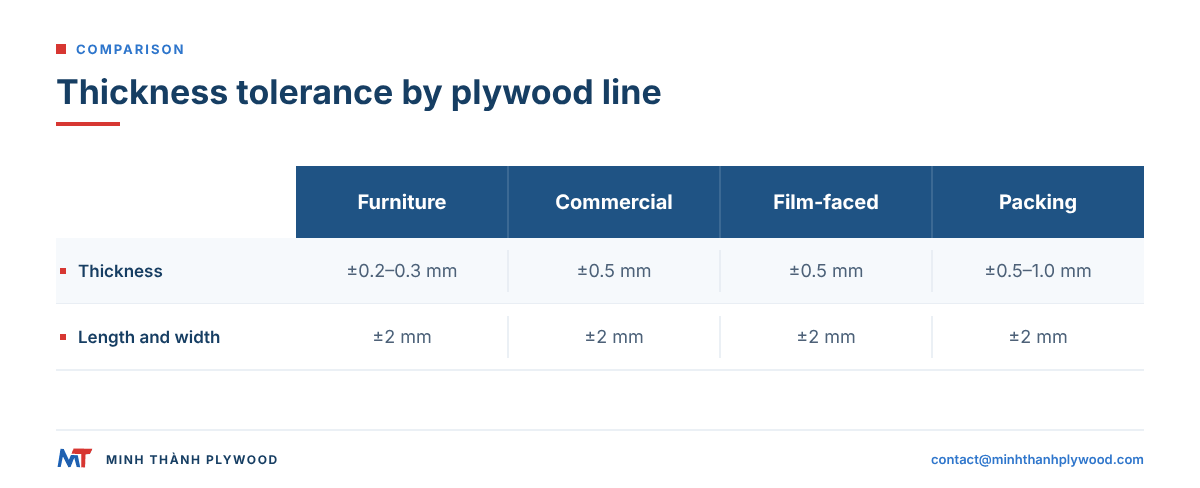
Thickness tolerance at Minh Thanh Plywood depends on the product line: sanded furniture panels ±0.2–0.3 mm, down to ±0.2 mm; commercial and film-faced panels ±0.5 mm; packing plywood ±0.5–1.0 mm. Length and width are held to ±2 mm on every line.
| Product line | Thickness tolerance | Length and width |
|---|---|---|
| Sanded furniture and interior plywood | ±0.2–0.3 mm, down to ±0.2 mm | ±2 mm |
| Commercial plywood | ±0.5 mm | ±2 mm |
| Film-faced plywood | ±0.5 mm | ±2 mm |
| Packing plywood | ±0.5–1.0 mm | ±2 mm |
The tight figure on furniture panels comes from the build, not from sorting at the end: the core board is pressed and calibrated before the faces go on, then the finished panel is sanded to thickness. A tolerance belongs on the order next to the thickness, because “18 mm” alone does not say how close to 18 mm the panel must be. A buyer who edge-bands, routes grooves or laminates needs ±0.2–0.3 mm; a crate maker does not.
Nominal and actual thickness: what will the caliper read?
The caliper reads the ordered thickness inside the tolerance written on the order: an 18 mm sanded furniture panel ordered at ±0.2 mm measures between 17.8 and 18.2 mm. Vietnamese export panels are sold by actual metric thickness, not by a trade name.
Confusion comes from imperial trade names. A North American “3/4 inch” sheet can be sold at 23/32 inch (18.26 mm), and a full 3/4 inch is 19.05 mm. Inch sizes convert at the NIST definition of 1 inch = 25.4 mm. A metric 18 mm panel is the usual substitute for 3/4 inch in cabinets, but it is 1.05 mm thinner than a full 3/4 inch, so grooves, hinges and CNC programs should use the ordered metric thickness.
Measure thickness at several points about 25 mm in from the edge, on a panel that has settled to the room’s humidity. Panels leave the mill at 8–12 % moisture content, the normal range for furniture plywood, so a panel measured straight from a damp warehouse can read a little thicker than it will in the plant.
How much does a sheet weigh at each size and thickness?
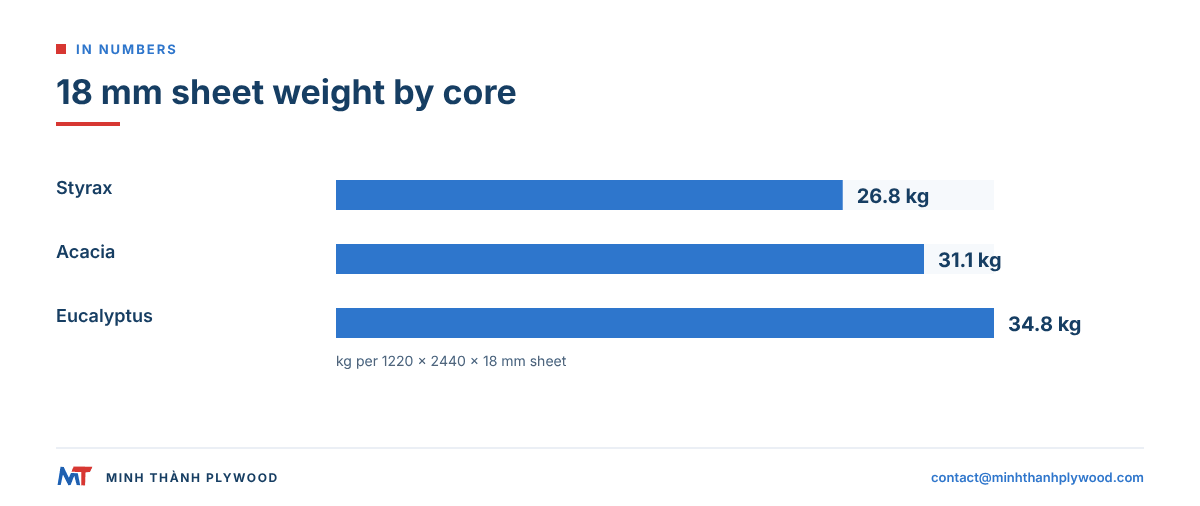
A sheet’s weight is its volume times the core’s density: an 18 mm sheet of 1220 × 2440 mm weighs about 26.8 kg on a white Styrax core (500 kg/m³), 31.1 kg on Acacia (580 kg/m³) and 34.8 kg on Eucalyptus (650 kg/m³). The face veneer is too thin to change the result.
| Thickness | 1220 × 2440, Styrax | 1220 × 2440, Acacia | 1220 × 2440, Eucalyptus | 1250 × 2500, Styrax | 1250 × 2500, Eucalyptus |
|---|---|---|---|---|---|
| 3 mm | 4.5 kg | 5.2 kg | 5.8 kg | 4.7 kg | 6.1 kg |
| 9 mm | 13.4 kg | 15.5 kg | 17.4 kg | 14.1 kg | 18.3 kg |
| 12 mm | 17.9 kg | 20.7 kg | 23.2 kg | 18.8 kg | 24.4 kg |
| 15 mm | 22.3 kg | 25.9 kg | 29.0 kg | 23.4 kg | 30.5 kg |
| 18 mm | 26.8 kg | 31.1 kg | 34.8 kg | 28.1 kg | 36.6 kg |
| 25 mm | 37.2 kg | 43.2 kg | 48.4 kg | 39.1 kg | 50.8 kg |
The densities are reference values for planning; Eucalyptus cores run 650–750 kg/m³ in practice, so a heavy batch of Eucalyptus weighs more. Weigh real panels before a load is booked. Many European furniture buyers choose the Styrax core because it is light and gives a clean face, and the lighter sheet puts more cubic metres in each container.
How many sheets fit in a 40HC at each thickness?
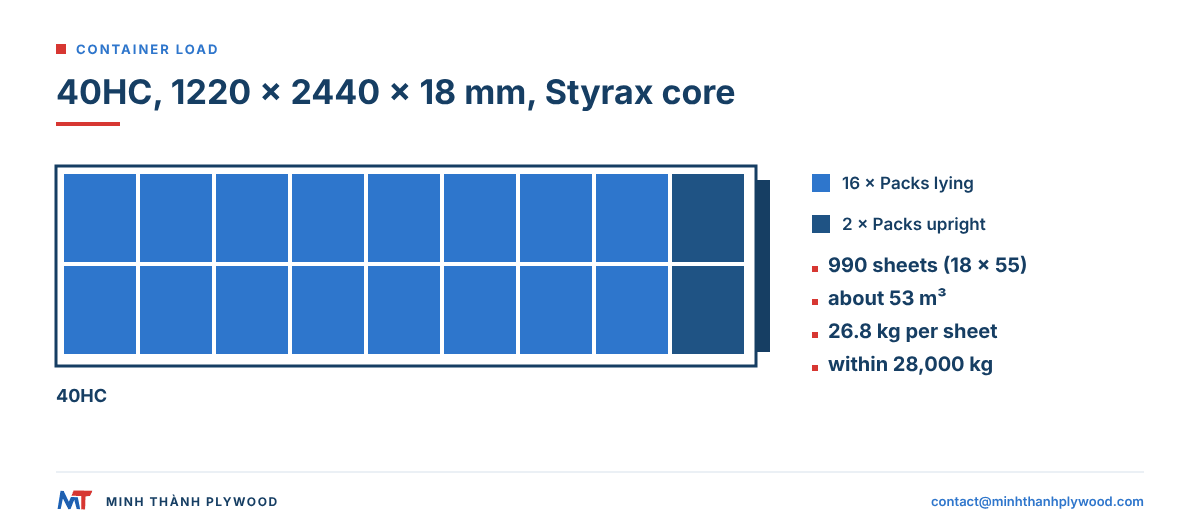
A 40HC carries 990 sheets of 1220 × 2440 × 18 mm on a Styrax core (18 packs of 55 sheets, about 53 m³), 880 on Acacia (16 packs of 55, about 47 m³) and 795 on Eucalyptus (15 packs of 53, about 43 m³). Packs are about one metre high; sheets per pack follow from thickness and are then capped by weight.
| Thickness, 1220 × 2440 mm, Styrax core | Sheets per pack | Sheets per 40HC (18 packs) | Sheet weight |
|---|---|---|---|
| 3 mm | 333 sheets | 5,994 sheets | 4.5 kg |
| 6 mm | 166 sheets | 2,988 sheets | 8.9 kg |
| 9 mm | 111 sheets | 1,998 sheets | 13.4 kg |
| 12 mm | 83 sheets | 1,494 sheets | 17.9 kg |
| 15 mm | 66 sheets | 1,188 sheets | 22.3 kg |
| 18 mm | 55 sheets | 990 sheets | 26.8 kg |
| 21 mm | 47 sheets | 846 sheets | 31.3 kg |
| 25 mm | 40 sheets | 720 sheets | 37.2 kg |
Every row stays inside a 28,000 kg planning payload, unless the booking is lower. Heavier cores reach the weight limit first, which is why Acacia and Eucalyptus loads carry fewer packs. A 1250 × 2500 mm sheet takes the same packs per container but weighs about 5% more, so its pack plan is checked against the payload per order. Every shipment is photographed and filmed before loading, and buyers get the photos and video. Try your own mix in the container packing calculator.
Plywood thickness for export by market
Plywood thickness for export from Vietnam follows what each market builds: European furniture plants order light, calibrated 15–18 mm panels and thin backs, US buyers order 4 × 8 sheets with CARB P2 / TSCA Title VI documents, and Gulf and African markets order 1220 × 2440 mm in a broad spread from 3 to 25 mm.
| Market | Sheet size most ordered | Thicknesses most ordered | What buyers ask for |
|---|---|---|---|
| Europe | 1250 × 2500 and 1220 × 2440 mm | 3–6, 15, 18 mm | Light white core, clean face, tight tolerance, low emission, EUDR dossier |
| United States | 1220 × 2440 mm (4 × 8 ft) | 12 and 18 mm, ordered against inch sizes | CARB P2 / TSCA Title VI label, species and origin for the Lacey Act declaration |
| Middle East (UAE, Saudi Arabia) | 1220 × 2440 mm | 3, 6, 9, 12, 15, 18 mm | Joinery and furniture faces, film-faced for formwork |
| Australia and New Zealand | 1200 × 2400 mm locally; 1220 × 2440 mm imported | 12, 17, 18 mm | Metric sizes, cut-to-size to 2400 × 1200 mm |
| Japan and Korea | Metric and 4 × 8 formats | 3–6 mm and 12–18 mm | Clean faces, low emission; about 2–3 weeks at sea |
For US orders, panels carry the TSCA Title VI label (producer, lot, certifier number TPC-43). The limit for veneer-core hardwood plywood is 0.05 ppm under 40 CFR 770.10. Minh Thanh Plywood holds CARB P2 / TSCA Title VI certification, ICTT mill no. 23024. For the EU, we supply the EUDR compliance dossier (origin records and geolocation files) with orders. Plywood under heading 4412 is a relevant product of Regulation (EU) 2023/1115. Australian and New Zealand sizes are covered in our guide to Australian and NZ sheet sizes.
Furniture plywood thickness: which part takes which panel?
Furniture plywood thickness follows the part: 15–18 mm for cabinet and wardrobe carcasses, 18–25 mm for tops and long shelves, 9–12 mm for drawer boxes and 3–6 mm for backs and drawer bottoms. Choose the thickness by span, load and hardware, then fix the tolerance.
| Furniture part | Usual thickness | Why |
|---|---|---|
| Cabinet and wardrobe sides | 15 or 18 mm | Holds hinges, shelf pins and cam fittings |
| Fixed and adjustable shelves | 18 mm; 25 mm for long spans | Less sag on long spans |
| Table tops and worktops | 18–25 mm, or two 18 mm layers | Edge profile and stiffness |
| Drawer sides and backs | 9–12 mm | Light, takes dovetail or dowel joints |
| Drawer bottoms and cabinet backs | 3–6 mm | Fits a groove, keeps weight down |
| Doors (painted or veneered) | 18 mm | Hinge cup depth and flatness |
For sanded furniture panels, order the tolerance with the thickness, for example “18 mm ±0.2 mm”. Size the groove for the back panel’s measured thickness and the required fit. Thin panels from 3 to 5 mm are always 5-ply here, which keeps a back panel flat in the groove. See the thin plywood 3–5 mm range for build details.
Plywood thickness options in Vietnam by core and face
Plywood thickness options in Vietnam depend less on the thickness itself than on the core and face it is built with. White Styrax and Eucalyptus are the standard furniture cores; Acacia and Pine cores are made on order. More than ten face veneers are offered, most often EV (engineered veneer), Poplar, Birch, Okoume and Pine.
| Core | Reference density | Best fit | Thickness note |
|---|---|---|---|
| White Styrax | 500 kg/m³ | Light furniture panels, clean faces, most m³ per container | All furniture thicknesses |
| Eucalyptus | 650–750 kg/m³ | Stiffer, heavier furniture and construction panels | Thick panels and worktops |
| Acacia | 580 kg/m³ | Commercial and film-faced panels | Formwork 12–21 mm |
| Pine | On order | Pine-faced and light panels | On order |
Face choice sets the appearance, not the thickness. Birch faces are graded D+, D and E in Vietnam and quoted as face/back pairs such as D+/D; Poplar, Eucalyptus and Pine faces are quoted as A/A, A/B or B/B, matched to the approved sample. Both faces can be made UV-ready, sanded to the standard buyers need to apply their own UV coating.
How does size and thickness change the price?
Plywood is priced per cubic metre, so a thicker or larger sheet costs more per sheet but about the same per cubic metre; thin panels and custom sizes cost more per cubic metre. Indicative starting prices in October 2026 are US$250/m³ for commercial plywood and US$350/m³ for furniture and interior plywood.
Four size and thickness effects show up on a quote:
- Thin panels cost more per m³. A 3 mm panel has the same two faces as a thicker panel, spread over less wood.
- Larger sheets cost more per sheet. A 1250 × 2500 mm sheet holds 4.98% more area than 1220 × 2440 mm, and it is priced on that area.
- Custom sizes add a line. Trimming, a separate pack plan and any offcut are quoted on their own line.
- Tight tolerance adds sanding. ±0.2 mm on a thick panel needs extra calibration passes.
Compare two quotes per cubic metre and per accepted part, never per sheet. Face, core, glue, thickness, size, quantity and delivery term set the final price.
How to choose a custom thickness plywood supplier in Vietnam
Choose a custom thickness plywood supplier in Vietnam by checking that the mill makes the panel itself, holds a written tolerance for the thickness you need, and can show the build: core species, ply count, glue and emission class. A supplier who cannot write these down cannot hold them.
Use this checklist before the first order:
- Manufacturer or reseller? Ask for factory photos and video of the press and sanding line, and the certificate holder’s name. Minh Thanh Plywood shows its own production and holds CARB P2 / TSCA Title VI (ICTT mill no. 23024), ISO 9001:2015 (KAC25/0185) and TCVN 11902:2017 (VietCert 141.1-VNC-HC).
- Thickness range. The mill should press 3–40 mm and name the plies at your thickness.
- Tolerance in writing. ±0.2–0.3 mm for sanded furniture panels; ±0.5 mm for commercial and film-faced.
- Build. Core species, stitched core layers, double pressing for furniture panels, glue and emission class as two separate lines.
- Custom sizes. Which full sheets it presses, and whether it cuts to size.
- Proof. Free samples, chamber test reports (six ASTM D6007 tests averaged 0.014–0.032 ppm against the 0.05 ppm limit), and pre-loading photos and video of your shipment.
A mill that answers all six in one reply is set up for export. Minh Thanh Plywood replies within hours.
What to write on a plywood size and thickness order
Write the size, thickness and tolerance on one line with the core, glue and face, so the quote and the panel match: for example “1250 × 2500 × 18 mm ±0.2 mm, white Styrax core, UF glue at E0 emission, birch D/E faces, sanded, 1×40HC CIF Genoa”.
Send these six fields:
- Application: cabinets, wardrobes, worktops, packing or formwork.
- Core: Styrax, Eucalyptus, Acacia or Pine; stitched layers if needed.
- Glue and emission: UF glue at E0 emission, MR, melamine-fortified or phenolic (WBP); CARB P2 / TSCA Title VI if the panel goes to the US.
- Face and back: species and grade pair, sanded or UV-ready.
- Size, thickness and tolerance: 1220 × 2440, 1250 × 2500 mm or a custom size; cut-to-size list if needed.
- Packing and quantity: containers, mix of specifications, destination port, FOB Hai Phong, CFR or CIF.
The minimum order is one 40HC, with mixed specifications by agreement; payment is a 30% deposit and 70% against the scanned B/L, or an irrevocable L/C at sight. Samples are free. Write to contact@minhthanhplywood.com or WhatsApp +84 988 586 601 (Lisa), Monday–Friday, 08:00–17:00 Vietnam time.
Buyer questions, answered
What sizes does plywood come in from Vietnam?
Vietnamese mills make plywood in two standard sheets, 1220 × 2440 mm (the 4 × 8 ft format) and 1250 × 2500 mm (the European metric format). Custom full sheets such as 1220 × 2500 and 1220 × 2280 mm, and cut-to-size pieces, are made on order.
What thicknesses does Minh Thanh Plywood make?
Minh Thanh Plywood makes plywood from 3 to 40 mm thick. The most ordered thicknesses are 3, 5, 6, 9, 12, 15, 18 and 25 mm, and any other thickness inside the range can be pressed to order.
Can Vietnamese plywood factories produce custom sizes and thicknesses?
Yes. A furniture mill presses custom full sheets such as 1220 × 2500 and 1220 × 2280 mm, cuts panels into 4, 6 or 8 pieces, and makes any thickness from 3 to 40 mm. The minimum order is one 40HC, which can mix specifications by agreement.
What is the thickness tolerance for plywood from Vietnam?
At Minh Thanh Plywood, sanded furniture panels are held to ±0.2–0.3 mm and down to ±0.2 mm, commercial and film-faced panels to ±0.5 mm, and packing plywood to ±0.5–1.0 mm. Length and width are held to ±2 mm.
How many plies does 18 mm plywood have?
An 18 mm Vietnamese furniture panel usually has 11–13 plies, made from core veneers of about 1.4–2.0 mm and two face veneers. Thin panels from 3 to 5 mm are always 5-ply at Minh Thanh Plywood.
How much does an 18 mm sheet of plywood weigh?
An 18 mm sheet of 1220 × 2440 mm weighs about 26.8 kg on a Styrax core, 31.1 kg on Acacia and 34.8 kg on Eucalyptus. The same sheet at 1250 × 2500 mm weighs about 28.1, 32.6 and 36.6 kg.
Which plywood size is standard in Europe?
European furniture and joinery plants often work in the metric 1250 × 2500 mm sheet, while many also buy 1220 × 2440 mm. Minh Thanh Plywood makes both and ships regularly to European buyers, including repeat orders into Italy.
What plywood sheet sizes are common in the UAE?
The UAE and wider Gulf market trade plywood mainly in the 1220 × 2440 mm (4 × 8 ft) sheet, in thicknesses from 3 to 25 mm for joinery, furniture, packing and formwork. Sea transit from Hai Phong to the Middle East takes about 15–25 days.
Does a custom size cost more?
A custom full sheet or a cut-to-size order adds a cutting step and a separate pack plan, so it is quoted on its own line. It often saves the buyer more than it costs, because fewer offcuts are paid for, shipped and thrown away.
How long does a custom-size order take?
Production takes 15–45 days after the 30% deposit, for standard and custom sizes alike. Thin 4 mm panels can take longer, because premium thin veneer is scarce and the standard is not lowered to go faster.
Is 18 mm plywood the same as 3/4 inch?
No. 18 mm is about 0.709 inch, and a full 3/4 inch is 19.05 mm. A metric 18 mm sheet from Vietnam is the usual substitute for 3/4 inch in furniture, but drawings and CNC programs should use the ordered metric thickness.
What is the minimum order for custom plywood sizes?
The minimum order is one 40HC container. One container can carry one or two specifications as standard, or three to six by agreement, so a custom size can share the load with standard sheets.
What is the minimum plywood thickness available for export from Vietnam?
The minimum plywood thickness in Minh Thanh Plywood’s standard production range is 3 mm. These thin panels are used for drawer bottoms, cabinet backs and door skins, and 3–5 mm panels are made with five plies. For an import order, specify the finished thickness, sheet dimensions, face and core, and the required tolerance rather than ordering by thickness alone.
How thick can plywood be when ordered from Vietnam?
Minh Thanh Plywood produces plywood from 3 to 40 mm thick, with thicker panels up to 80 mm available on request for special uses. Common furniture orders use 15 or 18 mm panels, while 28–40 mm panels are pressed to order for thick tops and jigs. Confirm the finished thickness, tolerance, core and ply construction before placing an order.
Is plywood sold as 3/4 inch actually 3/4 inch thick?
Not necessarily. A full 3/4 inch is 19.05 mm, while a North American panel sold under that trade name can measure 23/32 inch (18.26 mm). Minh Thanh Plywood quotes actual metric thickness: its 18 mm panel is not a full 3/4 inch. Buyers should specify the required finished millimetres and tolerance for CNC grooves, fittings and edge-banding.