
An intumescent coating for wood swells into an insulating char when heated and can lift a plywood lining to ASTM E84 Class A at the listed film thickness. Fire-retardant treatment puts the chemistry inside the panel and is the only route the US building code accepts as FRT wood. In the UK the target is Euroclass B under EN 13501-1 (the old BS 476 Class 0 is still quoted by some suppliers), and a clear intumescent varnish is the usual route. Minh Thanh Plywood explains which to use where.
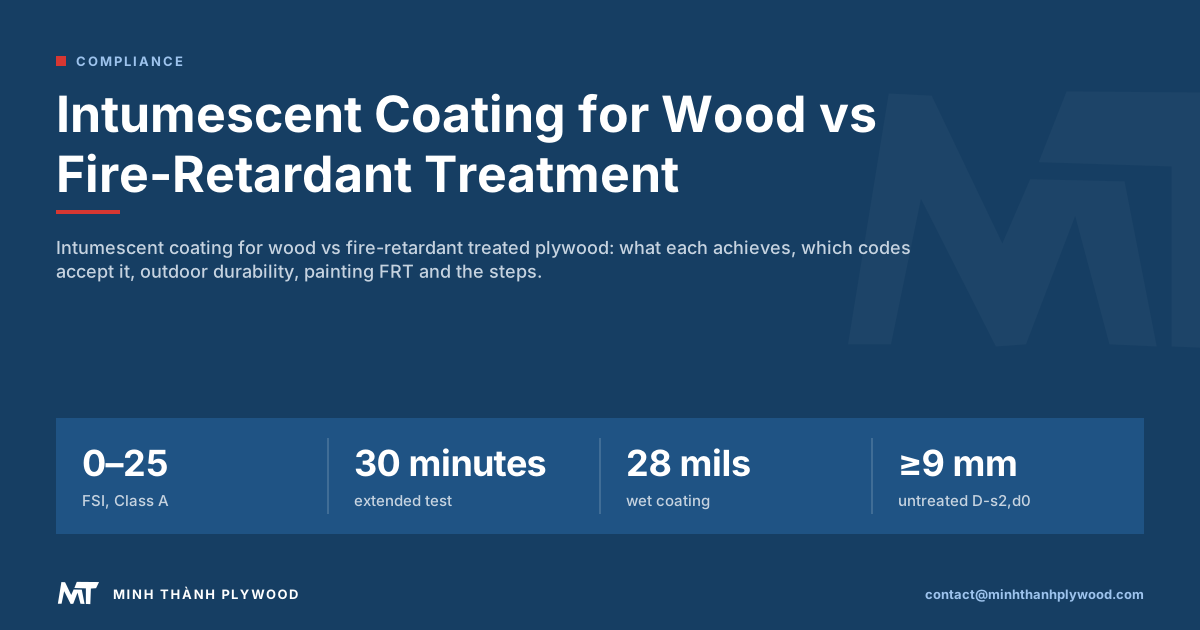
Intumescent coating for wood vs fire-retardant treatment: the short answer
An intumescent coating for wood is a paint-like film that swells into a thick, insulating char when it is heated; fire-retardant treatment (FRT) is a chemical forced into the wood fibres under pressure. Both slow ignition and flame spread on plywood. Only FRT makes the panel “fire-retardant-treated wood” under the International Building Code.
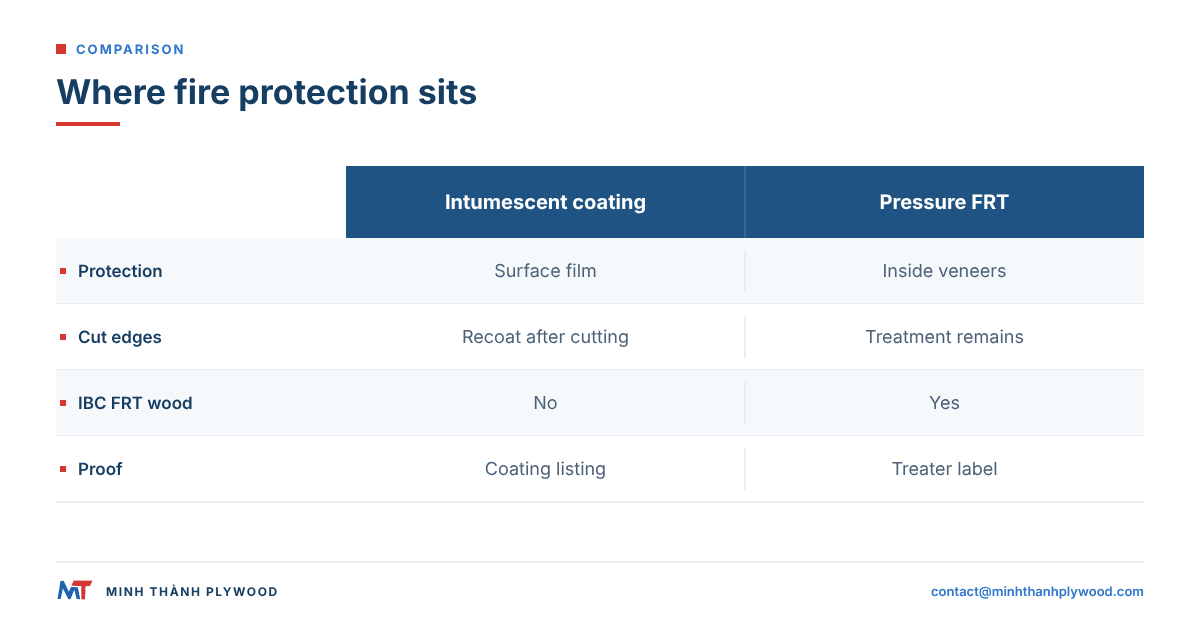
| Point | Intumescent coating | Fire-retardant treatment (FRT) |
|---|---|---|
| Where the chemistry sits | On the surface, as a film | Through the face veneers and plies |
| Applied | On site or in a finishing shop, by brush, roller or spray | At a treating plant, in a pressure cylinder, then kiln re-dried |
| Typical result | ASTM E84 Class A for the listed coating and substrate | ASTM E84 Class A with the extended 30-minute test |
| Counts as FRT wood under the IBC | No | Yes |
| Exterior use | Only products listed for exterior use, with topcoat | Exterior FRT tested after the ASTM D2898 rain test |
| Survives sanding and cutting | No: sanding removes it | Cutting yes; deep sanding thins the treated face |
| Proof | Coating listing or test report for that substrate and film thickness | Treater’s label on each panel, test report |
| Best for | Existing linings, upgrades, finishes the eye sees | New construction where the code calls for FRT wood |
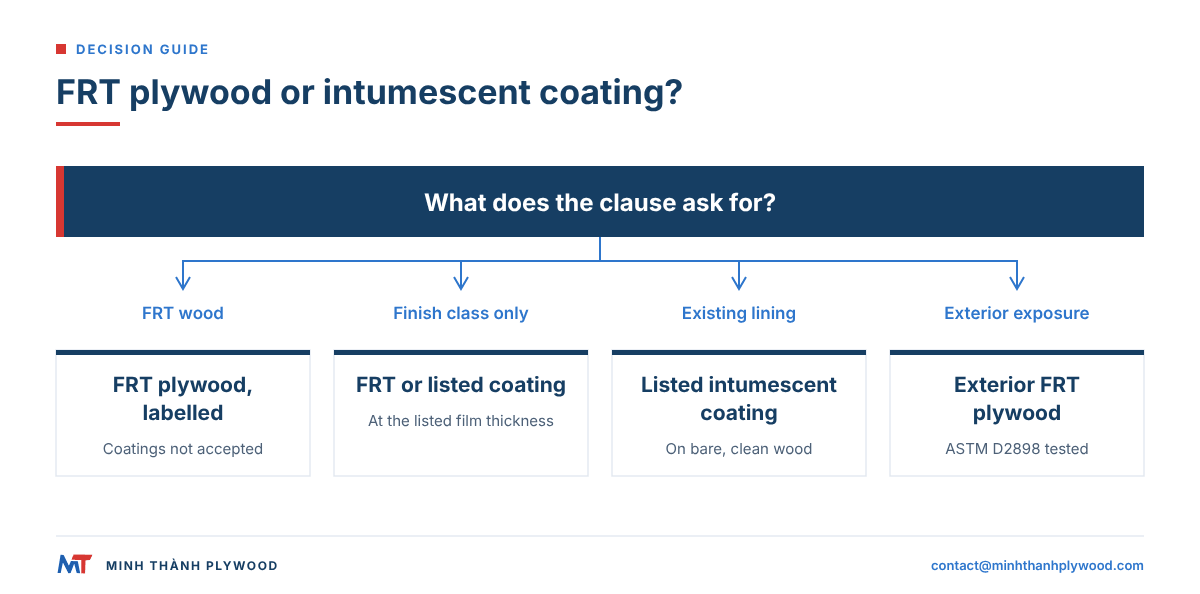
Choose by what the code clause or the fire engineer asks for. A clause that says “fire-retardant-treated wood” needs FRT plywood; a clause that sets an interior finish class can often be met with a listed coating.
Intumescent coating for wood in the UK: classes, products and cost per m2
In the UK an intumescent coating for wood is chosen to reach Euroclass B under EN 13501-1, which Approved Document B now uses in place of the old BS 476 Class 0 that some suppliers still quote, and some systems claim up to 60 minutes of fire resistance on timber. UK suppliers sell three forms: pigmented intumescent paint, clear intumescent varnish and clear impregnation (flame-retardant) treatment, as Fireproof Paint UK lists them, checked on 21 October 2026.
| Form | Class claimed | Example UK product family | Retail price seen |
|---|---|---|---|
| Pigmented (white) paint | Class 0, Euroclass B, up to 60 minutes | Iris Char 21 Timber, Envirograf HW01/F | By the litre |
| Clear intumescent varnish | Class 0, Euroclass B, up to 60 minutes | Iris Char 17 Timber, Thermoguard Fire Varnish, Envirograf HW02/N | £150 for a 20 m2 kit, £410 for 60 m2, £550 for 80 m2 (Iris Char 17), £195.13 for a 20 m2 Thermoguard interior kit |
| Clear impregnation | Class 0, Euroclass B | Flametect C-WD | £32.00 to £330.00 by pack size |
Brand families are named as examples of what UK buyers meet, not as endorsements. The kit prices work out at about £7.50 per m2 (20 m2 kit), £6.83 per m2 (60 m2) and £6.88 per m2 (80 m2) for the Iris Char 17 varnish, and £9.76 per m2 for the Thermoguard kit, before topcoat and VAT. Trade suppliers such as Paints4Trade list Thermoguard interior and exterior overcoats, a basecoat and wood fluids, and ship free over £99.
A typical water-based clear system, Envirograf HW02/N, is applied in 2 coats at 8 m2 per litre, brush, roller or spray, for interior and exterior wood; it comes in 1 L, 2.5 L and 5 L packs from £42.95 per litre ex VAT. Envirograf says its topcoats should be recoated every 8 to 12 years.
Class 0 was the national surface-spread class under BS 476 Parts 6 and 7; Approved Document B has withdrawn the national classes and now uses Euroclasses under EN 13501-1, with B-s1,d0 the usual target for a treated plywood lining, though some products still quote Class 0. ASTM E84 stays the US line, covered below. A coating only holds its class on the substrate and at the film thickness its test report names, so a plywood lining needs a report for plywood, not for softwood boards.
What does an intumescent coating do on wood?
An intumescent coating on wood reacts at around the temperature of a developing fire: the film foams and expands many times its thickness into a carbon char that insulates the plywood underneath and starves the surface of heat and oxygen. The wood still chars behind the foam, but slower, and flame travels less far across the surface.
The result depends on three things the listing fixes:
- Film thickness. Every listing states a wet and dry film thickness or a coverage rate. A thinner coat does not reach the rated class.
- Substrate. The test is run on a named substrate, often unfinished plywood of a stated species. A coating tested on spruce pine fir plywood is listed for that substrate.
- Topcoat. Some coatings allow a compatible topcoat; others lose their rating under one.
For example, the ICC-ES listing ESL-1423 for one water-based coating reports a flame spread index of 5 and a smoke developed index of 15 on Southern Yellow Pine plywood, at 28 mils wet and 15 mils dry, about 57.7 sq ft per gallon.
What is fire-retardant treated plywood?
Fire-retardant treated plywood is plywood impregnated with fire-retardant chemicals in a pressure cylinder: a vacuum draws air out of the wood, the solution is pressed into the veneers, and the panels are kiln-dried again before shipping. When heated, the chemicals release water and non-flammable gases and promote charring, which slows flame spread across the face.
The International Building Code defines FRT wood by test. The panel must reach a flame spread index of 25 or less in ASTM E84 or UL 723, with the test extended by 20 minutes (30 minutes in all), during which the flame front may not progress more than 10.5 feet beyond the burner centreline. The 2024 IBC also accepts ASTM E2768, the extended-duration version of the same test. The code adds that paints, coatings and stains are not an approved method of protection for FRT wood.
Each FRT panel carries the treater’s label: the treating company, the standard met, the class, and “Exterior” when it passed the weathering test. The International Code Council publishes the code; the local building official reads it for the project.
Fire retardant for wood: treatment or coating?
A fire retardant for wood comes in two forms: a treatment absorbed into the wood, and a coating that stays on the surface. The words “fire retardant” on a can or a label do not tell you which; the test report and the code clause do.
| Question to ask | Treatment answers | Coating answers |
|---|---|---|
| Is the chemistry inside the wood? | Yes | No |
| Does it need a plant and a pressure cylinder? | Yes | No |
| Can it be applied to plywood already installed? | No | Yes |
| Does it change the plywood’s moisture behaviour? | Interior formulations can absorb moisture | No, the panel is unchanged under the film |
| Can it be renewed? | No, the panel is replaced | Yes, the film can be recoated per the listing |
The practical rule: treatment for new FRT panels where the code names FRT wood; coating for linings, existing buildings and finishes where the code sets a surface flame spread class.
Fire retardant paint for wood: what it achieves and what it cannot claim
Fire retardant paint for wood, usually an intumescent paint, achieves a surface flame spread class on the substrate it was tested on, at the stated film thickness. It cannot claim to make wood fireproof, it cannot turn plywood into FRT wood under the code, and it cannot add fire resistance to an assembly unless the assembly itself was tested with it.
Three claims to check on a paint data sheet:
- The class and the test. “ASTM E84 Class A” or a Euroclass under EN 13501-1, with the report number.
- The substrate. Plywood, its species and thickness, unfinished or primed.
- The rate. Wet film thickness, dry film thickness and coverage per litre or gallon, and the number of coats.
A paint without a test listing for plywood is a decorative paint, whatever its name. Our guide to fire-rated plywood explains the classes in the US, the EU, the UK and Australia.
How flame spread is rated: ASTM E84 classes and Euroclasses
Flame spread on plywood is rated by ASTM E84 in North America. In Europe it is rated by EN 13501-1 Euroclasses; coatings and treatments are both rated by the same tests. The class is a property of the tested product, not of the paint or the chemical alone.
| System | Class | Criterion |
|---|---|---|
| ASTM E84 / UL 723 | Class A | Flame spread index 0–25, smoke developed 450 or less |
| ASTM E84 / UL 723 | Class B | Flame spread index 26–75 |
| ASTM E84 / UL 723 | Class C | Flame spread index 76–200 |
| EN 13501-1 | B-s1,d0 | Very limited contribution to fire, low smoke, no droplets |
| EN 13501-1 | D-s2,d0 | Untreated plywood ≥ 9 mm and ≥ 400 kg/m³, classified without further testing |
The European default for untreated plywood comes from Commission Decision 2007/348/EC: plywood of at least 9 mm and 400 kg/m³, mounted without an air gap, is D-s2,d0. Reaching B-s1,d0 takes a treatment or a coating tested on the plywood and classified by a notified body.
How to fireproof plywood: the steps for a new project
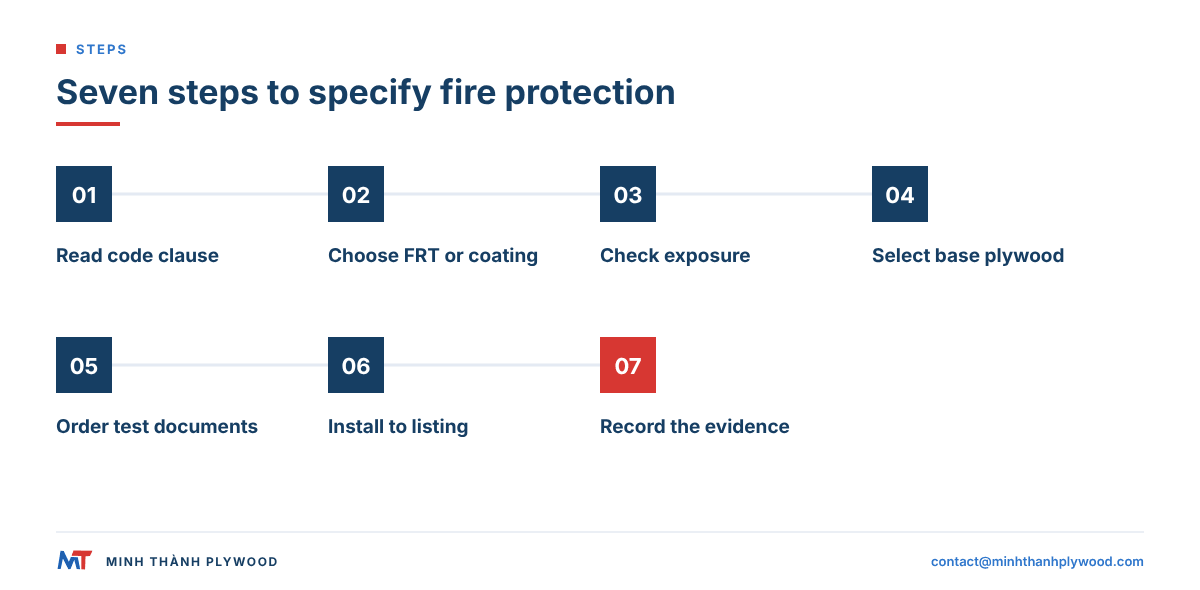
Plywood cannot be made fireproof, but it can be made fire-retardant to the class a project needs. For a new building, follow these seven steps.
- Read the clause. Find whether the code or the fire engineer asks for “fire-retardant-treated wood”, an interior finish class (Class A, B, C), a Euroclass, or a fire resistance rating for an assembly.
- Pick the route. FRT wood clause: FRT plywood. Finish class only: FRT plywood or a listed coating. Fire resistance rating: a tested assembly, which usually adds gypsum board or other layers.
- Pick the exposure. Interior or exterior. Exterior or damp locations need exterior FRT or a coating listed for exterior use.
- Pick the base panel. Thickness, glue bond (melamine-fortified or phenolic WBP for damp and exterior), and a face that takes the treatment or the coating.
- Order with documents. FRT: the treater’s label on every panel and the test report. Coating: the listing for the substrate and film thickness.
- Install to the listing. Fasteners rated for FRT wood, cut edges handled as the treater says, coating applied at the stated rate with a wet film gauge.
- Record it. Keep labels, listings, batch numbers and application records for the building official.
The same steps answer “how to make plywood fire resistant” for most specifiers: the fire resistance of a wall or floor comes from the tested assembly, not from the panel alone.
How to apply an intumescent coating to plywood
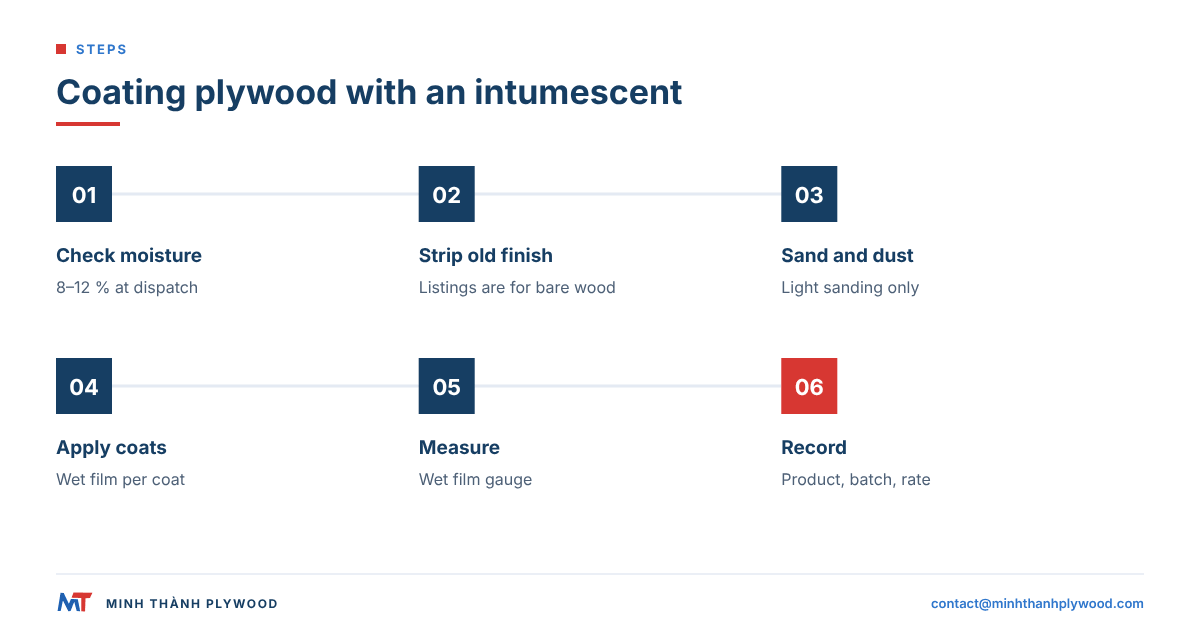
Apply an intumescent coating to plywood on clean, dry, bare wood, at the film thickness the listing states, and measure it as you go. A coat applied thin is a coat that fails the test.
- Check the panel. Moisture content near the coating maker’s limit; Minh Thanh panels are dried to 8–12 % at dispatch, the normal range for furniture plywood.
- Remove old finishes. Listings are for unfinished plywood; varnish and paint stop adhesion and change the result.
- Sand lightly and dust off. A sanded, polished face such as Minh Thanh’s takes an even film.
- Mix and thin only as allowed. Thinning beyond the data sheet lowers the dry film.
- Apply the coats. Brush, roller or airless spray, to the wet film thickness per coat, with drying time between coats.
- Measure. Wet film gauge on every coat; dry film by calculation from coverage.
- Topcoat if listed. Only the topcoat the listing names.
- Label and record. Product, batch, area, rate and date.
For fire retardant spray for wood, the same rules apply: the spray is a coating, and its listing sets the rate.
Can you paint fire rated plywood?
Yes. Fire rated plywood, meaning FRT plywood, can be painted, stained or sealed with ordinary finishes after light scuff sanding, and many treaters publish the finishes they have tested. The paint does not raise or lower the FRT rating when it is a normal thin decorative film.
Three cautions keep the rating intact:
- Sand lightly. Deep sanding or planing removes the treated face, which governs surface flame spread.
- Let the panel dry. FRT panels are kiln re-dried after treatment; paint them at normal moisture, not straight from damp storage.
- Use the treater’s guidance. Some treatment chemistries need a primer for water-based paint.
Painting an intumescent coating over FRT plywood is a separate question: neither the FRT test nor the coating listing covers the combination, so the building official decides.
Interior and exterior use: which one lasts outdoors?
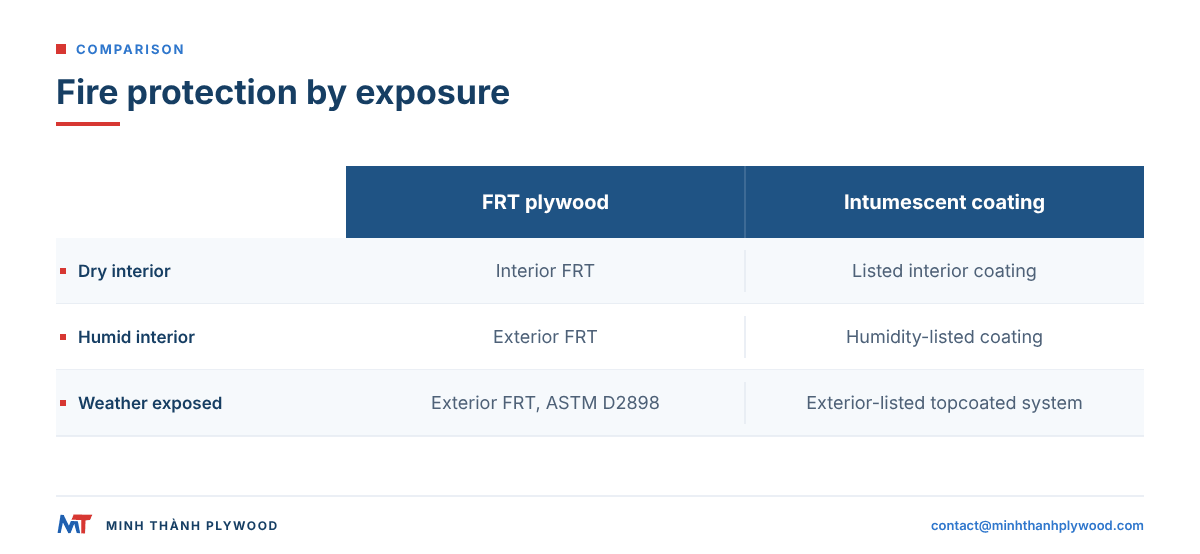
Exterior FRT plywood lasts outdoors; most intumescent coatings do not. Exterior FRT is tested after accelerated weathering under ASTM D2898, the standard rain test, and labelled “Exterior”; interior FRT and interior coatings lose their chemistry when rain washes or UV cracks them.
| Exposure | FRT plywood | Intumescent coating |
|---|---|---|
| Dry interior | Interior FRT | Interior coating, listed class |
| Humid interior (roof space, pool hall) | Exterior FRT: interior salts absorb moisture | Coating listed for humid exposure |
| Exterior, weather-exposed | Exterior FRT (ASTM D2898 tested) | Only an exterior-listed system with its topcoat, renewed per the listing |
The base panel matters outdoors too. A melamine-fortified or phenolic WBP bond keeps the plies together when treated panels see moisture. Our guide Is plywood waterproof? explains bond classes, and the plywood delamination guide covers what happens when the bond is wrong.
Which needs a test certificate, and what to check on it
Both routes need a test certificate: FRT plywood needs the treater’s test report and a label on every panel; an intumescent coating needs a listing or classification report for the substrate it is used on. A data sheet alone is not a certificate.
Check five lines on any fire document:
- Test standard and date. ASTM E84, ASTM E2768, EN 13501-1 classification based on EN 13823 and EN ISO 11925-2.
- Product tested. Treatment or coating name, plywood species, thickness, glue.
- Result. Flame spread index and smoke index, or the Euroclass with s and d sub-classes.
- Conditions. Film thickness or retention, mounting, air gap.
- Issuer. Accredited laboratory, notified body or evaluation service such as ICC-ES.
If the plywood you order differs from the plywood tested, in species or thickness, ask the treater or coating maker whether the report covers it.
Strength, finishing and moisture after treatment
Fire-retardant treatment can lower plywood’s strength and stiffness, change its moisture behaviour and affect fasteners; an intumescent coating changes none of these, because it sits on the surface. Engineers apply the treater’s design adjustment factors when FRT plywood carries load, particularly in hot roof spaces.
- Strength. Treaters publish adjustment factors by chemistry and service temperature.
- Moisture. Interior FRT chemistries are hygroscopic; in humid spaces they draw moisture and can corrode fasteners. Use exterior FRT there.
- Fasteners. Use the fastener coating the treater specifies.
- Finishing. FRT paints like plywood; coatings may limit the choice of topcoat.
What fire-retardant protection costs, and why
FRT plywood costs more than the same untreated panel because the price includes the treating cycle, the kiln re-dry, the fire testing and the labelling; exterior FRT costs more than interior. An intumescent coating costs the product plus labour per coat, and it rises with the film thickness the listing requires.
Compare the routes per square metre installed, not per sheet or per litre:
- FRT plywood: panel price, delivery from the treater, fasteners, no site coating labour.
- Coating: base panel, coating at the listed rate, labour for each coat, film measurement, recoating if the exposure demands it.
For large areas in new construction, FRT plywood usually wins on labour. For small areas, existing buildings and visible finishes, a coating usually wins.
What Minh Thanh Plywood supplies for fire-retardant projects
Minh Thanh Plywood, a manufacturer in Ha Hoa, Phu Tho, Vietnam, supplies the base plywood that treaters impregnate and coating applicators finish. The base panel decides how evenly a treatment penetrates and how evenly a coating films.
- Exterior plywood: melamine-fortified or phenolic (WBP) bonds to your specification, for treated panels that will see moisture.
- Furniture and interior plywood: UF glue at E0 emission, sanded and polished faces, both faces UV-ready, for coated linings and joinery.
- Build: Styrax or Eucalyptus cores as standard, core layers stitched horizontally and vertically, furniture panels pressed twice.
- Tolerance and moisture: thickness tolerance down to ±0.2 mm on sanded furniture panels; 8–12 % moisture at dispatch.
- Sizes: 1220 × 2440 and 1250 × 2500 mm, plus custom sizes such as 1220 × 2500 mm, thickness 3–40 mm.
- Proof: CARB P2 / TSCA Title VI certified (ICTT mill no. 23024); ISO 9001:2015 (KAC25/0185).
See the exterior plywood range and the furniture plywood range. Our fire rated plywood buying guide covers buying finished FRT panels.
What to send for a base-panel quote
Send the fire route and the base panel together, so we build the plywood your treater or coating system was tested on.
- Application and route: lining, roof sheathing, joinery; FRT treatment or intumescent coating, interior or exterior.
- Core: Styrax or Eucalyptus; stitched.
- Glue: melamine-fortified or phenolic WBP for treatment and damp use, UF glue at E0 emission for interior coated panels.
- Face: species and grade pair, sanded.
- Size and thickness: 1220 × 2440 or 1250 × 2500 mm, thickness and tolerance.
- Packing and quantity: containers per month, destination port, FOB Hai Phong, CFR or CIF.
Write to contact@minhthanhplywood.com or WhatsApp +84 988 586 601 (Lisa). We reply within hours, and free samples go out for your treater’s or coating maker’s trials.
Buyer questions, answered
How do you fireproof plywood?
No treatment makes plywood fireproof, but two methods slow ignition and flame spread: buy fire-retardant treated plywood, pressure-impregnated and labelled, or apply a listed intumescent coating at the film thickness its test report states.
Can you paint fire rated plywood?
Yes. FRT plywood takes ordinary paint and stain after light scuff sanding. Check the treater's finishing guidance, and avoid deep sanding, which removes the treated face.
Is intumescent paint as good as fire-retardant treated wood?
For surface flame spread on an interior lining, a listed intumescent coating can reach ASTM E84 Class A. It does not make the panel FRT wood under the International Building Code, which states that paints and coatings are not an approved method.
Does intumescent coating work on plywood outdoors?
Most intumescent coatings are made for interior use. Outdoors, rain and UV wash or crack the film unless the product is listed for exterior use with its topcoat. Exterior FRT plywood, tested after the ASTM D2898 rain test, is the durable outdoor route.
What is the difference between fire retardant and fire resistant?
Fire retardant describes a treatment or coating that slows ignition and flame spread on a surface. Fire resistance describes how long a wall, floor or door assembly holds back a fire, tested as a whole assembly.
What fire rating does untreated plywood have?
Untreated plywood is typically ASTM E84 Class C in the US. In Europe, plywood of at least 9 mm and 400 kg/m³ is classified D-s2,d0 without further testing under Commission Decision 2007/348/EC.
How thick should intumescent paint be on wood?
As thick as the product's test listing says. One ICC-ES listed coating needs 28 mils wet, 15 mils dry, about 57.7 sq ft per gallon, to reach Class A on plywood.
Does fire-retardant treatment weaken plywood?
Some treatments reduce strength and stiffness, especially at high service temperatures. FRT plywood used structurally carries design adjustment factors from the treater, which the engineer applies.
Can I apply fire retardant spray to existing plywood?
Yes, if the spray is a listed coating tested on plywood and applied at its stated rate to clean, bare wood. Old paint and varnish must come off first, because the listing is for unfinished plywood.
What fire class do UK intumescent coatings for wood reach?
UK intumescent paints and varnishes for timber claim Class 0 and Euroclass B, and some claim up to 60 minutes of fire resistance on the tested substrate. Check the report covers plywood at the film thickness you apply.
How much does intumescent varnish for wood cost in the UK?
Retail kits seen on 21 October 2026 run from about £6.83 to £9.76 per m2 ex topcoat, for example £150 for a 20 m2 Iris Char 17 kit and £550 for 80 m2. Envirograf HW02/N is about £42.95 per litre ex VAT.
Does Minh Thanh sell fire-retardant plywood?
Minh Thanh Plywood makes the base panels that treaters and coating applicators use: exterior plywood with melamine-fortified or phenolic WBP bonds and furniture plywood, dried to 8–12 % moisture at dispatch.