
Pine LVL is laminated veneer lumber made from pine veneers laid with the grain along the member. Minh Thanh Plywood supplies LVL in Acacia (about 580 kg/m³) and Eucalyptus (650–750 kg/m³) for furniture frames, door parts and packaging runners, in 1220 × 2440 and 1250 × 2500 mm billets cut to your sections. For rated pine beams or scaffold planks, buy a certified structural product.
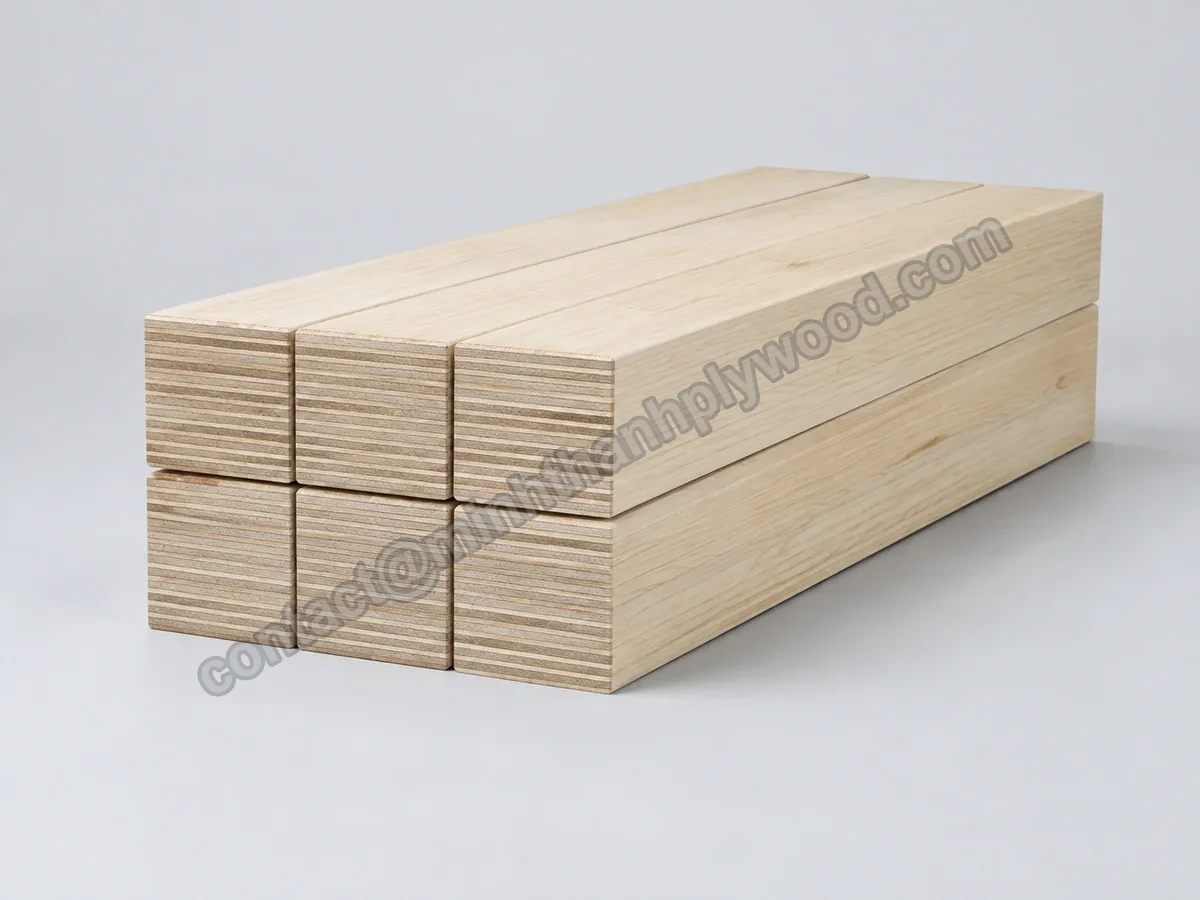
What is pine LVL, and what does Minh Thanh supply?
Pine LVL is laminated veneer lumber made from pine veneers bonded with the grain running along the member. The parallel layup makes a long, straight, stiff piece from veneer, much stiffer along its length than plywood of the same section.
Radiata pine in Oceania, spruce and Scots pine in Europe, and southern pine and Douglas fir in North America are the common LVL species. Minh Thanh Plywood does not peel pine. We make LVL from Acacia and Eucalyptus plantation veneers grown around our factory in Ha Hoa, Phu Tho:
| Specification | Minh Thanh LVL |
|---|---|
| Veneer species | Acacia or Eucalyptus, plantation-grown |
| Density | Acacia about 580 kg/m³; Eucalyptus 650–750 kg/m³ |
| Moisture at dispatch | 8–12% |
| Billet formats | 1220 × 2440 and 1250 × 2500 mm, cut to your member sections |
| Glue | UF at E0 for interiors (E1 option); MR / melamine-fortified or phenolic WBP for the service environment |
| Typical uses | Furniture frames and rails, door components, packaging runners and frames |
| Order terms | One 40HC minimum; production 15–45 days after the 30% deposit, 70% against the scanned B/L |
For a furniture rail, a door stile or a pallet runner, Acacia or Eucalyptus LVL does the job that buyers often specify as pine LVL, and it is denser and harder, which holds screws and connectors well. For a rated building beam or a scaffold plank, buy a certified structural pine LVL from a producer that publishes design values.
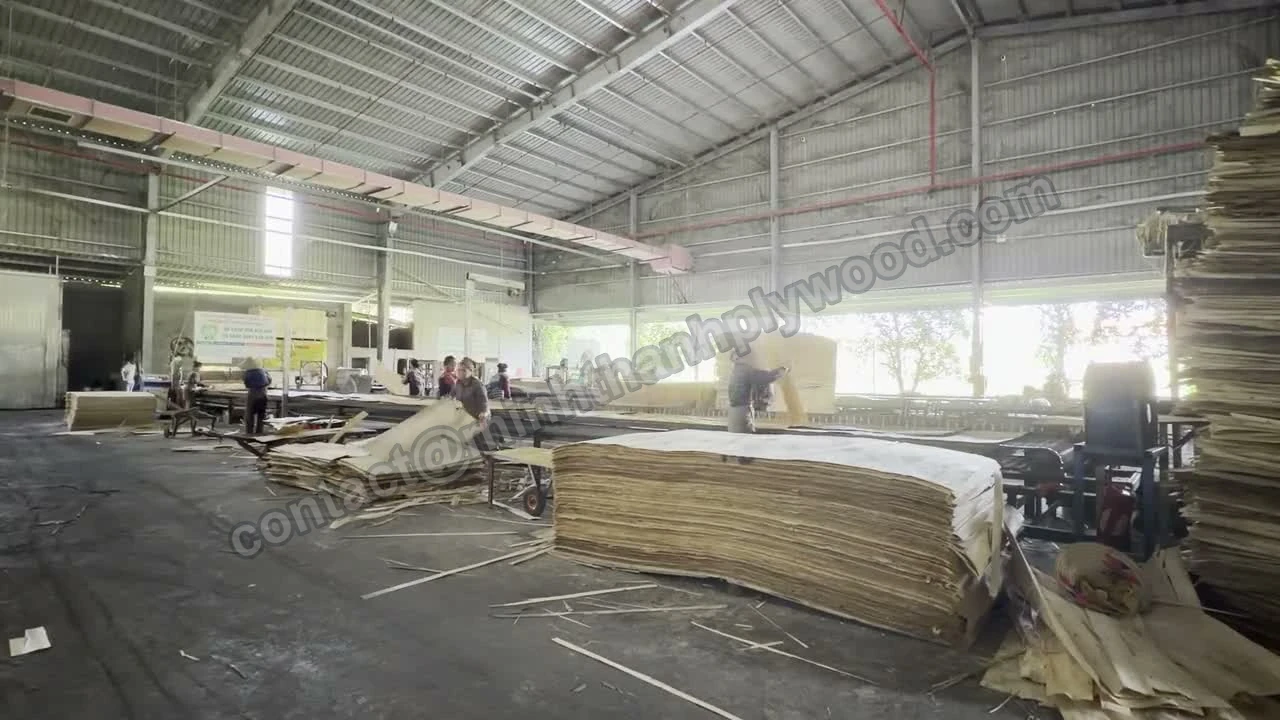
Core veneers stacked at the lay-up line in our Ha Hoa plant.
How is LVL different from pine plywood and solid pine?
LVL runs every veneer along the member; plywood crosses the grain layer by layer to make a stable sheet; solid pine keeps the grain and knots of the sawn log. That changes where each one is strongest.
| Property | LVL | Pine-faced plywood | Solid pine timber |
|---|---|---|---|
| Basic form | Member or billet | Sheet with face, back and cross-oriented core | Sawn board or timber |
| Grain direction | All veneers along the length | Alternating layers | Along the board |
| Strongest as | Beam, rail, stile, runner | Panel loaded across its face | Joinery and solid parts |
| Straightness | Very straight, defects dispersed through layers | Flat sheet | Can bow, twist and check |
| Appearance | Striped veneer edge | Graded face/back pair | Knots and grain |
| Typical Minh Thanh product | Acacia or Eucalyptus LVL | Pine plywood, A/A to B/B faces | Not supplied |
Ripping a plywood sheet into strips does not turn it into LVL: half its layers still run across the strip. Order LVL when the part is long and narrow and must stay straight under load along its length.
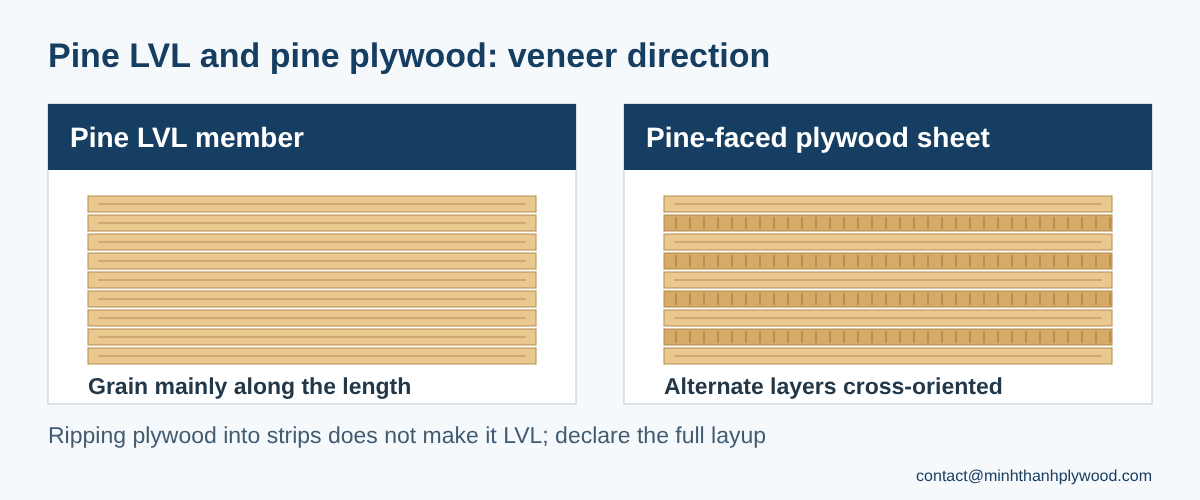
LVL veneers run along the member, while plywood alternates the grain direction layer by layer.
Which jobs suit pine LVL, and which suit Acacia or Eucalyptus LVL?
Pick the species by the job. Pine LVL is light and easy to machine; our Acacia and Eucalyptus LVL is denser and harder, with better screw holding.
| Job | Pine LVL | Minh Thanh Acacia / Eucalyptus LVL |
|---|---|---|
| Sofa and bed frames, rails | Works | Fits well; dense, holds staples and screws |
| Door stiles, rails and frame cores | Works | Fits well; straight, stable at 8–12% moisture |
| Packaging runners, pallet bearers, crate frames | Works | Fits well; heavy-duty runners in Eucalyptus |
| Furniture blanks for machining | Works | Fits well; billets cut to your sections |
| Rated building beams, headers, rafters | Certified structural product | Not supplied as a rated beam |
| Scaffold planks | Scaffold-grade product only | Not supplied |
Send the component drawing with the load case and fixings; we cut the billets to the section and length you need and pack by item code.
What do structural beams and scaffold planks need?
A structural beam needs a graded LVL with published design values for bending, stiffness and shear, plus a design for the actual span, bearings and connections. APA’s structural composite lumber guidance, checked 8 October 2026, explains that LVL design properties come from qualification testing of the specific product. Buy the grade named by the engineer and keep its label on every piece delivered to site.
Scaffold planks are a separate product class. The US OSHA scaffold standard 1926.451, checked 8 October 2026, requires scaffolds designed by a qualified person and loaded to that design, and OSHA’s laminated-planking interpretation asks for engineering data showing equivalence with scaffold-grade planks. Buy scaffold LVL from a producer that supplies that data and marks each plank.
Each market has its own LVL product standard: EN 14374 in Europe, AS/NZS 4357 in Australia and New Zealand, and ASTM D5456 in the United States. A structural pine LVL carries a grade under one of them, a stress class or design values, and a producer stamp. Check that the stamp on the delivered piece matches the grade in the purchase order and the engineer’s design.
Minh Thanh LVL serves furniture, door and packaging work, where the buyer’s own component trial is the approval. For a building beam or scaffold plank, use a certified structural producer.
Which billets, sections and tolerances should you order?
Order by finished member: thickness, width and length, with the grain direction marked and a drawing for any holes, recesses or profiles. We press LVL in 1220 × 2440 and 1250 × 2500 mm billets and cut them into your sections, so a rail, a stile and a runner can come from the same billet run.
State thickness and depth in the installed orientation, because two suppliers can write the same rectangle in a different order. Separate rough blanks with a machining allowance from finished members, and list left and right pieces, lengths and machining patterns as separate item codes. Pack labels repeat the drawing code.
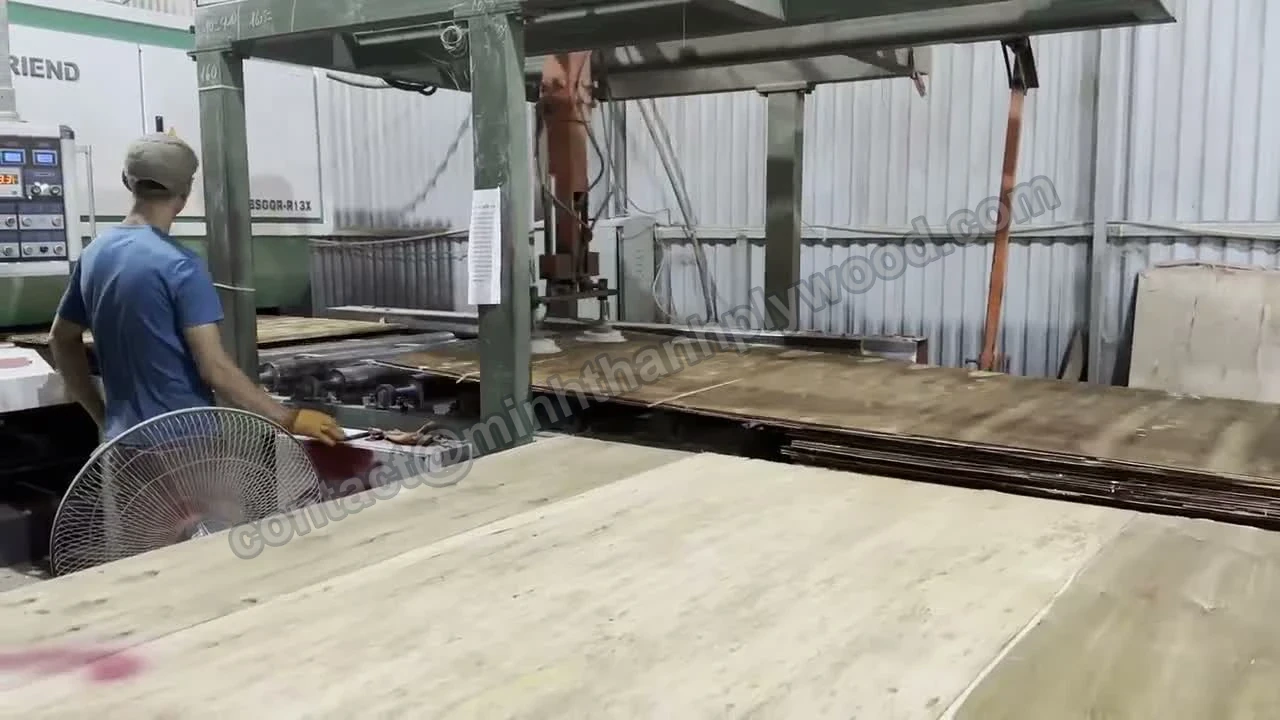
Calibration sanding brings the pressed billet to an even thickness before cutting.
Measure straightness and twist over the full length as well as the end section; a long member can pass at one end and fail in the middle. For furniture work, the fixture that holds the part is the best acceptance gauge.
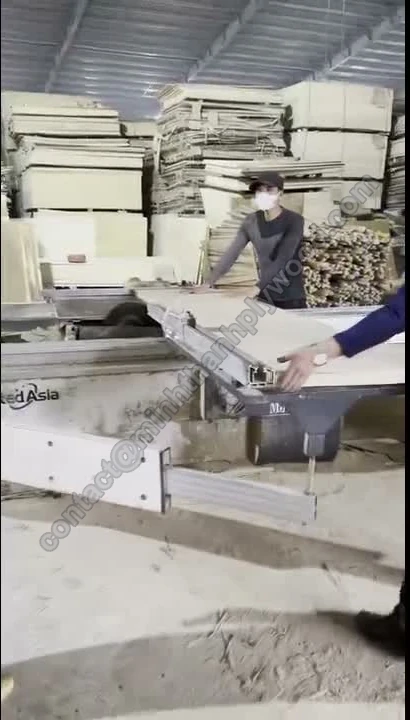
Billets are cut to the buyer’s member sections on the panel saw.
How is Minh Thanh LVL built: species, veneer and glue?
Acacia and Eucalyptus plantation veneers are peeled, dried to 8–12% moisture, graded, glued and laid with the grain along the member, then pressed into billets. Acacia gives the lighter member at about 580 kg/m³; Eucalyptus gives the denser, stiffer member at 650–750 kg/m³.
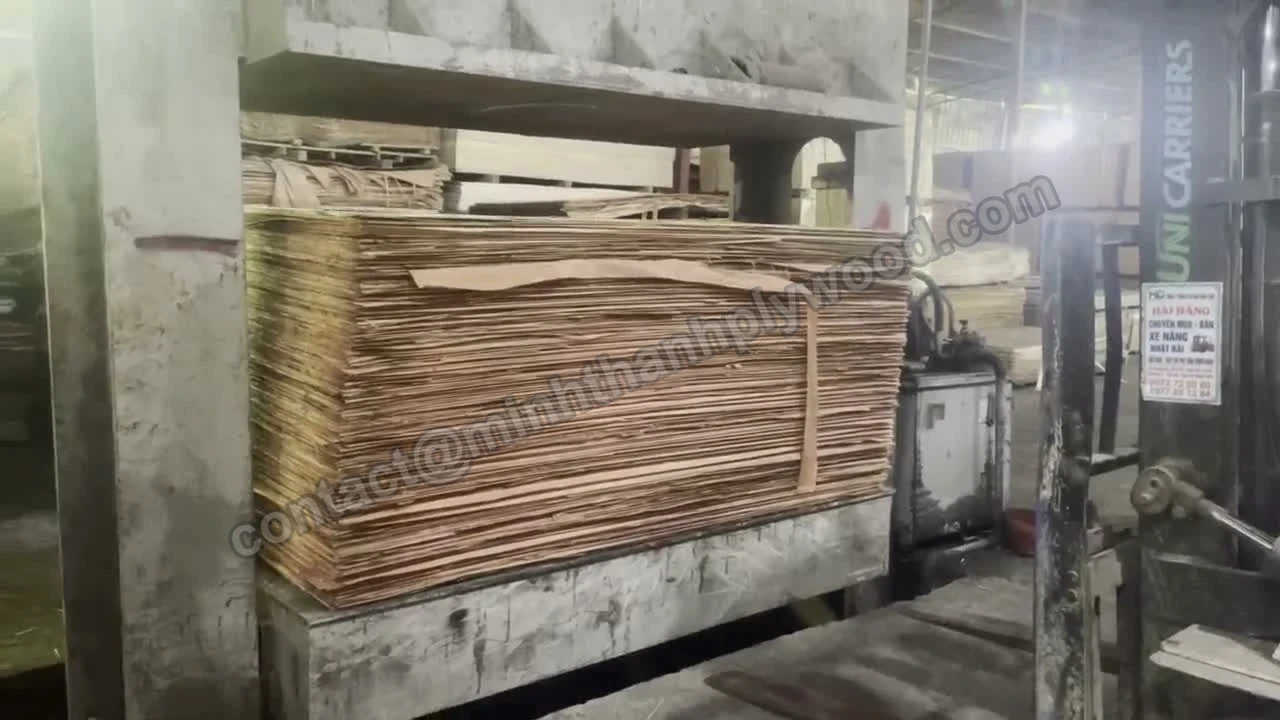
Laid-up veneers in the cold press before hot pressing.
The glue follows the service:
| Service | Glue | Example parts |
|---|---|---|
| Dry indoor furniture | UF at E0 (E1 option) | Sofa frames, bed rails, door cores |
| Humid storage or transport | MR / melamine-fortified | Export packaging frames |
| Weather exposure | Phenolic WBP | Outdoor runners, covered site use |
E0 and E1 are emission classes, written on the order next to the glue. For the US market, the rules are the CARB composite wood products programme and the EPA TSCA Title VI formaldehyde standards, both checked 8 October 2026; name the one your customer applies, and ask whether the LVL part itself falls under it. Our six ASTM D6007 chamber tests on plywood averaged 0.014–0.032 ppm against the 0.05 ppm CARB Phase 2 / TSCA Title VI limit, three by Shanghai Hongjun and three by ICTT Vietnam; the quality page lists the reports.
Why does LVL stay straighter than solid pine?
Solid pine carries every knot, sloping grain and growth stress of the log it came from, so a long board can bow, twist or split as it dries. LVL spreads those defects. Each veneer is only a few millimetres thick, the knots and splits in one layer sit over sound wood in the next, and the whole stack is glued and pressed at a controlled moisture content. The member comes out straight and stays close to its pressed shape.
For a buyer, that means fewer rejects in long parts. A 2,400 mm sofa rail or door stile in LVL keeps its section along the full length, so the frame fixture accepts it without forcing. Solid pine of the same length needs selection, often finger-jointing and more machining allowance to reach the same straightness.
The trade-off is appearance and edge machining. LVL shows a striped veneer edge, which most frames hide under upholstery, laminate or a door skin. Where a part is visible, edge-band it or choose a solid or plywood part instead.
Density also changes the result. Our Eucalyptus LVL is heavier than pine LVL and holds staples, screws and cam fittings firmly, which suits upholstered frames assembled with power staplers. Acacia LVL is the lighter choice for packaging runners where freight weight matters.
How do you estimate LVL weight and container load?
Multiply member volume by density. A 45 × 90 × 2440 mm rail holds 0.0099 m³, so it weighs about 5.7 kg in Acacia (580 kg/m³) and about 6.4–7.4 kg in Eucalyptus (650–750 kg/m³). Weigh one sample member and use its measured mass in the final loading plan.
For freight, our 40HC plan uses a 28,000 kg planning payload unless your booking is lower. That is about 48 m³ of Acacia LVL (28,000 ÷ 580), or about 37–43 m³ of Eucalyptus (28,000 ÷ 750 to 28,000 ÷ 650), before packing; weighed bundles confirm the final figure. Acacia fills more of the container before reaching the weight limit. If your booking caps the gross weight lower, scale the volume by the same division.
What should an LVL purchase specification list?
A pine LVL drawing often reaches us as a single line, such as “LVL rail, pine”. That line leaves most of the order open. Put these fields on the purchase specification so that the quotation, the production run and the receiving check all work from the same item:
| Field | What to write | Why it matters |
|---|---|---|
| Species | Pine, Acacia or Eucalyptus, as accepted for the part | Sets density, weight and screw holding |
| Section and length | Thickness × width × length in the installed orientation | Avoids two suppliers reading the same rectangle differently |
| Grain direction | Along the length, marked on the drawing | Confirms the part is LVL rather than a plywood strip |
| Glue and emission | UF glue at E0 emission (E1 option), MR or phenolic WBP | Matches the bond to the service and the emission rule |
| Moisture | 8–12% at dispatch | Sets the starting condition for machining |
| Machining | Holes, recesses, profiles by drawing revision | Prevents rework on arrival |
| Packing | Bundle size, bearers, end protection, labels by item code | Keeps long members straight in transit |
| Evidence | Approved sample, emission reports, shipment photos | Makes the repeat order match the first |
Where the drawing also needs third-party testing to the buyer’s own method, we arrange it through SGS on request. State that on the enquiry so the test sits in the production plan.
How should LVL be stored and conditioned on arrival?
LVL leaves the factory at 8–12% moisture, which suits furniture and door production. What happens after the container is opened decides whether it stays there. Unload bundles onto level bearers spaced closely enough that long members do not sag, and keep them off the floor and under cover. An open yard in a wet season lets the faces and cut ends take up water, and a wet member can swell, cup at the ends or show a raised grain after machining.
Keep the straps and wrapping on until the bundle is needed, and open one bundle at a time. Let the members reach workshop conditions before precision machining, and check a few pieces with a moisture meter against the factory’s dispatch range. Record straightness on a sample of the longest items before they reach the fixture. Compare those receiving records with the shipment photographs and films we share before loading, so any change in transit is easy to trace.
What should a sample trial and receiving check cover?
We send free samples cut to your section. Run them through your own process:
- Measure section, length, straightness and twist.
- Cut, drill and machine with your production tools.
- Fit the real connector, staple or screw in the working orientation.
- Assemble in the production fixture and apply the finish.
- Keep the approved sample with the drawing revision for repeat orders.
Long members ship in bundles on bearers, strapped clear of finished faces, with ends protected and each bundle labelled by item code and quantity. Minh Thanh photographs and films each shipment before loading. Store bundles flat on bearers under cover after arrival.
When comparing two LVL quotations, match species, glue, section, length, tolerance, machining and packing line by line, then compare cost per accepted component rather than price per m³.
How do you request an LVL quotation?
Send the application, member thickness, width and length, grain direction, quantity per item code, machining drawing, glue and emission requirement, packing and destination port through Contact. Say whether the drawing called for pine LVL so we can propose Acacia or Eucalyptus LVL for the same part. For sheet materials, the plywood types guide compares LVL with plywood and other panels.
Buyer questions, answered
What is pine LVL?
Pine LVL is laminated veneer lumber made using pine veneers bonded primarily with their grain along the member. The species description identifies the timber requirement; the manufactured grade and intended use determine its purchasing specification.
Is LVL pine the same as pine plywood?
No. LVL pine normally concentrates veneer grain along the member, while plywood uses cross-oriented layers to form a panel. Specify the actual layup and orientation because laminated products can include cross-bands for particular uses.
Can ordinary pine LVL be used as a structural beam?
Only if it carries a structural grade with published design values. Buy rated pine LVL from a certified structural producer for beams; non-rated LVL suits frames, rails and runners.
Can pine LVL be used for scaffold planks?
Only a scaffold-grade LVL plank with engineering data and use instructions for the scaffold system. Furniture or packaging LVL is not a scaffold plank.
Is pine LVL waterproof?
No. A phenolic WBP bond holds in wet conditions, but the wood still takes up water through its faces and cut ends. Keep LVL under cover before installation and seal or protect exposed ends.
Should I request density or bending strength first?
Request the required grade and relevant performance data for the application, then use density or measured weight for handling and freight. Density is useful purchasing information but cannot replace stiffness, bending, shear or connection data.
Can I drill or notch a pine LVL beam?
Follow the exact product's approved machining details and the project design. Include required holes, notches and connection positions in the drawing before ordering a structural member.
How do I compare two pine LVL quotations?
Match species declaration, veneer layout, product grade, dimensions, tolerances, adhesive, service exposure and machining. Include the same evidence package, packing, quantities and delivery term so both suppliers quote the same item.
Does Minh Thanh offer LVL?
Yes. Minh Thanh makes LVL from Acacia or Eucalyptus plantation veneers, not pine, for furniture frames, door components and packaging runners. Billets are 1220 × 2440 or 1250 × 2500 mm, cut to your member sections.
What should I send for a pine LVL enquiry?
Send the application, member thickness, width and length, grain direction, quantity and machining drawing, plus glue, emission requirement, packing and destination. Tell us whether Acacia or Eucalyptus LVL fits the job.