
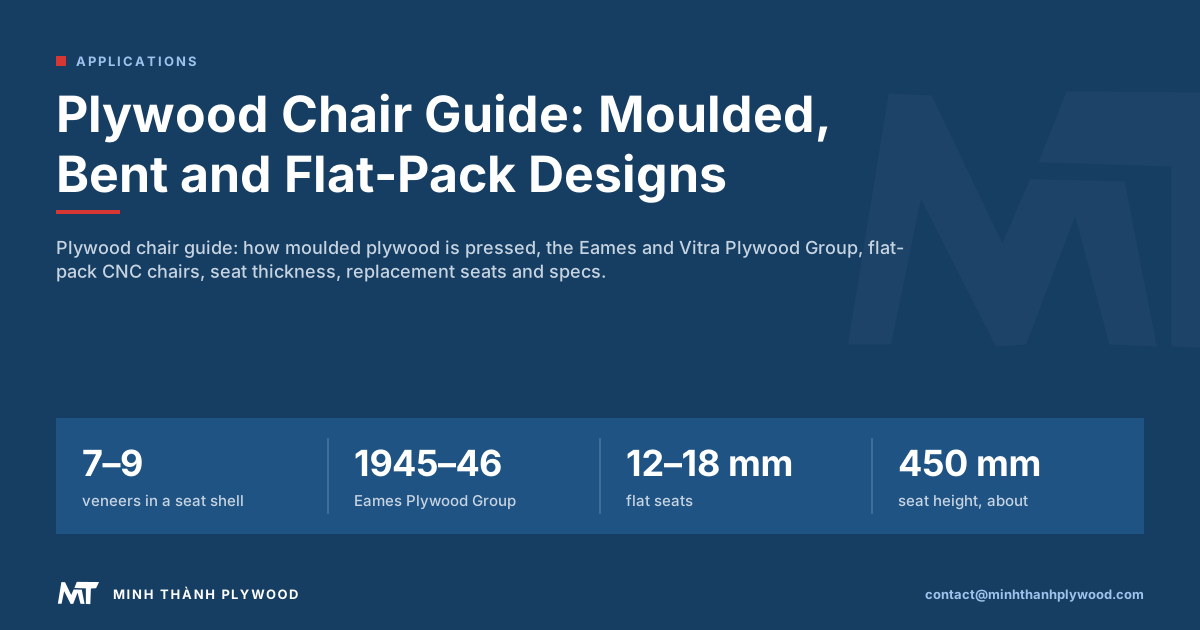
A plywood chair is made in one of two ways: thin veneers glued and pressed in a heated mould into a curved shell, as in the Eames chairs, or flat plywood panels cut on a CNC router and joined, as in most flat-pack designs. Moulded plywood gives comfort from its curves; flat plywood gives simple, strong parts. Minh Thanh Plywood makes flat furniture plywood for chair parts in Vietnam.
What is a plywood chair?
A plywood chair has its seat, back or whole frame made of plywood: either thin veneers pressed into curves (moulded or bent plywood) or flat panels cut and joined. Plywood is used because it is strong for its weight and does not split along the grain.
| Type | How it is made | Typical designs | Look |
|---|---|---|---|
| Moulded plywood shell | Veneers glued and pressed in a heated mould | Eames DCW and LCW, Jacobsen Series 7, school chairs | Smooth, curved, one piece |
| Bent plywood frame | Veneers or laminations pressed into a curved frame | Aalto Paimio, cantilever lounge chairs | Flowing curves |
| Flat-pack CNC chair | Flat plywood panels cut on a CNC router, slotted or screwed | Open-source designs, café chairs | Flat parts, visible edges |
| Plywood seat on a frame | Flat or moulded plywood seat on steel or timber legs | Dining and café chairs | Classic chair shape |
Moulded plywood gives comfort from its curves without upholstery. Flat plywood gives simple, strong parts that pack flat and ship cheaply.
How is moulded plywood made?
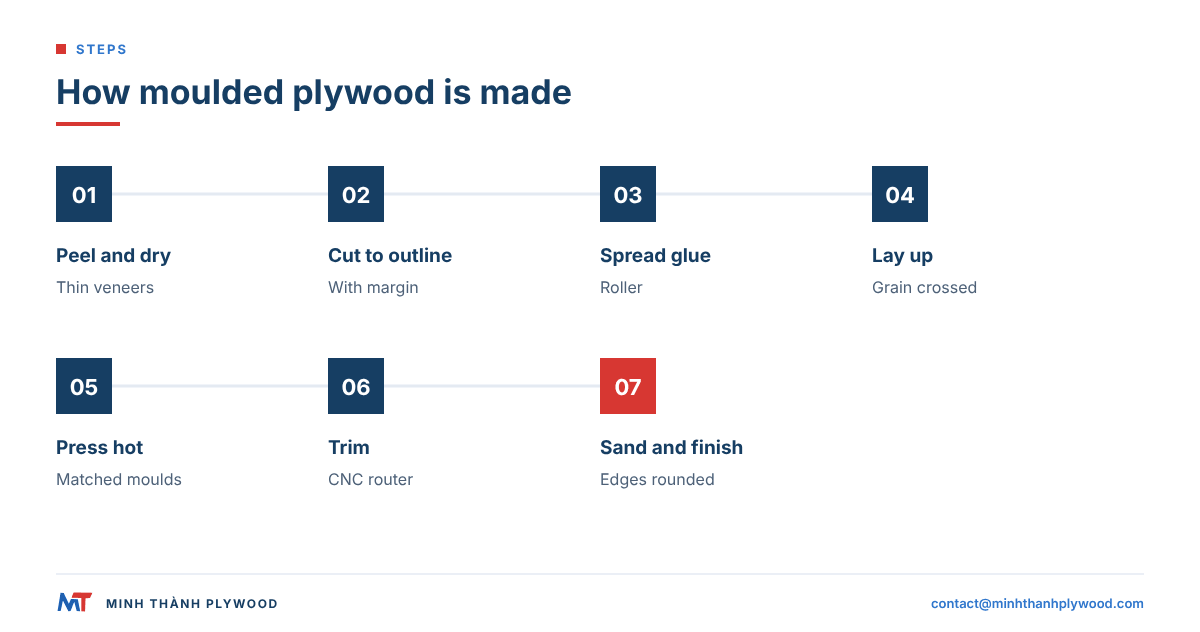
Moulded plywood is made by gluing thin veneers, laying them with the grain crossed or angled, and pressing the stack between heated matched moulds until the glue cures. The shell keeps the mould’s shape and is then trimmed, sanded and finished.
- Peel and dry the veneers: thin sheets, about a millimetre thick, are peeled from logs, typically beech or birch, and dried.
- Cut veneers to the shell’s outline with some margin.
- Spread glue on each veneer by roller, usually a urea-formaldehyde or melamine-fortified resin.
- Lay up the stack: seven to nine veneers for a seat shell, the grain of each turned against the one below.
- Press in a heated mould: a matched pair of male and female moulds closes on the stack; heat from heated platens or high-frequency (radio-frequency) energy cures the glue.
- Cool and release: the shell comes out holding its curve.
- Trim the outline on a CNC router or a profile cutter.
- Sand and finish: edges rounded and sanded, faces lacquered, stained or covered with a face veneer.
Every shell from one mould has the same shape, which is why moulded plywood suits production runs. The mould is the main cost; small runs often use vacuum bags over a single form instead.
Plywood chair design: moulded vs flat-pack
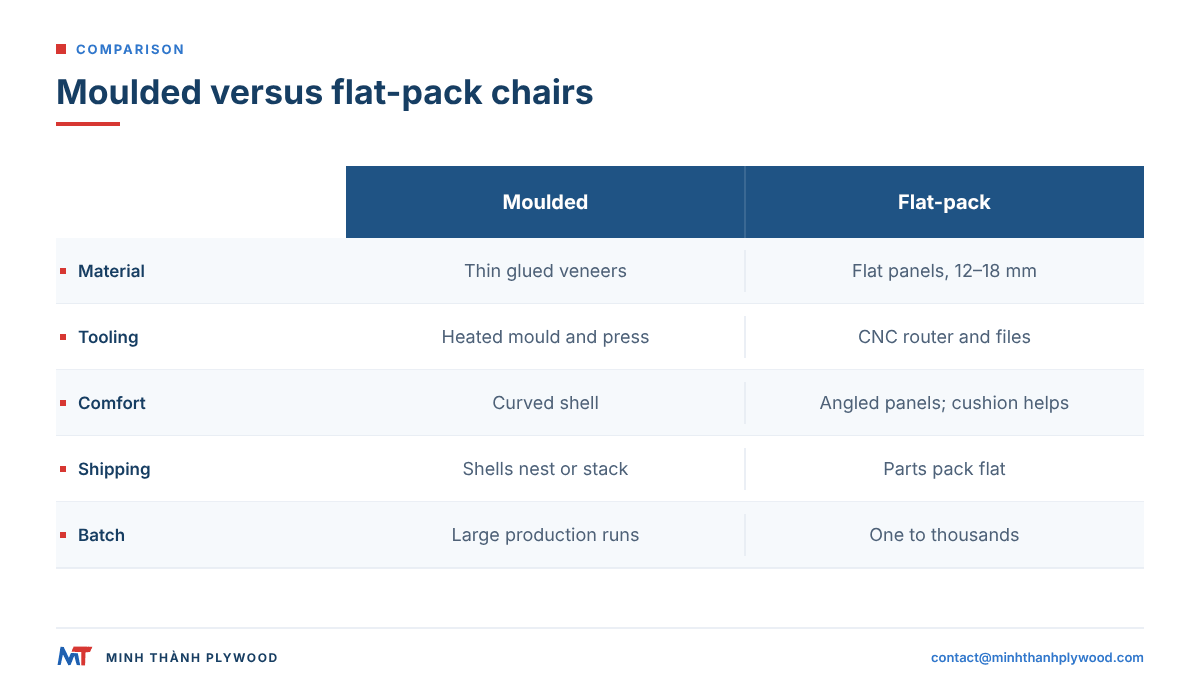
Plywood chair design splits into moulded shells and flat-pack panels. Moulded chairs need moulds and presses; flat-pack chairs need only a CNC router and good flat plywood.
| Moulded plywood chair | Flat-pack plywood chair | |
|---|---|---|
| Material | Thin veneers and glue | Flat plywood panels, 12–18 mm |
| Tooling | Heated matched moulds, press | CNC router, cutting files |
| Comfort | Curves follow the body | Angled flat seat and back; cushions help |
| Strength | High; continuous grain around curves | High at joints if parts are thick enough |
| Shipping | Shells nest or stack | Parts pack flat |
| Batch size | Large runs to pay for the moulds | One chair to thousands |
| Edge | Thin, rounded | Visible plies on every part |
Many modern plywood chair designs mix the two: a moulded seat and back on flat plywood or steel legs.
The Eames plywood chair: history and the Plywood Group
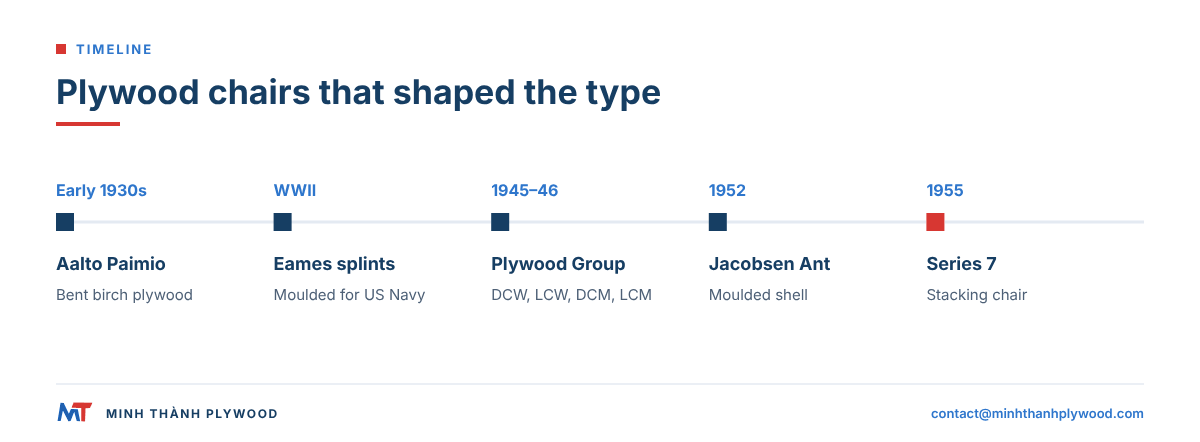
The Eames plywood chair began with moulded plywood leg splints that Charles and Ray Eames made for the US Navy during the Second World War. They used the same moulding technique for the Plywood Group chairs of 1945–46, which Herman Miller began selling in 1946.
| Model | Name | Base | Use |
|---|---|---|---|
| DCW | Dining Chair Wood | Moulded plywood legs | Dining, side chair |
| LCW | Lounge Chair Wood | Moulded plywood legs, lower | Lounge |
| DCM | Dining Chair Metal | Steel rod legs | Dining |
| LCM | Lounge Chair Metal | Steel rod legs, lower | Lounge |
In each chair, the moulded plywood seat and back are fixed to the frame through rubber shock mounts, so the back flexes slightly. The LCW is often called the Eames Molded Plywood Lounge Chair, and the DCW the Eames Molded Plywood Dining Chair. Herman Miller makes them for North America; Vitra makes them as the Plywood Group for Europe and the Middle East.
Other plywood chairs that shaped the type are Alvar Aalto’s Paimio chair of the early 1930s, in bent birch plywood, and Arne Jacobsen’s moulded plywood Ant chair of 1952 and Series 7 chair of 1955.
Vitra plywood chair: where to buy it
The Vitra Plywood Group chairs, the Eames DCW, LCW, DCM and LCM, are sold through Vitra’s own website and its authorised dealers. In Belgium and the Netherlands, design shops in Brussels, Antwerp and Ghent stock them, and online dealers such as espoo.be and Nordic New ship across the Benelux.
| Chair | Indicative new price, Benelux | Size |
|---|---|---|
| DCW, natural ash | about €1,650 (Nordic New) | 49.5 cm wide, 72.5 cm high, seat 40.5 cm |
| LCW, ash | about €1,620 to €2,840 (einrichten-design, Connox) | 56 cm wide, 68 cm high, seat about 32 cm |
| LCW, upholstered | €3,080 (espoo.be) | 56 cm wide, 53 cm deep, 68 cm high |
Delivery on the LCW runs 3 to 4 weeks at espoo.be and 4 to 6 weeks at Connox, because many are made to order. Prices vary by wood, upholstery and dealer, and were checked on 21 October 2026.
- Vitra.com: the full range of woods (ash, walnut, cherry and others) and finishes.
- Authorised Benelux dealers: design shops in Brussels, Antwerp and Ghent, and online stores that ship across the EU.
- Herman Miller: the same Eames designs in North America and other markets.
- Second-hand and vintage: vintage Plywood Group chairs sell through auction houses and marketplaces such as Pamono; check the label and shock mounts.
Buy from an authorised dealer to get the licensed design and the maker’s warranty. Copies use the same shape but often thinner shells and cheaper mounts.
Which plywood chairs are the icons, and who made them?
Seven plywood chairs define the type, and buyers searching for vintage pieces meet them on marketplaces such as Pamono.
| Chair | Designer | Year | Maker | Construction |
|---|---|---|---|---|
| Paimio 41 | Alvar Aalto | 1932 | Artek | Bent birch plywood seat on a bent frame |
| Model 66 | Alvar Aalto | 1935 | Artek | Birch frame, plywood seat and back |
| Lounge and dining chairs (LCW, DCW) | Charles and Ray Eames | 1945–46 | Herman Miller, Vitra | Moulded plywood shell on shock mounts |
| Series 7 (3107) | Arne Jacobsen | 1955 | Fritz Hansen | Moulded plywood shell on a steel base |
| CH07 Shell Chair | Hans Wegner | 1963 | Carl Hansen & Son | Three-legged moulded plywood shell |
| Bent plywood armchair | Gerald Summers | 1934 | Makers of Simple Furniture | One-piece bent plywood |
| Long Chair | Marcel Breuer | 1935-36 | Isokon | Bent plywood frame with a moulded plywood seat |
Plywood dining chair: what to look for
A good plywood dining chair has a seat about 450 mm high, a back angled for upright sitting, and joints that stay tight under daily use. Check the shell thickness, the joints and the finish before buying or specifying.
- Seat height: about 450 mm for a table about 750 mm high.
- Seat width and depth: about 400–450 mm wide for a dining chair.
- Shell or seat thickness: moulded shells are thin and curved; flat seats are 12–18 mm.
- Joints: glued, dowelled or bolted through metal inserts; no loose screws in end grain.
- Shock mounts or fixings: where the seat meets the frame, check they are bonded or bolted firmly.
- Finish: lacquer that resists spills and cleaning; edges sealed.
- Emission: low-formaldehyde plywood for indoor use, for example certified to CARB Phase 2 or TSCA Title VI.
For cafés and restaurants, choose chairs tested for contract use and ask for the test standard. In Europe that means EN 16139 for the strength and durability of non-domestic seating, EN 1728 for the test method. EN 1022 covers stability. A chair brand ordering moulded or flat parts from a factory should expect to pass these on the finished chair, so the panel needs a consistent thickness (Minh Thanh furniture panels hold ±0.2–0.3 mm) and a dense core.
Plywood stacking chair designs
A plywood stacking chair has a moulded shell on thin steel or plywood legs shaped so chairs nest on top of each other. Arne Jacobsen’s Series 7, made since 1955, is the best-known example.
- Moulded shell on steel legs: the most common stacking chair in schools, canteens and conference rooms.
- All-plywood stacking chair: legs and shell moulded in plywood, shaped to nest.
- Flat-pack stacking stool: three or four CNC-cut plywood parts that stack.
- Linking chairs: a clip on the frame links rows together for events.
Stacking chairs take more abuse than dining chairs. Look for a thick enough shell, rounded edges that resist chipping, and glides that protect floors.
Plywood modern chair: flat-pack and CNC designs
A plywood modern chair is often a flat-pack design cut from one or two plywood sheets on a CNC router and slotted together. Open designs can be downloaded and cut locally, so the chair is made near where it is used.
- Pick a design made for the plywood thickness you will use; slot widths must match the sheet.
- Measure the actual sheet thickness and adjust the slots in the cutting file.
- Nest the parts on a 1220 × 2440 mm or 1250 × 2500 mm sheet.
- Cut on the CNC router with a down-cut or compression bit to keep faces clean.
- Sand the edges and round them slightly.
- Dry-fit, then glue or pin the joints.
- Finish with lacquer or hardwax oil on every face and edge.
Slotted joints only stay tight when the plywood thickness is even. Our sanded furniture panels hold a thickness tolerance of ±0.2–0.3 mm, down to ±0.2 mm, so slot widths set in the file fit across a whole order.
Best plywood for chair seats
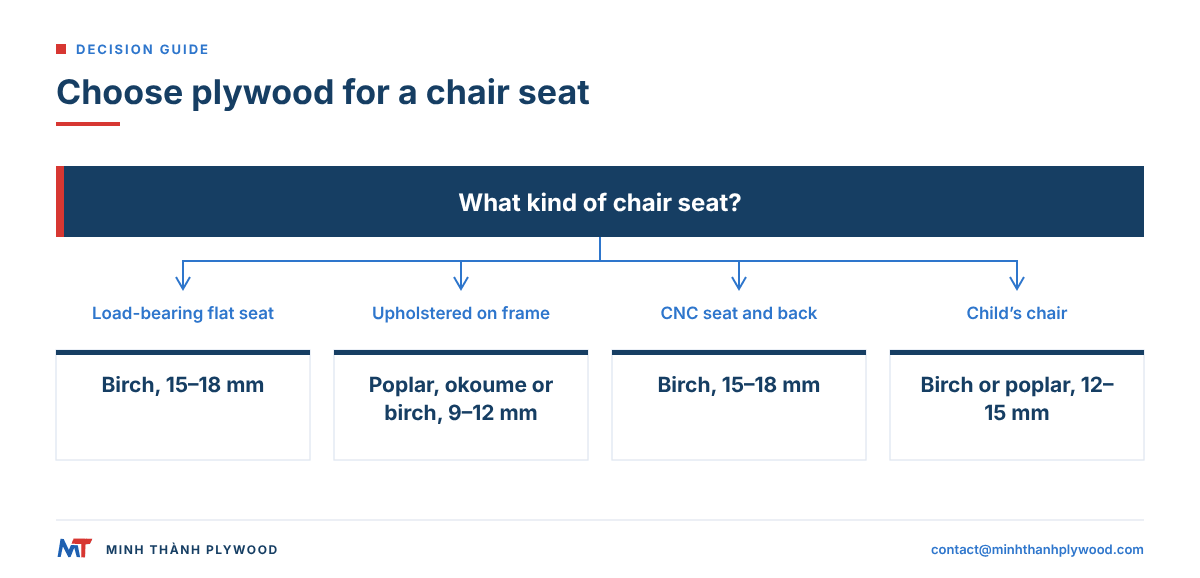
The best plywood for chair seats is birch plywood: 12–18 mm for flat seats and seat-and-back parts, with a sanded face and a void-free core. Birch is hard, fine-grained and holds screws well; poplar and okoume are lighter for upholstered seats.
| Seat part | Plywood | Thickness | Notes |
|---|---|---|---|
| Flat seat carrying load alone | Birch | 15–18 mm | Strong at the edges; screws hold |
| Seat on a frame, upholstered | Poplar, okoume or birch | 9–12 mm | Light; foam and fabric on top |
| Seat and back of a CNC chair | Birch | 15–18 mm | Slots and edges show; void-free core |
| Moulded shell | Thin beech or birch veneers | Shell made from veneers | Pressed in a mould |
| Child’s chair | Birch or poplar | 12–15 mm | Low-emission certified |
Our furniture-grade panels are pressed twice as standard: the core board is pressed and calibrated, then face and back are pressed on. For TSCA Title VI, the limit for veneer-core hardwood plywood is 0.05 ppm under 40 CFR 770.10. Furniture plywood uses UF glue at E0 emission, and our CARB P2 / TSCA Title VI certification is under ICTT mill no. 23024.
How to make a plywood chair
To make a plywood chair at home, choose between a flat-pack build from 12–18 mm plywood and a simple moulded seat pressed in a vacuum bag. Flat-pack is the easier first chair.
Flat-pack chair
- Draw the parts full size or download a tested design.
- Make a template from thin plywood or hardboard for repeated parts.
- Cut with a jigsaw and router, or on a CNC router.
- Join with glue and dowels, slots or screws into the face, never into end grain alone.
- Sand and finish every face and edge.
Simple moulded seat
- Build a form in the seat’s curve from stacked MDF or foam, smooth and sealed.
- Glue thin veneers or flexible plywood, grain crossed, on the form.
- Press in a vacuum bag until the glue cures.
- Trim, sand and finish the shell, then fix it to legs.
A moulded plywood chair like the Eames needs a matched mould and a heated press. For a home build, the vacuum bag gives a single-curve seat.
Replacement plywood chair seats and sizing
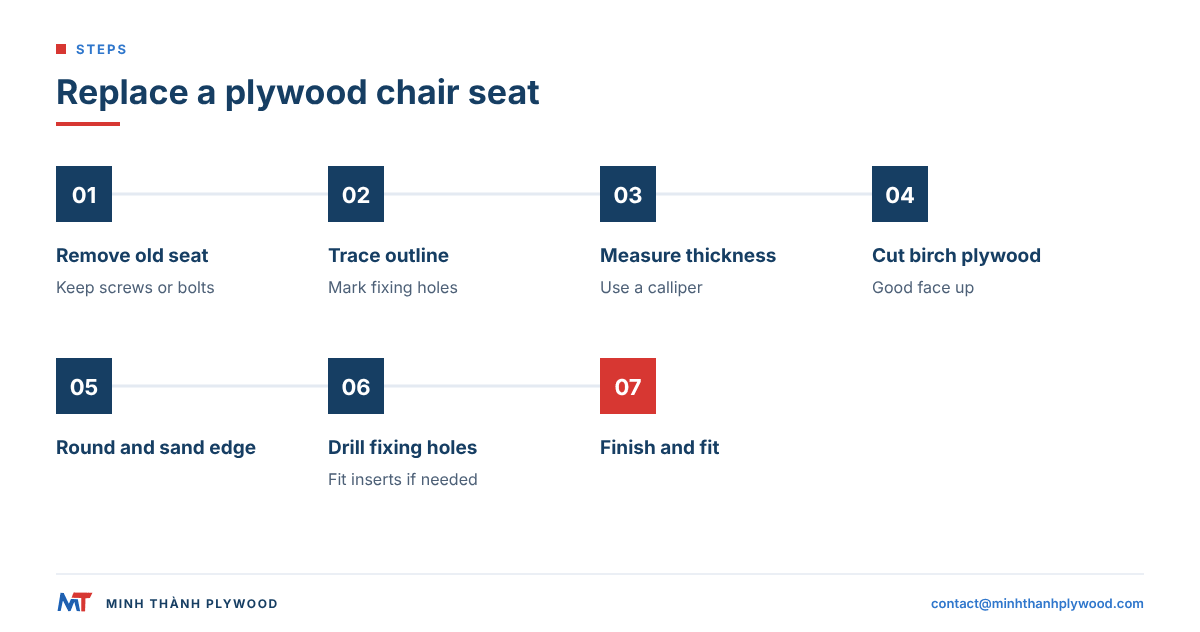
Size a replacement plywood chair seat from the old one: trace it as a template, match its thickness and the position of its fixing holes. Most replacement seats are 9–12 mm on a frame or 12–18 mm when the seat carries load alone.
- Remove the old seat and keep the screws or bolts.
- Trace the outline onto card or thin plywood, marking each fixing hole.
- Measure thickness at the edge with a calliper.
- Cut the new seat from birch plywood, good face up.
- Round the front edge for comfort and sand it.
- Drill the fixing holes from the template; fit T-nuts or threaded inserts if the old seat had them.
- Finish or upholster, then fit.
Moulded replacement seats for classic chairs come from the chair’s maker or specialist suppliers, because the curve must match the frame.
Is plywood good for chairs?
Yes. Plywood is good for chairs because it is strong for its weight, does not split along the grain, and can be moulded into shapes no solid board can take. Moulded plywood chairs from the 1940s are still in daily use.
- Strength: cross-laid veneers carry load in every direction across the part.
- Light: a moulded shell is thin and light to lift and stack.
- Comfort: moulded curves support the body without upholstery.
- Stable: plywood moves little with humidity, so joints stay tight.
- Repairable: flat parts can be recut; shells can be refinished.
The weak points are thin face veneers, which can be sanded through, and exposed edges, which chip if not rounded and sealed.
What this means for your order
For chair parts, order flat furniture plywood by part and face. Send these lines with your request:
- Application: chair seats, backs or flat-pack chair parts; moulded shells are pressed by chair makers from veneer.
- Thickness: 9–12 mm for upholstered seats, 15–18 mm for load-bearing seats and CNC parts.
- Face: birch (D+/D or D/E), poplar, okoume or EV, sanded.
- Core: white Styrax or Eucalyptus as standard.
- Glue and emission: UF glue at E0 emission, CARB P2 / TSCA Title VI certified.
- Size: 1220 × 2440 mm or 1250 × 2500 mm; cut-to-size by agreement.
- Quantity: from one 40HC with mixed specifications by agreement.
Production takes 15–45 days after the deposit, and free samples are available. See furniture plywood from Vietnam for the build.
Buyer questions, answered
How is moulded plywood made?
Thin wood veneers are coated with glue, stacked with the grain of each layer crossed or angled, and pressed between heated matched moulds until the glue cures. The shell keeps the mould's curve and is then trimmed, sanded and finished.
Is plywood good for chairs?
Yes. Plywood is strong for its weight, does not split along the grain like solid wood, and can be moulded into curves. Moulded plywood chairs from the 1940s are still in daily use.
What is the best plywood for chair seats?
Birch plywood, 12–18 mm for flat seats, with a sanded face and a void-free core. Moulded seats use thin birch, beech or other hardwood veneers pressed to shape.
What is the Eames Molded Plywood Lounge Chair?
The LCW (Lounge Chair Wood), designed by Charles and Ray Eames in 1945–46, has a moulded plywood seat and back joined to a moulded plywood frame by rubber shock mounts. Herman Miller and Vitra still make it.
What is the history of the Eames plywood chair?
Charles and Ray Eames moulded plywood leg splints for the US Navy during the Second World War, then used the same technique for the Plywood Group chairs of 1945–46. Herman Miller began selling them in 1946.
What do DCW, LCW, DCM and LCM mean?
Dining Chair Wood, Lounge Chair Wood, Dining Chair Metal and Lounge Chair Metal: the four main Eames Plywood Group chairs. The W versions have plywood legs, the M versions steel legs.
How do you make a plywood chair at home?
Draw or download a flat-pack design, cut the parts from 12–18 mm birch plywood with a CNC router or jigsaw, sand the edges, join the parts with glue and slots, dowels or screws, and finish with lacquer or oil.
What thickness plywood for a replacement chair seat?
Match the old seat, usually 9–12 mm for a seat on a frame and 12–18 mm for a seat that carries load alone. Use the old seat as the template.
Are plywood stacking chairs strong?
Yes. Moulded plywood stacking chairs such as Arne Jacobsen's Series 7 have been made since 1955, and contract versions are tested for daily use in schools, offices and cafés.
Where can I buy a Vitra Plywood Group chair?
From Vitra's own website and its authorised dealers and design shops in Europe and the Middle East; Herman Miller sells the same Eames designs in North America.