
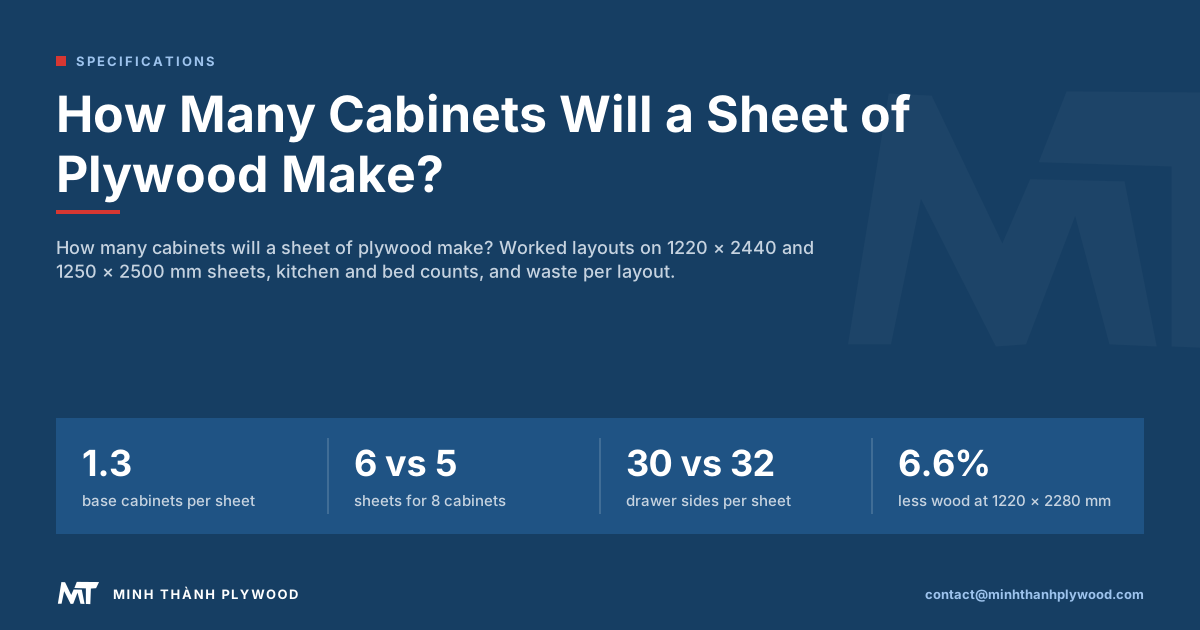
One 1220 × 2440 mm sheet of 18 mm plywood makes the sides and bottoms of two 600 mm base cabinets; with shelves and rails, four base cabinets take three sheets, about 1.3 cabinets per sheet. Eight cabinets can be cut from five sheets in either standard size. Minh Thanh Plywood, a Vietnamese manufacturer, works through cabinet, drawer and bed layouts on each sheet and shows when a custom size pays.
How many cabinets will a sheet of plywood make?
One 1220 × 2440 mm sheet of 18 mm plywood gives the sides and bottoms of two 600 mm base cabinets. Counting shelves and rails, eight cabinets take five sheets on either 1220 × 2440 or 1250 × 2500 mm when the parts are grouped for the full batch.
| Cabinet or part | 1220 × 2440 mm | 1250 × 2500 mm | 1220 × 2500 mm | 1220 × 2280 mm |
|---|---|---|---|---|
| Base cabinet sides, 720 × 560 mm | 6 | 6 | 6 | 6 |
| Wall cabinet sides, 720 × 320 mm | 9 | 9 | 9 | 9 |
| Doors, 597 × 716 mm | 6 | 6 | 6 | 6 |
| Drawer sides, 150 × 500 mm | 30 | 32 | 32 | 28 |
| Wardrobe sides, 2000 × 580 mm | 2 | 2 | 2 | 2 |
Every layout here trims 10 mm off each edge and allows a 4 mm saw kerf per cut, so a 1220 × 2440 mm sheet gives 1200 × 2420 mm of usable panel and a 1250 × 2500 mm sheet gives 1230 × 2480 mm. Counts are for guillotine cuts on a panel saw; nesting on CNC can add a part where offcuts allow.
How many cabinets per 4 × 8 ft sheet in US sizes?
A US buyer counts in inches on a 48 × 96 in sheet (1220 × 2440 mm): a 24 in wide base cabinet takes about 0.6 to 0.75 sheet and a 30 in wide wall cabinet about 0.4 to 0.5, so one sheet makes roughly 1.5 base cabinets or 2 wall cabinets before doors and backs. An inch is exactly 25.4 mm (NIST). Counting a kitchen in square feet and dividing by 32 undercounts, because every part leaves offcut and saw kerf.
| US cabinet, 3/4 in ply on 48 × 96 in | Size (W × D × H) | Parts in 3/4 in ply | Sheets per cabinet | Cabinets per sheet |
|---|---|---|---|---|
| Base cabinet | 24 × 24 × 34.5 in | 2 sides 23.25 × 34.5 in, bottom, shelf, 2 top stretchers | 0.6 to 0.75 | about 1.5 |
| Wall cabinet | 30 × 12 × 30 in | 2 sides, top, bottom, shelf, nailer | 0.4 to 0.5 | about 2 cabinets |
Sheets per cabinet come from the net part area (about 19 sq ft for the base cabinet, 12 sq ft for the wall cabinet, against 32 sq ft per sheet) plus 15 to 25% for kerf and offcut. Backs in 1/4 in ply, drawer boxes in 1/2 in ply and doors come from their own sheets.
| Kitchen footprint | Sheets of 3/4 in carcass ply | Sheets to buy with 1 to 2 spares |
|---|---|---|
| 10 × 10 ft, small | 6 to 8 | 7 to 10 |
| 12 × 12 ft, medium | 8 to 10 | 9 to 12 |
| 15 × 15 ft, large | 10 to 12 | 11 to 14 |
Waste depends on who cuts: professional shops plan for 10 to 15% and DIY builders for 15 to 20%, up to 25% on complex designs. Nesting software lowers it, and a panel saw with a good cut list does better than a circular saw in a garage.
Other sheet formats shift the count. A 5 × 5 ft Baltic birch sheet (1525 × 1525 mm) holds only 4 base cabinet sides of 720 × 560 mm, 69.4% yield against 6 and 81.3% on 1220 × 2440 mm. A 4 × 10 ft sheet (1220 × 3050 mm) holds 8 sides, 86.7% yield, which is why a shop with a cut list of long carcass parts asks for 10 ft sheets.
The price side is where a container beats a stack. Retail sheets run US$30 to US$100 each, and a small kitchen’s plywood is US$200 to US$1,200. At the raw factory price of furniture plywood from US$350/m³, FOB Vietnam, one 18 mm 1220 × 2440 mm sheet is 0.0536 m³ or about US$19 before freight, duty and the importer’s margin. That is a raw FOB example for one sheet, not a delivered price; a container buyer compares it with the shelf price above.
What parts does a base cabinet need?
A frameless 600 mm base cabinet, 720 mm high and 560 mm deep, needs six 18 mm parts: two sides, a bottom, a shelf and two top rails. The back is a thin 3–6 mm panel and the door comes from a separate, better-faced sheet.
| Part | Quantity | Finished size | Area |
|---|---|---|---|
| Side | 2 | 720 × 560 mm | 0.8064 m² |
| Bottom | 1 | 564 × 560 mm | 0.3158 m² |
| Shelf | 1 | 564 × 520 mm | 0.2933 m² |
| Top rail | 2 | 564 × 100 mm | 0.1128 m² |
| Carcass total | 6 parts | — | 1.5283 m² |
| Door | 1 | 597 × 716 mm | 0.4275 m² |
The bottom and shelf are 564 mm wide: 600 mm less two 18 mm sides. By area alone, the carcass would fit 1.95 times on a 2.9768 m² sheet, but parts come in fixed widths, so real counts are lower. The next sections lay the parts out sheet by sheet.
How many cabinets per sheet of plywood on 1220 × 2440 mm?
For a four-cabinet batch, the simple layout below uses three 1220 × 2440 mm sheets: two for sides and bottoms and one for shelves and rails, about 1.3 carcasses per sheet.
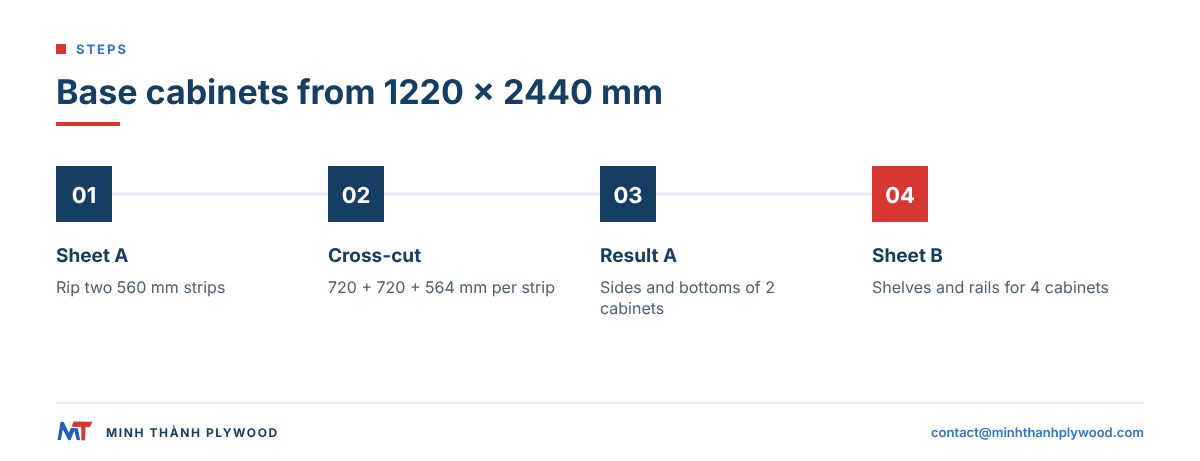
- Sheet A, sides and bottoms. Rip two 560 mm strips (560 + 4 + 560 = 1124 mm of the 1200 mm usable width). Cross-cut each strip into 720, 720 and 564 mm: two sides and a bottom, 2012 mm of the 2420 mm length. One sheet gives the sides and bottoms of two cabinets.
- Sheet B, shelves and rails. Rip one 520 mm strip and two 100 mm strips (728 mm). Cross-cut each into four 564 mm pieces (2268 mm). One sheet gives four shelves and eight rails: enough for four cabinets.
- Offcuts. Sheet A leaves two pieces of about 404 × 560 mm and a 72 mm strip; sheet B leaves a strip of about 468 × 2420 mm, wide enough for drawer parts or wall-cabinet tops.
Four cabinets use 3 × 2.9768 = 8.93 m² of sheet for 6.11 m² of parts, a 68% yield before the offcuts are used. Using sheet B’s 468 mm strip for drawer parts raises it.
For eight cabinets, five sheets suffice: two sheets give six sides each; a third gives four sides and all sixteen rails; the fourth gives eight bottoms; and the fifth gives eight shelves. On the third sheet, cross-cut the side block before ripping it, so the remaining full-width block can be cut into rails. The side grain still runs along the height; the rails rotate to fit the offcut.
What changes on a 1250 × 2500 mm sheet?
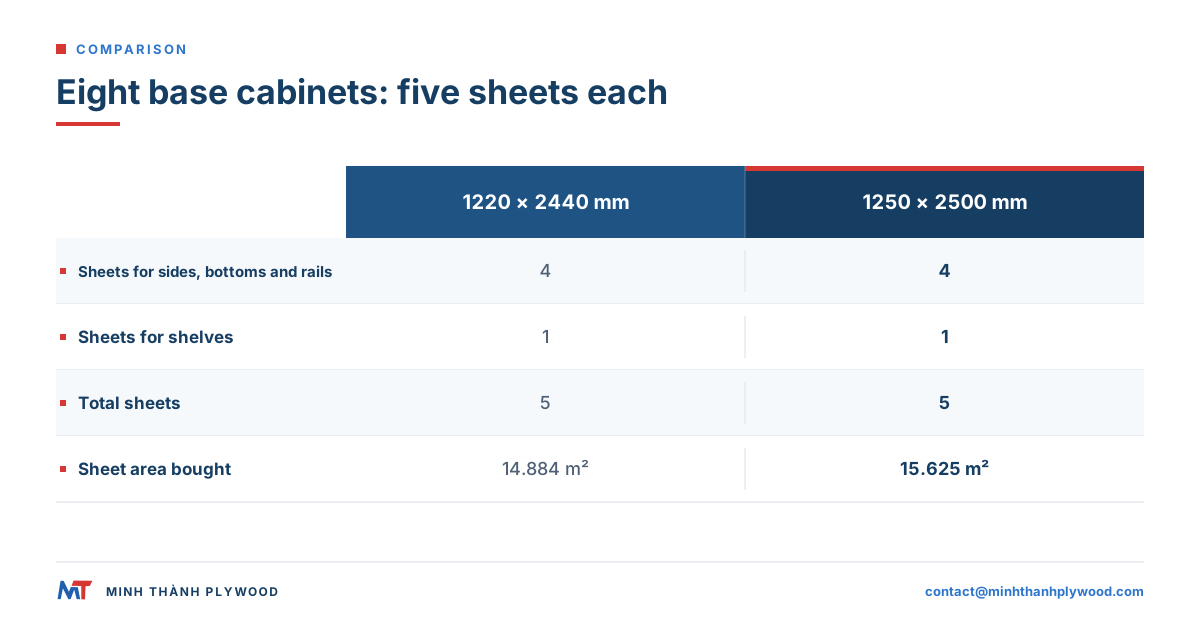
On 1250 × 2500 mm, the extra 30 mm of width fits a 100 mm rail strip beside the two 560 mm strips, so sheet A gives sides, bottoms and rails for two cabinets. Eight base cabinets take five sheets: four sheets A and one sheet of eight shelves, the same total as the alternative 1220 × 2440 mm layout.
| Eight base cabinets | 1220 × 2440 mm | 1250 × 2500 mm |
|---|---|---|
| Sheets for sides, bottoms and rails | 4 | 4 (rails included) |
| Sheets for shelves | 1 | 1 |
| Total sheets | 5 | 5 |
| Sheet area bought (m²) | 5 × 2.9768 | 5 × 3.125 |
| Cabinets per sheet | 1.6 | 1.6 |
| 18 mm volume bought (m³) | 5 × 0.05358 | 5 × 0.05625 |
The 1250 × 2500 mm layout: rip 560 + 560 + 100 mm (1124 + 4 + 100 = 1228 mm of 1230 mm usable). The shelf sheet takes two 520 mm strips of four shelves each. The extra width changes the cutting pattern, but both standard sizes need five sheets for these eight cabinets. The smaller sheets therefore buy less area for this part list.
1220 × 2440 vs 1250 × 2500: the sheet comparison
1250 × 2500 mm is 30 mm wider and 60 mm longer than 1220 × 2440 mm, with 4.98% more area and 4.98% more volume at the same thickness. Neither size wins on every part list; the winner is the sheet that leaves the narrower offcut for your parts.
| Point | 1220 × 2440 mm | 1250 × 2500 mm |
|---|---|---|
| Area | 2.9768 m² | 3.125 m² |
| Usable after 10 mm trim | 1200 × 2420 mm | 1230 × 2480 mm |
| Volume at 18 mm | 0.05358 m³ | 0.05625 m³ |
| Weight at 18 mm, Styrax core | 26.8 kg | 28.1 kg |
| Weight at 18 mm, Eucalyptus core | 34.8 kg | 36.6 kg |
| Grid it fits | 4 ft (1220 mm) module | Metric 625 and 1250 mm module |
| Where buyers use it | Global trade, 4 × 8 cutting lists | European furniture and joinery plants |
| When it wins | Parts sized on 600 or 1200 mm | Parts that leave a 30–60 mm strip on 1220 × 2440 |
Minh Thanh Plywood makes both sheets as standard, with Styrax or Eucalyptus cores and 3–40 mm thicknesses. The pillar plywood sheet sizes guide explains the conversions and grain direction.
How many kitchen cabinets from one sheet of plywood?
From one 1220 × 2440 mm sheet of 18 mm plywood, plan about 1.3 base cabinets or about 1.7 wall cabinets, counting carcass, shelves and rails but not doors or backs. A ten-unit kitchen of six base and four wall cabinets needs about seven carcass sheets, two door sheets and thin back panels.
| Kitchen of 6 base + 4 wall cabinets (600 mm wide) | 18 mm sheets, 1220 × 2440 mm |
|---|---|
| Base carcasses, 6 units | 4.5 |
| Wall carcasses, 4 units (720 × 320 mm sides) | 2.33 |
| Doors, 10 at 597 × 716 mm | 2 (six per sheet) |
| Backs, 3–6 mm | 3 thin sheets |
| Total 18 mm, rounded up | 9 |
Wall cabinets need two sides of 720 × 320 mm, a top and bottom of 564 × 320 mm and a 564 × 300 mm shelf. One sheet ripped into three 320 mm strips gives the sides, tops and bottoms of two wall cabinets; a shelf sheet ripped into three 300 mm strips gives 12 shelves. Plywood for cabinets is chosen on build as well as size: our guide to plywood for kitchen cabinets covers cores, faces and moisture.
How much plywood is required for a king size bed?
A UK king bed base, 150 × 200 cm, needs two 1220 × 2440 mm sheets of 18 mm plywood: each sheet gives half the platform (750 × 2000 mm) and two 200 mm rails. A US king, 76 × 80 inches (1930 × 2032 mm), needs three sheets, and a headboard adds one more.
| Bed (mattress size) | Platform pieces | Rails, 200 mm high | 18 mm sheets, 1220 × 2440 mm |
|---|---|---|---|
| US queen, 1524 × 2032 mm | 2 × 762 × 2032 mm | 2 × 2032 + 2 × 1560 mm | 2 |
| UK king, 1500 × 2000 mm | 2 × 750 × 2000 mm | 2 × 2000 + 2 × 1536 mm | 2 |
| UK super king, 1800 × 2000 mm | 2 × 900 × 2000 mm | 2 × 2000 + 2 × 1836 mm | 3 |
| US king, 1930 × 2032 mm | 2 × 965 × 2032 mm | 2 × 2032 + 2 × 1966 mm | 3 |
The rule behind the table: each platform half takes one sheet, and the strip left beside it gives two 200 mm rails only when it is at least 404 mm wide (200 + 4 + 200). A 750 mm half leaves 446 mm, so a UK king base fits in two sheets; a 965 mm half leaves 231 mm, one rail, so a US king needs a third sheet. A centre support and legs come from the third sheet or from timber.
How much plywood for a king size bed with a headboard?
For a king size bed with a plywood headboard, add one sheet to the counts above: three sheets for a UK king and four for a US king. A 1220 × 2440 mm sheet gives a headboard up to 1200 mm high and 2400 mm wide, with the face grain running across the bed.
How to cut plywood for a queen bed
To cut plywood for a US queen bed, split the 1524 × 2032 mm platform into two 762 × 2032 mm halves, cut one half from each 1220 × 2440 mm sheet along the face grain, and take the four rails from the strips beside them.
- Measure the mattress. A US queen is 60 × 80 inches, 1524 × 2032 mm; add the clearance your mattress maker gives.
- Mark the platform halves. Two pieces of 762 × 2032 mm, the face grain along the 2032 mm length.
- Rip each sheet. Rip 762 mm from the 1220 mm width, leaving a strip of about 434 mm.
- Cross-cut the halves. Cut each 762 mm strip to 2032 mm.
- Cut the rails. Rip each 434 mm strip into two 200 mm strips: cut the first sheet’s to 2032 mm for the side rails and the second’s to 1560 mm for the end rails (1524 mm plus two 18 mm rails).
- Drill ventilation holes. A solid platform needs holes or slots so the mattress breathes.
- Seal the edges. Sand, then seal or band the cut edges before finishing.
A 1250 × 2500 mm sheet gives the same layout with 30 mm more strip, useful if the rails are taller than 200 mm.
What waste does each layout leave?
Waste is the share of the sheet that ends up as offcut and saw kerf: in these layouts it runs from about 14% for doors on 1220 × 2440 mm to about 46% for long, narrow slats. Repeating parts sized close to a sheet fraction waste least.
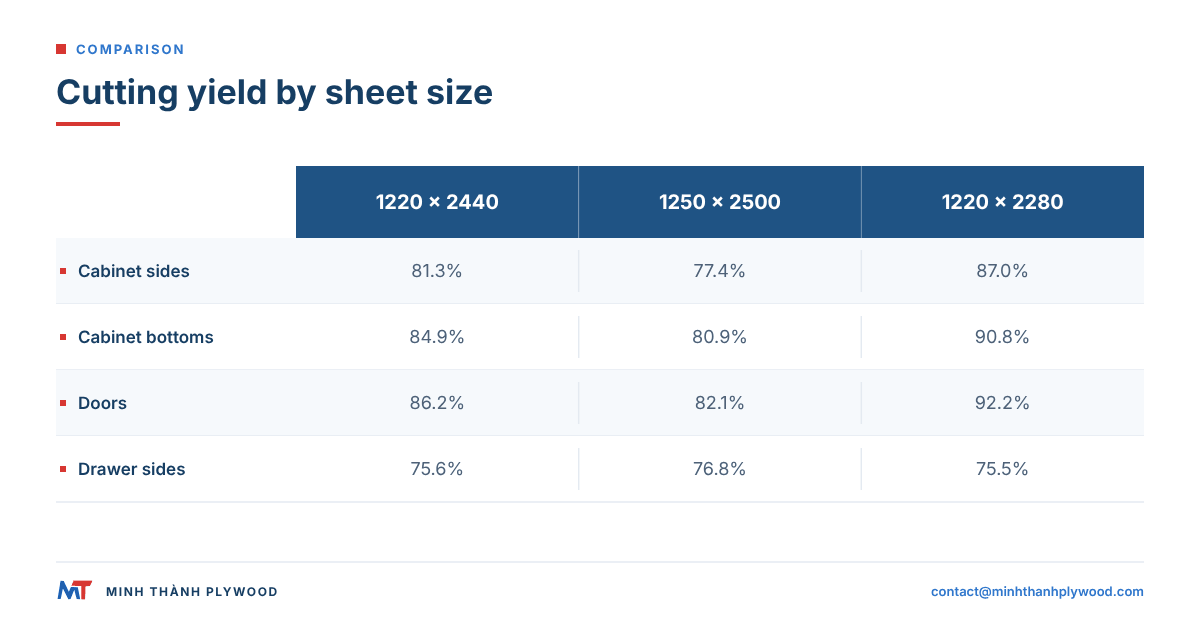
| Part, 18 mm | Pieces on 1220 × 2440 | Yield | Pieces on 1250 × 2500 | Yield | Pieces on 1220 × 2280 | Yield |
|---|---|---|---|---|---|---|
| Base cabinet side 720 × 560 | 6 | 81.3% | 6 | 77.4% | 6 | 87.0% |
| Shelf 564 × 520 | 8 | 78.8% | 8 | 75.1% | 8 | 84.3% |
| Base cabinet bottom 564 × 560 | 8 | 84.9% | 8 | 80.9% | 8 | 90.8% |
| Door 597 × 716 | 6 | 86.2% | 6 | 82.1% | 6 | 92.2% |
| Drawer side 150 × 500 | 30 | 75.6% | 32 | 76.8% | 28 | 75.5% |
| Wall cabinet side 720 × 320 | 9 | 69.7% | 9 | 66.4% | 9 | 74.5% |
| Bed slat 90 × 1500 | 12 | 54.4% | 13 | 56.2% | 12 | 58.2% |
Yield is the parts’ area divided by the full sheet area. Where both sheets give the same count, the smaller sheet has the higher yield, because the buyer pays for less wood. Where the larger sheet adds a row, as with drawer sides, it can win. A rail strip alone does not establish a saving across the complete cabinet part list.
When does a custom sheet size pay?
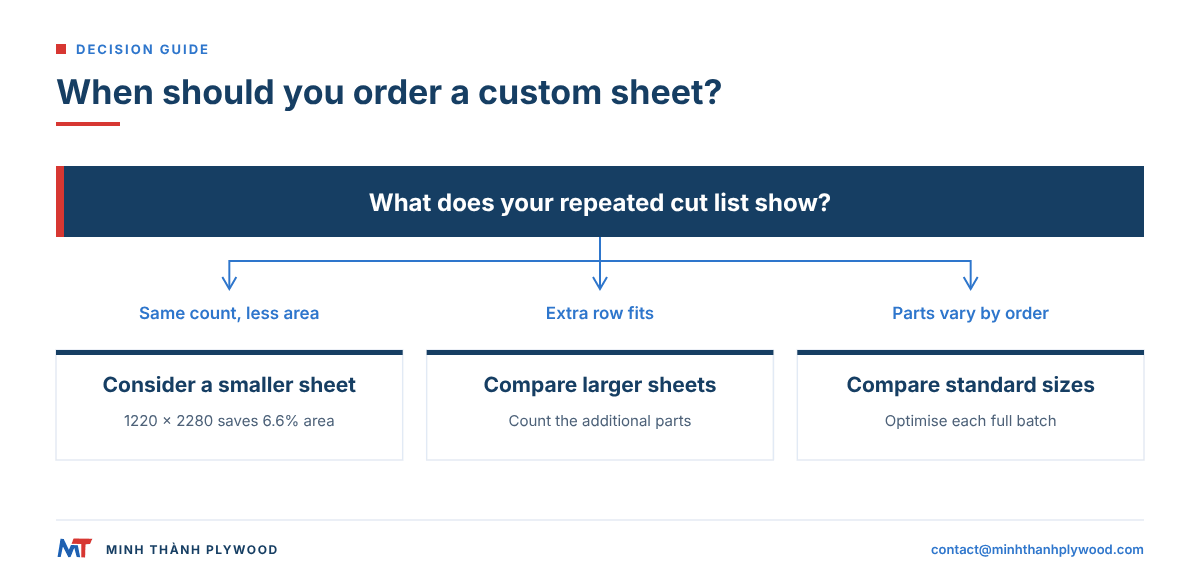
A custom sheet size pays when one part list repeats every month and leaves the same offcut on every standard sheet: a 1220 × 2280 mm sheet gives the same six 720 × 560 mm cabinet sides, or two sides and a bottom per strip, as 1220 × 2440 mm with 6.6% less wood.
Three checks before ordering a custom size:
- Same count, smaller sheet? If a smaller sheet gives the same parts, the saving is the area difference: 2.7816 m² against 2.9768 m² for 1220 × 2280 mm.
- One more row or column on a larger sheet? If 1250 × 2500 or 1220 × 2500 mm adds a strip, the gain is the extra parts less 4.98% or 2.5% more area.
- Enough volume? A custom full sheet is pressed, trimmed and packed for the order. One 40HC is the minimum order, and it can mix specifications by agreement: one or two as standard, three to six by agreement.
Minh Thanh Plywood makes 1220 × 2440 and 1250 × 2500 mm as standard and custom sizes such as 1220 × 2500 and 1220 × 2280 mm. For parts, the cut-to-size plywood service cuts one panel into 4, 6 or 8 pieces.
How do you plan a cutting list for the sheet you order?
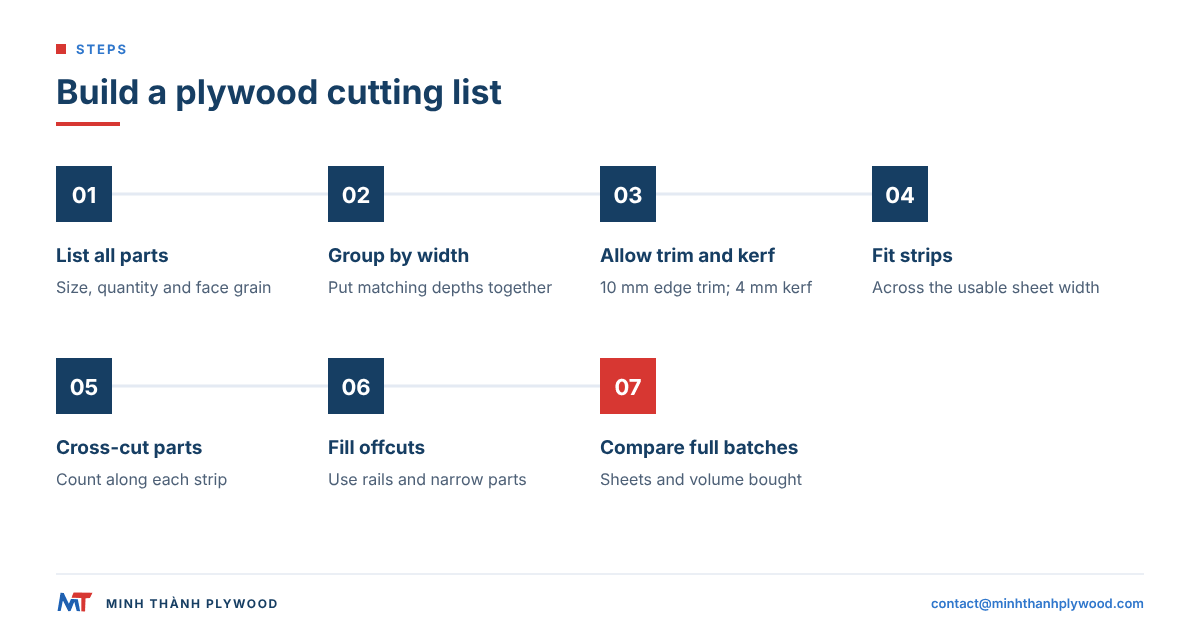
Plan a cutting list by grouping parts by width, ripping strips of each width, cross-cutting each strip and counting parts per sheet on both standard sizes before you order. The steps take ten minutes on paper and save a sheet in every few.
- List every part with finished size, quantity and face-grain direction.
- Group parts by width. Parts of the same depth, such as 560 mm sides and bottoms, share a strip.
- Subtract trim and kerf. Use 1200 × 2420 mm usable on 1220 × 2440 and 1230 × 2480 mm on 1250 × 2500, with 4 mm per cut, or your saw’s figures.
- Fit strips across the width. Add strip widths plus kerf until the next strip will not fit; note the leftover.
- Fit parts along each strip. Add lengths plus kerf until the next part will not fit.
- Fill the leftovers. Put narrow parts, rails and drawer stock into the leftover strips.
- Compare sheets bought. Count sheets for the whole order on each size, then compare the volume bought.
Optimisation software does the same and nests mixed parts better, but the hand count shows quickly whether a size change adds a strip.
Does grain direction change the yield?
Grain direction cuts the options a layout can use: a cabinet side or door needs the face grain running along its height, so it cannot be turned on the sheet to fill a gap. Hidden parts, such as bottoms, rails and drawer bottoms, can turn either way and fill offcuts.
On both standard sheets the face grain runs along the length: 2440 or 2500 mm. Write sizes as width × length, so a 1220 × 2440 mm order is unambiguous. Doors and sides that show the face are laid with their height along the sheet length; parts painted or hidden can be rotated by the optimiser. Matching the grain across doors in one run also fixes which door comes from which sheet.
Weight and container load for each sheet
A 1250 × 2500 × 18 mm sheet weighs about 28.1 kg on a Styrax core and 36.6 kg on Eucalyptus, against 26.8 and 34.8 kg for 1220 × 2440 mm. At 1220 × 2440 × 18 mm, a 40HC carries 990 sheets on Styrax (about 53 m³), 880 on Acacia and 795 on Eucalyptus, within a 28,000 kg planning payload.
For a cabinet plant, the useful figure is cabinets per container, not sheets. Using the four-cabinet, three-sheet layout, 990 Styrax sheets of 1220 × 2440 mm hold the carcasses of 1,320 base cabinets. A 1250 × 2500 mm load is planned per order against the same payload, because each sheet weighs about 5% more. Every shipment is photographed and filmed before loading. Check your own mix in the container packing calculator.
What to write on the order for a cabinet or bed project
Write the sheet size, thickness and tolerance with the build, and attach the cutting list if you want cut-to-size: for example “1250 × 2500 × 18 mm ±0.2 mm, white Styrax core, stitched, UF glue at E0 emission, birch D/E faces, sanded, 1×40HC CIF Genoa”.
- Application: base and wall cabinets, wardrobes, beds, drawers.
- Core: white Styrax for light, flat carcasses; Eucalyptus where stiffness matters.
- Glue and emission: UF glue at E0 emission. For US orders, specify compliance with EPA’s TSCA Title VI emission standards.
- Face and back: species and grade pair, sanded or UV-ready.
- Size, thickness and tolerance: 1220 × 2440, 1250 × 2500 mm or a custom size; cutting list for cut-to-size. Plywood dimensional tolerances are defined in BS EN 315:2000; write the figure itself on the order.
- Packing and quantity: containers, mix, destination port, FOB Hai Phong, CFR or CIF.
Production takes 15–45 days after the 30% deposit, and samples are free. Send the cutting list to contact@minhthanhplywood.com or WhatsApp +84 988 586 601 (Lisa); we reply within hours with the sheet count on both sizes.
Buyer questions, answered
How many cabinets can you get out of one sheet of plywood?
One 1220 × 2440 mm sheet of 18 mm plywood gives the sides and bottoms of two 600 mm base cabinets, 720 mm high and 560 mm deep. Adding shelves and rails, four base cabinets take three sheets, about 1.3 cabinets per sheet; doors come from a separate sheet at six per sheet.
How many kitchen cabinets from one sheet of plywood?
About 1.3 base cabinets or about 1.7 wall cabinets per 1220 × 2440 mm sheet, counting carcass, shelves and rails but not doors or backs. A ten-unit kitchen of six base and four wall cabinets needs about seven carcass sheets, two door sheets and thin back panels.
How much plywood is needed for a king size bed?
A UK king bed base, 150 × 200 cm, needs two 1220 × 2440 mm sheets of 18 mm plywood for the platform and 200 mm side and end rails. A US king, 76 × 80 inches, needs three sheets. Add a sheet for a headboard.
How many sheets of plywood for a queen bed?
A US queen platform bed, 60 × 80 inches (1524 × 2032 mm), needs two 1220 × 2440 mm sheets of 18 mm plywood: each sheet gives half the platform and two 200 mm rails. One sheet is never enough, because the platform alone is 3.10 m².
Which is larger, 1220 × 2440 or 1250 × 2500?
1250 × 2500 mm is larger: 3.125 m² against 2.9768 m², 4.98% more area, 30 mm wider and 60 mm longer. It is the metric sheet of European furniture plants; 1220 × 2440 mm is the 4 × 8 ft format.
Which plywood size is better for furniture manufacturing?
The better size is the one that gives the most accepted parts per cubic metre for your part list. For the eight-cabinet layout here, both standard sizes need five sheets. Compare the complete cutting plan, including offcuts, before choosing.
Which plywood size is more common in Europe?
European furniture and joinery plants often use the metric 1250 × 2500 mm sheet, and many also buy 1220 × 2440 mm. Minh Thanh Plywood makes both, ships regularly to European buyers and has repeat orders into Italy.
Which size is better for construction?
For construction, the size that matches the framing grid is better: 1220 × 2440 mm for 4 ft grids, 1250 × 2500 mm for metric 625 mm grids, and 1200 × 2400 mm in Australia and New Zealand. Formwork panels follow the formwork system.
When does a custom sheet size pay?
A custom size pays when one part list repeats every month and leaves the same offcut on every standard sheet. A 1220 × 2280 mm sheet gives the same six 720 × 560 mm cabinet sides as 1220 × 2440 mm with 6.6% less wood.
How much waste is normal when cutting plywood?
For cabinet carcasses on a panel saw, about 14–25% of the sheet ends up as offcut and saw kerf; in the layouts here, six 720 × 560 mm sides use 81.3% of a 1220 × 2440 mm sheet. Small, mixed parts and nesting software lower the waste.