
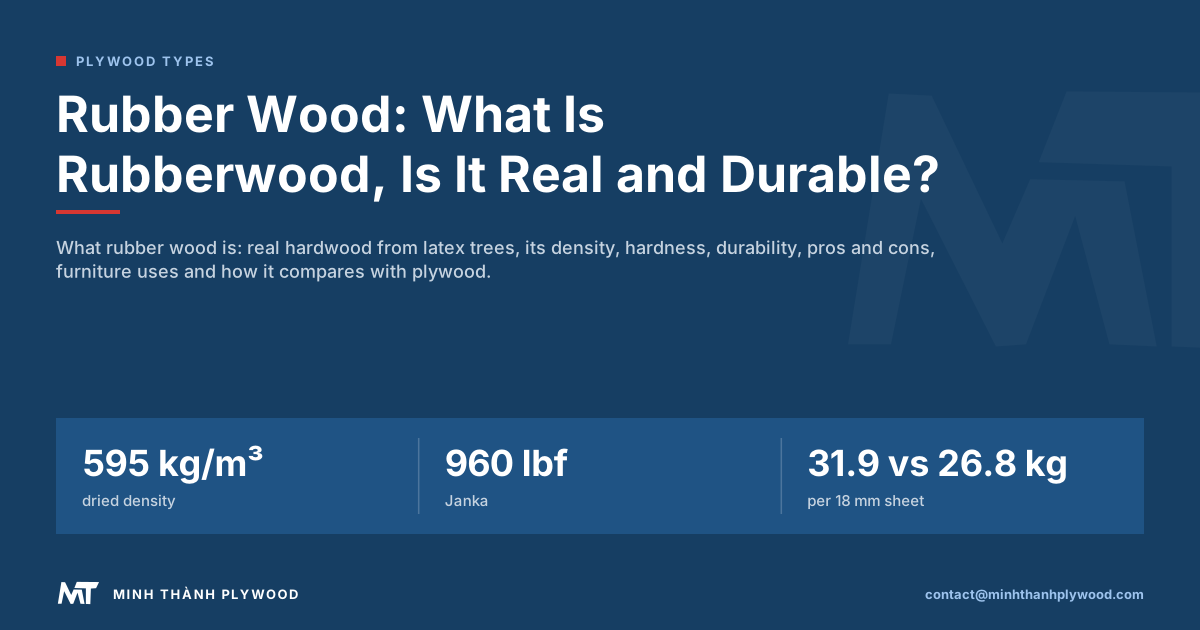
Rubber wood is the timber of the Pará rubber tree, Hevea brasiliensis, felled when its latex yield ends and sawn for furniture, panels and plywood. It is a real, medium-density hardwood, pale and easy to work, but not durable outdoors without treatment. Minh Thanh Plywood, a Vietnamese furniture plywood maker, explains its properties, its limits and when plywood is the better buy.
What is rubberwood?
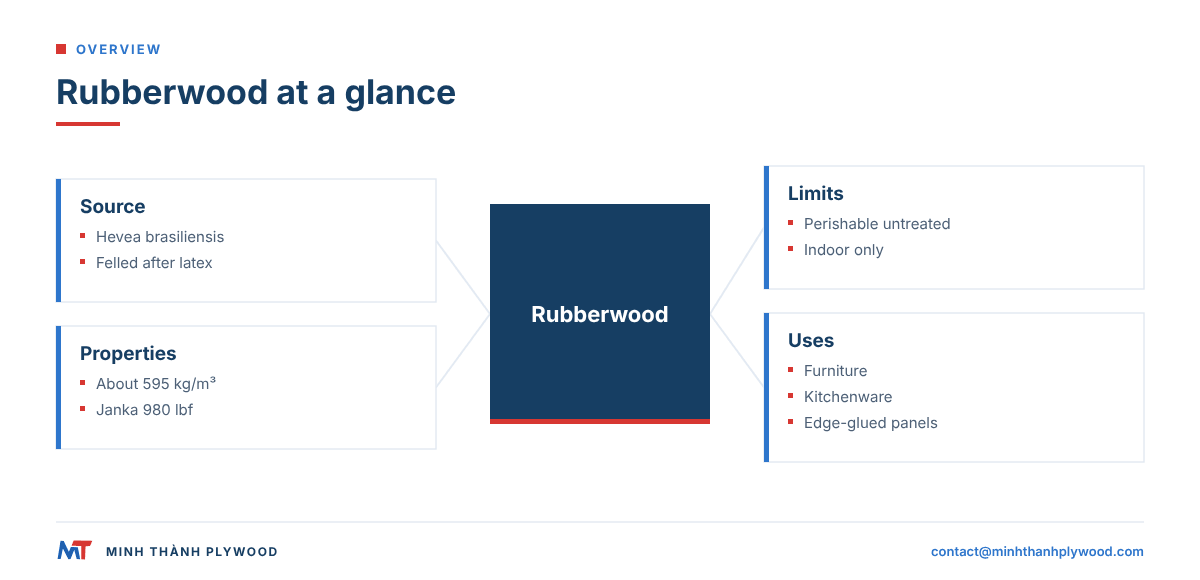
Rubberwood is the timber of the Pará rubber tree, Hevea brasiliensis, harvested when a plantation tree’s latex yield falls and it is felled for replanting. The wood is sawn, treated and kilned for furniture, kitchenware, edge-glued panels and plywood.
Rubber trees grow on plantations across Southeast Asia, South Asia and West Africa. Each tree is first tapped for natural rubber. After about 25–30 years the latex yield declines and the tree is no longer worth tapping, so it is felled and the land is replanted. Because the timber comes from plantation trees at the end of their latex life, no natural forest is cut for it. The trunk, once a by-product burnt on site, is now a main source of furniture timber in the region.
The history is short. Hevea brasiliensis is native to the Amazon basin in Brazil, was planted across Southeast Asia from the late 19th century as a rubber crop, and was marketed as “Malaysian oak” from 2002 when the Malaysian Ministry of Primary Industries promoted its timber.
The wood itself is pale cream to light tan, with a straight to slightly interlocked grain and a medium, even texture. It darkens a little with age and light.
Rubber wood names: parawood, hevea and Malaysian oak
Rubber wood is sold under several names, and they all mean the same timber. Knowing them avoids paying for a “new” species that is rubberwood under another label.
| Name | Where you see it |
|---|---|
| Rubberwood, rubber wood | Standard trade name |
| Parawood | Furniture retail, from the Pará rubber tree |
| Hevea, hevea wood | Botanical name, European catalogues |
| Malaysian oak | Older furniture marketing; it is not oak |
| Plantation hardwood | Generic label on imported furniture |
| Rubber tree wood | Common search phrase |
“Malaysian oak” is misleading: rubberwood is not related to oak. When a catalogue uses it, ask for the botanical name on the specification.
Is rubberwood real wood?
Yes, rubberwood is real wood: solid timber sawn from the trunk of a tree, not a composite, a plastic or a printed board. The word “rubber” refers to the latex the tree produced before felling, not to the wood’s texture.
Confusion comes from two places. First, rubberwood furniture is often made of finger-jointed or edge-glued strips, which look different from a single wide board. Second, cheaper pieces may use rubberwood for the frame and MDF or particle board for panels. Ask whether a part is solid rubberwood, edge-glued rubberwood, or a veneered board.
Solid rubberwood means sawn timber, sometimes glued into wider panels from strips. It is still solid wood through its thickness.
Is rubberwood a hardwood?
Yes, rubberwood is a hardwood: botanically, any wood from a broad-leaved flowering tree is a hardwood, and Hevea is one. In hardness it sits in the middle of the range, harder than pine and poplar, softer than oak, maple and teak.
The Janka test measures the force to press a steel ball halfway into the wood. Figures from The Wood Database:
| Species | Janka hardness |
|---|---|
| Rubberwood | 960 lbf (4,280 N) |
| Teak | 1,070 lbf (4,740 N) |
| Red oak | 1,220 lbf (5,430 N) |
| Hard maple | 1,450 lbf (6,450 N) |
So rubberwood is hard enough for tables, chairs and worktops in normal use, but it will mark sooner than oak under heavy knocks.
Rubberwood properties: density, stability and workability
Rubberwood has an average dried density of about 595 kg/m³ (The Wood Database), close to many furniture hardwoods and lighter than oak. It machines, glues and finishes well, and it is moderately stable once dried properly.
- Density: about 595 kg/m³ dried; a medium-weight wood.
- Colour: pale cream to light tan, takes stain evenly when sanded.
- Grain: straight to slightly interlocked, medium texture.
- Workability: saws, planes, turns and glues well; tension wood can cause fuzzy surfaces.
- Stability: moderate; badly dried stock can warp and twist.
- Odour: fresh-cut wood can smell sour; dried wood is neutral.
| Property (Wood Database) | Value |
|---|---|
| Tree height | 23–30 m |
| Basic specific gravity (12% MC) | 0.49 and 0.59 |
| Modulus of rupture | 71.9 MPa (10,420 psi) |
| Elastic modulus | 9.07 GPa |
| Crushing strength | 42.1 MPa |
| Shrinkage, radial | 2.3 % |
| Shrinkage, tangential | 5.1 % |
| Shrinkage, volumetric | 7.5 % |
| T/R ratio | 2.2 |
A T/R ratio of 2.2 is moderate: rubberwood moves less across the grain than many hardwoods, but badly dried stock still cups, which is why kiln drying matters.
Weight is density times volume. A board of 1220 × 2440 × 18 mm at 595 kg/m³ weighs about 31.9 kg (0.0535824 m³ × 595 kg/m³), close to an Acacia-core plywood sheet of the same size at 31.1 kg.
Is rubberwood durable?
Rubberwood is durable indoors when kiln-dried and treated, and not durable outdoors. The Wood Database rates the heartwood as perishable: it has little natural resistance to decay and is prone to insect attack.
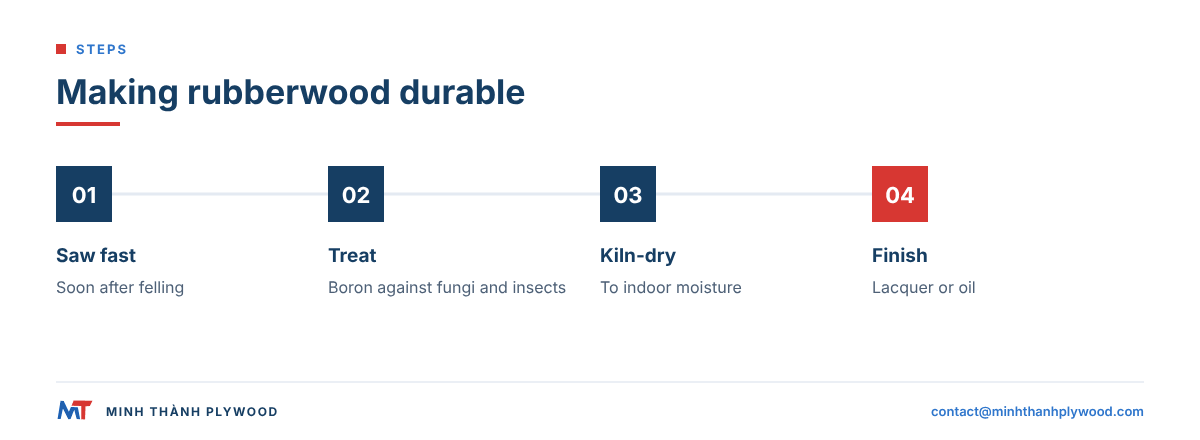
How durability is built into rubberwood:
- Fast processing after felling. Fresh logs stain blue and decay quickly in tropical heat, so they are sawn soon after felling.
- Preservative treatment. Boron-based treatment against fungi and insects is normal practice before drying.
- Kiln drying. Timber is dried to a moisture content that suits indoor furniture, which also stops fungal growth.
- Finishing. Lacquer or oil seals the surface and slows moisture exchange.
Treated and dried rubberwood makes furniture that lasts for many years indoors. Outdoors, even treated rubberwood weathers and decays far faster than teak or exterior-glued plywood.
Rubberwood disadvantages
The main disadvantages of rubberwood are its low natural durability, its need for prompt treatment, its tendency to warp if dried badly, and a face that dents more easily than oak. None stops it being a good indoor furniture wood, but each affects how you buy it.
- Decay and insects: perishable when untreated; ask for treatment and drying records.
- Warping: poorly dried stock twists; check moisture before machining.
- Dents: medium hardness, so table tops mark under heavy use.
- Outdoor use: not suitable.
- Width: rubber trees give modest log diameters, so wide parts are edge-glued or finger-jointed.
- Appearance: plain grain; some buyers prefer more figure.
Plywood avoids the width and warping limits, because cross-laminated veneers stay flat in large sheets.
Solid rubberwood vs edge-glued and veneered parts
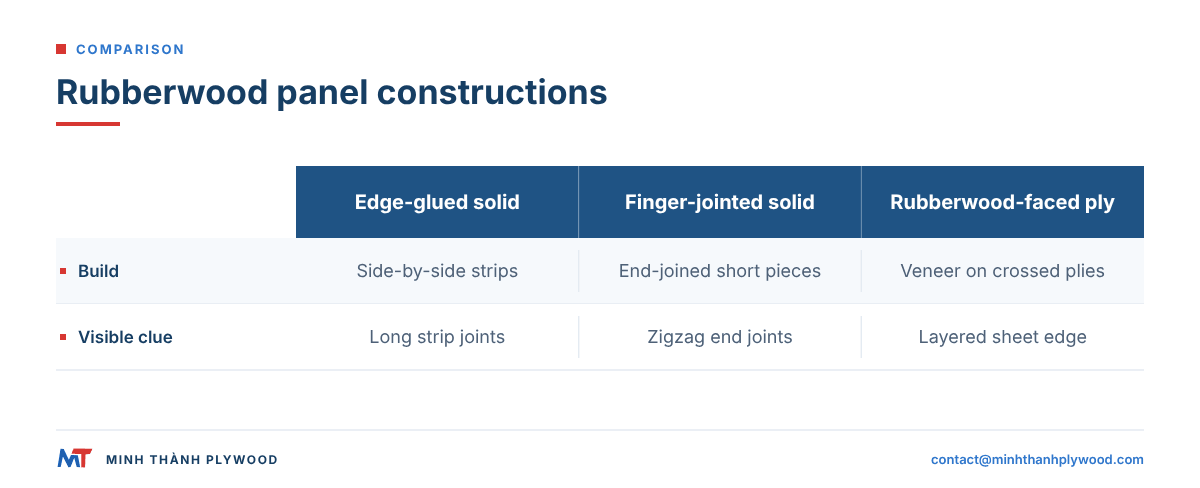
Solid rubberwood means the part is rubberwood through its full thickness, either one sawn piece or strips glued edge to edge. Veneered rubberwood means a thin rubberwood veneer on a board of another material. Furniture labels use both, and the price gap between them is large.
| Label | What it is | How to recognise it |
|---|---|---|
| Solid rubberwood, one piece | A single sawn board | Same grain on face and edge |
| Solid rubberwood, edge-glued | Strips glued side by side | Visible strip joints on the face |
| Finger-jointed rubberwood | Short pieces joined end to end | Zigzag joints across the grain |
| Rubberwood veneer on MDF or particle board | Thin face on a composite | Edge shows a fibre or chip core |
| Rubberwood-faced plywood | Thin face on plywood | Edge shows crossed plies |
Edge-glued and finger-jointed rubberwood are still solid wood and are normal practice, because rubber trees give modest log diameters. They are often more stable than one wide board, since the strips are arranged to balance movement.
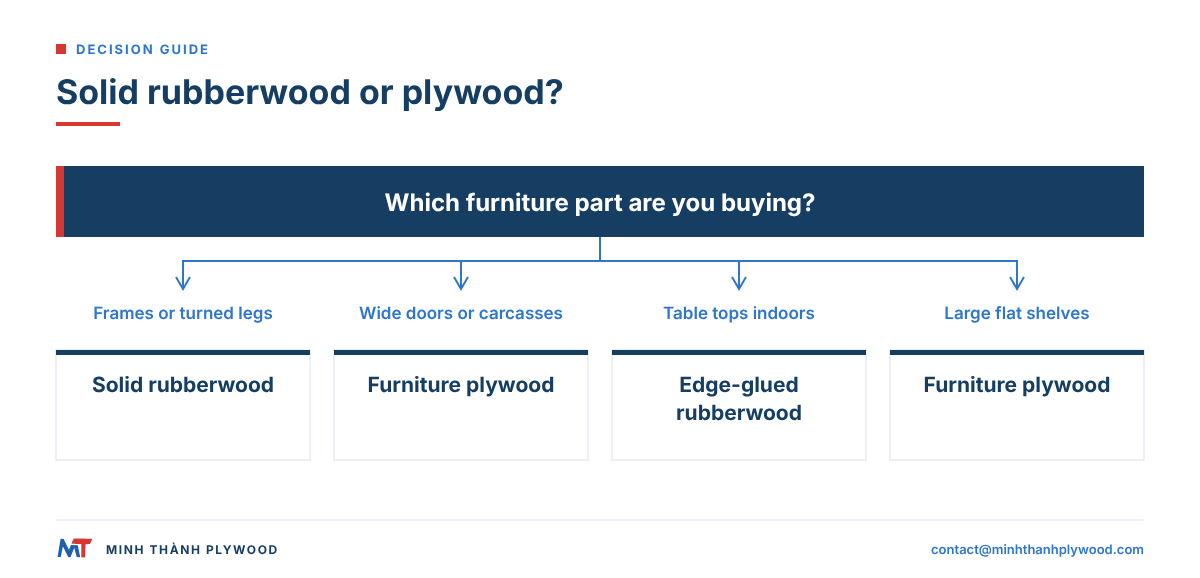
For buyers, the useful question is not “solid or not”, but which construction suits each part. Frames and legs suit solid rubberwood; wide doors, carcasses and shelves suit plywood or a veneered panel, which stay flat over a large area.
Rubberwood in kitchens: cutting boards and worktops
Rubberwood is widely used for cutting boards, butcher blocks and edge-glued kitchen worktops, because its closed grain and medium hardness are kind to knives and it is cost-effective. It needs a food-contact oil finish and should be kept dry between uses.
- Cutting boards: edge-grain or end-grain blocks; oil regularly; never soak.
- Worktops: edge-glued staves; seal the underside and cut-outs as well as the top.
- Near sinks: seal every edge and joint; standing water darkens and lifts the grain.
- Cabinet carcasses under the worktop: plywood with sealed edges stays flatter in kitchen humidity.
Rubberwood is not a substitute for a waterproof material. It works in kitchens because it is finished and kept dry, not because the wood resists water by nature.
Is rubberwood good for furniture?
Yes, rubberwood is good for furniture and is one of the most used furniture timbers in Asia. It is affordable, consistent, easy to machine and finishes well, so it suits dining sets, chairs, beds, children’s furniture, kitchenware and edge-glued worktops.
| Furniture part | Rubberwood fit | Note |
|---|---|---|
| Chair and table frames | Good | Solid, shapeable, strong joints |
| Table tops | Good indoors | Edge-glued; marks under heavy use |
| Turned legs and spindles | Very good | Turns cleanly |
| Cabinet carcasses | Fair | Plywood is flatter and lighter per area |
| Large flat panels and shelves | Fair | Plywood resists warping better |
| Outdoor furniture | Poor | Not durable outside |
Many furniture makers combine both materials: solid rubberwood for frames, legs and edges, and plywood for carcasses, backs, drawer bottoms and wide panels.
Rubber wood vs plywood: which is better?
Solid rubber wood is better for shaped, carved and turned parts and for solid edges; plywood is better for large, flat, stable panels at a lower weight per square metre. For cabinets, shelving and carcasses, plywood is usually the better and more economical choice.
| Point | Solid rubberwood | Furniture plywood |
|---|---|---|
| Form | Boards, edge-glued panels | Sheets 1220 × 2440 or 1250 × 2500 mm |
| Flatness over large areas | Can cup and warp | Cross-laminated, stays flat |
| Edges | Solid wood, can be profiled | Band or paint the edge |
| Shaping and turning | Excellent | Not for turning |
| Thickness tolerance | Machined per part | ±0.2–0.3 mm when sanded |
| Weight, 18 mm sheet size | about 31.9 kg | 26.8 kg on white Styrax core |
| Face options | Rubberwood only | Birch, poplar, EV, okoume, pine and more |
Our guide to plywood vs MDF compares the panel options used next to solid wood in furniture.
Rubberwood plywood and rubberwood panels
Rubberwood is used in three panel products: edge-glued and finger-jointed boards from solid strips, rubberwood-core plywood, and rubberwood veneer faces. Each suits a different part.
- Edge-glued and finger-joint panels: solid rubberwood strips glued into wide boards for worktops, stair treads and furniture parts.
- Rubberwood-core plywood: rubberwood veneers in the core under a decorative face, giving a medium-weight, stable panel.
- Rubberwood-faced plywood: a rubberwood veneer face on another core, for a matching look with solid rubberwood parts.
In Vietnam, rubberwood-core plywood is a niche, higher-cost core made mainly in the south, where rubber plantations are. Northern furniture plywood mills use white Styrax and Eucalyptus cores as standard, with Acacia and Pine on order. Our guide to acacia plywood covers one of those cores.
How Vietnam turns plantation wood into furniture panels
Vietnamese mills turn plantation logs into furniture plywood in a fixed sequence, whether the core is rubberwood, Styrax or Eucalyptus. The steps decide flatness and bond quality more than the species does.
- Peel: logs are rotary-peeled into core veneers.
- Dry: veneers are dried; finished panels leave at 8–12 % moisture content.
- Grade and assemble: core veneers are graded, laid crosswise and stitched both horizontally and vertically.
- Glue and press the core: the core board is pressed and calibrated.
- Press face and back: furniture-grade panels are pressed twice as standard, with the face and back pressed on in the second press.
- Sand and inspect: faces are sanded and polished to ±0.2–0.3 mm on furniture panels.
Our furniture plywood uses UF glue at E0 emission. Six ASTM D6007 chamber tests between April 2025 and June 2026 on 9, 15 and 18 mm panels averaged 0.014–0.032 ppm. The CARB Phase 2 / TSCA Title VI limit for hardwood plywood with a veneer core is 0.05 ppm (40 CFR 770.10).
Rubberwood, EUDR and legal sourcing
The rubber tree feeds two EUDR commodities: its latex falls under “rubber” and its timber, panels and furniture under “wood”. Regulation (EU) 2023/1115 names “cattle, cocoa, coffee, oil palm, rubber, soya and wood” as relevant commodities (EUR-Lex, Regulation (EU) 2023/1115, read 20 October 2026). Importers into the EU need origin records and plot geolocation for wood products, including rubberwood furniture and panels.
The EU’s country benchmarking, Implementing Regulation (EU) 2025/1093, lists Vietnam as a low-risk country. For any species, we supply the EUDR compliance dossier (origin records and geolocation files) with orders, and for US orders the face and core species and Vietnamese harvest origin for the importer’s Lacey Act declaration.
Rubberwood vs acacia, eucalyptus and Styrax
Rubberwood sits between Styrax and Eucalyptus in weight, and its role in Vietnam is mostly solid furniture rather than plywood cores. The three common plywood core species of northern Vietnam compare as below, using our reference densities.
| Species | Density used | Main use in Vietnam |
|---|---|---|
| White Styrax | 500 kg/m³ | Light furniture plywood core |
| Acacia | 580 kg/m³ | Commercial, film-faced and furniture cores |
| Rubberwood | about 595 kg/m³ (dried timber) | Solid furniture; niche plywood core |
| Eucalyptus | 650 kg/m³ | Furniture, film-faced and commercial cores |
Many European furniture buyers choose white Styrax core because it is light and gives a clean, pale edge. See our eucalyptus plywood for the heavier, harder option.
What this means for your order
If your furniture needs shaped solid parts, rubberwood is a sound choice; if it needs wide, flat, light panels with a chosen face, specify furniture plywood. Send these lines with your request:
- Application: carcasses, doors, shelves, drawer parts or table tops.
- Core: white Styrax or Eucalyptus as standard; Acacia or Pine on order.
- Glue and emission: UF glue at E0 emission; CARB P2 / TSCA Title VI for the US.
- Face: birch, poplar, EV, okoume or pine, sanded and UV-ready.
- Size and thickness: 1220 × 2440 or 1250 × 2500 mm, 3–40 mm.
- Packing and quantity: from one 40HC, mixed specifications by agreement.
As of October 2026, our furniture and interior plywood starts from US$350/m³, with production in 15–45 days after the deposit and free samples. See our furniture plywood from Vietnam for the full build.
Buyer questions, answered
Is rubberwood real wood?
Yes. Rubberwood is solid timber sawn from the Pará rubber tree, Hevea brasiliensis. It is not a composite or a plastic; the name comes from the latex the tree produced before it was felled.
Is rubberwood a hardwood?
Yes. Rubberwood is a hardwood in the botanical sense, because it comes from a broad-leaved flowering tree. Its Janka hardness of about 960 lbf puts it in the medium range, softer than oak and maple.
Is rubberwood durable?
Indoors, yes: kiln-dried and treated rubberwood makes long-lasting furniture. Outdoors or in damp places it is not durable, because untreated rubberwood is rated perishable and attracts fungi and insects.
Is rubberwood good for furniture?
Yes. Rubberwood is one of the most widely used furniture timbers in Southeast Asia: it machines, glues, stains and finishes well, and it is cost-effective. Keep it indoors and away from standing water.
What are the disadvantages of rubberwood?
Untreated rubberwood stains and rots quickly and attracts insects, so it must be treated and dried soon after felling. It can also warp if dried badly, dents more easily than oak, and is unsuitable for outdoor use.
Is rubber wood better than plywood?
Neither is better in every case. Solid rubberwood gives solid edges and can be shaped and carved; plywood gives large, flat, stable sheets that resist warping. For panels, carcasses and shelves, plywood is usually the better and more economical choice.
What is parawood?
Parawood is another trade name for rubberwood, from the Pará rubber tree. Hevea wood, plantation hardwood and Malaysian oak are other names used in furniture catalogues.
Does rubberwood contain latex?
Sawn and dried rubberwood contains very little latex, because the tree is tapped for years before felling and the timber is then processed and dried. Buyers with a latex allergy concern should ask the furniture maker about finishing.
Is rubberwood good for cutting boards?
Rubberwood is widely used for cutting boards, because its fine, closed grain and medium hardness are kind to knives. Choose boards finished with a food-contact oil and keep them dry between uses.
Is rubberwood plywood a good product?
Rubberwood-core plywood is a stable, medium-weight panel. In Vietnam it is a niche, higher-cost core made mainly in the south; most furniture plywood uses white Styrax, Eucalyptus or Acacia cores.