
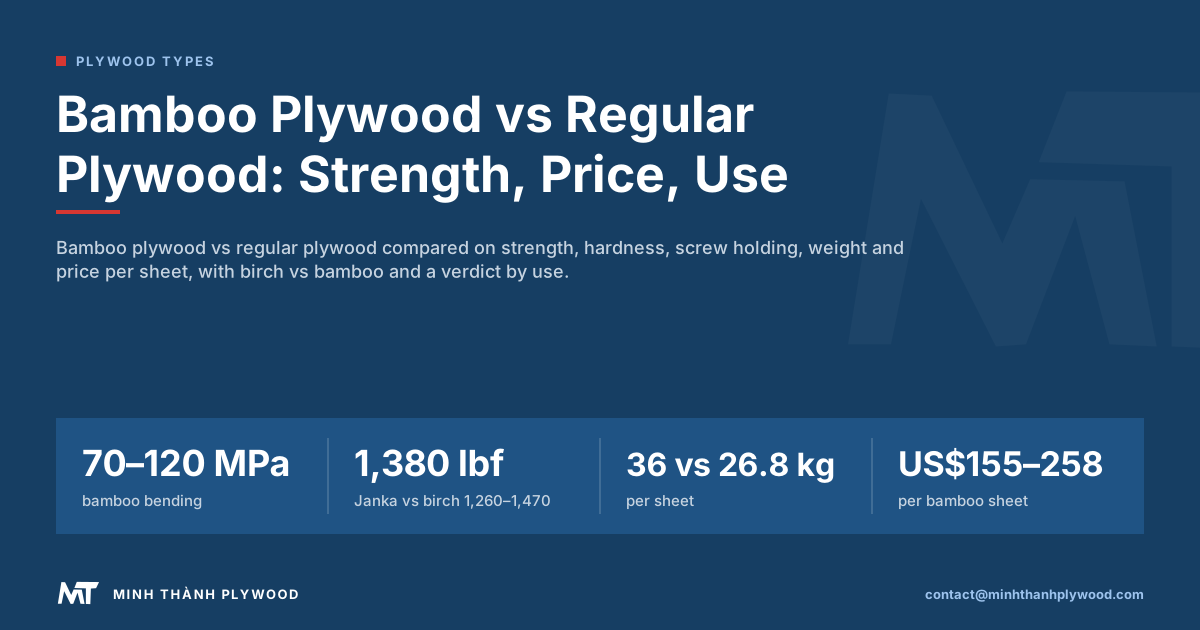
Bamboo plywood vs regular plywood is a choice between a hard, striped decorative panel and a lighter, cheaper standard sheet. Strip bamboo plywood bends about as well as good hardwood plywood and its face is harder, but it weighs more and costs several times as much per sheet. Minh Thanh Plywood makes regular furniture plywood in Vietnam; this guide gives the verdict by use.
Bamboo plywood vs regular plywood: the short answer
Bamboo plywood vs regular plywood comes down to the job. Choose bamboo plywood when the striped bamboo face is the design and the panel stays indoors. Choose regular plywood, made of wood veneers, for carcasses, shelving, sheathing, packing and anything priced by the sheet; it is lighter and costs a fraction of bamboo per sheet.
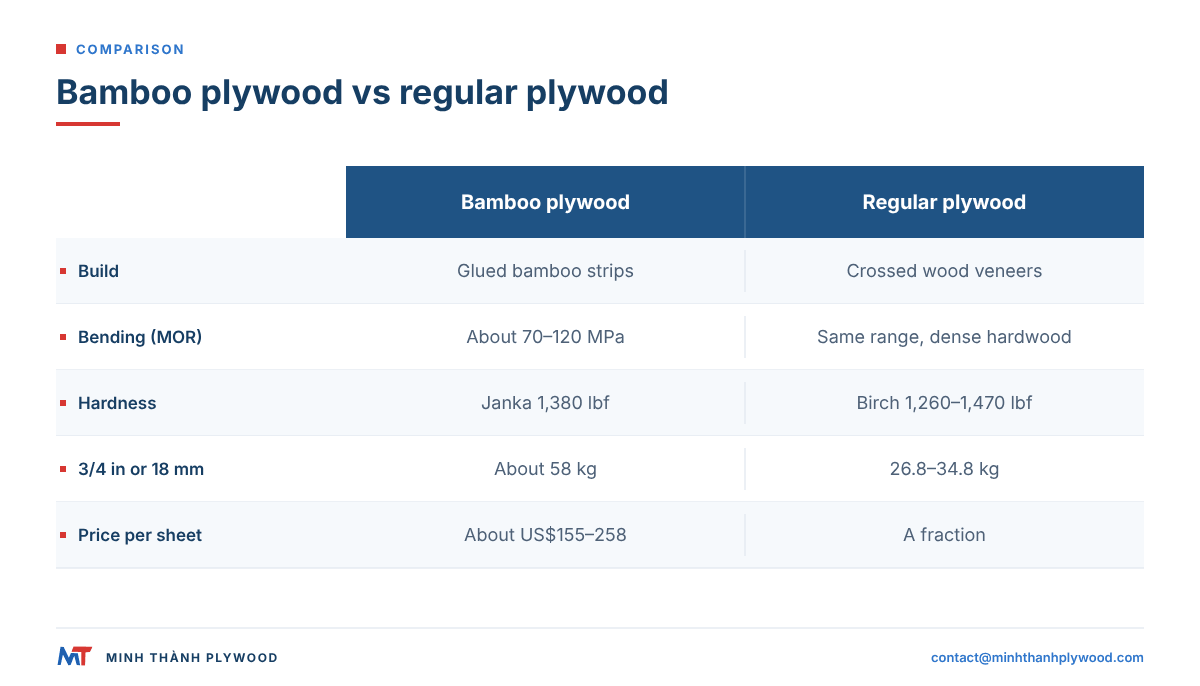
| Metric | Bamboo plywood (strip) | Regular hardwood plywood |
|---|---|---|
| Build | Bamboo strips glued edge to edge, layers crossed | Wood veneers, grain crossed in each layer |
| Bending strength (MOR) | About 70–120 MPa reported | Varies by species and layup; good hardwood plywood is in the same range |
| Face hardness | Natural bamboo Janka 1,380 lbf | Birch 1,260–1,470 lbf; softer faces such as poplar lower |
| Weight, 3/4 in or 18 mm sheet | About 36 kg (4 × 8 ft, 19 mm; strand-woven about 58 kg) | 26.8 kg to 34.8 kg (1220 × 2440 × 18 mm) |
| Price per sheet | About US$155–258 (US quotes) | A fraction of that |
| Face | Striped bamboo, vertical or flat grain | Wood veneer, many species and grades |
| Bond | Mostly interior glues; phenolic on formwork grades | UF, MR or phenolic to order |
| Best use | Visible furniture, countertops, panels | Carcasses, shelving, packing, construction |
The hardness figures are Janka values from the published Janka test tables (read October 2026). The bamboo strength range is from published panel test summaries; the weight is calculated from a US maker’s strip-panel density for a 3/4 in panel.
What is bamboo plywood?
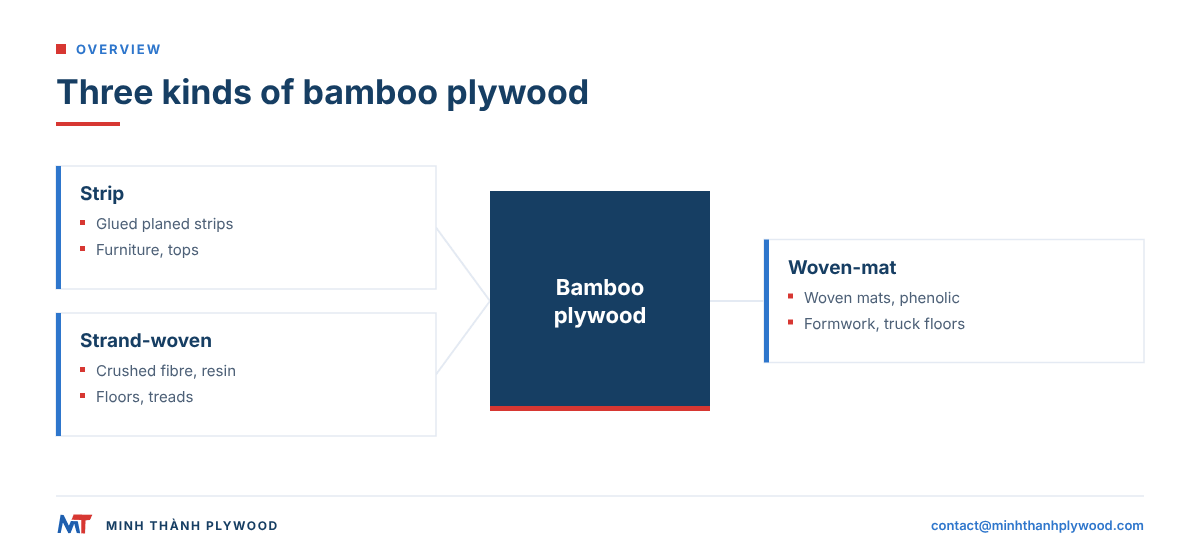
Bamboo plywood is a panel made of bamboo strips or strands glued together under heat and pressure, usually from Moso bamboo harvested at three to five years. The strips are split from the culm, boiled or steamed to remove sugars, dried, planed and glued into sheets; thicker panels cross the layers like wood plywood.
The name covers three different products:
| Type | How it is built | What it looks like | Main use |
|---|---|---|---|
| Strip (vertical or flat grain) | Planed strips glued side by side, layers crossed | Straight bands; knuckles show on flat grain | Furniture, countertops, panels |
| Strand-woven | Crushed bamboo fibres pressed with resin into blocks, then sliced | Dense, mottled, hardwood-like | Floors, stair treads, heavy-wear tops |
| Woven-mat | Thin bamboo slivers woven into mats, layered with phenolic resin | Basket weave or plain resin face | Concrete formwork, truck and container floors |
Buyers compare these three as if they were one panel. Ask which construction is on the quote before comparing strength or price; for a full product overview, read our bamboo plywood guide.
What is regular plywood?
Regular plywood is made of thin wood veneers glued in an odd number of layers, each layer’s grain crossed with the next. The cross-laminated build makes it stiff in both directions, light for its strength, and stable in size when humidity changes.
Furniture plywood from Vietnam is typically built on plantation hardwood cores. Our panels use white Styrax or Eucalyptus cores, with faces chosen for the look the buyer orders: EV (engineered veneer), poplar, birch, okoume, pine and others. The glue decides where the panel can go: UF glue for dry interiors, MR/melamine-fortified for humid rooms, phenolic (WBP) for exterior and wet use. See types of plywood for the full range.
Is bamboo plywood stronger than regular plywood?
Bamboo plywood is about as strong as good hardwood plywood in bending, not clearly stronger. Published test summaries for strip bamboo plywood report a modulus of rupture (MOR) of about 70–120 MPa and a stiffness (MOE) of about 10,000–12,000 MPa, values that overlap with dense hardwood plywood.
Per kilogram, regular plywood wins. A 3/4 in strip bamboo panel weighs about 36 kg (strand-woven about 58 kg); an 18 mm hardwood plywood sheet weighs 26.8 kg to 34.8 kg on our cores. A shelf or a wall unit gets the same stiffness for less weight in plywood.
Bamboo plywood strength claims need three caveats:
- Fibre vs panel: “bamboo is stronger than steel in tension” describes a single fibre along the culm, not a glued panel.
- Direction: strip panels are stronger along the strips; ask for the layup and test both directions.
- Glue lines: a bamboo panel has many more glue lines than plywood, so the adhesive and pressing decide how it fails.
Bamboo plywood strength: how should buyers compare test data?
Compare bamboo plywood strength only against a test report for the same construction, thickness and direction. A strand-woven floorboard figure says nothing about a 3-layer strip panel, and a figure measured along the strips is higher than one measured across.
Ask the supplier for:
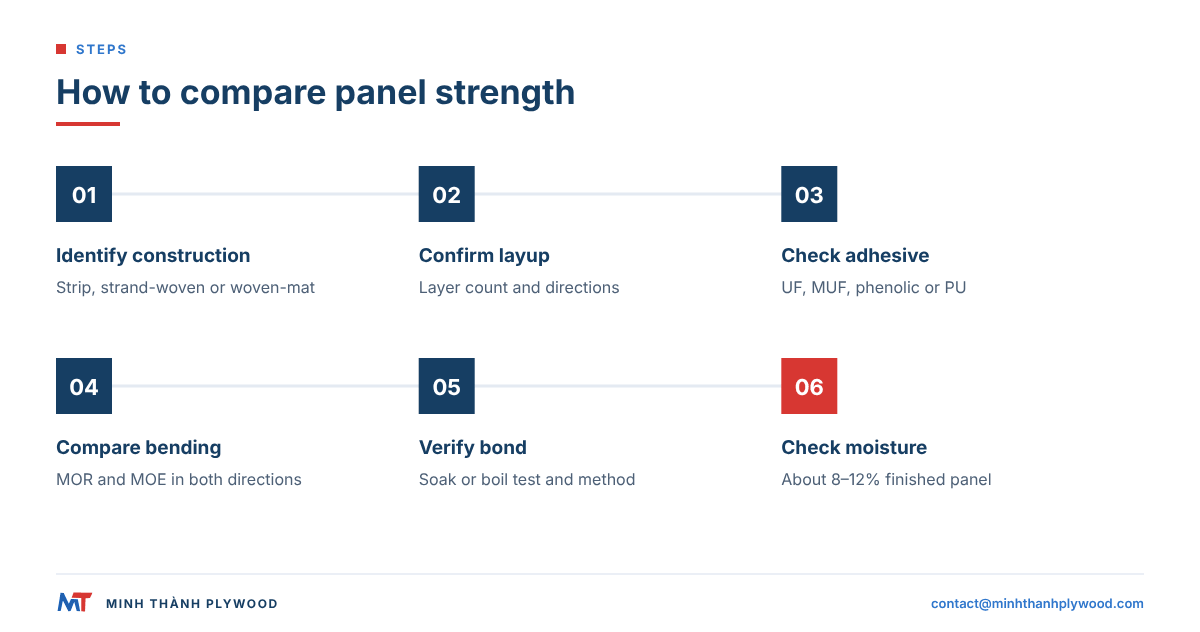
- Construction: strip, strand-woven or woven-mat; number of layers; layer directions.
- Adhesive: UF, MUF, phenolic or PU, and the emission class.
- Bending: MOR and MOE in both directions, with the test method.
- Bond test: soak or boil cycle passed, with method.
- Moisture content: finished panels at about 8–12 %.
Hold regular plywood to the same list. A plywood quote should name core species, glue, emission class and thickness tolerance; ours names white Styrax or Eucalyptus core, UF glue at E0 emission, and ±0.2–0.3 mm on sanded furniture panels.
Which standards apply?
Regular plywood has published standards; strip bamboo plywood does not. Buyers should know which paper applies to which panel:
- ANSI/HPVA HP-1-2020: the US standard for hardwood and decorative plywood, with face grades AA to E, back grades 1 to 4 and bond classes.
- EN 636: the European standard for plywood by service class: 636-1 dry, 636-2 humid, 636-3 exterior.
- BS 1088: marine plywood, with a gap-free core and a boil-proof bond.
- Bamboo plywood: no HP-1 grade map or EN 636 service class covers it. Ask for the mill’s test report with MOR and MOE, the bond test method and the CARB P2 / TSCA Title VI emission result.
- Our plywood: quoted with the glue class, emission class and thickness tolerance, and CARB P2 / TSCA Title VI certified (ICTT mill no. 23024).
Sources: ANSI/HPVA HP-1-2020, Hardwood Plywood and Veneer Association, EN 636, BSI, BS 1088, BSI, EPA TSCA Title VI and FSC, all checked on 21 October 2026.
Birch vs bamboo: hardness, look and price
Birch vs bamboo is close on hardness and far apart on look and price. On the Janka scale, natural bamboo is listed at 1,380 lbf (6,100 N), sweet birch at 1,470 lbf (6,500 N) and yellow birch at 1,260 lbf (5,600 N). Strand-woven bamboo is much harder than all three, which is why it is used for floors.
| Factor | Birch plywood | Bamboo plywood |
|---|---|---|
| Face hardness | Janka 1,260–1,470 lbf (solid birch) | Janka 1,380 lbf (natural bamboo) |
| Edge | Fine, even layers; a popular exposed edge | Striped strips; also shown as a feature |
| Face | Pale, fine grain; graded by face quality | Bands and knuckles; carbonised (amber) or natural |
| Machining | Clean in CNC work | Hard on tools; pre-drill |
| Price | Lower per sheet | Higher per sheet |
Birch-faced plywood from our mill carries birch face veneers graded D+, D and E (comparable to European B, BB and CP/C) on a plantation hardwood core, quoted in pairs such as D+/D, matched to the buyer’s approved sample. See birch plywood for sizes and grades.
Bamboo plywood vs regular plywood price
Bamboo plywood costs several times more than regular plywood. US quotes for a 3/4 in 4 × 8 ft bamboo panel run about US$155–258 per sheet depending on maker and quantity; a 3/4 in exterior CDX plywood sheet was priced at about US$30–70 in mid-2026 US cost guides.
Per square foot, US$155–258 per 32 sq ft sheet is about US$4.8–8.1, against about US$0.9–2.2 for the CDX sheet (US$30–70 over 32 sq ft). A US retailer, Forest Plywood, puts bamboo at 3 to 4 times standard plywood and 20–40 % above Baltic birch (checked on 21 October 2026).
Per cubic metre the gap is clearer. A 4 × 8 ft panel at 19 mm is about 0.0566 m³, so US$155–258 per sheet is roughly US$2,700–4,600/m³ retail. Minh Thanh Plywood’s indicative export prices in October 2026 start from US$250/m³ for commercial plywood and from US$350/m³ for furniture and interior plywood (FOB; face, core, glue, thickness, size and quantity set the final price). Retail and FOB prices are different levels, but the order of magnitude holds.
What moves the bamboo plywood vs regular plywood price:
| Driver | Bamboo plywood | Regular plywood |
|---|---|---|
| Material yield | Low: round hollow culms, many glue lines | High: veneer peeled from logs |
| Labour | Splitting, planing and gluing strips | Peeling, drying, laying up veneers |
| Volume | Niche, few mills | Large-scale production |
| Face choice | Natural or carbonised, vertical or flat | Many species and grades |
For bamboo price details, see bamboo plywood price.
How do bamboo and regular plywood handle moisture and outdoor use?
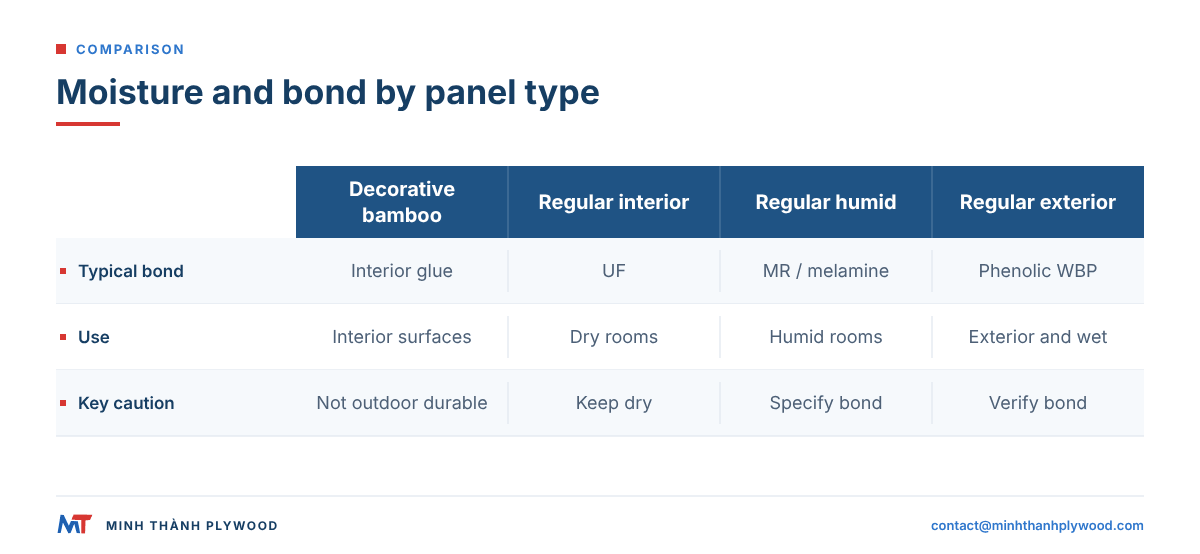
Decorative bamboo plywood is an interior panel, and regular plywood can be ordered for interior or exterior use. Most strip bamboo panels use interior glues, and bamboo itself is not naturally durable outdoors without treatment; the sugars removed in processing are what attract insects and mould.
Regular plywood has a ladder of bonds: UF for dry rooms, MR/melamine-fortified for humid rooms, phenolic (WBP) for exterior and wet use. Our exterior/CDX-type panels use water-resistant melamine-fortified or phenolic (WBP) glue for stair treads and wall sheathing. Read is plywood waterproof for the bond classes.
Can bamboo plywood be used for formwork?
Woven-mat bamboo plywood can be used for formwork; decorative strip bamboo plywood cannot. Formwork bamboo is a separate product: woven bamboo mats and phenolic resin pressed into a hard, heavy panel, used for concrete forms and for truck and container floors.
For concrete, film-faced hardwood plywood with a phenolic film and a WBP bond is the more common choice: it is lighter, the film gives a smooth concrete face, and it is easy to cut and nail. We make film-faced plywood for this use. Bamboo plywood is not a substitute for marine plywood either; marine plywood needs a void-free core and a boil-proof bond to a marine standard.
How should buyers judge surface wear separately from bending and screw holding?
Surface wear, bending and screw holding are three separate tests, and bamboo and plywood rank differently on each. A hard bamboo face resists dents and scratches; plywood is lighter and stiffer per kilogram; screw holding depends on density and on how the fibres meet the screw.
| Test | Bamboo plywood | Regular plywood |
|---|---|---|
| Dents and scratches | Better; hard face | Depends on face species; laminate fixes it |
| Bending per kilogram | Lower; heavy panel | Better |
| Face screws | Good; pre-drill | Good |
| Edge screws | Fair; can split along strips | Good; long fibres in each layer |
| Tool wear | Higher | Lower |
For a countertop or stair tread, surface wear wins and bamboo earns its price. For a cabinet box, bending and screws win and plywood is the better buy.
Is bamboo plywood greener than regular plywood?
Bamboo regrows fast: Moso culms are harvested at three to five years, and new shoots grow from the same roots without replanting. That is a real advantage over a tree crop. The full comparison also counts glue content, which is higher in bamboo panels, and the distance the panel travels.
Ask for documents rather than slogans:
- Chain of custody: FSC certificates exist for both bamboo and wood plantations; US bamboo panel maker Smith & Fong, for example, supplies FSC-certified bamboo. Our FSC supply is available*.
- Emissions: CARB P2 / TSCA Title VI certification for the glue line, under the EPA formaldehyde standards for composite wood products (read October 2026). Ours: ICTT mill no. 23024.
- Origin for the EU: under Regulation (EU) 2023/1115 (EUDR, read October 2026), we supply the EUDR compliance dossier (origin records and geolocation files) with plywood orders.
Plantation Styrax, Acacia and Eucalyptus from Vietnam are also short-rotation crops, so plywood from them answers the same questions with paperwork.
*Supplied directly or through qualified partner mills.
Which should you choose? Verdict by use
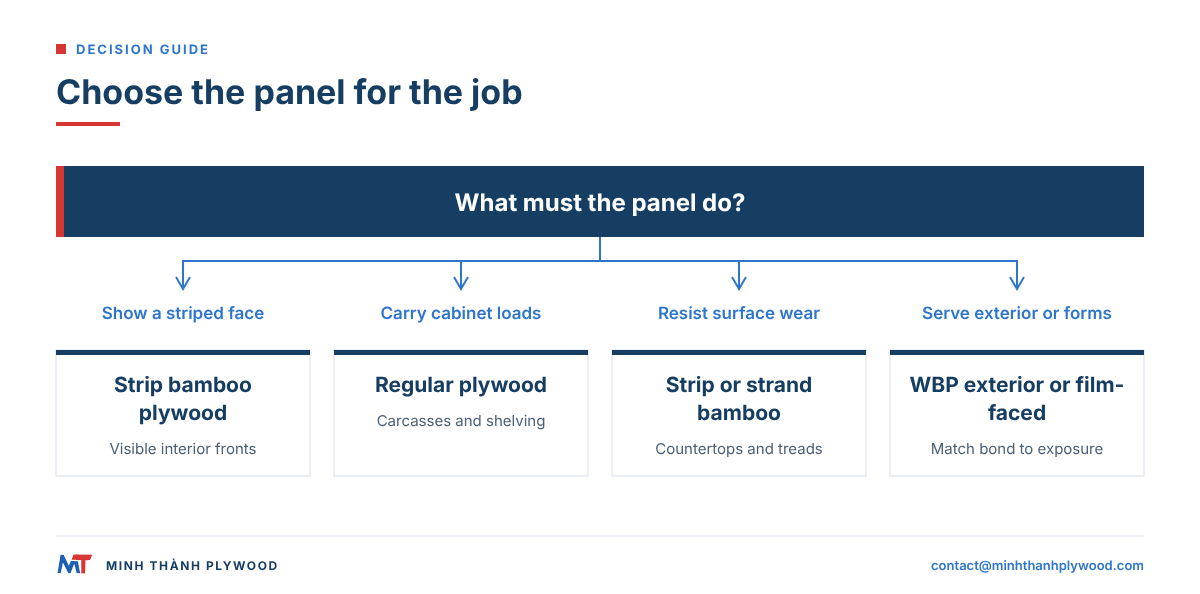
Choose bamboo plywood for visible interior surfaces where its look and hardness justify the price, and regular plywood for everything else. The table gives the verdict by job.
| Job | Better choice | Why |
|---|---|---|
| Visible cabinet fronts, modern style | Bamboo plywood | The striped face is the design |
| Kitchen and wardrobe carcasses | Regular plywood | Lighter, cheaper, good edge screws |
| Countertops and stair treads | Bamboo (strip or strand) | Hard, wear-resistant face |
| Shelving | Regular plywood | Stiffer per kilogram |
| Wall panels, shop fittings | Either | Look and budget decide |
| Concrete formwork | Film-faced plywood or woven bamboo | Phenolic bond and hard face needed |
| Packing, crates | Regular plywood | Price |
| Exterior sheathing | Exterior plywood (WBP) | Rated bond |
A mixed build is common: plywood carcasses with bamboo fronts or tops. Our commercial plywood and furniture plywood cover the carcass side.
What should a plywood order for this job say?
A plywood order should name the core, glue, face, thickness and size, so the quote matches the job you compared against bamboo. Without the glue line, “plywood” can mean an interior UF panel or an exterior WBP sheet.
Spec lines we can quote from:
- Application: furniture carcasses, shelving or wall panels.
- Core: white Styrax (light) or Eucalyptus (denser).
- Glue and emission: UF glue at E0 emission; MR or phenolic (WBP) to order.
- Face/back: birch D+/D, EV, poplar or okoume, to an approved sample.
- Thickness and size: 18 mm ±0.2 mm, 1220 × 2440 mm or 1250 × 2500 mm.
- Quantity and terms: one 40HC (MOQ), production 15–45 days after the 30% deposit, FOB Hai Phong, CFR or CIF.
Free samples let you put our face next to a bamboo sample before you decide. Send the spec to contact@minhthanhplywood.com.
Buyer questions, answered
Is bamboo plywood stronger than regular plywood?
Strip bamboo plywood is about as strong in bending as good hardwood plywood, with a reported modulus of rupture of 70–120 MPa, and its face is harder. It is not stronger per kilogram, because it is heavier.
Is bamboo plywood cheaper than regular plywood?
No. A 3/4 in (19 mm) 4 × 8 ft bamboo panel has been quoted at about US$155–258 per sheet in the US, several times the price of a hardwood plywood sheet of the same size.
Birch vs bamboo: which is harder?
They are close. On the Janka scale, natural bamboo is listed at 1,380 lbf, sweet birch at 1,470 lbf and yellow birch at 1,260 lbf. Strand-woven bamboo is much harder than both.
Can bamboo plywood be used outdoors or for formwork?
Decorative strip bamboo plywood is an interior panel. Woven-mat bamboo plywood with a phenolic bond is made for concrete formwork and truck floors, but it is a different product from the furniture panel.
Is bamboo plywood a substitute for marine or film-faced plywood?
No. Marine plywood has a void-free core and a boil-proof bond, and film-faced plywood has a phenolic film for concrete. Decorative bamboo plywood has neither.
Is bamboo plywood greener than hardwood plywood?
Bamboo regrows from its roots and is harvested at three to five years, which is a real advantage. Glue content, transport distance and chain-of-custody paperwork decide the rest, and plantation hardwood plywood with origin records competes on the same terms.
Does bamboo plywood hold screws well?
Yes in the face, because it is dense and hard; pre-drill to avoid splitting. In the edge of strip panels, screws can follow the glue lines between strips, so use pilot holes and keep screws away from the ends.
How much does bamboo plywood weigh?
A 3/4 in 4 × 8 ft strip bamboo panel weighs about 80 lb (36 kg), and strand-woven bamboo about 128 lb (58 kg), against 26.8 kg to 34.8 kg for an 18 mm 1220 × 2440 mm hardwood plywood sheet from our mill.
What is bamboo plywood used for?
Furniture fronts, countertops, stair treads, wall panels and shop fittings where the striped face is the design. Hardwood plywood is used for carcasses, sheathing, packing and anything sold by price.
How do I tell strip, strand and woven bamboo plywood apart?
Strip panels show straight bands of bamboo, flat or on edge; strand-woven panels look like dense, mottled hardwood; woven-mat panels show a basket weave on the face or core.