
The best plywood for furniture combines an appropriate face, core, thickness and bond. Select cabinet grade plywood by component, and define plywood grades for cabinets as face/back pairs. Minh Thanh Plywood makes stitched, double-pressed furniture panels with Styrax or Eucalyptus core and decorative faces. Choose appearance separately from the internal construction, then approve machining, hardware and finishing on the specified sample.
Video transcript
The best furniture plywood matches the component you make. Start with the visible finish and the assembly, then choose the core, thickness and bond. A beautiful face and a suitable internal construction belong on the same order.
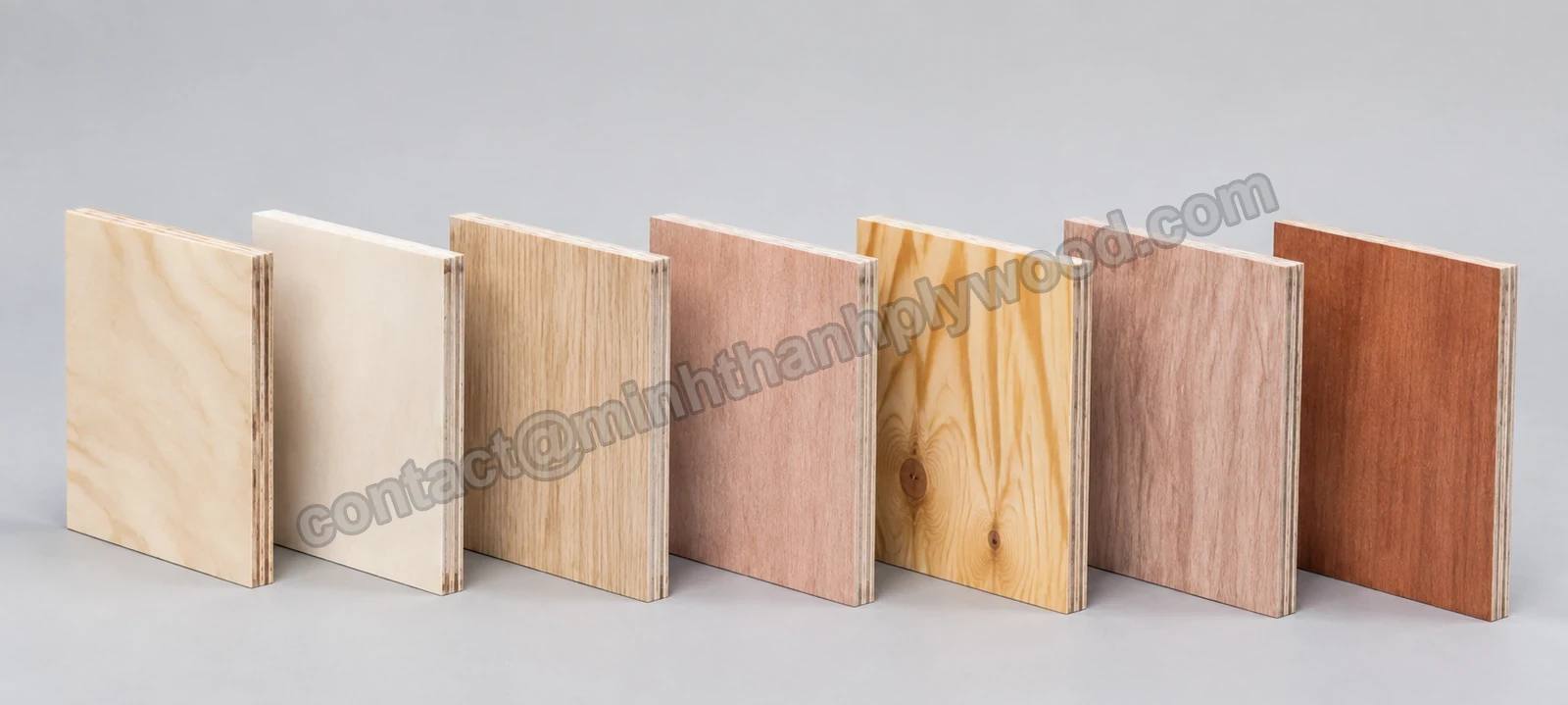
Birch, poplar and engineered veneer describe the face you see. Minh Thanh furniture panels use white Styrax or Eucalyptus cores. Name both on your specification. A birch face gives you a birch appearance without specifying birch throughout the panel.
Clear finished furniture needs the grain and appearance you want to keep. Painted or laminated components need a smooth prepared substrate. Specify the face and back separately. An exposed cabinet interior deserves an appearance instruction just as much as the outside.
Thickness follows the part drawing, support spacing and hardware. Thin plywood from three to six millimetres has five plies. Cabinet sides, doors and shelves need their own component trials. Compare the same construction using your actual cutting and assembly process.
Furniture quality begins before the face is applied. Core veneers are stitched across and along the sheet. The core board is pressed and calibrated, then the face and back are pressed on. This preparation supports a smooth surface for furniture production.
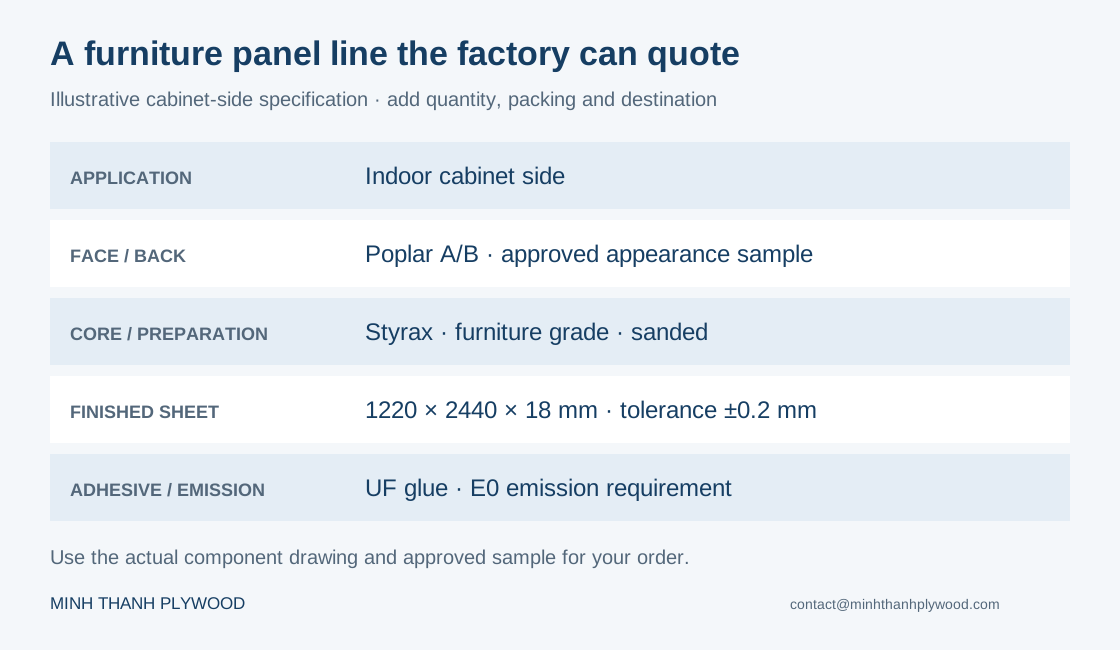
Our standard furniture specification uses U F glue at E zero emission. The adhesive requirement and emission requirement occupy separate lines. Tell us about dry interiors, humidity or wet exposure. Your application determines the bond, while the destination determines the product records.
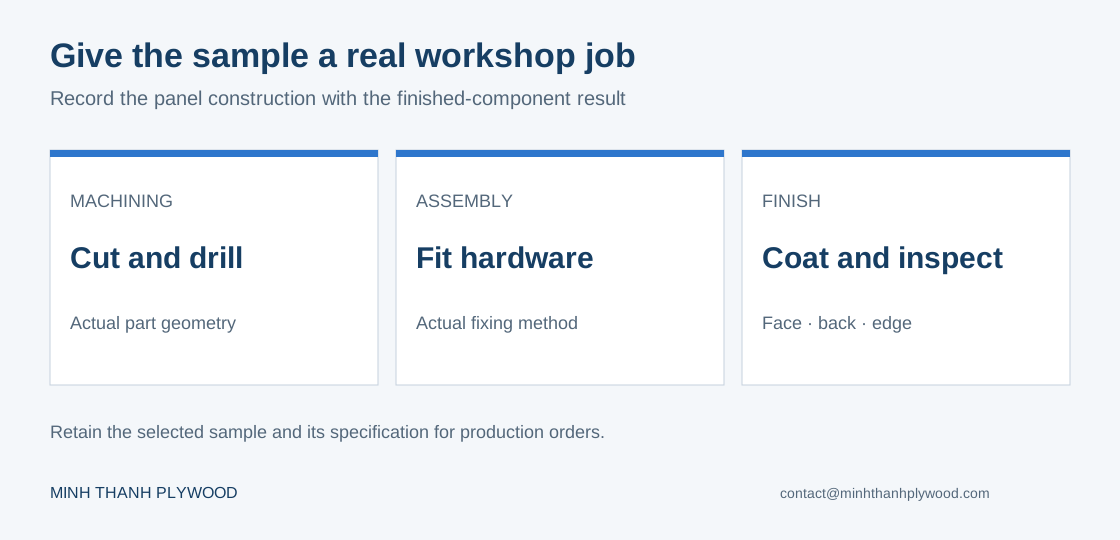
Use the sample for a real workshop trial. Cut the shape, drill the hardware holes and apply the intended finish. Check the face, back and visible edges together. Keep the successful sample and cutting drawing as the reference for the container order.
Weight changes with the core, even when the face looks identical. Calculate sheet volume, multiply by the planning density and add packing mass. Check the load against the booking and road limits. Order sheets by thickness and format so the receiving team can identify every component.
Send the application, face and back grades, core, dimensions and quantity. Include the adhesive, emission requirement, finish, packing and destination. Minh Thanh Plywood supplies furniture and interior panels from Vietnam. Free samples help your workshop choose the construction for the next production run.
How do you choose the best plywood for furniture?
For clear-finished furniture, start with birch or another decorative face on a furniture-grade veneer core. For painted components, compare poplar-faced plywood with MDF using the finished component, its joints and the service exposure. The best plywood for furniture is a complete construction specification: face/back, core, thickness, adhesive, emissions and surface preparation.
Minh Thanh’s furniture plywood uses white Styrax or Eucalyptus cores, stitched assembly and double pressing. Birch-faced plywood describes the outside veneer; it does not mean all-birch or Baltic birch construction.
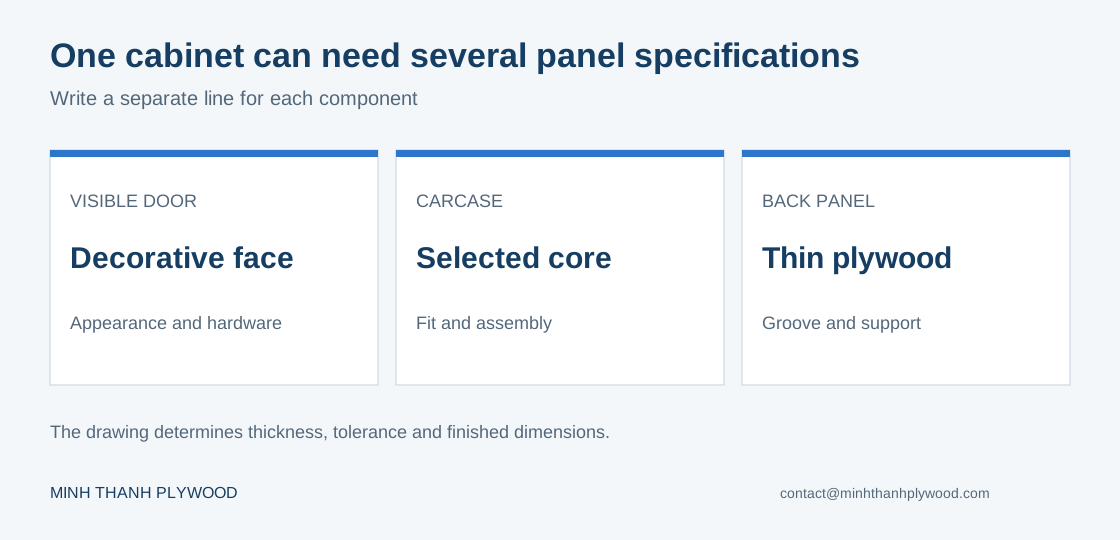
- List the parts: sides, doors, shelves, backs and drawer bottoms.
- Mark visible faces, exposed edges and grain direction on the drawing.
- Choose thickness and core for the load, span and hardware.
- Specify bond performance and destination emission requirements separately.
- Trial the finish and assembly on identified samples.
- Order each approved construction as a separate line item.
A broad request for “premium plywood” leaves the core, machining tolerances and reverse face undefined. Those omissions can produce a cheaper quotation for a different panel.
Which face veneer suits your furniture finish?
Choose the face for the surface that remains visible after finishing, then choose the core independently.
| Finished furniture | Starting face choice | Appearance reference to approve |
|---|---|---|
| Clear-coated cabinet doors | Birch | Natural colour, patches, knots and grain direction across adjacent doors |
| Repeated decorative pattern | EV, engineered veneer | Pattern, repeat and orientation in the cutting layout |
| Painted interior components | Poplar | Sanded face, primer adhesion, repaired areas and grain visibility after topcoat |
| Figured desk or shelving surface | Eucalyptus | Actual veneer colour and figure under clear finish |
| Softwood-grain interiors | Pine | Knot character and permitted face repairs |
For an opaque finish, premium figure adds little value; a smooth substrate and stable finishing process matter. For clear finishes, compare larger face samples rather than only a small edge offcut. Our birch-faced panels and EV panels offer different appearance routes over the selected furniture core.
What does cabinet grade plywood mean inside the panel?
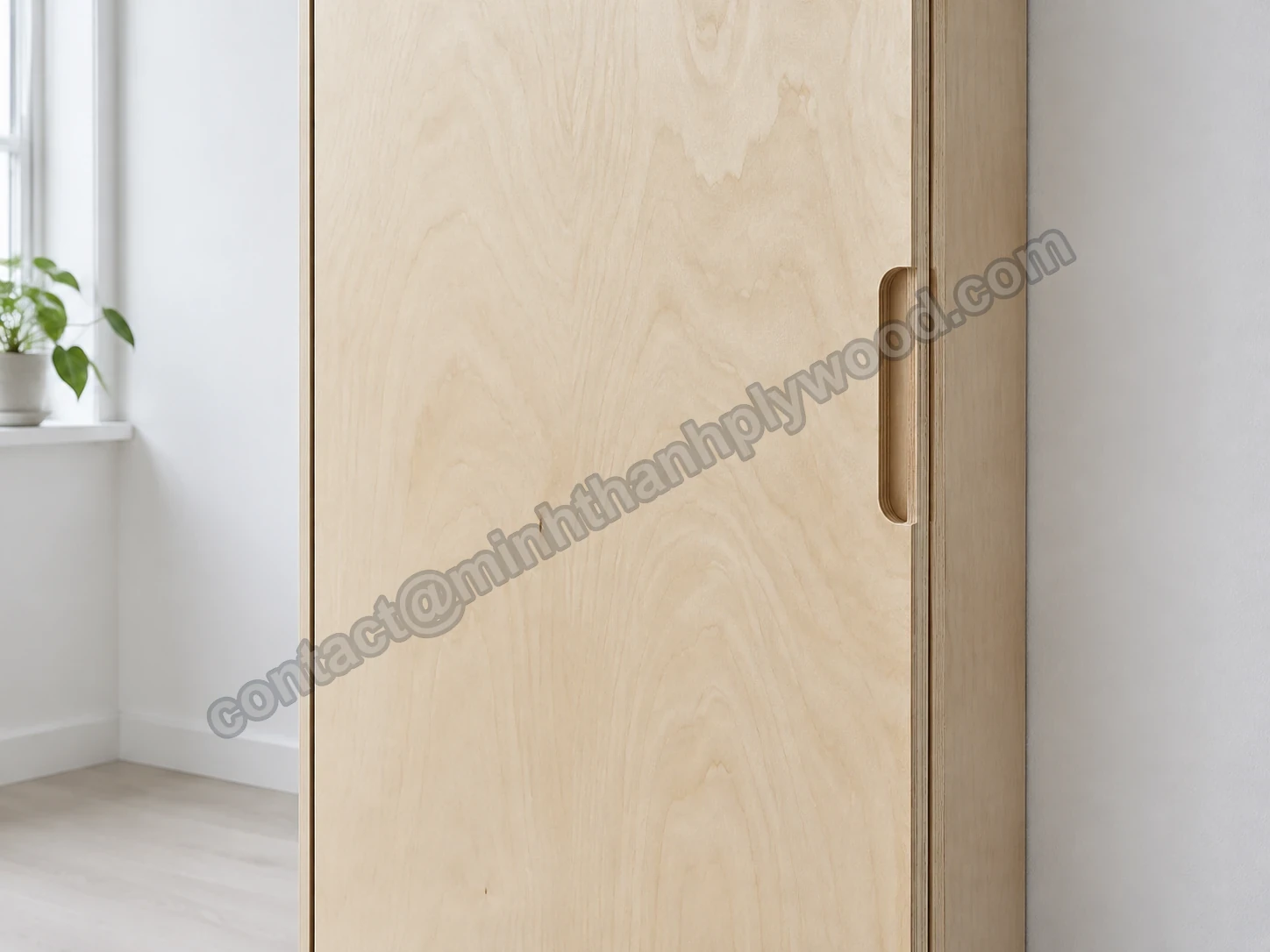
Furniture grade means paying attention to the core assembly, pressing, thickness and surface as one manufactured panel. Minh Thanh furniture cores are stitched horizontally and vertically, then prepared for double pressing. The core board is pressed and calibrated before the face and back veneers are applied in the second press.
This sequence matters because the thin visible veneer follows the surface beneath it. A well-prepared core provides a better base for sanding, coating and machining. Evaluating only the decorative face misses the work that supports it. Ask for a sawn sample edge alongside the full surface view so the workshop can inspect both.
Should you choose Styrax or Eucalyptus core?
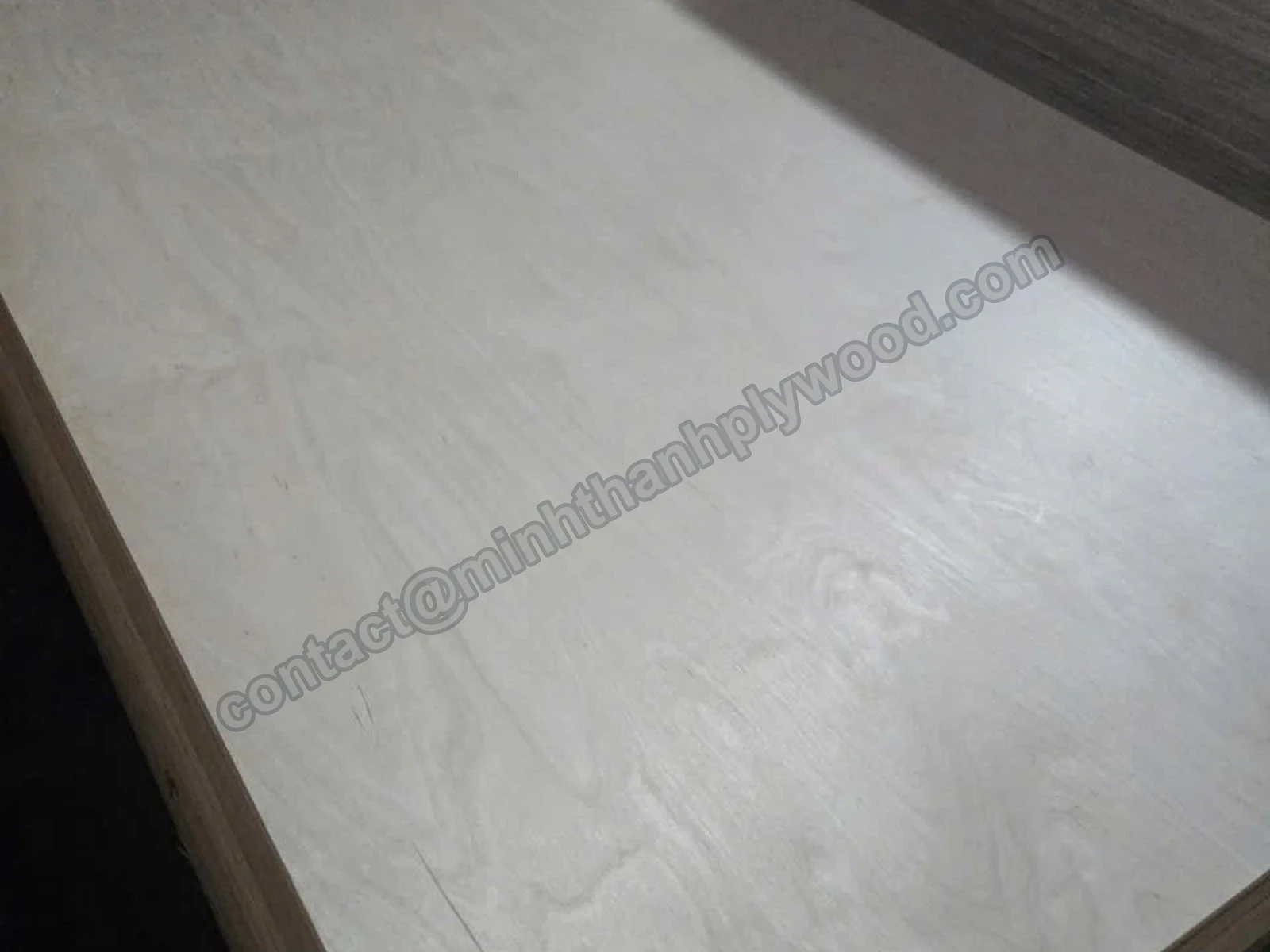
Choose Styrax when low panel mass is a priority and Eucalyptus when your approved furniture construction calls for the denser core option. Both belong in Minh Thanh’s furniture range. The face veneer can be chosen independently, so the same decorative appearance can be ordered with the selected core.
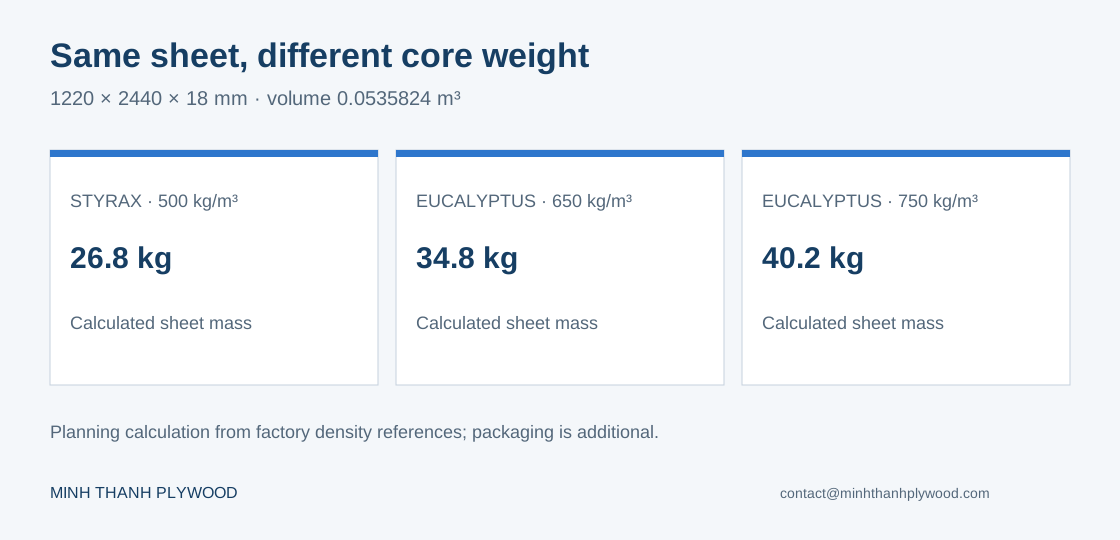
The factory reference values use approximately 500 kg/m³ for Styrax and 650–750 kg/m³ for Eucalyptus panels. These values are useful for comparing handling and freight before the actual sheets are weighed. They describe planning densities, rather than a bending-strength grade or a guarantee of screw performance.
How do you select plywood for cabinets and shelves?
Choose thickness by component rather than buying every cabinet part at one thickness. The table is a starting component schedule for design and sampling; it is not a load rating or a ready-made bill of materials.
| Component | Sizes to evaluate in a sample schedule | What determines the final choice |
|---|---|---|
| Cabinet back or drawer bottom | 3–6 mm thin plywood | Groove fit, fixing spacing and supported area; Minh Thanh uses five plies |
| Drawer sides or light internal dividers | 9–12 mm | Joint geometry, fastener engagement and component load |
| Cabinet sides, doors and ordinary shelves | 15–18 mm | Hardware drawing, unsupported span and assembled rigidity |
| Thick desktop or heavily loaded shelf | 21–25 mm | Load/deflection criteria and support design |
These dimensions sit within Minh Thanh’s 3–40 mm supply range. Eighteen-millimetre furniture construction commonly uses 11–13 plies; put the selected layup on the sample record when the edge remains exposed. Increasing thickness also increases material volume and weight, so adding a support can be a more efficient design decision than changing every panel.
For shelving, report span between supports, depth, grain direction, load distribution and duration. A laboratory bending result and a finished shelf trial answer different questions. Never assign a universal kilogram load from the species name or an 18 mm nominal thickness.
Why does thickness tolerance matter during assembly?
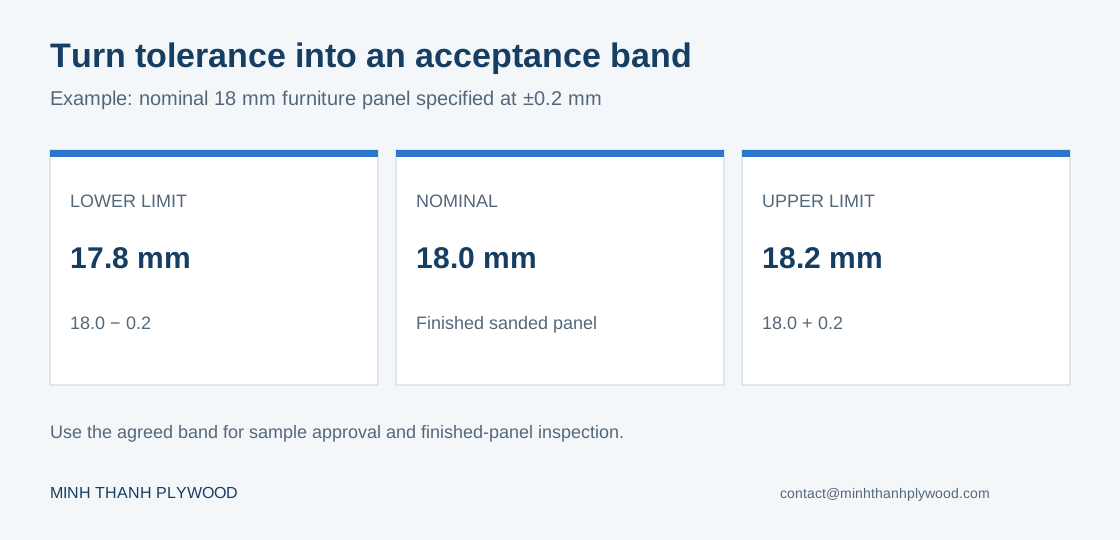
Thickness tolerance determines how consistently panels fit grooves, hardware and edge treatments set up for one nominal size. Minh Thanh’s furniture line uses a normal reference tolerance of ±0.2–0.3 mm, with tight specifications down to ±0.2 mm. Put the selected requirement on the order beside the nominal thickness.
For example, an 18 mm panel specified at ±0.2 mm has a stated band from 17.8 to 18.2 mm. That simple range helps the workshop connect the panel specification to tooling settings. Use the same band during sample approval and pre-shipment checking, with measurements taken on the finished sanded panel.
How should you specify the face and back grades?
Specify a face/back pair and approve the appearance on a physical sample. The front surface and the reverse surface often have different visibility in the finished furniture. A cabinet side with both surfaces exposed needs a different sorting instruction from a panel whose reverse side is hidden behind an assembly.
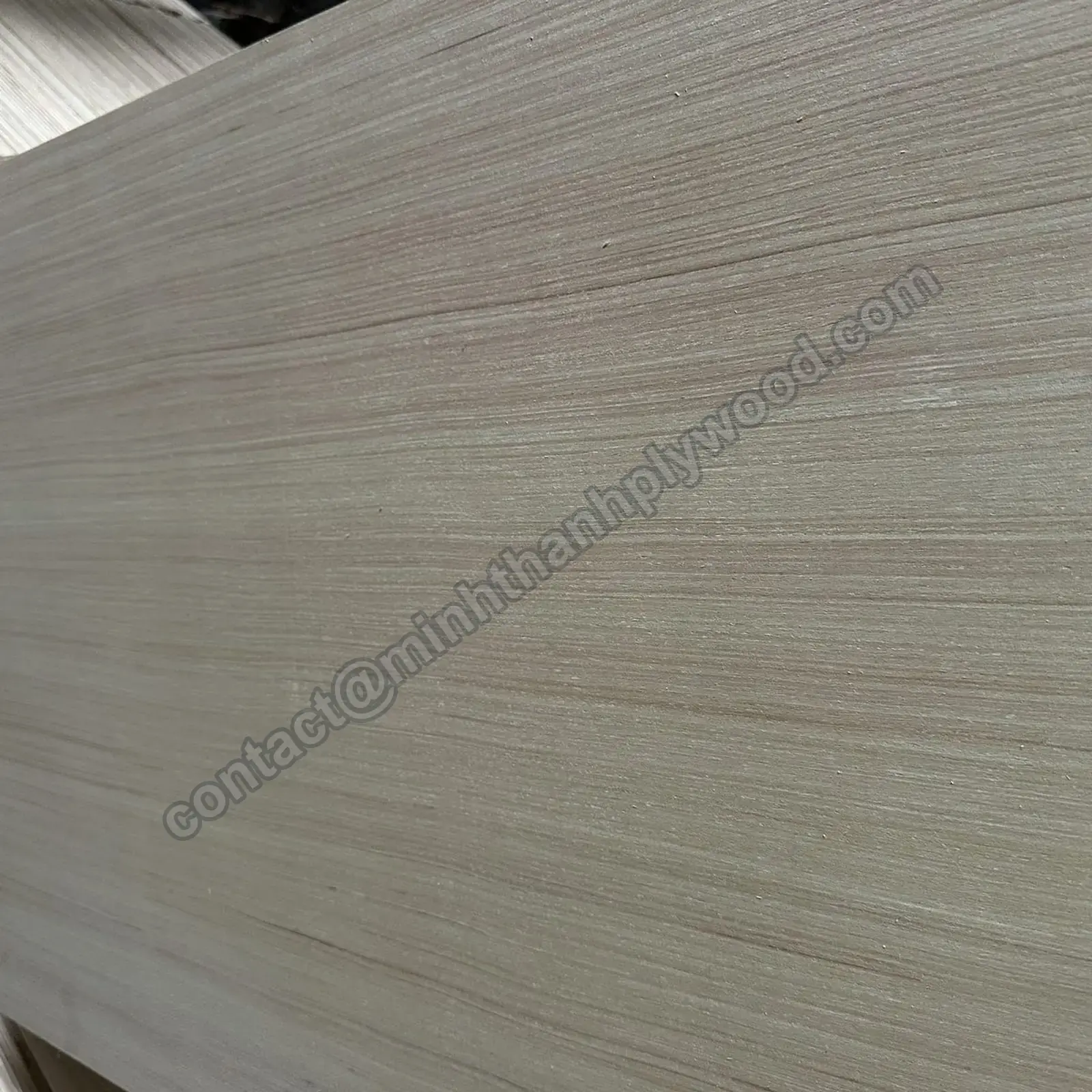
For poplar-faced panels, the factory uses A/A, A/B and B/B pairs. Buyers also encounter B/BB, BB/CC and CP codes in the trade, so connect the requested code to the approved sample. The sample provides the shared visual reference for the appearance that the furniture line will accept.
Should you choose plywood, MDF or particleboard for painted cabinets?
Compare the completed part: MDF provides a fine, uniform fibre surface for routed and painted designs; veneer-core plywood exposes layered edges and allows the core and face to be chosen separately. Particleboard provides a particle-based substrate frequently used under decorative surfaces. Each needs its own hardware, edge and service specification.
| Procurement decision | Veneer-core plywood | MDF | Particleboard |
|---|---|---|---|
| Visible edge | Layered veneer; finish directly or cover with edging | Fibre edge; seal and finish | Particle edge; specify edging |
| Painted routed profile | Check veneer breakout and exposed core | Check edge sealing and coating process | Check routed-edge quality and edge treatment |
| Fixing | Trial face and edge joints with actual hardware | Trial screw/dowel arrangement on the selected grade | Trial connectors on the selected board grade |
| Humid service | Specify bond, coating and exposed edges | Choose the required moisture-rated grade and detailing | Choose the required moisture-rated grade and detailing |
The USDA Wood Handbook, wood-based composites chapter explains these different constructions (2010; consulted 7 October 2026). A general material label is insufficient to promise strength, moisture service or furniture life. Keep the density and machining data for the actual grade being bought.
For poplar-faced plywood, run the complete primer, intermediate sanding and topcoat sequence on the face, back and edge detail. Record whether grain or repairs remain visible after curing. This is the useful comparison with a painted MDF component.
What is UV-ready plywood and who applies the coating?
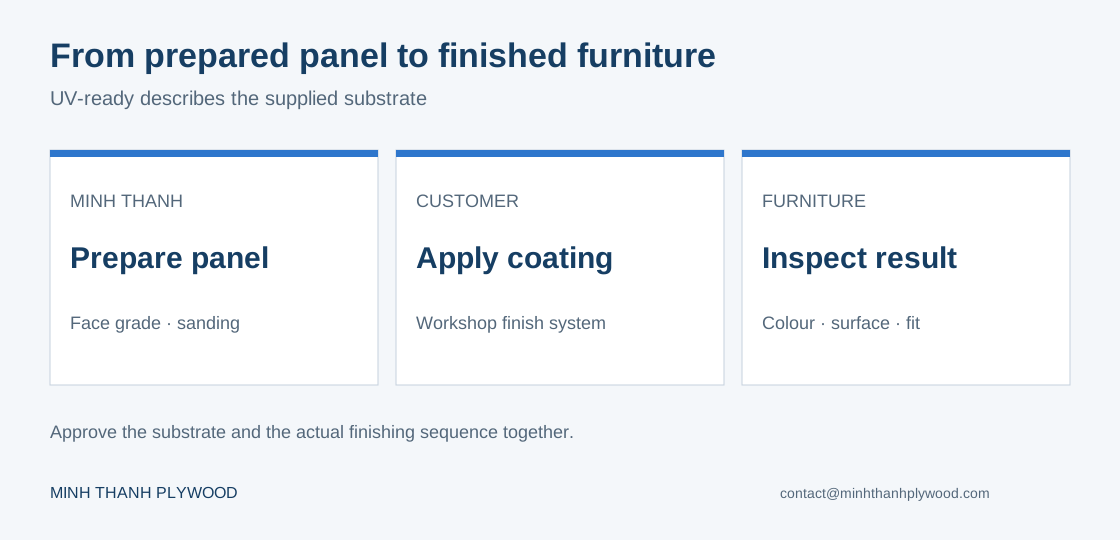
UV-ready plywood is a prepared panel whose faces meet the requirements for the customer’s ultraviolet-curing coating process. Minh Thanh supplies the sanded, polished substrate; the furniture manufacturer applies its own coating. Put the required face quality and thickness tolerance on the order before running the sample through the line.
The coating trial should include the preparation used in production. Check the panel surface as received, apply the intended sequence and inspect the cured result under the workshop’s normal lighting. Keep the sample identification so the coating team’s observations relate to a specific face, core and surface specification.
How do plywood grades for cabinets translate into face/back pairs?
Plywood grades for cabinets describe the appearance of each surface; core quality, bond and dimensional tolerance still need separate instructions. Cabinet grade plywood is a purchasing term, not one universal international certificate. Specify the grade system used by the supplier and the defects allowed on the finished part.
| Minh Thanh birch face | Approximate European buying comparison | Appearance selection | Component use |
|---|---|---|---|
| D+ | B | Highest selected face in our ladder; approve colour and small permitted natural features | Clear-finished principal face or selected visible components |
| D | BB | More visible repairs/patches and natural variation than D+ | Secondary visible surfaces or finished parts where repairs are accepted |
| E | CP/C | Utility appearance with more permitted defects agreed by sample | Covered, painted or concealed parts that accept the selected appearance |
The comparison is approximate, not a certificate that these trading codes are interchangeable. D+/D corresponds approximately to B/BB; D/D corresponds approximately to BB/BB. The first code identifies the main face and the second the back. Do not replace D+/D with A/A without checking which species and grading contract those letters describe.
For poplar and Eucalyptus faces, Minh Thanh quotes A/A, A/B and B/B pairs. Buyers also use poplar codes B/BB, BB/CC and CP. Tie the requested pair to agreed sample photos and the actual coating. A patched face that is acceptable under an opaque laminate can remain conspicuous under clear lacquer. Colour matching is also a separate visual requirement: two sheets in one face grade can have different natural colour.
Make the grade approval useful for the cutting plan. Mark which part of the full face becomes a visible door, which edge is exposed and whether a repair can be placed in an offcut. If the layout cannot avoid permitted repairs, specify the appearance required across the usable area rather than approving only a clean corner sample. This connects face sorting to furniture yield without inventing a universal rejection percentage.
How should you buy plywood for kitchen and bathroom furniture?
Divide the furniture by exposure: a dry upper cabinet, a sink base and a bathroom vanity do not have identical service conditions. Choose the bond and completed edge/coating design for each component. A decorative birch face or a dense Eucalyptus core does not, on its own, create a waterproof cabinet.
For a sink base, identify cut-outs for plumbing, joints close to the floor and edges exposed after installation. These details can admit moisture even when both broad faces are finished. Put edge treatment and installation detailing on the component drawing, and use the buyer’s chosen bond test for the supplied plywood. A face appearance grade answers a different question from a bond class.
The purchase order should distinguish intermittent humidity from repeated wetting. “Kitchen plywood” is too broad to tell the factory whether the customer is making sealed doors, a wet-service base or a dry decorative side panel. If the buyer specifies a national standard, record the exact standard and required certificate or test scope. Do not treat MR, BWR, BWP and marine as one ascending ladder of every mechanical and appearance property.
When painting, qualify the coating on machined details as well as a flat face. When laminating, include the reverse treatment and edge finish in the finished sample. The completed cabinet is an assembly of panel, adhesives, fasteners and finishes; purchase approval should cover the interfaces where that assembly meets its service environment.
Minh Thanh makes UF furniture construction at E0 emission and specified melamine-fortified or phenolic bond constructions. The service brief determines the bond specification. The water-resistance guide explains how a water-resistant adhesive bond differs from protecting the wood surfaces and cut edges.
What can a sawn sample reveal about the core?
A sawn sample reveals the veneer sequence, joining quality and gaps encountered at the cut; it cannot prove the condition of the entire sheet by itself. Pair edge inspection with a full-face sample and the actual furniture operation. This is especially useful for hinge holes, narrow routed rails and exposed-edge designs.
Look for a discontinuity between layers, an unfilled core gap or an overlap that changes the local thickness. Then relate the defect to the drawing. A gap at a critical fixing position is a different acceptance problem from a defect cut away in an offcut. Define workmanship limits that the supplier can inspect instead of relying on an undefined promise of “perfect core.”
The construction description shows why face and core should be labelled independently. A pale birch veneer outside can cover Styrax inside. For exposed edges, approve layer appearance and the sanded finish; for covered edges, check whether the machined edge gives a continuous base for the selected band and adhesive.
Furniture-grade preparation at Minh Thanh includes two-way core stitching and double pressing. Stitching normally covers the outer core layers, with all-layer stitching specified when needed. The core board is pressed and calibrated before the face/back press. State the required scope when the furniture line depends on it; the word stitched alone does not mean every layer is stitched.
Inspection should continue after the first machining pass. A routed feature can encounter a different part of the sheet from a straight edge cut. Keep the panel code with the inspected pieces so the observations can be traced to the sample construction that purchasing approves. The result is a repeatable acceptance instruction rather than a photograph with no material identity.
Which adhesive and emission requirements belong on the order?
Specify adhesive/bond performance and formaldehyde emissions on different lines. Minh Thanh’s standard furniture construction uses UF glue at E0 emission; melamine-fortified and phenolic constructions address the specified bond requirement. E0 is an emission designation, not a resin name, a water-resistance class or one globally defined numerical limit.
Dry bedroom furniture, a humid kitchen carcass and a sink base exposed to leaks are different service briefs. State the exposure, bond test method and acceptance criterion. MR, BWR and BWP are market terms; writing “marine” or a boiling duration alone does not establish certification to a named marine or European bond standard.
For US supply, EPA TSCA Title VI covers hardwood plywood, MDF and particleboard. Specify the compliant product, its third-party certification and labelling records rather than replacing the requirement with “E0.” Our certification and emission records are on Quality.
For EU furniture and wood-based articles, Regulation (EU) 2023/1464, REACH entry 77 sets a 0.062 mg/m³ release limit from 6 August 2026, using Appendix 14 conditions; articles exclusively for outdoor use are among the exemptions. Match the testing plan to the finished article and its market. CARB/TSCA results in ppm must not be converted into a claim of passing the EU chamber requirement. SGS testing to the buyer’s method can be arranged.
Sources reviewed 7 October 2026. The bond protects the specified adhesive joint; furniture coating and edge detailing still belong in the design.
How should you evaluate edges, machining and hardware?
Use the drawing’s most demanding feature as the sample trial: a hinge cup, narrow groove, visible routed edge or edge-banded end. Compare candidate constructions with the same tool, feed setting and fastener setup.
| Trial | Record | Rejection evidence to photograph |
|---|---|---|
| Sawing and routing | Tool condition, orientation, dimensions and panel code | Face tear-out, core gaps exposed at the cut, broken narrow features |
| Hardware | Fastener model, pilot hole, location and assembly procedure | Stripping, cracking or failed engagement in the actual joint |
| Edge banding | Prepared edge, band and workshop adhesive | Open edge, visible telegraphing or poor finished adhesion |
| Final finish | Primer/coating sequence and cure conditions | Visible repairs, sanding-through or uneven finished appearance |
How do sheet size and cut-to-size orders affect yield?
Choose sheet dimensions by nesting the actual component sizes, including grain direction and cutting allowance. Minh Thanh’s standard formats are 1220 × 2440 mm and 1250 × 2500 mm, with agreed custom sizes such as 1220 × 2500 mm and 1220 × 2280 mm. Compare usable parts before choosing a format solely by sheet area.
The area of a 1220 × 2440 mm sheet is 2.9768 m². A 1250 × 2500 mm sheet has 3.125 m², approximately 5% more nominal area. That extra area improves yield only when the part layout can use it. A layout that leaves a long narrow offcut can still waste material despite starting with a larger sheet.
A full sheet can be cut into four, six or eight pieces, but a saw kerf consumes material. Include the final trimming allowance and tool kerf in the drawing. Dividing a nominal 1220 mm width by four does not supply four finished 305 mm parts after three saw cuts.
For a nesting calculation, use the finished part rectangle plus cutting allowances and grain restrictions. A door panel that must follow the long grain cannot simply be rotated to fill an offcut. Treat visible face orientation as a constraint alongside dimensions. Different sheet formats can yield the same accepted part count despite a difference in gross area.
| Cutting-plan input | Why purchasing needs it |
|---|---|
| Finished part length/width | Defines the furniture output rather than only the sheet size |
| Grain arrow and face orientation | Prevents a rotated part from failing the visual layout |
| Saw kerf and trim allowance | Separates nominal sheet area from usable dimensions |
| Visible surfaces and edges | Defines where permitted face repairs and core defects matter |
| Quantity by part | Connects sheet nesting to the actual component bill of materials |
Minh Thanh’s cut-to-size range supplies smaller pieces from the agreed full-sheet construction. Bundle those pieces by part code and record whether the workshop performs further trimming. For full-format planning, the sheet-size guide explains nominal formats and their cutting implications.
What should the sample approval record contain?
Keep one identified panel sample, one construction sheet and the workshop acceptance record. The record connects the approved appearance to the order the factory will reproduce.
Record face/back grades, core species, stitching scope, ply construction, nominal thickness and tolerance, dimensions, bond, emission method, sanding and finished appearance. Attach the component drawing, hardware model and coating reference. Record acceptance or rejection of each trial rather than only “sample looks good.”
For repeat orders, change the construction revision when face, core, adhesive or thickness changes. A higher sheet count can use the same approved construction. Keep an agreed retained sample with both the supplier and receiving workshop.
How much does furniture plywood cost, and how do you compare offers?
For October 2026, Minh Thanh furniture/interior plywood is from US$350/m³ and commercial plywood is from US$250/m³. These are entry prices for the two ranges, not a birch, poplar or Eucalyptus price list. A quote identifies the actual construction and delivery term.
A panel-price comparison uses the actual quotation: sheet cost equals quoted US$/m³ multiplied by sheet volume in m³. Match core, face/back grades, thickness and delivery scope before using the result. Do not apply a range entry price to every decorative face or compare a commercial entry price with a finished furniture specification.
Compare core grade, stitching scope, face/back grades, thickness tolerance, adhesive, emission method, finish and packing before comparing totals. A lower commercial quote can omit the surface preparation or dimensional control needed by the furniture line.
Calculate cost per usable part = (panel purchase cost + relevant processing and finishing cost) ÷ accepted parts. Use the real cutting layout and workshop rejection count. FOB Hai Phong, CFR and CIF quotes include different freight/insurance scopes; match the term and destination in the comparison.
What documents and checks belong with a furniture plywood container?
Order the approved construction by sheet count and bundle reference, then link the product file to each shipment. Standard terms are one 40HC, production in 15–45 days after the 30% deposit, and 70% against the scanned B/L or irrevocable L/C at sight.
| Record | What the importer reconciles |
|---|---|
| Commercial invoice | Product construction, quantities, agreed value and delivery term |
| Packing list | Bundle codes, sheet counts, dimensions and cargo/packing weights |
| Bill of lading | Container, seal, parties and booked routing |
| Origin evidence/C/O | Product origin and evidence needed for the destination’s tariff treatment |
| Product compliance file | Correct mill/product certification, labelling and applicable test methods |
| QC record | Actual thickness, 8–12% dispatch moisture, face/back acceptance, packing and loading images |
| EU wood origin dossier | Species and origin for core, face and back, production-plot geolocation and production period |
Minh Thanh supplies origin records and geolocation files for the EU buyer’s due diligence. Under EUDR Article 9, traceability reaches all wood constituents; an invoice species name is insufficient. Vietnam’s low-risk listing supports the applicable simplified due-diligence route when every wood constituent comes from a low-risk country. The importer remains responsible for its market-entry duties; a supplier dossier is not an official EUDR certificate.
Reconcile packs and damage at receipt, store panels flat and condition them for the workshop before cutting. The packing calculator uses the frozen reference plan: 18 mm, 1220 × 2440 mm gives 990 Styrax sheets or 795 Eucalyptus sheets at 650 kg/m³, on a 28,000 kg board-only basis. Weighed packaging and the booking limit determine the final cargo plan.
Before loading, compare the order’s construction revision with the sample and QC records. Record actual thickness readings, face/back sorting and moisture observations rather than only a photograph of a closed pack. A calibrated furniture order should be checked against its stated furniture band; a commercial ±0.5 mm specification cannot silently replace it.
At receipt, count bundles and reconcile each label with the packing list. Photograph damaged corners and disrupted wrapping before opening the affected pack. Keep shipping observations separate from machining observations made after storage or processing, with the material code attached to both. This helps supplier and workshop discuss the same construction and the point where a problem appeared.
For the next order, retain the active face sample, construction sheet and component acceptance record. If the furniture designer changes hardware, thickness or the intended coating, qualify that revised combination rather than reusing an approval for a different part. Quantity and freight can change without changing the accepted construction; a core or adhesive change should be recorded as a material revision.
For cut parts, keep grain arrows and part codes on the schedule supplied to both the factory and receiving workshop. These fields prevent a correctly manufactured panel from becoming the wrong furniture component when it is rotated or assigned to another material line.
Send application, face/back grades, core, stitching, dimensions, thickness tolerance, bond, emission requirement, finish, quantities, packing and destination through Contact. Free samples help the workshop qualify the specified construction; the plywood thickness guide supports the component schedule, and particleboard versus plywood covers another furniture substrate.
Buyer questions, answered
What is the best plywood for furniture manufacturing?
Choose furniture-grade plywood with a core and face matched to the component. Minh Thanh uses Styrax or Eucalyptus furniture cores, stitched construction and double pressing; birch, poplar, EV and other faces provide the required appearance. Approve the thickness, hardware and finishing result on a production sample.
Is birch plywood always the best plywood for cabinets?
Birch-faced plywood is a strong choice when the grain remains visible. Poplar-faced plywood suits pale interior components and painted work, while EV provides a consistent decorative pattern. State the core separately because a birch face does not specify the layers inside the panel.
What thickness should I order for a cabinet?
Use the component drawing, support arrangement and hardware to select thickness. A cabinet can combine thin backs with thicker sides, doors and shelves, so list each component separately. Minh Thanh supplies 3–40 mm panels and thin 3–6 mm plywood with five plies.
What is the difference between furniture grade and commercial plywood?
Furniture-grade production puts more work into the core assembly, face preparation and calibrated thickness. Minh Thanh furniture panels have stitched cores and are pressed twice, with the core calibrated before the face and back are applied. Commercial panels serve uses with different surface and tolerance priorities.
Is E0 a type of plywood glue?
E0 describes an emission requirement; the adhesive is a separate specification. Our standard furniture panel uses UF glue at E0 emission. Put adhesive or bond performance and the emission requirement on different lines in the purchase order.
Can I order plywood ready for my own UV coating line?
Yes, both faces can be prepared UV-ready for the customer's finishing process. Specify the face grade, sanding and thickness tolerance, then run the sample through your coating line. Minh Thanh supplies the prepared panel; the customer applies the UV finish.
Which core should I choose for lighter furniture panels?
Styrax is the lighter standard furniture-core option, using an approximate planning density of 500 kg/m³. Eucalyptus has a reference range of 650–750 kg/m³. Calculate sheet weight from the finished dimensions and use actual panel weights for the shipment plan.
Should both faces have the same appearance grade?
Use equal grades when both faces remain visible and matching appearance matters. An A/B face/back pair works when one side is the main visible surface, with the approved sample defining the back. Name the face and back grades separately so the factory sorts each side for its job.
Can you cut furniture panels into smaller pieces?
Yes, cut-to-size orders include a full panel divided into four, six or eight pieces. Provide finished dimensions, grain direction, quantities and the cutting drawing. The layout must allow for the saw kerf and any final trimming needed in your workshop.
How do I compare two furniture plywood quotations?
Compare the same face and back, core species and assembly, thickness tolerance, adhesive, emission requirement, finish and packing. Use the same delivery term and quantities. Then compare the usable parts and finishing work from a sample of each construction.
Do you provide furniture plywood samples?
Free samples. Use the sample to check machining, hardware installation, edge treatment and the intended finish. Keep the approved reference with the component drawing for repeat orders.
What should I send for a furniture plywood quotation?
Send the application, face/back grades, core, finished sheet dimensions, thickness and sheets per specification. Add the adhesive, emission requirement, sanding or UV-ready finish, packing and destination. Standard orders start at one 40HC container, with production in 15–45 days after deposit.
How much does furniture plywood cost?
Minh Thanh furniture/interior plywood is from US$350/m³ as of October 2026; commercial plywood is from US$250/m³. The actual quotation identifies the face/back, core, thickness, preparation, quantity and delivery term. Compare those fields before comparing prices.
Is E0 enough for EU furniture requirements?
E0 is an emission designation rather than one globally defined test limit. EU REACH entry 77 uses a 0.062 mg/m³ limit for furniture and wood-based articles from 6 August 2026 under Appendix 14 conditions, with exemptions including exclusively outdoor articles. Specify the applicable test plan; a CARB/TSCA ppm result cannot be substituted for that EU test result.