
CNC plywood furniture is cut from flat sheets by a router and assembled with joints machined into the parts, often without screws. The joints only fit when the slot width matches the real thickness of the sheet, so the panel matters as much as the drawing. This guide covers joint types, clearances, nesting and sheet choice. Minh Thanh Plywood makes calibrated, double-pressed furniture panels in Vietnam.
What is CNC plywood furniture?
CNC plywood furniture is furniture whose parts are cut from flat plywood sheets by a computer-controlled router and joined by shapes machined into the parts themselves. A design file holds every part, the router cuts them from the sheet in one run, and the parts slot, lock or glue together.
- Flat-pack by design: parts ship as flat stacks and are assembled at the destination.
- Joints in the part: slots, tabs, fingers and wedges replace most metal fittings.
- Repeatable: the same file cuts the same part on any matching sheet.
- Exposed edges: the layered plywood edge is part of the look.
Chairs, tables, shelving, desks, beds, display units and kitchen carcasses are all made this way, from one-off studio pieces to OEM runs for furniture brands.
Which plywood thickness tolerance suits slot-together furniture?
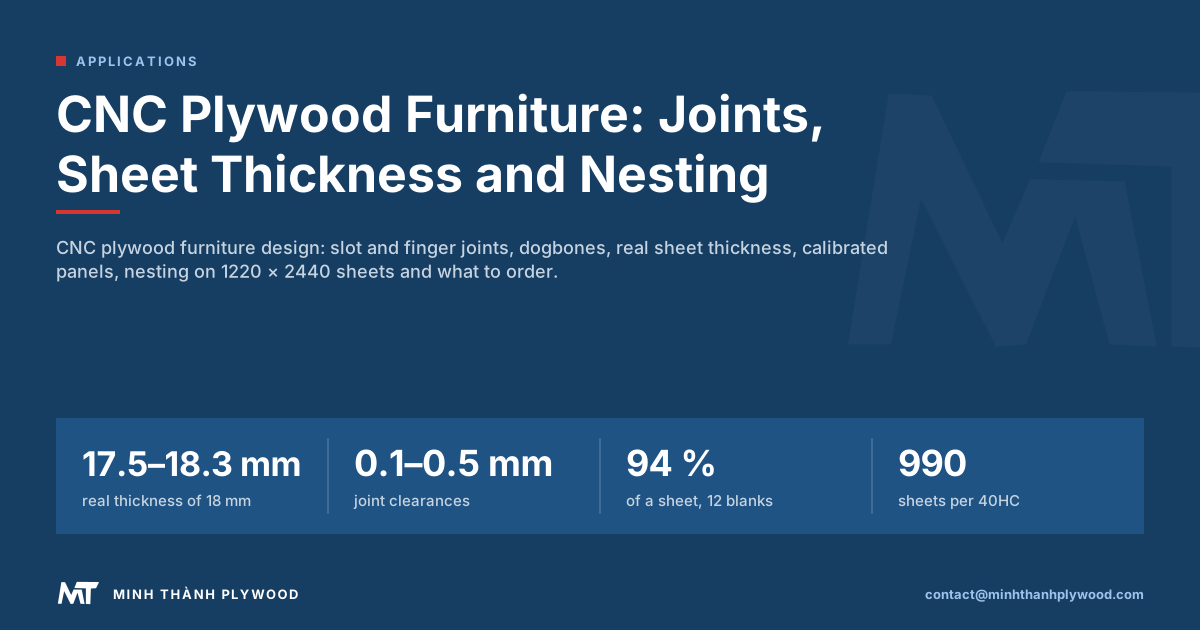
A slot joint fits only when the slot width matches the real thickness of the sheet, not its nominal size. A sheet sold as 18 mm can measure anywhere from about 17.5 to 18.3 mm, and a slot drawn at exactly 18 mm is then loose on one sheet and too tight to assemble on the next.
The tolerance of the panel sets how much this varies within one order:
| Panel class | Thickness tolerance | What it means for slot joints |
|---|---|---|
| Sanded furniture panel | ±0.2–0.3 mm, down to ±0.2 mm (±0.008–0.012 in) | Narrower thickness range; verify slot fit on measured sheets |
| Commercial or film-faced | ±0.5 mm (±0.020 in) | Measure and sort sheets, adjust slots per batch |
| Packing grade | ±0.5–1.0 mm (±0.020–0.040 in) | Not suited to press-fit joints |
A nominal US sheet name can differ from the declared finished thickness. The fractions below are conversion examples; check the supplier’s finished dimension before selecting a metric replacement. Inch sizes convert at exactly 25.4 mm to the inch (NIST).
| Nominal sales name (example fraction) | Fraction converted to mm | Metric target to assess |
|---|---|---|
| 1/2 in (15/32 in) | about 11.9 mm | 12 mm |
| 5/8 in (19/32 in) | about 15.1 mm | 15 mm |
| 3/4 in (23/32 in) | about 18.3 mm | 18 mm |
Thickness also varies across one sheet. A sheet that is thicker in the middle than at the edges gives tight joints on some parts and loose ones on others. Our furniture-grade panels are pressed twice: the core board is pressed and calibrated to thickness first, then the face and back are pressed on. That calibration step reduces thickness variation before the joint trial.
How are CNC plywood joints designed?
CNC plywood joints are designed around three numbers: the measured sheet thickness, the clearance for the fit you want and the radius of the router bit. Slot width equals measured thickness plus clearance, and every inside corner gets a relief for the bit radius.
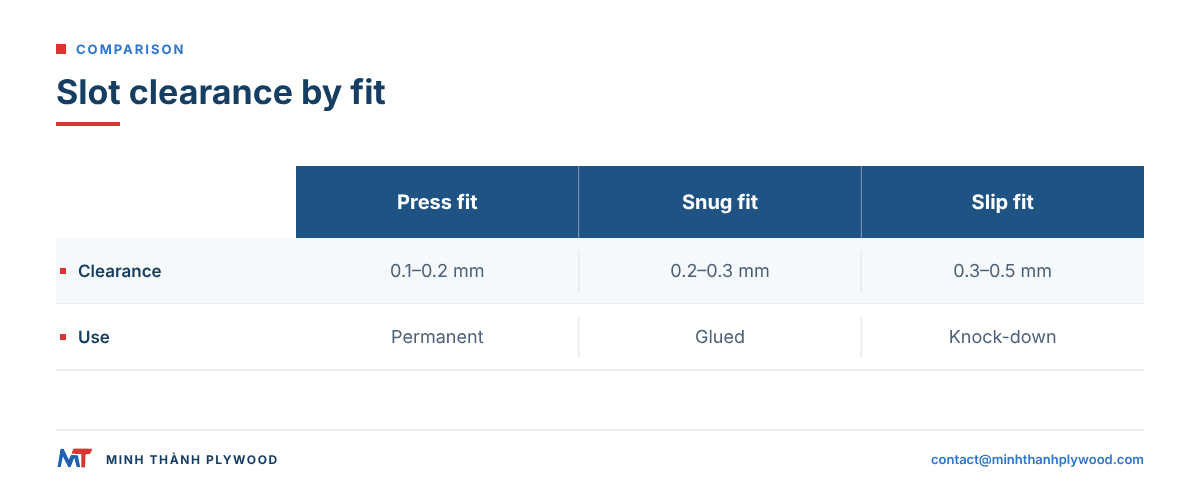
| Fit | Clearance over measured thickness | Use |
|---|---|---|
| Press fit | about 0.1–0.2 mm (0.004–0.008 in) | Permanent joints, knocked together once |
| Snug fit | about 0.2–0.3 mm (0.008–0.012 in) | Glued joints with room for glue |
| Slip fit | about 0.3–0.5 mm (0.012–0.020 in) | Knock-down furniture assembled often |
These clearances are common shop starting points, not a standard. Router deflection, bit wear and the face veneer all change the result, so the real number comes from a test cut.
Common CNC plywood joints and where each fits
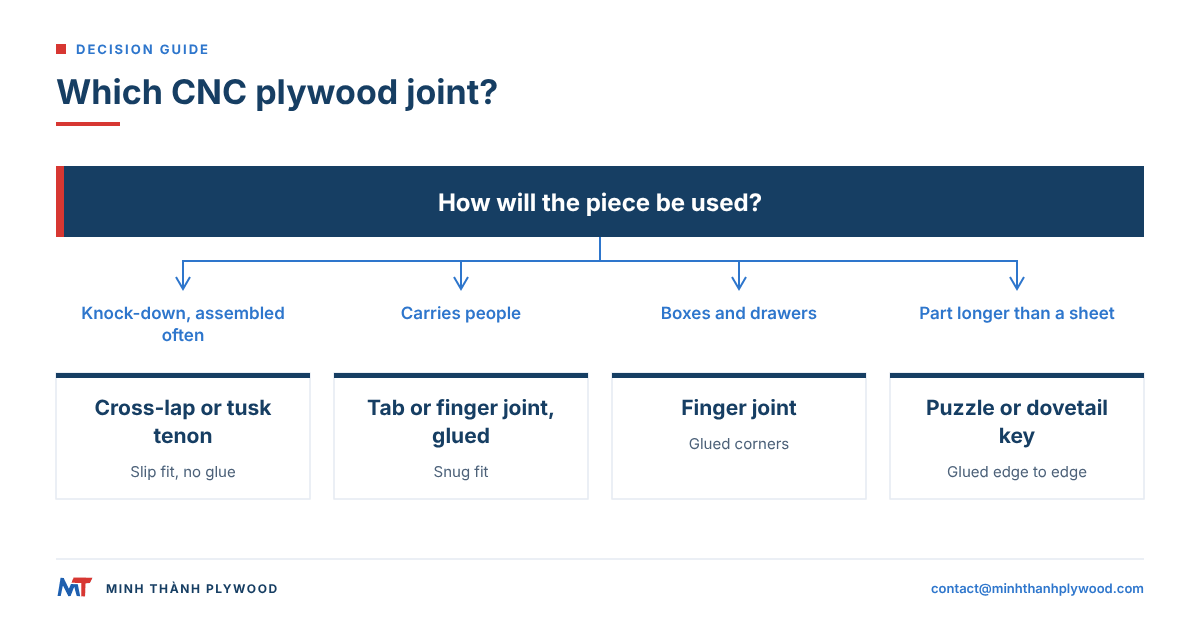
The common CNC plywood joints are the cross-lap slot, tab and slot, finger joint, wedged and tusk tenons, the half-lap and the puzzle or dovetail key. Each trades strength, look and ease of assembly differently.
| Joint | How it holds | Best for | Glue needed |
|---|---|---|---|
| Cross-lap slot | Two parts slotted halfway into each other | Shelving, partitions, bases | No |
| Tab and slot (through tenon) | A tab passes through a slot in the mating part | Carcasses, chair sides, drawers | Optional |
| Finger (box) joint | Interlocking fingers along a corner | Boxes, drawers, cabinet corners | Yes |
| Wedged tenon | A tab passes through and a wedge spreads or locks it | Stools, benches | No |
| Tusk tenon | A loose key through the tenon pulls the joint tight | Knock-down tables and beds | No |
| Half-lap | Each part cut to half depth where they cross | Frames, stretchers | Yes |
| Puzzle or dovetail key | Shaped key locks two parts edge to edge | Joining parts larger than one sheet | Yes |
Knock-down designs lean on cross-laps and tusk tenons. Pieces that carry people, such as chairs and benches, add glue to finger and tab joints or hide a connector inside the joint.
Dogbones and inside corners
A dogbone is a round relief cut into each inside corner of a slot so a square-cornered tab can seat fully. A round router bit cannot cut a sharp inside corner; it leaves a radius equal to its own, and the relief removes it.
- Dogbone: a circle at the corner, on the diagonal. Strong and quick to draw, visible from the side.
- T-bone: the relief runs along one side of the slot. Hidden when the joint is assembled in one direction.
- Smaller bit for corners: a second, finer bit cleans the corners. Neater, slower.
- Radius on the tab instead: round the tab corners to match. No relief, slightly less bearing area.
Most CAD tools add dogbones automatically from the bit diameter, so set the bit size before generating toolpaths. A 6 mm bit leaves a 3 mm radius in every inside corner.
Plywood CNC design: a parametric workflow
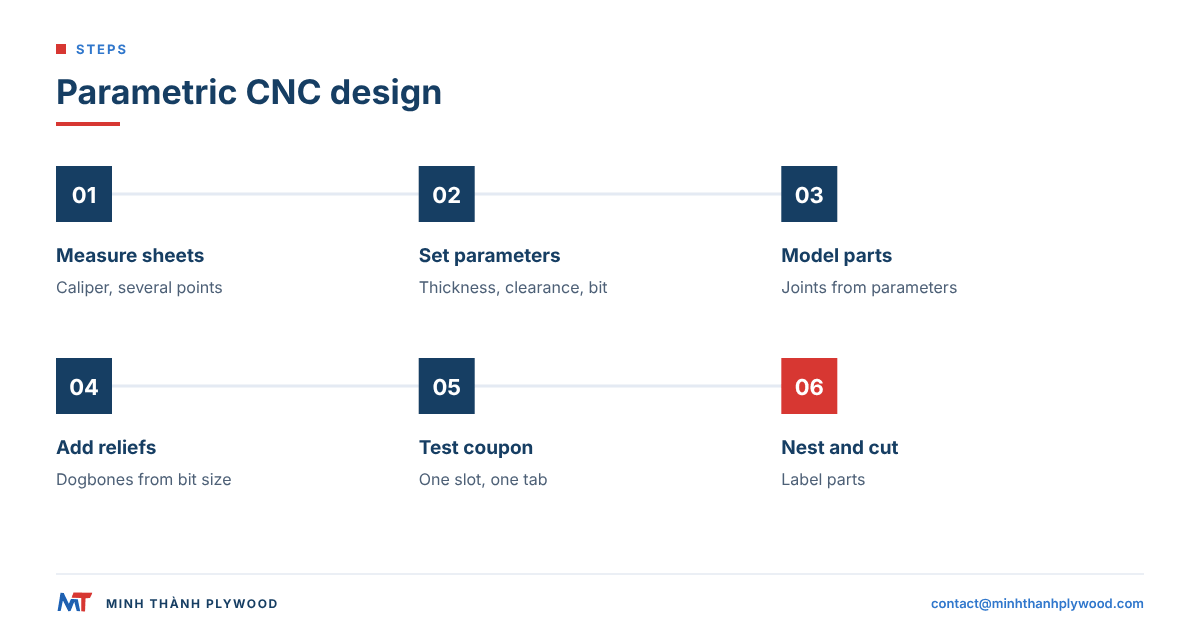
Plywood CNC design works best as a parametric model in which the sheet thickness and the joint clearance are named values that drive every slot. When a new batch of sheets arrives, you change one number and regenerate the parts.
- Measure the sheets: several points on several sheets of the batch, with a caliper.
- Set parameters: thickness, clearance and bit diameter in the model.
- Model the parts: joints drawn from the parameters, never typed as fixed numbers.
- Add reliefs: dogbones or T-bones from the bit diameter.
- Cut a test coupon: one slot and one tab from the same sheet.
- Adjust and nest: correct the clearance, then nest the parts on the sheet.
- Cut and label: cut the run and mark part numbers for assembly.
The Fusion 360 and similar CAD communities give the same advice: model in parameters, test the fit and never trust the nominal thickness on the sheet label.
Which plywood is best for CNC furniture?
The best plywood for CNC furniture is a sanded furniture panel with a void-free core, a tight thickness tolerance and a flat sheet. Face species then follows the look you want.
| Panel | Face look | Core | Where it fits |
|---|---|---|---|
| Birch plywood | Pale, fine, even | White Styrax or Eucalyptus | Exposed edges, chairs, shelving |
| Poplar plywood | Light, plain | White Styrax | Painted or laminated parts, light pieces |
| EV plywood | Engineered veneer in oak, walnut and other looks | White Styrax | Visible faces with a uniform figure |
| Okoume plywood | Pinkish-brown, smooth | White Styrax | Warm-toned visible faces |
| Pine plywood | Knotty, rustic | White Styrax or Eucalyptus | Rustic and children’s furniture |
Plywood for dry or humid interior use is specified in BS EN 636:2012+A1:2015, covering plywood for structural and general-purpose use in dry, humid or exterior conditions. Three build points matter more than the face:
- No core voids: a void in a slot wall leaves a weak or broken joint. Our core layers are stitched both horizontally and vertically, which closes gaps between core veneers.
- Thickness tolerance: sanded furniture panels hold ±0.2–0.3 mm, down to ±0.2 mm.
- Glue and emission: UF glue at E0 emission for interior furniture; panels meet the emission requirements European and US furniture buyers ask for, with CARB P2 / TSCA Title VI certification as proof. The TSCA Title VI limit for veneer-core hardwood plywood is 0.05 ppm under EPA’s TSCA Title VI guidance.
Flatness, moisture and the vacuum table
A flat, dry sheet cuts accurately on a CNC vacuum table; a bowed or damp one lifts, chatters and moves after cutting. Flatness and moisture content are as important as thickness for parts that must fit.
- Flatness: double pressing and a calibrated core keep the sheet flat on the table and in the stack.
- Moisture: our veneers and finished panels are dried to 8–12 % moisture content at dispatch, the normal range for furniture plywood.
- Acclimatise: store sheets flat in the workshop for some days before cutting.
- Small parts: use onion-skin passes or tabs so small parts do not move when cut free.
A sheet that moves after cutting changes the slot width. Cutting acclimatised sheets keeps the fit you tested.
Nesting yield on a 1220 × 2440 sheet
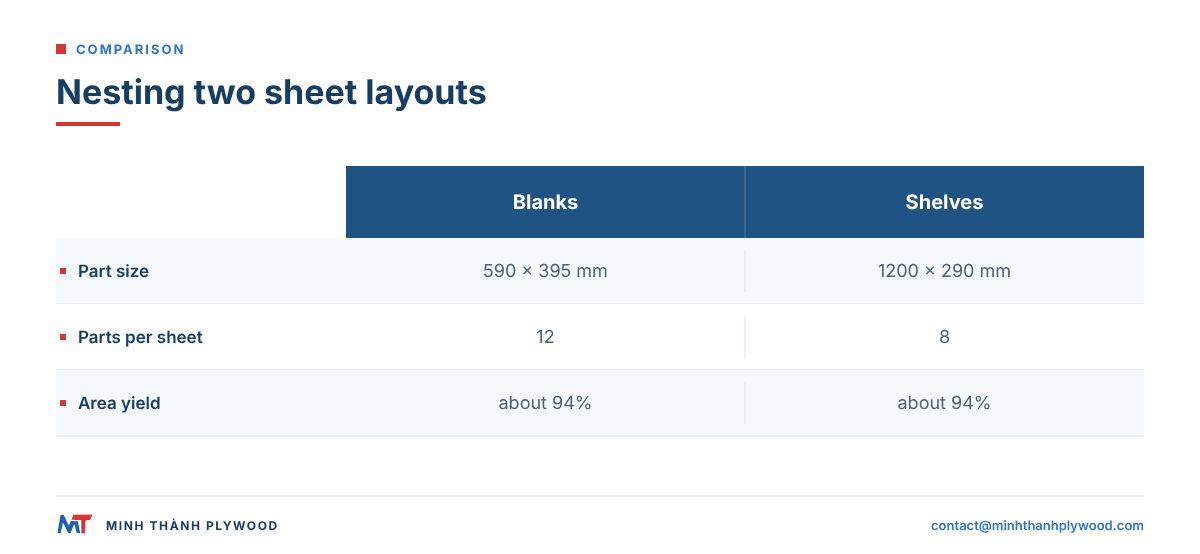
Nesting places all the parts on the sheet with the least waste, and yield is the share of the sheet area that ends up in parts. A standard 1220 × 2440 mm sheet has about 2.98 m² of area.
| Example layout | Parts per sheet | Part area | Yield before shaping |
|---|---|---|---|
| Blanks 590 × 395 mm, 4 × 3 grid | 12 | about 2.80 m² | about 94 % |
| Shelves 1200 × 290 mm, 2 × 4 grid | 8 | about 2.78 m² | about 94 % |
Both layouts leave room for the bit to pass between parts. Shaped outlines such as chair sides use less of each blank, so real yields are lower; filling the gaps with small parts (wedges, keys, drawer fronts) brings them back up.
Sheet size changes the numbers. We make 1220 × 2440 and 1250 × 2500 mm sheets, plus custom sizes such as 1220 × 2500 and 1220 × 2280 mm, so a design nested for a European sheet can be cut from the size it was drawn for.
Router bits, feeds and clean edges
A compression spiral bit gives the cleanest edges on veneered plywood because it cuts down at the top face and up at the bottom face. Tear-out at the face veneer is the most common edge defect on CNC plywood parts.
- Compression bit: through-cuts on sanded faces, both faces clean.
- Down-cut bit: pockets and shallow grooves, clean top face.
- Up-cut bit: deep slots, clears chips, can lift the top fibres.
- Ballnose or V-bit: engraving and chamfers.
Sharp tooling, a feed rate that makes chips rather than dust, and a good hold-down reduce tear-out and burn marks. Plywood with thin, well-bonded face veneer and no core voids also holds a crisp edge.
Finishing exposed CNC-cut edges
The exposed layered edge is often the signature of CNC plywood furniture, so it is sanded and finished rather than covered. A light round-over or chamfer removes splinters and softens the edge.
- Sand the edges with a fine grit after a light chamfer or round-over.
- Seal the end grain of the core layers so the finish absorbs evenly.
- Finish faces and edges together: oil, water-based lacquer or UV coating.
- Band the edges only where a covered edge is wanted, with veneer tape or solid lipping.
Our sanded and polished faces are UV-ready on both sides, to the standard customers need to apply their own UV coating.
CNC plywood furniture design for flat-pack and OEM sourcing
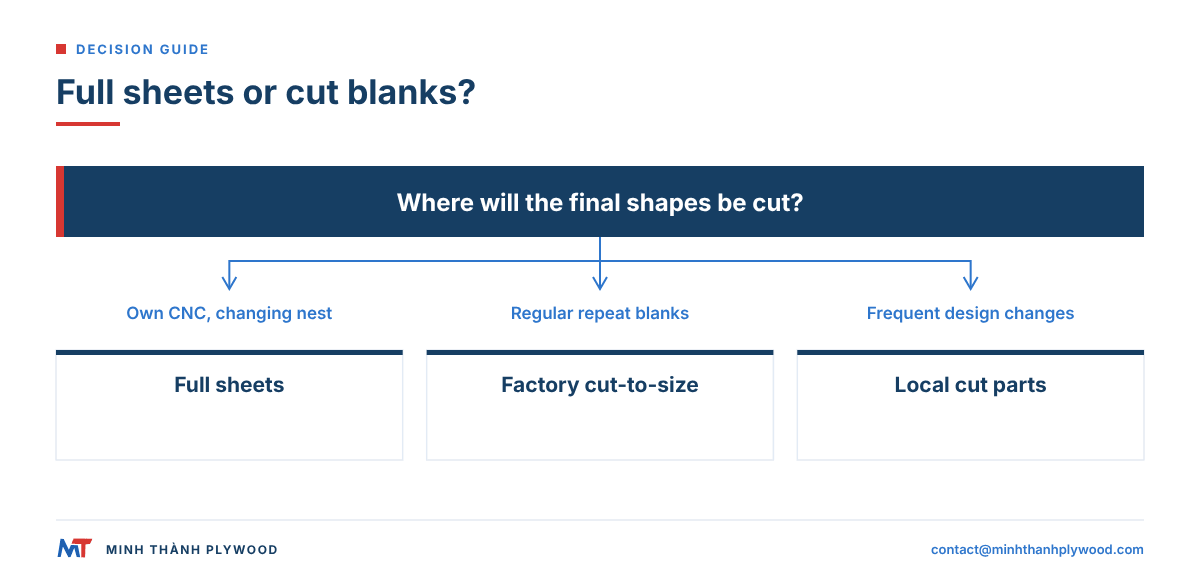
CNC plywood furniture design for flat-pack means the parts must ship flat, assemble without a workshop and survive repeated assembly. For brands sourcing abroad, it also decides whether to buy full sheets for local cutting or panels cut to size at the mill.
| Sourcing route | What arrives | Best when |
|---|---|---|
| Full sheets | 1220 × 2440 or 1250 × 2500 mm panels | You own the CNC and nest locally |
| Cut-to-size blanks | One panel cut into 4, 6 or 8 pieces | Parts follow a regular grid |
| Your own cut parts | Parts cut from your files by your local workshop | Design changes often |
We cut panels to size, one panel into 4, 6 or 8 pieces, and ship cut-to-size panels regularly to Italy and other European markets.
CNC plywood furniture plans and DXF files
CNC plywood furniture plans come as DXF, SVG or native CAD files, free from open design libraries such as OpenDesk or paid from plan shops at about US$5–16 a design. Most are drawn for one sheet of 18 mm plywood on a 1220 × 2440 mm (4 × 8 ft) bed; chairs and stools often fit a 1220 × 1220 mm (4 × 4 ft) work area.
| Typical CNC plywood piece | Sheet thickness | Sheets and work area | Where the plan comes from |
|---|---|---|---|
| Desk | 18 mm (3/4 in) | One 4 × 8 ft sheet | Free step-by-step build on Instructables |
| Kids chair | 18 mm (23/32 in) | One 4 × 8 ft sheet makes two chairs | Paid plan on Etsy |
| Slatted “Curve” chair | 15 mm (5/8 in) | 1220 × 1220 mm work area | Furnishapes DXF, free to US$4.99 |
| Slat stool or bench | Set by the plan | One sheet | Furnishapes DXF |
| Butterfly chair | Set by the plan | Check the plan’s parts list | Furnishapes DXF, SVG and EPS, US$12.99 |
| Shelving unit | 18 mm | 8 shelves of 1200 × 290 mm per sheet | Our nesting example above |
| OpenDesk desks, chairs and shelves | 18 mm for most designs | Full 1220 × 2440 mm sheets | OpenDesk, free download |
Before you cut a plan, adjust it to your panels:
- Check the licence: some plans allow personal use only, not production.
- Find the thickness value: change it to your measured sheet, in millimetres. A plan marked “3/4 in” may specify 23/32 in, about 18.3 mm; follow the plan’s finished-thickness requirement and measure the panels.
- Check the bit diameter: dogbones were drawn for a bit size.
- Check the sheet size: plans drawn for 1220 × 2440 may not nest on 1250 × 2500 the same way. OpenDesk’s guidance leaves 20 mm between parts and around the board edge.
- Cut one joint first: always, on every new batch.
Interlocking plywood furniture from free plans fails most often at the joints, for the reason in the first part of this guide. A flat-pack maker using calibrated, double-pressed sheets sets slot widths from measured panels and verified test cuts, and our furniture panels are certified to CARB Phase 2 / TSCA Title VI (ICTT mill no. 23024).
What this means for your order
For CNC plywood furniture, order panels by tolerance and flatness first, then face and core. Send these lines with your request:
- Application: CNC-cut furniture parts, with the joint type (press fit or knock-down).
- Core: white Styrax or Eucalyptus.
- Glue and emission: UF glue at E0 emission for interiors.
- Face and grade: birch D+/D or D/E, poplar, EV, okoume or pine, matched to an approved sample.
- Thickness and tolerance: for example 18 mm, sanded, ±0.2–0.3 mm.
- Size: 1220 × 2440, 1250 × 2500 mm or cut to size.
- Packing and quantity: from one 40HC, mixed specifications by agreement.
The factory’s board-only planning reference for 18 mm Styrax-core panels is 990 sheets in 18 packs of 55; the shipped count uses weighed packs, including packaging, within the booked payload and container layout. Production takes 15–45 days after the deposit, and free samples are available. See cut-to-size plywood, birch plywood, and read CNC cutting plywood and plywood joints.
Buyer questions, answered
How many sheets of plywood does a CNC desk or chair need?
A desk can be cut from one 4 × 8 ft (1220 × 2440 mm) sheet of 18 mm plywood, and a kids chair plan fits two chairs on one sheet. Check the plan's parts list for the exact count.
What is the best plywood for CNC furniture?
A sanded furniture panel with a void-free, calibrated core and a tight thickness tolerance, such as birch, poplar or EV-faced plywood on a Styrax or Eucalyptus core. Thickness control matters more than species for slot joints.
How much clearance should a CNC slot joint have?
Size the slot to the measured sheet thickness plus a small allowance: about 0.1–0.2 mm for a tight press fit and 0.3–0.5 mm for a slip fit that is glued or knocked down often. Cut a test coupon from the same sheet before the full run.
Why do my CNC plywood joints not fit?
Usually because the slots were drawn for the nominal thickness, such as 18 mm, while the sheet measures thinner or thicker. Measure several points on each sheet and set the slot width from the measurement.
What is a dogbone in CNC joinery?
A dogbone is a small round relief cut at an inside corner so that a square tab can seat fully. A round router bit cannot cut a sharp inside corner, so the relief removes the radius it leaves.
What thickness plywood is used for CNC furniture?
18 mm is the usual sheet for chairs, tables, shelving and cabinets; 12–15 mm suits drawers, backs and light pieces; 21–25 mm suits worktops and heavily loaded frames.
Can CNC plywood furniture be made without glue or screws?
Yes. Interlocking slot, wedge and tusk-tenon joints hold many designs together without glue, which makes flat-pack shipping easy. Loaded pieces such as chairs usually add glue or hidden fixings.
How many parts fit on one 1220 × 2440 sheet?
It depends on the part outlines and the gap the router bit needs between them. As an example, 12 rectangular blanks of 590 × 395 mm fit on one sheet, about 94 % of its area before the outlines are cut.
Where can I get CNC plywood furniture plans?
Open design libraries and maker communities share DXF and SVG files. Before cutting, change the sheet-thickness parameter to the measured thickness of your panels and cut one joint first.
Which router bit is best for cutting plywood furniture parts?
A compression spiral bit leaves clean edges on both faces of veneered plywood. A down-cut bit protects the top face for shallow pockets, and an up-cut bit clears chips in deep slots.