
The strongest plywood joints give glue a large face-to-face area and hold the parts mechanically: a glued dado or rabbet, a tongue and groove, or dowels and loose tenons. Butt joints rely on screws, which hold well in plywood faces and less well in edges. Minh Thanh Plywood makes calibrated furniture plywood, ±0.2–0.3 mm, so dados and tenons fit the sheet.
What are plywood joints?
Plywood joints are the ways two plywood parts are fastened together: by shaping the edges so they interlock (dado, rabbet, tongue and groove, finger joint), by adding a connector (biscuit, dowel, loose tenon, pocket screw, cam fitting), or by gluing and screwing faces and edges. The right joint depends on the load, the thickness and whether the joint is seen.
Plywood joins differently from solid timber. Every edge shows alternating long-grain and end-grain plies, the face veneer is thin, and the sheet does not shrink or swell much across its width. Those three facts make some solid-wood joints better on plywood, some weaker, and some unnecessary.
Which plywood joints are strongest?
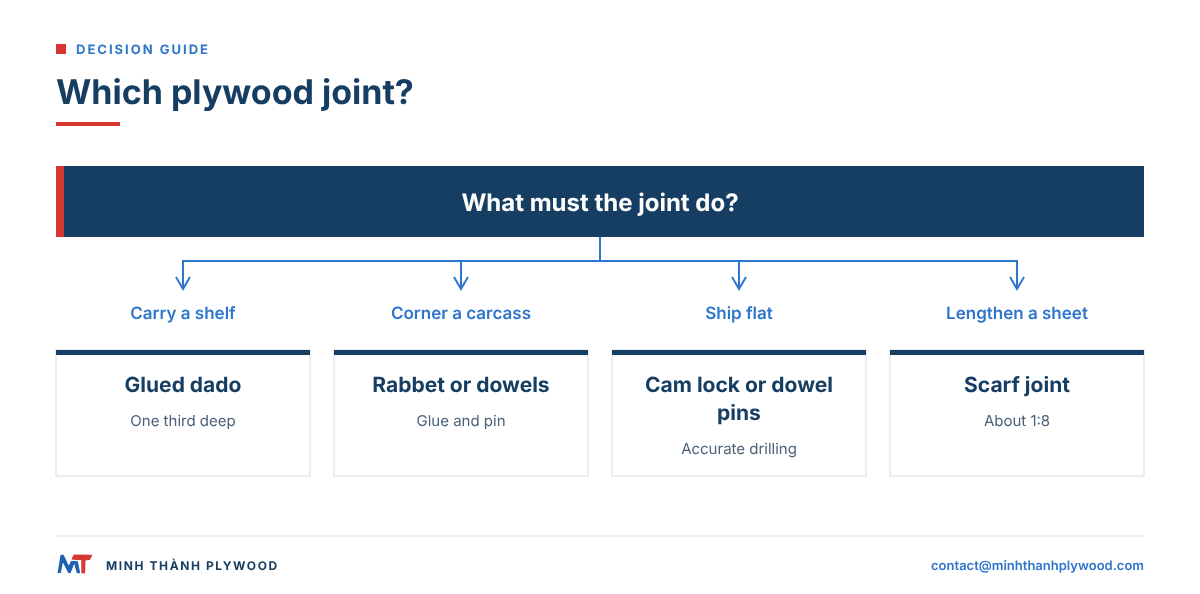
The strongest plywood joints are glued dados, rabbets and tongue-and-groove joints, followed by dowels and loose tenons; a plain butt joint held only by screws is the weakest. Strength comes from long-grain glue area plus a mechanical shoulder that stops the joint racking.
| Joint | Relative strength | Glue area | Alignment | Best use |
|---|---|---|---|---|
| Dado (housing) | Very high | Large, three faces | Self-aligning | Shelves, fixed partitions |
| Rabbet (rebate) | High | Two faces | Self-aligning | Cabinet backs, corners |
| Tongue and groove | High | Large | Self-aligning | Floors, panels, long edges |
| Dowels | High | Moderate | Accurate with a jig | Carcass corners, flat-pack |
| Loose tenon (Domino) | High | Moderate | Accurate, fast | Frames, carcasses, tables |
| Biscuits | Moderate | Small | Good | Alignment, edge-to-face joins |
| Pocket hole screws | Moderate | Small | Good | Face frames, quick carcasses |
| Mitre (45 degrees) | Moderate when splined, low if only glued | Large end-grain face, weak | Needs splines, biscuits or a corner block | Visible box and cabinet corners |
| Finger joint (box joint) | High | Very large | Self-aligning | Boxes, drawers, CNC corners |
| Scarf joint | Full sheet strength | Very large | Needs a jig | Lengthening sheets |
| Butt joint and screws | Low to moderate | Small | Clamps and care | Hidden, utility work |
A glued joint in plywood is usually stronger than the plywood around it: when a well-made dado fails, it is the face veneer and outer plies that tear, not the glue line. That is why the best joints spread load into several plies instead of one.
A mitre cuts both edges at 45 degrees to give a clean 90-degree corner with no visible plywood edge. It looks clean, but the glue meets exposed end grain, which bonds poorly, so reinforce it with splines, biscuits or a corner block.
Best plywood joints for beginners: a rabbet with glue and brads, a butt joint with glue and screws plus a glue block, or pocket screws. Each needs only a saw, a drill and clamps, and 18 mm sheet is the usual starting thickness.
How to hide plywood joinery: use a blind dado stopped short of the front edge, fill screw heads with plugs, edge-band exposed plies, or let a face frame cover the joint.
Why is plywood joinery different from solid wood?
Plywood joinery is different because the cross-laminated plies give a stable sheet with mixed grain at every edge. A screw or glue line in the edge meets end grain in half the plies and long grain in the other half.
What that changes in practice:
- Edge screws: threads bite well into long-grain plies and poorly into end-grain plies, so edge holding is lower than face holding and the plies can split apart along a glue line.
- Face screws: threads driven into the panel face cross the plies. In a face-to-edge joint, withdrawal resistance still depends on the receiving edge.
- Thin faces: the face veneer may be less than a millimetre thick, so deep sanding, tear-out at a cut and a poorly fitted joint show immediately.
- Little movement: plywood barely moves across its width, so wide glued panels and frame-and-panel allowances matter far less than in solid timber.
- Core quality: a gap or void inside the core weakens any joint that lands on it.
The Wood Handbook of the US Forest Products Laboratory sets out the engineering behind this: fastener holding in end grain is markedly lower than in side grain, and plywood edges contain both.
Which joint for which plywood thickness?
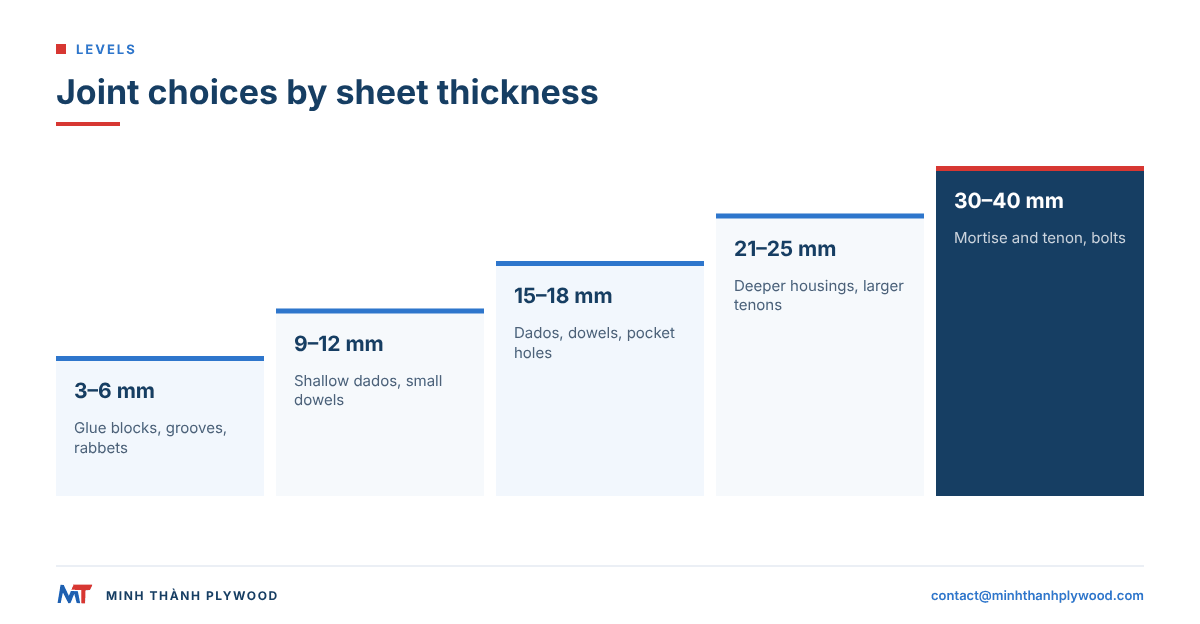
Thicker sheets allow deeper housings and centred connectors; thin sheets need joints that glue faces or add a block. Use this table when the drawing gives the thickness first.
| Thickness | Joints that work | Avoid |
|---|---|---|
| 3–6 mm | Glued rabbets into a thicker frame, glue blocks, finger joints by CNC, grooves to hold the panel | Screws into the edge, biscuits, dowels |
| 9–12 mm | Rabbets, shallow dados, finger joints, small dowels, No. 0 biscuits, glue blocks | Edge screws without pilot holes |
| 15–18 mm | Dados, rabbets, dowels, Domino, No. 10 or No. 20 biscuits, pocket holes, confirmat screws | Dados deeper than half the thickness |
| 21–25 mm | All of the above, deeper housings, larger tenons | Little to avoid; watch weight |
| 30–40 mm | Mortise and tenon, bolted joints, laminated blocks | Joints sized for thin sheet |
A dado in a carcass side is usually cut to about one third of the side’s thickness. Deeper than half, it weakens the side more than it strengthens the joint.
How do you screw into plywood edges?
Screw into a plywood edge with a pilot hole, a parallel-thread screw centred in the thickness, and enough distance from the end of the edge. Done that way, an 18 mm plywood edge holds furniture screws reliably; skipped, the plies split.
Rules that keep edge screws holding:
- Drill a clearance hole through the first part and a pilot hole sized to the screw manufacturer’s guidance in the receiving edge.
- Centre the screw in the edge so it does not break out of a face.
- Use the right screw: a confirmat (one-piece connector) screw or a parallel-thread chipboard-style screw; tapered wood screws wedge the plies apart.
- Stay back from ends: keep the first screw several screw diameters from the end of the edge.
- Add glue on the joint faces; screws clamp, glue carries the load.
- Choose the receiving surface: where the design allows, drive the threads into a panel face or an added cleat. A face-to-edge joint still relies on edge holding.
Core species matters for edge screws. Denser cores such as Eucalyptus hold screws better than light cores; Styrax-core furniture plywood, at about 500 kg/m³, is light and flat and takes connectors well with pilot holes and glue.
What pocket hole screw size for 18 mm plywood?
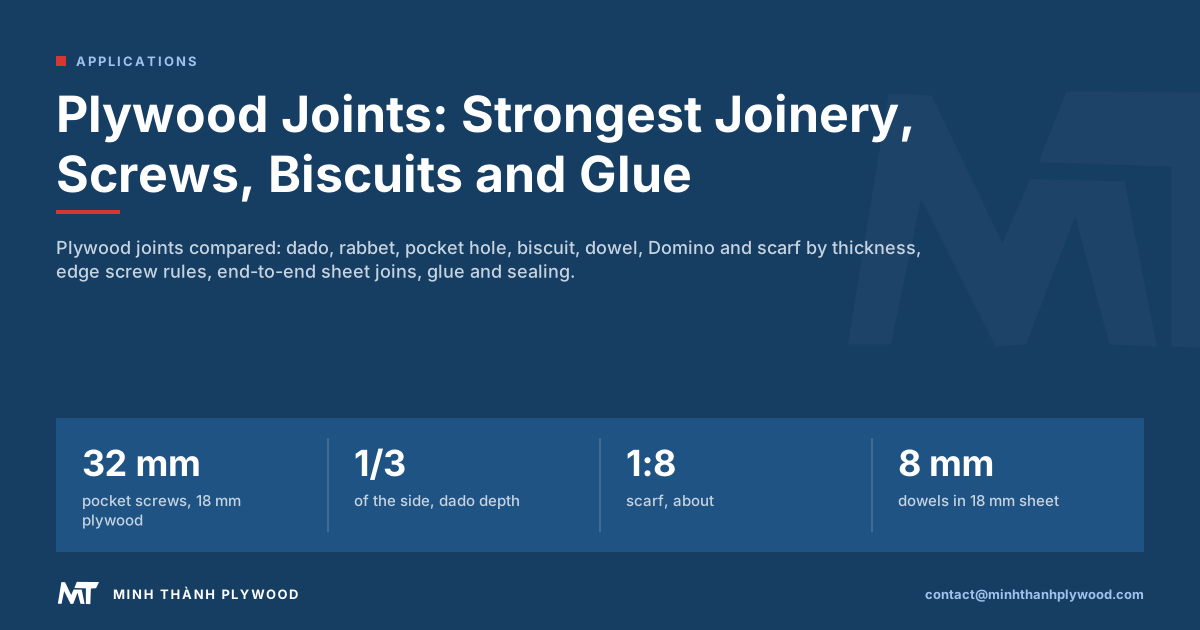
For 18 mm (3/4 in) plywood, use 32 mm (1-1/4 in) coarse-thread pocket screws with the jig and drill collar set for 3/4 in stock. Coarse threads are the type pocket-hole makers specify for plywood and softwood.
| Plywood thickness | Jig setting | Pocket screw length | Thread |
|---|---|---|---|
| 12 mm (1/2 in) | 1/2 in | 25 mm (1 in) | Coarse |
| 15–16 mm (5/8 in) | 5/8 in | 25–32 mm | Coarse |
| 18–19 mm (3/4 in) | 3/4 in | 32 mm (1-1/4 in) | Coarse |
| 25 mm (1 in) | 1 in or more | 38 mm (1-1/2 in) | Coarse |
Pocket holes in plywood work best into the face of the mating part. Driven into an edge, they hold less and can split the plies; add glue and keep the screw away from the end. Over-tightening strips the threads in the plies, so set the driver clutch low.
How do you cut dado and rabbet joints in plywood?
Cut dado and rabbet joints to the measured thickness of the sheet, not its nominal size, then glue them. A dado that fits with light hand pressure is the strongest everyday plywood joint.
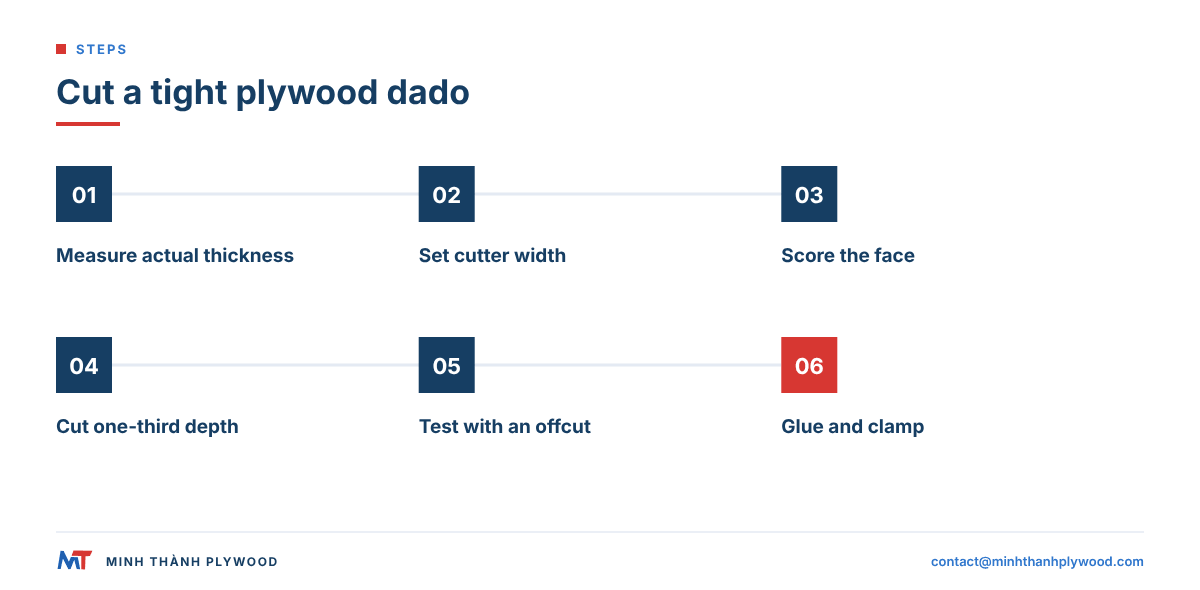
Steps for a tight dado in plywood:
- Measure the batch: caliper the actual thickness at several points of a few sheets.
- Set the cutter to that width: a stacked dado blade, a router with an undersized bit and two passes, or a CNC toolpath.
- Score the face first or use a down-cut bit, so the thin face veneer does not tear out.
- Cut to depth, about one third of the side’s thickness.
- Test-fit with an offcut from the same batch.
- Glue and clamp, with glue on both the walls and the floor of the housing.
Thickness tolerance decides the result. Calibrated furniture plywood, sanded to ±0.2–0.3 mm and pressed twice so the core board is flat before the faces go on, reduces thickness variation; measure the batch and test-fit the dado. Commercial plywood at ±0.5 mm allows more variation.
Biscuits, dowels and Domino: which plywood joiner?
A biscuit joiner, a dowel jig or a Domino joiner all work on plywood; biscuits align, dowels and Domino tenons align and add real strength. Choose by the load and by how many joints the job has.
- Biscuit joiner: cuts a crescent slot for a compressed beech biscuit. Fast and forgiving; best for aligning panels and for light edge-to-face joints. Use No. 20 or No. 10 in 15–18 mm sheet and No. 0 in 12 mm.
- Dowels: 8 mm dowels are the common choice in 18 mm plywood, centred in the edge, two or more per joint. Jigs or CNC drilling give the accuracy dowels need.
- Domino (loose tenon): the 5 mm or 8 mm tenon gives more glue area than a dowel and keeps alignment with a slightly wider slot setting. It suits carcasses and frames where speed and strength both count.
Whatever the connector, keep the slot or hole centred in the thickness so it sits in the core plies, and glue it. A biscuit that breaks out through a face veneer is a scrapped panel.
How do you join two plywood sheets end to end?
Join two plywood sheets end to end with a glued scarf joint for a flush, full-strength join, or with a glued and screwed splice plate where the back is hidden. Tongue and groove edges or a support underneath suit floors and roofs.
Epoxyworks bend tests compare the options. A butt block, with reinforcement on one side only, reaches about 20 % of the strength of a solid plywood section, because the block concentrates stress and the joint is unbalanced. A butt strap in 1/4 in plywood with 9 oz glass tape on both sides of the joint failed outside the taped area when 2 in strips were bent to failure, so the joint was stronger than the plywood beside it. A scarf at about 1:8 gets close to full sheet strength.
Ways of connecting plywood sheets:
| Method | Strength | Flush both faces | Where used |
|---|---|---|---|
| Scarf joint, about 1:8 | Close to the full sheet | Yes | Boat panels, long curved parts, signs |
| One-sided splice plate (butt block) | Design-dependent; lower in bending | One face | Hidden backs, designed hull joints, crates |
| Tongue and groove | Moderate, needs support | Yes | Floors, roof decks |
| Joint over a support | Depends on the support | Yes | Floors, walls, sheathing |
| CNC finger or puzzle joint | High when glued | Yes | Long CNC parts, signs |
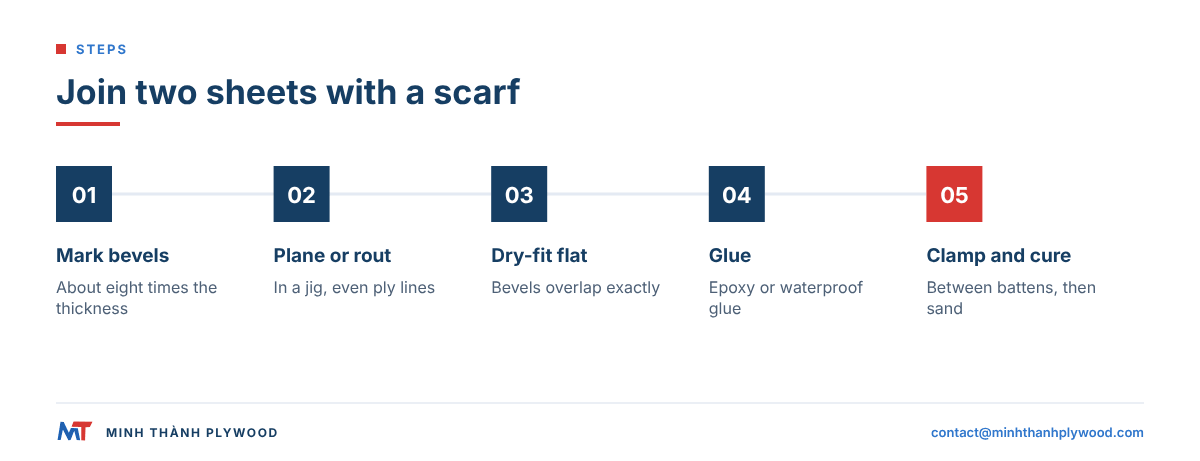
Steps for a glued scarf:
- Mark the bevel on both sheet ends at a length of about eight times the thickness.
- Plane or rout the bevels in a jig, keeping the glue lines between plies even.
- Dry-fit on a flat surface with the bevels overlapping exactly.
- Glue with epoxy or a gap-filling waterproof adhesive.
- Clamp flat between battens with release film, and let it cure fully before sanding.
What are plywood joint pins and knock-down fittings?
Plywood joint pins and knock-down fittings are connectors that hold plywood parts together without permanent glue, so furniture ships flat and assembles on site. They range from wooden dowel pins to steel cam locks and connector bolts.
The common types:
- Dowel pins: wooden pins in drilled holes, glued or dry, for alignment and shear.
- Cam lock and bolt: a steel bolt in one panel’s edge, pulled tight by a cam in the face of the other; the standard flat-pack fitting.
- Confirmat screws: one-piece connector screws through the face into the edge of the next panel.
- Connector bolts and barrel nuts: for beds, tables and heavy frames that are taken apart.
- CNC tab-and-slot or wedge joints: shaped in the plywood itself, sometimes locked with a plywood pin or wedge.
Knock-down fittings ask a lot of the edge. Accurate drilling, a gap-free core and consistent thickness decide whether a cam lock pulls the parts square.
Which plywood furniture joints suit cabinets and CNC flat-pack?
Cabinet makers use dados, rabbets and dowels for carcasses and pocket screws or Domino tenons for face frames; CNC flat-pack furniture uses finger joints, tab-and-slot joints and knock-down fittings cut straight from the nesting program.
| Part | Common plywood furniture joints |
|---|---|
| Carcass sides to top and bottom | Dados, rabbets, dowels, confirmat screws |
| Fixed shelves | Dados, dowels |
| Back panel | Rabbet or groove, glued and pinned |
| Drawer boxes | Finger joints, dado and rabbet, dovetails in 12 mm sheet |
| Face frames | Pocket screws, Domino, dowels |
| CNC flat-pack | Tab-and-slot, finger joints, cam locks |
| Table and bed frames | Connector bolts, loose tenons |
CNC joinery is where the panel spec shows most. A slot drawn for 18.0 mm fails on a sheet that measures 17.4 mm, so CNC shops write the actual thickness and tolerance on the order and cut every slot to it.
Which glue is best for plywood joints?
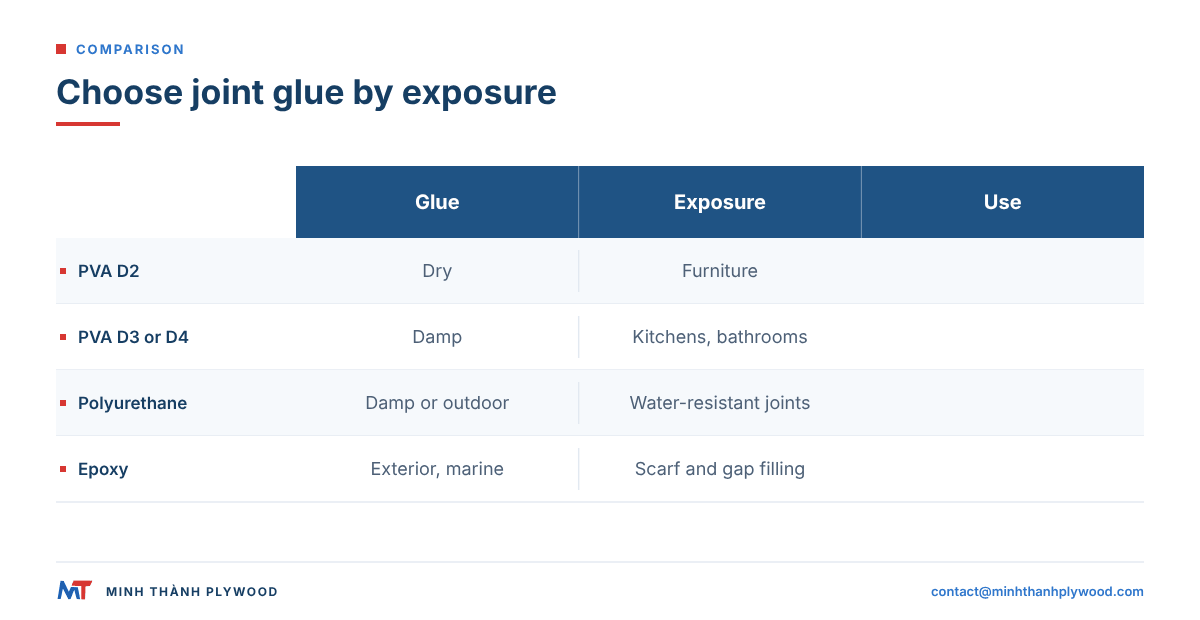
PVA wood glue is best for indoor plywood joints, a D3 or D4 water-resistant PVA or polyurethane glue for damp areas, and epoxy for exterior, marine and gap-filling joints. The joint glue should match the service class of the plywood.
| Glue | Water resistance | Gap filling | Best for |
|---|---|---|---|
| PVA (D2, interior) | Low | Poor | Indoor furniture and cabinets |
| PVA (D3 or D4, EN 204 classes) | Moderate to high | Poor | Kitchens, bathrooms, damp rooms |
| Polyurethane | High | Moderate, foams | Damp and outdoor joints |
| Epoxy | Very high | Good | Exterior, boats, scarf joints |
| UF powder glue | Moderate | Poor | Workshop veneering, large glued areas |
The plywood’s own glue limits the joint. Furniture plywood made with UF glue at E0 emission is an interior panel, so a waterproof joint glue does not make the part exterior. For outdoor or wet joints, start from plywood bonded with phenolic WBP glue.
The plywood’s service class (dry, humid or exterior) is set out in BS EN 636, and its bonding quality is defined in BS EN 314-2.
How do you seal and waterproof plywood joints?
Seal plywood joints by gluing them with a waterproof adhesive, sealing every exposed edge and end grain, and finishing the whole part so water cannot reach the glue lines. Water enters plywood at the edges, so the joint is where sealing matters most.
- Choose WBP plywood for any part that will get wet.
- Glue the joint with epoxy, polyurethane or D4 PVA, filling it completely.
- Seal cut edges and the inside of holes with unthinned epoxy or a suitable penetrating sealer, following the product instructions.
- Fill and cover visible joints on outdoor parts with a flexible sealant or a lipping.
- Finish the whole part, both faces and all edges, with paint or a clear exterior finish.
- Re-coat edges and joints at each maintenance cycle.
What do plywood joints mean for your plywood order?
Joint quality starts with the sheet: a consistent thickness, a flat panel, a gap-free core and the right glue class. Write those four lines on the order and the joints fit from the first part to the last.
What Minh Thanh Plywood supplies for joinery and furniture work:
- Thickness tolerance: sanded furniture panels at ±0.2–0.3 mm, down to ±0.2 mm, so dados, slots and tenons fit across the order.
- Flatness: furniture-grade panels are pressed twice as standard, the core board calibrated before the faces go on.
- Core: white Styrax or Eucalyptus cores, with core layers stitched both horizontally and vertically.
- Glue: UF glue at E0 emission for interior furniture; melamine-fortified or phenolic WBP to the buyer’s specification for damp and outdoor parts.
- Sizes: 3–40 mm, 1220 × 2440 or 1250 × 2500 mm, and cut-to-size parts with one panel cut into 4, 6 or 8 pieces.
A furniture plant’s order line reads like this: “Furniture plywood, 18 mm ±0.2 mm, 1220 × 2440 mm, birch D/E face, Styrax core, UF glue at E0 emission, sanded both faces, for dado and dowel carcasses.” Send the drawing and the thickness you cut to, and Minh Thanh quotes with free samples.
Buyer questions, answered
What is the strongest joint for plywood?
A glued dado, rabbet or tongue and groove is the strongest everyday plywood joint, because glue bonds long-grain face plies over a large area and the shoulder takes the load. Dowels and loose tenons such as Domino come close and are easier to align.
What is the best joint for plywood cabinets?
Dados for shelves and fixed parts, rabbets at the back and top corners, and dowels or confirmat screws where the carcass is assembled flat. Pocket holes suit face frames and quick carcasses that are not seen from the outside.
What pocket hole screw size for 18 mm plywood?
Use 32 mm (1-1/4 in) coarse-thread pocket screws with the jig set for 18 mm (3/4 in) stock. Coarse threads grip plywood plies better than fine threads, which are meant for hardwood.
Can you biscuit joint plywood?
Yes. Biscuits align plywood panels well and add some strength in edge-to-face joints, using a No. 10 or No. 20 biscuit in 18 mm sheet. Keep the slot centred in the thickness so it stays inside the core plies.
How do you join two plywood sheets end to end?
Glue a scarf joint at about 1:8 for a flush, full-strength join, or glue and screw a plywood splice plate behind the joint where the back is hidden. Tongue and groove edges or a joist under the joint work for floors.
Do screws hold well in the edge of plywood?
They hold, but less than in the face, and they can split the plies. Drill a pilot hole, keep the screw centred in the thickness, use a parallel-thread screw and keep it well back from the end of the edge.
What glue is best for plywood joints?
PVA wood glue for indoor furniture, a D3 or D4 class PVA or polyurethane glue for damp areas, and epoxy for exterior and marine joints or gap filling. The glue should match the bond class of the plywood itself.
How do you waterproof plywood joints?
Glue the joint with a waterproof adhesive, seal the exposed end grain and edges with epoxy or a penetrating sealer, then finish the whole part. Plywood made with phenolic WBP glue is needed for any joint that will stay wet.
What is a plywood joint pin?
A plywood joint pin is a dowel, connector bolt or knock-down pin that holds two plywood parts in line, often used in flat-pack and CNC furniture so the piece can be taken apart and reassembled.
Why does a plywood dado come out loose?
Because the real sheet is often thinner than its nominal size. Measure the actual thickness of the batch and cut the dado to it; calibrated furniture plywood at ±0.2–0.3 mm reduces variation, but the batch still needs measurement and a test fit.
What is the best plywood joint for beginners?
A rabbet joint with glue and brads, or a butt joint with glue, screws and a glue block. Pocket screws are the quickest. All three need only a saw, a drill and clamps, and 18 mm plywood is a forgiving thickness to start with.
How do you hide plywood joints?
Stop dados short of the visible edge so they are blind, cover screw heads with plugs, edge-band the exposed plies, or let a face frame or applied trim cover the joint. A mitre also hides the edge, but needs splines or biscuits to be strong.