
Decorative plywood is plywood made to be seen: a face of real veneer, engineered veneer, a textured or carved surface, or a laminate, on a stable core of crossed veneers. Minh Thanh Plywood builds decorative faces for furniture and interior buyers in the United States, Europe and beyond, double-pressed on Styrax and Eucalyptus cores. This guide puts the decorative families in one table, explains grades and face thickness, and shows what to put on a request for quotation.
What is decorative plywood?
Decorative plywood is plywood made to be seen. Its face is chosen for appearance, a real wood veneer, an engineered veneer, a textured or carved surface or a laminate, and its core of crossed veneers keeps the panel flat, light and strong enough for furniture and interiors. It goes where a painted MDF or a melamine particleboard would look cheaper.
The difference from commercial plywood is the face and the care taken under it. A decorative panel has a selected face graded to a sample, a calibrated core so the thin face lies flat, and sanded or polished surfaces ready for lacquer or UV coating. A commercial panel has a utility face for hidden or painted parts.
Decorative board is a wider trade name. It covers decorative plywood and also veneered MDF, melamine-faced particleboard and laminate-faced panels. When a quote says “decorative board”, ask what the core is.
Decorative plywood for US buyers: HP-1 grades, inch sizes and core types
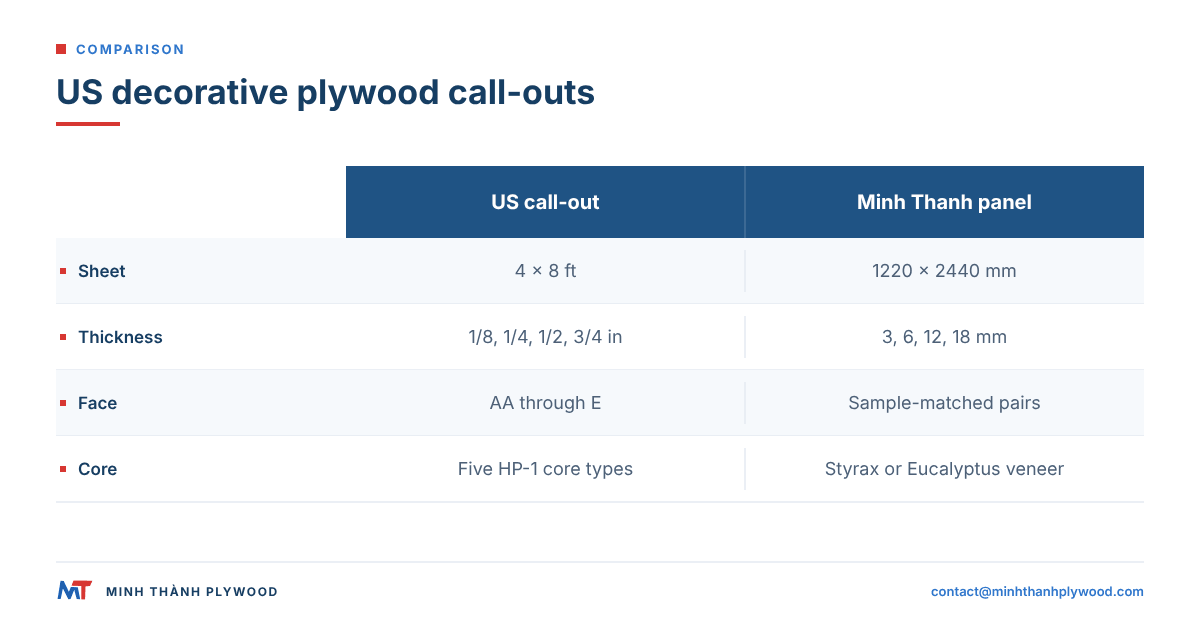
A US buyer specifies decorative plywood to ANSI/HPVA HP-1: a face grade, a back grade, a core type and a nominal inch thickness on a 4 × 8 ft sheet. Minh Thanh’s panel is 1220 × 2440 mm, the same 4 × 8 ft, so the call-out translates directly.
| Item | HP-1 call-out | Minh Thanh equivalent |
|---|---|---|
| Sheet | 4 × 8 ft, thicknesses from 5/32 to 1-1/2 in | 1220 × 2440 mm; 3–40 mm |
| Thickness | 1/8, 1/4, 1/2 and 3/4 in nominal | 3, 6, 12 and 18 mm |
| Face grade | AA, A, B, C, D, E (AA is the most restrictive) | EV and poplar A/A, A/B, B/B; birch D+/D; matched to an approved sample |
| Back grade | 1, 2, 3, 4 | Back grade quoted as a pair with the face, matched to sample |
| Core | Veneer core, MDF core, particleboard core, combination core, lumber core | Veneer core on Styrax or Eucalyptus; say on the RFQ if you need another core |
| Emission | TSCA Title VI, third-party certified | CARB P2 / TSCA Title VI, ICTT mill no. 23024 |
The grade pairs are closest matches, not legal equivalents: the approved sample, not the letter, decides the face. Write both on the RFQ, for example “HP-1 face A, back 2, matched to sample no. 3”. For green-building projects, HP-1 lists LEED v4.1 credit opportunities for low-emitting materials and responsible sourcing, and the buyer asks the supplier for the documents each credit needs; chain-of-custody papers such as FSC go on the enquiry when a project requires them.
US shelf prices, October 2026. A 3/4 in birch 4 × 8 ft sheet retails at about $70 for cabinet grade (Sutherlands) to $85 (The Home Depot); red oak cabinet grade is about $90. Home Depot and Lowe’s also sell 2 × 4 ft and 4 × 4 ft project panels in 1/4 to 3/4 in. A container buyer compares those rows with a mill price per cubic metre; furniture and interior plywood from Minh Thanh starts from US$350/m³ (October 2026), and one 18 mm sheet is 0.0536 m³.
Beaded and grooved panels. US merchants also list 1/4 in beaded panels with a bead every 1-1/2 in, in birch, maple, red oak and alder. They are the thin end of the grooved range in the textured section below, and a CNC line cuts the same bead spacing on a plywood face.
Decorative plywood families in one table
Seven families make up decorative plywood. They differ in what the face is, how thick it is and where it is used, and each one is ordered with a different specification line.
| Family | Face | Usual face thickness | Grades | Main uses |
|---|---|---|---|---|
| Natural veneer (fancy) plywood | Sliced oak, ash, walnut, teak, sapele | 0.3–0.6 mm | Matched to approved sample | Furniture, doors, wall panels |
| Engineered veneer (EV) plywood | Dyed, re-sliced veneer | 0.2–0.3 mm | Repeat face, matched to sample | Furniture and interiors in volume |
| Architectural plywood | Birch, poplar, hoop pine, okoume, bamboo | 0.3 mm to a full rotary ply | Birch D+/D, poplar A/B | Exposed-edge furniture, walls, ceilings |
| Pine and knotty faces | Rotary pine | Full rotary ply | A/A, A/B, B/B | Rustic interiors, shelving |
| Textured, brushed, grooved | Veneer brushed, sawn or routed | Thicker face or solid ply | Visual | Feature walls, ceilings, shopfitting |
| Fretwork and carved panels | Plain face cut through or carved by CNC | Any | Visual | Screens, dividers, radiator covers |
| Laminate and melamine faced | HPL, melamine paper, foil | 0.6–1.0 mm laminate | Decor code | Kitchens, retail, offices |
Every family above is made on a veneer core. HP-1 also names MDF-core, particleboard-core and combination-core panels (a veneer core with MDF crossbands); these cost less and are heavier, and they are a different quotation from the plywood in this table.
Minh Thanh’s most produced decorative faces are EV, Poplar, Birch, Okoume and Pine, with Bintangor, Eucalyptus, Gurjan, Sapele and others on request.
Natural veneer and fancy plywood
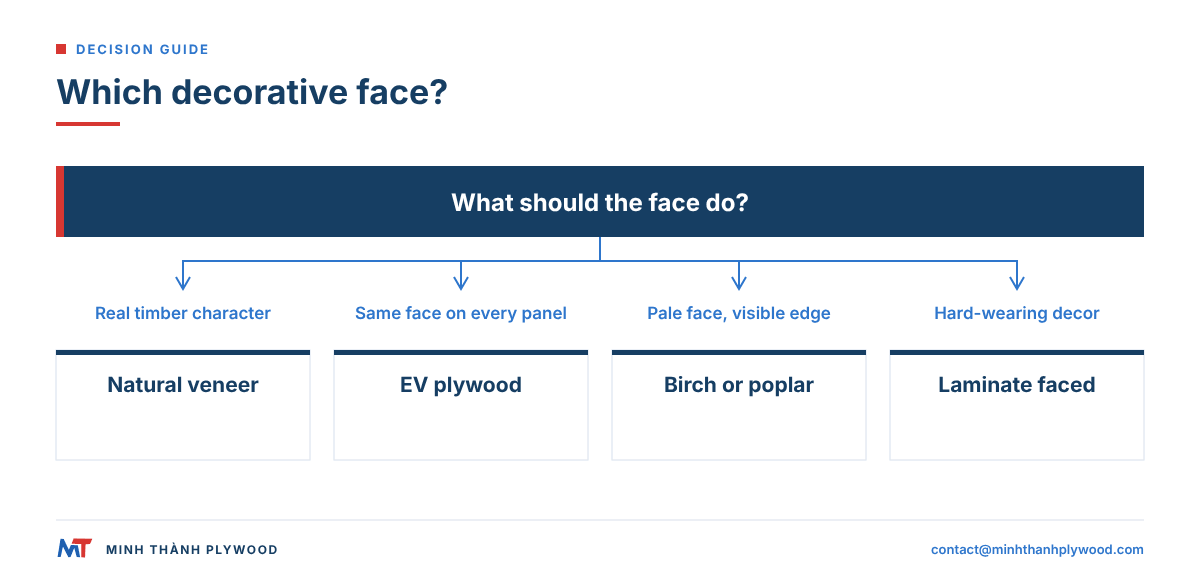
Natural veneer plywood, often called fancy plywood in Asian and Middle East markets, carries a sliced face of a premium hardwood such as oak, ash, walnut, teak or sapele. Each leaf comes from one log, so the colour and figure vary and the panel looks like solid timber.
Sliced faces are thin, usually 0.3–0.6 mm, and wide panels are made by jointing several leaves. The joint pattern, book match or slip match, is part of the look and must be named on the order. Crown cut faces show a cathedral figure; quarter and rift cut faces show straight stripes.
Natural veneer suits furniture and wall panels that will be stained or clear-lacquered, where the customer expects real timber character. It costs more than EV and varies more from panel to panel, so large projects order faces from the same flitch or the same log batch.
Engineered veneer (EV) decorative plywood
Engineered veneer plywood gives a real wood face that repeats from panel to panel. EV starts as peeled veneer of a fast-growing species, which is dyed, glued into a block and sliced again to reproduce the figure of oak, walnut, teak or a colour of its own.
EV is one of the most produced faces at Minh Thanh. It suits kitchen fronts, wardrobes, hotel rooms and retail fit-outs, where panel 1 and panel 400 must match. EV faces are thin, usually 0.2–0.3 mm, so they need a flat, calibrated core: Minh Thanh presses its furniture panels twice, first the core, which is then calibrated, then the face and back.
See the EV plywood page for face options and sizes.
Architectural plywood: birch, poplar, hoop pine and bamboo
Architectural plywood is decorative plywood whose own face and edge are the design. The visible edge stripes, the pale face and the clean finish are why architects specify it for exposed-edge furniture, wall linings and ceilings. Birch, poplar, hoop pine, okoume and bamboo are the usual faces.
- Birch: pale and fine; graded D+, D and E in Vietnam and quoted as pairs such as D+/D. See birch-faced plywood.
- Poplar: very pale and plain, light in weight; graded A/A, A/B and B/B. See poplar-faced plywood.
- Hoop pine: an Australian plantation pine with a fine, even face, popular in Australian interiors.
- Okoume: pink-brown and even. See okoume-faced plywood.
- Bamboo: pressed bamboo strips with a striped edge, sold as a separate panel family.
For an exposed edge, the core matters as much as the face. Stitched cores, laid without gaps and stitched both across and along the panel at Minh Thanh, show a clean striped edge without voids.
Textured, brushed and grooved decorative panels
Textured decorative panels add depth to the face by brushing, sawing or routing. A wire brush removes the soft earlywood and leaves the grain in relief; a band-saw texture leaves rough-sawn marks; a router cuts grooves along the panel for a planked or slatted wall.
- Brushed faces: pine, oak and larch faces brushed and then stained or oiled.
- Sawn texture: a rustic, rough-sawn look for retail and hospitality walls.
- Grooved panels: V or U grooves at a fixed spacing, for wall cladding and ceilings.
- Slatted acoustic panels: grooves or slots cut through the face onto an acoustic backing.
- 3D surfaces: waves and shapes milled into a thicker panel by CNC.
Texture removes wood from the face, so a textured panel needs a thicker face ply than a flat lacquered one. Order the base panel with a full rotary face, and leave the texture to the processor.
Fretwork panels and carved wood panels
Fretwork panels have a pattern cut right through the sheet; carved wood panels have a pattern cut into the face without going through. Both are made today by CNC routers or lasers from plain plywood or MDF, and both are sold as screens, room dividers, radiator covers, ceiling panels and wooden carved panels for wall art.
Plywood is the better base when the pattern leaves thin bridges between cut-outs: crossed veneers hold the bridges together where MDF would break. Choose a void-free core and a face sanded on both sides, because a fretwork panel is seen from both sides.
- Thickness: 6–9 mm for screens and wall art, 12–18 mm for room dividers that stand on their own.
- Face: birch or poplar for a pale finish, EV or a natural veneer for a wood look, B/B for panels that will be painted.
- Edge: every cut edge shows, so the core should be stitched and free of gaps.
Minh Thanh supplies the base panels and cut-to-size plywood, one panel cut into 4, 6 or 8 pieces; the CNC cutting and carving is done by the buyer’s processor.
Laminated and melamine decorative board
Laminated decorative board carries a printed or plain decor under resin instead of real wood. The two common faces are melamine paper, pressed straight onto the panel, and high-pressure laminate (HPL), a 0.6–1.0 mm sheet glued on later. Both resist scratches and stains better than lacquered veneer.
On a plywood core, laminated board is lighter and holds screws better near the edge than the same decor on particleboard, which is why buyers in the Gulf and Dubai ask for laminated plywood for kitchens, wardrobes and shopfitting. Many decorative boards in that market are particleboard or MDF; ask for “plywood core” on the order if that is what you need.
Order laminated plywood with the decor code and the substrate grade: a B/B or BB/CC face under the laminate is normal, because the face is covered.
What is decorative plywood used for?
Decorative plywood is used for furniture, interiors and any surface people see and touch. Decorative panels for furniture are the largest use, followed by wall panelling and ceilings.
| Use | Usual thickness | Face | Glue |
|---|---|---|---|
| Kitchen and wardrobe fronts | 15–18 mm | EV, birch, natural veneer | UF at E0, or MR for kitchens |
| Furniture carcasses | 15–18 mm | Poplar, birch, EV | UF at E0 |
| Table tops and shelves | 18–25 mm | Birch, natural veneer | UF at E0 |
| Wall panelling | 6–12 mm | EV, natural veneer, textured | UF at E0 |
| Ceilings and acoustic panels | 9–18 mm | Birch, poplar, grooved | UF at E0 |
| Doors | 3–6 mm skins | EV, natural veneer | UF at E0 |
| Shopfitting and display | 12–18 mm | Birch, laminate faced | UF or MR |
Furniture panels at Minh Thanh use UF glue at E0 emission; MR (melamine-fortified) and phenolic (WBP) bonds are made to the buyer’s specification. See sande plywood vs birch for how two common furniture faces compare.
Ply decor ideas: how to decorate plywood
Ply decor starts with a sanded face and a sealed edge. Whatever the finish, sand the face lightly, remove the dust and seal both faces and every edge so the panel stays flat.
- Clear finish: oil, hard wax oil or water-based lacquer to keep the pale birch or poplar look.
- Stain: water- or oil-based stain on a well-sanded face; test on an offcut, because birch can blotch.
- Paint: primer and paint on a B/B or poplar face, sanded between coats.
- Whitewash and limed finishes on pine and oak faces.
- Veneer or laminate: glue a decorative veneer or HPL sheet onto plain plywood.
- Wallpaper and fabric on thin plywood for headboards and panels.
- CNC grooves, fretwork and carving for screens and feature walls.
- Exposed edges: sand and lacquer the striped edge as a design line.
UV-coated panels arrive finished. Minh Thanh’s faces are UV-ready on both sides, sanded to the standard buyers need to run them through their own UV coating line.
Which plywood is best for outdoor decorations?
For outdoor decorations, such as Christmas cut-outs, garden signs and stage props, use exterior plywood bonded with phenolic (WBP) glue. Interior decorative plywood, glued with UF, delaminates after a few weeks of rain.
- Thickness: 9–12 mm for cut-out figures that stand on stakes; 15–18 mm for large signs.
- Face: a smooth, sanded face that takes primer, such as a B/B or C face sanded flat.
- Finish: exterior primer and paint on every face and edge, and a second coat on the edges.
- Fixing: stainless or galvanised screws, and a gap at the foot so water drains.
Minh Thanh’s exterior plywood uses low-grade faces with water-resistant melamine-fortified or phenolic (WBP) glue, made for stair treads, wall sheathing and outdoor uses.
Grades and face thickness of decorative faces
Decorative faces are graded on what the eye sees, colour, knots, patches and joints, and quoted as face/back pairs. The face thickness decides how much sanding and texture the panel can take.
| Face | Grade pairs at Minh Thanh | Usual face thickness |
|---|---|---|
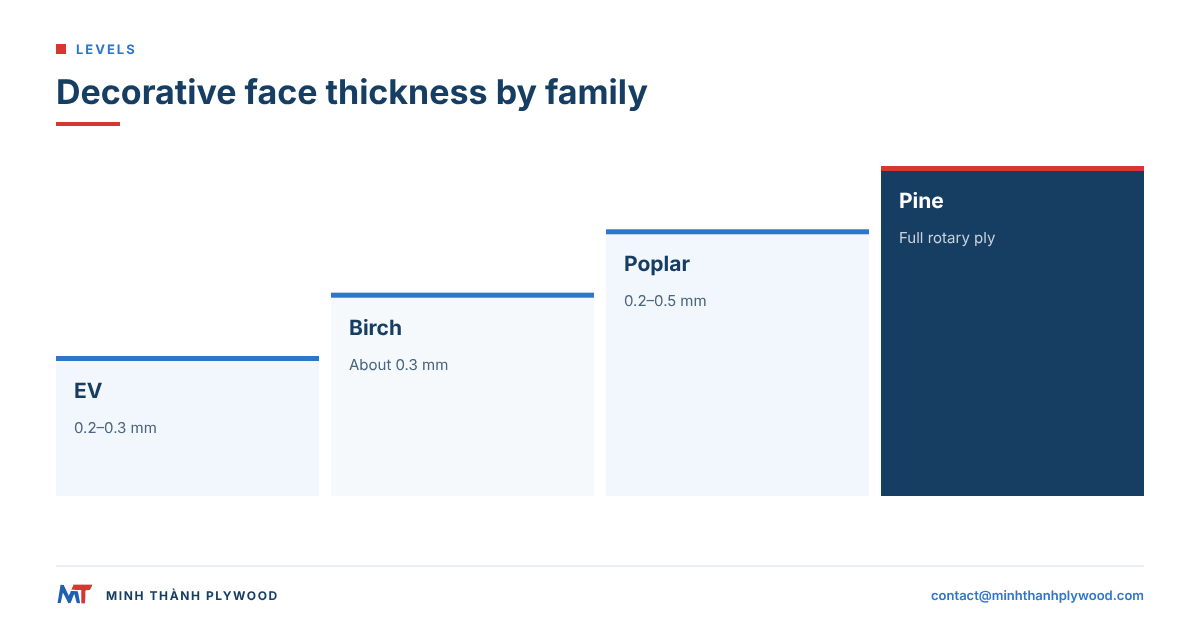
| Birch | D+/D, D/D, D/E | about 0.3 mm |
| Poplar | A/A, A/B, B/B; also B/BB, BB/CC, CP | 0.2–0.5 mm |
| Pine | A/A, A/B, B/B, B/C | Full rotary ply |
| Eucalyptus | A/A, A/B, B/B | 0.2–0.5 mm |
| EV | Matched to approved sample | 0.2–0.3 mm |
Decorative face veneer is usually 0.2–0.5 mm; European furniture panels most often carry about 0.3 mm. Every grade is matched to the buyer’s approved sample. Panels are sanded and calibrated to ±0.2–0.3 mm, down to ±0.2 mm, and dried to 8–12 % moisture content at dispatch.
How decorative plywood is made
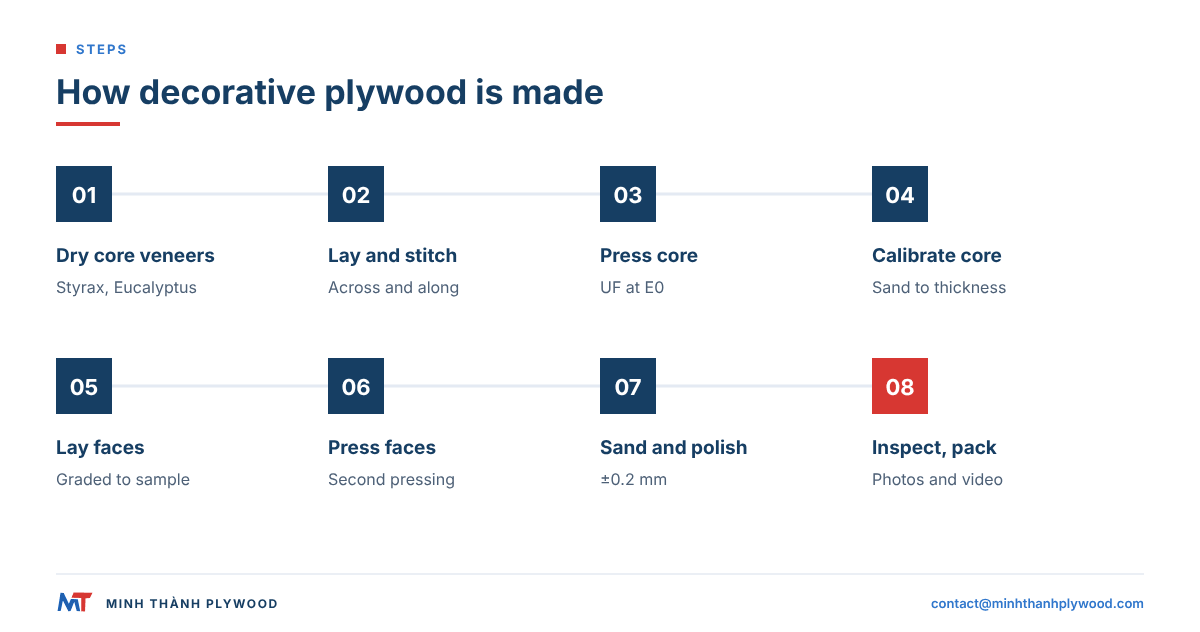
Decorative plywood is made in two pressings so a thin face lies flat on a calibrated core. The steps below are the furniture-grade route at Minh Thanh.
- Dry the core veneers of locally grown plantation Styrax or Eucalyptus from the Ha Hoa area, Phu Tho, to the target moisture.
- Lay and stitch the core, with core layers stitched both horizontally and vertically so there are no gaps.
- Press the core board with UF glue at E0 for interior panels.
- Calibrate the core, sanding it flat to an exact thickness.
- Select and lay the faces: veneers sorted by grade, jointed and laid on the core and back.
- Press the face and back onto the calibrated core.
- Sand and polish both faces, then trim to size.
- Inspect and pack, with every shipment photographed and filmed before loading.
The second pressing is what decorative buyers pay for: a face pressed on a flat, calibrated core shows fewer core marks through a thin veneer after lacquer. The veneer grading page shows the face selection step.
Hardwood and decorative plywood from Vietnam: the US trade case
US imports of hardwood and decorative plywood from Vietnam fall under a trade case with a defined product scope, so check the scope and the rate that applies to your panel with your customs broker before ordering (USITC news release). The formaldehyde rule is separate: the limit for veneer-core hardwood plywood is 0.05 ppm under 40 CFR 770.10, and US order panels carry the TSCA Title VI label. The Commerce Department’s final dumping determination for Vietnam is in Federal Register notice 2026-14614.
Plywood decorativo: buying in Latin America and the Caribbean
Plywood decorativo is the Spanish trade name for decorative plywood in the Dominican Republic, the Caribbean and much of Latin America, next to triplay in Mexico, terciado in Chile and contrachapado decorativo in Spain. Retail buyers in Santo Domingo buy it by the sheet from hardware stores and timber yards; distributors import it by the container.
For an importer the steps are the same as in any market: choose the face family, the grade pair, the core and the glue, then the sizes. A mixed container lets a distributor carry several faces from the first order: at Minh Thanh the MOQ is one 40HC with mixed specifications by agreement, shipped FOB Hai Phong, CFR or CIF.
What to put on a decorative plywood RFQ
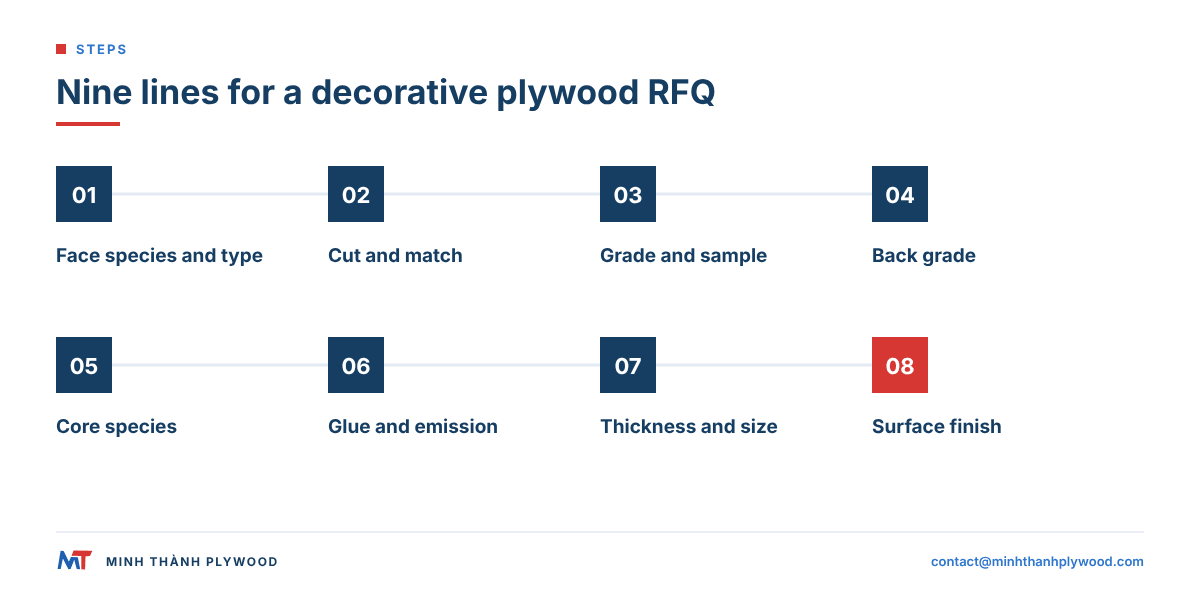
A decorative plywood request for quotation needs nine lines, and the first three decide the look.
- Face species and type: natural sliced, EV, rotary birch, poplar, pine, laminate.
- Cut and match: rotary, crown cut or quarter cut; book or slip match for sliced faces.
- Grade pair and sample: for example A/B or D+/D, matched to your approved sample.
- Back: same as face for two visible sides, or a lower grade.
- Core: Styrax or Eucalyptus as standard, Acacia or Pine on order.
- Glue and emission: UF at E0, MR for kitchens, or WBP for exterior.
- Thickness, tolerance and size: for example 18 mm, ±0.2 mm, 1220 × 2440 mm or 1250 × 2500 mm.
- Surface: sanded, polished or UV-ready.
- Quantity and term: sheets or m³ per specification, 1×40HC, FOB, CFR or CIF.
A complete line reads: 18 mm EV plywood, walnut-look EV face A/B, Styrax core, UF glue at E0, sanded ±0.2 mm, 1220 × 2440 mm, UV-ready both faces, mixed 1×40HC with 12 mm of the same face. Production takes 15–45 days after the 30% deposit. Send it to contact@minhthanhplywood.com or request a quotation, and ask for free samples of the face before you confirm.
Buyer questions, answered
What is decorative plywood?
Decorative plywood is plywood with a face chosen for its appearance: natural or engineered veneer, a textured or carved surface, or a laminate. The crossed-veneer core keeps the panel flat and strong; the face is what the customer sees.
What is decorative plywood used for?
Furniture, kitchen and wardrobe fronts, wall panelling, ceilings, doors, shopfitting, hotel and office interiors, and display stands. Plain plywood with a good face is also the base for painted and CNC-cut decorative panels.
What type of plywood is best for outdoor Christmas decorations?
Exterior plywood bonded with phenolic (WBP) glue, 9–12 mm thick for cut-out figures, primed and painted on every face and edge. Interior decorative plywood will delaminate outdoors.
How can I decorate plywood?
Sand it and paint, stain, oil or lacquer it; glue on veneer, laminate or wallpaper; rout grooves or cut patterns with a CNC router; or burn and brush the face for texture. Seal the edges whatever finish you choose.
What is the difference between decorative plywood and normal plywood?
The face. Normal commercial plywood has a utility face for hidden or painted uses; decorative plywood has a selected, graded face, sanded or prefinished, meant to stay visible.
Is engineered veneer plywood real wood?
Yes. Engineered veneer (EV) is made from real wood veneer that is dyed, glued into a block and re-sliced, so every sheet carries the same grain and colour.
What is fretwork plywood?
Fretwork panels are plywood or MDF sheets with a pattern cut right through them, by CNC router or laser. They are used as screens, radiator covers, ceiling panels and room dividers.
What thickness is decorative plywood?
Wall panels are usually 6–12 mm, furniture carcasses and fronts 15–18 mm, and tops and shelves 18–25 mm. Minh Thanh makes 3–40 mm panels.
Is hardwood and decorative plywood from Vietnam subject to US duties?
The US investigated hardwood and decorative plywood from China, Indonesia and Vietnam from 2025, with affirmative final determinations in 2026. Importers should check the scope and their rate with a US customs broker before ordering.
What is the minimum order for decorative plywood from Vietnam?
At Minh Thanh the MOQ is one 40HC container, with mixed specifications by agreement, so one container can carry several faces and thicknesses.
Can decorative plywood be used in kitchens and bathrooms?
Yes, in cabinets and wall panels away from standing water, with a melamine-fortified (MR) glue line and a sealed finish on every face and edge.