
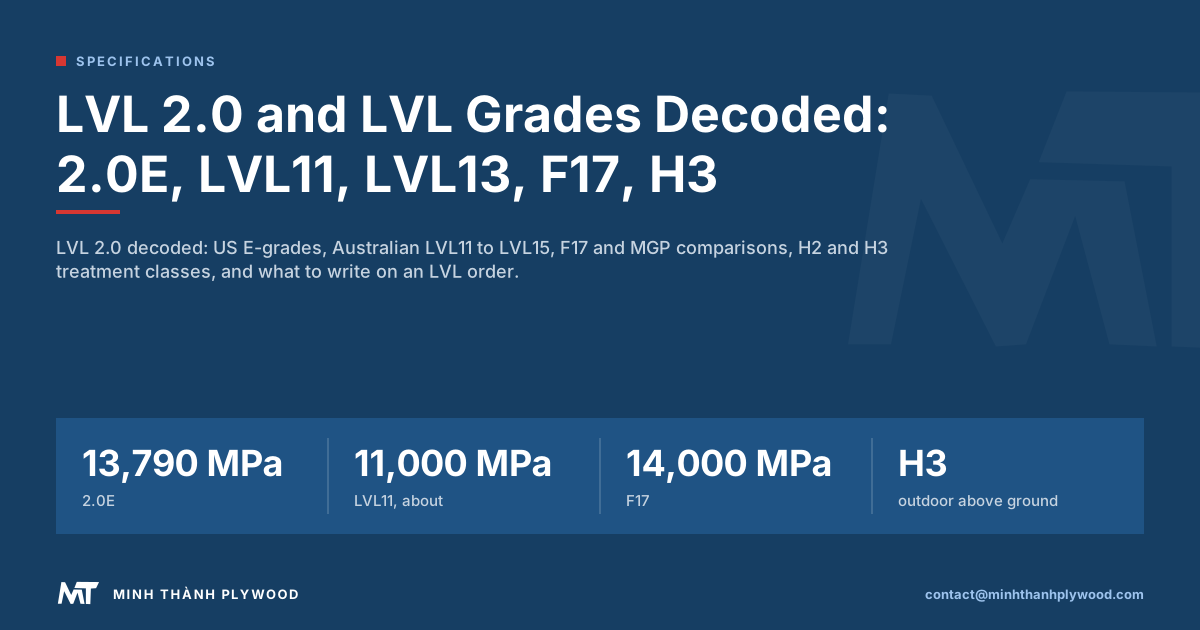
LVL 2.0 is short for a 2.0E laminated veneer lumber grade: its modulus of elasticity, the stiffness, is 2.0 million psi, about 13,800 MPa. In Australia and New Zealand the same idea is written as LVL13 or LVL14, the stiffness in gigapascals. This guide decodes US E-grades, Australian LVL numbers, F17 comparisons and H2 or H3 treatment. Minh Thanh Plywood makes LVL in Vietnam from plantation veneers.
LVL 2.0 meaning: the short answer
LVL 2.0 means laminated veneer lumber with a 2.0E grade: a modulus of elasticity (MOE) of 2.0 million pounds per square inch, about 13,800 MPa. The number tells you how stiff the member is, and stiffness sets how much a beam sags under load.
- US and Canada: LVL is named by E, in million psi: 1.5E, 1.9E, 2.0E, 2.1E, often with a bending value such as 2.0E-2900Fb.
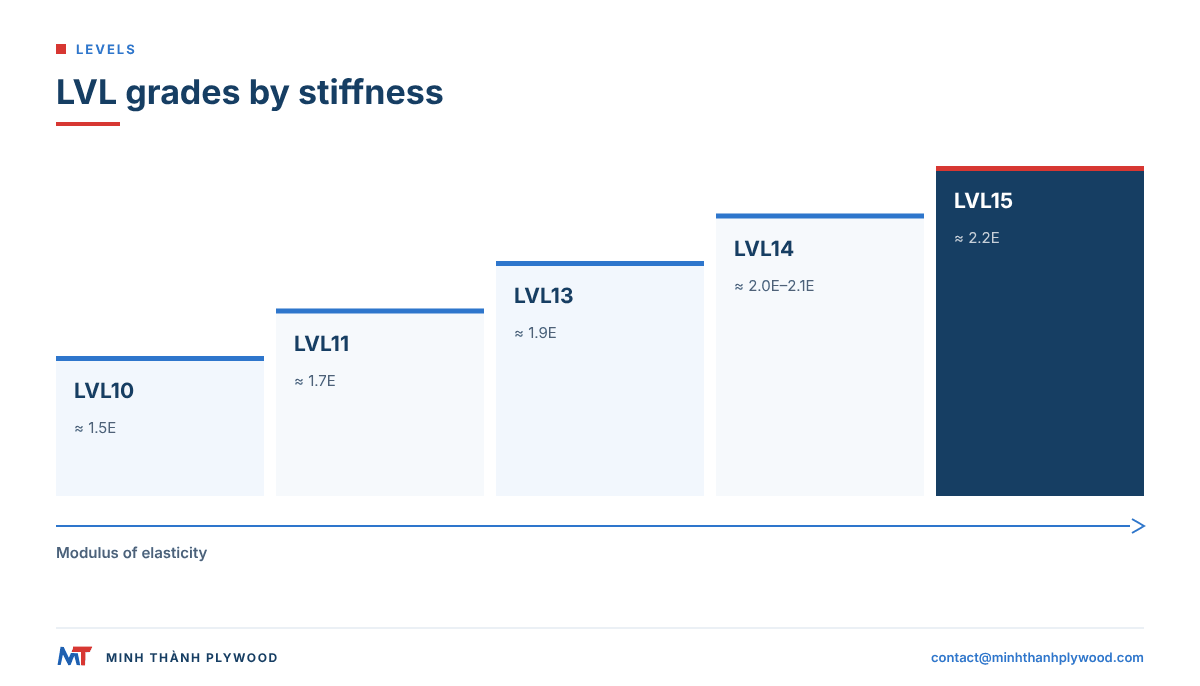
- Australia and New Zealand: LVL is named by E in gigapascals: LVL10, LVL11, LVL13, LVL14, LVL15.
- Europe: producers declare characteristic values under EN 14374; LVL is grouped as LVL-P (all veneers parallel) or LVL-C (some veneers crosswise).
LVL 2.0 is therefore close to the Australian LVL13 or LVL14: three names for nearly the same stiffness. Our LVL laminated veneer lumber page explains how the product is built.
LVL grade decoder table
The decoder table converts each US E-grade into MPa and the nearest Australian LVL name. Use it to compare quotes from different markets, then size the member from the producer’s own published values.
| US E-grade | MOE (million psi) | MOE (MPa) | Nearest AU/NZ name |
|---|---|---|---|
| 1.3E | 1.3 | about 8,960 MPa | Below LVL10 |
| 1.5E | 1.5 | about 10,340 MPa | LVL10 |
| 1.7E | 1.7 | about 11,720 MPa | LVL11 to LVL12 |
| 1.9E | 1.9 | about 13,100 MPa | LVL13 |
| 2.0E | 2.0 | about 13,790 MPa | LVL13 to LVL14 |
| 2.1E | 2.1 | about 14,480 MPa | LVL14 |
| 2.2E | 2.2 | about 15,170 MPa | LVL15 |
Conversion: 1 psi = 6.895 kPa, so 2.0 million psi × 6.895 = 13,790 MPa. The table matches stiffness only; bending strength, shear and bearing values differ between producers and must be read from each product’s data sheet.
What does 2.0E-2900Fb mean on an LVL beam?
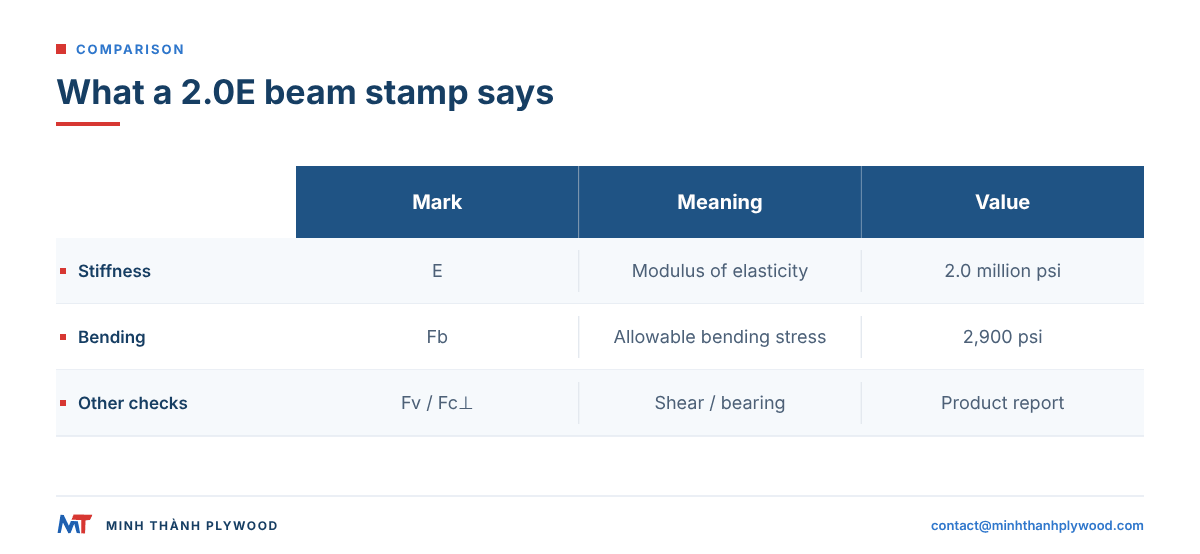
2.0E-2900Fb means a modulus of elasticity of 2.0 million psi and an allowable bending stress (Fb) of 2,900 psi, about 20.0 MPa. US LVL stamps give both numbers, because the first controls deflection and the second controls breaking strength.
- E (modulus of elasticity): stiffness, in million psi; sets deflection.
- Fb (bending): allowable bending stress, in psi; common values are 2,600, 2,900 and 3,100 psi (about 17.9, 20.0 and 21.4 MPa).
- Fv (shear): allowable shear stress along the grain.
- Fc⊥ (bearing): compression perpendicular to grain, which sets the bearing length at supports.
- Evaluation: US structural LVL is evaluated to ASTM D5456 and listed in an evaluation report with its design values.
Two beams both called 2.0E can carry different loads if their Fb values differ. The span table of the actual product is what the engineer uses.
What are representative 2.0E design values, and what backs them?
Representative 2.0E values are a bending stress Fb of 2,900 psi, a compression stress parallel to grain Fc of 2,900 psi and a mean modulus of elasticity E0,mean of 13.8 kN/mm² (13,800 MPa). They are a guide only: design from the supplier’s ICC-ES or APA evaluation report, never from a catalogue figure.
A real grade stamp is backed by a named report. Weyerhaeuser’s 2.0E Microllam LVL, for example, is listed in ICC-ES report ESR-1387 (US), CCMC evaluation 08675-R (Canada) and Florida approval FL6527-R16, and has beam guides for 22 and 24 inch depths. Ask any LVL supplier for the same trail: report number, standard and design values. For the US standard behind such reports, see ASTM D5456; the US Forest Products Laboratory Wood Handbook covers structural composite lumber, including LVL, in its chapter on wood-based composite materials.
Australian LVL grades: LVL10 to LVL15
Australian and New Zealand LVL grades are named by the modulus of elasticity in gigapascals, rounded: LVL11 means about 11 GPa, LVL13 about 13 GPa. Structural LVL is made and verified under AS/NZS 4357.0, and each producer publishes its own characteristic values.
| AU/NZ grade | MOE, about | Typical uses |
|---|---|---|
| LVL10 | 10,000 MPa | Studs, plates, light lintels |
| LVL11 | 11,000 MPa | Wall framing, formwork bearers, lintels |
| LVL12 | 12,000 MPa | Framing and beams in some product ranges |
| LVL13 | 13,000 MPa | Floor bearers, beams, rafters |
| LVL14 | 14,000 MPa | Beams and lintels instead of F17 hardwood |
| LVL15 | 15,000 MPa | Long-span beams and headers |
Builders searching “lvl 13”, “lvl 14” or “15 lvl” are looking for these grades. Each brand’s range does not include every number; a producer may offer LVL11 and LVL13 only, for example.
Which Australian LVL brands sell which grade?
Australian builders mostly meet LVL13 under a few brand names, so the table below maps each name to the grade it sells. Wesbeam, a Western Australian maker, sells e-beam, which it calls E13 or E13.2 after its short-term average modulus of elasticity, in lengths up to 12.6 m. It is offered as a size-swap for common F17/E14 call-ups. The hySPAN range (Carter Holt Harvey) is made to AS/NZS 4357 in 35, 45, 63 and 75 mm thicknesses with lengths up to 13.2 m; the range now appears in shops as meySPAN.
| Brand | Grade sold | Sections and lengths | Treatment and standard |
|---|---|---|---|
| Wesbeam e-beam | E13 / E13.2 (LVL13) | 35, 45, 63 and 75 mm thick; depths 90 to 450 mm by thickness; up to 12.6 m | Internal and external; AS/NZS 4357 |
| hySPAN / meySPAN | LVL13 class (E13) | 35 to 75 mm thick; depths 90 to 600 mm; up to 13.2 m | H2-S termite treatment south of the Tropic of Capricorn; AS/NZS 4357 |
| Minh Thanh LVL | Not an evaluated E-grade | Billets cut to the buyer’s drawing | Ordered by species, density, bond, section and moisture |
Design to AS 1720.1 with the producer’s own span tables. Shelf prices per lineal metre change by section, length and state, so Australian shops quote them per metre; for container volumes, LVL is quoted per m³ by quotation.
LVL 7, LVL 11 and other numbers: what is real?
LVL 11 is a real and common Australian grade; LVL 7, LVL 5, LVL 17 and LVL 18 are not usual structural grade names. Common structural LVL sits between about 10,000 and 15,000 MPa, so a number far outside that range is either a product code, a size or a different system.
- LVL 11, LVL 12, LVL 13, LVL 14, LVL 15: AU/NZ stiffness grades, in GPa.
- LVL 5 or LVL 7: often a thickness or a product line code, or non-structural LVL; ask for the declared MOE.
- LVL 17 or LVL 18: usually a mix-up with F17 hardwood, or a section size; check the data sheet.
- 2.0: almost always the US 2.0E grade.
When a quote shows a grade you cannot find in a standard, ask for the declared modulus of elasticity, the bending value and the standard the product is verified under. If the supplier cannot give them, the LVL is not a structural grade.
F17 LVL: how LVL compares with F-grade hardwood
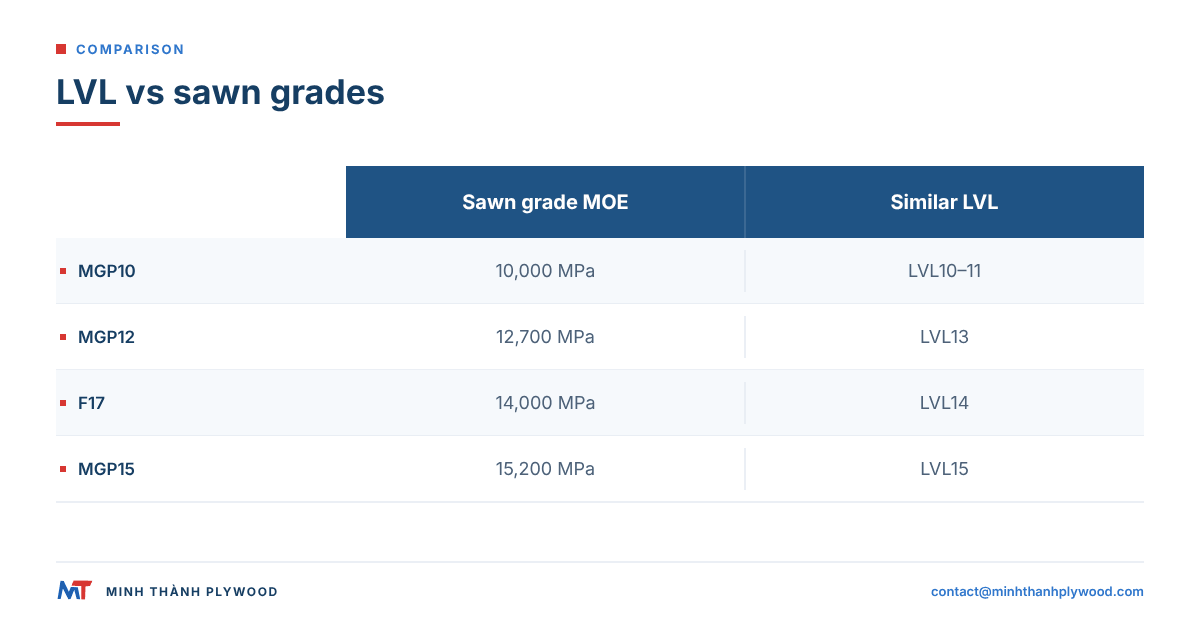
“F17 LVL” means LVL used instead of F17 sawn hardwood; LVL14 is the usual like-for-like match, because F17 has a design modulus of elasticity of 14,000 MPa under AS 1720.1. LVL gives the same stiffness with less variation and in longer, straighter lengths.
| Sawn timber grade | MOE (MPa) | Bending f’b (MPa) | LVL of similar stiffness |
|---|---|---|---|
| F8 | 9,100 MPa | 22 MPa | Below LVL10 |
| F14 | 12,000 MPa | 36 MPa | LVL12 |
| F17 | 14,000 MPa | 42 MPa | LVL14 |
| F27 | 18,500 MPa | 67 MPa | Above common LVL |
F-grades are stress grades for sawn timber; the number comes from the old basic working stress in MPa (F17 has a characteristic bending strength of 42 MPa). An LVL member replacing an F17 beam must be checked for bending, shear and deflection with the LVL’s own values.
MGP10 and MGP12 vs LVL: which grade replaces which?
MGP10 and MGP12 are machine-graded pine grades with a modulus of elasticity of 10,000 and 12,700 MPa, so LVL10 to LVL13 replace them in framing where a straighter or longer member is needed.
| Pine grade | MOE (MPa) | Typical LVL substitute |
|---|---|---|
| MGP10 | 10,000 MPa | LVL10 or LVL11 |
| MGP12 | 12,700 MPa | LVL13 |
| MGP15 | 15,200 MPa | LVL15 |
Pine framing is cheaper per metre; LVL earns its place in lintels, long beams and parts where sawn timber twists or bows. The construction plywood that sheathes these frames is chosen separately.
H2 and H3 LVL: treatment hazard classes
H2 and H3 are hazard classes under the Australian standard AS 1604: H2 LVL is treated against termites and borers for dry inside use, and H3 LVL is treated for outdoor use above ground. The H number tells you where the member can go, not how strong it is.
| Class | Exposure | Typical LVL use |
|---|---|---|
| H1 | Inside, dry, protected from termites | Furniture and joinery parts |
| H2 | Inside, dry, termite risk | House framing in termite areas |
| H3 | Outside, above ground, weather exposed | Decks, pergolas, exposed beams |
| H4 | In ground contact | Not common for LVL |
| H5 | In ground or fresh water, critical | Not common for LVL |
| H6 | Marine | Not used for LVL |
H3 LVL still needs end sealing after cutting, because a fresh cut exposes untreated wood. For in-ground posts, use a member made and treated for H4 or H5.
Bond and glue: what keeps an LVL grade valid
A structural LVL grade only holds if the glue line keeps its strength in the moisture the member will see, so the bond is part of the grade. Structural LVL uses exterior-type phenolic adhesive; interior components can use other bonds.
- Phenolic (WBP): water- and boil-resistant; the usual bond for structural LVL and outdoor exposure.
- MR or melamine-fortified: moisture-resistant for damp interior or protected use.
- UF at E0 emission: interior, dry use, low formaldehyde emission for furniture parts.
Our LVL interior option is UF glue at E0 emission, with E1 also available; MR or melamine-fortified and phenolic (WBP) bonds are made to the buyer’s specification. Emission class and bond are two separate lines on the order.
Moisture, density and size: the other grade lines
An LVL grade is valid at the moisture content and density the producer declares, so these belong on the order too. Wet LVL is less stiff and can swell at its edges.
- Moisture: our LVL veneers and members are dried to 8–12 % moisture content at dispatch.
- Density: Acacia LVL about 580 kg/m³; Eucalyptus LVL 650–750 kg/m³.
- Billet format: 1220 × 2440 or 1250 × 2500 mm, then cut to the members on the buyer’s drawing.
- Tolerance: thickness, width and length to the drawing; length and width ±2 mm on panels.
Density also sets the weight per metre: a 45 × 90 mm Acacia member weighs about 0.045 × 0.090 × 580 = 2.3 kg per metre, before packing.
Structural vs non-structural LVL
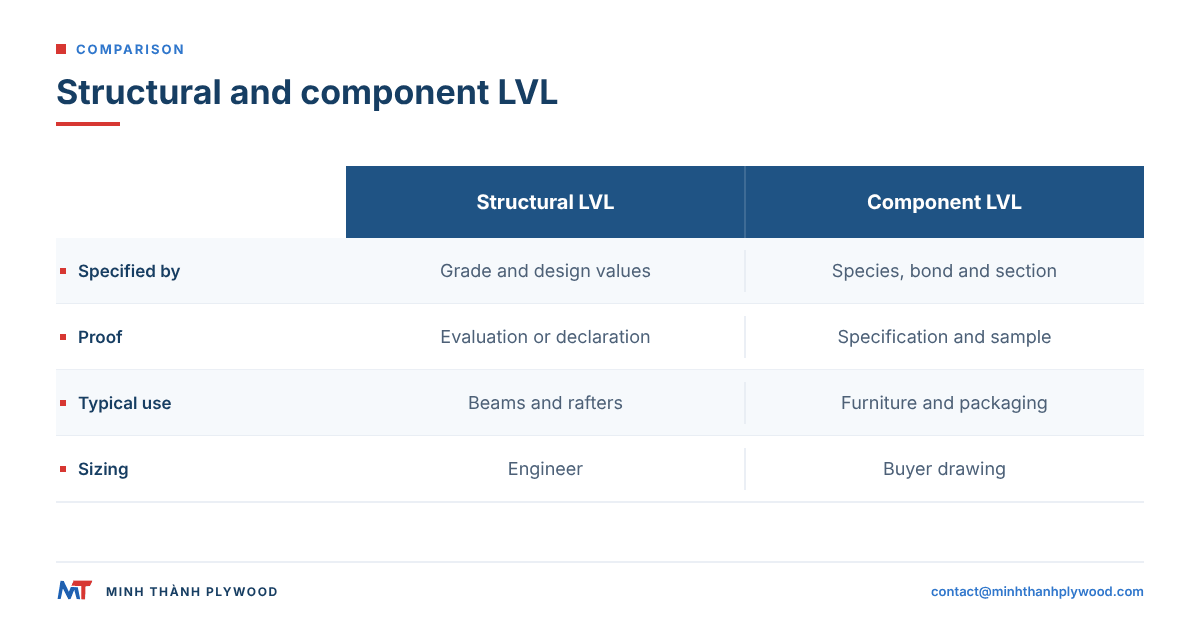
Structural LVL is an evaluated product with published design values under AS/NZS 4357.0, EN 14374 or ASTM D5456; non-structural LVL is made to a drawing for parts that do not carry building loads. Both are veneers glued with the grain along the member; the difference is the evaluation and the stamp.
| Point | Structural LVL | Non-structural LVL |
|---|---|---|
| Named by | E-grade or LVL number | Species, density, bond, section |
| Proof | Evaluation report or declaration of performance | Order specification and sample |
| Stamp on the member | Grade, producer, standard | Not required |
| Typical uses | Beams, lintels, bearers, rafters | Furniture frames, door stiles, packaging runners |
| Who sizes it | The engineer, from design values | The buyer, from the drawing |
Our LVL is made for specified components such as furniture frames, door members and packaging, ordered by species, density, bond, section and moisture.
How to read an LVL quote or stamp
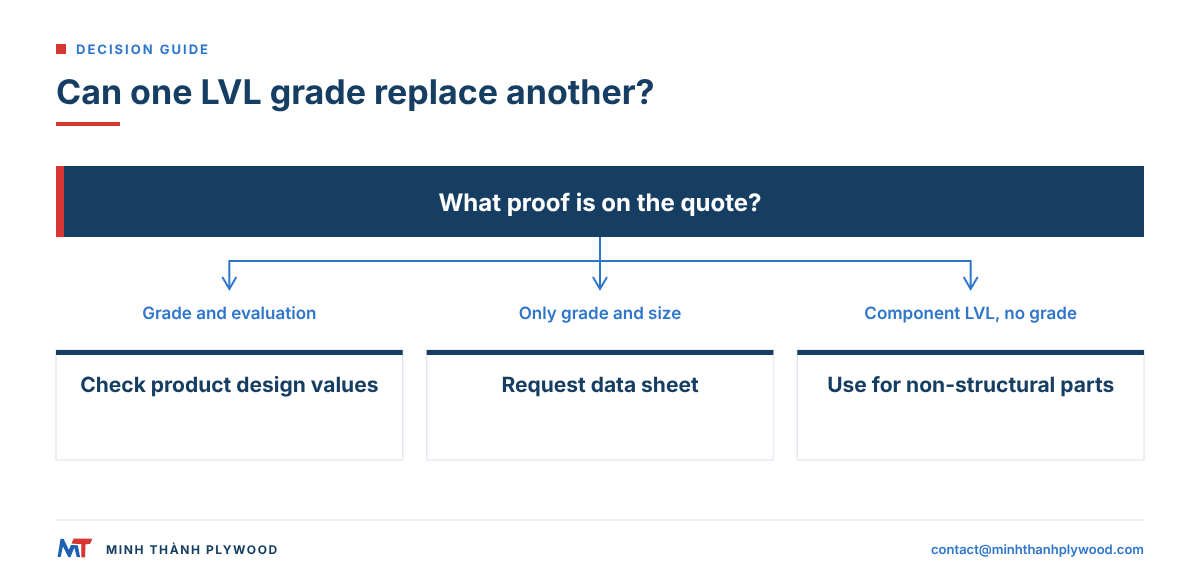
Read an LVL quote line by line: grade, section, length, species, bond, treatment and standard. A quote that gives only “LVL 2.0” or “LVL13” and a size is not enough to compare two suppliers.
- Grade: E-grade or LVL number, plus Fb or bending value.
- Standard: AS/NZS 4357.0, EN 14374 or ASTM D5456, and the evaluation report or declaration.
- Section: thickness × depth in mm, and length.
- Species: radiata pine, Acacia, Eucalyptus, poplar or another veneer.
- Bond: phenolic, MR or melamine-fortified, or UF at E0 emission.
- Treatment: H1, H2, H3 or none.
- Moisture: content at delivery.
If any line is missing on a structural quote, ask for the data sheet before ordering.
LVL grades in Europe and the US
In the US, LVL is evaluated to ASTM D5456; in Europe, LVL is placed on the market under EN 14374 with a declaration of performance and CE marking, and its characteristic values are declared under EN 14374, while EN 14279 sets the definitions and classification (LVL-P, LVL-C). The names on the member differ, but each system gives the engineer a stiffness and a bending value.
| Region | Standard | How the grade is shown |
|---|---|---|
| Australia / New Zealand | AS/NZS 4357.0 | LVL10–LVL15 by stiffness |
| United States / Canada | ASTM D5456 | E-grade and Fb, e.g. 2.0E-2900Fb |
| Europe | EN 14374, EN 14279 | Declared values in the DoP; LVL-P or LVL-C |
European LVL is placed on the market under the Construction Products Regulation (Regulation (EU) No 305/2011, read 20 October 2026).
What this means for your LVL order
For components, order LVL by what the part needs: species, density, bond, section, length and moisture. For our LVL, send these lines with your request:
- Application: furniture frame, door member, packaging runner or other component.
- Species: Acacia (about 580 kg/m³) or Eucalyptus (650–750 kg/m³) plantation veneer.
- Glue and emission: UF glue at E0 emission for interiors, E1 also available; MR or melamine-fortified and phenolic (WBP) for damp areas.
- Section and length: thickness, width and length per piece, with grain direction.
- Moisture: 8–12 % at dispatch.
- Packing and quantity: from one 40HC, mixed specifications by agreement.
Production takes 15–45 days after the deposit, and free samples are available. Related reading: what is LVL, LVL strength, LVL beams and can LVL be used outside.
Buyer questions, answered
What does 2.0E mean on LVL?
2.0E means the LVL's modulus of elasticity is 2.0 million pounds per square inch, about 13,800 MPa. It tells the engineer how stiff the beam is, which controls how much it deflects under load.
What is the difference between 1.9E and 2.0E LVL?
2.0E LVL is about 5 % stiffer than 1.9E LVL, so it deflects slightly less over the same span. The two are not interchangeable without checking the span tables for the grade on the drawing.
What does LVL13 mean?
LVL13 is an Australian and New Zealand LVL name meaning a modulus of elasticity of about 13 GPa, or 13,000 MPa. It sits close to US 1.9E and 2.0E LVL.
Is LVL stronger than F17 hardwood?
F17 sawn hardwood has a design modulus of elasticity of 14,000 MPa, similar to LVL14. LVL usually has more consistent strength than sawn F17 timber, but members must be sized from each product's published design values.
What is LVL11 used for?
LVL11, with a stiffness of about 11,000 MPa, is used for wall framing, studs, lintels over short openings and formwork bearers, where an MGP10 or MGP12 pine member would otherwise go.
What is H3 LVL?
H3 LVL is laminated veneer lumber treated to hazard class H3 under AS 1604, for use outdoors above ground, such as decks, pergolas and exposed framing protected from soil contact. It is not for in-ground use, which needs H4 or higher.
What is H2 LVL?
H2 LVL is treated against termites and borers for inside, above-ground use, such as house framing in termite areas. It must stay dry and protected from the weather.
Is there an LVL 7 or LVL 17 grade?
Common structural LVL sits between about 10,000 and 15,000 MPa, so labels such as LVL 7 or LVL 17 are not usual structural grade names. Ask the supplier for the declared modulus of elasticity and bending value before you compare.
What grade is Minh Thanh LVL?
Our LVL is made for specified components such as furniture frames, door members and packaging, from Acacia or Eucalyptus plantation veneers. It is ordered by species, density, bond, section and moisture, not sold as an evaluated structural E-grade.
Can I swap a 2.0E LVL beam for LVL11?
No, not without an engineer's check. LVL11 is about 20 % less stiff than 2.0E LVL, so the same section would deflect more; a deeper or doubled member is usually needed.