
LVL beams are straight structural members made from thin veneers glued with every grain running along the length, so they carry more load and stay straighter than sawn timber of the same size. They serve as headers, floor and ridge beams, rim boards and blocking, and in non-structural form as furniture, door and packaging members. This guide from Minh Thanh Plywood covers uses, sizes, grades and how to order.
What is an LVL beam?
An LVL beam is a beam made of laminated veneer lumber: veneers about as thick as a fingernail, glued under heat and pressure with all or nearly all of their grain running along the length. The result is a straight, dimensionally uniform member that is stronger in bending than sawn timber of the same section.
The name tells the build. “Laminated” means many layers bonded together, “veneer” means each layer is peeled from a log rather than sawn, and “lumber” means the product is used like a piece of timber, not like a sheet. LVL laminated beams are made as wide billets and then ripped into members of the depth the buyer orders.
Three things set an LVL beam apart from a sawn beam:
- Defects are spread out. A knot in one veneer sits beside clear wood in the next, so no single weak point runs through the section.
- Moisture is controlled. Veneers are dried before gluing, so the member arrives dry and does not shrink or twist in the wall the way green timber can.
- Length is free. Veneer joints are staggered through the billet, so members are made far longer than the logs they come from.
“Lam beam” is the site word for the same product, and “laminated veneer beam” is a longer name for it. For a full definition of the material, read the guide What is LVL? Meaning and uses.
What are LVL beams used for?
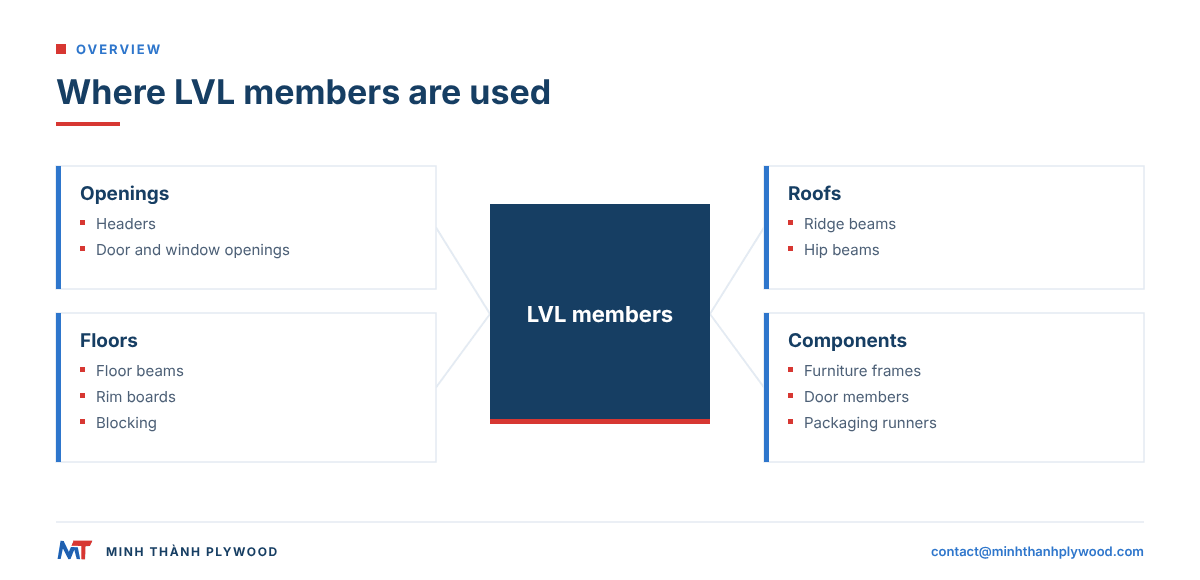
LVL beams are used wherever a straight member must carry a load across an opening or along a floor: headers over doors and windows, floor beams, ridge and hip beams, rim boards, stair stringers, blocking and, in thicker sections, posts and columns. In factories, non-structural LVL makes furniture frames, door stiles and packaging runners.
| Use | Where it sits | Why LVL is chosen |
|---|---|---|
| Header | Over a door, window or garage opening | Carries the load above without sagging or twisting |
| Floor beam | Under joists, across a basement or open plan | Long lengths, straight top edge for a flat floor |
| Ridge or hip beam | Along the roof peak | Spans between posts with little creep |
| Rim board | Around the edge of a floor frame | Same depth as the I-joists, stays square |
| Blocking | Between joists or studs | Stable stiffener and fixing ground |
| Post or column | Under a point load | Thick sections glued or fastened up |
| Furniture frame | Sofa, bed and cabinet frames | Straight, screw-holding, no knots on edges |
| Door member | Stiles, rails and lock blocks | Stays flat under veneer or laminate |
| Packaging runner | Crate skids and pallet bearers | Uniform strength, dry, insect-free veneer |
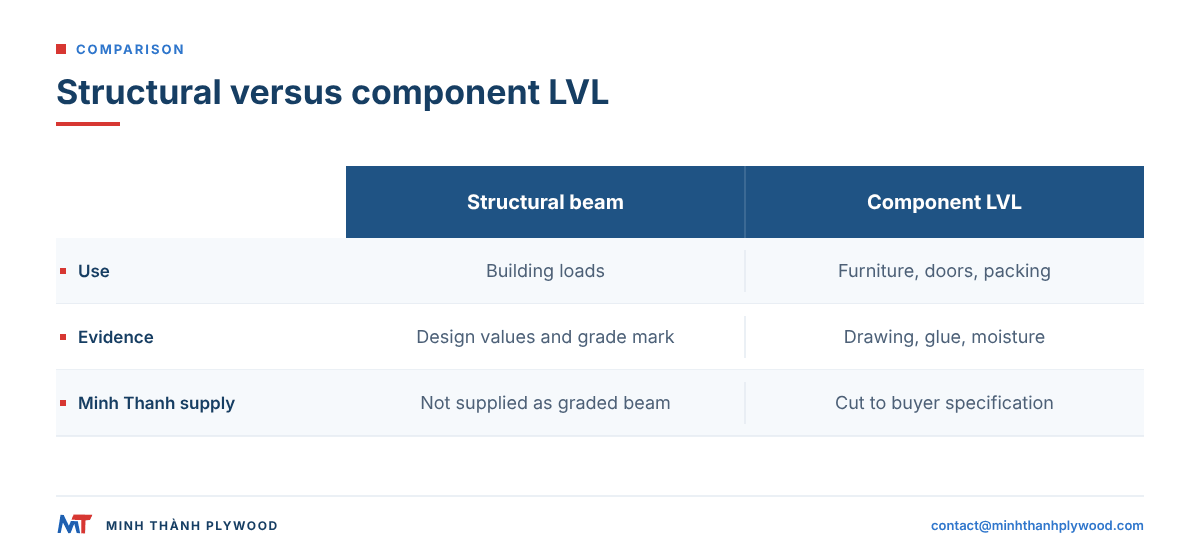
The first six rows are structural uses: they need a product with published design values that the local building code accepts. The last three are component uses, where the member is sized by the furniture, door or crate maker. Minh Thanh supplies the component side, from Acacia or Eucalyptus plantation veneers.
Lumber LVL beam vs sawn lumber: which is better?
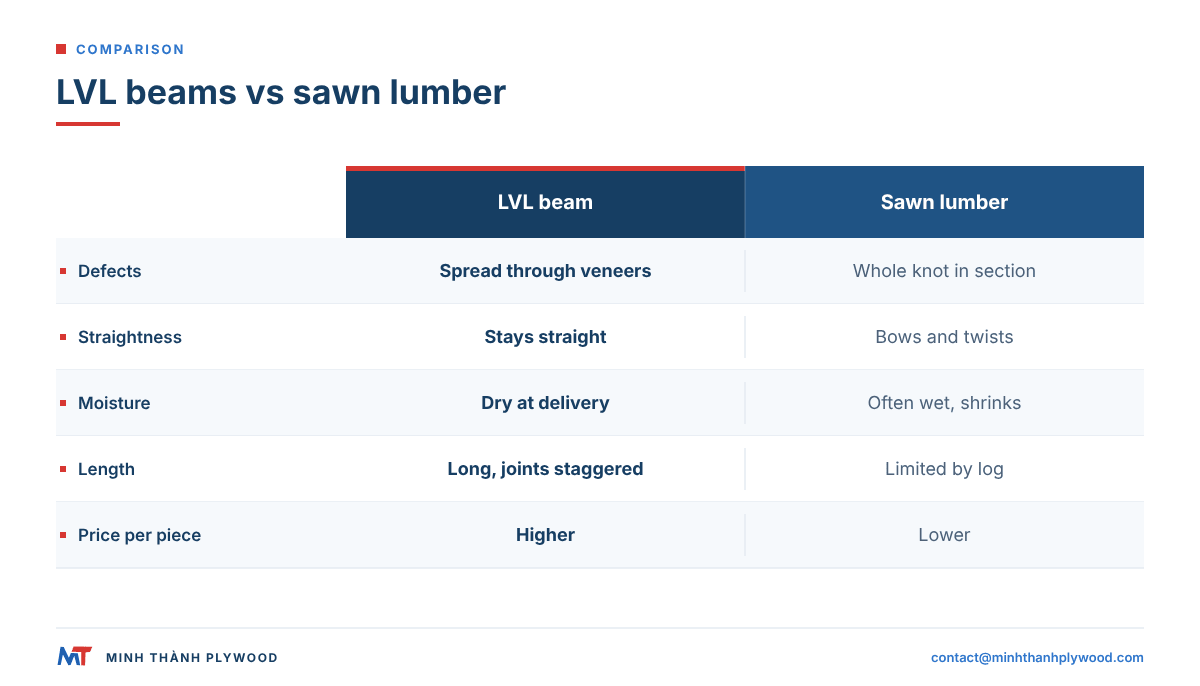
LVL beams are the better choice when a member must be long, straight and predictable; sawn lumber is the better choice for short, lightly loaded members where cost per piece decides. The table compares them on the points a buyer or specifier checks.
| Metric | LVL beam | Sawn lumber beam |
|---|---|---|
| Grain and defects | Knots and slope of grain spread through many veneers | One knot or split can weaken the whole section |
| Consistency between pieces | Narrow, set by veneer grading and press control | Wide, set by the log and visual grade |
| Straightness | Stays straight, little twist, cup or crown | Bows, twists and crowns as it dries |
| Moisture at delivery | Dry: veneers dried before gluing | Often above service moisture, shrinks in place |
| Length | Long members from staggered veneer joints | Limited by the log |
| Design values | Higher, published per evaluated product | Lower, by species and visual grade |
| Depth for the same load | Shallower | Deeper, or doubled up |
| Weight per metre | Higher density than many sawn softwoods | Lower for softwoods |
| Appearance | Industrial edges, glue lines visible | Natural timber look |
| Price per piece | Higher | Lower |
Verdict by use. Choose LVL for headers over wide openings, beams that carry floors or roofs, and any member where a twist or crown would show in the finish. Choose sawn lumber for short headers in light walls, studs and non-critical framing. In furniture and door plants the same logic holds: LVL for rails and stiles that must stay straight under a veneer or laminate, sawn timber where the part is short and visible.
“Lumber LVL beam” is how many yards list it: an engineered lumber product sold beside sawn timber, priced per piece or per lineal foot.
LVL laminated beams vs glulam and plywood
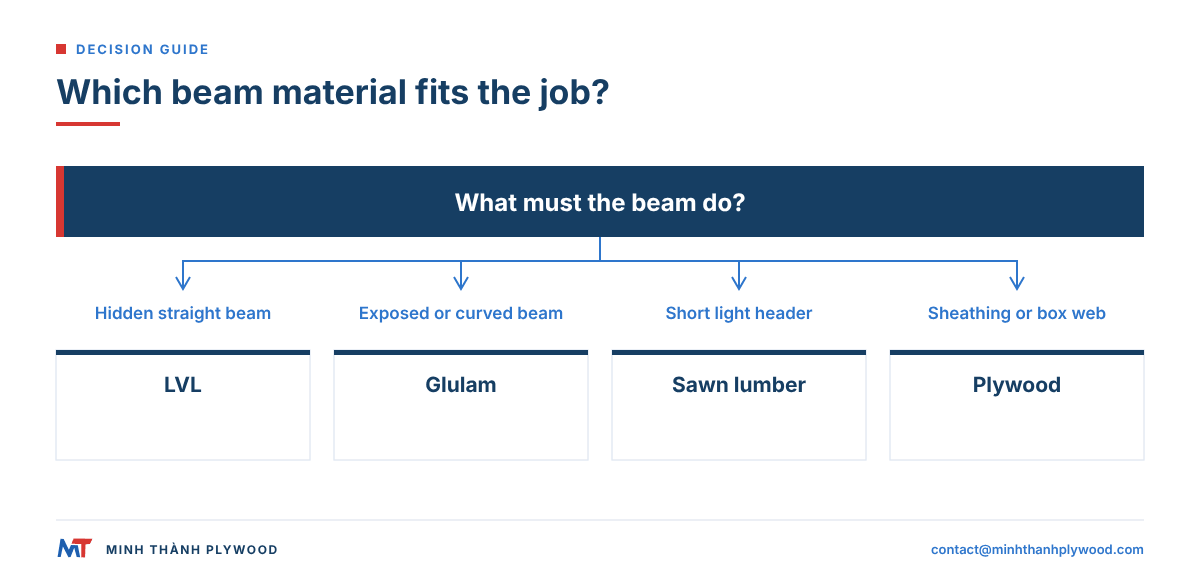
For a straight, hidden beam, LVL is usually the most efficient choice; glulam suits exposed and curved architectural beams; plywood is a sheet for sheathing and box beams, not a beam on its own.
| Point | LVL | Glulam | Plywood |
|---|---|---|---|
| Built from | Thin veneers, grain along the member | Sawn laminations glued in layers | Veneers with alternating grain |
| Shape | Straight members only | Straight, curved or tapered | Flat sheets |
| Appearance | Hidden framing finish | Architectural, can be exposed | Faces chosen for the look |
| Best use | Headers, floor and roof beams, rim boards | Exposed beams, long-span halls | Sheathing, webs of box beams, furniture panels |
| Strength along the length | Highest per section | High | Lower: only part of the veneers run along it |
Plywood vs LVL for beams is a question builders in many markets ask, including Israel and the Gulf, where both are imported. The answer is the same everywhere: a sheet with crossed veneers resists splitting and stays flat in two directions, which suits floors, walls and furniture panels; a member with all veneers along its length carries a load across a span. The guide LVL vs plywood compares the two materials point by point.
What sizes do LVL beams come in?
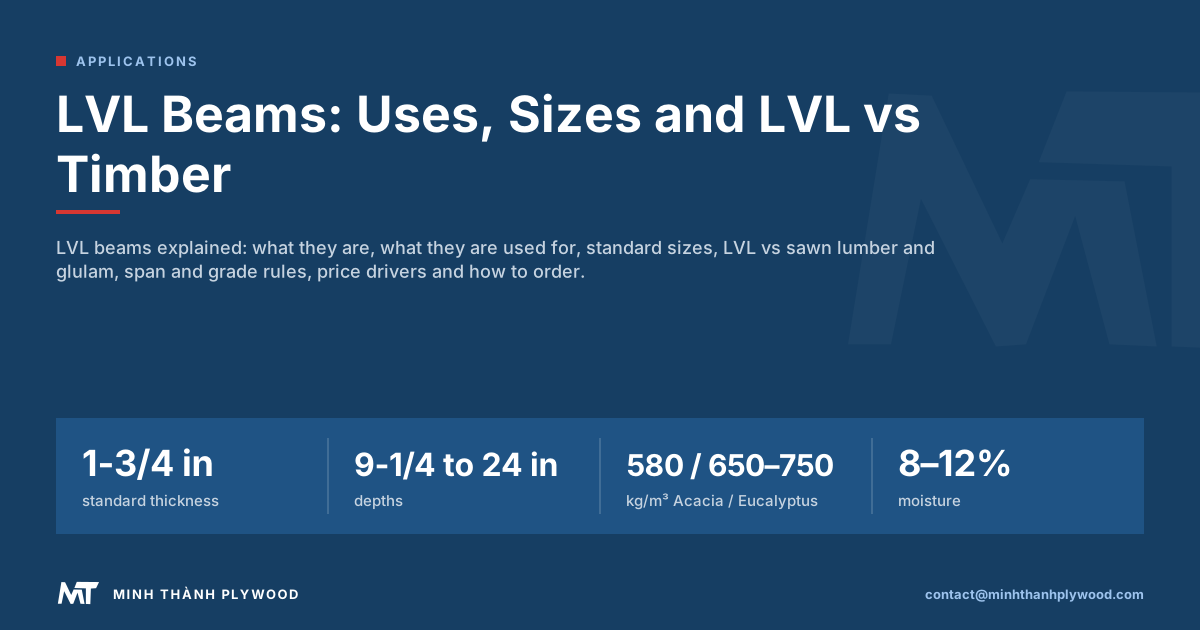
In North America, LVL beams come in a standard thickness of 1-3/4 inches and depths from about 9-1/4 to 24 inches, in long lengths; wider beams are made by nailing or bolting two, three or four plies together. Elsewhere, LVL is sold in metric sections cut from billets to the depth the project needs.
| Format | Typical sizes | How it is used |
|---|---|---|
| North American beam | 1-3/4 inch thick; depths about 9-1/4, 9-1/2, 11-1/4, 11-7/8, 14, 16, 18 and 24 inches | Single ply, or two to four plies fastened together |
| Rim board | Depths matching the I-joists of the floor | Edge of floor frames |
| Metric structural sections | Thickness and depth set by the producer’s range | Beams, purlins, studs and posts |
| Billets | Wide panels ripped to order | Members cut to the buyer’s drawing |
| Minh Thanh billet formats | 1220 × 2440 mm or 1250 × 2500 mm | Furniture, door and packaging members cut to section |
Two rules keep a size order right. First, give the finished section (thickness × depth × length) and the grain direction, never only a trade name. Second, for structural work, order the depth from the span table of the product you will install, because two brands with the same nominal size can carry different loads.
Stock lengths and Canadian shelf prices. North American beams are stocked in 12 to 26 ft lengths (about 3.7 to 7.9 m), in 2 ft steps, so a header is bought as a whole piece and cut on site. Typical 2026 prices for 1-3/4 × 11-7/8 inch beams at Canadian yards run about CAD 9.3 to 9.7 per lineal foot before tax, and vary by yard and week:
| Piece | Yard | Price (CAD, before tax) |
|---|---|---|
| 1-3/4 × 11-7/8 in × 12 ft | Peacock Lumber | 115.90 each, about 9.66 per ft |
| 1-3/4 × 11-7/8 in × 18 ft | Downtown Lumber | 172.62 each, about 9.59 per ft |
| 1-3/4 × 11-7/8 in × 20 ft | Canac | 186.12 each, about 9.31 per ft |
| 1-3/4 × 11-7/8 in × 24 ft | Peacock Lumber | 231.80 each, about 9.66 per ft |
The metal hangers and connectors for these beams are priced per piece as a separate line at Peacock Lumber. The guide LVL sheet sizes and dimensions lists the mill formats in full.
How far can an LVL beam span?
An LVL beam spans as far as its depth, thickness and grade allow under the load it carries: the same 11-7/8 inch beam spans further as a roof ridge with a light roof than as a floor beam carrying a wall. There is no single number; the span comes from the evaluated product’s span table, checked by the engineer for the actual loads.
What decides the span:
- Load type. Floor live load, roof snow load, a bearing wall above or a point load from a post.
- Depth. Stiffness rises steeply with depth, so a deeper beam spans much further than a thicker one.
- Number of plies. Two plies carry about twice the load of one at the same depth.
- Grade. Stiffer grades, such as the 2.0E class in North America, deflect less.
- Deflection limit. Floors that carry tile or stone need a stiffer limit than roofs.
- Bearing length. Each end needs enough bearing on the post or wall to carry the reaction.
Producers publish span tables for their own grades; span tables do not transfer from one brand to another. Our guide LVL beam span chart explains how to read them.
What grades and certification do structural LVL beams need?
A structural LVL beam needs published design values from a recognised evaluation and a grade mark on every piece, under the code of the country where it is built. Without them, a building inspector will not accept the member as a beam, however strong it looks.
| Market | Product standard or route | What the beam carries |
|---|---|---|
| United States | Evaluation to ASTM D5456, code evaluation report | Grade stamp with producer, grade class (for example 1.9E or 2.0E) and report number |
| Canada | CCMC evaluation listing, design values under CSA O86, 2.0E or 1.9E grade stamp | Grade stamp and CCMC report number (for example Weyerhaeuser Microllam 2.0E: CCMC ER 08675-R) |
| European Union (EN 14374 structural LVL) | CE marking under the Construction Products Regulation (EU) No 305/2011 | CE mark and declaration of performance |
| Australia and New Zealand | AS/NZS 4357.0 structural LVL | Product mark and grade |
Where the span table comes from. In Canada and the United States the span table is the producer’s own evaluated guide, not a generic chart: a Canadian building official accepts a beam on its CCMC listing and the producer’s published design values, and a US one on the code evaluation report (for example ICC-ES ESR-1387 for Weyerhaeuser Microllam). A beam without a listing cannot be sized from any table, which is why a Canadian or US structural buyer purchases evaluated LVL locally.
What Minh Thanh supplies. Our LVL is made for furniture, door and packaging members, sized by the buyer’s own drawing and tests. Our LVL is non-structural component grade, and we do not supply graded structural beams: for a house header or a floor beam, specify a product evaluated and graded for your market, chosen by the project engineer.
LVL beams, posts, studs and blocking: one material, four shapes
The same LVL billet becomes a beam, a post, a stud or blocking depending on how it is ripped and how it carries load. A beam works on edge in bending, a post works on end in compression, a stud works in a wall, and blocking ties joists together.
- Beams and headers are ripped deep and narrow and loaded on edge, so most of the veneers sit in tension and compression at the top and bottom.
- Posts and columns are made from several plies fastened or glued together to reach the cross-section, loaded along the grain.
- Studs in tall walls use LVL where sawn studs would bow; they stay straight for flat plasterboard and tiled walls.
- LVL blocking and rim boards match the depth of the joists and stay square, so the floor edge carries walls and fixings.
In component work the same four shapes appear at smaller scale: bed and sofa rails, cabinet posts, door lock blocks and crate skids. For bed bases, see our guide bed plywood: thickness and build for bed bases, where LVL slats are compared with plywood bases.
How are LVL beams made?
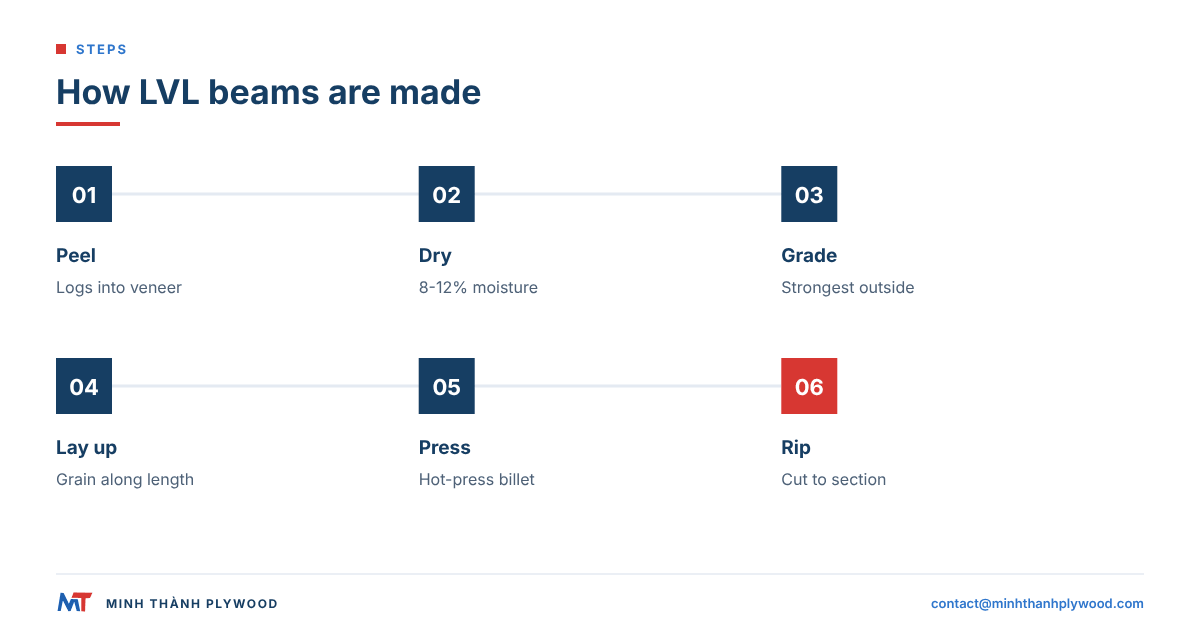
LVL beams are made by peeling logs into veneers, drying and grading them, laying them up with their grain along the length, pressing them into a thick billet and ripping the billet into members.
- Peel. Logs are rotary-peeled into thin continuous veneer.
- Dry. Veneers are dried to the moisture range for gluing; Minh Thanh dries to 8–12%.
- Grade. Veneers are sorted by defects and stiffness, so the strongest go to the outer layers.
- Glue and lay up. Glue is spread and veneers are stacked with every grain along the member, joints staggered from layer to layer.
- Press. The stack is hot-pressed into a solid billet.
- Rip and finish. The billet is cut to thickness, depth and length, sanded where faces show, then marked and packed.
For the full process, read How LVL is made.
What do LVL beams cost?
LVL beams cost more per piece than sawn timber of the same size and less than glulam, and the price follows section, length, grade and glue. Structural beams are sold per lineal foot or metre from stock; component LVL from a mill is priced per cubic metre for the build ordered.
What moves the price:
- Species and density. Eucalyptus veneer, at 650–750 kg/m³, makes a stiffer and heavier member than Acacia at about 580 kg/m³.
- Glue. UF glue at E0 emission for interiors; water-resistant MR / melamine-fortified or phenolic WBP bonds cost more.
- Section and length. Deep and long members waste more billet in cutting.
- Faces. Sanded, visible faces cost more than hidden framing faces.
- Quantity and packing. A full 40HC of one section is priced better than many small sections.
Retail price lists for structural beams move with the local lumber market. In Canada the shelf price of an 11-7/8 inch beam is about CAD 9.3 to 9.7 per lineal foot (see the table of yard prices above), so a 20 ft header costs about CAD 186 before tax and hardware. A mill quotes component LVL per cubic metre instead. For mill pricing, send the cutting schedule; the guide LVL price explains how a mill quotes per cubic metre.
How do you store, handle and install LVL beams?
Store LVL beams flat, off the ground and under cover, handle them on edge, and install them exactly as the producer’s guide says: full bearing at each end, plies fastened to the published schedule, and no cuts or holes the guide does not allow.
- Keep it dry. LVL leaves the press dry; rain and ground moisture make it swell at the edges and ends.
- Support the stack. Use bearers close enough that long members do not sag in storage.
- Do not notch or drill freely. A notch in the tension edge of a beam removes the strongest veneers.
- Fasten multi-ply beams to the schedule. Nails, screws or bolts in the rows and spacing the producer publishes.
- Seal cut ends of members that will see humidity before they are closed in.
For component members, the same rules apply on the factory floor: keep packs wrapped until machining and acclimatise them in the plant before cutting.
Non-structural LVL from Vietnam: where it fits
Non-structural LVL from Vietnam fits furniture frames, door components and packaging members, where a straight, dry, knot-free member at a stable price matters more than a structural grade stamp. Minh Thanh makes it from locally grown plantation veneers, the same timber that goes into our plywood cores.
| Specification | Minh Thanh LVL |
|---|---|
| Veneer species | Acacia or Eucalyptus plantation timber |
| Density | Acacia about 580 kg/m³; Eucalyptus 650–750 kg/m³ |
| Moisture at dispatch | 8–12% |
| Interior glue and emission | UF glue at E0 emission; E1 as an option |
| Water-resistant bonds | MR / melamine-fortified or phenolic WBP |
| Billet formats | 1220 × 2440 mm or 1250 × 2500 mm |
| Members | Cut to the buyer’s section and length |
| Documents | EUDR compliance dossier (origin records and geolocation files) |
Every shipment is photographed and filmed before loading, and the buyer receives the photos and video. For European buyers, we supply the EUDR dossier required under Regulation (EU) 2023/1115 with the order.
What this means for your order
An LVL order goes right when the drawing, not the word “beam”, defines it. Write the use, the finished section, the species and the bond on one line, and approve a sample before production.
A specification line for component LVL looks like this:
LVL, Eucalyptus veneer, grain along the length, UF glue at E0 emission, section and length to drawing no. …, cut from 1250 × 2500 mm billets, sanded on two faces, 8–12% moisture, packed for one 40HC.
For a structural beam, add the grade, the evaluation required in your market and the span table the engineer used, and buy from a producer that holds that evaluation.
Minh Thanh’s minimum order is one 40HC, with mixed specifications by agreement; production takes 15–45 days after the deposit, and free samples are available. Send your cutting schedule to [email protected] or see the LVL product page.
Buyer questions, answered
What is an LVL beam?
An LVL beam is a beam made of laminated veneer lumber: thin wood veneers glued under heat and pressure with their grain running along the member. It is straighter, more uniform and stronger in bending than sawn timber of the same section.
What are LVL beams used for?
Structural LVL beams are used for door and window headers, floor beams, ridge and hip beams, rim boards, blocking and posts. Non-structural LVL is used for furniture frames, door stiles and rails, and packaging runners.
Is an LVL beam stronger than a solid timber beam?
Yes, at the same section and grade class. Veneering spreads knots and grain defects through many thin layers, so LVL carries higher design values and deflects less than sawn timber of the same size.
How far can an LVL beam span?
It depends on the beam depth, thickness, grade and the load it carries. Take the span from the span tables of the exact evaluated product being installed, checked by the project engineer; spans do not transfer between brands.
What sizes do LVL beams come in?
In North America the standard thickness is 1-3/4 inches, with depths from about 9-1/4 to 24 inches, and plies are nailed together for wider beams. Billets are cut into members to order; Minh Thanh billets are 1220 × 2440 or 1250 × 2500 mm.
Can you use plywood instead of an LVL beam?
No. Plywood alternates grain direction, so only part of its veneers run along a beam. LVL puts all or nearly all of them along the length, which is why it is the beam material and plywood is the sheathing.
Is LVL better than glulam?
LVL is better for straight, hidden framing members where precision and cost per member count. Glulam is better for exposed, curved or very large architectural beams.
Can LVL beams be used outside?
Only with a water-resistant bond and protection. Phenolic WBP glue resists weather, but the faces and cut ends still need cover, treatment or cladding for long outdoor exposure.
Why are LVL beams so expensive?
They use peeled, dried and graded veneers, more glue and a heavier press than sawn timber, and structural products carry evaluation and grading costs. Per unit of load carried, they often cost less than an oversized sawn beam.
Does Minh Thanh supply structural LVL beams?
No. Minh Thanh supplies LVL for non-structural members: furniture frames, door components and packaging. Structural beams need a locally evaluated and graded product chosen by the project engineer.
What do I send to get an LVL quotation?
Send the application, member thickness, width and length, quantity, species, glue and emission class, face requirements and destination port. Free samples go out with the quotation.