
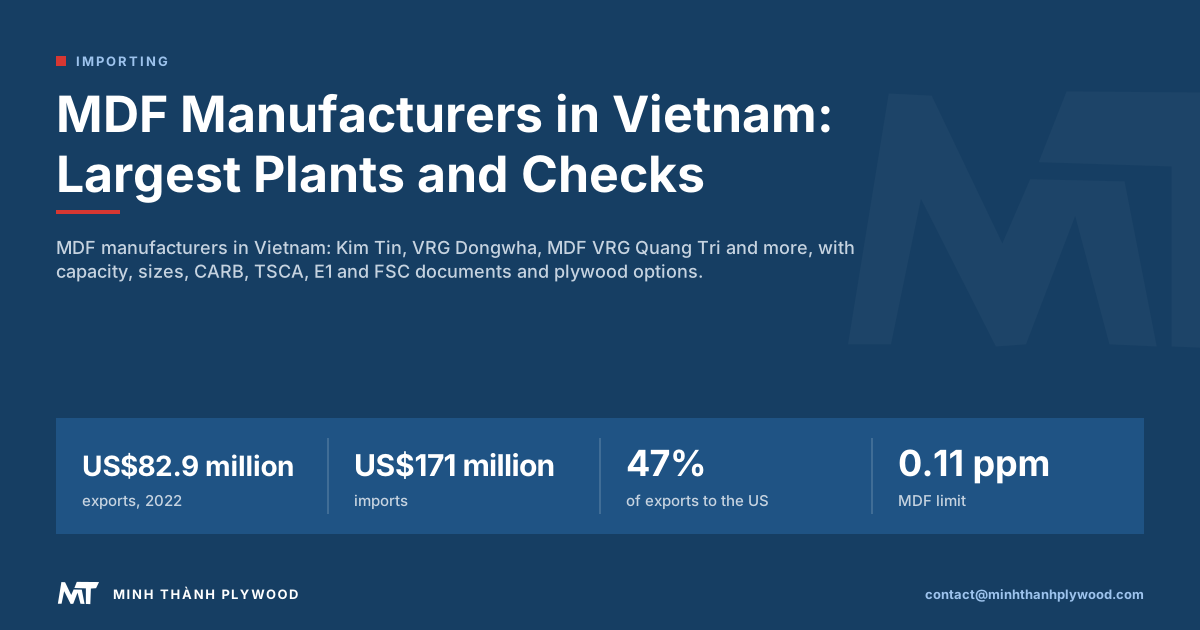
MDF manufacturers in Vietnam are a small group of large fibreboard plants, led by Kim Tin, VRG Dongwha and MDF VRG Quang Tri, that sell mostly to Vietnam's own furniture industry; the country exported US$82.9 million of fibreboard in 2022 and imported US$171 million. Minh Thanh Plywood makes plywood, not MDF, in Vietnam and explains how to qualify an MDF producer and when a plywood panel fits the part better.
MDF manufacturers in Vietnam: the short answer
MDF manufacturers in Vietnam are a few large fibreboard plants, led by Kim Tin Group, VRG Dongwha and MDF VRG Quang Tri; a buyer usually reaches them directly or through a distributor. Vietnam is a net importer of fibreboard: it exported US$82.9 million under HS 4411 in 2022 and imported US$171 million.
- Who makes MDF: large integrated plants using plantation wood fibre, plus lines for thin MDF and HDF; the largest are in Dong Nai (including former Binh Phuoc) in the south.
- Who sells it abroad: the plants themselves, their distributors and trading companies.
- Main export market: the United States, 47% of Vietnam’s fibreboard exports in 2022.
- Documents to ask for: TSCA Title VI or CARB Phase 2, E1 or a REACH test report, FSC on request, EUDR information for the EU.
The sections below name the main plants, show how to tell the producer from the reseller and list the checks that matter before the first container.
Who are the largest MDF manufacturers in Vietnam?
Kim Tin Group, VRG Dongwha MDF and MDF VRG Quang Tri are the best-known MDF manufacturers in Vietnam, with Dongwha Vietnam, An Cuong and the Vinafor group as other well-known names. The table uses each company’s own figures or official reports.
| Manufacturer | Province | Capacity (published) | Products | Emission documents |
|---|---|---|---|---|
| Kim Tin Group | Dong Nai (former Binh Phuoc) | 500,000 m³ a year in two plants in former Binh Phuoc; 1,200,000 m³ with the Dong Nai plant | MDF, HDF, LDF, HMR | CARB P2 / EPA TSCA |
| VRG Dongwha MDF | Dong Nai (former Binh Phuoc; Minh Hung III) | 480,000 m³ a year on two lines | MDF, thin MDF | CARB P2 (ask for the current certificate) |
| MDF VRG Quang Tri (UPCoM: MDF) | Quang Tri | 180,000 m³ a year since its second line in 2017 | MDF, HDF, LDF, HMR, 2.5–30 mm | Ask for the current certificate |
| Dongwha Vietnam | Thai Nguyen (Song Cong II) | Not stated | MDF, HDF | Ask for the current certificate |
| An Cuong Wood-Working (HOSE: ACG) | Ho Chi Minh City (former Binh Duong) | Laminator and furniture-board maker | Melamine-faced MDF, laminated boards | Ask for the current certificate |
Sources: Kim Tin MDF (checked on 21 October 2026); Binh Phuoc provincial portal, VRG Dongwha visit (2022, checked on 21 October 2026); Ministry of Industry and Trade, MDF VRG Quang Tri (checked on 21 October 2026). Kim Tin reports more than 20% of Vietnam’s domestic board market.
Two points follow for an importer. First, most of the capacity sits in the south, near Cat Lai and Cai Mep ports, so most Vietnamese MDF ships from the south rather than from Hai Phong. Second, capacity on paper is not export capacity: these plants sell first to Vietnamese furniture factories, so ask each one what volume and lead time it offers export buyers before you plan a programme.
How is MDF supply in Vietnam organised?
MDF supply in Vietnam is organised around a few large production lines that feed the domestic furniture industry first and export the rest. Vietnam’s furniture factories use more fibreboard than the country’s plants export, which is why Vietnam also imports it.
Most Vietnamese MDF plants use fibre from plantation acacia, eucalyptus and rubberwood, the same plantation timber that supplies the plywood industry. A plant runs a continuous press and sells standard boards by thickness and grade, often with a melamine-faced range from the same site or a partner laminating line.
Three types of seller answer an export enquiry:
- The plant’s own sales office, which quotes full containers of standard boards.
- Distributors and laminators, which buy raw MDF, add melamine or veneer faces and sell mixed loads.
- Trading companies, which resell boards from one or more plants and sometimes add plywood.
Each type can be a good supplier. The difference is who issues the certificates and who answers for the board’s quality when a claim arises.
How much MDF does Vietnam export and import?
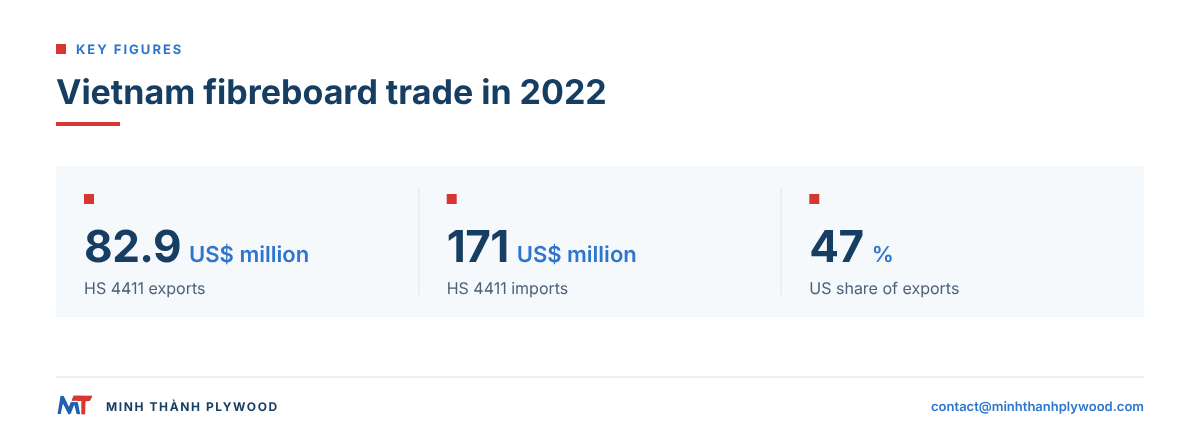
According to TrendEconomy’s analysis of UN Comtrade data (checked on 20 October 2026), Vietnam exported more than US$82 million of fibreboard (HS 4411, which includes MDF and HDF) in 2022, 12.8% more than in 2021, and imported US$171 million.
| Vietnam fibreboard trade, 2022 | Value (US$ million) | Main partners (share) |
|---|---|---|
| Exports | 82.9 | United States 47%, Korea 17.5%, India 10.7%, Saudi Arabia 6.6% |
| Imports | 171 | Thailand 43%, China 31%, New Zealand 13.2% |
Two conclusions follow. First, Vietnam’s MDF plants sell most of their output at home, so export capacity for a new buyer is limited and booked ahead. Second, a “Vietnamese MDF” offer can be a board imported from Thailand, China or New Zealand and resold; the certificate tells you which plant made it.
For comparison, Vietnam’s plywood exports under HS 4412 were about US$1.02 billion in 2024, more than ten times the fibreboard figure. Our Vietnam plywood export statistics show where those panels go.
Medium density fiberboard manufacturers vs MDF suppliers: who sells what?
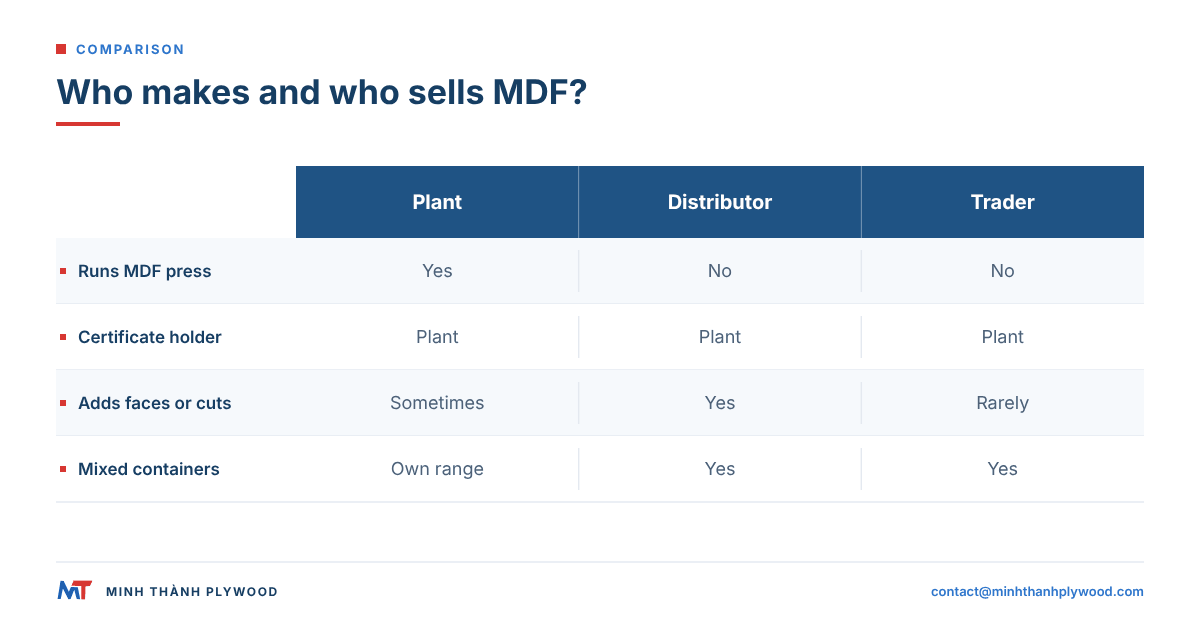
Medium density fiberboard manufacturers run the fibreboard press and hold the board’s certificates; MDF suppliers may be those manufacturers, their distributors or traders who buy from several plants. Ask every seller which plant makes the board and whose name is on the certificate.
| Question | Manufacturer | Distributor or laminator | Trading company |
|---|---|---|---|
| Runs the MDF press | Yes | No | No |
| Name on the TSCA or CARB certificate | Its own | The plant’s | The plant’s |
| Adds faces or cuts to size | Sometimes | Yes | Rarely |
| Mixes products in one container | Its own range | Yes | Yes |
| Answers a quality claim | Directly | Through the plant | Through the plant |
A supplier that names the plant, shows the plant’s certificate and can send a sample from the same production line is a supplier you can qualify. A supplier that cannot name the plant cannot give you a traceable board.
What grades and specifications do Vietnamese MDF manufacturers offer?
Vietnamese MDF manufacturers offer standard MDF, moisture-resistant MDF, thin MDF and HDF, raw or melamine-faced, mostly in 1220 × 2440 mm sheets. The grade names follow the European system: the European Panel Federation’s MDF standards page (read 20 October 2026) identifies EN 622-5 as the standard for dry-process MDF.
- Standard MDF for dry interior furniture, shelving and painted fronts.
- Moisture-resistant MDF, often green-dyed, for kitchens and bathrooms; it resists humidity, not water exposure.
- Thin MDF and HDF for drawer bottoms, back panels and door skins.
- Melamine-faced MDF for carcasses and flat furniture parts.
- Fire-retardant MDF from some plants, with its own fire test report.
| Specification | Typical Vietnamese MDF offer |
|---|---|
| Sheet size | 1220 × 2440 mm; 1830 × 2440 mm and cut-to-size from some plants |
| Thickness | About 2.5–30 mm by plant; thin MDF and HDF at the low end |
| Grades | Standard MDF, HMR (moisture-resistant), LDF, HDF |
| Faces | Raw, melamine-faced, veneered |
Sources: FOMEX, importing MDF from Vietnam for the 1830 × 2440 mm size (checked on 21 October 2026). The Ministry of Industry and Trade article above covers the 2.5–30 mm range.
Write the grade, the thickness, the density class, the emission class and the face on every enquiry. A “MDF 18 mm” request leaves the plant free to quote its cheapest board.
Emission documents: CARB, TSCA Title VI, E1 and E0
MDF sold in the United States must carry TSCA Title VI certification, and MDF sold in Europe needs an E1 or REACH-compliant test report; both come from the MDF plant, not from the seller. The US limits are 0.11 ppm for MDF and 0.13 ppm for thin MDF.
- United States: the EPA’s TSCA Title VI guidance (read 20 October 2026) lists MDF and thin MDF among the regulated composite wood products, with labelling on each panel or bundle.
- European Union: the REACH restriction (Regulation (EU) 2023/1464) limits formaldehyde from furniture and wood-based articles to 0.062 mg/m³ from 6 August 2026, measured in a test chamber.
- E0 and E1: emission classes, not glue types. Ask for the test method and the laboratory with every result.
A plywood mill’s certificate never covers another plant’s MDF. Our own panels are certified CARB P2 / TSCA Title VI (ICTT mill no. 23024) for hardwood plywood veneer core, which is a separate product category from MDF.
FSC and EUDR documents for MDF
FSC-certified MDF from Vietnam needs the plant’s FSC chain-of-custody certificate and the FSC claim on the invoice; EU buyers also need EUDR origin information for the wood fibre. Ask for both before the order, because a plant can only sell what its certificate covers.
- FSC: check the certificate code and product scope in the FSC public database.
- Invoice claim: the FSC claim and certificate code must be on the invoice for the FSC chain to continue.
- EUDR: fibreboard (heading 4411) and plywood (heading 4412) are both in the product scope of Regulation (EU) 2023/1115 (read 20 October 2026). As amended by Regulation (EU) 2025/2650, it applies to large and medium operators from 30 December 2026.
- Fibre origin: MDF mixes fibre from many plantations, so the geolocation file is larger than for a single-species product.
For plywood we supply the EUDR compliance dossier (origin records and geolocation files) with orders. FSC is available* for our plywood.
*Supplied directly or through qualified partner mills.
How to check an MDF manufacturer in Vietnam
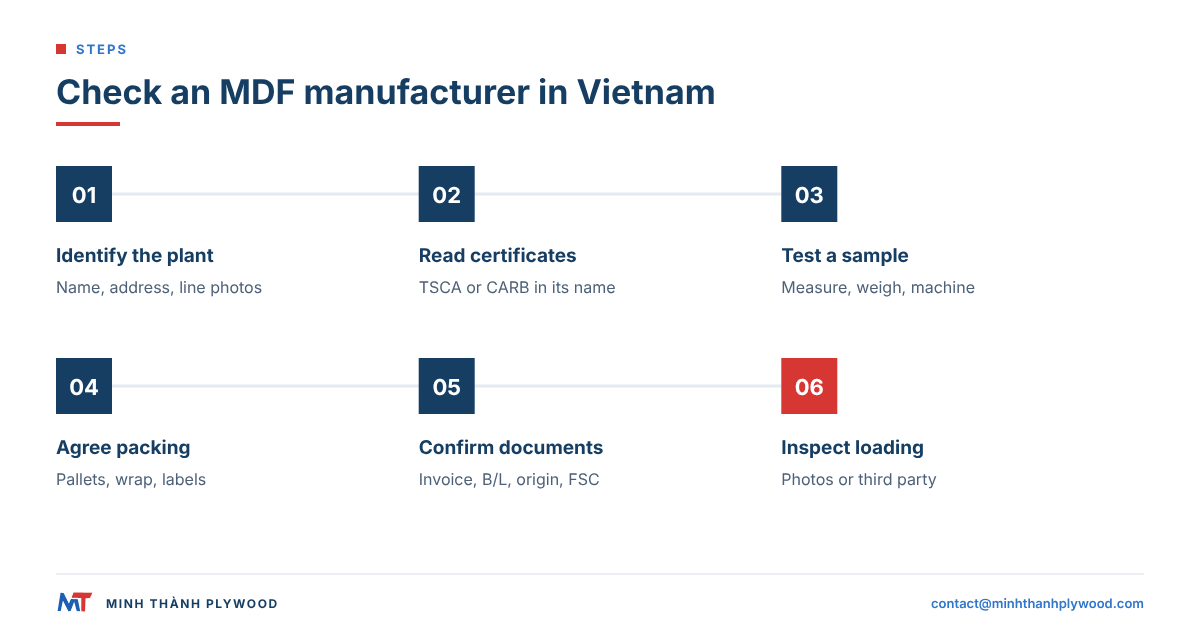
Check an MDF manufacturer in Vietnam with six steps: identify the plant, read its certificates, test a sample, agree the packing, confirm the documents and inspect before loading. The steps work for any panel supplier.
- Identify the plant: name, address and production photos or video of the line.
- Read the certificates: TSCA Title VI or CARB certificate with the plant’s own name, and the emission test report with method and laboratory.
- Test a sample: measure thickness at several points, weigh it to check density, machine and paint a piece the way your factory will.
- Agree the packing: pallet type, corner protection, moisture wrap and labels.
- Confirm the documents: commercial invoice, packing list, B/L, certificate of origin and the FSC or EUDR files you need.
- Inspect before loading: photos of packs, labels and the container, or a third-party inspection.
Weighing a sample takes a minute and tells you more than a brochure: a board well below the stated density machines poorly and holds screws badly.
MDF or plywood for your furniture parts?
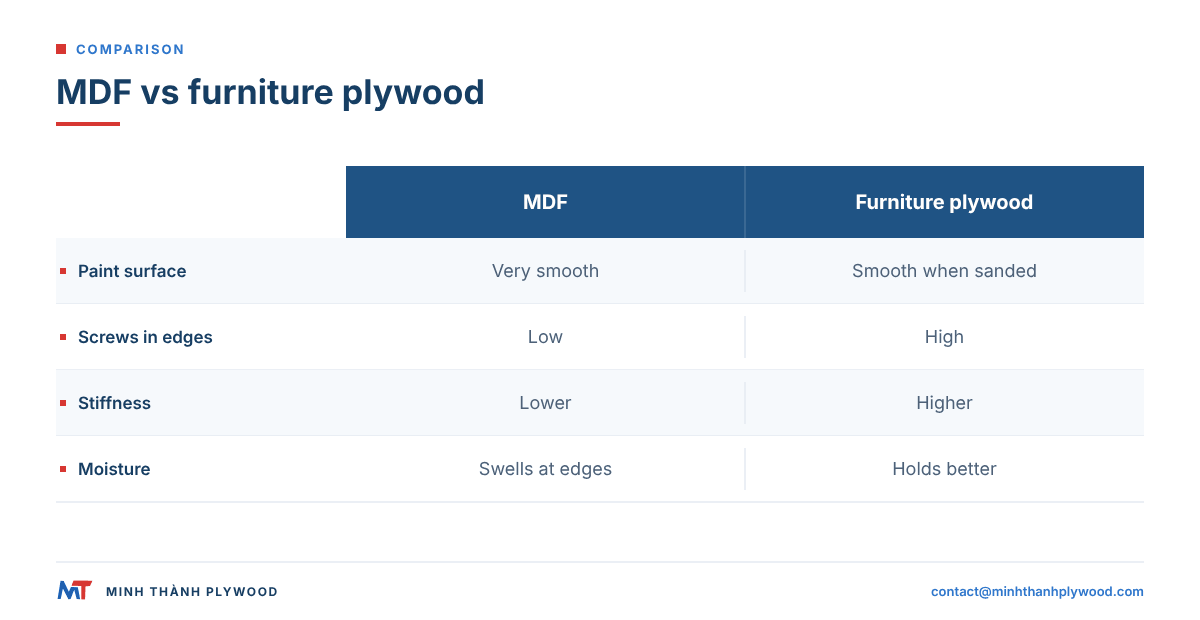
Choose MDF for painted fronts, routed profiles and flat panels that stay dry, and plywood for parts that carry screws, span distances, see edges or meet moisture. Many furniture factories in Vietnam use both in one product.
| Property | MDF | Furniture plywood |
|---|---|---|
| Surface for paint | Very smooth, no grain | Smooth when sanded; needs a good face |
| Screw holding in edges | Low | High |
| Weight for the same thickness | Heavier in most grades | Lighter on Styrax core |
| Stiffness over a span | Lower | Higher, cross-laminated |
| Moisture | Swells at edges | Holds better, more with MR or WBP glue |
| Routed profiles | Clean | Shows plies |
| Natural wood face | Needs veneer or foil | Face veneer pressed on |
Our plywood vs MDF guide compares the two by furniture component. For shelves, carcasses, drawer sides and exposed edges, a Styrax-core furniture plywood at 500 kg/m³ reference density gives a lighter, stiffer part.
Can MDF and plywood ship in one container from Vietnam?
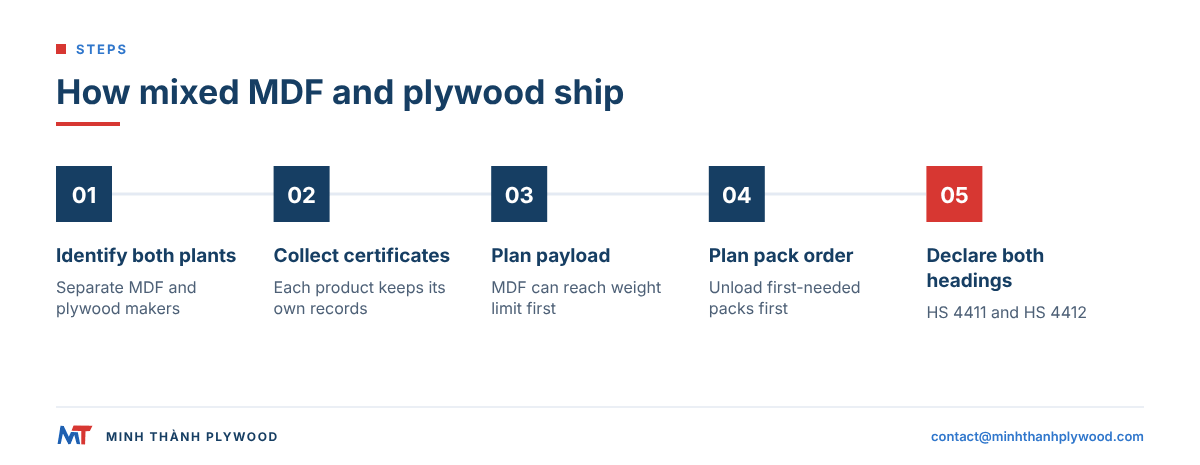
MDF and plywood can ship in one container from Vietnam when one exporter supplies both products or a forwarder consolidates them at the port. Each product keeps its own manufacturer, certificates and packing list, and the importer declares two customs headings, 4411 and 4412.
- One exporter, two products: simpler paperwork; ask who manufactures each product.
- Forwarder consolidation: two suppliers deliver to the forwarder’s warehouse, which loads one container.
- Weight: MDF is heavy, so a mixed load reaches the payload limit before the container is full.
- Pack order: plan which packs come out first at your warehouse.
For plywood alone, we load mixed specifications in one 40HC by agreement, usually one or two specifications and up to six. Loads are planned against a 28,000 kg payload unless the booking is lower.
MDF suppliers for buyers in the UAE, Saudi Arabia and India
Buyers in the UAE, Saudi Arabia and India already buy Vietnamese fibreboard: India took 10.7% and Saudi Arabia 6.6% of Vietnam’s HS 4411 exports in 2022. Gulf and Indian buyers compare Vietnamese MDF with boards from Thailand, Malaysia, China and local plants.
- Ask for the plant, not only the exporter, and compare like grades.
- Ask for the destination’s documents: the certificate of origin and any conformity registration the importing country requires, handled with the importer’s clearing agent.
- Compare landed cost, not FOB price: freight to Jebel Ali, Dammam or Nhava Sheva changes the comparison.
- Combine products: a buyer who also needs plywood can source both from Vietnam and plan the containers together.
For any origin, the plant’s own certificate, a tested sample and the landed cost decide the comparison, not the country on the offer.
Lead time, terms and payment for MDF from Vietnam
MDF from Vietnam is usually quoted per container on FOB, CFR or CIF terms, with a deposit and the balance against the bill of lading or a letter of credit. Production lead time depends on the plant’s booking, because domestic furniture customers take most of its output.
| Term | MDF plant (typical) | Minh Thanh plywood |
|---|---|---|
| Minimum order | Full container | One 40HC, mixed specifications by agreement |
| Production | Commonly 30–45 days, by the plant’s booking | 15–45 days after the deposit |
| Payment | Deposit and balance, or L/C | 30% deposit, 70% against the scanned B/L, or irrevocable L/C at sight |
| Delivery terms | FOB, CFR or CIF | FOB Hai Phong, CFR or CIF |
| Samples | On request | Free samples |
The 30–45 day MDF figure is a sourcing-agent estimate (Primo, MDF manufacturers in Vietnam); confirm it with the plant. Sea transit from Hai Phong to the US West Coast is typically 20–30 days and to Northern Europe 30–40 days, by carrier and route.
Every shipment of our plywood is photographed and filmed before loading, and buyers get the photos and video. Ask any MDF supplier for the same.
What to send when you request MDF or a plywood alternative
Send the same specification lines to an MDF plant and to a plywood mill, so the offers compare the same part. For furniture parts that need screw holding, stiffness or a natural face, ask for a plywood option next to the MDF offer.
- Application: the furniture part, painted, laminated or veneered.
- Core: MDF grade and density class, or Styrax or Eucalyptus plywood core.
- Glue and emission: TSCA Title VI or CARB P2, E1, or the REACH method; UF glue at E0 emission for our furniture plywood.
- Face: raw, melamine, veneer, or a plywood face such as birch, poplar, EV or okoume.
- Size and thickness: 1220 × 2440 mm or 1250 × 2500 mm; 3–40 mm for plywood.
- Packing and quantity: from one 40HC; destination port.
Free samples of our plywood are available. See our plywood range and the MDF price guide for Vietnam, or read who imports plywood from Vietnam for the export picture.
Buyer questions, answered
Are there MDF manufacturers in Vietnam?
Yes. Vietnam has several large MDF plants using plantation wood fibre, plus thin-board and HDF lines. Most of their output goes to Vietnamese furniture factories, so export volumes are smaller than the plants' size suggests.
Who is the largest MDF manufacturer in Vietnam?
Kim Tin Group is the largest: it reports two MDF plants in Dong Nai (former Binh Phuoc) with 500,000 m³ a year and more than 20% of the domestic board market, rising to 1,200,000 m³ with its Dong Nai plant. VRG Dongwha in Dong Nai (former Binh Phuoc) follows with 480,000 m³ a year on two lines.
What sizes and thicknesses does Vietnamese MDF come in?
The standard sheet is 1220 × 2440 mm, with 1830 × 2440 mm and cut-to-size from some plants. Published thickness ranges run from about 2.5 mm to 30 mm, with thin MDF and HDF at the low end.
Does Vietnam export MDF?
Yes, but less than it imports. Vietnam exported US$82.9 million of fibreboard (HS 4411) in 2022, with the United States taking 47%, and imported US$171 million, mainly from Thailand and China.
What is the difference between an MDF manufacturer and an MDF supplier?
An MDF manufacturer runs the fibreboard line and issues the board's own certificates. An MDF supplier may be the manufacturer, its distributor or a trading company reselling boards from one or more plants.
Which emission certificate do I need for MDF sold in the United States?
MDF and thin MDF sold in the United States must be certified under TSCA Title VI, the federal rule that matches CARB Phase 2. The limits are 0.11 ppm for MDF and 0.13 ppm for thin MDF.
Is E1 MDF enough for Europe?
E1 is the long-standing European emission class for wood-based panels. From 6 August 2026 the EU REACH restriction sets a limit of 0.062 mg/m³ for furniture and wood-based articles, so ask the MDF producer for a test report to that method.
Can I buy FSC-certified MDF from Vietnam?
Yes, from producers that hold FSC chain-of-custody certification for the product. Check the certificate code in the FSC public database and make sure the claim appears on the invoice.
Should I use MDF or plywood for furniture?
Use MDF for painted fronts, routed profiles and flat panels that stay dry; use plywood where screws, edges, spans or moisture matter. Many furniture plants use both in one product.
Can MDF and plywood be shipped in the same container from Vietnam?
Yes, when one exporter supplies both products or a forwarder consolidates them. Each product keeps its own manufacturer, certificates and packing list.
What is the MOQ for MDF from Vietnam?
Most MDF plants quote by full container. For plywood our MOQ is one 40HC with mixed specifications by agreement.
How do I check an MDF manufacturer in Vietnam?
Ask for the plant address, production photos, the TSCA or CARB certificate, an E1 or EN 717-1 test report, the FSC code if needed, and a sample. Then weigh, measure and machine the sample before ordering.