
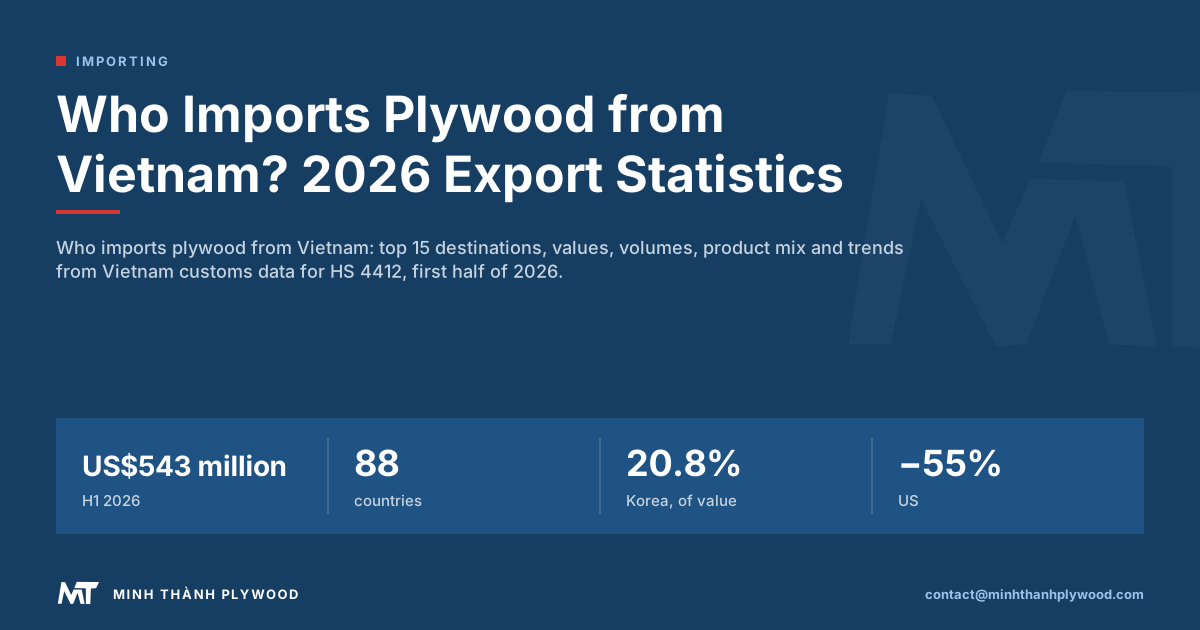
Korea, Malaysia, the United States, Japan and Thailand import the most plywood from Vietnam, and the European Union is the fastest-growing buyer. In the first half of 2026 Vietnam exported US$543 million of HS 4412 plywood to 88 countries. Minh Thanh Plywood, a Vietnamese mill with Europe as its main market, compiled these figures from Vietnam customs declarations.
Who imports plywood from Vietnam: the short answer
Korea, Malaysia, the United States, Japan and Thailand import the most plywood from Vietnam by value; together they took 61% of Vietnam’s HS 4412 export value in the first half of 2026. The European Union is the fastest-growing buyer: EU destinations took US$121 million, up from US$19 million a year earlier.
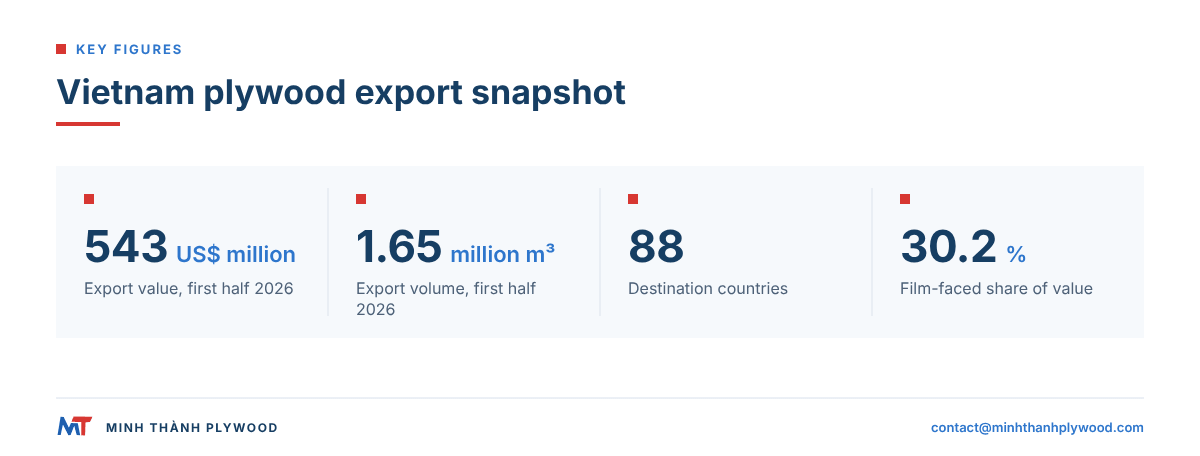
- Exports, January–June 2026: US$543 million and 1.65 million cubic metres, to 88 countries.
- Largest buyer: Korea, US$113 million, 20.8% of value.
- Fastest growth: Belgium, Germany, France, Poland and the Netherlands.
- Largest fall: the United States, down 55% in value.
- Largest product group: film-faced plywood, 30.2% of value.
The tables below show each destination with value, volume, trend and the product it buys.
How much plywood does Vietnam export?
Vietnam exports about US$1 billion of plywood and similar laminated wood (HS 4412) a year: customs declarations add up to US$1.02 billion and 3.27 million cubic metres in 2024. The figure fell slightly in 2025 and grew again in the first half of 2026.
| Period | Export value (US$ million) | Volume (million m³) | Exporters filing |
|---|---|---|---|
| 2024, January–December | 1,022 | 3.27 | 774 |
| 2025, January–November | 933 | 2.93 | not compiled |
| First half of 2025 | 523 | 1.68 | 755 |
| First half of 2026 | 543 | 1.65 | 793 |
The first half of 2026 was 3.9% higher in value than the first half of 2025 and 1.8% lower in volume. The average declared value rose from about US$311 to US$329 per cubic metre, because the mix moved toward film-faced and furniture panels for Europe and away from lower-value panels for nearby Asian markets.
June 2026 was the strongest month in the series, with US$117 million. February is the weakest month every year because of the Lunar New Year break at Vietnamese mills.
Top 15 destinations for Vietnamese plywood in the first half of 2026
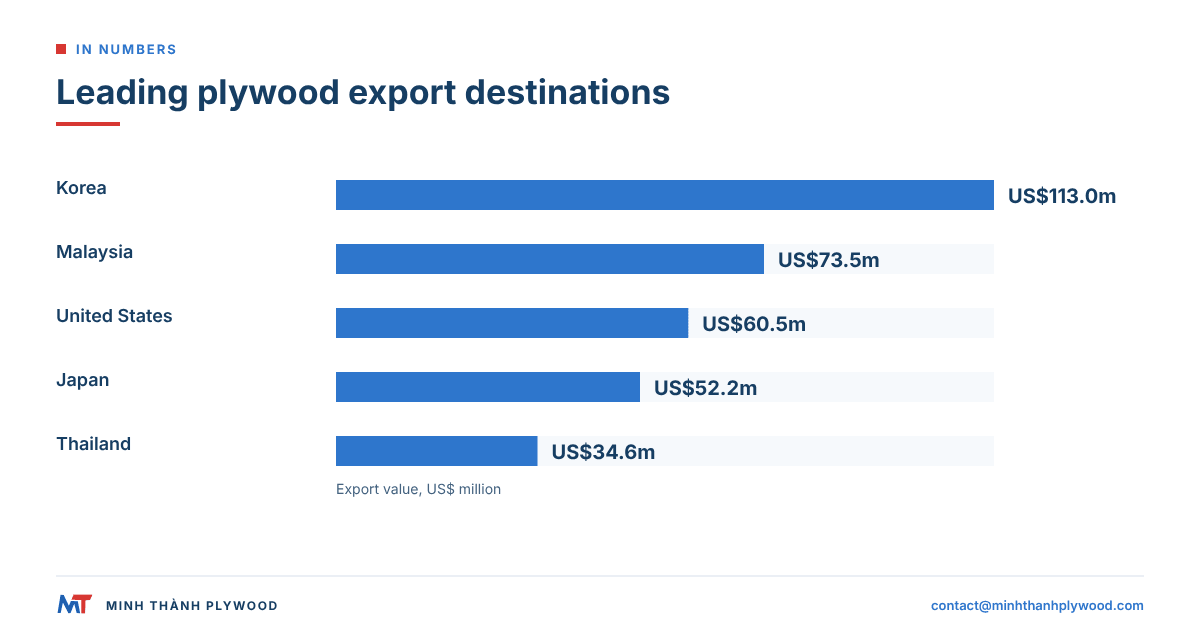
Fifteen destinations took 87.5% of Vietnam’s plywood export value from January to June 2026. The table ranks them by value and shows each one’s main product group.
| Rank | Destination | Value (US$ million) | Share of value (%) | Volume (m³) | Change in value vs H1 2025 (%) | Main product group |
|---|---|---|---|---|---|---|
| 1 | Korea | 113.0 | 20.8 | 434,278 | +37 | Commercial, Bintangor-faced |
| 2 | Malaysia | 73.5 | 13.5 | 269,892 | +16 | Commercial, film-faced |
| 3 | United States | 60.5 | 11.1 | 104,426 | −55 | Flooring components, film-faced |
| 4 | Japan | 52.2 | 9.6 | 192,093 | +43 | LVL, commercial |
| 5 | Thailand | 34.6 | 6.4 | 110,228 | +4 | Commercial, film-faced |
| 6 | Belgium | 33.5 | 6.2 | 81,523 | from US$1.0 million | Film-faced |
| 7 | Germany | 18.0 | 3.3 | 41,864 | +181 | Film-faced |
| 8 | Vietnam (export processing zones) | 15.3 | 2.8 | 41,410 | −52 | Commercial, packing |
| 9 | Cambodia | 15.1 | 2.8 | 35,117 | +272 | Birch-faced, eucalyptus-faced |
| 10 | France | 12.6 | 2.3 | 31,530 | from US$1.0 million | Film-faced |
| 11 | Poland | 12.5 | 2.3 | 32,060 | +528 | Film-faced |
| 12 | Singapore | 12.2 | 2.3 | 46,465 | −49 | Film-faced |
| 13 | India | 7.7 | 1.4 | 23,391 | −65 | LVL, commercial |
| 14 | Philippines | 7.7 | 1.4 | 28,603 | +21 | Film-faced |
| 15 | Netherlands | 6.9 | 1.3 | 11,980 | from US$0.1 million | Birch-faced, film-faced |
“Vietnam” as a destination means sales into export processing zones and non-tariff areas inside the country, which customs records as exports. Volume shares differ from value shares: Korea took 26.3% of the volume because it buys mostly commercial panels at a lower value per cubic metre.
Which markets grew and which fell?
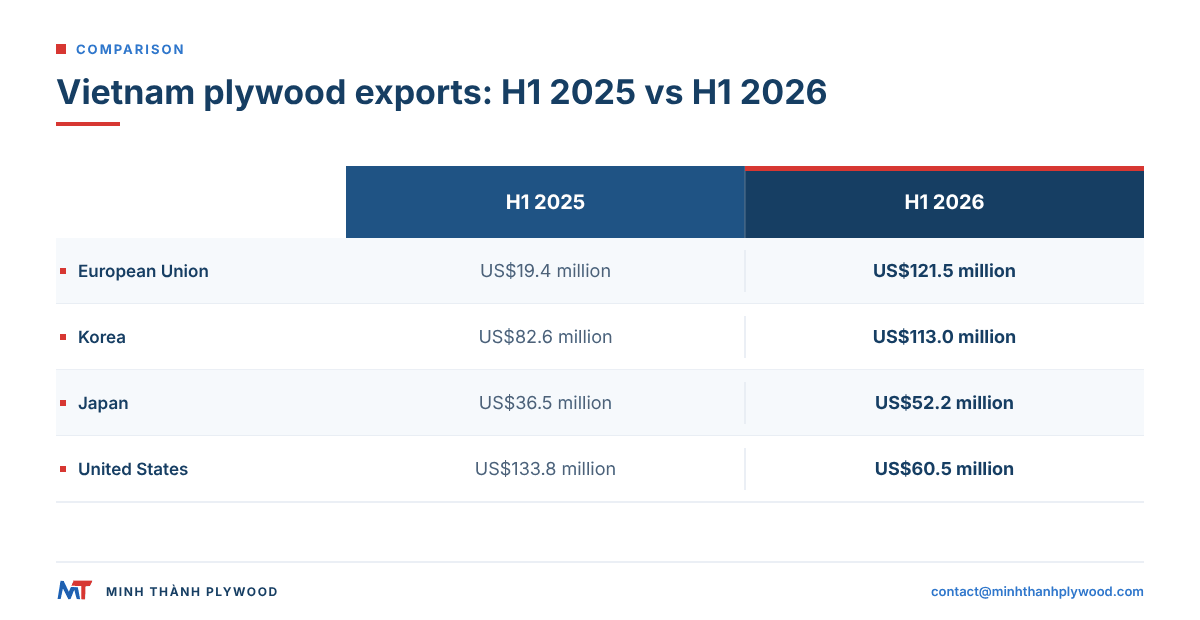
European markets grew fastest in the first half of 2026, and the United States, India and Singapore fell most. Korea and Japan, the two largest Asian buyers, grew by more than a third.
| Market | H1 2025 (US$ million) | H1 2026 (US$ million) | Direction |
|---|---|---|---|
| European Union, all destinations | 19.4 | 121.5 | Up about six times |
| Korea | 82.6 | 113.0 | Up |
| Japan | 36.5 | 52.2 | Up |
| United States | 133.8 | 60.5 | Down by more than half |
| India | 22.2 | 7.7 | Down |
| Singapore | 23.9 | 12.2 | Down |
| United Kingdom | 0.35 | 0.37 | Flat, small |
The EU total in the first half of 2026 was about 287,300 cubic metres, against about 46,600 cubic metres a year earlier. Smaller markets moved too: Australia rose from US$0.68 million to US$3.03 million, while Canada fell from US$10.0 million to US$4.6 million and the United Arab Emirates from US$4.5 million to US$1.1 million.
Who buys which Vietnamese plywood?
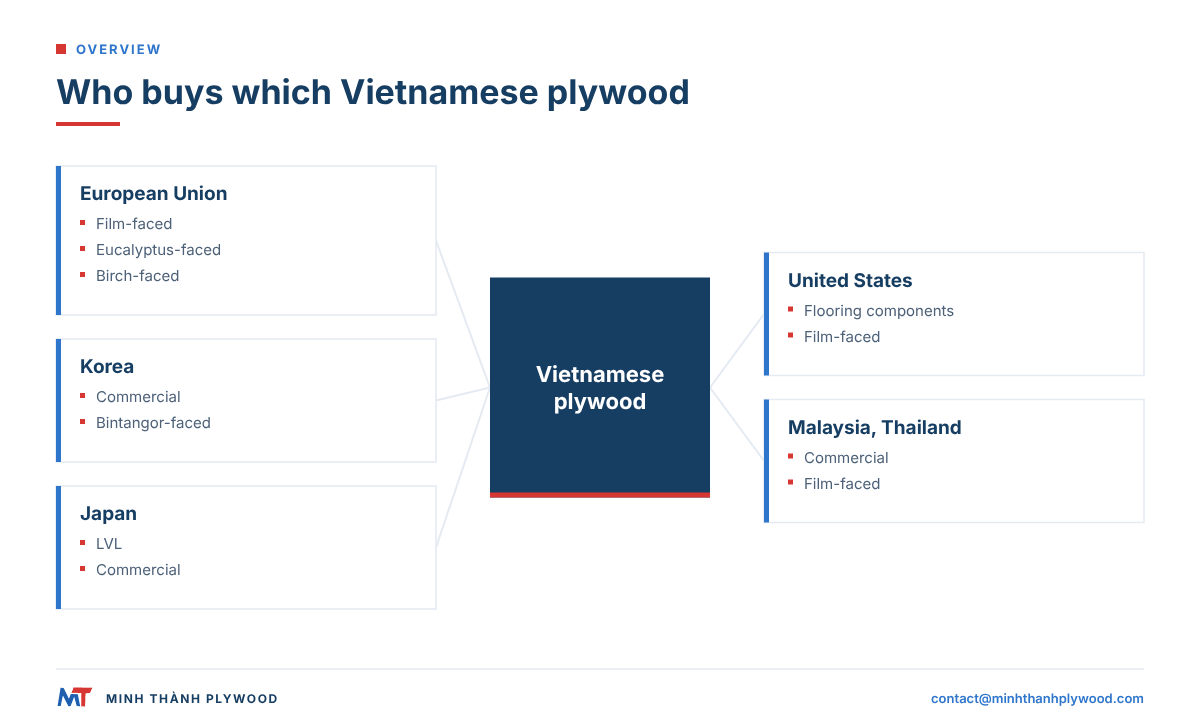
Each market buys a different Vietnamese panel: Europe buys film-faced and furniture plywood, Korea and Malaysia buy commercial panels, Japan buys LVL, and the United States buys flooring components and film-faced panels. The product group follows the way each market uses plywood.
| Product group | Value H1 2026 (US$ million) | Share of value (%) | Volume (m³) | Who buys most |
|---|---|---|---|---|
| Film-faced plywood | 164.1 | 30.2 | 462,262 | Belgium, Germany, France, Poland, Singapore |
| Commercial, face not named | 146.7 | 27.0 | 558,131 | Korea, Malaysia, Thailand |
| LVL | 58.0 | 10.7 | 204,351 | Japan, India |
| Bintangor-faced | 46.8 | 8.6 | 183,693 | Korea |
| Birch-faced | 40.8 | 7.5 | 78,585 | Cambodia, Netherlands, United States |
| Flooring and finished components | 27.7 | 5.1 | 21,002 | United States |
| Eucalyptus-faced | 20.0 | 3.7 | 50,362 | Cambodia, Belgium |
| Packing plywood | 4.7 | 0.9 | 13,850 | Domestic export zones |
Film-faced plywood grew from US$91.9 million to US$164.1 million year on year, the largest gain of any group. Birch-faced plywood fell from US$135.9 million to US$40.8 million, mainly because the US market for birch-faced panels from Vietnam shrank.
Why does Europe now buy more plywood from Vietnam?
Europe buys more Vietnamese plywood because two former sources closed: the EU has banned imports of Russian wood products, plywood included, since 2022, and set anti-dumping duties on hardwood plywood from China in 2025. Vietnamese mills offer plantation-core panels outside both measures.
- Russia: Council Regulation (EU) 2022/576 added wood products of chapter 44, which includes plywood, to the EU import ban from 9 April 2022 (read 20 October 2026).
- China: Regulation (EU) 2025/2333 set definitive anti-dumping duties of 43.3% for one named producer and 86.8% for all other companies on hardwood plywood from China, on its stated product scope (read 20 October 2026).
- Import side: the ITTO market report for 16–30 September 2026 puts EU+UK plywood imports from Vietnam at close to 229,000 m³ in the first half of 2026, against fewer than 29,000 m³ a year earlier.
Belgium leads because Antwerp is a main port and distribution hub for plywood entering the EU; the panels then move to buyers across the region. Film-faced plywood makes up 77% of Belgium’s value and 81% of Germany’s, which shows that construction formwork drove most of the first wave. Furniture panels follow more slowly, because a furniture buyer approves samples and runs trials before switching supplier.
How do Korea, Japan and Malaysia buy Vietnamese plywood?
Korea, Japan and Malaysia buy large, repeat volumes of standard panels: Korea buys commercial and Bintangor-faced plywood, Japan buys LVL, and Malaysia buys commercial and film-faced panels. Together they took 43.9% of Vietnam’s plywood export value in the first half of 2026.
- Korea: 48% of its value is commercial plywood without a named face and 21% Bintangor-faced plywood. Korea took 434,278 m³, the largest volume of any market.
- Japan: 54% of its value is LVL, with commercial plywood second. Japanese buyers grew their purchases by 43%.
- Malaysia: 45% commercial plywood and 17% film-faced plywood.
- Thailand: commercial and film-faced panels in almost equal parts, steady year on year.
These markets buy mainly on price per cubic metre and delivery reliability. Their average declared value was about US$260–US$315 per cubic metre, well below the European average.
What happened to Vietnamese plywood exports to the United States?
Vietnamese plywood exports to the United States fell by 55% in value in the first half of 2026, from US$133.8 million to US$60.5 million. In 2024 the United States was the largest buyer, with US$260 million and 25.4% of value.
The US Department of Commerce ran anti-dumping and countervailing duty investigations on hardwood and decorative plywood from Vietnam (cases A-552-851 and C-552-852) and published final affirmative determinations on 21 July 2026 (read 20 October 2026). Earlier, the 2023 circumvention rulings in cases A-570-051 and C-570-052 treat Vietnamese panels made with Chinese core components (core platforms or core veneers, with or without Chinese faces) as Chinese for duty purposes.
What the United States still buys from Vietnam are mostly products outside those cases: flooring and finished components made up 40% of US value and film-faced plywood 39%. A US importer checks the scope of each case with a customs broker before placing an order.
Average declared export value per cubic metre
The average declared export value of Vietnamese plywood was about US$329 per cubic metre in the first half of 2026, and it depends mainly on the product group and the market. These are customs averages over many specifications, not price offers.
| Product group | Average declared value (US$ per m³) |
|---|---|
| Commercial, face not named | about 263 |
| Bintangor-faced | about 255 |
| LVL | about 284 |
| Film-faced | about 355 |
| Eucalyptus-faced | about 397 |
| Birch-faced | about 520 |
By market, Korea averaged about US$260 per cubic metre and Malaysia about US$272, while Germany averaged about US$430 and Belgium about US$411. The gap reflects the product, the face veneer, the thickness mix and the delivery term, not only the country. Our indicative starting prices are from US$250/m³ for commercial plywood and from US$350/m³ for furniture and interior plywood (October 2026); see the plywood price guide for what drives a quote.
How these Vietnam plywood export statistics are compiled
These statistics are compiled from Vietnam customs export declarations under HS heading 4412, which covers plywood, veneered panels and similar laminated wood. Each declaration line is assigned to a destination country and a product group from its goods description, then summed.
- Source: Vietnam customs export declarations for HS 4412, October 2023 to June 2026.
- Gap: December 2025 is missing from the source files, so 2025 is shown for January to November.
- Value: declared US dollar value on each line, on the declared delivery term (FOB, CFR or CIF), not converted to one term.
- Volume: declared cubic metres; lines declared in other units are counted in value only.
- Product group: read from the goods description: film-faced, commercial, LVL, a named face veneer, packing, flooring components.
- Privacy: totals only; no exporter or importer names are published.
UN Comtrade and the ITTO publish their own series from importing countries’ statistics. Those figures differ from Vietnamese customs because of timing, freight and insurance in import values, and re-exports through hubs such as Belgium and Singapore. We update this page twice a year when a new half-year of declarations is available.
How to import plywood from Vietnam to the UK, the UAE and Europe
Importing plywood from Vietnam follows the same steps for every market: agree the specification, the delivery term and the documents with the mill, then clear the goods under heading 4412 with the destination’s own rules. The differences are in those rules.
- Specify the application, core, glue and emission class, face, size, thickness, packing and quantity.
- Agree the term: FOB Hai Phong, CFR or CIF, and the payment terms.
- Approve a sample before production starts.
- Collect the documents: commercial invoice, packing list, B/L, certificate of origin (EUR.1 for the EU), phytosanitary and fumigation certificates, and insurance with CIF.
- Clear customs at destination with the importer’s broker.
- European Union: the importer files the EUDR due-diligence statement; we supply the EUDR compliance dossier (origin records and geolocation files) with orders. Vietnam is classed as low risk under Implementing Regulation (EU) 2025/1093 (read 20 October 2026).
- United Kingdom: the importer meets the due-diligence duty of the UK Timber Regulation (read 20 October 2026). Vietnamese plywood is still a small market in the UK, at US$0.37 million in the first half of 2026.
- United Arab Emirates: shipments are smaller, US$1.12 million in the first half of 2026.
Our guide to importing plywood from Vietnam covers each step in detail.
What is the MOQ for plywood from Vietnam?
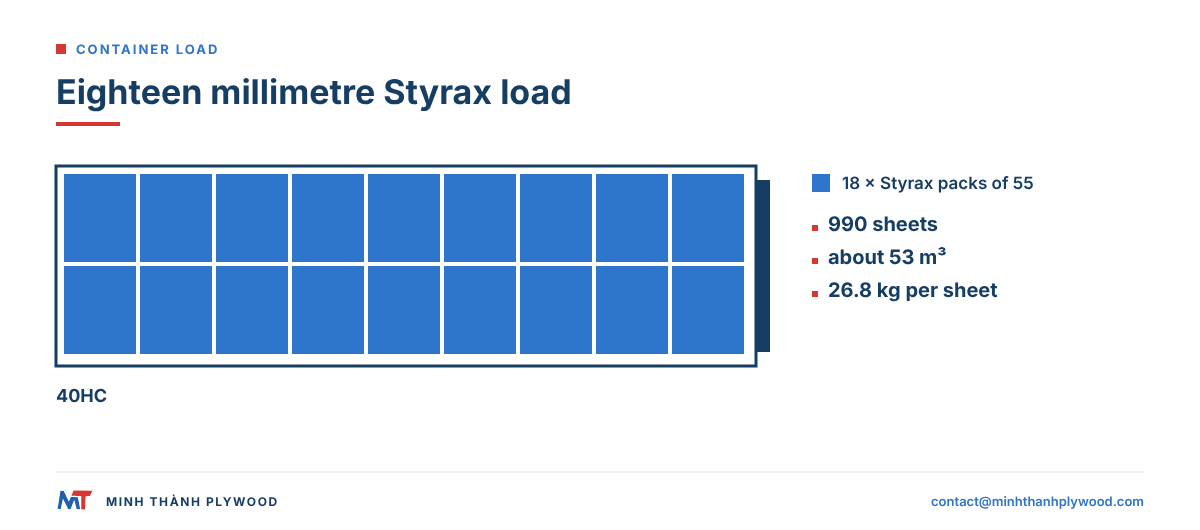
The usual minimum order for plywood from Vietnam is one 40HC container, and many mills, ours included, load mixed specifications in it by agreement. One 40HC holds about 43 m³ of 18 mm eucalyptus-core panels or about 53 m³ of Styrax-core panels.
| Core, 18 mm, 1220 × 2440 mm | Sheets per 40HC | Volume | Sheet weight |
|---|---|---|---|
| Styrax | 990 sheets | about 53 m³ | 26.8 kg |
| Acacia | 880 sheets | about 47 m³ | 31.1 kg |
| Eucalyptus | 795 sheets | about 43 m³ | 34.8 kg |
The loads are planned against a 28,000 kg payload unless the booking is lower. Production takes 15–45 days after the 30% deposit, and the 70% balance is paid against the scanned B/L or by irrevocable L/C at sight.
What these statistics mean for your plywood order
The figures show where Vietnamese plywood is already proven: formwork and furniture panels for Europe, commercial panels for Asia. A buyer entering from Europe joins a supply chain that grew about six times in a year, so book production early and fix the specification by sample.
Our factory in Ha Hoa, Phu Tho makes top-grade furniture and interior plywood with Europe as its main market, at 50,000+ m³ a year, and also produces commercial, packing and film-faced plywood. Furniture panels are pressed twice and sanded to a thickness tolerance down to ±0.2 mm.
Send these lines with your request:
- Application: furniture, interiors, formwork, packing or construction.
- Core: Styrax or Eucalyptus for furniture; Acacia or Eucalyptus for film-faced.
- Glue and emission: UF glue at E0 emission, MR or WBP to your specification.
- Face: birch, poplar, EV, okoume, pine or another face, with the face/back grade.
- Size and thickness: 1220 × 2440 mm or 1250 × 2500 mm, 3–40 mm.
- Packing and quantity: from one 40HC, mixed specifications by agreement; destination port.
Free samples are available. See furniture plywood from Vietnam or our trade terms, and read where plywood is produced worldwide for the global picture.
Buyer questions, answered
Who imports plywood from Vietnam?
In the first half of 2026 the largest importers of Vietnamese plywood by value were Korea, Malaysia, the United States, Japan and Thailand. Belgium, Germany, France, Poland and the Netherlands were the fastest-growing destinations.
How much plywood does Vietnam export a year?
Vietnam customs declarations for HS 4412 add up to about US$1.02 billion and 3.27 million cubic metres in 2024. The first half of 2026 reached US$543 million and 1.65 million cubic metres.
Which country is the biggest buyer of Vietnamese plywood?
Korea was the biggest buyer in the first half of 2026, with US$113 million, or 20.8% of Vietnam's plywood export value. In 2024 the United States was first.
What type of plywood does Vietnam export most?
Film-faced plywood for concrete formwork ranked first among product groups by value in the first half of 2026, followed by commercial plywood without a named face and face-veneer plywood for furniture and interiors.
Why did Vietnamese plywood exports to Europe increase?
European buyers replaced Russian birch plywood, banned in the EU since 2022, and reduced Chinese hardwood plywood after the EU set anti-dumping duties in 2025. EU destinations took US$121 million of Vietnamese plywood in the first half of 2026.
Why did exports of Vietnamese plywood to the United States fall?
US anti-dumping and countervailing duty cases on hardwood and decorative plywood from Vietnam ran through 2025 and 2026, with final determinations published in July 2026. Shipments to the United States fell from US$134 million to US$60 million year on year in the first half.
Is there a standard MOQ for plywood imports from Vietnam?
Most Vietnamese mills quote one 40HC container as the minimum order. Our MOQ is one 40HC with mixed specifications by agreement.
How do I import plywood from Vietnam to the UK?
Agree the specification and delivery term with the mill, then have your importer meet the UK Timber Regulation due-diligence duty and clear the goods under the plywood heading 4412. The mill supplies the invoice, packing list, bill of lading, certificate of origin and species information.
Where does the data in this article come from?
The tables are compiled from Vietnam customs export declarations under HS heading 4412, aggregated by destination country and product group. No company names are used. December 2025 is missing from the source files.
How many Vietnamese companies export plywood?
793 exporters filed HS 4412 export declarations in the first half of 2026, against 755 in the first half of 2025.