
MDF panels are sheets of medium-density fibreboard, sold plain, as tongue and groove boards and as decorative wall panelling. They give a smooth, paint-ready surface at low cost, but weigh more than plywood, hold screws less well and swell if water reaches a cut edge. This guide shows when plywood is the better substrate. Minh Thanh Plywood makes plywood, not MDF, in Phu Tho, Vietnam.
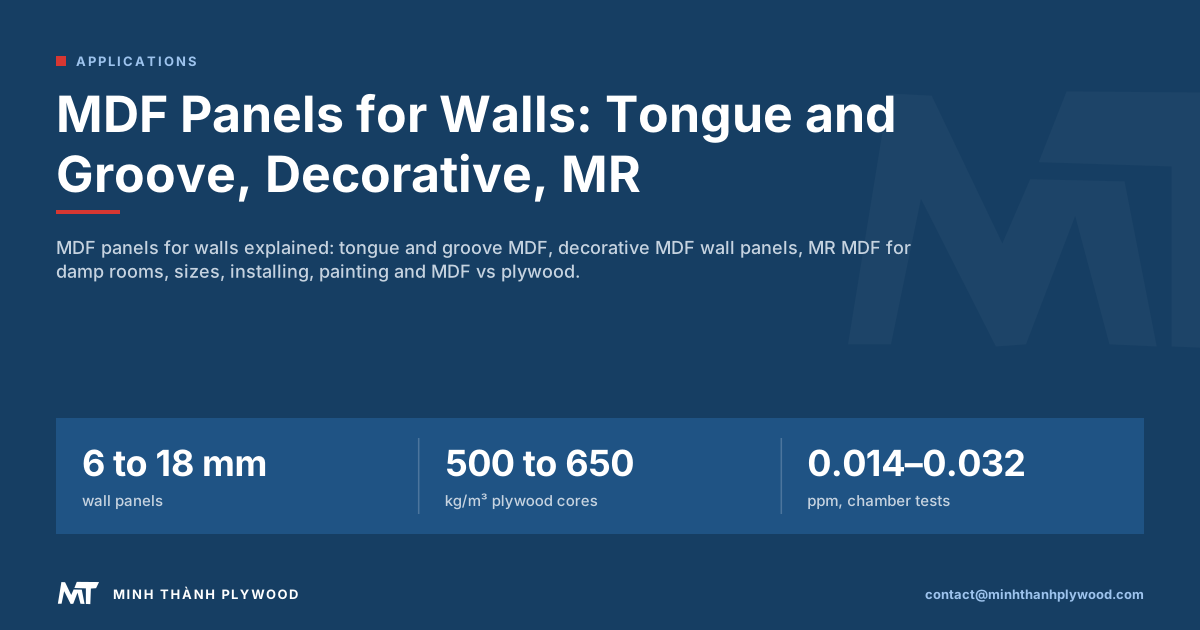
What are MDF panels?
MDF panels are flat sheets of medium-density fibreboard, made from wood fibres bonded with resin under heat and pressure. Because the fibres are fine and evenly spread, the board has no grain, no knots and no voids, so it machines cleanly and paints to a smooth finish.
For walls, MDF comes in three forms:
- Plain sheets, cut and fixed on site, often with battens to make shaker or panelled designs.
- Machined panelling: tongue and groove boards, V-groove and beaded sheets, slatted and fluted panels.
- Faced panels: MDF with a melamine paper, foil or real wood veneer already applied.
The trade-offs are weight, screw holding and moisture. Those three points decide when MDF is the right wall panel and when plywood is.
How are MDF panels made?
MDF panels are made by breaking wood into fibres, bonding them with resin and pressing them into a board. The main steps:
- Chipping: logs, thinnings and sawmill residues are cut into chips.
- Refining: chips are steamed and ground into fine fibres.
- Resin blending: resin, usually urea-formaldehyde, and wax are added to the fibres.
- Drying: the coated fibres are dried in a flash dryer.
- Mat forming: fibres are laid into an even mat and pre-pressed.
- Hot pressing: the mat is pressed to final thickness and the resin cures.
- Cooling, sanding and cutting: boards are cooled, sanded to thickness and cut to size.
Plywood is made differently: thin veneers are peeled from logs, dried, glued with grain in alternate directions and pressed. That cross-laminated build is why plywood holds screws and resists bending better than MDF. Our furniture-grade plywood is pressed twice: the core is pressed and calibrated, then face and back are pressed on.
Types of decorative MDF wall panels
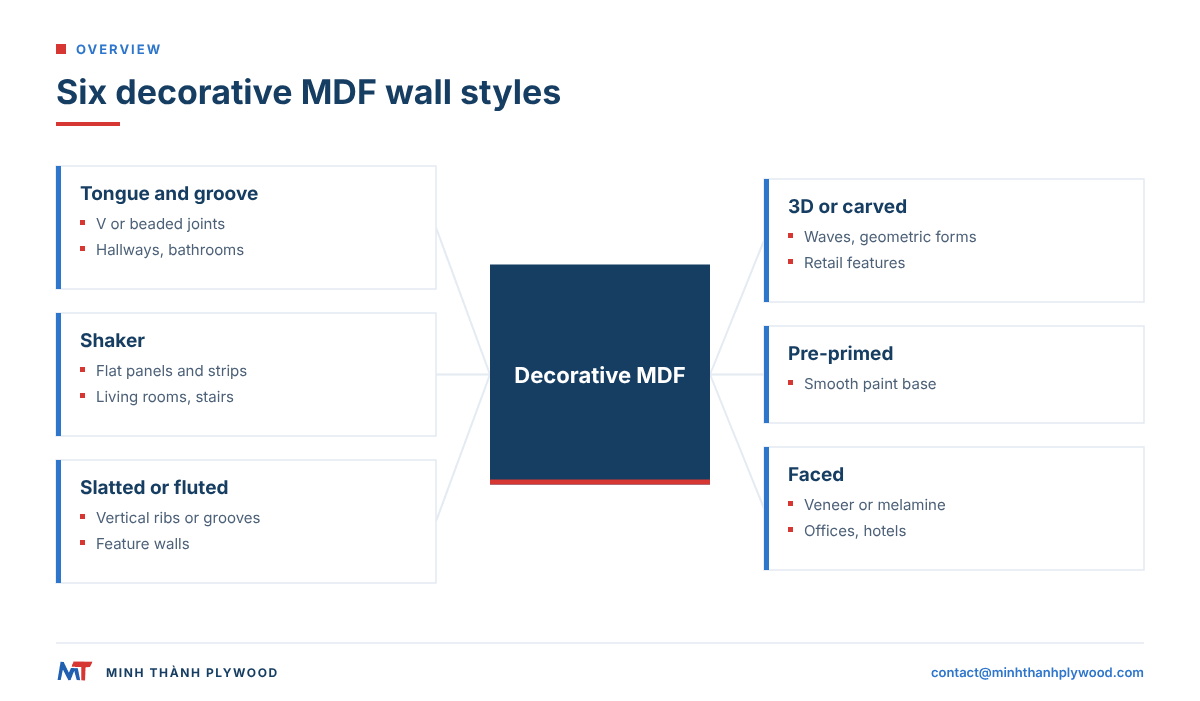
Decorative MDF wall panels come in six common styles, each made by machining or facing a plain MDF board:
| Style | What it looks like | Typical use |
|---|---|---|
| Tongue and groove | Vertical boards with a V or bead at each joint | Hallways, bathrooms, cottage style |
| Shaker panelling | Flat panels framed by applied strips | Living rooms, stairs, dado height |
| Slatted or fluted | Vertical ribs or grooves | Feature walls, headboards, offices |
| 3D and carved | Waves, geometric patterns | Feature walls, retail |
| Pre-primed sheets | Smooth, ready for paint | Any painted design |
| Veneered or melamine-faced | Wood look or plain colour | Offices, shops, hotels |
MDF decorative panels are mostly painted on site. Where the look must be real wood grain, a veneered panel or a decorative plywood is used instead.
Tongue and groove MDF panels: how they fit
Tongue and groove MDF panels lock together edge to edge: the tongue of one board slides into the groove of the next. The joint hides the fixings, keeps the faces flush and leaves a small V or bead that gives the panelled look.
Points to check when buying MDF tongue and groove wall panelling:
- Profile: V-groove, bead or square joint.
- Board or sheet: narrow boards fit one at a time; wide sheets with machined grooves go up faster.
- Primed or raw: pre-primed boards save a coat on site.
- Core: standard MDF for dry rooms, MR MDF for damp rooms.
- Fixing: secret nailing through the tongue, or adhesive onto a flat wall or battens.
The same look can be made in plywood: grooved and V-groove plywood sheets give the board pattern with a real veneer face. The planned guide on tongue and groove panelling compares boards and plywood sheets.
MDF panel sizes and thicknesses
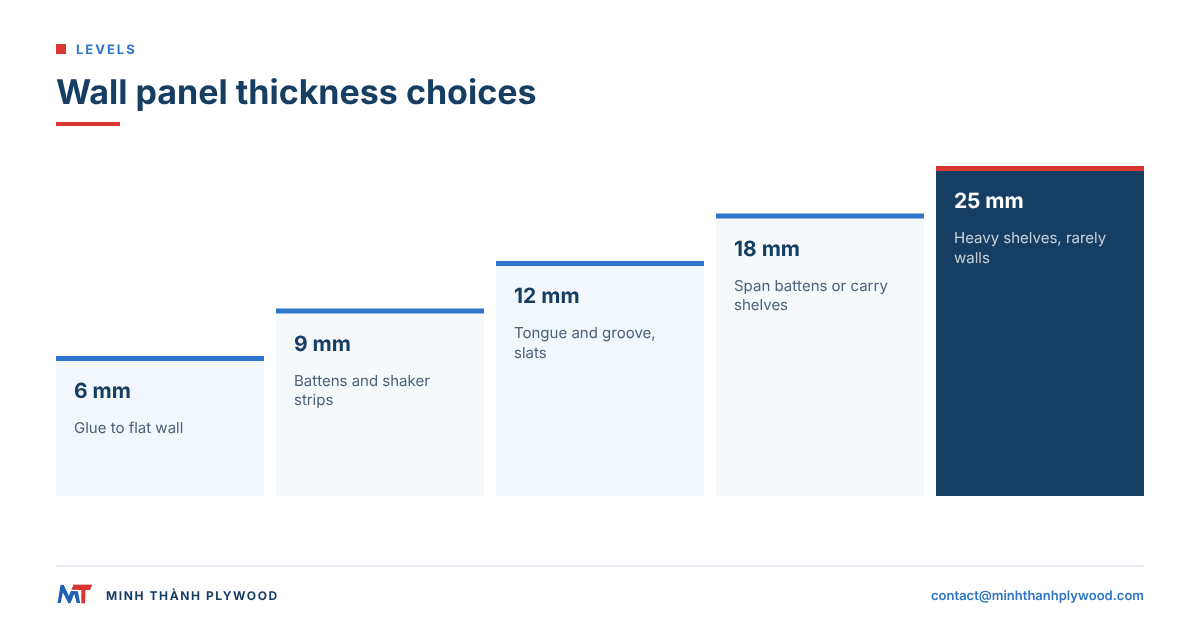
MDF sheets are usually sold at 1220 × 2440 mm (8 × 4 ft), with thicknesses from thin door-skin boards to thick shelving boards. For walls, the common thicknesses are:
| Thickness | Use on walls |
|---|---|
| 6 mm | Panelling glued onto a flat wall |
| 9 mm | Panelling on battens, shaker strips |
| 12 mm | Tongue and groove boards, slatted panels |
| 18 mm | Panels that span between battens or carry shelves |
| 25 mm | Heavy shelving and worktops, rarely walls |
Thicker is stiffer, but MDF gets heavy quickly. For a large feature wall on battens, a lighter plywood sheet of the same thickness is easier to lift and fix.
MDF panel sizes, prices and standards in the UK
In the UK a full 2440 × 1220 mm, 18 mm sheet of general-purpose MDF costs about £28 to £30 at a DIY chain, and cut sizes, wall-panel modules and moisture-resistant grades cost more per square metre. The tables give the sizes UK shops list and the sheet weights, with prices read on 21 October 2026.
| Format | Sizes (mm) | Thicknesses | Price seen |
|---|---|---|---|
| Full sheet | 2440 × 1220 | 3–25 mm | £27.17 incl. VAT at Robert Price; £28–£30 for 18 mm general purpose at Wickes |
| Half and square cuts | 1220 × 610; 1220 × 1220; 915 × 915 | 12 and 18 mm | Priced per piece at DIY.com |
| Tongue-and-groove wall panels | 811 × 606; 1215 × 606; 2440 × 600 | 12 mm class | Per panel at Panel Company |
| Raised-and-fielded or T&G modules | 915 × 516; 1522 × 516 | Module panels | Per panel at Panel Company |
| Dado rail and skirting | 2400 length | Profile | Per length at Panel Company |
| Cut-to-size | Minimum 100 × 50 mm, tolerance ±1 mm | 3, 6, 9, 12, 15, 18, 22, 25 mm | Priming £55 per m² per side at Cutmy |
Cut-to-size services keep a cut at least 20 mm from the board edge to prevent cracking, and the 3 mm CNC bit leaves a 1.5 mm minimum internal radius (Cutmy, read 21 October 2026).
MDF is also heavy. Standard MDF has a density of about 700 to 800 kg/m³, so an 18 mm 1220 × 2440 mm sheet weighs about 38 to 43 kg (sheet volume × density), against about 26.8 kg for our 18 mm Styrax-core plywood at about 500 kg/m³. That gap matters when one fitter lifts a sheet onto battens.
For the standards, UK buyers specify MDF to EN 622-5, which grades dry-process boards for dry use (MDF), humid use (MDF.H) and load-bearing use, and wood-based panels in construction fall under BS EN 13986 with the CE or UKCA marking on the declaration of performance. Moisture-resistant boards are the humid-use grade and are not waterproof.
| Buyer | What fits |
|---|---|
| DIY or one wall | MDF panel kits and 18 mm sheets from a UK shop; price per sheet above |
| Shopfitter or panel maker | Plywood wall panels in 1220 × 2440 mm, cut and finished in your workshop |
| Trade or container buyer | FOB Vietnam plywood by the 40HC, mixed specifications by agreement, from us |
Standard, moisture-resistant and fire-retardant MDF
MDF is made in three main grades for walls: standard, moisture-resistant (MR) and fire-retardant (FR). Many mills colour the core so the grade can be seen at a cut edge: green for MR and red for FR is a common code in Europe.
- Standard MDF: for dry rooms only. It swells at the edges if water gets in.
- MR MDF: resists humidity better, for kitchens, bathrooms away from direct water, and utility rooms. It is still not waterproof.
- FR MDF: treated to slow the spread of flame, used where building rules ask for a fire class. In the EU the class is assigned under Commission Delegated Regulation (EU) 2016/364.
All three must be sealed with primer and paint on every face and cut edge. The edges are where moisture enters.
MDF vs HDF
HDF (high-density fibreboard) is made like MDF but pressed denser and usually thinner. It is harder, more impact-resistant and less likely to dent, and it is used for door skins, drawer bottoms, cabinet backs and laminate flooring cores.
For wall panelling, MDF is the normal choice: it machines into profiles more easily and costs less per sheet. HDF is used for thin decorative skins and printed panels.
Is MDF better than plywood for wall panels?
MDF is better for a smooth painted finish and machined profiles in a dry room; plywood is better for strength, fixings, weight and moisture. The table answers the questions buyers ask most: is MDF stronger than plywood, is MDF heavier than plywood, and which is better.
| Point | MDF panels | Plywood panels |
|---|---|---|
| Strength in bending | Lower | Higher, cross-laminated veneers |
| Screw holding | Weak near edges, needs pilot holes | Good across the face and edges |
| Weight per sheet | Heavier than most plywood | Lighter: about 500 kg/m³ (Styrax core) to 650 kg/m³ (Eucalyptus core) |
| Moisture | Swells at cut edges when wet | Exterior bonds resist water; edges still sealed |
| Painted finish | Very smooth, no grain | Smooth on poplar and birch; may show grain |
| Natural wood look | Only with an applied veneer | Real veneer face: birch, oak-look EV, pine |
| Machined profiles | Clean, crisp | Good; edges show plies |
| Cost per sheet | Lower | Higher |
Our guide on plywood vs MDF compares the two panels across furniture and joinery as well.
Which substrate for bathrooms and feature walls?
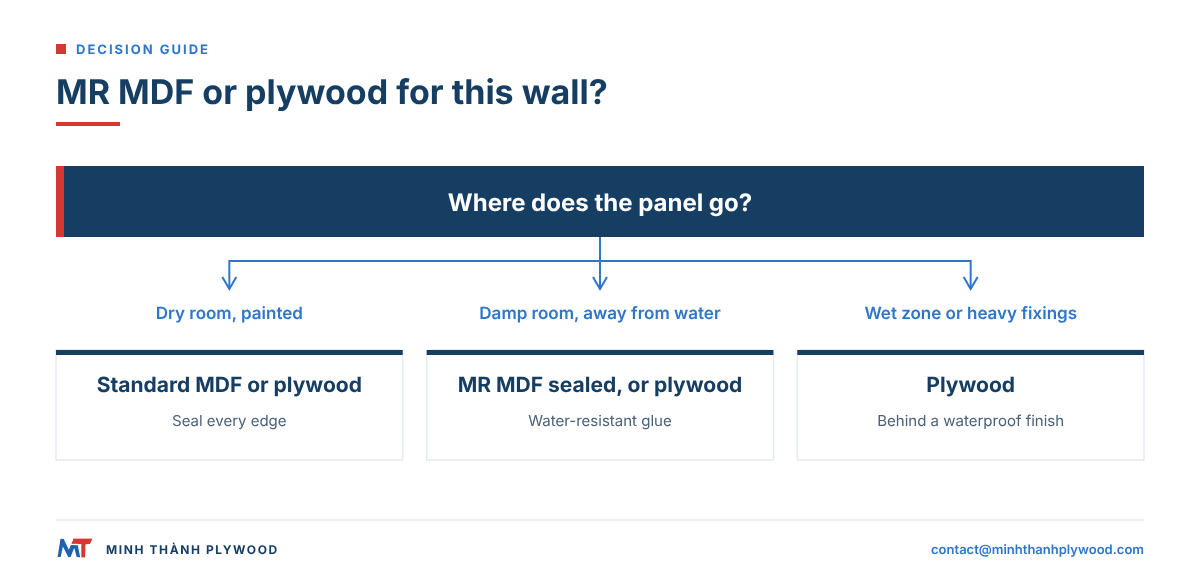
For bathrooms and other wet rooms, plywood with a water-resistant bond is the safer substrate; MR MDF works only in damp areas away from direct water and only when sealed everywhere. For dry feature walls, either works, and the choice comes down to the look.
| Room or wall | MR MDF | Plywood |
|---|---|---|
| Bathroom, away from shower | Possible, fully sealed | Good with a water-resistant glue |
| Shower surround, wet zone | No | Only behind a waterproof finish |
| Kitchen splashback area | Possible, sealed | Good |
| Living room feature wall, painted | Good | Good |
| Feature wall, natural wood look | Needs an applied veneer | Good: veneer face is the finish |
| Wall carrying TVs, shelves, cabinets | Needs battens and anchors | Fixings and supporting structure must suit the load |
The planned guide on plywood bathroom wall panels covers which panels survive moisture. Our article on whether plywood is waterproof explains glue classes.
How do you install MDF wall panels?
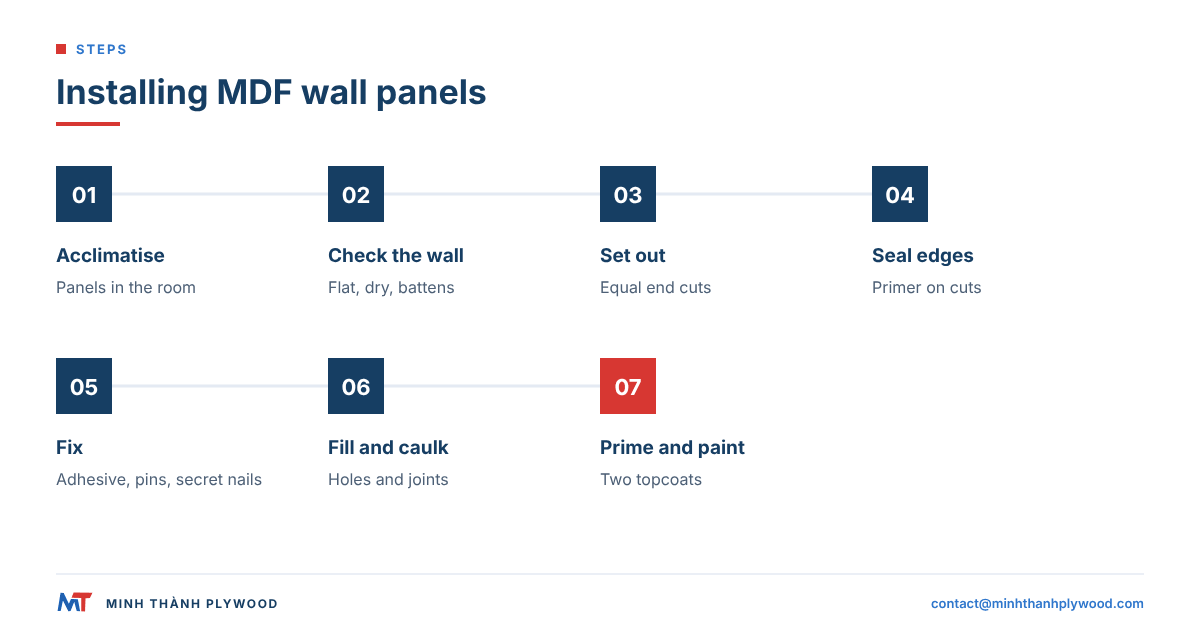
MDF wall panels are installed onto a flat wall with adhesive, or onto timber battens with nails or screws. A clean installation runs in seven steps:
- Acclimatise the panels in the room for a couple of days before fixing.
- Check the wall is flat and dry; fix battens where it is not.
- Set out the panel layout so cut boards at the ends are equal.
- Seal cut edges with primer before fixing, especially in damp rooms.
- Fix the panels: adhesive plus pins, or secret nails through the tongue.
- Fill and caulk nail holes and the joints to walls and ceilings.
- Prime and paint with two topcoats.
Leave a small gap at the floor and at the ceiling where the room moves with seasons, and cover it with skirting or trim.
Painting and finishing MDF panels
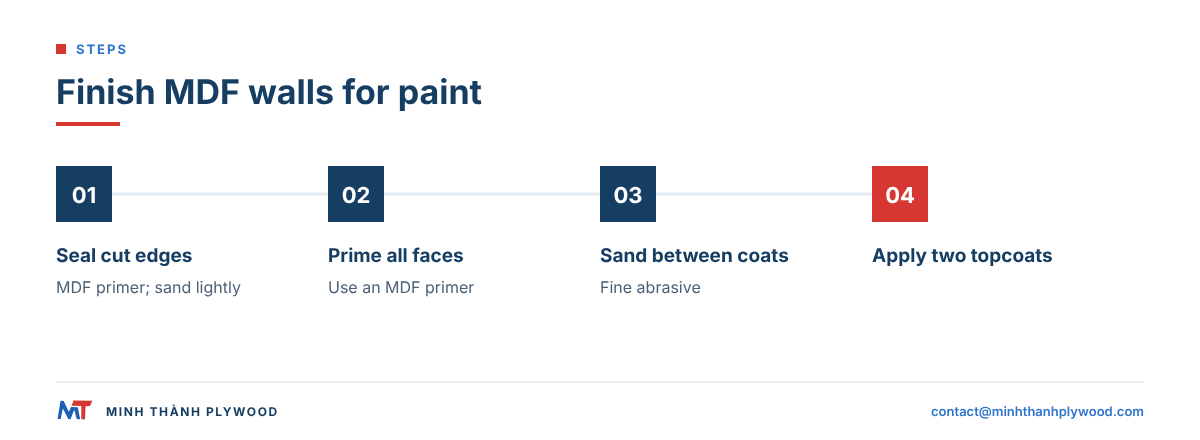
MDF panels need a primer before paint, because raw MDF soaks up the first coat unevenly and the cut edges drink paint. The normal system:
- Seal cut edges with an MDF primer or a thinned coat, and sand lightly.
- Prime all faces with a primer made for MDF.
- Sand between coats with a fine abrasive.
- Apply two topcoats of the chosen paint.
Plywood with a smooth poplar or birch face paints well too, but its grain may show through a thin finish. For a clear finish that shows wood, plywood is the better base, because the face is real veneer. Both faces of our furniture panels are sanded and UV-ready.
Formaldehyde and MDF panels
Most MDF is bonded with urea-formaldehyde resin, so its emission class matters on walls, where panels cover a large area of the room. Buyers in Europe usually ask for E1 or lower; in the US, composite wood panels must meet CARB Phase 2 and TSCA Title VI under the US EPA formaldehyde emission standards. EPA’s TSCA Title VI guidance lists separate formaldehyde limits for MDF and thin MDF.
The same question applies to plywood. Our furniture and interior plywood uses UF glue at E0 emission and holds CARB P2 / TSCA Title VI certification as ICTT mill no. 23024. Six chamber tests between April 2025 and June 2026 averaged 0.014–0.032 ppm against the 0.05 ppm limit for veneer-core hardwood plywood.
When to choose plywood wall panels, and what we supply
Choose plywood wall panels when the wall must hold fixings, look like real wood, stay light, or face moisture. Minh Thanh Plywood makes plywood, not MDF, so this is the part of the job we supply:
| Item | Minh Thanh plywood for wall panels |
|---|---|
| Faces | 10+ face veneers: EV (oak, walnut, teak looks), poplar, birch, okoume, pine |
| Core | White Styrax or Eucalyptus, stitched horizontally and vertically |
| Glue | UF glue at E0 emission; MR or WBP bonds for damp areas to your specification |
| Thickness | 3–40 mm; thin 3–6 mm for overlays, 9–18 mm for panels |
| Size | 1220 × 2440 mm, 1250 × 2500 mm, custom and cut-to-size |
| Tolerance | ±0.2–0.3 mm on sanded furniture panels |
| Surface | Sanded, UV-ready on both faces |
Orders start at one 40HC with mixed specifications by agreement, 15–45 days after the 30% deposit. See EV plywood and poplar plywood for decorative faces, or our plywood product range.
Specify your wall panel plywood
Send us the line your joinery or fit-out team would write, and we will quote it within hours:
Wall panel plywood, 12 mm, 1220 × 2440 mm, EV oak face / poplar back, white Styrax core, UF glue at E0 emission, sanded UV-ready faces, ±0.2–0.3 mm, export packing, one 40HC, CIF your port.
For the full picture of wood-based wall linings, read our pillar guide on plywood wall panels. The planned guides on grooved plywood and plywood partition walls cover the next steps.
Buyer questions, answered
What are MDF panels?
MDF panels are sheets of medium-density fibreboard, made by breaking wood into fibres, mixing them with resin and pressing them into a dense, uniform board. They are sold as plain sheets and as machined wall panelling.
Is plywood better than MDF?
Plywood is better where strength, screw holding, low weight or moisture matter; MDF is better where a perfectly smooth painted face or a machined profile matters and the panel stays dry. For wall panelling, both work; for bathrooms and heavy fixings, plywood is the safer choice.
Is MDF stronger than plywood?
No. Plywood is stronger in bending and holds screws better, especially near the edges, because its cross-laminated veneers carry load in both directions. MDF is uniform and stable but weaker per thickness.
Is MDF heavier than plywood?
Yes, usually. MDF is denser than most plywood, so an MDF sheet of the same size and thickness weighs more. Our furniture plywood ranges from about 500 kg/m³ on Styrax core to about 650 kg/m³ on Eucalyptus core.
Can MDF wall panels go in a bathroom?
Only moisture-resistant (MR) MDF, fully sealed on every face and edge, and kept away from direct water such as shower areas. Standard MDF swells when water reaches it; exterior or WBP-bonded plywood is the safer substrate in wet rooms.
What are tongue and groove MDF panels?
Tongue and groove MDF panels are machined boards or sheets with a tongue on one edge and a groove on the other, so they lock together into a continuous panelled wall, often with a V-groove or bead at each joint.
Do MDF wall panels need to be primed?
Yes. Raw MDF absorbs paint unevenly, especially at cut edges. Use a primer made for MDF, seal the edges, lightly sand, then apply two topcoats; many panels are sold pre-primed.
What is the difference between MDF and HDF?
HDF (high-density fibreboard) is made the same way as MDF but pressed denser and usually thinner. It is harder and more impact-resistant and is used for door skins, drawer bottoms and flooring cores.
What thickness are MDF wall panels?
Decorative MDF wall panels are usually 6 mm to 12 mm thick when fixed onto a wall or battens, and 18 mm for panels that must span or carry fixings. Plain MDF sheets run from about 3 mm to 30 mm.