
Melamine plywood is plywood with a décor paper soaked in melamine resin pressed onto each face, so the surface comes out hard, closed and finished, with no paint or lacquer. The paper is thin, which means the plywood under it decides how flat and clean the panel looks. Minh Thanh Plywood makes the calibrated, double-pressed furniture plywood that a good melamine face needs.
What is melamine plywood?
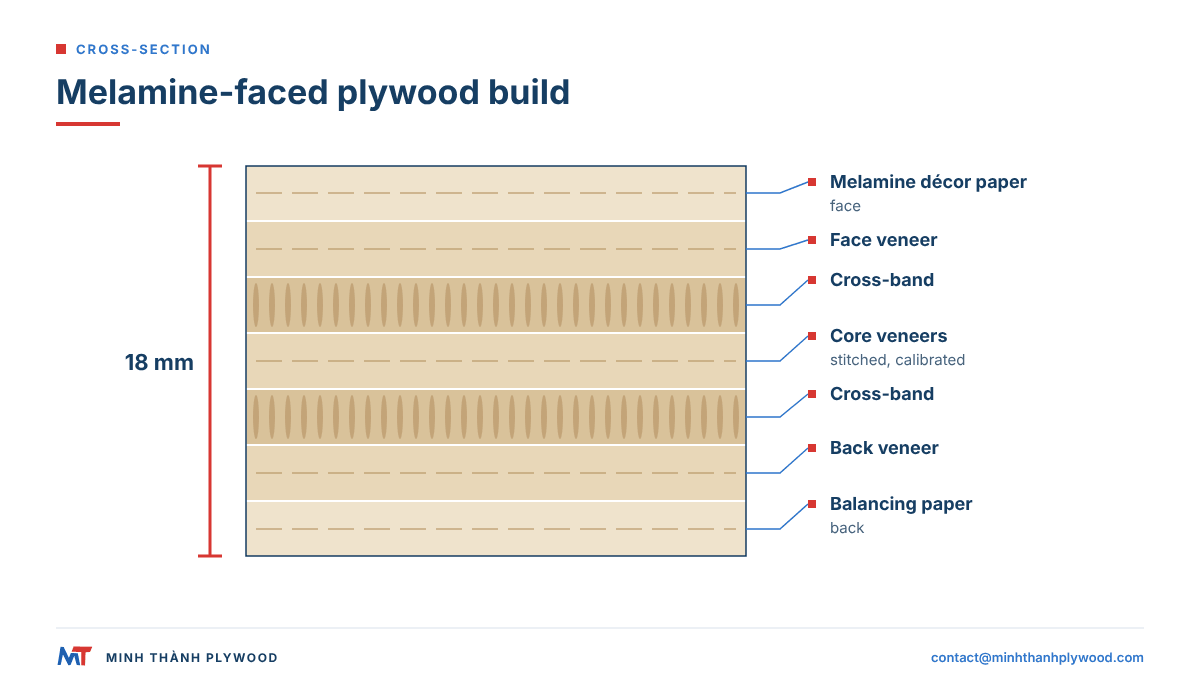
Melamine plywood is a plywood panel faced on one or both sides with décor paper impregnated with melamine-formaldehyde resin, pressed on under heat until the resin cures. The cured resin is the finish: hard, closed, wipeable and coloured right through the visible layer, so the panel can go straight into a cabinet or wardrobe without paint.
Trade names vary: melamine faced plywood, melamine coated plywood, melamine laminated plywood, plywood with melamine face, and in some markets MFP or “laminated plywood”. They describe the same build when the paper is pressed directly onto the plywood. When a separate laminate sheet is glued on instead, the product is HPL plywood, covered in our HPL and Formica plywood guide.
Melamine plywood is the plywood version of the melamine-faced chipboard and MDF that most flat-pack furniture uses. The difference is underneath: a plywood core is lighter for its stiffness, holds screws better and tolerates moisture better than particleboard.
How is melamine-faced plywood made?
Melamine-faced plywood is made in two stages: the plywood substrate first, then the faces. The face is only as good as the board it is pressed on, so the first stage decides most of the result.
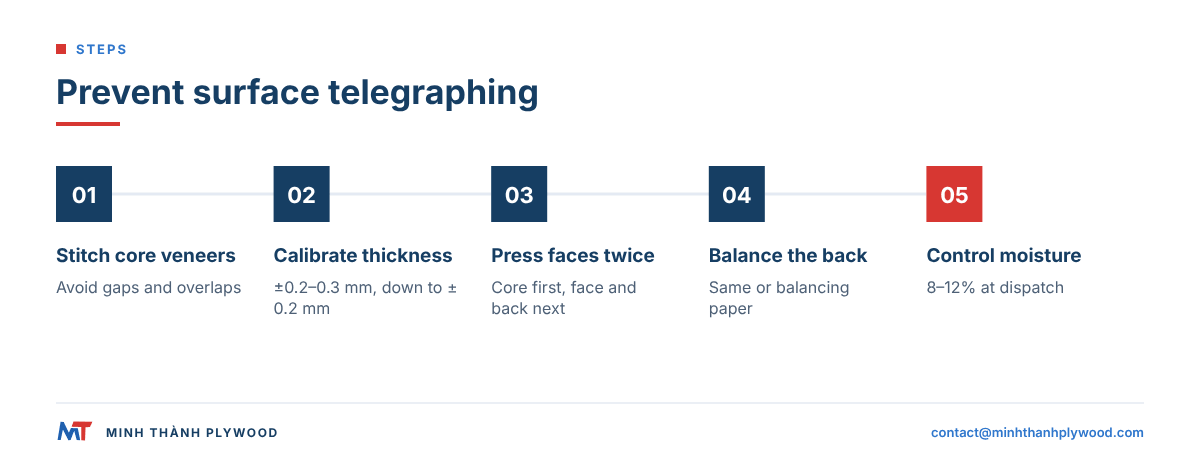
- Press the core. Veneers are glued and pressed into a core board. At Minh Thanh, core layers are stitched both horizontally and vertically, so no gaps or overlaps sit under the face.
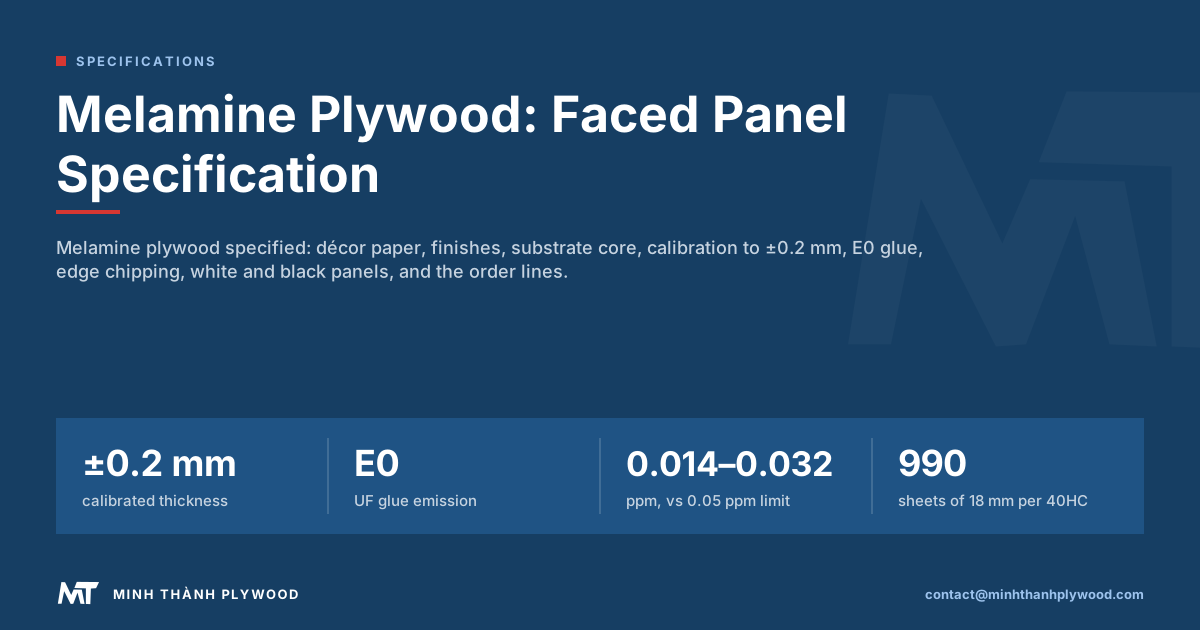
- Calibrate. The core board is sanded to a calibrated thickness, down to ±0.2 mm, so the surface is flat before the face goes on.
- Second pressing. Face and back veneers are pressed on: furniture-grade panels at Minh Thanh are pressed twice as standard. The panel is sanded again.
- Impregnate the paper. Décor paper is soaked in melamine resin and dried to a controlled resin content, ready to cure.
- Lay up the faces. One décor paper goes on the face; the same paper, or a balancing paper, on the back.
- Short-cycle press. A heated press, with a steel plate that carries the gloss or texture, cures the resin onto the plywood in a short cycle. No extra glue is needed: the resin in the paper is the bond.
- Trim and inspect. The panel is trimmed, checked for surface defects, then stacked flat face to face.
Because the melamine bonds through its own resin, the plywood surface must be smooth, clean and dry. Our veneers and finished panels leave at 8–12% moisture content.
Why does the plywood core decide flatness?
The plywood core decides flatness because a melamine paper is far too thin to hide what is under it. Under a glossy or solid-colour face, every overlap, gap or thickness step in the core can show through as a line, a dip or a shadow when light falls across the panel. Buyers call this telegraphing.
Four core properties prevent it:
- Stitched core layers. Core veneers joined both ways, so there are no open joints or overlaps.
- Calibrated thickness. A sanded, even board: our furniture panels hold ±0.2–0.3 mm, down to ±0.2 mm.
- Double pressing. The core is pressed and calibrated before the faces are pressed on, which flattens the panel a second time.
- Even moisture. 8–12% moisture content at dispatch, so the board does not move after the face cures.
A melamine face also needs a balanced build: the same paper, or a balancing paper of similar weight, on the back. A panel faced on one side only pulls towards the face as the resin cures and the room humidity changes. Cabinet sides seen from both sides get the décor on both; carcass backs can take a cheaper balancing paper.
Which core species works best under melamine?
The core species sets the weight, the screw holding and the colour of the cut edge. Minh Thanh’s furniture panels use white Styrax or Eucalyptus cores as standard; Acacia and Pine cores are made on order.
| Core | Density | 18 mm sheet, 1220 × 2440 mm | Best under melamine for |
|---|---|---|---|
| White Styrax | about 500 kg/m³ | about 26.8 kg | Wardrobes, cabinet carcasses, shelving, van and caravan linings |
| Acacia | about 580 kg/m³ | about 31.1 kg | General furniture, stronger screw holding |
| Eucalyptus | 650–750 kg/m³ | about 34.8 kg at 650 kg/m³ | Doors, hinge sides, heavily loaded shelves |
Styrax is the light, pale choice: a white edge under a white or light décor, easy handling on the line and more sheets per container by weight. Eucalyptus is the dense choice where hinges, drawer runners and connectors must hold. Buyers who edge-band every visible edge choose by weight and screw holding; buyers who leave edges exposed choose the paler Styrax.
Which décor papers and finishes are available?
A melamine face is defined by three choices: the décor, the surface texture and the paper build. Each goes on its own line in the order.
Décor families:
- Solid colours: whites from warm to cool, greys, beiges, black, and brand colours.
- Wood décors: oak, walnut, ash, elm and other printed wood grains, in many tones.
- Stone and concrete: marble, slate, terrazzo and cement looks.
- Fabric and fantasy: linen, metal and textile prints.
Surface textures:
- Smooth or satin: the everyday cabinet finish.
- Matt and super-matt: low reflection; some matt surfaces resist fingerprints.
- Gloss and high gloss: reflective, shows any unevenness of the core.
- Embossed wood grain: texture pressed by the steel plate.
- Synchronised texture (embossed in register): the texture follows the printed grain, the closest look to real veneer.
Paper build: a single décor paper is standard. An overlay paper, a clear resin-rich sheet on top of the décor, adds wear resistance for worktops and shop furniture. The décor and texture are approved against a physical sample, because the same colour code looks different on a different texture.
What do white laminated plywood and black laminated plywood need?
White laminated plywood and black laminated plywood are the two most ordered melamine colours, and each puts its own demand on the build.
White: white décors range from warm to cool and from soft white to brilliant white. Approve the exact white beside the edge band and the mating panels, under the light the furniture will stand in. A pale Styrax core gives a light cut edge that matches white décors when an edge is left visible.
Black: black shows everything. Scratches, fingerprints and any unevenness under the face catch the light, so black melamine needs the flattest calibrated core and, for gloss black, the tightest thickness tolerance. Matt black hides handling marks better than gloss. A dark edge band, or a black-dyed edge, finishes the look.
Both colours also come in high-gloss versions for doors and display furniture. Gloss is where double pressing and a calibrated core pay off most: a reflective face shows any core step that a matt face would hide.
How thick is melamine plywood, and what is 3/4 melamine plywood?
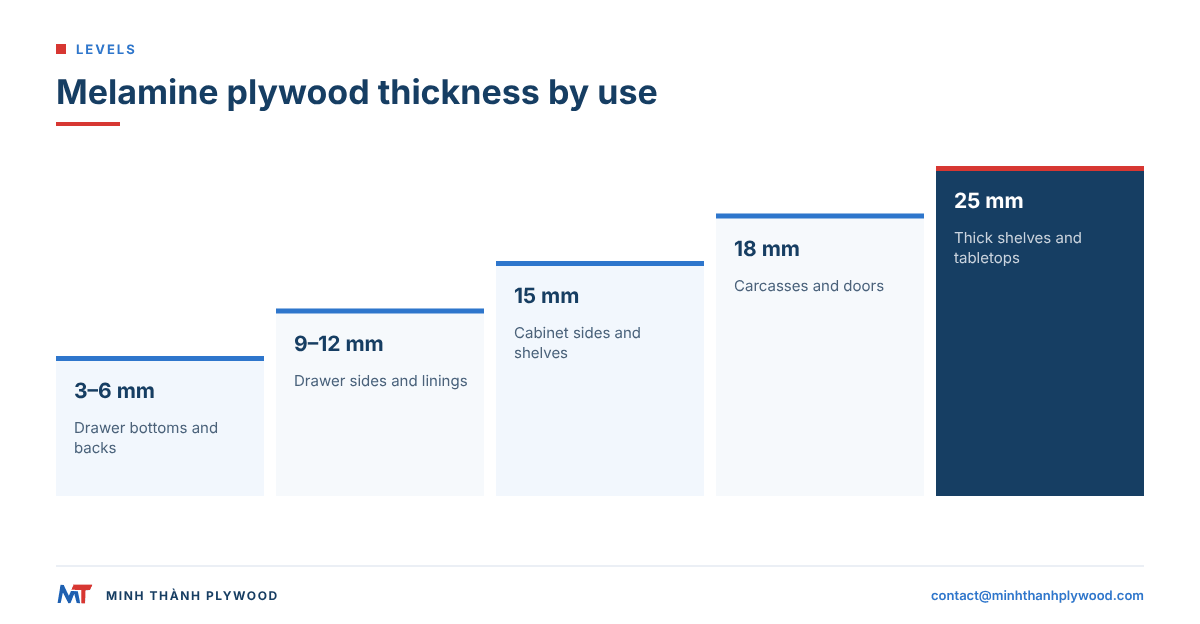
Melamine plywood is pressed in the same thicknesses as furniture plywood; the paper adds only a fraction of a millimetre. The common furniture thicknesses are 9, 12, 15, 18 and 25 mm, and Minh Thanh presses plywood from 3 to 40 mm.
“3/4 melamine plywood” is the North American name for the cabinet thickness. 3/4 inch is 19.05 mm nominal; metric mills supply 18 mm. Most cabinet hardware, hinge cups and edge bands work with both, but a drawing with fixed dados or grooves must state which it was drawn for.
| Thickness | Typical melamine part |
|---|---|
| 3–6 mm | Drawer bottoms, cabinet backs, linings (thin panels of 3–5 mm are always 5-ply) |
| 9–12 mm | Drawer sides, light shelves, van and trailer wall linings |
| 15 mm | Cabinet sides and shelves in European kitchens |
| 18 mm | Cabinet carcasses and doors, wardrobes, common metric cabinet thickness |
| 25 mm | Thick shelves, worktop cores, tabletops |
Standard sheet sizes are 1220 × 2440 mm and 1250 × 2500 mm, with custom sizes such as 1220 × 2500 and 1220 × 2280 mm. Panels can also be cut to size, one sheet into 4, 6 or 8 pieces.
Melamine plywood vs melamine MDF vs melamine particleboard
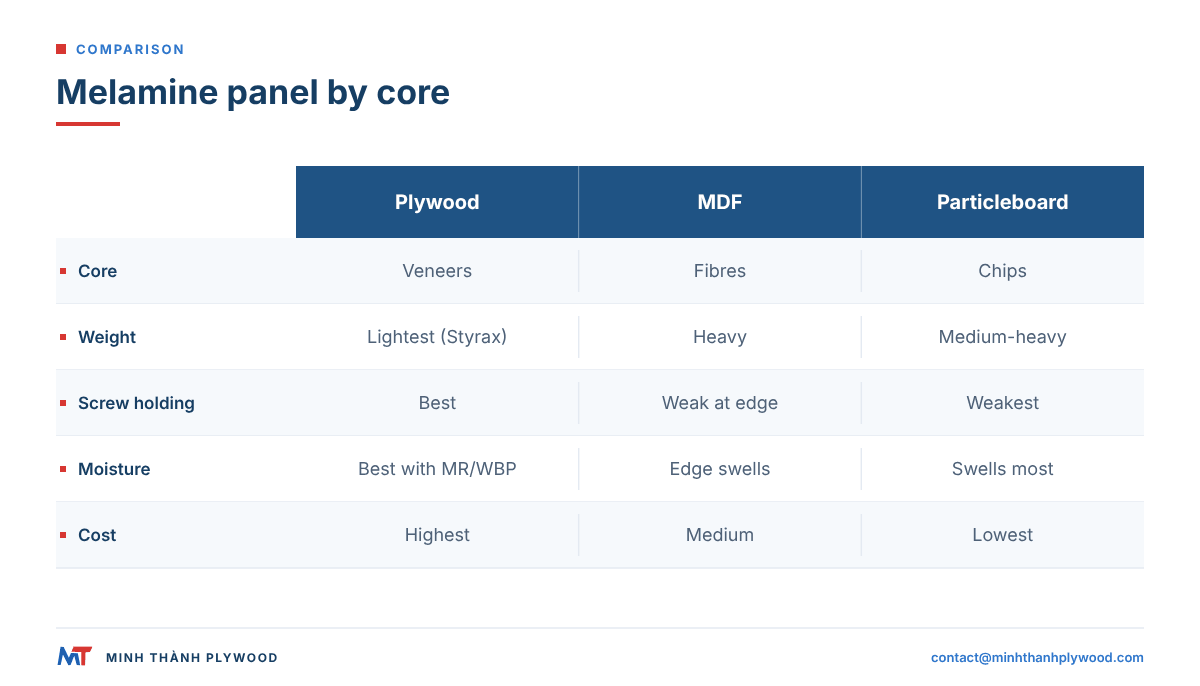
All three are melamine-faced panels; the core is the difference. One row per property:
| Property | Melamine plywood | Melamine MDF | Melamine particleboard |
|---|---|---|---|
| Core | Cross-laminated veneers | Wood fibres pressed with resin | Wood chips pressed with resin |
| Weight for the same thickness | Lightest on a Styrax core | Heavy | Medium to heavy |
| Screw holding | Best, also near edges | Good in the face, weak in the edge | Weakest, needs special fittings |
| Stiffness and span | Best for shelves and long parts | Sags more over a span | Sags most |
| Moisture tolerance | Best, especially with MR or WBP glue | Swells at the edge when wet | Swells most |
| Cut edge | Ply layers, can be left visible | Smooth, needs banding | Rough, needs banding |
| Cost | Highest | Medium | Lowest |
Melamine plywood is the choice where weight, screw holding or moisture matters: kitchens, bathrooms, vans, caravans, boats, shop fittings and furniture that ships far. Particleboard wins on price for flat-pack furniture that stays dry. MDF wins where the edge is profiled or painted. The broader comparison is in plywood vs MDF.
Is melamine stronger than plywood?
Melamine is a resin surface, not a board, so it adds hardness to the face but almost no strength to the panel. The strength of a melamine panel is the strength of its core. A melamine plywood panel is therefore much stronger than melamine particleboard: its cross-laminated veneers resist bending in both directions, carry shelves over longer spans and hold screws even close to the edge.
The melamine face does add surface properties: it resists scratches, stains and household chemicals far better than a bare or lacquered veneer, and it cleans with a damp cloth. Impact is its weak point. A sharp knock can crack the thin resin layer, which is why worktops and shop counters use thicker HPL instead.
Which glue goes inside melamine plywood: UF, MR or phenolic?
The glue inside the plywood is a separate choice from the melamine on the face, and buyers often confuse the two. “Melamine glue” or MR glue means a urea glue fortified with melamine resin to resist moisture. It has nothing to do with the décor paper.
| Glue inside the plywood | Bond | Where it fits |
|---|---|---|
| UF glue at E0 emission | Interior, dry use | Standard for furniture and interior panels |
| Melamine-fortified (MR) | Moisture-resistant | Kitchens, bathrooms, vans, humid climates |
| Phenolic (WBP) | Boil-resistant, exterior | Exterior and wet use; dark glue lines |
UF glue at E0 emission is standard for Minh Thanh’s furniture and interior panels; MR and phenolic WBP bonds are made to the customer’s specification. Glue and emission class are two separate lines on the order: E0 and E1 describe how much formaldehyde the panel releases, not which glue was used. The phenolic option is described on our exterior plywood page.
Is melamine plywood low in formaldehyde (E0)?
A melamine face is a cured resin and releases little on its own; the plywood glue is what decides emission. Minh Thanh’s furniture panels use UF glue at E0 emission and are certified to CARB P2 / TSCA Title VI (ICTT mill no. 23024).
Six third-party chamber tests to ASTM D6007, April 2025 to June 2026, on 9, 15 and 18 mm panels averaged 0.014–0.032 ppm, against the CARB Phase 2 and TSCA Title VI limit. That limit is 0.05 ppm for hardwood plywood with a veneer core under 40 CFR 770.10. Three were run by Shanghai Hongjun and three by ICTT Vietnam. E0 emission is tested every 3 months.
For the EU, Regulation (EU) 2023/1464 sets a limit of 0.062 mg/m³ of formaldehyde for wood-based panels and furniture placed on the market from 6 August 2026 (consulted 20 October 2026). Our panels meet the emission requirements European furniture buyers ask for, and SGS tests to EN 717-1 on request. How the classes compare is on our E0 and E1 emission page.
How do you stop edge chipping when cutting melamine plywood?
Melamine chips where the saw tooth leaves the hard resin layer, so a clean edge comes from the saw set-up and from a well-bonded, flat substrate. Five habits keep the edge clean:
- Use a scoring blade. A small blade scores the bottom face just ahead of the main blade, so neither face chips.
- Keep the blade sharp and fine. A blade with many teeth and a triple-chip grind cuts melamine without tearing it.
- Set the right feed speed. Too fast tears the surface; too slow burns it.
- Support the panel flat. A panel that bows or vibrates on the table chips at the exit.
- Test a sample first. Cut an approved sample panel on your own line and inspect both faces at the edge before the order runs.
The substrate matters because a melamine face over a void, a loose veneer or an uneven core breaks away more easily at the cut. A stitched, double-pressed core gives the saw an even, solid edge. Edge banding then seals the cut against moisture and impact.
What is melamine marine plywood?
Melamine marine plywood is a market name, used mainly in the Philippines, for melamine-faced plywood with a water-resistant glue, sold for kitchen cabinets, bathroom vanities and furniture in humid climates. “Marine” there describes the bond, not boat-building certification.
Buyers in humid markets should order the parts by name rather than by the label:
- Bond: phenolic WBP for wet areas, or melamine-fortified MR for humid interiors.
- Face: the décor and texture, with a balancing paper or the same décor on the back.
- Edges: banded on every edge that meets water.
True marine plywood for boat hulls is a separate, certified build to BS 1088. For cabinets and vanities, the melamine-faced build with a WBP or MR bond is the product the name describes, and it is what a buyer comparing laminated marine plywood suppliers in the Philippines should quote against.
Where is melamine-faced plywood used?
Melamine-faced plywood is used wherever a finished, wipeable surface on a strong, light panel saves a finishing step. The main uses:
- Kitchen and bathroom cabinets: carcasses, shelves and doors, with an MR bond for humid rooms; see plywood for kitchen cabinets.
- Wardrobes and bedroom furniture: large light panels on a Styrax core.
- Office and shop furniture: desks, counters, shelving and display units.
- Vans, trailers and caravans: wall and ceiling linings and furniture, where light weight counts.
- Boats and yachts: interior furniture in a humid environment.
- Doors: flush door skins and cabinet doors in solid colours and wood décors.
For trailer and van builders the gain over particleboard is weight and screw holding; for furniture plants it is a panel that needs no spraying.
What should you check when melamine plywood arrives?
Inspect melamine plywood on arrival in this order, on a sample of sheets from different packs:
- Pack and marks: pack labels match the order, wrapping intact, corners undamaged.
- Surface under raking light: shine a light along the face to find telegraphing, dents, pressure marks or dust under the paper.
- Colour and texture: compare with the approved sample, and between packs.
- Thickness: measure with a calliper at several points; compare with the ordered tolerance.
- Flatness: lay the sheet on a flat surface and check for bow or twist.
- Edge and cut test: cut one sheet on your own saw and check for chipping and core voids.
Minh Thanh photographs and films every shipment before loading, and buyers receive the photos and video, so the first check starts before the container leaves Hai Phong.
How much melamine plywood fits in a 40HC container?
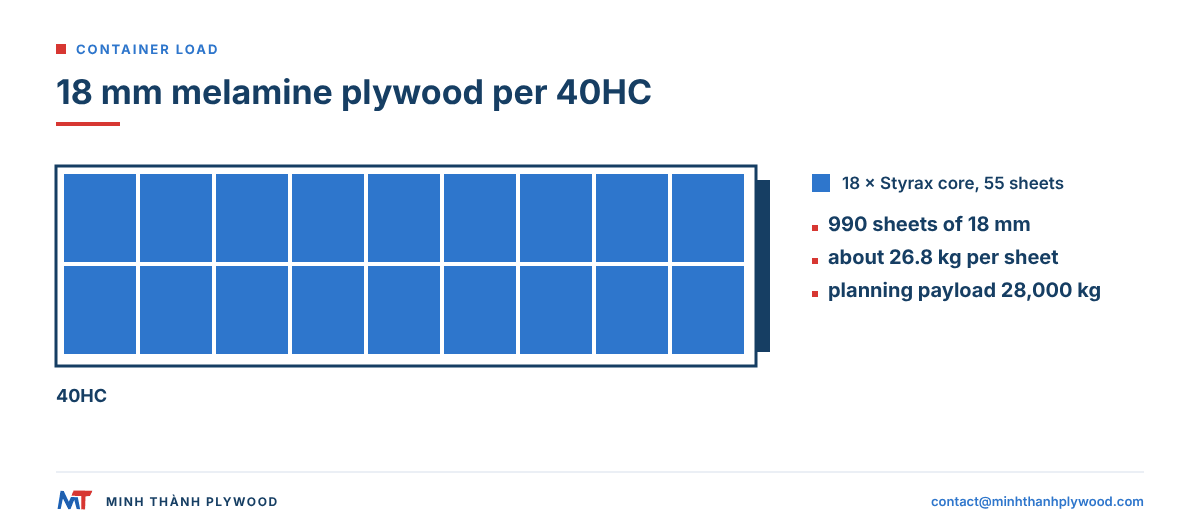
A 40HC holds about 990 sheets of 18 mm, 1220 × 2440 mm plywood on a Styrax core: 18 packs of 55 sheets. The packing plan by core:
| Core | Packs per 40HC | Sheets per pack at 18 mm | Sheets per 40HC | Weight per sheet |
|---|---|---|---|---|
| Styrax | 18 (16 lying + 2 upright) | 55 | 990 | about 26.8 kg |
| Acacia | 16 | 55 | 880 | about 31.1 kg |
| Eucalyptus | 15 | 53 | 795 | about 34.8 kg |
Packs are about 1,000 mm high; sheets per pack are 1,000 ÷ thickness, rounded down, then capped by weight. The planning payload is 28,000 kg unless the booking is lower. The minimum order is one 40HC with mixed specifications by agreement, so several thicknesses and faces can share one container. The packing calculator works out other thicknesses.
How do you specify melamine plywood on an order?
A melamine plywood order is complete when the substrate and the face are written as separate lines. Use this list:
- Use: kitchen carcass, wardrobe, door, van lining, shelving.
- Substrate core: white Styrax, Eucalyptus, or Acacia or Pine on order.
- Glue and emission: UF glue at E0 emission, MR or phenolic WBP; emission class on its own line.
- Thickness, tolerance and size: for example 18 mm, ±0.2 mm, 1220 × 2440 mm.
- Face: décor name or code, texture, one or two sides, balancing paper on the back.
- Packing and quantity: sheets per thickness, pack marks, destination port.
For delivery into the EU, add the origin documents to the same list: plywood under heading 4412 is a relevant product of Regulation (EU) 2023/1115, the EU Deforestation Regulation.
Send the list to contact@minhthanhplywood.com or on WhatsApp +84 988 586 601 (Lisa); replies come within hours, and samples are free. Production takes 15–45 days after the 30% deposit, shipped FOB Hai Phong, CFR or CIF. The substrate builds are on our furniture plywood page; other laminated faces are compared in laminated plywood.
Buyer questions, answered
What is melamine plywood?
Plywood with a melamine-resin-impregnated décor paper pressed onto its faces under heat and pressure. The resin cures into a hard, finished surface, so the panel needs no painting or lacquering.
What is melamine faced plywood used for?
Kitchen and bathroom cabinets, wardrobes, office and shop furniture, shelving, and van, trailer and caravan linings, anywhere a clean, wipeable finished surface is wanted straight from the panel.
Is melamine stronger than plywood?
Melamine is a surface, not a board, so the question is really melamine particleboard versus melamine plywood. Melamine plywood is stronger, lighter for its stiffness and holds screws better than melamine particleboard of the same thickness.
What thickness is 3/4 melamine plywood?
3/4 inch converts to 19.05 mm; 18 mm is a different metric thickness. Check the drawing, hardware and edge-band width against the ordered panel thickness before ordering.
Is melamine plywood waterproof?
The melamine face resists water and wipes clean, but the edges and drilled holes do not. Moisture resistance comes from edge banding and from the glue inside the plywood, such as a melamine-fortified MR bond.
What is the difference between melamine and HPL on plywood?
Melamine paper is pressed directly onto the plywood at low pressure; HPL is a separate, thicker laminate sheet made at high pressure and glued on afterwards. HPL resists impact and wear better and costs more.
What is melamine marine plywood?
A trade name, common in the Philippines, for plywood with a melamine face and a water-resistant bond. The word marine there describes the glue; order the bond by name, phenolic WBP or melamine-fortified MR.
Can melamine plywood be painted?
Not without preparation: the cured melamine surface is closed and paint does not key to it. Sand it and use a bonding primer, or order the colour as a melamine décor instead.
Why does melamine plywood chip when cut?
The hard resin surface fractures where the saw tooth exits. A scoring blade, a sharp fine-tooth blade, the right feed speed and a flat, well-bonded substrate keep the cut edge clean.
Is melamine or phenolic glue better for furniture plywood?
For dry interior furniture neither is needed: UF glue at E0 emission is the standard. Melamine-fortified glue is chosen for humid rooms; phenolic WBP glue is for exterior and wet use.
Does melamine plywood emit formaldehyde?
Emission comes mainly from the glue in the plywood. Minh Thanh's furniture panels use UF glue at E0 emission, and six chamber tests averaged 0.014–0.032 ppm against the 0.05 ppm CARB Phase 2 limit.
What sizes does melamine plywood come in?
The common sheet sizes are 1220 × 2440 mm and 1250 × 2500 mm. Minh Thanh also presses custom sizes such as 1220 × 2500 and 1220 × 2280 mm and cuts panels to size.