
A ply worktop is a kitchen countertop made from plywood: either the finished top itself, with a lacquered birch face or a laminate surface, or the substrate under granite, quartz or tile. Minh Thanh Plywood explains the thickness for each build, which glue to order, how to seal the edges and cut-outs, and the specification line a kitchen maker should send.
Can you use plywood as a kitchen worktop?
Yes, plywood makes a good kitchen worktop. A ply worktop at least 25 mm thick, or two 18 mm sheets bonded together, stays flat, holds screws for brackets and hinges, and resists swelling at the edges far better than laminated chipboard. The conditions are a moisture-resistant bond near the sink and a sealed face, edge and cut-out everywhere.
Plywood worktops come in two families. In the first, plywood is the top you see: a lacquered or oiled birch face with the layered edge on show, or a high-pressure laminate pressed onto plywood. In the second, plywood is the hidden substrate under granite, quartz, tile or a thin solid surface, where it gives the stone a flat, stiff bed.
Both are kitchen-maker products. Minh Thanh Plywood supplies the panels: furniture-grade plywood pressed twice, sanded to tight tolerance and bonded to the specification each build needs.
Ply worktop types: what plywood countertops are made of
Plywood countertops are made in five builds, and each one calls for a different panel:
| Build | What you see | Panel to order | Where it fits |
|---|---|---|---|
| Exposed birch ply worktop | Birch face, layered edge, oil or lacquer | Birch-faced plywood, D+/D faces, MR bond, 18 mm doubled or 25–40 mm | Modern and Scandinavian kitchens, islands |
| Laminated plywood countertop | High-pressure laminate (HPL) on top, edge banding or exposed edge | Poplar, EV or eucalyptus faces, 18 mm or more | Rental flats, offices, schools, budget kitchens |
| Veneered top | Oak, walnut or other veneer pressed on plywood | Sanded poplar or birch-faced core panel | Design kitchens, furniture-style islands |
| Substrate under stone | Granite or quartz | 18 mm MR or WBP-bonded plywood subtop | Thin stone, long runs, cantilevered islands |
| Substrate under tile | Ceramic or porcelain tile | 18 mm exterior or MR plywood with backer board | Outdoor kitchens, utility rooms |
The surface decides the face. A face that will be on show needs a high grade and a clear finish; a face that will be covered with laminate, veneer, stone or tile needs only to be flat, sanded and well bonded.
Plywood kitchen worktop thickness
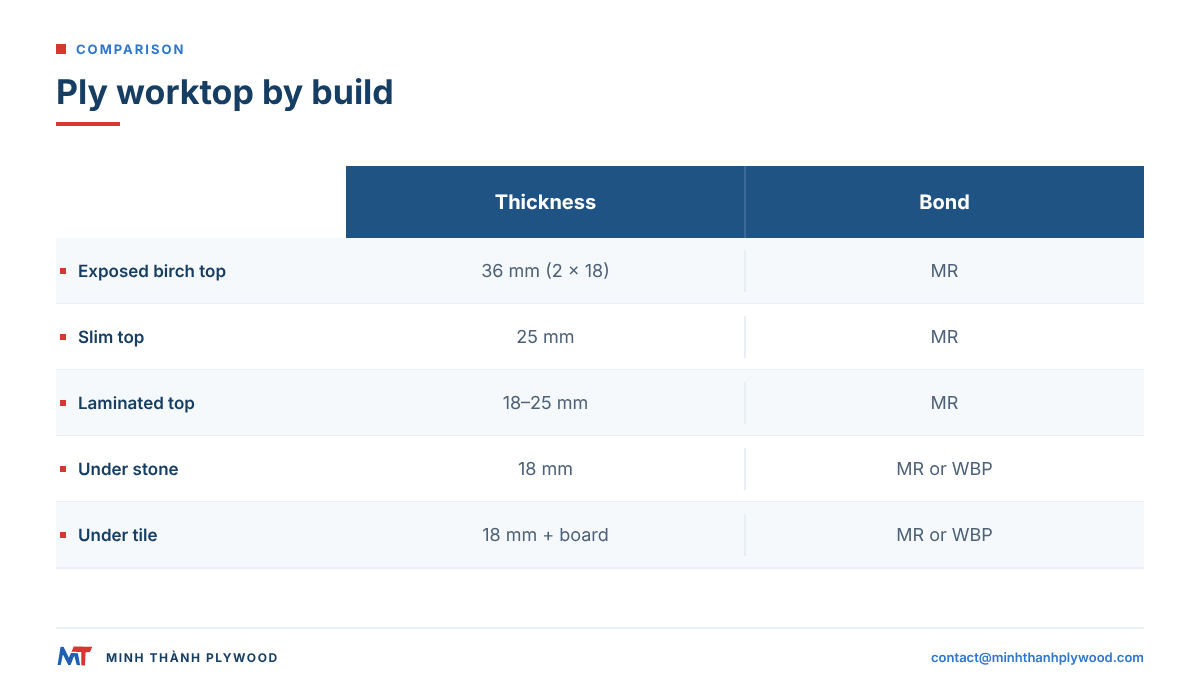
A plywood kitchen worktop is 25 to 40 mm thick when the plywood is the finished top, and 18 mm when it is a substrate under laminate, stone or tile. The table gives the usual thickness for each build.
| Build | Thickness | How it is made |
|---|---|---|
| Finished ply worktop, standard | 36 mm | Two 18 mm sheets glued face to face |
| Finished ply worktop, slim | 25 mm | One panel, the thin modern look |
| Finished ply worktop, heavy | 40 mm | One panel, or doubled for an island edge |
| Laminated plywood countertop | 18 mm to 25 mm plus laminate | HPL on top, balancing sheet underneath |
| Subtop under granite or quartz | 18 mm | Screwed to cabinets, stone bonded on top |
| Subtop under tile | 18 mm | Plus cement backer board, then tile |
Minh Thanh makes plywood from 3 to 40 mm, so a single panel covers every thickness in the table. Doubling two 18 mm sheets is common because it gives a thick edge from stock panels and lets the maker cross the joints of the two layers for a long run. Thickness tolerance on sanded furniture panels is ±0.2–0.3 mm, down to ±0.2 mm, which keeps a doubled top even along its length.
Standard ply worktop sizes and prices in the UK
UK kitchen fitters order finished worktops by length, depth and thickness, not by sheet. The table lists the sizes that UK makers sell, so a kitchen maker can work back to the panel to order.
| Maker | Worktop size (length × depth × thickness) | Build and note |
|---|---|---|
| Laminate and Ply | 3030 × 640 mm or 3030 × 600 mm, 32 mm | 30 mm birch ply core plus laminate; a pair is £649 ex VAT |
| Made in Ply | 2400 or 3000 mm long, 635 or 900 mm deep | Formica-faced plywood worktops |
| Plykea | Up to 1280 × 3040 mm, 18, 24 or 36 mm thick, 700 mm deep | Birch ply core from an FSC-certified supplier; the 700 mm depth is made to fit IKEA base cabinets |
Three points follow from the table:
- Depths run from 600 to 640 mm for standard cabinets, 700 mm where a kitchen is fitted to IKEA carcasses and 900 mm for islands and deep runs.
- Minimum thickness for joints: undermount worktop bolts need at least 28 mm, so a worktop that will be joined should be 30 mm or more. A 25 mm top suits a run without joints.
- Standards: the plywood core is described by its service class in EN 636 (EN 636-2 humid, EN 636-3 exterior), the bond by EN 314-2, and a high-pressure laminate top by EN 438-2 for heat, scratch and stain resistance. Laminate and Ply cite EN 636 Class 3 for its birch core.
A pair of 3030 × 640 × 32 mm laminated birch tops at about £649 ex VAT is the retail benchmark. Minh Thanh sells the plywood panel to the worktop maker, not the finished top. Furniture plywood starts from US$350/m³ FOB, so the panel is a small part of the finished price, and the margin sits in the laminate, the cutting and the finish. Panels are 1220 × 2440 mm or 1250 × 2500 mm; tops of 3000 mm and 3030 mm length need a custom-length blank or a jointed top, which we quote on request. FSC-certified supply is available when the project requires it.
Birch ply worktops with an exposed edge
Birch ply worktops are chosen for the face and the edge: a pale, even birch surface and a striped edge where the layers show. They suit modern, Scandinavian and workshop-style kitchens, and they are the most common finished ply worktop.
What the edge shows depends on the core. Minh Thanh birch-faced plywood has birch face and back veneers on a white Styrax or Eucalyptus core, so the edge shows pale, even plies under the birch face. Core layers are stitched both horizontally and vertically, so the plies on a sanded edge are closed, without the gaps that catch water and crumbs.
Birch face grades are quoted as face/back pairs: D+/D for a top whose face is on show and whose underside is hidden, D/E for a substrate. The ladder is comparable to the European birch grades, with D+ close to B and D close to BB, and the order is matched to the approved sample. Faces are sanded and polished and both faces are UV-ready, for a kitchen maker who applies its own UV lacquer.
Edges on a birch ply worktop are sanded to a soft radius and sealed twice, because end grain takes in water and oil much faster than the face. The underside of the overhang, which nobody sees, is sealed too.
Plywood for countertops under granite and quartz
Plywood for countertops under granite and quartz is an 18 mm subtop screwed to the cabinets, with the stone bonded on top. Thin stone of about 20 mm usually needs it for support and to spread point loads; stone of about 30 mm normally sits straight on the cabinet frames. The stone fabricator decides for each slab and layout.
A plywood subtop under stone does three things. It spreads the stone’s weight over the whole cabinet run, it bridges the gaps between cabinets and around the sink, and it gives a dead-flat bed so the slab is not stressed by an uneven carcass. Under a cantilevered island overhang it adds stiffness where the stone is weakest.
For a stone subtop, order:
- 18 mm, the thickness most fabricators work to.
- MR (melamine-fortified) or WBP (phenolic) bond, because the subtop sits next to the sink and the dishwasher.
- Flat, calibrated panels. Pressing twice, first the core board and then face and back, gives the flat panel a stone slab needs.
- Utility or B/B faces. Nobody sees them.
The subtop is screwed down from inside the cabinets, not glued to the carcass, and the sink cut-out is sealed before the stone goes on.
Plywood under a tile countertop
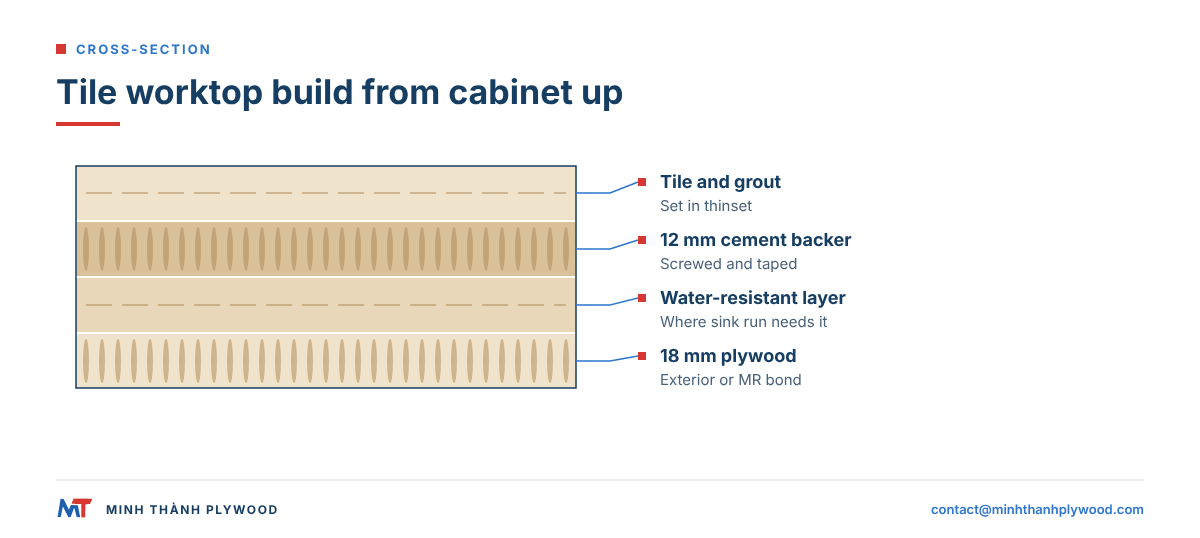
A tile countertop is built on 18 mm exterior or MR-bonded plywood screwed to the cabinets, with a cement backer board on top and the tile set into thinset on the backer board. Tile is not laid straight on plywood: the backer board stops water reaching the wood through the grout and gives the adhesive a mineral surface to grip.
The build, from the cabinet up:
- 18 mm plywood, screwed to the cabinet frames, joints over a support.
- A water-resistant membrane or the board maker’s specified layer, where the sink run needs it.
- 12 mm cement backer board, screwed and taped at the joints.
- Thinset adhesive and tile, then grout and sealer.
Outdoor kitchens follow the same build with an exterior phenolic (WBP) bond, because the panel sees rain and frost. Our exterior plywood page lists the water-resistant bonds.
Laminated plywood countertop: HPL on plywood
A laminated plywood countertop is plywood faced with high-pressure laminate (HPL) on top and a balancing laminate on the underside. The laminate gives a hard, stain-resistant surface; the plywood under it holds screws near the edge and resists swelling when water gets past a seal, which is where laminated chipboard tops fail.
How kitchen makers build them:
- Core. 18 mm or 25 mm plywood with poplar, EV or eucalyptus faces: smooth, flat and cheaper than birch, because the laminate covers it.
- Laminate. HPL pressed on with PVAc or urea glue in a press, or bonded with contact adhesive for one-offs.
- Balancing sheet. A backer laminate underneath, so the top does not cup when the laminate on one side moves with humidity.
- Edge. Matching laminate strip, ABS edge banding, solid wood lipping, or the plywood edge left exposed and lacquered for a contrast stripe.
The plywood face under laminate needs no high grade, but it must be flat and evenly sanded, or the glue line telegraphs through a gloss laminate. Minh Thanh furniture panels are sanded and polished on both faces.
Which glue: MR or WBP plywood for worktops?
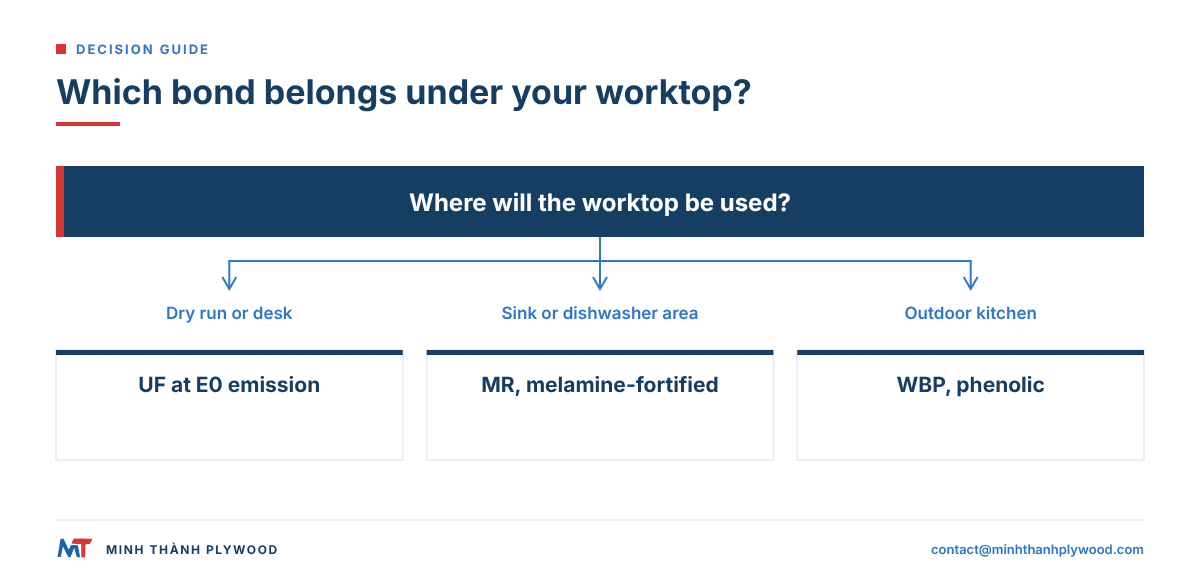
Worktops near water take an MR (melamine-fortified) or WBP (phenolic) bond. The bond decides whether the glue lines hold when water reaches an edge at the sink or the dishwasher; the face and the finish decide how fast water gets there.
| Bond | Where it fits | Note |
|---|---|---|
| UF glue at E0 emission | Dry runs, islands without a sink, desks, shelves | The standard furniture bond, lowest emission |
| MR, melamine-fortified | Kitchen worktops with a sink, laminated tops, stone subtops | Holds in a wet kitchen when the panel is sealed |
| WBP, phenolic | Outdoor kitchens, tile substrates outdoors, utility rooms | Exterior bond, darker glue line on the edge |
MR and WBP bonds are made to the customer’s specification. Bond and emission are separate lines on the order: write the bond (“MR bond”) and the emission class you need as two specifications. For the sink cabinet below the worktop, our guide to moisture-resistant plywood for sink cabinets covers MR, WBP and marine choices.
How to seal a plywood worktop
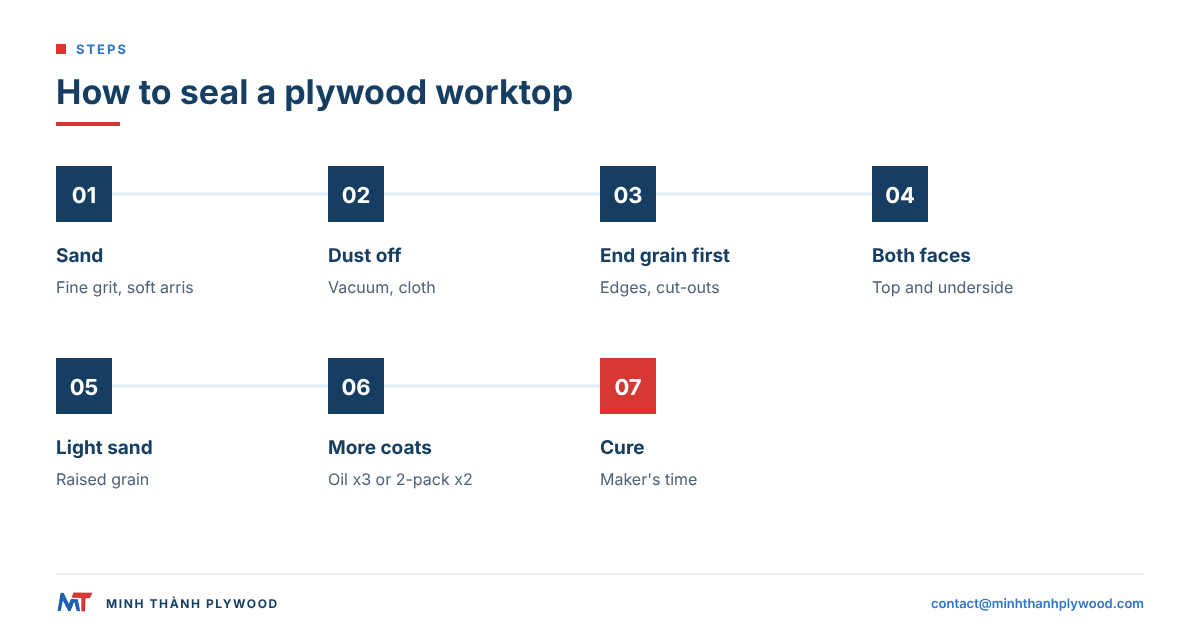
A plywood worktop is sealed in seven steps, and the end grain and cut-outs come first. Sand the faces and edges, remove the dust, seal the end grain and cut-outs, coat the top and underside, sand lightly, apply the remaining coats, then cure for the time the finish maker states before use. The steps in order:
- Sand faces and edges in stages to a fine grit, removing every mark; round the edges slightly so the finish does not wear through on a sharp arris.
- Remove the dust with a vacuum and a lint-free cloth.
- Seal the end grain and cut-outs with the first coat before the faces, letting it soak in; repeat on the sink and hob cut-outs.
- First coat on the faces, top and underside, so both sides take up moisture at the same rate.
- Light sand when dry, to knock down raised grain.
- Second and third coats. Hardwax oil goes on in three thin coats; a 2-pack polyurethane lacquer goes on in two.
- Cure for the time the finish maker states before the kitchen is used.
The finish is a choice of look and upkeep. Hardwax oil keeps the matt wood look and is repaired by re-oiling a worn patch; 2-pack lacquer is harder and wipes clean, but repairs need sanding. Near the sink, many kitchen makers lacquer the sink run and oil the rest.
Sink and hob cut-outs, joints and supports
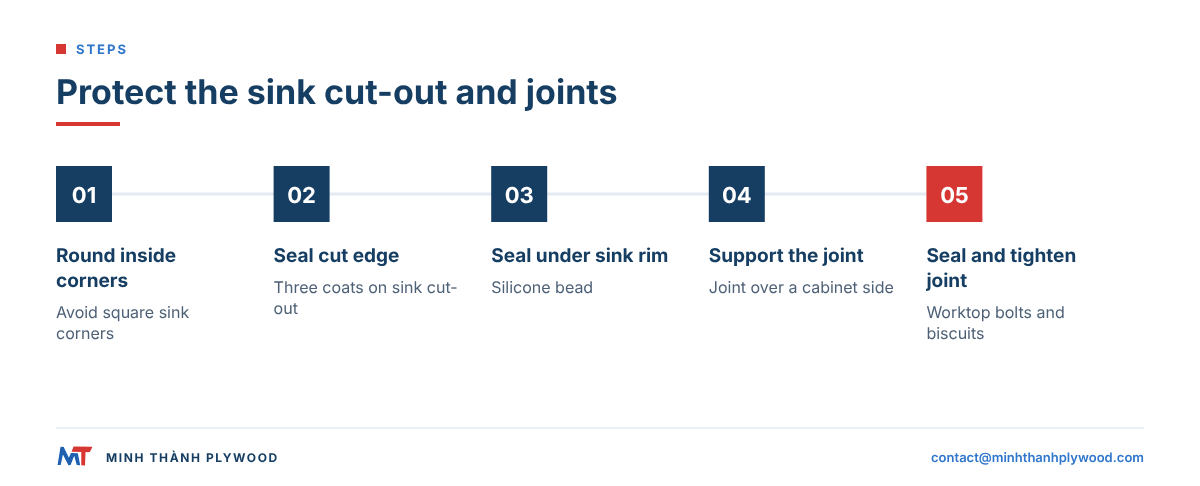
The sink cut-out is where ply worktops fail, so it gets the most care: rounded inside corners, three coats of finish on the cut edge, and a bead of silicone under the sink rim. A square inside corner cracks the finish and lets water into the end grain.
Hob cut-outs follow the hob maker’s clearance and are sealed the same way; many makers add aluminium heat tape on the cut edge. Joints along a run fall over a cabinet side, are cut square and joined with worktop bolts and biscuits, and the joint is sealed before it is pulled tight.
Sheet size sets the joint plan. A 1220 × 2440 mm sheet gives two worktop blanks about 600 mm deep and 2440 mm long, after the saw cut; a 1250 × 2500 mm sheet gives 2500 mm. Runs longer than that are jointed, or made from two doubled layers with the joints staggered. Supports go under every cabinet side; an island overhang beyond the cabinets takes a bracket or a leg.
Food contact, heat and care of a plywood worktop
A plywood worktop that touches food takes a finish whose maker states it is suitable for food contact once cured, whether hardwax oil or lacquer. The finish, not the panel, is the food-contact surface, so kitchen makers choose and document it with the coating supplier.
Care rules for a ply worktop are short:
- Wipe spills, water most of all, before they stand around the sink.
- Use a cutting board and trivets: knives open the finish and hot pans mark it.
- Re-oil oiled tops every year, or when water stops beading on the surface.
- Touch up lacquered tops where they wear, before the wood greys.
A sealed ply worktop that is kept up lasts as long as the kitchen. Moisture at delivery helps: Minh Thanh panels are dried to 8–12 % moisture content at dispatch, the normal range for furniture plywood, so a sealed top moves little in a heated kitchen.
Ply worktop vs solid wood, laminate chipboard and quartz
A ply worktop sits between laminate chipboard and stone: stronger and more water-resistant than chipboard, lighter and warmer than quartz, and more stable than solid wood.
| Ply worktop | Solid wood block | Laminate on chipboard | Quartz | |
|---|---|---|---|---|
| Stability across the width | Very stable, crossed layers | Moves with humidity | Stable | Stable |
| Water at the edge | Holds with MR or WBP bond and sealing | Swells, needs oiling | Swells and fails | Waterproof |
| Screw holding | High, near edges too | High | Low near edges | Not screwed |
| Look | Layered edge, wood face | Wood strips | Printed surface | Stone |
| Repair | Sand and re-oil or re-lacquer | Sand and re-oil | Replace | Professional repair |
| Weight to install | Light, maker can fit | Heavy | Light | Heavy, fabricator fits |
The comparison decides by use. A ply worktop suits makers who want a wood look with stable, light panels; quartz suits buyers who want zero upkeep; laminate chipboard suits the lowest budget where water is kept away. For the kitchen carcass below the top, our guide to plywood for kitchen cabinets covers thickness and face by part.
Faces, cores and sizes for ply worktops
Ply worktop panels are ordered by face, core, bond and size. Minh Thanh supplies the range kitchen makers use:
- Faces: birch for exposed tops; poplar, EV and eucalyptus under laminate; okoume and other faces on request for a veneered or coloured look. More than ten face veneers are offered, chosen for the look the buyer orders.
- Cores: white Styrax or Eucalyptus as standard; Acacia and Pine on order.
- Thickness: 3 to 40 mm, so 18, 25, 30 and 40 mm worktop panels are all single panels.
- Sizes: 1220 × 2440 mm and 1250 × 2500 mm, plus custom sizes such as 1220 × 2500 mm; cut-to-size supply cuts one panel into 4, 6 or 8 pieces.
- Build: core layers stitched both ways, pressed twice, sanded and polished, dried to 8–12 % moisture content.
The core also sets the weight a kitchen fitter lifts. An 18 mm sheet of 1220 × 2440 mm weighs about 26.8 kg on a Styrax core, at 500 kg/m³, and about 34.8 kg on Eucalyptus, at 650 kg/m³. Furniture panels are bonded with UF glue at E0 emission as standard and certified to CARB P2 / TSCA Title VI (ICTT mill no. 23024). The CARB rule on composite wood products and the US EPA formaldehyde standard set the limit our chamber tests are measured against. The limit for veneer-core hardwood plywood is 0.05 ppm under EPA’s TSCA Title VI guidance.
What to write in your RFQ for ply worktops
An RFQ for ply worktop panels names the build, the face, the bond and the cutting, so the mill quotes the right panel the first time:
Use: kitchen worktops, exposed birch edge, sink runs; 18 mm for doubling to 36 mm; face/back birch D+/D; Styrax core; MR bond; emission class as your market requires; sanded, thickness ±0.2–0.3 mm; 1220 × 2440 mm, or cut-to-size into 4 pieces; mixed load 1×40HC with 18 mm poplar for laminated tops; CIF your port.
Furniture and interior plywood starts from US$350/m³ (indicative, October 2026); the final price follows face, core, glue, thickness, size, quantity and delivery term. Production is 15–45 days after the 30% deposit. Minh Thanh sends free samples and replies within hours: contact@minhthanhplywood.com or WhatsApp +84 988 586 601. Kitchen makers building the whole kitchen in plywood will find fronts and carcasses in our guide to plywood kitchens.
Buyer questions, answered
What are the standard sizes of a plywood worktop in the UK?
UK makers sell ply worktops 2400, 3000 or 3030 mm long, 600 to 640 mm deep for standard cabinets, 700 mm deep for IKEA fit and 900 mm for islands, in 18 to 36 mm. Worktops that will be joined with undermount bolts should be at least 28 mm thick.
Can you use plywood as a kitchen worktop?
Yes. Plywood makes a stable kitchen worktop when it is at least 25 mm thick or two 18 mm sheets bonded together, has a moisture-resistant bond near the sink, and every face, edge and cut-out is sealed.
How thick should a plywood worktop be?
A finished ply worktop is 25 to 40 mm thick, often two 18 mm sheets bonded to 36 mm. A substrate under laminate is 18 mm, and under granite, quartz or tile it is 18 mm with the stone or a backer board on top.
How do you seal a plywood worktop?
Sand the faces and edges smooth, seal the end grain and cut-outs first, then apply three thin coats of hardwax oil or two coats of a 2-pack polyurethane lacquer, sanding lightly between coats.
Are birch ply worktops good?
Yes for a modern kitchen that shows the layered edge. Seal them well around the sink and hob, re-oil oiled tops every year, and order a moisture-resistant bond for the sink run.
Do you need plywood under granite countertops?
Thin stone of about 20 mm usually needs an 18 mm plywood subtop for support. Stone of about 30 mm normally sits straight on the cabinets; the stone fabricator confirms it for each slab.
Can you put quartz on plywood?
Yes. Quartz can be bonded to an 18 mm plywood subtop screwed to the cabinets, which gives a flat, stiff base and lets the fabricator use thinner slabs over long runs.
What plywood is best under a tile countertop?
Use 18 mm exterior or MR-bonded plywood screwed to the cabinets, with a cement backer board on top and the tile set on the backer board, not straight on the plywood.
What is a laminated plywood countertop?
It is plywood faced with high-pressure laminate (HPL) on top and a balancing laminate underneath. The laminate gives a hard, wipeable surface; the plywood gives strength and screw holding near the sink.
Is plywood better than chipboard for a worktop?
Yes near water. Plywood holds screws better and its glue lines resist swelling far better than chipboard when water reaches an edge, which is where laminated chipboard worktops fail.
What finish is safe for a plywood worktop that touches food?
Choose a hardwax oil or lacquer whose maker states it is suitable for food contact once cured, and cut food on a separate board so the knife does not open the finish.
How long do plywood worktops last?
A well-sealed ply worktop lasts as long as the kitchen when the finish is kept up: oiled tops are re-oiled every year, lacquered tops are touched up where they wear.