
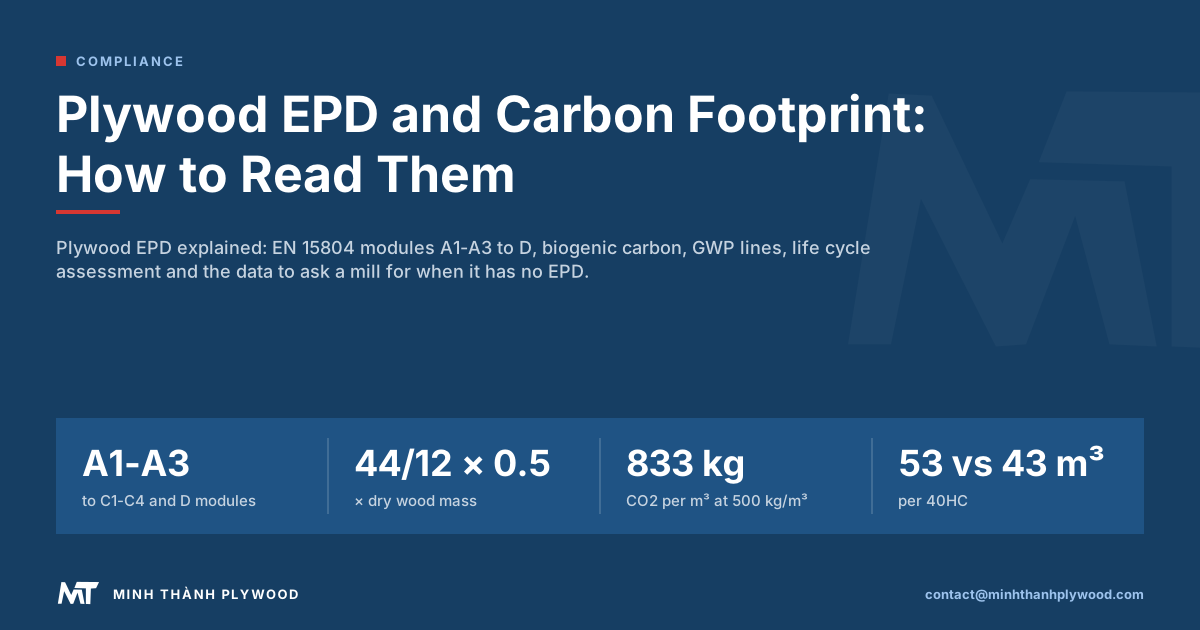
A plywood EPD is an independently verified environmental product declaration: a life cycle assessment of one cubic metre of a named panel, reported in fixed modules from raw wood to end of life under EN 15804. Read the GWP lines by module and keep biogenic carbon apart from fossil emissions. Minh Thanh Plywood supplies the mill data a buyer's own footprint needs.
What is a plywood EPD?
A plywood EPD (environmental product declaration) is a verified summary of a life cycle assessment of a named plywood product, published in a fixed format so that architects, engineers and building rating schemes can use it. It is a Type III declaration under ISO 14025, and an independent verifier checks the mill’s data before a programme operator publishes it.
The rules are set in advance and the data come from the mill. For plywood the rule set has three layers:
| Rule | Role in a plywood EPD |
|---|---|
| ISO 14025 | Type III declarations: verification and programme operator |
| ISO 14040 / ISO 14044 | Life cycle assessment method |
| EN 15804+A2 | Core product category rules for all construction products: modules, indicators, biogenic carbon |
| EN 16485 | Product category rules for wood and wood-based products |
| EN 16449 | How to calculate the CO2 stored in wood |
BS EN 15804:2012+A2:2019 sets the core rules for the product category of construction products. An EPD does not rate the product as good or bad. It declares numbers. Their value lies in being comparable, which is why the rules matter as much as the results.
Plywood life cycle assessment: what does it measure?
A plywood life cycle assessment measures the inputs and emissions of every stage of the panel’s life, per declared unit, usually one cubic metre of plywood at a stated density and moisture. Logs, resin, energy, transport, waste and end-of-life treatment are all counted.
The main indicators an EN 15804+A2 EPD reports:
- Global warming potential (GWP): split into GWP-total, GWP-fossil, GWP-biogenic and GWP-luluc (land use and land-use change), in kg CO2 equivalent.
- Ozone depletion, acidification, eutrophication, photochemical ozone formation.
- Resource use: renewable and non-renewable primary energy, water, secondary materials.
- Waste and output flows: hazardous and non-hazardous waste, materials for recycling or energy recovery.
Buyers who report greenhouse gases read GWP-fossil first. Building rating schemes read the whole table.
How do you read EPD modules A1-A3, A4, C and D?
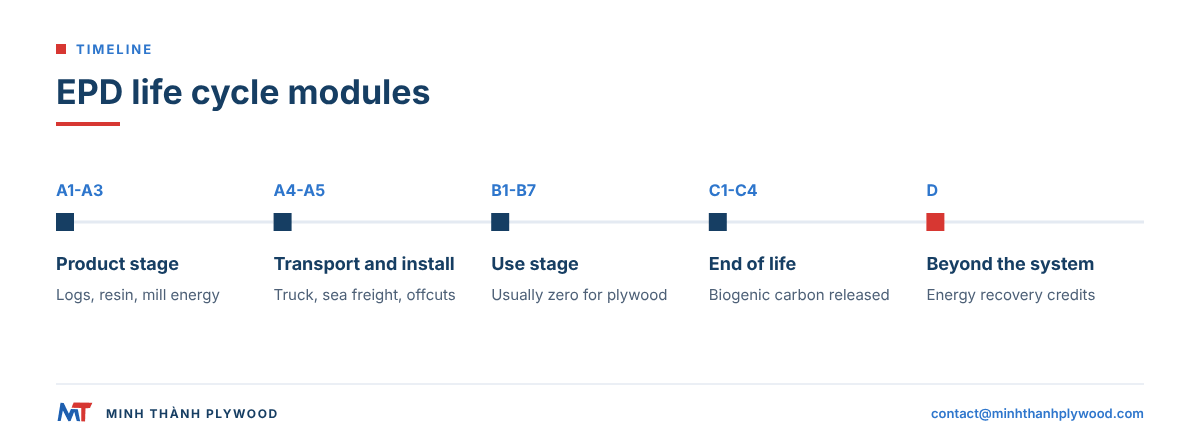
An EN 15804 EPD reports results in modules that follow the panel from forest to end of life. A1-A3 together are the product stage, often called cradle to gate.
| Module | Stage | What it covers for plywood |
|---|---|---|
| A1 | Raw material supply | Forestry, logs, resin and additives |
| A2 | Transport to the mill | Log trucks, resin delivery |
| A3 | Manufacturing | Peeling, drying, gluing, pressing, sanding, packing, mill energy |
| A4 | Transport to site | Truck to port, sea freight, delivery to the buyer |
| A5 | Installation | Cutting waste, fixings |
| B1-B7 | Use stage | Maintenance, repair, replacement; usually zero for plywood |
| C1-C4 | End of life | Demolition, transport, waste processing, disposal |
| D | Beyond the system boundary | Credits for energy recovery or reuse |
Since the A2 amendment, EN 15804 requires A1-A3, C1-C4 and D in most EPDs, so the carbon stored in A1 must reappear at end of life. A1-A3 is the comparison buyers ask for most; A4 is where an export panel differs most from a local one.
Biogenic carbon: why plywood shows a negative number
Plywood shows a negative GWP in module A1 because the wood holds carbon that the tree drew from the air while it grew. EN 15804+A2 records that biogenic carbon as an uptake when the wood enters the system and as an emission when it leaves, at incineration or disposal in C3 and C4.
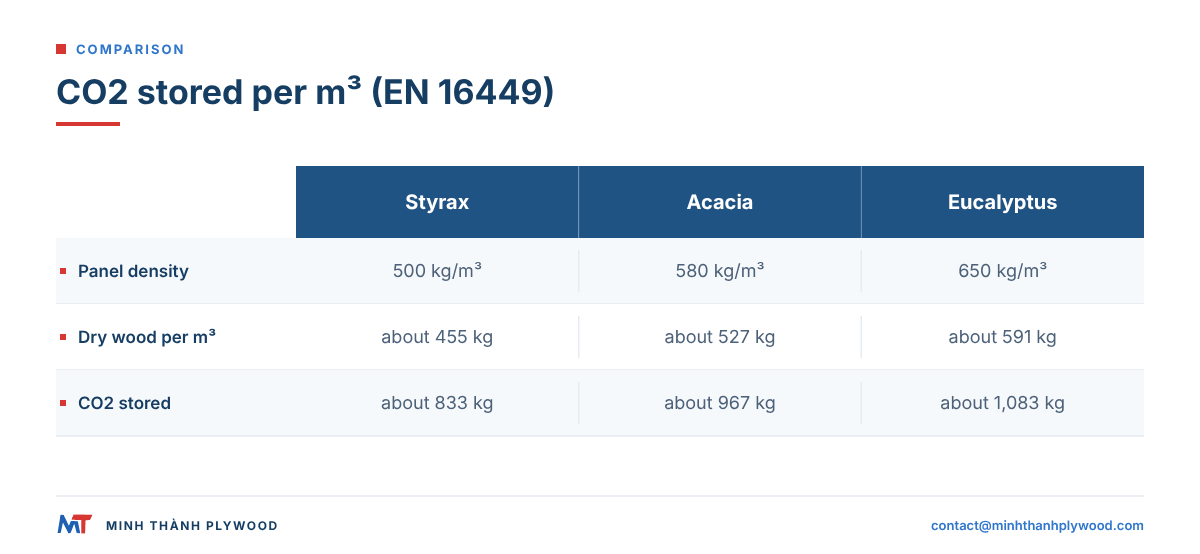
EN 16449 sets the calculation: stored CO2 = 44/12 × carbon fraction × oven-dry mass, with a default carbon fraction of 0.5. Applied to the reference densities of plantation cores at 10 % moisture content:
| Core | Reference panel density | Oven-dry wood mass per m³ | CO2 stored per m³ |
|---|---|---|---|
| Styrax | 500 kg/m³ | about 455 kg | about 833 kg |
| Acacia | 580 kg/m³ | about 527 kg | about 967 kg |
| Eucalyptus | 650 kg/m³ | about 591 kg | about 1,083 kg |
These are upper estimates: glue is part of the panel density and holds no biogenic carbon. Two rules follow for reading an EPD. Never subtract the A1 uptake from A1-A3 fossil emissions and call the result the footprint. Report GWP-fossil and biogenic carbon side by side.
What drives the plywood carbon footprint?
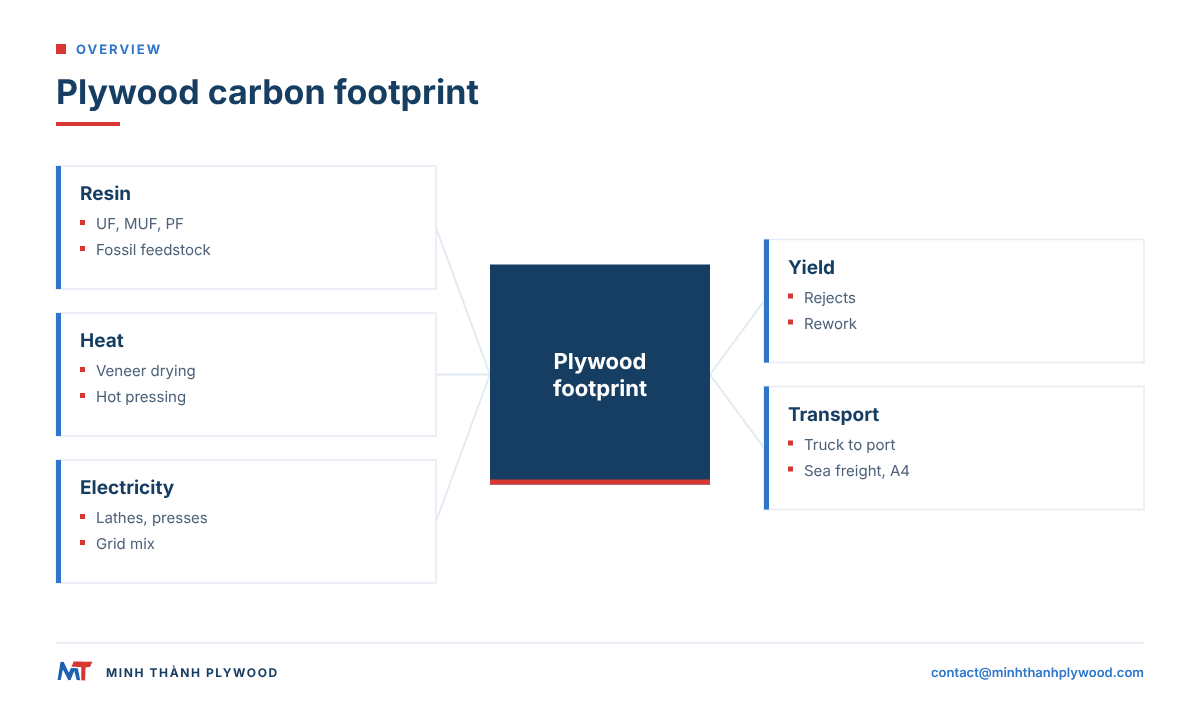
The plywood carbon footprint, cradle to gate, comes mainly from three places: the resin, the heat for drying veneer and pressing, and the electricity of the mill. Logs and forestry add less, and transport adds a share that grows with distance.
- Resin: urea-, melamine- and phenol-formaldehyde resins are made from fossil feedstock, so the glue line carries fossil carbon per square metre of veneer bonded.
- Drying and pressing heat: veneer is dried to a furniture moisture content of 8–12 %, and panels are hot-pressed at about 110–120 °C for MR and 130–145 °C for WBP. Mills that burn their own wood residues for heat count biogenic rather than fossil emissions for that energy.
- Electricity: peeling lathes, presses, sanders and saws. The grid mix of the country weighs heavily on this part.
- Yield: every rejected sheet carries the full footprint of a good one. Tight thickness tolerance and double pressing cut rework.
- Transport: truck to port and sea freight in A4.
A panel with more glue lines per millimetre of thickness, such as thin plywood with many plies, carries more resin per cubic metre than a thick panel.
Embodied carbon of engineered wood: plywood beside LVL, OSB and MDF
Embodied carbon in engineered wood products depends on how much resin and energy each product needs to turn wood into a panel. A fair comparison uses EPDs to the same standard, per cubic metre and per function.
| Product | What changes the footprint | Biogenic carbon stored |
|---|---|---|
| Plywood | Veneer drying, glue lines per thickness, press heat | High: solid veneers, mostly wood |
| LVL | Same process as plywood, veneers all one direction | High |
| OSB | Strand drying, resin share, pressing | High |
| Particleboard and MDF | Fibre or chip drying, higher resin share, refining energy for MDF | High, with more resin per cubic metre |
| Solid timber | Kiln drying, sawing | High, almost no resin |
Use the table to read EPDs, not to rank products: a lighter panel that does the same job may win per function even when it loses per cubic metre. For plantation wood, glue and waste, see what buyers should ask a mill about plywood’s footprint.
Environmental product declaration for plywood: how to check one
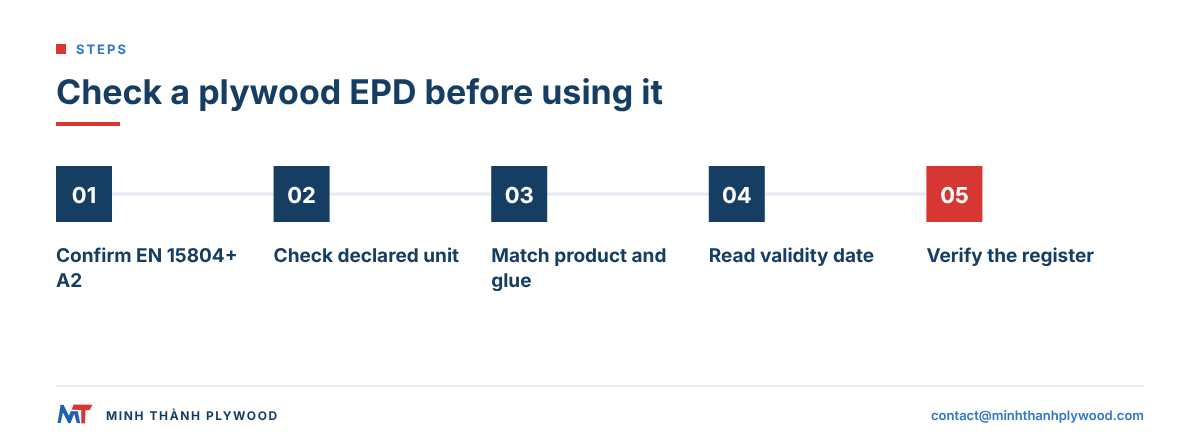
Check five things before you use an environmental product declaration for plywood in a calculation or a tender:
- Standard: EN 15804+A2, with EN 16485 for wood. Older EN 15804+A1 EPDs report GWP differently and do not compare cleanly.
- Declared unit and density: one cubic metre at a stated density and moisture, or one square metre at a stated thickness. Convert before comparing.
- Product match: the EPD names a product family, glue and thickness range. A birch-faced phenolic panel EPD says nothing about a UF furniture panel.
- Validity: usually five years from verification. Look for the validity date on the cover page.
- Verification and register: the verifier’s name and the programme operator, such as the International EPD System, IBU, EPD Norge or INIES, with the EPD listed in its online register.
An EPD that is specific to one mill carries more weight than an industry-average EPD for a whole country.
Is there an EPD for Vietnamese plywood?
An EPD belongs to one mill and one product family, so the way to answer is to search the programme operators’ registers under the mill’s name. Plywood EPDs exist mainly for European and North American products today, with a few Asian mills registered; for most Asian mills the buyer works from mill data instead.
A missing EPD does not leave you without numbers. Your own LCA consultant, or the EPD of your finished product, can use primary mill data for A1-A4. The next section lists what to ask for.
The same approach works when your customer asks for the footprint of a cabinet or a piece of furniture: the plywood enters your product’s assessment as a material with its own A1-A4 data.
US plywood EPDs: industry-wide and product-specific
US buyers find plywood EPDs in two kinds. The American Wood Council (AWC) and Canadian Wood Council publish an industry-wide EPD for North American softwood plywood, verified through UL Environment, with a declared unit of 1 m³ of 9.5 mm plywood. Its A1-A3 result is 219.32 kg CO2e per m³ (TRACI 2.1, 2020).
Product-specific EPDs sit on the EPD International library: EPD-IES-0015672 covers plywood from 2.4 to 34 mm, 3 to 13 plies, density 345 to 719 kg/m³, under EN 15804+A2 and PCR 2019:14-c-PCR-006, with FSC chain of custody. It belongs to an Indonesian mill and runs to 3 September 2029, so Asian plywood EPDs do exist, and they are mill-specific.
| Plywood EPD | Type | Declared unit | A1-A3 fossil GWP |
|---|---|---|---|
| AWC and CWC North American softwood plywood | Industry-wide | 1 m³, 9.5 mm | 219.32 kg CO2e (TRACI) |
| Finieris raw plywood | Product-specific | 1 m³ | 370 kg CO2e |
| Delignit beech plywood (EN 636) | Product-specific | 1 m³ | about 350 kg CO2e |
Fossil A1-A3 values for plywood therefore run from about 220 to 370 kg CO2e per m³, depending on species, glue, drying energy and the grid. The stored biogenic carbon is a separate line, as the biogenic section above shows.
How a buyer uses them: search the programme library by product category and PCR, check the declared unit and the EN 15804 version, and confirm the validity date. LEED v4 credits products with verifiable EPDs, and the EC3 tool of Building Transparency lists EPDs for embodied-carbon comparison. Until a mill has its own EPD, a buyer uses the industry-wide figure for a generic estimate and requests mill activity data for the actual sheet, as the next sections list.
What can a buyer ask for when the mill has no EPD?
Ask for the activity data an LCA consultant needs, per product and per cubic metre. A mill that answers these eight lines gives you a defensible estimate for A1-A4:
| Data line | What Minh Thanh supplies |
|---|---|
| Species of face, back and core | Named on the specification, for example a white Styrax or Eucalyptus core |
| Origin of the wood | EUDR compliance dossier with origin records and geolocation files, supplied with orders |
| Panel density | Reference densities: Styrax 500, Acacia 580, Eucalyptus 650 kg/m³ |
| Moisture content at dispatch | 8–12 % |
| Glue type and emission class | For example UF glue at E0 emission; MR or WBP on order |
| Build | Ply count, thickness, double pressing |
| Transport to port and by sea | FOB Hai Phong; typical days at sea by route |
| Load per container | Volume and weight per 40HC for the order |
Energy and resin consumption per cubic metre are the two lines that need the mill’s production records; ask for them with the quotation so that your consultant can model A3.
Transport, module A4: what does shipping from Vietnam add?
Module A4 adds the truck to the port and the sea voyage, per cubic metre delivered. Two numbers drive it: the distance and how full each container is.
Typical days at sea from Hai Phong are 30–40 days to Northern Europe, 25–35 days to the Mediterranean, 20–30 days to the US West Coast and 35–45 days to the US East Coast, by carrier and route.
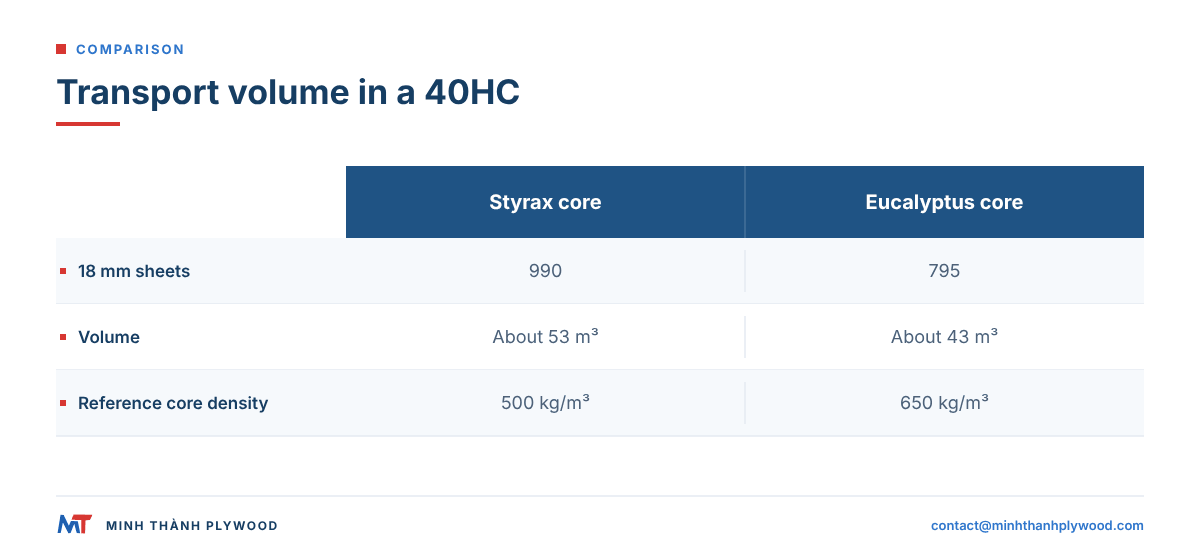
Container fill is the lever a buyer controls. On the 40HC plan for 1220 × 2440 × 18 mm panels, a Styrax core loads 990 sheets, about 53 m³, while a Eucalyptus core loads 795 sheets, about 43 m³, because the heavier core reaches the planning payload of 28,000 kg first. The same voyage carries about a quarter more cubic metres of the light core, so its A4 share per cubic metre is lower.
Scope 3 reporting for wood products
Under the GHG Protocol, plywood a company buys sits in Scope 3 Category 1, purchased goods and services, and the freight it pays for to bring the panels in sits in Category 4, upstream transportation and distribution. Companies reporting under the EU Corporate Sustainability Reporting Directive disclose Scope 3 in their climate standard, ESRS E1, where it is material.
For Scope 3 on wood products, the order of data quality is:
- Supplier-specific EPD for the exact product.
- Supplier activity data: species, density, glue, energy and transport per cubic metre, modelled by your consultant.
- Industry-average EPD for the panel type.
- Spend-based factors per euro spent: the weakest option.
Moving from step 4 to step 2 usually changes the number more than any change of supplier. Ask for activity data at the quotation stage.
Plywood EPDs in EU construction rules
For plywood sold as a construction product in the EU, environmental data are moving into the formal product documents. Regulation (EU) 2024/3110, the new Construction Products Regulation, adds environmental sustainability information, starting with global warming potential, to the declaration that accompanies harmonised construction products, product family by product family as the technical rules are adopted.
Plywood for construction is covered by EN 13986, the harmonised standard for wood-based panels; its route to CE marking is explained in EN 13986 and CE marking for plywood. Furniture plywood is not a construction product and falls outside these rules; for furniture, the buyer’s own reporting and the customer’s requests are what drive footprint data.
Chain-of-custody claims such as FSC or PEFC answer a different question, where the wood came from, and do not replace a footprint. See PEFC vs FSC and what is FSC wood? for those labels.
How do you request plywood carbon data with a quotation?
Put the carbon data request on the RFQ itself, line by line, so that the mill can price and document in one reply. A useful request has six lines:
- Product: use, face, core species, glue, thickness and size, for example furniture plywood, 18 mm, 1220 × 2440 mm, Styrax core, UF glue at E0 emission.
- Declared unit: per cubic metre, with density and moisture content at dispatch.
- EPD: product-specific EPD to EN 15804+A2 if one exists; otherwise activity data for A1-A3.
- Origin: species and harvest origin, with the EUDR dossier for EU imports.
- Transport: port of loading, destination port and container plan.
- Format: a one-page data sheet your LCA consultant can use.
Minh Thanh Plywood supplies furniture and interior plywood from plantation timber grown around Ha Hoa, Phu Tho, with MOQ one 40HC and free samples. Send your RFQ to contact@minhthanhplywood.com, or start from furniture plywood from Vietnam.
Buyer questions, answered
What is an EPD for plywood?
An environmental product declaration for plywood is a third-party verified report of the panel's life cycle impacts, usually per cubic metre, calculated to EN 15804 and the wood product rules of EN 16485 and published by an EPD programme operator.
What do modules A1-A3 mean in a plywood EPD?
A1-A3 is the product stage, cradle to gate: A1 raw materials such as logs and resin, A2 transport to the mill, A3 manufacturing, including drying, gluing, pressing and packing. Most comparisons start with the A1-A3 total.
Why is the GWP of plywood negative in module A1?
Because wood stores carbon the tree took from the air. Under EN 15804 that stored biogenic carbon enters as a negative value in A1 and leaves again at end of life in C3 or C4, so it does not vanish from the balance.
How much CO2 does a cubic metre of plywood store?
EN 16449 counts 44/12 × 0.5 × the oven-dry wood mass. For a 500 kg/m³ panel at 10 % moisture content that is about 833 kg CO2 per m³, before deducting the glue share.
Is there an EPD for Vietnamese plywood?
EPDs are made per mill and per product, so check the programme operator's register under the mill's name. Where none exists, ask the mill for the inputs: species, origin, density, glue, energy and transport data.
What is the difference between an EPD and a carbon footprint?
A carbon footprint reports greenhouse gases only. An EPD reports a full set of impact categories, including global warming potential, acidification and resource use, under fixed rules and with independent verification.
How long is a plywood EPD valid?
Usually five years from verification, after which it must be checked and reissued. An EPD past its validity date should not be used for a new building assessment.
Can I compare two plywood EPDs?
Only when both use EN 15804+A2, the same declared unit, the same modules and comparable density and moisture. Compare GWP-fossil for A1-A3 first, then the full life cycle.
Which Scope 3 category does purchased plywood fall into?
Purchased plywood is Scope 3 Category 1, purchased goods and services, under the GHG Protocol. The sea freight you pay for falls into Category 4, upstream transportation and distribution.
What lowers the carbon footprint of plywood?
Light plantation cores, fewer rejects, efficient drying energy, less resin per cubic metre and full containers. A full 40HC of light-core panels moves more cubic metres per voyage.