
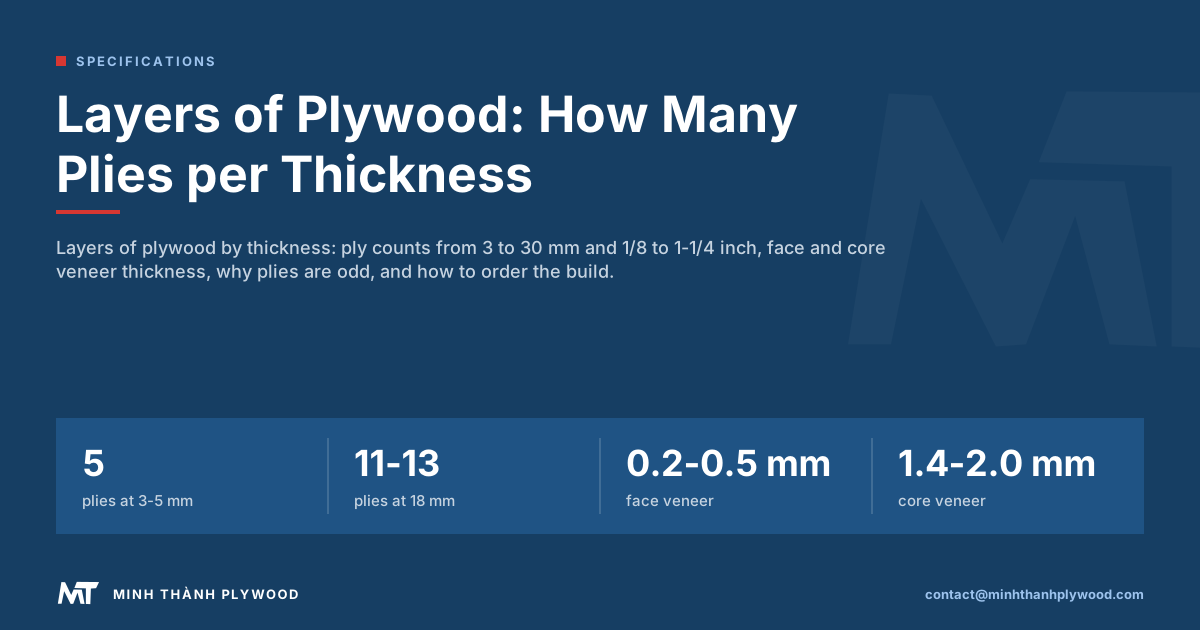
The layers of plywood follow its thickness: a 3–5 mm panel has 5 plies, a 12 mm panel 7–9 and an 18 mm panel 11–13, most often 11. Each layer is a veneer laid at 90° to the next, so the count is usually odd. Minh Thanh Plywood gives the table below from its own furniture-panel build, with face and core veneer thickness and what to write on the order.
How many layers does plywood have by thickness?
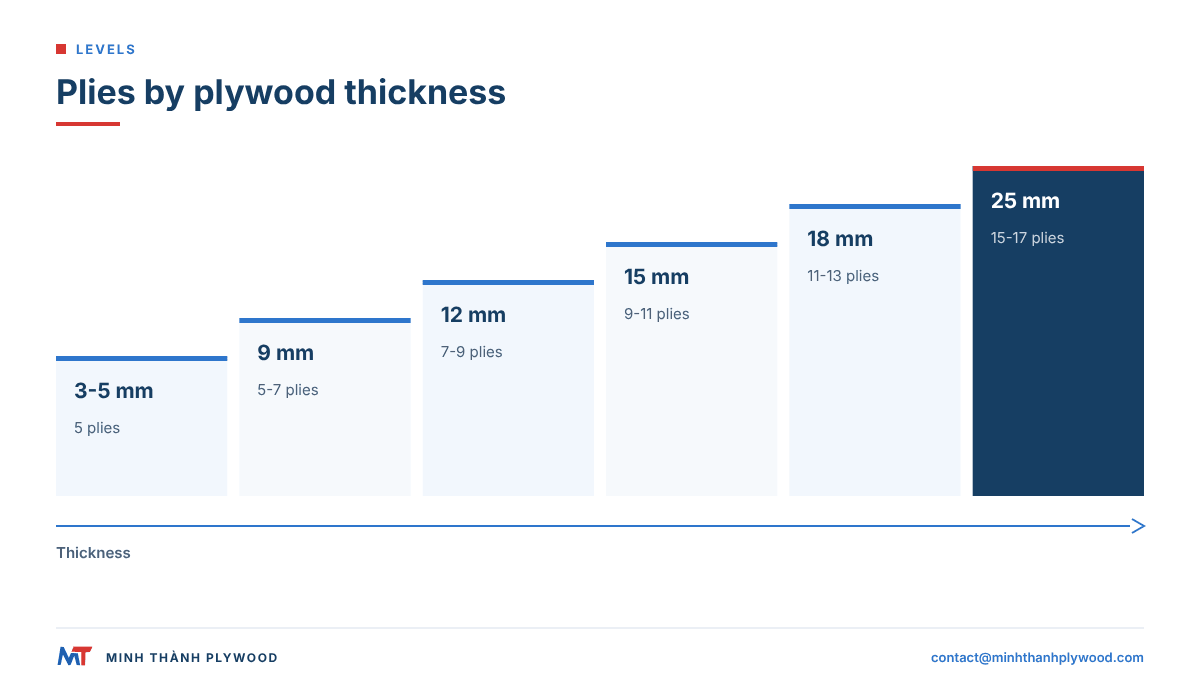
Plywood has as many layers as its thickness needs at the veneer thickness used. In a furniture build each pressed ply is about 1.4–1.65 mm, so the count rises by about two plies every 3 mm. The table gives the counts for Minh Thanh’s furniture panels, with the nearest inch size.
| Panel thickness | Nearest inch size | Plies in our furniture build | Build note |
|---|---|---|---|
| 3 mm | 1/8 in | 5 plies | 1 core, 2 cross-bands, 2 faces |
| 4 mm | 5/32 in | 5 plies | 3 core veneers of 1.3 mm, 2 faces |
| 5 mm | 3/16 in | 5 plies | 3 core veneers, 2 faces |
| 6 mm | 1/4 in | Confirmed with the order | Ply count and lay-up stated on the proforma |
| 9 mm | 3/8 in | 5–7 plies | set by core veneer thickness |
| 12 mm | 1/2 in | 7–9 plies | most common for drawer sides |
| 15 mm | 5/8 in | 9–11 plies | carcass and shelf panels |
| 18 mm | 3/4 in | 11–13 plies | most often 11 plies |
| 21 mm | 7/8 in | 13–15 plies | tops and heavy shelves |
| 25 mm | 1 in | 15–17 plies | worktops, benches |
| 30 mm | 1-1/4 in | 19–21 plies | thick tops and stair parts |
Inch sizes use the exact NIST definition of 1 inch = 25.4 mm. The 3–5 mm and 18 mm rows come straight from our build rules. The other rows follow from the same veneer: thickness divided by 1.4–1.65 mm per pressed ply, rounded to the odd count. The exact count of every order is written on the proforma.
For thickness tolerances and inch-to-metric conversions in depth, see the plywood thickness guide.
How many plies are in the plywood UK merchants sell?
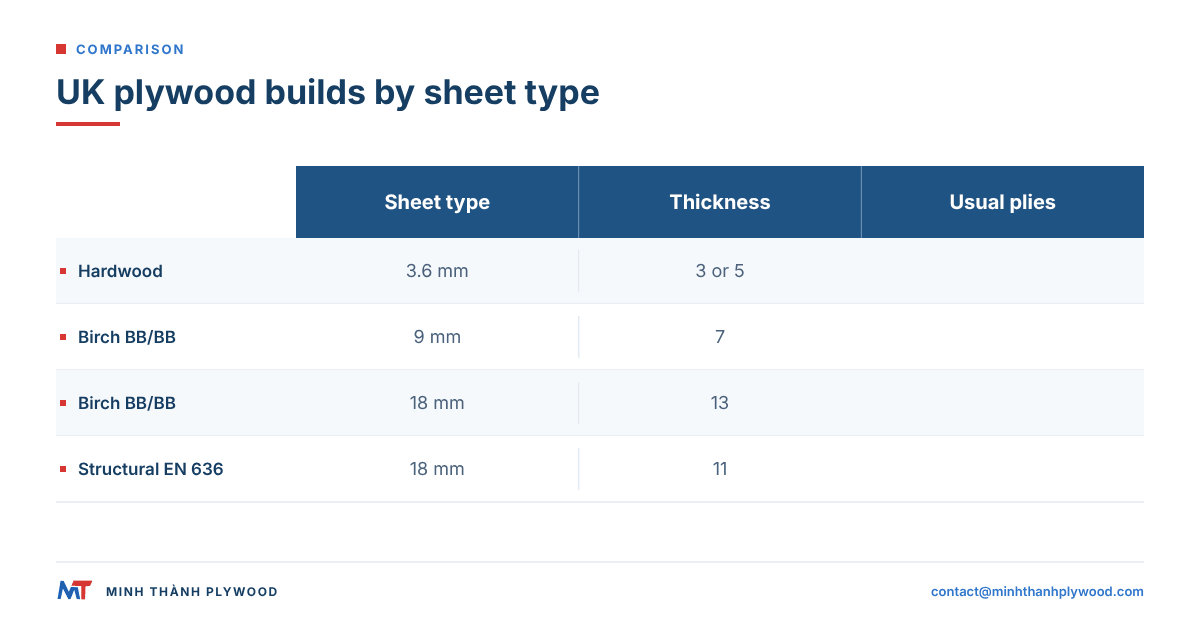
The plywood sold by UK merchants carries its ply count in the thickness and the grade, not on the label, and the usual counts are 3 to 5 plies at 3.6 mm and 13 plies at 18 mm for birch throughout. This table maps the sheet names a GB buyer sees at DIY chains and builders’ merchants to the count behind them.
| UK sheet name (8 × 4 ft sheet) | Thickness | Usual plies | Why |
|---|---|---|---|
| Non-structural hardwood plywood | 3.6 mm | 3 plies, or 5 plies on better sheets | Thin poplar or hardwood veneers, 2.5–4 mm panels are often 3-ply |
| Smooth hardwood plywood board | 5.5 mm | 5 plies | Two faces, two cross-bands, one core |
| Birch plywood throughout, BB/BB | 9 mm | 7 plies | About 1.4 mm per birch ply |
| Marine plywood to BS 1088 | 12 mm | 7–9 plies | Face veneers 1.3–3.8 mm, no core gaps |
| Birch plywood throughout, BB/BB | 18 mm | 13 plies | 18 ÷ 1.4 mm gives 13 |
| Structural hardwood plywood to EN 636 | 18 mm | 11 plies | Thicker hardwood plies, most often 11 |
| Marine plywood to BS 1088 | 18 mm | 11–13 plies | Same build range as a hardwood 18 mm sheet |
| Structural hardwood plywood to EN 636 | 25 mm | 15–17 plies | 25 ÷ 1.4–1.65 mm, odd count |
Two standards sit behind those labels. BS 1088 is the British marine plywood standard. It sets face veneers of 1.3–3.8 mm and no core gaps. EN 636 classifies plywood by use class and is the basis of the structural labels. The counts are typical builds, not limits in either standard, so ask the merchant or supplier for the ply count of the batch. Our furniture panels follow the table above: 5 plies from 3 to 5 mm, and 11–13 plies at 18 mm.
What is a ply layer, and what are the layers of plywood called?
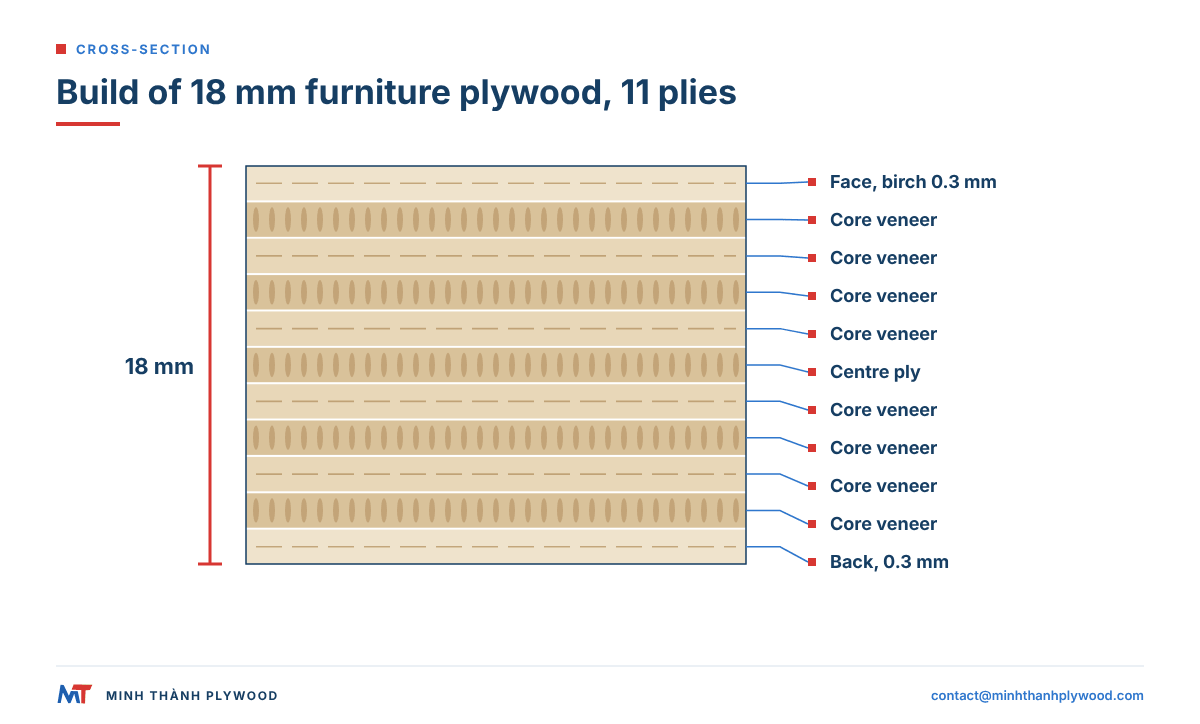
A ply layer is one sheet of wood veneer in the panel; layers and plies mean the same thing. Each ply has a name by its position:
- Face: the top veneer, the side you see, graded for appearance.
- Back: the bottom veneer, graded one step lower when only one side shows.
- Cross-band: the plies directly under face and back, laid at 90° to them.
- Core: the centre plies, which give the panel its thickness and stiffness.
A ply is not always one layer of glue apart. In very thick panels two core veneers can be laid parallel and act as one thicker ply. That is how “4-ply” and other even counts exist.
Why does plywood have an odd number of layers?
Plywood has an odd number of layers so that both faces run in the same grain direction, with the centre ply as the axis. Wood moves across the grain far more than along it. With equal plies on each side of the centre, the pull on one side matches the pull on the other, and the sheet stays flat.
An even count is possible when the two centre plies are laid in the same direction and bonded as one. The panel is then balanced like a 3-ply or 5-ply panel. North American 1/2 inch sheathing made as 4-ply works this way.
What matters for a buyer is balance, not the number itself. A balanced build has matching face and back thickness, matching species on both sides and a centred core. An unbalanced panel cups, however many plies it has.
How thick is each layer of plywood?
Face veneers are 0.2–0.5 mm thick and core veneers 1.4–2.0 mm before pressing. European furniture buyers usually order a face of about 0.3 mm. The press compresses the stack, so the pressed panel is thinner than the sum of the dry veneers.
| Layer | Veneer thickness before pressing | What sets it |
|---|---|---|
| Face and back | 0.2–0.5 mm | the face species and the look ordered |
| Cross-band in 3 mm panels | thin, matched to the face | flatness of a 5-ply thin panel |
| Core veneer, thin panels | 1.3 mm at 4 mm | five plies in a 4 mm sheet |
| Core veneer, 9 mm and thicker | 1.4–2.0 mm | ply count and core species |
Thinner core veneers mean more plies and more glue lines for the same thickness. The panel is more even and closes small gaps better, at a higher cost per cubic metre. Premium thin veneer is scarce, so a 4 mm panel can take longer to produce; we keep the standard rather than shorten the time.
How many layers are in 18 mm and 3/4 inch plywood?
An 18 mm furniture panel has 11–13 plies, most often 11 plies. The 3/4 inch size, 19.05 mm nominal, is sold in North America as 23/32 inch, about 18.3 mm, with the same 11–13 ply build. Thinner veneers raise the count:
- Furniture build on Styrax or Eucalyptus core: 11–13 plies, most often 11.
- All-birch Baltic-style panels: about 1.4 mm birch plies, so 13 plies at 18 mm.
- Light poplar commercial panels: often 13–15 plies, because thin poplar veneer is peeled and laid in larger numbers.
A count on its own does not decide the grade. An 11-ply panel with closed, stitched core veneers can be flatter than a 13-ply panel with gaps. Ask for the ply count and the core grade together. Details by grade and core: 18 mm plywood specifications.
How many plies are in 1/2 inch and 12 mm plywood?
A 12 mm panel, the metric size of 1/2 inch, has 7–9 plies in a furniture build. North American 1/2 inch sheathing is also made as 4-ply or 5-ply with thick softwood veneers, because it is sold for walls and roofs, not for exposed edges.
For drawer sides, cabinet backs and doors, 9 plies at 12 mm gives a cleaner edge and holds screws better near the edge. For sheathing, the agency stamp and span rating matter more than the count. See 1/2 inch plywood and its 12 mm equivalent for sizes and grades.
How thick are 3-ply, 5-ply and 7-ply plywood?
Three-ply plywood is usually 2.5–4 mm, 5-ply runs from 3 mm to about 9 mm, and 7-ply from about 9 mm to 12 mm. The ranges overlap because veneer thickness differs between mills and species.
| Ply count | Usual thickness | Typical use |
|---|---|---|
| 3-ply | 2.5–4 mm | door skins, backing, craft |
| 5-ply | 3–9 mm | drawer bottoms, cabinet backs, thin panels |
| 7-ply | 9–12 mm | drawer sides, partitions |
| 9-ply | 12–15 mm | carcass panels |
| 11 to 13-ply | 15–18 mm | furniture carcasses, shelves |
| 15-ply and more | 21 mm and thicker | tops, benches, stair parts |
At Minh Thanh, 3 mm is made as 5-ply rather than 3-ply: one core veneer, two cross-bands and two faces. The extra cross-bands keep a thin sheet flat on a large format and stop the face from telegraphing the core. All 3–5 mm panels are 5-ply; see thin plywood 3–6 mm.
What is the build recipe of a plywood panel?
A plywood build, or lay-up recipe, lists every layer from face to back with its species, thickness and grain direction. It is what a mill presses and what a buyer approves on the sample.
- Face: species and grade, for example birch D+, about 0.3 mm.
- Cross-band: at 90° to the face, under thin faces.
- Core plies: species (white Styrax, Eucalyptus, Acacia or Pine), grade and veneer thickness, alternating direction.
- Back: species and grade, the same thickness as the face for balance.
- Glue: UF glue at E0 emission for furniture, backed by our emission certificate and chamber tests; MR or phenolic WBP for damp and outdoor use.
- Pressing: furniture panels are pressed twice: the core board is pressed and calibrated, then face and back are pressed on.
Double pressing is why a furniture panel with fewer, thicker core plies can still have a flat, even face: the core is sanded to thickness before the faces go on.
Does more plies mean better plywood?
More plies at the same thickness give a more uniform panel, but the ply count is one input among four. At equal species and glue, a panel with more, thinner plies:
- spreads defects over more layers, so a single gap matters less;
- holds screws better near the edge;
- shows a finer, more even edge when the edge stays exposed;
- costs more, because it uses more veneer handling, glue and press time.
Species changes the comparison. A 7-ply 18 mm hardwood panel can be stiffer and dearer than a 13-ply poplar panel. Compare builds by core species, core grade, glue and tolerance as well as the count.
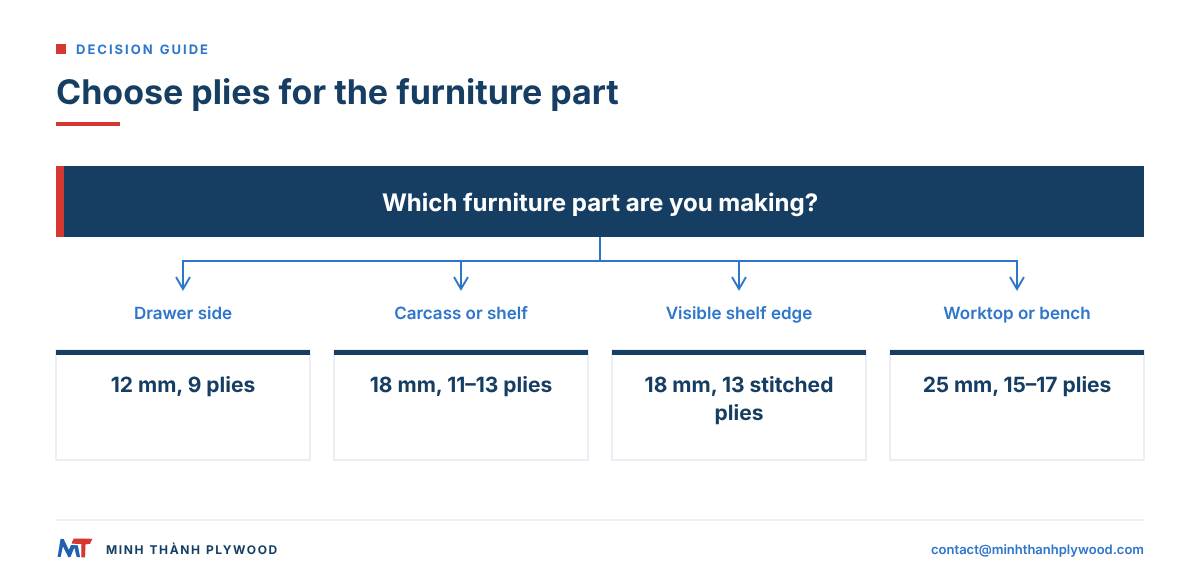
Which ply count suits each furniture part?
Choose the ply count by the part: thin backs and drawer bottoms need 5 even plies, carcass panels 9–13, and exposed edges the highest count your thickness allows. The table matches common furniture parts to thickness and build.
| Part | Thickness | Plies to ask for | Why |
|---|---|---|---|
| Drawer bottom, cabinet back | 4–6 mm | 5 plies (3–5 mm) | flat thin sheet, no telegraphing |
| Drawer side | 12 mm | 9 plies | screws and dowels near the edge |
| Door, partition | 15 mm | 11 plies | flat under one-side lacquer |
| Carcass side, shelf | 18 mm | 11–13 plies | stiffness and screw holding |
| Exposed-edge shelf, display unit | 18 mm | 13 plies, all plies stitched | even, closed edge after routing |
| Worktop, bench | 25 mm | 15–17 plies | stiffness over long spans |
Where the edge is banded, an 11-ply 18 mm panel on a stitched Styrax core is the cost-effective build. Where the edge stays visible under clear lacquer, ask for 13 plies and every ply stitched, so routed profiles show closed, even lines. Specify the face for the look: see birch-faced plywood for the D+/D grade pairs used on exposed parts.
How are the layers of plywood stitched and checked?
Core veneers in a furniture panel are stitched horizontally and vertically so their joints stay closed under the press. We stitch the 2–4 outer core plies as standard and every ply on request, for panels whose edges are routed or left visible.
The checks that tell you the layers are right:
- Edge view: count the plies on a cut edge and look for open joints or overlaps.
- Thickness: caliper at the corners and centre; sanded furniture panels are held to ±0.2–0.3 mm.
- Flatness: lay a sheet on a flat table; a balanced build lies flat.
- Moisture: veneers and panels are dried to 8–12 % at dispatch.
Our veneer grading page shows how core and face veneers are sorted before lay-up.
How many layers of plywood do you need for a subfloor or a boat deck?
One layer of 18 mm (23/32 inch) tongue-and-groove plywood is the usual subfloor on 16 or 19.2 inch joist centres. Wider spacing, stone or tile adds a second layer or a 22 mm (7/8 inch) panel. Joist spacing and finish decide it; see subfloor plywood thickness.
On boat decks sheathed in fibreglass, builders usually lay one or two layers of glass cloth in epoxy over marine plywood. That is a boat-building specification, not a ply count of the panel. Marine plywood to BS 1088 has its own veneer rules.
What do the layers of plywood look like for each core?
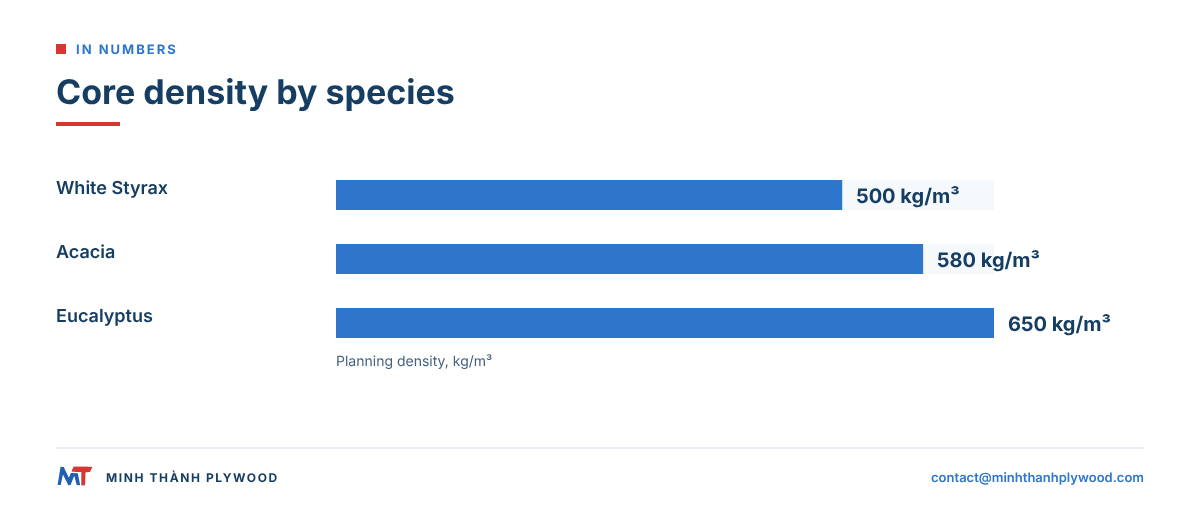
The core species changes the colour, weight and look of the layers on the edge. Minh Thanh’s furniture panels use white Styrax or Eucalyptus cores as standard, with Acacia and Pine on order.
| Core | Edge look | Planning density | Typical 18 mm sheet weight |
|---|---|---|---|
| White Styrax | pale, even layers | 500 kg/m³ | 26.8 kg |
| Acacia | light brown layers | 580 kg/m³ | 31.1 kg |
| Eucalyptus | pinkish brown layers | 650 kg/m³ | 34.8 kg |
Weights are for a 1220 × 2440 × 18 mm sheet at the planning density. A pale Styrax core gives a clean, light edge under clear lacquer, which is why many European furniture buyers choose it for exposed edges.
What this means for your order
Write the layers on the order the way you would write the thickness: as a number with its build.
- Thickness and tolerance: for example 18 mm, ±0.2–0.3 mm sanded.
- Ply count: for example 13 plies, or “11–13 plies” if any build in that range is acceptable.
- Core: species, grade and stitching (outer plies or all plies).
- Face and back: species, grade pair and veneer thickness.
- Glue and emission: UF glue at E0 emission, or MR or phenolic WBP.
Minh Thanh writes the ply count on the proforma and sends a free sample of the build before production. A spec line to copy: 18 mm furniture plywood, 13 plies, white Styrax core stitched, birch D+/D faces, UF glue at E0 emission, 1220 × 2440 mm, ±0.2–0.3 mm, packed for 40HC. Send it to contact@minhthanhplywood.com.
Buyer questions, answered
How many layers are in 18 mm plywood?
An 18 mm furniture panel has 11–13 plies, most often 11. Commercial poplar or Baltic-style birch builds with thinner veneers reach 13–15 plies.
How many plies are in 1/2 inch plywood?
Half-inch plywood, or 12 mm in metric, usually has 7–9 plies in a furniture build. North American 1/2 inch sheathing is also made as 4-ply or 5-ply with thicker veneers.
How many layers are in 3/4 birch plywood?
Birch-faced 3/4 inch, or 18 mm, plywood usually has 11–13 plies. All-birch Baltic-style panels use about 1.4 mm plies and reach 13 plies at 18 mm.
How thick is 5-ply plywood?
Five-ply plywood runs from 3 mm to about 9 mm. At Minh Thanh every 3–5 mm panel is 5-ply, and a 9 mm panel is 5–7 plies depending on the core veneer chosen.
How thick is 3-ply plywood?
Three-ply plywood is usually 2.5–4 mm: two faces and one core veneer. Minh Thanh builds its thinnest 3 mm panel as 5-ply instead, for a flatter sheet.
Why does plywood have an odd number of layers?
An odd count puts the same grain direction on both faces, so the panel is balanced around its centre ply and stays flat as moisture changes.
Does more plies mean stronger plywood?
At the same thickness and species, more and thinner plies give a more even, more stable panel with fewer core gaps. Species, glue and core grade matter as much as the count.
What is the thinnest layer in plywood?
The face veneer: 0.2–0.5 mm thick, and about 0.3 mm on most European furniture orders. Core veneers are thicker, 1.4–2.0 mm before pressing.
How many layers of plywood do I need for a subfloor?
One layer of 18 mm (23/32 inch) tongue-and-groove plywood on 16 or 19.2 inch joist centres covers most floors. Tile or wide joist spacing adds a second layer or a thicker panel.
Is 4-ply plywood real?
Yes. Some North American 1/2 inch sheathing is 4-ply: the two centre plies run the same way and act as one thick layer, so the panel still balances.
Can I order a specific ply count?
Yes. Write the ply count and core veneer thickness on the order, for example 18 mm, 13 plies; the count is then fixed on the proforma and checked on the sample.