
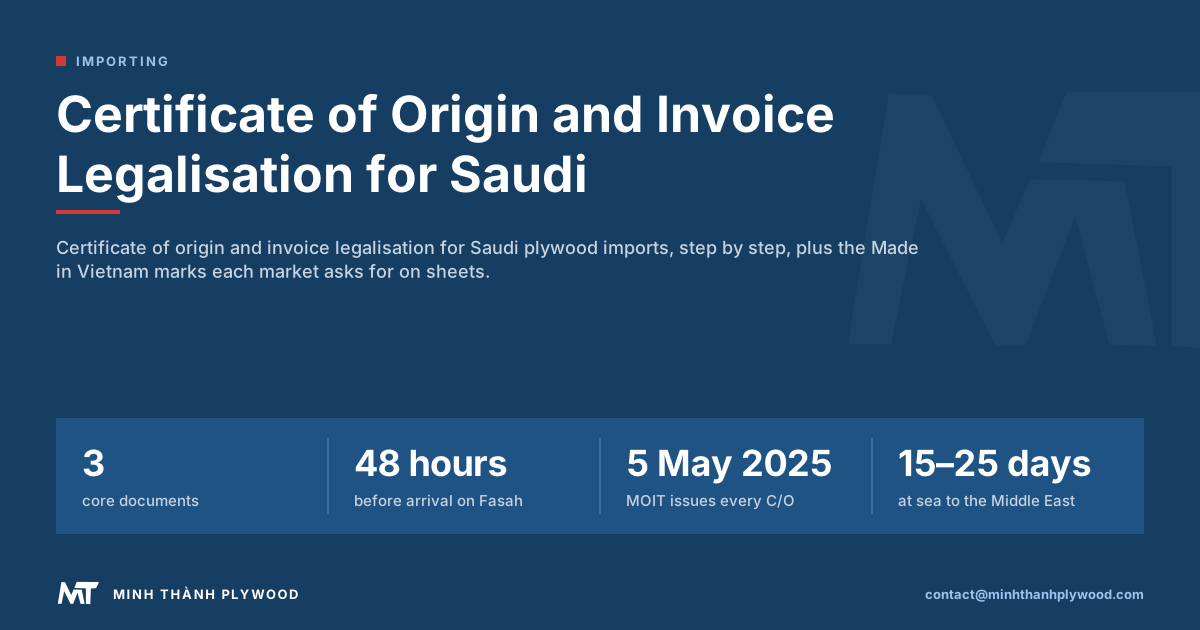
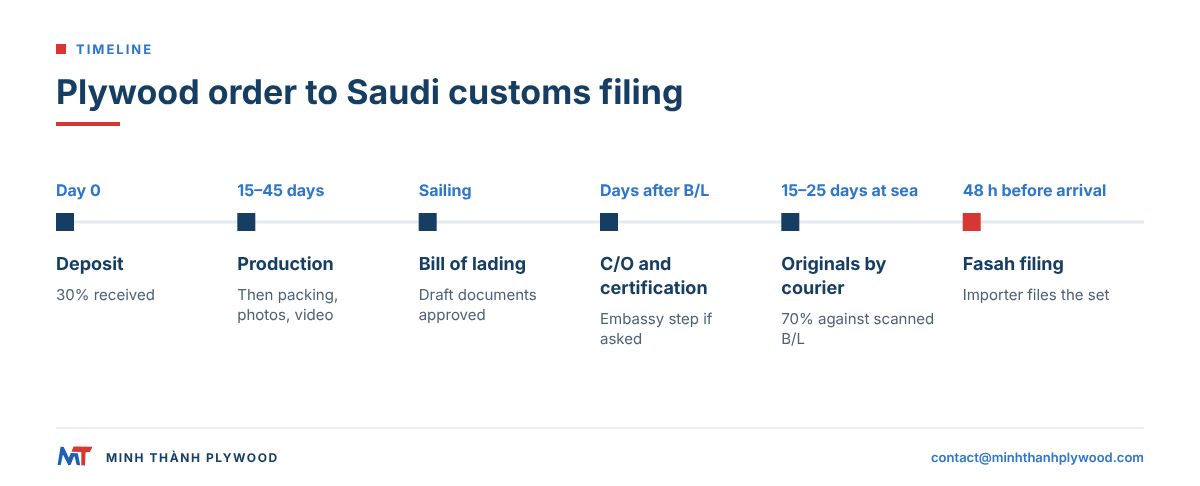
For Saudi Arabia, plywood from Vietnam clears customs on three documents: commercial invoice, bill of lading and certificate of origin, with the origin also marked permanently on the goods in Arabic or English. Vietnam's Ministry of Industry and Trade has issued every Vietnamese certificate of origin since May 2025, and the invoice and certificate are certified before shipment. Minh Thanh Plywood prepares the set in the order below.
What does Saudi customs need for a plywood shipment?
Saudi customs needs three documents for a plywood shipment: the commercial invoice, the bill of lading and the certificate of origin. ZATCA, the Zakat, Tax and Customs Authority, lists them in its import instructions and adds any other certificate the product’s own rules require (ZATCA import instructions, read 20 October 2026).
The importer files the declaration and documents on Fasah, the Saudi single window, “at least 48 hours prior to the arrival of the shipment at the port of entry”. The documents must therefore be ready, certified and in the importer’s hands well before the vessel reaches Jeddah or Dammam.
ZATCA notes that the certificate of origin is not needed when the origin is clearly established. For a plywood import that exemption is rarely used: the importer’s clearing agent nearly always asks for the certificate, and the Saudi origin-marking rule below applies regardless.
How does certificate of origin and invoice legalisation for Saudi Arabia work?
Certificate of origin and invoice legalisation for Saudi Arabia works in a fixed order: the documents are issued, certified by a chamber of commerce or other authorised body in the exporting country, and, where the importer’s agent requires it, legalised by the Saudi mission.
US government guidance for Saudi exports describes the same core rule (US Commercial Service, Saudi Arabia import requirements, read 20 October 2026).
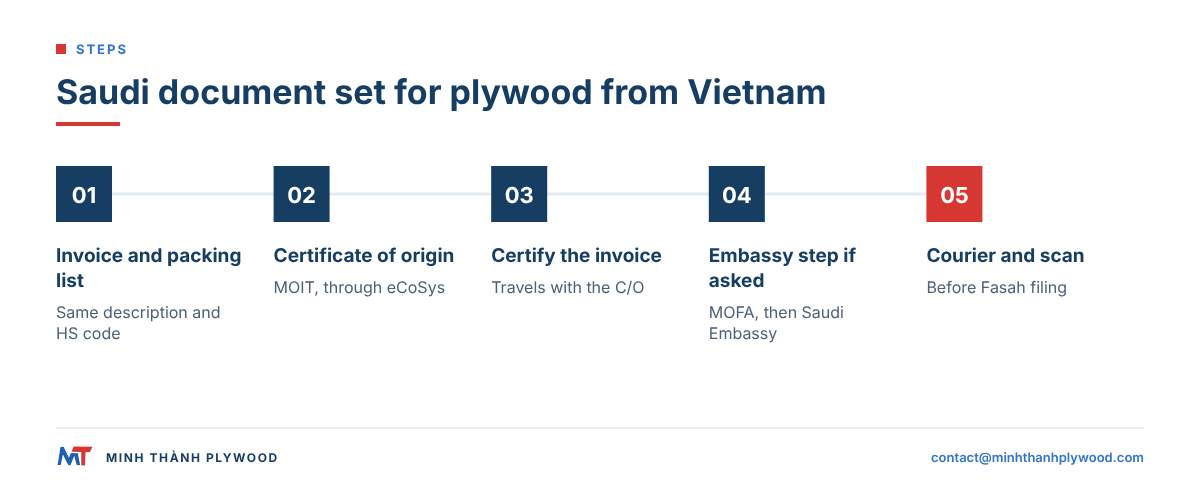
From Vietnam the steps are:
- Issue the commercial invoice and packing list, matching the bill of lading and the goods.
- Apply for the certificate of origin from the Ministry of Industry and Trade on eCoSys, with the invoice, packing list, bill of lading and export declaration.
- Have the commercial invoice certified with the certificate of origin, so the pair travels as one set.
- Add the embassy step only when asked: consular certification by Vietnam’s Ministry of Foreign Affairs, then legalisation by the Saudi Embassy in Hanoi.
- Courier the originals and send scans so the importer can start Fasah.
Saudi missions set their own practice for commercial documents, and some have stopped legalising invoices and certificates of origin. The importer’s clearing agent knows what the port is accepting this month; write that answer into the sales contract.
Who issues a Vietnamese certificate of origin since 2025?
Vietnam’s Ministry of Industry and Trade (MOIT) issues every Vietnamese certificate of origin since 5 May 2025. MOIT Decision 1103/QĐ-BCT withdrew the Vietnam Chamber of Commerce and Industry’s (VCCI) authority to issue non-preferential certificates, such as Form B and certificates required by importing countries, and handed the work to the ministry’s Agency of Foreign Trade and its regional offices.
For importers the change means one office and one system. Preferential certificates under Vietnam’s trade agreements and non-preferential certificates now go through the same eCoSys application. A supplier still saying “the chamber will issue our C/O” is describing the pre-2025 arrangement.
For Saudi Arabia the usual certificate is the non-preferential one. It proves where the plywood was made; it does not lower the duty. Minh Thanh panels are manufactured at the factory in Ha Hoa, Phu Tho, on cores of locally grown plantation timber, and the certificate names Vietnam as the country of origin.
What must a certificate of origin for Saudi Arabia show?
A certificate of origin for Saudi Arabia must show the same facts as the invoice, in the same words. The certifying office checks them against each other, and Saudi customs checks them again on arrival.
| Field | What to write for plywood | Must match |
|---|---|---|
| Exporter | Name and address of the manufacturer | Invoice, B/L shipper |
| Consignee | Saudi importer’s name and address | Invoice, B/L consignee |
| Transport | Vessel, port of loading Hai Phong, port of discharge | B/L |
| Marks and numbers | Pack marks as printed on the packs | Packing list, packs |
| Goods description | Plywood, face and core species, thickness, size | Invoice |
| HS code | Six-digit or national line, such as 4412.33 | Invoice, declaration |
| Quantity | Sheets, packs, m³ and gross weight | Packing list |
| Invoice number and date | As on the commercial invoice | Invoice |
| Country of origin | Vietnam | Origin marks on the goods |
The HS line follows the face veneer, as our plywood HS code guide explains: 4412.33 for birch, poplar or eucalyptus faces, 4412.31 for okoume. One description, copied word for word across the invoice, packing list and certificate, is the surest way through.
Is a Made in Vietnam stamp on plywood required for Saudi Arabia?
Yes, a Made in Vietnam stamp on plywood is required in practice for Saudi Arabia, on each sheet. Saudi rules require the country of origin on all imported goods, in Arabic or English, unless it is not feasible because of the size or the nature of the goods, and the mark must be unremovable, whether by printing, engraving, embossing, sewing, or other permanent method (US Commercial Service, Saudi Arabia labelling and marking, checked on 27 October 2026).
A plywood sheet has room for a mark, so the exception for small goods does not apply to it. The packaging-only route is for goods too small or unsuitable to mark. A sticker is accepted only if it cannot be removed.
The guidance adds that containers should be marked with the country of manufacture as well. For plywood that means three levels: the sheet, the pack label and the container contents described on the documents.
What country of origin marking does plywood need by destination?
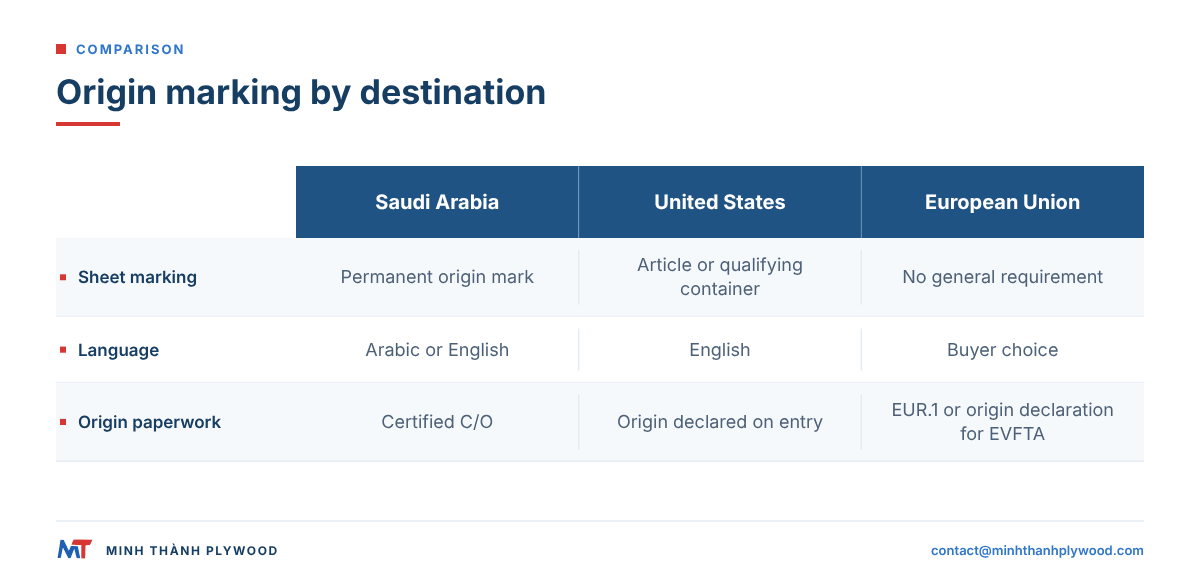
The country of origin marking plywood needs varies more by destination than any other document detail. The table gives the rule for the markets most often asked about.
| Destination | Mark on each sheet | Mark on pack or carton | Language | Origin document at import |
|---|---|---|---|---|
| Saudi Arabia | Required, permanent | Required | Arabic or English | Certificate of origin, certified |
| United States | Required, or the container where the sheet reaches the ultimate purchaser in it | Required | English | Declared on entry; TSCA Title VI label on each panel |
| European Union | No general requirement | Commercial practice | Buyer’s choice | EUR.1 certificate of origin (or origin declaration) for the EVFTA rate |
| Other destinations | Per national rule | Per national rule | Per national rule | As the importer’s broker asks |
For the US, Section 304 of the Tariff Act requires every imported article, or its container where the article cannot be marked, to be marked “as legibly, indelibly, and permanently as the nature of the article (or container) will permit” with its country of origin in English (19 U.S.C. 1304, read 20 October 2026). Minh Thanh panels for US orders already carry the TSCA Title VI label with producer, lot and certifier number TPC-43.
For the EU, origin matters for duty, not for marking. The EVFTA duty guide covers the EUR.1 certificate of origin (or origin declaration) that unlocks the preferential rate.
How is plywood marked with its origin at the factory?
Plywood is marked with its origin at the factory in one of three ways, chosen in the order because each one looks different on the finished face:
- Edge stamp: an ink stamp on the panel edge, “Made in Vietnam” with the buyer’s reference if wanted. It leaves both faces clean, which suits furniture and interior plywood.
- Back-face print or stamp: a print on the back of each sheet, readable when the sheet is lifted. It suits commercial, packing and film-faced panels.
- Non-removable label: a printed label bonded to the edge or back where ink does not take, such as on some film faces.
Each pack then carries its own label with the pack number, specification, sheet count and “Made in Vietnam”, matching the marks column of the packing list. Custom buyer labels and edge printing are options by order.
Mark the back or the edge, never the show face, of a panel that will be veneered, lacquered or UV-coated. Minh Thanh’s faces are sanded, polished and UV-ready on both sides, so a buyer who wants both faces untouched should order edge stamps.
What is the legalisation chain for Vietnamese documents?
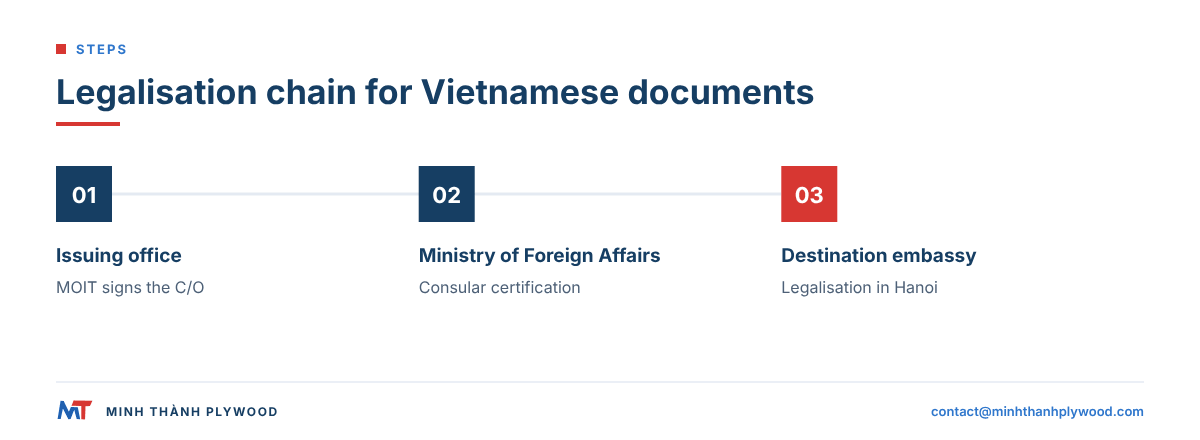
The legalisation chain for Vietnamese documents has two links when a foreign mission asks for it: consular certification by Vietnam’s Ministry of Foreign Affairs, then legalisation by the embassy of the destination country in Hanoi. The ministry’s Consular Department, or the Department of Foreign Affairs in Ho Chi Minh City, confirms the signature and seal on the Vietnamese document; the embassy then confirms the ministry’s stamp.
Order matters. The embassy will only stamp a document that already carries the ministry’s certification, and the ministry will only certify a document whose issuing signature it can check, such as an MOIT certificate of origin.
For Saudi plywood orders, add this chain only when the importer’s clearing agent asks for it. Every extra stamp adds days and courier legs, and documents that travel back and forth between offices are the ones that miss the vessel.
Does plywood for Saudi Arabia need a SABER certificate?
A SABER certificate is needed when the product falls under a Saudi technical regulation. SABER is the Saudi Standards, Metrology and Quality Organization (SASO) platform for product conformity: a regulated product gets a product certificate of conformity, and each shipment of it then gets a shipment certificate on the same platform.
The importer, not the exporter, registers the product on SABER, using the HS code and the product details. That is why the importer should check the HS line against SABER at the quotation stage. If a certificate is needed, the conformity body asks for the specification and any test reports for the panel.
Minh Thanh supplies what such a request usually needs: the panel specification, the ISO 9001:2015 quality management certificate (KAC25/0185), the CARB P2 / TSCA Title VI certification and the third-party chamber tests on file. The emission rules behind them are the US EPA formaldehyde standards for composite wood products.
What other documents travel with a plywood shipment?
Every Minh Thanh plywood shipment travels with the commercial invoice, packing list, bill of lading and certificate of origin, plus the phytosanitary and fumigation certificates when the order names them and insurance with CIF. Certificate files, such as CARB P2 / TSCA, test reports, the EUDR dossier and the PPWR packaging test, are added by order.
For Saudi Arabia the core set is short; the work is in getting it certified and consistent. Two documents are often added by the importer’s agent:
- a packing list with marks, matching the pack labels and the certificate’s marks column;
- a fumigation or phytosanitary certificate if the importer’s own receiving rules list one, even though plywood is processed wood; our guide on fumigation certificates for plywood covers when that is.
Draft documents are sent to the buyer for review after packing and before the originals are issued, so any wording the agent wants is fixed once on all papers.
How long does the document process take?
The document process for Saudi Arabia takes a few working days after the bill of lading is issued, longer if the embassy step is added. It runs in parallel with the sea voyage, which takes 15–25 days from Hai Phong to the Middle East.
| Stage | When it happens | What it waits for |
|---|---|---|
| Production | 15–45 days after deposit | Deposit received |
| Packing, photos, video | Before loading | Production finished |
| Draft documents to buyer | After packing | Packing list |
| Bill of lading | After the vessel sails | Loading on board |
| Certificate of origin | After the B/L or export declaration | eCoSys application |
| Certification and any embassy step | A few working days | Certificate of origin |
| Originals by courier | Before arrival | Certified set |
| Fasah filing | At least 48 hours before arrival | Originals or scans |
The balance of 70% is paid against the scanned bill of lading, so the certified set can be couriered as soon as payment is received. Under a letter of credit, the certified documents are what the bank examines.
What happens when documents or marks are wrong?
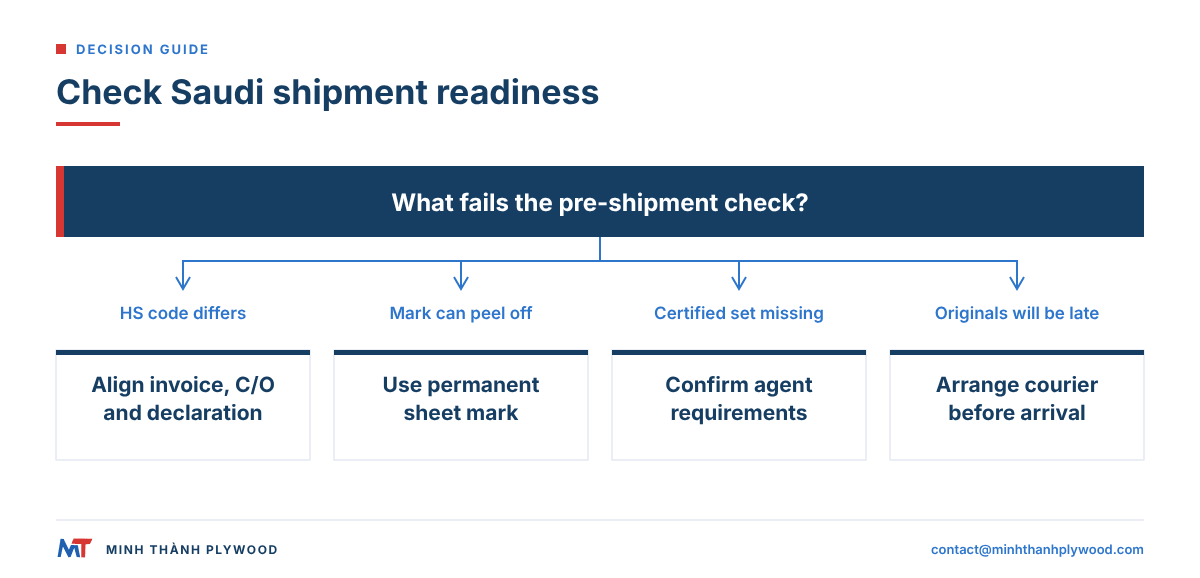
When documents or marks are wrong, the container waits. The importer cannot finish the Fasah declaration without the right documents, and storage and demurrage charges run at the port from the day the free time ends.
The usual faults are simple:
- Mismatched descriptions or HS codes between the invoice, packing list and certificate of origin;
- Missing or removable origin marks on the sheets, such as a paper label that peels off;
- Uncertified copies where certified originals were expected;
- Originals that arrive after the vessel, because the courier was booked late.
Each one is caught before shipment by one check: lay the draft invoice, packing list, certificate and a photo of a marked sheet side by side, and compare them line by line.
What should you write in the plywood order for Saudi Arabia?
Write the document set and the marks into the plywood order, so the mill, the certifying office and your clearing agent work to one list. A complete order line reads:
“Documents: commercial invoice, packing list with marks, bill of lading, certificate of origin issued by MOIT; invoice certified with the certificate of origin; embassy legalisation [required / not required]. Marks: Made in Vietnam edge stamp on each sheet, pack labels in English with pack number and specification.”
Add the panel specification beside it: application, core, glue and emission class, face grade, size and thickness, packing and quantity, and the port of discharge. Send it to Minh Thanh for a quote on furniture plywood from Vietnam or on any panel in the range; samples are free, and replies come within hours.
Buyer questions, answered
What documents does Saudi customs need for plywood?
Saudi Arabia's Zakat, Tax and Customs Authority (ZATCA) asks for the commercial invoice, the bill of lading and a certificate of origin, plus any certificate the product's regulation requires. The importer files them on the Fasah platform at least 48 hours before the shipment arrives.
Who issues the certificate of origin for plywood in Vietnam?
Vietnam's Ministry of Industry and Trade, through its regional import-export offices and the eCoSys online system. It took over non-preferential certificates such as Form B from the Vietnam Chamber of Commerce and Industry in 2025 and has been the single issuer since 5 May 2025.
Does the invoice for Saudi Arabia need legalisation?
Saudi practice is that the commercial invoice and certificate of origin are certified in the exporting country before shipment. Whether a further stamp from the Saudi embassy is needed is set by the Saudi mission and the importer's clearing agent, so agree it in the sales contract.
Is a Made in Vietnam stamp required on every plywood sheet?
For Saudi Arabia, yes in practice: the country of origin must be shown on all imported goods in a way that cannot be removed, and the package is allowed only when the goods cannot be marked. A plywood sheet can be stamped or printed, so each sheet carries the mark.
What language must the origin mark be in for Saudi Arabia?
Arabic or English. Made in Vietnam in English is accepted, printed, stamped, embossed or on a sticker that cannot be removed. The cartons, packs and container contents should also show the country of manufacture.
Does the EU require a Made in Vietnam mark on plywood?
No general EU rule requires an origin mark on plywood sheets. Origin is declared on the customs declaration, and the EVFTA preferential rate needs proof of origin, normally an EUR.1 certificate of origin (or an origin declaration where the exporter qualifies), not a mark on the panel.
Does the US require country of origin marking on plywood?
Yes. US law requires every imported article, or its container where the article cannot be marked, to show the country of origin in English, legibly and permanently. Plywood sold on as sheets is usually marked on each sheet or pack.
How long do certification and legalisation take?
The certificate of origin follows the bill of lading or the export declaration, and certification takes a few working days. An extra embassy step adds more days, so courier the originals early enough to reach the importer before the vessel arrives.
What happens if the documents are not certified?
The importer cannot complete clearance on the Fasah platform, and the container waits at the port with storage and demurrage charges running until correct documents arrive. Agree the document set before the order is confirmed.
Can the HS code differ between the invoice and the certificate of origin?
No. The invoice, packing list and certificate of origin must carry the same goods description, HS code, quantities and marks. A mismatch is the most common reason a certifying office or customs rejects a set.