
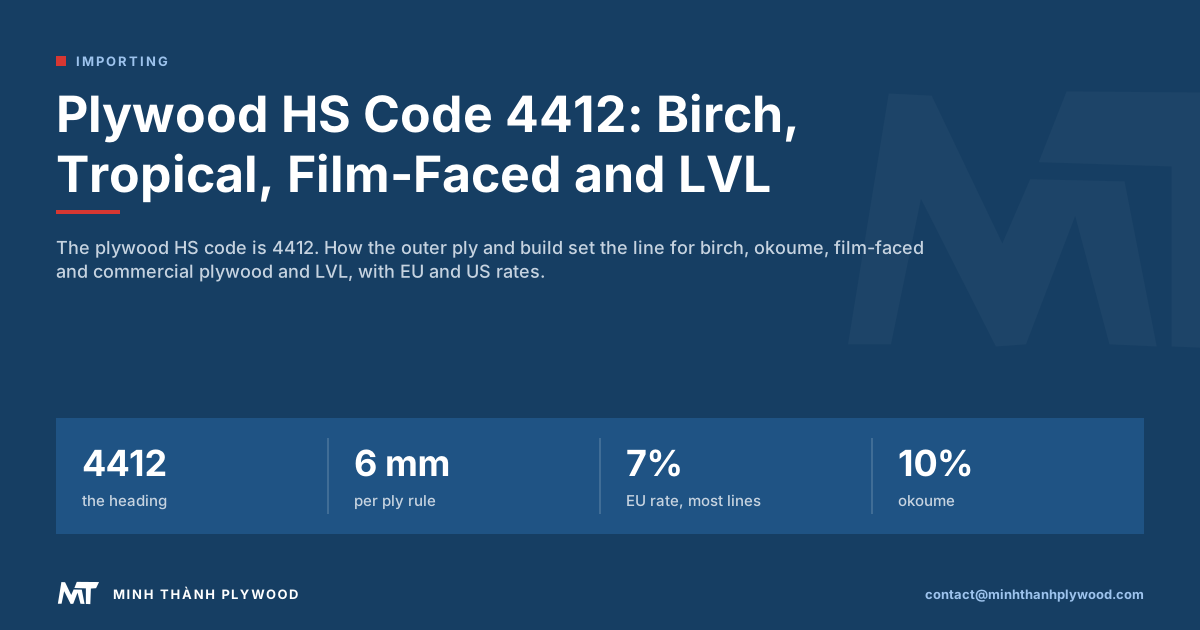
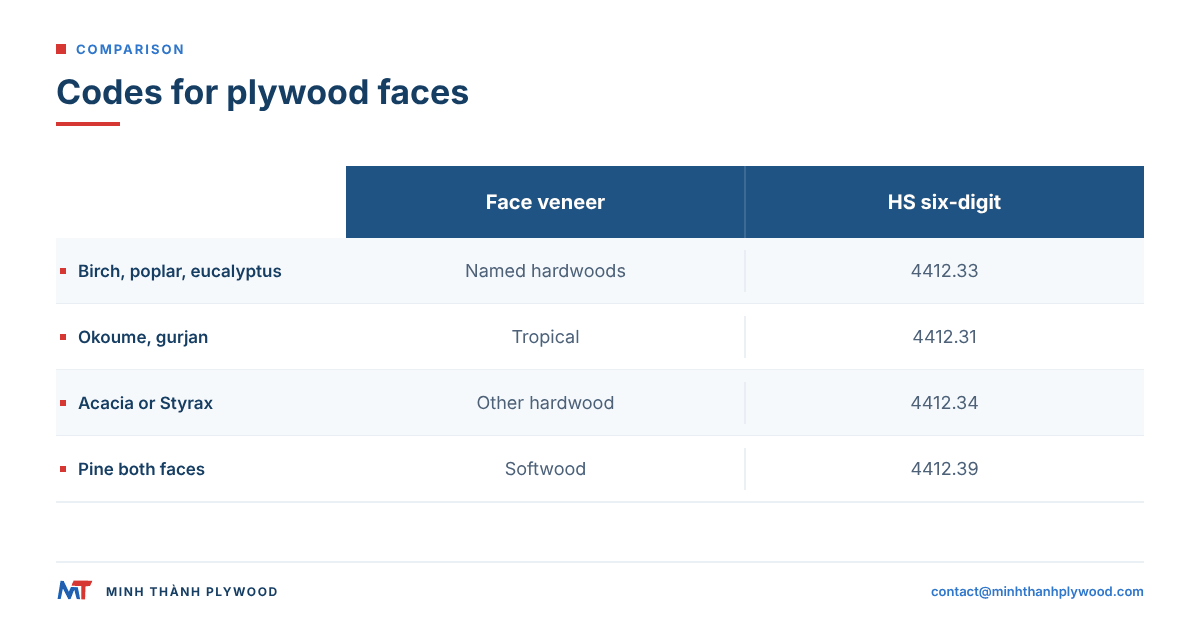
The plywood HS code is heading 4412, "plywood, veneered panels and similar laminated wood". The six-digit subheading then follows the species of the two outer plies, not the core: 4412.31 for a tropical face, 4412.33 for birch, poplar or eucalyptus, 4412.34 for other hardwoods, 4412.39 for pine on both faces and 4412.41 to 4412.49 for LVL. Minh Thanh Plywood prints the line on every export invoice.
What is the HS code for plywood?
The HS code for plywood is heading 4412, worded “plywood, veneered panels and similar laminated wood” in the Harmonized System that the World Customs Organization keeps and that more than 200 customs administrations apply. Every plywood panel Minh Thanh makes, from 3 mm thin plywood to 40 mm furniture board, is declared somewhere inside 4412.
The heading splits into four families of six-digit subheadings:
- 4412.10: plywood of bamboo.
- 4412.31 to 4412.39: plywood made only of sheets of wood, each ply no thicker than 6 mm. This is ordinary veneer plywood and covers almost every furniture, commercial, packing and film-faced panel.
- 4412.41 to 4412.49: laminated veneer lumber (LVL).
- 4412.51 to 4412.59: blockboard, laminboard and battenboard, panels with a sawn-wood core.
- 4412.91 to 4412.99: other laminated wood, such as panels with a layer of particle board or plies thicker than 6 mm.
The EU text of this structure is the Combined Nomenclature (CN) in Commission Implementing Regulation (EU) 2021/1832, chapter 44 (CN 2022, read 20 October 2026). The US text is the Harmonized Tariff Schedule, heading 4412 (read 20 October 2026).
What is the HS code for plywood sheet, and how is the subheading chosen?
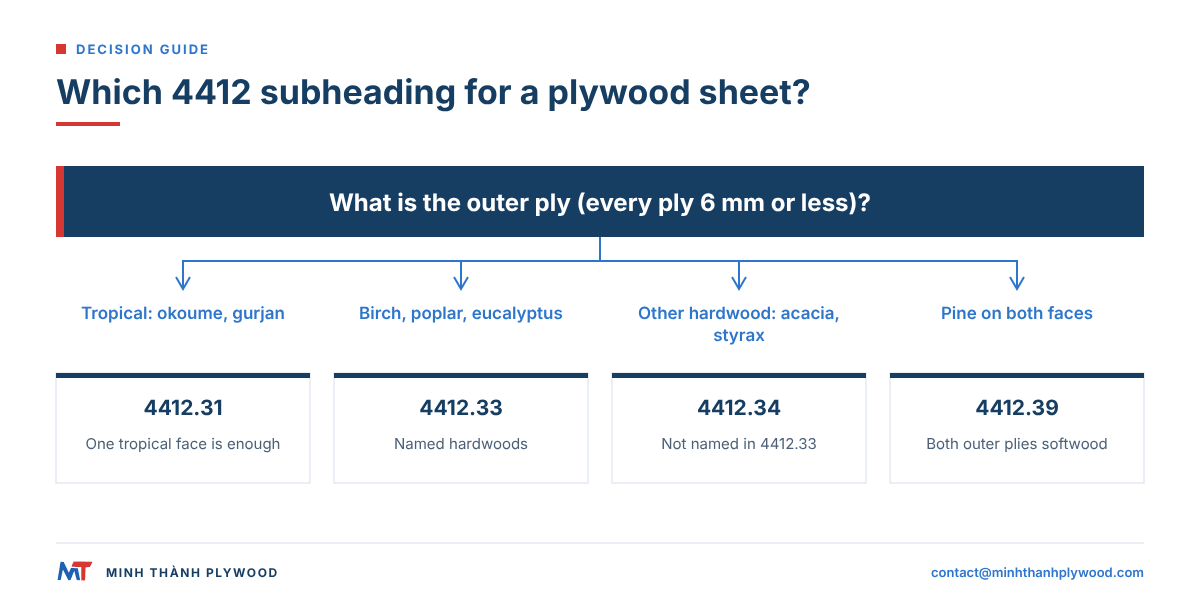
The HS code for a plywood sheet is chosen in three questions, asked in this order. The answers come from the panel’s build, so the mill that pressed it knows them before anyone else.
- Is it veneer plywood, LVL or blockboard? Cross-laminated veneers make plywood (4412.3x). Veneers laid mostly in one grain direction make LVL (4412.4x). A sawn-strip core under veneers makes blockboard (4412.5x).
- Is every ply 6 mm thick or less? The limit applies to each veneer, not to the panel. A Minh Thanh 18 mm board has 11–13 plies, each well under 6 mm, so it stays in 4412.3x.
- What species are the two outer plies? A tropical outer ply sends the panel to 4412.31; one of the eighteen named hardwoods to 4412.33; any other hardwood to 4412.34; softwood on both faces to 4412.39.
The order matters. A tropical face wins over a named hardwood back, and a named hardwood face wins over a softwood back: the CN wording is “with at least one outer ply of”, so one face is enough to decide.
Why does the core species not change the code?
The core species does not change the code because every 4412.3x subheading is defined by the outer plies alone. Customs reads the face and the back; the veneers inside the panel are not named in any of the six-digit texts.
That has a practical effect for Minh Thanh panels. The factory builds on a white Styrax core or a Eucalyptus core, both stitched across and along the grain before pressing. A birch face on either core is birch plywood for customs. An okoume face on a Eucalyptus core is tropical plywood, even though eucalyptus is one of the named hardwoods of 4412.33.
Write both outer species on the commercial invoice and packing list, for example “face birch, back birch, core Styrax”. The broker then classifies from the document instead of from a guess, and the same description serves the Lacey Act declaration for US orders and the species field of the EUDR dossier for EU orders.
Which subheading fits each plywood face species?
Each Minh Thanh face veneer maps to one six-digit subheading. The table gives the EU eight-digit line and its conventional duty from the CN 2022 text, and the US general rate from the HTS read on 20 October 2026.
| Face (outer ply) | HS six-digit | EU CN line | EU conventional rate | US general rate |
|---|---|---|---|---|
| Birch | 4412.33 | 4412 33 10 | 7% | Free (4412.33.06) |
| Poplar | 4412.33 | 4412 33 20 | 7% | 8% |
| Eucalyptus | 4412.33 | 4412 33 30 | 7% | 8% |
| Okoume | 4412.31 | 4412 31 10 | 10% | 8% |
| Gurjan (keruing) | 4412.31 | 4412 31 90 | 7% | 8% |
| Acacia, Styrax or other hardwood face | 4412.34 | 4412 34 00 | 7% | 8% |
| Pine on both faces | 4412.39 | 4412 39 00 | 7% | 5.1% or 8% by line |
| Pine face, hardwood back | 4412.33 or 4412.34 | by the back species | 7% | 8% |
The US column is the general (most-favoured-nation) rate only. Anti-dumping or countervailing duty cases and other additional duties are separate measures that sit on top of it; the anti-dumping status for plywood from Vietnam has its own guide.
For bintangor, ask your broker to confirm the line before the first shipment. The US schedule lists bintangor among the tropical woods of 4412.31, and in the EU both candidate lines, 4412 31 90 and 4412 34 00, carry the same 7% conventional rate.
What are the UK commodity codes and duty for plywood?
The UK uses a ten-digit commodity code, and plywood from Vietnam enters at 0% duty when the origin is proven under the UK–Vietnam Free Trade Agreement. The UK Global Tariff rate, which applies without an origin proof, is 6% for most hardwood-faced plywood, including most tropical faces, and 10% for okoume and the other woods named in 4412 31 10. All rates below are from the UK Integrated Online Tariff (checked on 21 October 2026); the tariff states the unit as cubic metres (m³).
| Face (outer ply) | UK commodity code | UK Global Tariff | Vietnam preferential rate |
|---|---|---|---|
| Okoume (tropical) | 4412 31 10 10 | 10% | 0% |
| Other tropical face | 4412 31 90 00 | 6% | 0% |
| Birch | 4412 33 10 14 or 4412 33 10 84 | 6% | 0% |
| Poplar | 4412 33 20 90 | 6% | 0% |
| Eucalyptus | 4412 33 30 90 | 6% | 0% |
| Acacia, Styrax or other hardwood face | 4412 34 00 90 | 6% | 0% |
| Pine on both faces | 4412 39 00 90 | 6% | 0% |
| LVL, non-coniferous outer ply | 4412 42 00 00 | 10% | 0% |
The final digits split one face species into further lines, for example by coating or by country of consignment, so two panels with the same face can take different final digits. Give the broker the face species, coating and size, and let the tariff pick the line.
The UK is a separate tariff from the EU: the EU line for birch plywood is 4412 33 10 at 7%, and the UK line is a ten-digit code at 6%, so an EU document cannot simply be reused for a UK entry. Proving origin for the 0% rate needs the origin declaration on the invoice; our UK import duty guide covers the documents.
What is the birch plywood HS code?
The birch plywood HS code is 4412.33, the subheading for plies of 6 mm or less with at least one outer ply of the named hardwoods, birch first among them. The EU splits it at eight digits: 4412 33 10 is “with at least one outer ply of birch”, ahead of poplar and eucalyptus.
Birch is also the one face with a duty-free US line. HTS 4412.33.06 covers plywood “with a face ply of birch”, general rate free, while other faces in 4412.33 pay 8%. A birch face on a poplar or eucalyptus core keeps that birch line, because the US text, like the EU one, looks at the face.
Minh Thanh birch faces are graded D+, D and E, the Vietnamese names for the ladder that compares with B, BB and CP/C in European birch grading, and quoted as pairs such as D+/D or D/E. The grade changes the price and the look; it does not change the HS code.
What is the film faced plywood HS code?
The film faced plywood HS code is the 4412.3x line of the veneer under the film, because the plywood subheadings apply “whether or not coated or surface-covered”. The phenolic film is a surface covering; it does not move the panel out of heading 4412.
So a film-faced panel with a eucalyptus face veneer under the film is 4412.33 (EU 4412 33 30); one with an acacia or mixed hardwood face veneer is 4412.34. The EU wording is quoted in the scope of Implementing Regulation (EU) 2025/2333, which describes plywood of 4412 31, 4412 33 and 4412 34 “whether or not coated or surface-covered”.
The US schedule keeps surface-covered panels in their own ten-digit lines. A film-faced panel with an eucalyptus face falls in the “other” line of 4412.33 rather than the “not surface covered” line, at the same 8% general rate.
Film-faced and anti-slip panels from Minh Thanh carry a stated glue, phenolic WBP or melamine-fortified MR, and a stated core. Put the face veneer species on the invoice as well; the film colour tells customs nothing about the wood.
What is the commercial plywood HS code?
The commercial plywood HS code follows the same rule as furniture plywood: 4412.33 for a eucalyptus, poplar or birch face and 4412.34 for another hardwood face. “Commercial” is a trade name for a cost-effective grade, not a customs category, and no subheading reads it.
The same holds for packing plywood, which Minh Thanh makes with low-grade faces and ±0.5–1.0 mm thickness tolerance for crates and pallets. As sheets it is 4412. Made into a box or crate, it changes heading (see below).
Two things do change a commercial panel’s line. A face of okoume, gurjan or another tropical veneer moves it to 4412.31. A core layer of particle board, used by some mills to cut cost, moves it out of 4412.3x into 4412.9x; Minh Thanh cores are veneer only, so its panels stay in 4412.3x.
Which HS code is used for LVL?
LVL uses HS 4412.41, 4412.42 or 4412.49, the laminated veneer lumber subheadings created in the HS 2022 edition. Before 2022 LVL was declared with plywood or under “other” lines, which is why older import records show it in mixed codes.
The split follows the outer plies again:
- 4412.41: at least one outer ply of tropical wood;
- 4412.42: at least one outer ply of other non-coniferous wood, such as eucalyptus, acacia or poplar LVL;
- 4412.49: both outer plies coniferous, such as pine LVL.
Most plantation-hardwood LVL from Vietnam is therefore 4412.42, not 4412.41. The EU conventional rate for 4412 42 00 is 10%; the US general rate for all three LVL lines is free. Minh Thanh supplies LVL to order; the face species on the invoice settles the line in the same way as for plywood.
Does thin plywood or a small panel get a different code?
Thin plywood keeps the same six-digit code. Minh Thanh’s 3–5 mm panels are always 5-ply, each veneer far under 6 mm, so a 4 mm poplar panel is 4412.33 like an 18 mm one.
The US schedule adds statistical suffixes for small thin panels: “not exceeding in any dimension 3.6 mm in thickness, 1.2 m in width and 2.2 m in length”. The suffix changes the statistics, not the duty, but the broker must pick it, so put the exact size on the invoice. A 3 mm panel cut to 1220 × 2440 mm is longer than 2.2 m and does not fall in that suffix; a cut-to-size piece might.
Which national lines does the Harmonized System leave out?
The six-digit subheadings do not name every product, so national tariffs add lines of their own below them. Examples seen on tariff sites are marine plywood, tea-chest panels and cuttings or trimmings of plywood not wider than 5 cm, each declared in the plywood heading under its own eight-digit line in some tariffs.
The US tariff also adds a statistical suffix by size and a unit of quantity in cubic metres, and several US trade agreements give a free special rate, among them Australia, Chile, Colombia, Korea and Singapore (Flexport HTS 4412 tree, checked on 21 October 2026). Minh Thanh panels are full-size sheets and fall in the main lines above, not in these special ones.
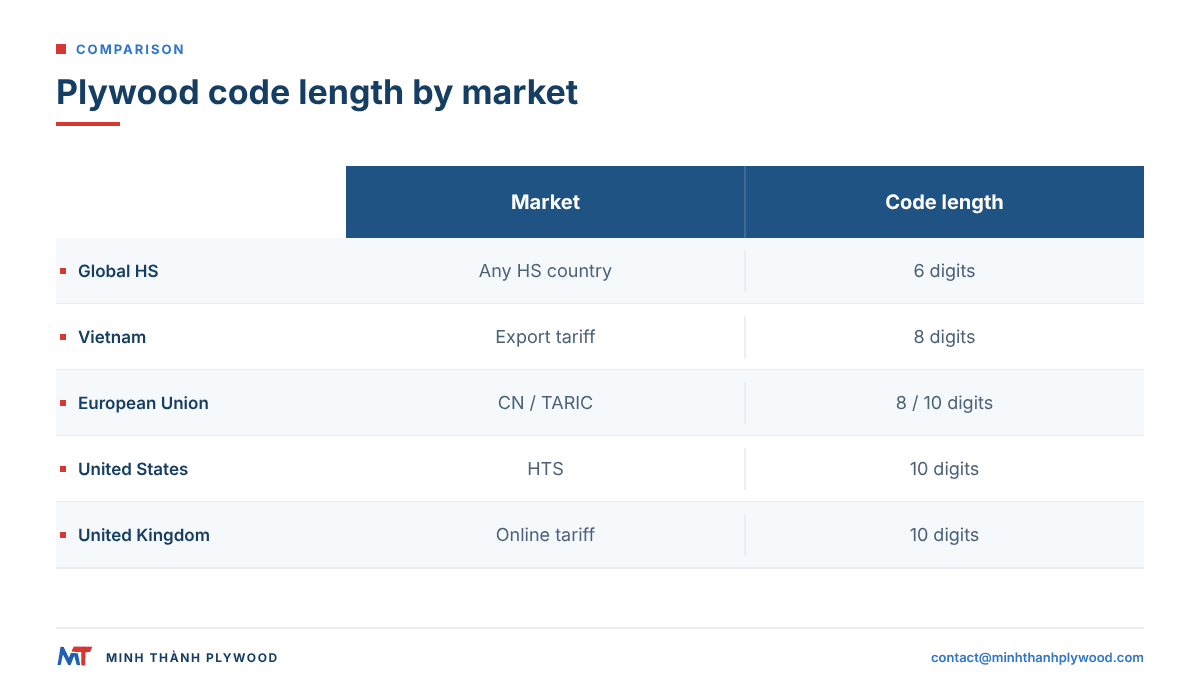
How many digits does a plywood code have in each market?
The first six digits are global; the rest are national. A buyer quoting “4412” alone is quoting a heading, not a line the customs system will accept.
| Market | Tariff | Digits on the declaration | Example for birch-faced plywood |
|---|---|---|---|
| Any HS country | Harmonized System | 6 | 4412.33 |
| Vietnam (export) | Vietnam export and import tariff, ASEAN nomenclature | 8 | 4412.33.xx |
| European Union | Combined Nomenclature / TARIC | 8 / 10 | 4412 33 10 / 4412 33 10 xx |
| United States | Harmonized Tariff Schedule | 10 | 4412.33.06.xx |
| United Kingdom | UK Integrated Online Tariff | 10 | 4412 33 10 14 |
| Gulf states, Australia and others | National tariffs | 8 to 12 | 4412.33 then national digits |
The TARIC ten-digit code is where the EU attaches measures such as anti-dumping duty and EUDR due diligence. The EU customs tariff (TARIC) returns every measure for the code, origin and date of import.
What changed for plywood codes in HS 2022?
HS 2022 gave LVL and blockboard their own subheadings and rebuilt the “other” lines at the end of heading 4412. Before 2022, blockboard sat under 4412.94 and many LVL and thick-ply panels under 4412.99.
The result for importers:
- LVL moved to 4412.41, 4412.42 and 4412.49;
- blockboard, laminboard and battenboard moved to 4412.51, 4412.52 and 4412.59;
- the remaining laminated wood moved to 4412.91, 4412.92 and 4412.99, split by tropical, hardwood and softwood outer ply.
Ordinary veneer plywood, 4412.31 to 4412.39, kept its codes. A supplier still printing 4412.94 on an invoice is working from a pre-2022 tariff, and the declaration will be rejected or corrected.
Which HS code do plywood crates and boxes use?
Plywood crates, boxes and cases use heading 4415, “packing cases, boxes, crates, drums and similar packings, of wood”. The plywood is no longer traded as a sheet but as packaging, so it leaves 4412.
The split is clear in an order of packing plywood: the sheets a buyer will cut into crates are 4412; finished crates are 4415. Pallets of wood are 4415 too. For plant-health purposes, crates and pallets made wholly of plywood are processed wood and need no ISPM 15 treatment; the fumigation guide explains when a certificate is still asked for.
What are the import duties on 4412 plywood?
Import duty on 4412 plywood depends on the line, the origin and the trade agreement, so the code is only the first half of the answer. Three layers apply:
- The general rate of the importing country: in the EU 7% for most 4412.3x lines and 10% for okoume and the other woods named in 4412 31 10, in the US free for birch-faced and 8% for most other faces.
- A preferential rate where an agreement applies and the origin is proven: Vietnamese plywood can use the EU–Vietnam Free Trade Agreement with a statement on origin; the EVFTA duty guide covers the tariff schedule and the REX origin proof.
- Trade remedies and extra measures: anti-dumping or countervailing duty, safeguard or retaliatory duty, set per origin and sometimes per producer.
Prices are quoted before duty. Minh Thanh quotes FOB Hai Phong, CFR or CIF; duty is assessed on the customs value at the destination and paid by the importer. The import duty guide gathers the rates by market.
How does Minh Thanh put the HS code on export documents?
Minh Thanh writes the eight-digit export line on the Vietnamese customs declaration and the HS code with the full panel description on the commercial invoice, the packing list and the certificate of origin. The description names what customs reads: face and back species, core, thickness, size, glue and surface.
A typical invoice line reads: “Plywood, face/back birch D/E, Styrax core, UF resin at E0 grade, 18 × 1220 × 2440 mm, sanded, HS 4412.33”. For a US order the same line adds the TSCA Title VI statement and the species and Vietnamese harvest origin for the Lacey Act declaration. For an EU order the EUDR dossier carries the same species list with the plot geolocations.
Draft documents are sent to the buyer for review after packing and before the originals are issued. If your broker uses a different line, tell us at that stage and the invoice, packing list and certificate of origin are corrected together, so the three documents never disagree.
How do you confirm the code before the first shipment?
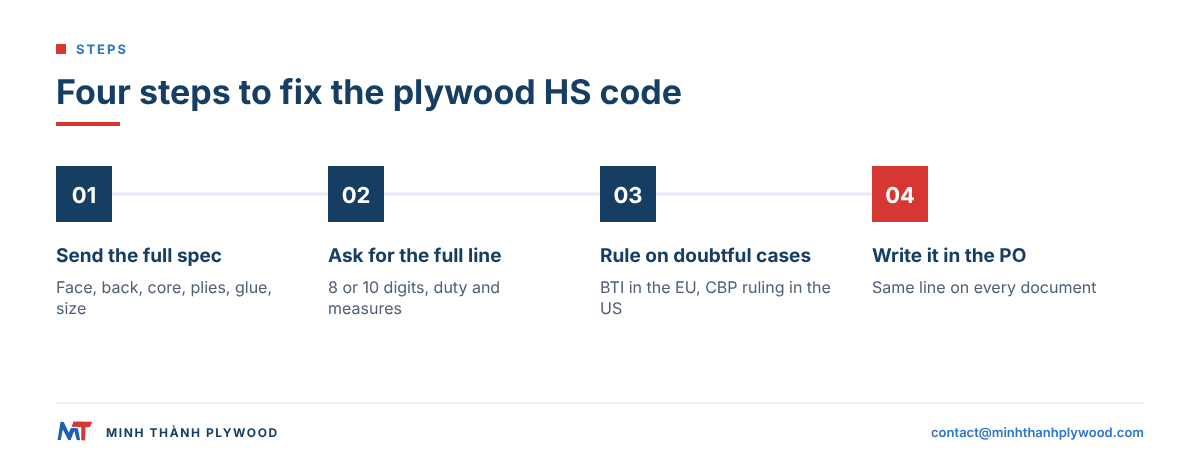
Confirm the code before the first shipment in four steps:
- Send the full panel specification to your customs broker: face, back and core species, ply count, thickness, glue, surface and size.
- Ask for the national line at the full length your declaration uses, eight or ten digits, and the duty and measures attached to it for Vietnamese origin.
- Request a binding ruling for a doubtful case, such as an EU Binding Tariff Information decision or a US Customs ruling, when a face species or build sits between two lines.
- Fix the code in the purchase order, so the mill prints the agreed line on every document for every shipment.
Then send Minh Thanh the order specification with the agreed code: application, core, glue and emission class, face grade, size and thickness, packing and quantity, and the destination port. Quotes for furniture plywood from Vietnam come back within hours, and samples are free.
Buyer questions, answered
What is the HS code for plywood?
Plywood is classified under HS heading 4412, plywood, veneered panels and similar laminated wood. Ordinary plywood with every ply 6 mm or thinner then goes to 4412.31, 4412.33, 4412.34 or 4412.39 according to the species of its outer plies.
What is the HS code for film-faced plywood?
Film-faced plywood stays in heading 4412, because the subheadings cover plywood whether or not coated or surface-covered. It is classified on the wood veneer under the film: 4412.33 for a eucalyptus or poplar face, 4412.34 for another hardwood face.
What is the HS code for birch plywood?
Birch-faced plywood with plies of 6 mm or less is 4412.33. In the EU Combined Nomenclature it is 4412 33 10, carrying a 7% conventional duty; in the US schedule it is 4412.33.06, which is duty free under the general column.
What is the HS code for 18 mm plywood?
Panel thickness does not set the code. An 18 mm panel built from 11–13 thin veneers has every ply under 6 mm, so it goes to 4412.31, 4412.33, 4412.34 or 4412.39 by its face species, the same as a 9 mm panel of the same build.
What is the HS code for LVL?
Laminated veneer lumber has its own subheadings since HS 2022: 4412.41 with a tropical outer ply, 4412.42 with another hardwood outer ply and 4412.49 with both outer plies of softwood. LVL is duty free under the US general rate.
Does the core species change the plywood HS code?
No. The 4412 subheadings name the outer plies only. A Styrax or Eucalyptus core under a birch face is still birch plywood for customs, and the invoice should name the face and back species so the broker can see it.
What HS code do plywood crates and boxes use?
Plywood made into packing cases, boxes or crates leaves heading 4412 and goes to heading 4415, packing cases, boxes, crates and similar packings of wood. The plywood sheets themselves stay in 4412.
Is the HS code the same in every country?
The first six digits are the same in every country that uses the Harmonized System. The digits after that are national: eight in the EU Combined Nomenclature and Vietnam's export tariff, ten in TARIC and the US schedule.
What is the EU import duty for plywood from Vietnam?
The conventional third-country rate in the Combined Nomenclature is 7% for most 4412.3x lines and 10% for okoume and the other named tropical woods under 4412 31 10. Vietnamese origin can qualify for the EVFTA preferential rate with an origin statement.
Who is responsible for the HS code on an import?
The importer of record, through its customs broker, is responsible for the code on the import declaration. The exporter's invoice line is the starting point, and a binding tariff ruling settles a doubtful case.