
The hardwood plywood association most buyers mean is the Hardwood Plywood & Veneer Association (HPVA), now the Decorative Hardwoods Association, which maintains the ANSI/HPVA HP-1 grade standard. APA, CHPVA, IWPA, Timber Development UK and Vietnam's VIFOREST and HAWA play other roles. Minh Thanh Plywood explains how a buyer uses each one to vet a mill.
What is the hardwood plywood association?
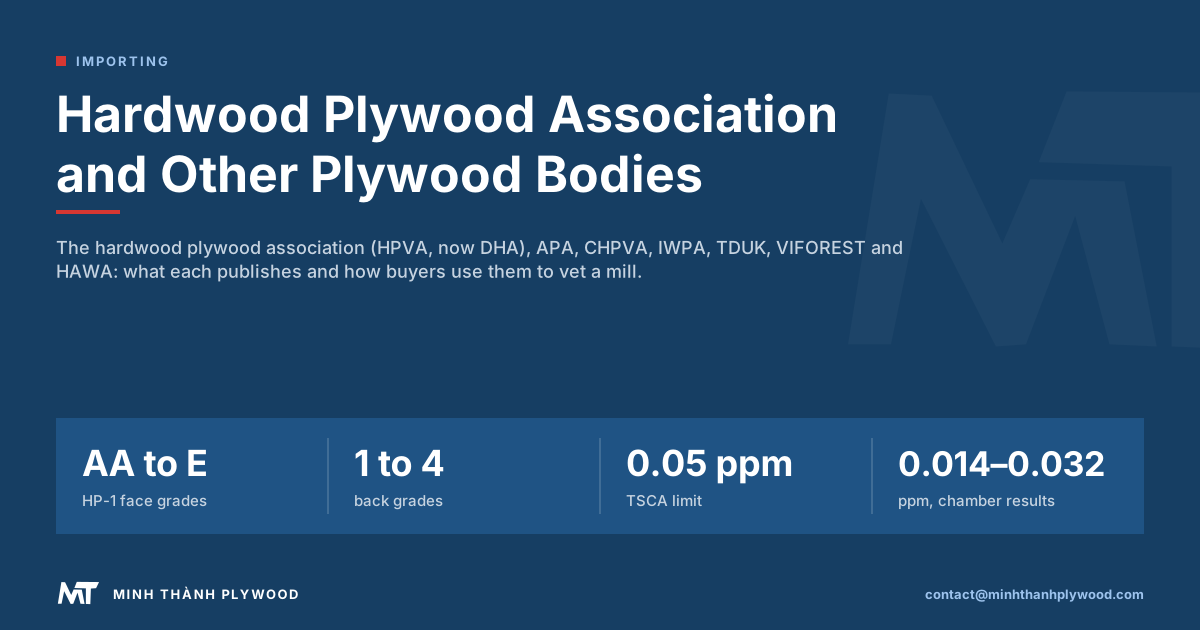
The hardwood plywood association is the Hardwood Plywood & Veneer Association (HPVA), the US trade body for makers of hardwood plywood, veneer and engineered wood flooring, renamed the Decorative Hardwoods Association (DHA). It maintains ANSI/HPVA HP-1, the American National Standard for hardwood and decorative plywood.
The association was founded in 1921 and is based in Sterling, Virginia (42777 Trade West Drive). Its member companies produce 90% of the hardwood plywood stock panels and hardwood veneer made in North America, according to its AECinfo company profile. The DHA website carries its member list, free PDF downloads and the HP-1 ordering page, so a buyer looking for the association itself goes there first.
For a buyer, the association matters through three things it produces:
- The HP-1 grade standard, which defines face grades, back grades, bond types and tolerances for hardwood plywood sold in North America. The current edition is HP-1-2024.
- Testing and certification services through HPVA Laboratories: product emissions, flame spread by radiant panel, smoke density, horizontal and vertical flammability, variable-environment tests and certification of a mill’s quality control programme.
- Technical and regulatory work, including input on formaldehyde rules for composite wood products in the United States.
When a North American buyer writes “HPVA grade” or “HP-1” on a purchase order, the supplier must grade faces and backs to that standard, whatever country the panel comes from.
Hardwood plywood and veneer association: what does HP-1 cover?
ANSI/HPVA HP-1 covers the grading, construction and performance of hardwood and decorative plywood: face grades, back grades, bond durability types, dimensional tolerances and formaldehyde emission references. It is a voluntary standard, so a panel can be hardwood plywood without HP-1 certification.
The grade system buyers meet most often:
| Element | HP-1 scale | What it describes |
|---|---|---|
| Face grade | AA, A, B, C, D, E | Appearance of the face veneer, best to lowest |
| Back grade | 1, 2, 3, 4 | Appearance and soundness of the back |
| Written grade | Face letter + back number, e.g. A-1, B-2 | One grade for the panel |
| Bond type | Technical, Type I, Type II | Durability of the glue line |
The US definition of hardwood plywood under the TSCA Title VI formaldehyde rule refers to HP-1. Emission limits are set by the rule itself: 0.05 ppm for hardwood plywood with a veneer core, under 40 CFR 770.10, aligned with California’s CARB Phase 2 limit.
HPVA birch plywood: how do HP-1 grades compare with other ladders?
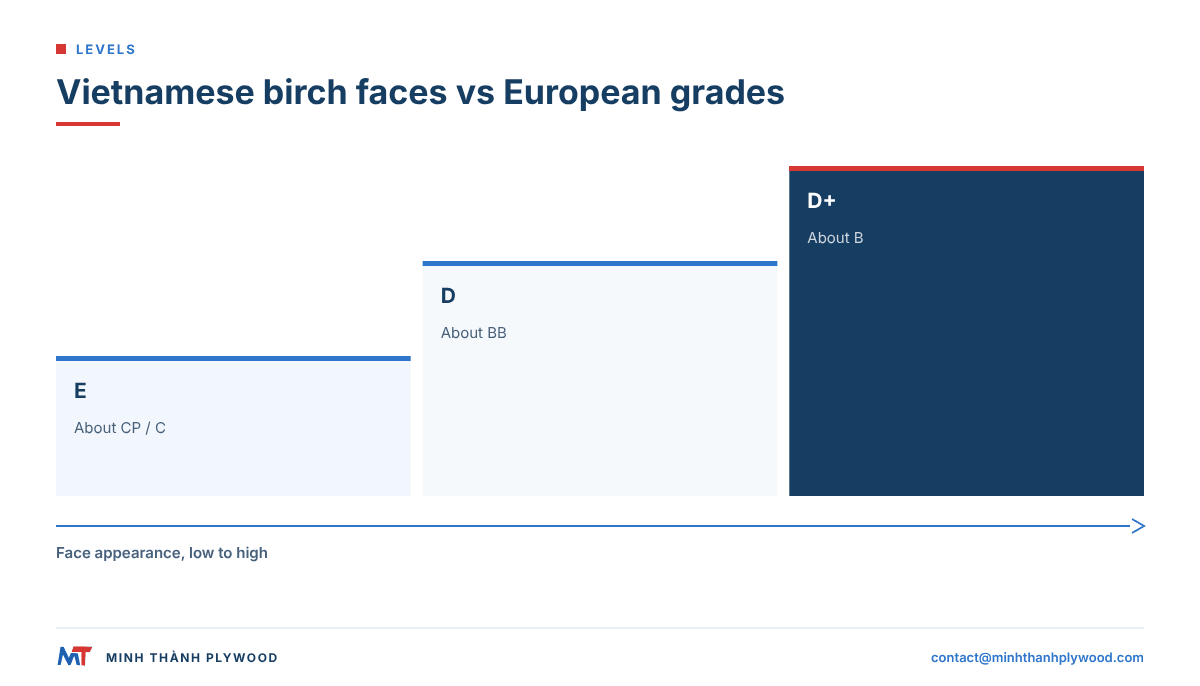
HPVA birch plywood is birch-faced plywood graded to HP-1, written as a face letter and a back number such as A-1 or B-2. Birch made for Europe and Asia uses other ladders: B, BB, CP and C for Baltic birch, and D+, D and E for Vietnamese birch faces.
A buyer moving between ladders should fix the look with an approved sample, because the scales measure different things in different words. The Vietnamese birch ladder, quoted as face/back pairs, compares with the European one as follows:
| Vietnamese birch face | Approximate European grade |
|---|---|
| D+ | B |
| D | BB |
| E | CP / C |
| D+/D pair | B/BB |
| D/D pair | BB/BB |
Minh Thanh supplies birch faces in D+/D and D/E pairs, matched to the approved sample. Faces are chosen for the look the buyer orders, including imported birch and okoume.
What was the Douglas Fir Plywood Association, and what is APA today?
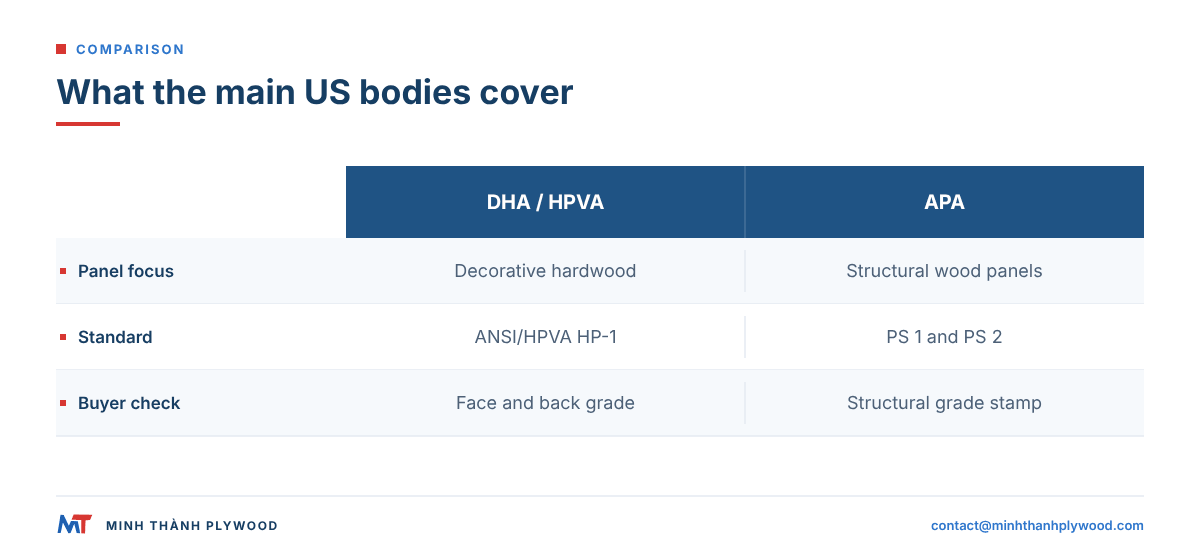
The Douglas Fir Plywood Association was founded in 1933 as the trade body of US softwood plywood mills; it became the American Plywood Association and is now APA – The Engineered Wood Association, based in Tacoma, Washington. APA certifies structural wood panels and their grade stamps.
APA’s work covers softwood plywood, oriented strand board and engineered wood products for construction:
- Product standards: structural plywood is made to Voluntary Product Standard PS 1, and performance-rated panels to PS 2.
- Grade stamps: the APA trademark on a structural panel shows grade, span rating, bond classification and thickness.
- Technical guides on design and installation for builders and engineers.
Hardwood and decorative plywood for cabinets and furniture sits outside APA’s structural focus. A furniture buyer specifies to HP-1 or to the mill’s own grade pairs, not to an APA stamp.
What does the Canadian Hardwood Plywood and Veneer Association do?
The Canadian Hardwood Plywood and Veneer Association (CHPVA) represents Canada’s hardwood plywood, veneer and decorative panel makers on technical, regulatory, quality and product-acceptance matters. Its grading rules classify veneer by colour, such as red heartwood or white sapwood, and by matching style.
For an importer into Canada, the rule that decides market access for hardwood plywood is the federal Formaldehyde Emissions from Composite Wood Products Regulations (SOR/2021-148). It sets a 0.05 ppm limit for hardwood plywood, third-party certification and a compliance label. Structural sheathing follows CSA standards.
CHPVA grades help when a Canadian buyer orders a decorative face by colour and match. For core construction, glue and emission, the order names the specification directly.
Which plywood manufacturers association covers each country?
Each plywood-producing country has its own plywood manufacturers association or wood-industry body, and importing countries have importer associations. The table lists the ones buyers meet most, what they do and how a buyer uses each.
| Association | Country | Members | What it publishes or does | How a buyer uses it |
|---|---|---|---|---|
| Decorative Hardwoods Association (formerly HPVA) | USA | Hardwood plywood, veneer and flooring makers | ANSI/HPVA HP-1 grade standard, testing | Write HP-1 grades on North American orders |
| APA – The Engineered Wood Association | USA | Structural panel mills | PS 1 and PS 2 certification, grade stamps | Check structural stamps on sheathing |
| International Wood Products Association (IWPA) | USA | Importers of wood products | Import compliance guidance, Lacey Act resources | Find US importers and compliance practice |
| Composite Panel Association (CPA) | USA, Canada | Particleboard, MDF and hardboard makers | ANSI A208.1 particleboard and A208.2 MDF standards, emission certification | Specify MDF and particleboard cores and check their labels |
| Architectural Woodwork Institute (AWI) | USA | Architectural millwork firms | Architectural Woodwork Standards for casework and panels | Set the grade (Economy, Custom, Premium) for fit-out casework |
| National Hardwood Lumber Association (NHLA) | USA | Hardwood lumber producers and buyers | Hardwood lumber grading rules, inspector training | Grade solid hardwood edging and parts, not plywood |
| CHPVA | Canada | Hardwood plywood and veneer makers | Grading rules for veneer and panels | Decorative grades for Canadian orders |
| Timber Development UK | UK | Importers, merchants, producers | Member directory, technical guidance, responsible purchasing | Find UK importers and merchants |
| European Panel Federation (EPF) | Europe | National panel industry associations | Industry statistics and positions on standards | Understand EU panel standards |
| APKINDO | Indonesia | Indonesian wood panel producers | Export representation for wood panels | Map Indonesian plywood producers |
| VIFOREST | Vietnam | Wood and forest products companies | Industry representation, trade promotion, legality work | Check Vietnamese company membership |
| HAWA | Vietnam (Ho Chi Minh City) | Wood and handicraft companies | HawaExpo fair, export promotion | Meet southern wood exporters |
Associations represent; they do not certify a mill’s panels. Product certification comes from certifiers and laboratories.
Is there a Vietnam plywood association?
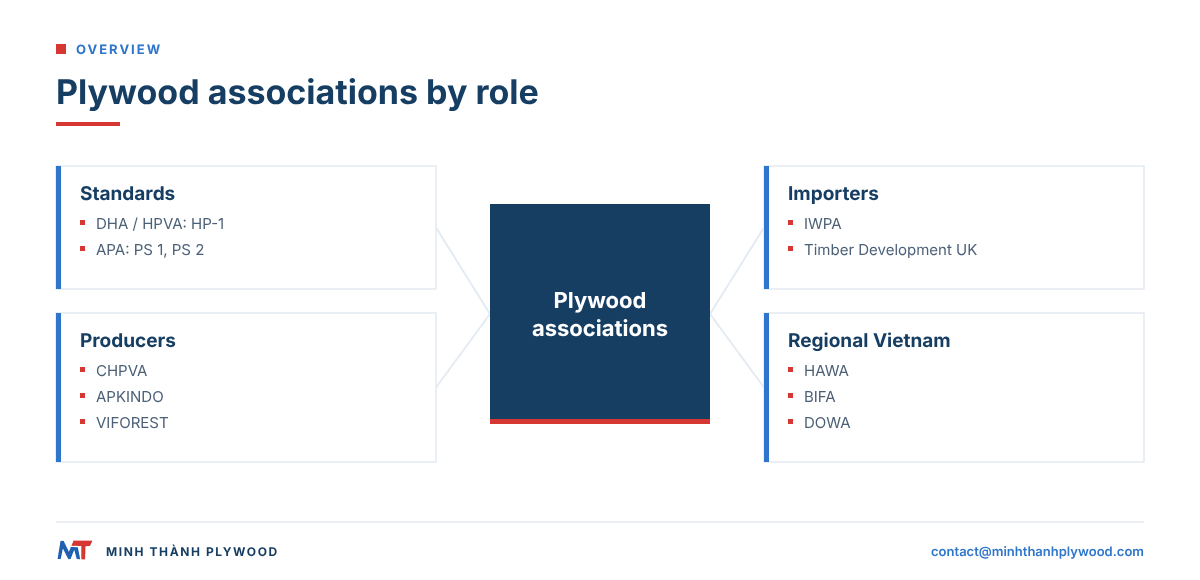
Vietnam’s plywood makers are represented by the country’s wood-industry associations rather than one plywood-only body. VIFOREST, the Vietnam Timber and Forest Products Association, works at national level, alongside regional associations such as HAWA in Ho Chi Minh City, BIFA in Binh Duong, DOWA in Dong Nai and the Binh Dinh forest products association.
- VIFOREST is the national association for companies that produce, process and trade timber and forest products, including plywood, furniture and wood panels. It works on market access, timber legality and trade promotion, and held its fifth congress in December 2025.
- HAWA (Handicraft and Wood Industry Association of Ho Chi Minh City) organises HawaExpo every March and promotes southern wood exporters.
- BIFA and DOWA represent the furniture and wood clusters in Binh Duong and Dong Nai.
Most Vietnamese plywood mills are in the north and centre, near the plantation forests that supply core veneer. Minh Thanh’s factory is in Ha Hoa, Phu Tho, where locally grown plantation timber supplies its cores.
How do you check a mill’s association membership?
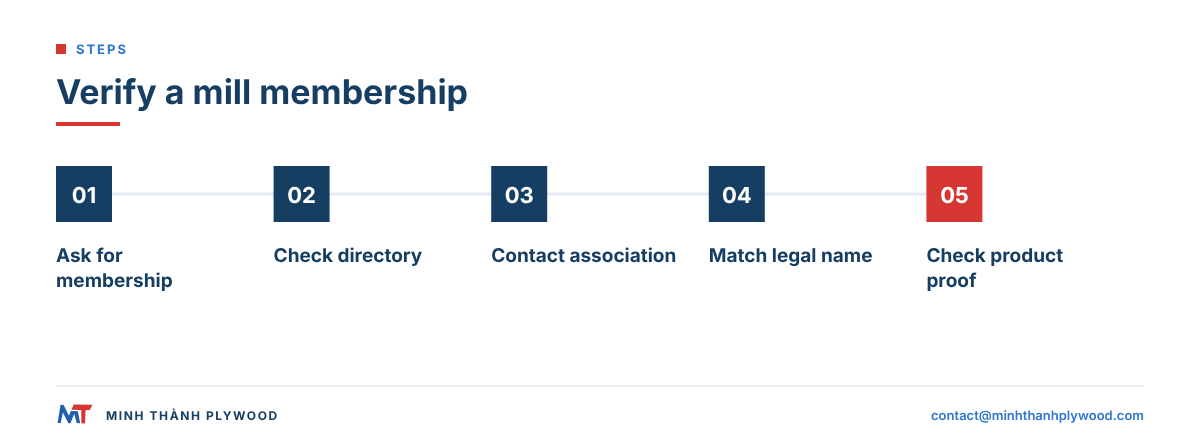
Check a mill’s association membership by asking for its membership record and then confirming it in the association’s member directory or with the association office. Treat membership as a sign of industry presence, and verify product quality separately.
- Ask the mill which associations it belongs to and since when.
- Look it up in the association’s online member directory, where one exists.
- Contact the association office if the directory is not public.
- Match the name: the member name should match the company on the proforma invoice and the bill of lading.
- Move on to product proof: certification numbers, test reports and samples.
An association logo on a website proves nothing on its own. The checks that protect a buyer are the ones in the next section.
What proves a plywood mill’s quality better than association membership?
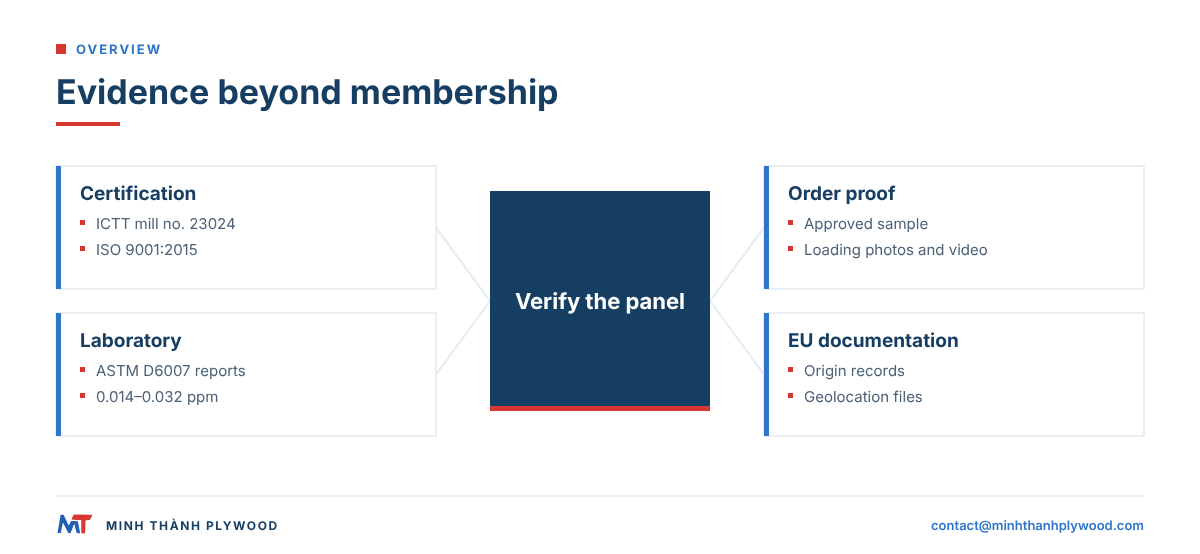
Product certification with a number you can check, test reports from a named laboratory, a sample made to your specification and photos of real loadings prove a mill’s quality; association membership does not. These are the documents to collect before paying a deposit.
Minh Thanh’s evidence, with each item checkable:
- CARB P2 / TSCA Title VI certification, ICTT mill no. 23024, for veneer-core hardwood plywood, 3–50 mm.
- ISO 9001:2015 quality management system for plywood manufacturing, certificate KAC25/0185.
- TCVN 11902:2017 certification for veneer-faced plywood, VietCert 141.1-VNC-HC.
- Six ASTM D6007 chamber tests, April 2025 to June 2026, on 9, 15 and 18 mm panels: averages of 0.014–0.032 ppm against the 0.05 ppm limit. Three were run by Shanghai Hongjun (HJ-QAT-250597, HJ-QAT-251303, HJ-QAT-261036) and three by ICTT Vietnam (ICTTVN-QAT-250841, ICTTVN-QAT-251173, ICTTVN-QAT-260272).
- E0 emission tested periodically, every three months.
- Loading photos and video of every shipment, sent to the buyer.
- EUDR compliance dossier with origin records and geolocation files for EU orders.
FSC and CE are available*.
*Supplied directly or through qualified partner mills.
How do associations shape plywood standards and rules?
Associations shape plywood standards by writing or maintaining them (HP-1 by DHA, PS 1 and PS 2 with APA’s involvement), by taking part in standards committees and by commenting on regulations such as formaldehyde limits and timber legality rules. Buyers feel this through the grades and limits written into their orders.
Three examples a buyer meets in practice:
- Grades. HP-1 face and back grades appear on North American hardwood plywood orders.
- Emission rules. The TSCA Title VI rule refers to HP-1 in its definition of hardwood plywood, and its 0.05 ppm limit applies to every hardwood plywood panel sold in the US.
- Timber legality. Importer associations such as IWPA and Timber Development UK publish guidance on Lacey Act and UK Timber Regulations due diligence; European buyers apply Regulation (EU) 2023/1115, the EUDR.
A Vietnamese mill that exports to these markets builds to the rules first. Minh Thanh’s furniture plywood uses UF glue at E0 emission, and US orders carry the TSCA Title VI label with certifier number TPC-43.
How do importers use associations to find and vet suppliers?
Importers use associations in three ways: to find counterparts through member directories, to learn the compliance practice of their market and to meet suppliers at the fairs associations organise or support. The supplier itself is then vetted on product documents.
- Directories: Timber Development UK and IWPA list members; producer associations such as VIFOREST and APKINDO represent exporters.
- Compliance practice: importer associations publish due diligence guidance for timber legality rules.
- Fairs: HAWA runs HawaExpo; other associations support national pavilions at international fairs.
For a buyer sourcing plywood from Vietnam, the sequence that saves time is: shortlist by product and region, request certificates and samples, hold a video call on the production floor, then place a trial container.
What should a buyer ask a mill instead of its memberships?
Ask a mill for seven specification lines and the evidence behind them: application, core, glue and emission, face grade, size and thickness, packing and quantity, and trade terms. A mill that answers each with a number is a manufacturer; one that answers with logos is not ready.
- Application: kitchen cabinets, furniture, shopfitting, packing.
- Core: white Styrax or Eucalyptus, stitched both horizontally and vertically.
- Glue and emission: UF glue at E0 emission; MR/melamine-fortified or phenolic (WBP) on order.
- Face grade: birch D+/D, poplar or EV A/B, matched to an approved sample.
- Size and thickness: 1220 × 2440 mm or 1250 × 2500 mm, 3–40 mm; tolerance down to ±0.2 mm on sanded panels.
- Packing and quantity: one 40HC, mixed specifications by agreement.
- Terms: 30% deposit, 70% against the scanned bill of lading, FOB Hai Phong, CFR or CIF; commercial plywood from US$250/m³ and furniture plywood from US$350/m³ (October 2026).
Minh Thanh Plywood replies within hours: contact@minhthanhplywood.com or WhatsApp +84 988 586 601 (Lisa). Free samples on request. See commercial plywood from Minh Thanh and furniture plywood from Minh Thanh.
Buyer questions, answered
What is the Hardwood Plywood and Veneer Association?
The Hardwood Plywood & Veneer Association (HPVA) is the US trade body for hardwood plywood, veneer and engineered flooring makers, now called the Decorative Hardwoods Association. It maintains ANSI/HPVA HP-1, the American grade standard for hardwood and decorative plywood.
Where is the Decorative Hardwoods Association based?
The Decorative Hardwoods Association, formerly HPVA, is based in Sterling, Virginia, and its website is decorativehardwoods.org. It was founded in 1921, and its members produce 90% of the hardwood plywood stock panels and hardwood veneer made in North America.
Which association covers MDF and particleboard?
The Composite Panel Association (CPA) covers particleboard, MDF and hardboard in North America and maintains the ANSI A208.1 and A208.2 standards. Hardwood plywood sits with the Decorative Hardwoods Association, and architectural casework grades with the Architectural Woodwork Institute.
What is the HPVA HP-1 standard?
ANSI/HPVA HP-1 is the voluntary American National Standard for hardwood and decorative plywood. It sets face grades AA, A, B, C, D and E and back grades 1 to 4, plus bond types and tolerances; the current edition is HP-1-2024.
What does HPVA birch plywood mean?
It means birch plywood graded to ANSI/HPVA HP-1, written as a face letter and a back number, such as A-1 or B-2. Baltic and Vietnamese birch use other ladders, such as B/BB or D+/D.
What was the Douglas Fir Plywood Association?
The Douglas Fir Plywood Association was the US softwood plywood trade body founded in 1933. It became the American Plywood Association and is now APA – The Engineered Wood Association, which certifies structural panels to PS 1 and PS 2.
What is the Canadian Hardwood Plywood and Veneer Association?
The Canadian Hardwood Plywood and Veneer Association (CHPVA) represents Canadian makers of hardwood plywood, veneer and decorative panels on technical, regulatory and product-acceptance matters, and publishes grading rules for veneer and panels.
Is there a Vietnam plywood association?
Vietnam's wood industry is represented nationally by VIFOREST, the Vietnam Timber and Forest Products Association, with regional bodies such as HAWA in Ho Chi Minh City, BIFA in Binh Duong and DOWA in Dong Nai. Plywood makers belong to these associations.
Does membership of a plywood association prove a mill's quality?
No. Membership shows a company is part of the industry body; it does not certify panels. Quality is proven by product certification with a number, test reports from a named laboratory and a sample built to your specification.
How do I check a Vietnamese plywood mill's association membership?
Ask the mill for its membership record, then check it in the association's member directory or by contacting the association office. Check its product certificates with their issuers the same way.
What is the plywood manufacturers association in the US?
For structural softwood plywood it is APA – The Engineered Wood Association; for hardwood and decorative plywood it is the Decorative Hardwoods Association, formerly HPVA. Importers of plywood are represented by the International Wood Products Association (IWPA).
Which UK association covers plywood importers?
Timber Development UK, formed from the merger of the Timber Trade Federation and TRADA, represents UK timber and panel importers, merchants and producers, with the Timber Trade Federation continuing as its trade division.