
Timber means wood prepared for building and joinery: standing trees with commercial value, felled logs and the beams, boards and planks sawn from them. In British English timber is the everyday word for sawn wood; in North America the same boards are called lumber. Minh Thanh Plywood sets out the terms, the grades, the units timber is sold in, and where plywood and LVL fit.
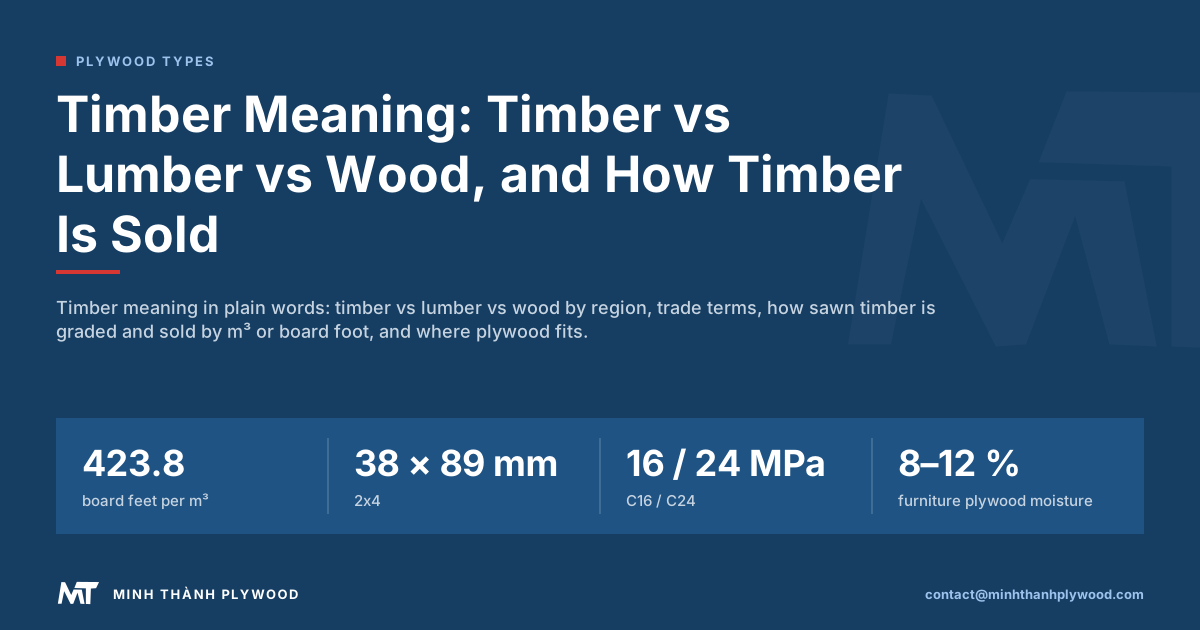
What does timber mean?
Timber means wood that is grown, cut and prepared for building, carpentry and joinery. The word covers three stages of the same material: standing trees with commercial value, the logs felled from them, and the sawn sections cut from those logs.
In everyday British, Irish, Australian and New Zealand English, timber mostly means the third stage: beams, joists, battens, boards and planks sold by a timber merchant. A builder ordering “timber for the roof” wants sawn softwood sections.
Timber: all the meanings in one list
Dictionaries give timber six senses. Cambridge Dictionary and Merriam-Webster, both checked on 21 October 2026, agree on the core ones:
- Uncountable noun, wood prepared for building: “a timber merchant”, “timber for the roof”.
- Growing trees with commercial value: “timber-producing forests”, “a timber industry”; this is the sense Cambridge marks at level C2.
- Countable noun, “a timber”: one long piece of wood used in building, especially houses and ships; “the ship’s timbers” are its ribs and beams.
- Figurative, mainly US: the qualities that fit a person for a role, as in “presidential timber” or “management timber”.
- The shout “Timber!”: the warning that a felled tree is about to fall.
- Verb, “to timber”: to fit or support with timber, which gives “a timbered house”.
Merriam-Webster dates the first noun sense to before the 12th century. Timber is also easy to confuse with timbre, the sound quality of a voice or instrument, which is spelled differently and pronounced /ˈtæm.bər/ in British English, against /ˈtɪm.bər/ for timber.
The word also carries a set of trade compounds:
- Sawn timber: wood cut lengthwise into sections at a sawmill.
- Structural timber: sawn timber graded for strength and used in load-bearing work.
- Timber frame: a building method with a load-bearing frame of timber studs and beams.
- Engineered timber: products made by gluing wood pieces, veneers or strands, such as plywood, LVL and glulam.
What is lumber?
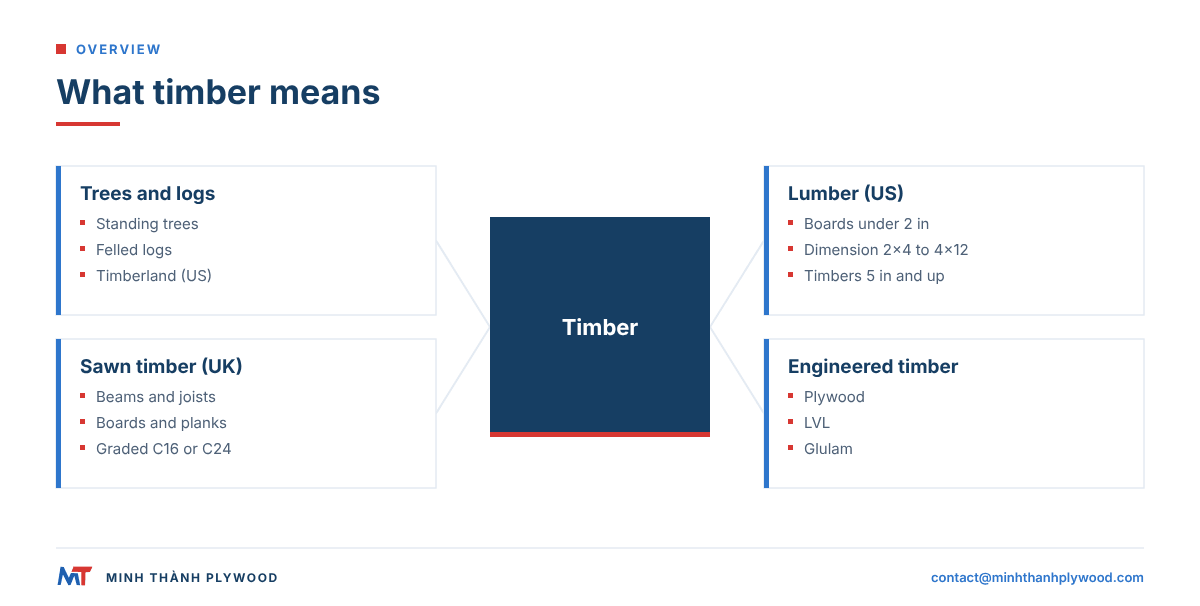
Lumber is wood sawn into boards, planks and small sections of standard sizes, the word used in the United States and Canada for what British English calls sawn timber. A North American lumber yard sells studs, joists, boards and decking by species, grade and nominal size.
US trade language splits the material by size. Under the American Softwood Lumber Standard (PS 20), sawn softwood falls into three groups:
| Group | Smallest dimension (nominal) | Examples |
|---|---|---|
| Boards | Under 2 inches | Sheathing boards, shelving, trim |
| Dimension lumber | 2 inches up to but not including 5 inches | 2x4 studs, 2x10 joists |
| Timbers | 5 inches and more | Posts, beams, heavy framing |
So in the United States, timber can mean either standing trees (“timberland”, “timber sale”) or the heaviest sawn sections. Everything lighter is lumber.
What is the difference between timber and lumber?
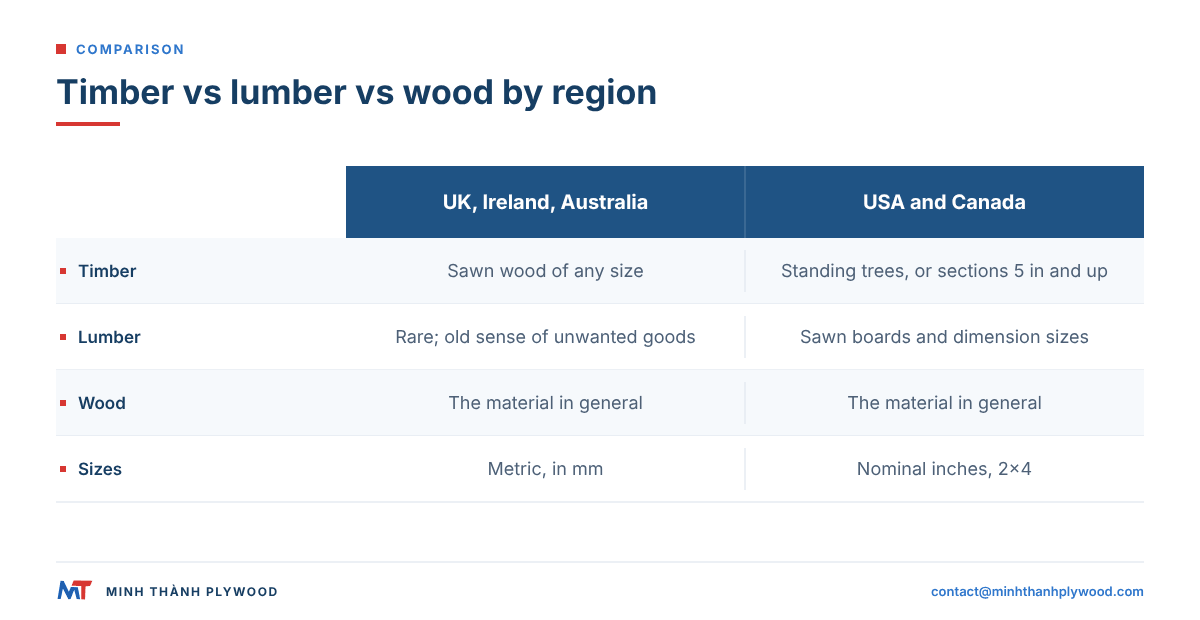
The difference between timber and lumber is mostly a matter of where you are. Both words name sawn wood for building; timber is the British and Commonwealth word, lumber the North American one. The table shows how each word is used in each market.
| Term | United Kingdom, Ireland, Australia, New Zealand | United States and Canada |
|---|---|---|
| Timber | Sawn wood of any size, and growing trees | Standing trees, and sawn pieces 5 inches and more |
| Lumber | Rarely used; old sense of unwanted goods | Sawn boards, planks and dimension sizes |
| Wood | The material in general | The material in general |
| Timber merchant / lumber yard | The shop that sells sawn wood | The shop that sells sawn wood |
| Sizes | Metric, in mm | Nominal inches (2x4, 1x6) |
In international trade documents both words appear. Customs tariffs avoid the problem with codes: sawn wood falls under heading 4407 whichever word the buyer uses, and plywood under heading 4412.
What is the difference between timber and wood?
Wood is the material; timber is wood as a building commodity. Wood is the hard fibrous tissue of trees in any form, from firewood and pulp to a carved bowl. Timber is wood that has been, or will be, cut to sizes for construction and joinery.
Three quick tests separate them:
- Fuel and pulp are wood, not timber. Nobody buys firewood from a timber merchant.
- Products are made of wood, but sold as timber only while they are sections. A floorboard is timber; the finished floor is a wood floor.
- Engineered panels are wood-based. Plywood, LVL and glulam are engineered timber products, and particleboard and MDF are wood-based panels.
Timber terms explained: sawn, dressed, kiln-dried and engineered
The same piece of wood gets several names on its way from the forest to the building site. This table sets out the terms buyers meet on quotes and delivery notes.
| Term | Meaning | Where you meet it |
|---|---|---|
| Roundwood / logs | Felled stems, cut to length, bark on or off | Forestry, sawmill intake, veneer peeling |
| Sawn (rough sawn) | Cut lengthwise, surfaces straight from the saw | Formwork, packaging, hidden framing |
| Regularised | Sawn and then machined on two edges to an even width | UK structural joists |
| Dressed / planed all round (PAR) / S4S | Planed on all four faces to a smooth, exact size | Joinery, trim, visible framing |
| Green | Freshly sawn, not dried | Heavy oak framing, fencing |
| Air-dried (AD) | Dried by stacking outdoors under cover | Hardwood boards, fencing |
| Kiln-dried (KD) | Dried in a heated kiln to a target moisture content | Structural timber, joinery, furniture |
| Hardwood | Wood of broadleaf trees (oak, birch, iroko) | Furniture, flooring, joinery |
| Softwood | Wood of conifers (pine, spruce, fir) | Framing, roofing, carcassing |
| Engineered timber | Wood pieces, veneers or strands glued into a product | Plywood, LVL, glulam, CLT |
Hardwood and softwood name the tree type, not the hardness. Balsa is a hardwood and one of the softest woods there is; yew is a softwood and harder than many hardwoods.
Timber meaning and lumber meaning: where do the words come from?
Timber is an old Germanic word: Old English timber meant a building or building material, and it is related to the German Zimmer, a room. The sense moved from “a building” to “wood to build with”.
Lumber has a stranger history. In 16th-century England it meant disused furniture and odds and ends, possibly from Lombard, the name for a pawnbroker’s shop where unredeemed goods piled up. The phrase “lumber room” keeps that meaning. In the American colonies of the 17th century, lumber came to mean sawn planks and boards, and the new sense stuck in North America.
How is sawn timber graded?
Sawn timber is graded either for strength, when it carries loads, or for appearance and yield, when it is cut into furniture and joinery parts. The grading rules differ by market.
Structural softwood in Europe. Each piece is graded visually or by machine under EN 14081-1 and assigned a strength class from EN 338. The class name gives the characteristic bending strength:
| Strength class | Typical species | Bending strength | Common use |
|---|---|---|---|
| C16 | Spruce, pine, larch | 16 MPa | Studs, rafters, joists in houses |
| C24 | Selected spruce and pine | 24 MPa | Longer spans, trussed rafters, visible beams |
| D30 and up | Oak and tropical hardwoods | 30 MPa and more | Heavy frames, bridges, marine work |
Structural softwood in North America. Lumber is graded under rules approved within the American Softwood Lumber Standard: Select Structural, #1, #2 and #3 for joists and planks, plus Stud and Construction grades. Species are sold in groups such as Douglas fir-larch and spruce-pine-fir.
Hardwood for furniture. The National Hardwood Lumber Association rules grade boards by the share of clear wood they yield. FAS, the top grade, needs boards at least 6 inches wide and 8 feet long that yield 83⅓% clear cuttings; #1 Common and #2A Common yield less and cost less.
How is timber sold: cubic metres, board feet and nominal sizes
Outside North America timber is sold by the cubic metre (m³); in the United States and Canada it is sold by the board foot. Both measure volume, so any quote converts.
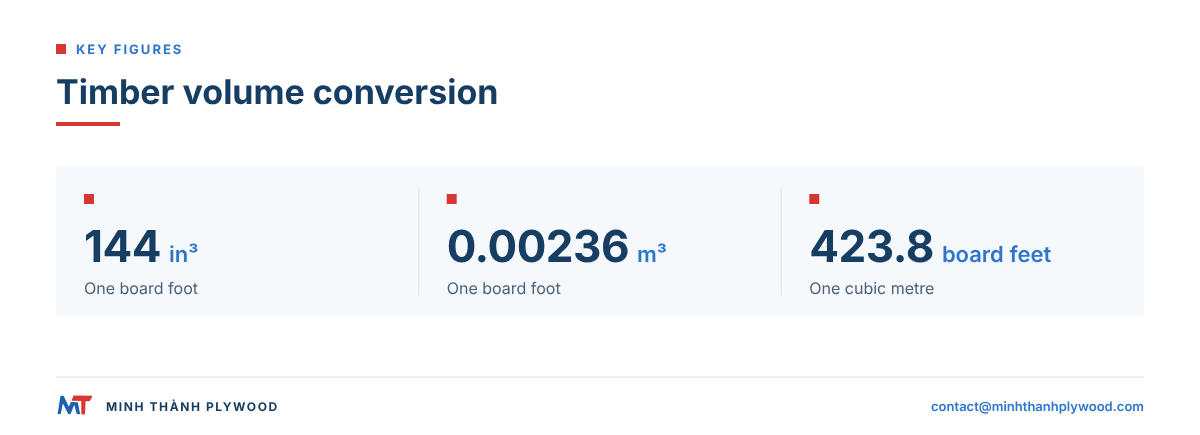
- Board foot: a piece 1 inch thick, 12 inches wide and 12 inches long, 144 cubic inches, or 0.00236 m³.
- Cubic metre: 423.8 board feet; a thousand board feet (MBF) is about 2.36 m³.
- Nominal sizes: North American lumber is named by its size before drying and planing. A 2x4 is 1.5 × 3.5 inches dressed, which is 38 × 89 mm.
- Metric sizes: UK and European sections are named by their actual size in millimetres, such as 47 × 100 mm, with lengths stocked in 300 mm steps.
Retail yards also sell planed sections by the linear metre or by the piece. When comparing quotes, convert both to a price per cubic metre at the same moisture content and grade; the board feet calculator does the conversion.
Plywood is sold differently again: by the sheet, priced per cubic metre for export. An export container is planned in sheets and packs, not in board feet.
Why does moisture content matter in timber?
Moisture content decides whether timber stays the size it was bought at. Wood shrinks as it dries below about 30% moisture, so timber fitted wet will shrink, twist and open its joints as it dries in service.
The trade sets moisture targets by use:
- Structural softwood: “dry graded” timber in Europe and KD19 lumber in North America are dried to 20% and 19% moisture content or less.
- Joinery and furniture: kiln-dried to suit heated interiors, typically 8–12% moisture content.
- Plywood: veneers and finished panels at 8–12 % moisture content at dispatch, the normal range for furniture plywood.
Check moisture with a pin meter on delivery, on several pieces from the middle of a pack, not only the top layer.
What drives the price of timber?
The price of timber is set by species, grade, section size, drying, documents and freight, with market cycles on top. A buyer comparing quotes should line up each of these:
- Species: spruce and pine are the cheapest structural woods; oak and tropical hardwoods cost several times more.
- Grade: C24 costs more than C16; FAS hardwood more than #1 Common.
- Section and length: long lengths and large sections cost more per cubic metre.
- Drying and machining: kiln-dried and planed timber costs more than green sawn.
- Documents: EUDR, FSC or PEFC paperwork carries a cost.
- Freight: heavy hardwoods and long lengths are expensive to ship.
Timber prices also move with housing starts and sawmill output. The timber price guide shows how to compare quotes line by line.
How do plywood and LVL relate to lumber?
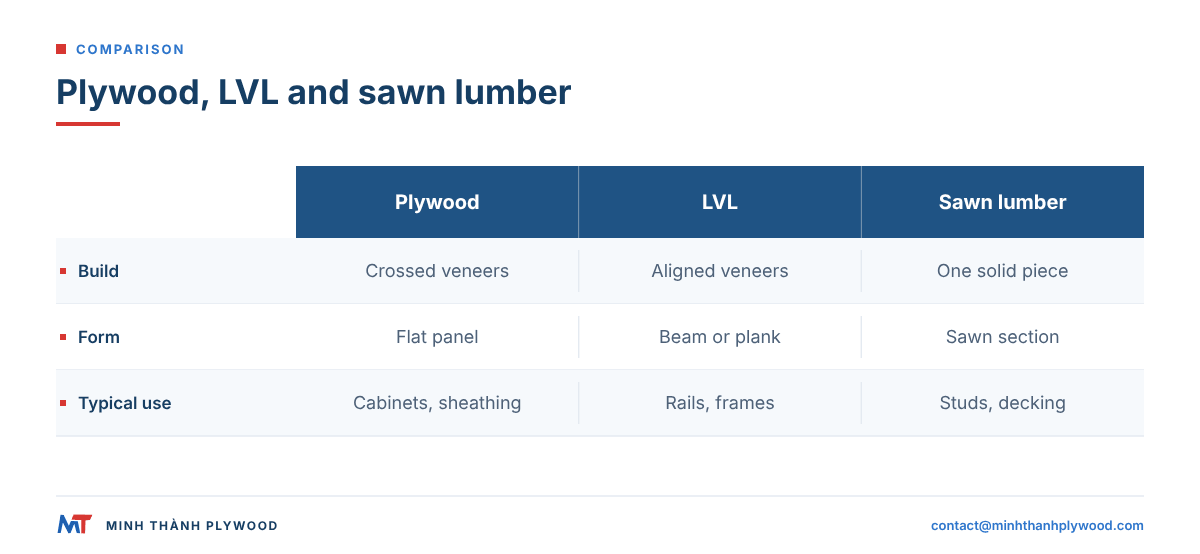
Plywood and LVL are engineered timber products made from veneer, not from sawn lumber. A log is peeled on a lathe into a continuous sheet of veneer, the veneer is dried and cut, and the sheets are glued under heat and pressure.
The difference is in how the veneers are laid:
| Product | Veneer layout | Behaves like | Typical uses |
|---|---|---|---|
| Plywood | Grain of each layer crossed at 90° | A stable panel, strong in both directions | Furniture, cabinets, floors, packing, formwork |
| LVL (laminated veneer lumber) | All grain running the same way | A beam or plank with even strength | Beams, rails, door frames, shelving, packing frames |
| Glulam | Sawn lumber laminations glued in layers | A large beam | Long-span roofs and halls |
| Sawn lumber | One solid piece | Varies with knots and grain | Framing, joinery, decking |
Peeling lets mills use small plantation logs that would give little sawn timber. Minh Thanh Plywood peels locally grown plantation Styrax and Eucalyptus for its cores in Ha Hoa, Phu Tho, and presses 50,000+ m³ of panels per year.
LVL is the engineered product closest to lumber. Minh Thanh makes LVL for beams, rails, frames and packing structures, and the comparison of LVL and plywood explains which to use where.
Timber, lumber or plywood: which should you use?
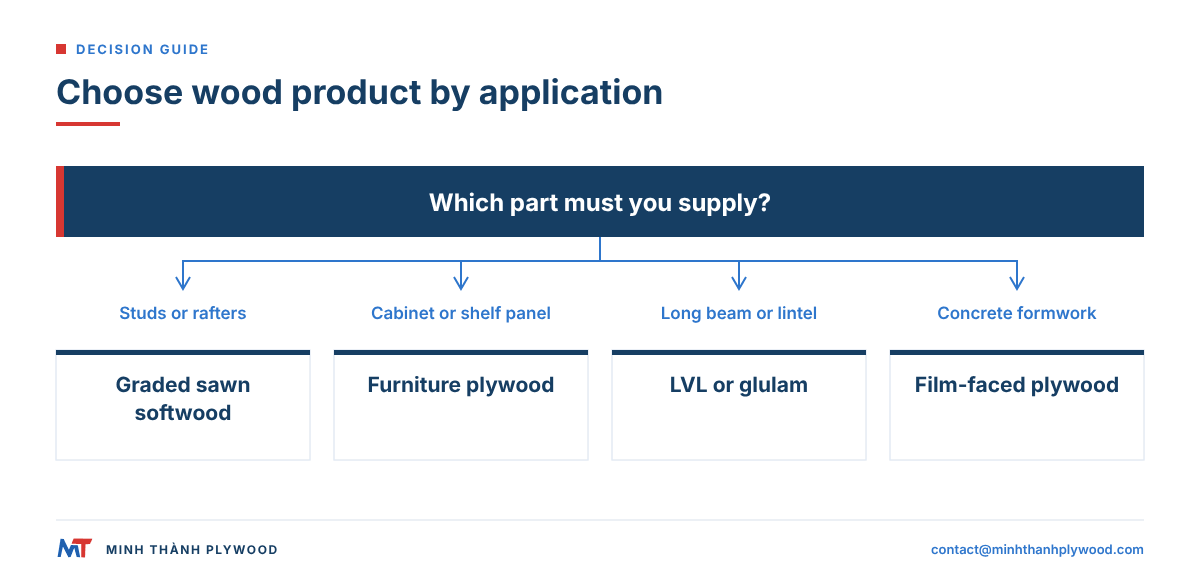
Use sawn timber or lumber for framing and visible solid joinery, plywood for flat panels and sheathing, and LVL where a beam must carry a known load. The choice by job:
| Job | Best choice | Why |
|---|---|---|
| Wall studs, rafters, joists | Sawn softwood, C16 or C24 / #2 | Cheapest per load carried; standard sizes |
| Long-span beams, lintels | LVL or glulam | Even strength, no large knots |
| Cabinet carcasses, wardrobes, shelving | Furniture plywood | Flat, stable in large sizes; holds screws at edges |
| Floors and roof sheathing | Structural plywood | Spans between joists and braces the frame |
| Concrete formwork faces | Film-faced plywood | Smooth faces, reused across pours |
| Crates and pallets | Packing plywood with sawn bearers | Light, strong panels; bearers under ISPM 15 |
| Worktops, stair treads, solid furniture | Hardwood timber | Solid edges that can be sanded and refinished |
The plywood or solid wood guide goes deeper into the panel side of this choice.
Which timber rules apply to imports?
Timber imports into the main markets need proof of legal harvest, and in the EU proof of where the wood was grown. The rules apply to sawn timber and plywood alike.
- European Union: Regulation (EU) 2023/1115, the EUDR, covers wood products of Chapter 44, from logs and sawn timber to veneer and plywood. The operator needs due diligence with the geolocation of every harvest plot and files a due diligence statement.
- United Kingdom: the UK Timber Regulation requires due diligence on legal harvest.
- United States: the Lacey Act requires a declaration of species and country of harvest.
For plywood from Minh Thanh, we supply the EUDR compliance dossier (origin records and geolocation files) with orders. For US orders we give the face and core species and their Vietnamese harvest origin for the importer’s Lacey Act declaration.
What to send for a quote
When you buy panels rather than sawn timber, a quote needs six lines: application, core, glue and emission class, face, size, and packing with quantity. A typical request reads:
Furniture plywood, birch face D/E, Eucalyptus core, UF glue at E0 emission, 18 mm, 1220 × 2440 mm, sanded, 1×40HC, CIF Felixstowe.
For LVL, give the section, length, glue type and use (beams, rails or packing). Production runs 15–45 days after the 30% deposit, free samples are available, and the minimum order is one 40HC with mixed specifications by agreement. Send your list to contact@minhthanhplywood.com or through the quote form.
Buyer questions, answered
What is the meaning of timber?
Timber is wood prepared for building and carpentry. The word covers standing trees grown for wood, felled logs, and the beams, boards and planks sawn from them; in British English it mostly means sawn wood.
Is timber the same as lumber?
For sawn boards and planks, yes: timber is the British, Irish, Australian and New Zealand word and lumber the North American one. In US trade, timber also means standing trees and sawn pieces 5 inches or more in their smallest dimension.
What is the difference between timber and wood?
Wood is the material itself, in any form, from a twig to a table. Timber is wood as a building commodity: trees, logs and sawn sections cut to sizes for construction and joinery.
What does lumber mean?
Lumber is wood that has been sawn into boards, planks and small sections of standard size, the North American word for sawn timber. In older British English lumber meant unwanted household goods, which survives in the phrase lumber room.
How many board feet are in a cubic metre?
One cubic metre is 423.8 board feet. A board foot is a piece 1 inch thick, 12 inches wide and 12 inches long, or 144 cubic inches, equal to 0.00236 m³.
Why is a 2x4 not 2 inches by 4 inches?
Because 2x4 is a nominal size measured before drying and planing. A dressed, kiln-dried 2x4 in North America measures 1.5 × 3.5 inches, or 38 × 89 mm.
What do C16 and C24 mean on timber?
They are strength classes for structural softwood under EN 338: C16 has a characteristic bending strength of 16 MPa and C24 of 24 MPa. Timber is graded into a class under EN 14081-1 and marked with it.
Is plywood timber?
Plywood is an engineered timber product: thin veneers peeled from logs and glued with the grain of each layer crossed. Builders and merchants sell it alongside sawn timber, but it is graded and specified as a panel, not as lumber.
What is LVL?
LVL, laminated veneer lumber, is an engineered product made of veneers glued with all the grain running the same way. It is used like lumber for beams, rails and frames, with more even strength than a sawn piece of the same size.
Does the EUDR apply to timber?
Yes. Regulation (EU) 2023/1115 covers wood products of Chapter 44, including sawn timber, logs, veneer and plywood. The operator placing them on the EU market needs due diligence with the geolocation of the harvest plots.