
There are three types of woods a buyer meets: hardwood from broadleaf trees, softwood from conifers, and engineered wood made from veneers, strands or fibres. Within them sit thousands of species, but a few dozen cover almost all furniture, building and panel work. This chart from Minh Thanh Plywood, a Vietnamese plywood manufacturer, groups them by use, with hardness, origin and the matching plywood face.
How many different wood types are there?
There are about 60,000 tree species on Earth, according to Botanic Gardens Conservation International’s GlobalTreeSearch count of 2017, but buyers sort wood into three types: hardwood, softwood and engineered wood. Only a few dozen species are traded in volume for furniture, building and panels.
A timber yard or a panel mill works from a much shorter list than the botanical one. Each species is chosen for a mix of hardness, weight, stability, colour, durability and price. A furniture maker needs a different list from a formwork contractor, and both need different woods from a boat builder.
This guide works from that practical list. It groups the common types of woods by use, gives Janka hardness for the solid timbers and shows which species end up as plywood faces and cores. Hardness figures are from The Wood Database, read 20 October 2026.
What are the 3 types of wood?
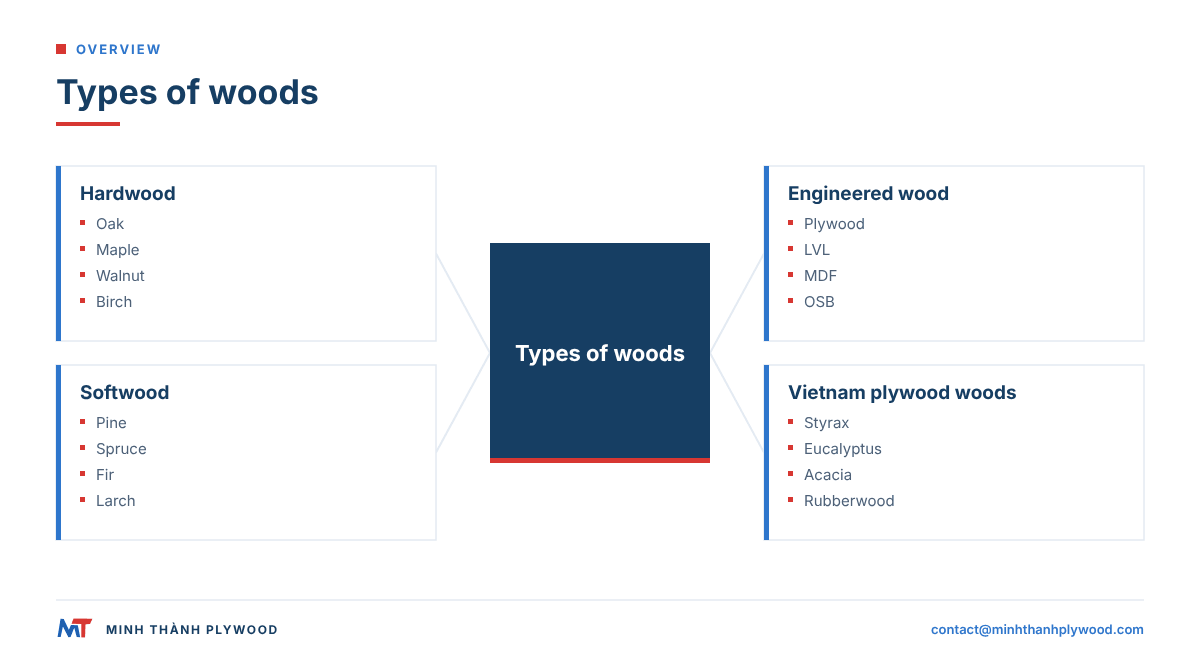
The three types of wood are hardwood, softwood and engineered wood. Hardwood and softwood are botanical groups; engineered wood is a product group made from either.
| Type | Comes from | Examples | Typical traits | Typical uses |
|---|---|---|---|---|
| Hardwood | Broadleaf, flowering trees with enclosed seeds | Oak, maple, walnut, ash, birch, eucalyptus, acacia | Usually denser, fine grain, pores visible on the end grain | Furniture, floors, cabinets, plywood faces |
| Softwood | Conifers with needles and cones | Pine, spruce, fir, larch, cedar | Usually lighter, resinous, fast-growing | Structural timber, joinery, sheathing |
| Engineered wood | Veneers, strands, chips or fibres bonded with glue | Plywood, LVL, MDF, particle board, OSB | Stable, made to size, consistent | Furniture panels, formwork, sheathing, beams |
Most finished products combine the three. A kitchen cabinet may have a solid oak door frame, a softwood back rail and a plywood carcass with a birch face on a Styrax core. Our guide to engineered wood covers the third group in detail.
Hardwood vs softwood: botany, not hardness
Hardwood and softwood are named after the tree, not the hardness of the wood. Hardwoods come from broadleaf trees whose seeds grow inside a fruit or nut; softwoods come from conifers whose seeds grow in cones.
The names break both ways. Balsa is a hardwood and one of the softest commercial woods. Yew and longleaf pine are softwoods that are harder than many hardwoods. For hardness, use the Janka test: the force needed to press a steel ball 11.28 millimetres across halfway into the wood, quoted in pounds-force (lbf) or newtons.
Structure gives a more reliable test than the name. Hardwoods carry vessels, seen as pores on the end grain. Softwoods have no vessels; their end grain shows only growth rings, often with resin. That is how a wood scientist tells them apart under a hand lens.
Hardwood species chart: furniture and joinery woods
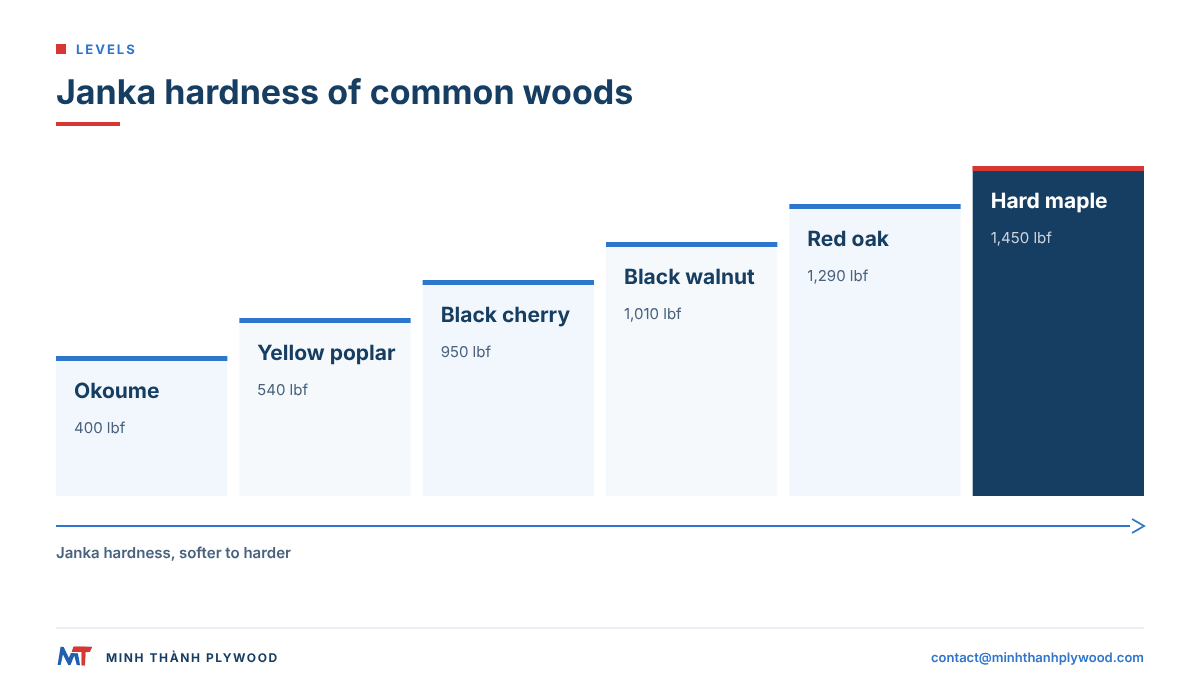
The hardwoods below make most solid furniture and decorative faces in Europe and North America. Janka figures are side hardness in pounds-force from The Wood Database.
| Species | Botanical name | Janka hardness | Colour | Main uses | Matching plywood face |
|---|---|---|---|---|---|
| Red oak | Quercus rubra | 1,220 lbf | Light to reddish brown, open grain | Furniture, floors, cabinets | Oak-faced plywood |
| White oak | Quercus alba | 1,350 lbf | Light to mid brown, closed pores | Furniture, floors, outdoor, barrels | Oak-faced plywood |
| Hard maple | Acer saccharum | 1,450 lbf | Creamy white | Kitchens, floors, worktops | Maple-faced plywood |
| Black walnut | Juglans nigra | 1,010 lbf | Chocolate brown | Premium furniture, panels | Walnut-faced plywood |
| Black cherry | Prunus serotina | 950 lbf | Pink-brown, darkens with light | Furniture, cabinets | Cherry-faced plywood |
| White ash | Fraxinus americana | 1,320 lbf | Pale, oak-like grain | Chairs, handles, bent parts | Ash-faced plywood |
| Yellow birch | Betula alleghaniensis | 1,260 lbf | Pale cream, even grain | Cabinets, furniture, plywood | Birch plywood |
| Yellow poplar | Liriodendron tulipifera | 540 lbf | Pale with green streaks | Painted furniture, mouldings | Poplar plywood |
| Sapele | Entandrophragma cylindricum | 1,410 lbf | Red-brown, ribbon figure | Doors, joinery, furniture | Sapele face on request |
| Okoume | Aucoumea klaineana | 400 lbf | Pink-brown, light | Panels, interiors | Okoume plywood |
Birch, poplar and okoume reach most buyers as plywood faces rather than solid boards. Face veneers are thin, so the panel’s hardness and screw holding come from the core below, not from the face species. Our walnut plywood, oak plywood and maple plywood guides cover the decorative faces.
Softwood species chart: building and joinery woods
Softwoods are the building timber of Europe and North America: light, straight, fast-growing and easy to work. The chart lists the species buyers meet most often.
| Species | Botanical name | Janka hardness | Traits | Main uses |
|---|---|---|---|---|
| Eastern white pine | Pinus strobus | 380 lbf | Soft, light, stable | Joinery, mouldings, furniture |
| Scots pine (redwood) | Pinus sylvestris | — | Resinous, strong | Construction, joinery, plywood faces |
| Radiata pine | Pinus radiata | 710 lbf | Plantation pine, even texture | Furniture, mouldings, plywood |
| Douglas fir | Pseudotsuga menziesii | 620 lbf | Strong for its weight | Beams, joists, plywood |
| Norway spruce (whitewood) | Picea abies | — | Light, pale | Studs, joists, CLT, glulam |
| Larch | Larix decidua | — | Dense, resinous, durable | Cladding, decking, boats |
| Western red cedar | Thuja plicata | 350 lbf | Very light, naturally durable | Cladding, shingles, outdoor |
Scots pine, spruce and larch are traded in Europe by strength class rather than by hardness, so the Janka column stays empty for them. For panels, pine also appears as a warm, knotty face on hardwood cores: we make pine plywood with face/back grade pairs A/A, A/B and B/B.
The woods Vietnam’s plywood mills use
Vietnamese plywood is built from plantation hardwoods grown close to the mills: white Styrax, Eucalyptus and Acacia, with rubberwood as a niche core in the south. Vietnam has no poplar or birch cores; birch, okoume, gurjan and bintangor appear only as face veneers.
| Wood | Role in Vietnamese plywood | Planning density for panels | What it gives |
|---|---|---|---|
| White Styrax (Styrax tonkinensis) | Standard furniture core at Minh Thanh; grown only in northern Vietnam | About 500 kg/m³ | Light sheets, smooth base for faces |
| Eucalyptus | Standard furniture core; also film-faced and commercial cores; also a face | 650 kg/m³, in practice 650–750 kg/m³ | Stiffness, strength |
| Acacia | Core made on order; common for commercial and film-faced plywood | About 580 kg/m³ | Balance of weight and strength |
| Pine | Core on order and face | — | Warm face, lighter core |
| Rubberwood | Niche core in southern Vietnam | — | Dense, even core at a higher price |
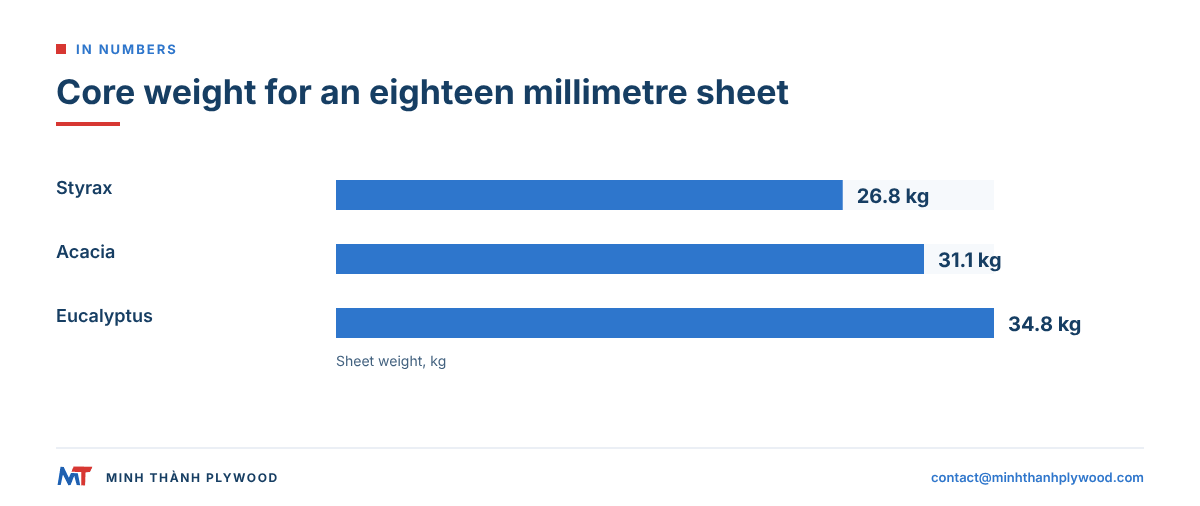
At 18 mm and 1220 × 2440 mm, those planning densities give sheet weights of about 26.8 kg on Styrax, 31.1 kg on Acacia and 34.8 kg on Eucalyptus. Many European furniture buyers choose Styrax for the lighter sheet and the clean face. Minh Thanh’s factory in Ha Hoa, Phu Tho, sits among these plantations, which keeps core wood local. Our rubberwood plywood guide covers the southern core.
Woods used for plywood faces
A plywood face is a veneer of 0.2–0.5 mm, chosen for the look of the finished panel. The face species gives plywood its name, while the core underneath gives it strength.
| Face | Look | Grades we quote | Typical use |
|---|---|---|---|
| Birch | Pale, fine, even | D+, D, E, as pairs such as D+/D | Cabinets, furniture, shop fittings |
| Poplar | Pale, smooth, light | A/A, A/B, B/B | Furniture, painted and laminated panels |
| Engineered veneer (EV) | Reconstituted veneer in oak, walnut or teak looks | Matched to sample | Decorative interiors, doors |
| Okoume | Pink-brown, light | Matched to sample | Interior panels, furniture |
| Pine | Warm, knotty | A/A, A/B, B/B | Furniture, interiors |
| Eucalyptus | Light brown, firm | A/A, A/B, B/B | Stiff furniture parts, painted panels |
| Bintangor, Gurjan | Red-brown | Matched to sample | Commercial and interior panels |
We produce faces in more than ten veneers, most often EV, Poplar, Birch, Okoume and Pine. See EV plywood, Eucalyptus plywood, Gurjan plywood and Bintangor plywood. For a two-face comparison, read Sande plywood vs birch.
Which types of wooden furniture use which wood?
Solid hardwoods make the visible frames and tops of furniture; plywood makes most carcasses, drawers and panels. The table matches common types of wooden furniture with the wood that suits them.
| Furniture | Solid wood often used | Panel often used | Why |
|---|---|---|---|
| Dining tables | Oak, walnut, ash | Veneered plywood tops | Hard, attractive grain |
| Chairs | Ash, beech, oak | Bent plywood seats | Strength and bending |
| Kitchen cabinets | Maple or oak doors | Birch or poplar plywood carcasses | Stable carcass, hard door |
| Wardrobes | Oak or painted frames | Poplar or EV plywood | Large flat panels |
| Beds | Oak, pine, beech | Plywood or LVL slats | Strength along the length |
| Shelving | Oak, pine | 18 mm plywood on Eucalyptus core | Stiffness per span |
| Painted furniture | Poplar, pine | Poplar-faced plywood | Smooth, takes paint |
UK furniture makers lean on oak above all, then ash, walnut, beech, cherry and maple, with birch, poplar and oak-faced plywood behind the scenes. Plywood carcasses are built for flatness: at Minh Thanh, furniture panels are pressed twice, with the core calibrated before the faces go on.
Main types of wood used in US construction
US house framing runs on softwood lumber sold in species groups: SPF (spruce-pine-fir), southern yellow pine, Douglas fir-larch and hem-fir. Studs, joists and rafters are graded No. 2 or Select Structural under the grading rules of each lumber association. Engineered panels such as plywood and OSB sheathe walls, roofs and floors.
| Group | Main species | Typical use |
|---|---|---|
| SPF | Spruce, lodgepole pine, balsam fir | Studs, plates and joists in light-frame houses, widely from Canada |
| Southern yellow pine (SYP) | Loblolly, longleaf, shortleaf and slash pine | Joists, rafters, decking and pressure-treated lumber |
| Douglas fir-larch | Douglas fir, western larch | Beams, long-span joists and heavy framing in the West |
| Hem-fir | Western hemlock, true firs | Studs and joists, lighter and paler than Douglas fir |
- Beams and long spans: glulam, LVL and engineered I-joists.
- Sheathing and decking: plywood and OSB; read plywood vs OSB.
- Cladding: western red cedar, cypress, thermally modified softwood.
- Concrete formwork: film-faced plywood with melamine-fortified or phenolic WBP glue.
Hardwood is used in houses mainly where it is seen: oak and maple floors, stair parts, doors and cabinets. In the UK the same job is done by spruce and pine graded C16 and C24 under BS EN 338. For the panel side, read what plywood is and how its glue decides where it can be used.
Best types of wood for outdoor use in the US
The best woods for outdoor use are naturally durable heartwoods and pressure-treated softwoods. In the US the usual choices are western red cedar and redwood for decks and fences, pressure-treated southern yellow pine for posts and framing, white oak and ipe for hard-wearing surfaces, and teak for furniture.
| Wood | Natural durability | Outdoor uses |
|---|---|---|
| Teak | Very durable | Garden furniture, decking, boats |
| Ipe | Very durable, very hard | Decking, boardwalks |
| White oak heartwood | Durable | Frames, gates, boat parts, barrels |
| Redwood heartwood | Durable | Decks, fences, planters |
| Western red cedar | Durable | Cladding, shingles, decks |
| Pressure-treated southern yellow pine | Treated, durable | Posts, joists, fencing, decking |
| Pine and spruce | Not durable untreated | Interior and treated use only |
Sapwood of every species is less durable than its heartwood, so specify heartwood for exposed parts. In a wet, mild climate such as the UK, the same list reads iroko, European oak, sweet chestnut, western red cedar and larch, graded for durability class 1 to 5 under EN 350. For outdoor sheet material, use exterior plywood with melamine-fortified or phenolic WBP glue and seal every cut edge; see exterior plywood. Interior plywood with UF glue is for dry use only.
A to Z of timber species: botanical names and legality
Buyers ask for a species by common name, and the same name often covers several trees, so the botanical name and the trade status belong in the order. The list runs A to Z; where a species is on a CITES appendix, trade needs a permit. Pseudowoods such as bamboo and palm are grasses and palms, not true wood, and are left out of the wood tables, though bamboo is sold as board and flooring.
| Species | Botanical name | Group | Trade note |
|---|---|---|---|
| Acacia | Acacia mangium | Hardwood | Plantation supply, used for plywood cores |
| Alder, red | Alnus rubra | Hardwood | US supply, FSC-certified stock available |
| Ash, white | Fraxinus americana | Hardwood | FSC-certified supply available |
| Basswood | Tilia americana | Hardwood | FSC-certified supply available |
| Beech, European | Fagus sylvatica | Hardwood | FSC-certified supply available |
| Birch, yellow | Betula alleghaniensis | Hardwood | FSC-certified supply available |
| Cedar, western red | Thuja plicata | Softwood | FSC-certified supply available |
| Cedar, eastern red | Juniperus virginiana | Softwood | US supply |
| Cherry, black | Prunus serotina | Hardwood | FSC-certified supply available |
| Cypress, bald | Taxodium distichum | Softwood | Check origin and chain of custody |
| Douglas fir | Pseudotsuga menziesii | Softwood | FSC-certified supply available |
| Ebony, African | Diospyros crassiflora | Hardwood | Check origin and legality documents |
| Elm, American | Ulmus americana | Hardwood | Limited supply |
| Eucalyptus | Eucalyptus globulus | Hardwood | Plantation supply, used for plywood cores |
| Fir, balsam | Abies balsamea | Softwood | Part of SPF lumber |
| Hemlock, western | Tsuga heterophylla | Softwood | Part of hem-fir lumber |
| Hickory | Carya ovata | Hardwood | FSC-certified supply available |
| Ipe | Handroanthus spp. | Hardwood | Check origin and legality documents |
| Iroko | Milicia excelsa | Hardwood | Check origin and legality documents |
| Jarrah | Eucalyptus marginata | Hardwood | Western Australian supply |
| Kapur | Dryobalanops spp. | Hardwood | Check origin and legality documents |
| Larch, European | Larix decidua | Softwood | FSC-certified supply available |
| Lignum vitae | Guaiacum officinale | Hardwood | CITES Appendix II |
| Mahogany, genuine | Swietenia macrophylla | Hardwood | CITES Appendix II |
| Maple, hard | Acer saccharum | Hardwood | FSC-certified supply available |
| Meranti, red | Shorea spp. | Hardwood | Check origin and legality documents |
| Oak, white | Quercus alba | Hardwood | FSC-certified supply available |
| Okoume | Aucoumea klaineana | Hardwood | Check origin and legality documents |
| Padauk, kosso | Pterocarpus erinaceus | Hardwood | CITES Appendix II |
| Pine, eastern white | Pinus strobus | Softwood | FSC-certified supply available |
| Pine, ponderosa | Pinus ponderosa | Softwood | US West supply |
| Pine, radiata | Pinus radiata | Softwood | Plantation supply |
| Pine, southern yellow | Pinus taeda | Softwood | Plantation supply, FSC-certified stock available |
| Afrormosia | Pericopsis elata | Hardwood | CITES Appendix II |
| Ramin | Gonystylus spp. | Hardwood | CITES Appendix II |
| Redwood, coast | Sequoia sempervirens | Softwood | FSC-certified supply available |
| Rosewood, Indian | Dalbergia latifolia | Hardwood | CITES Appendix II |
| Sapele | Entandrophragma cylindricum | Hardwood | Check origin and legality documents |
| Spruce, Sitka | Picea sitchensis | Softwood | FSC-certified supply available |
| Styrax | Styrax tonkinensis | Hardwood | Plantation supply, used for plywood cores |
| Sweetgum | Liquidambar styraciflua | Hardwood | US supply |
| Sycamore | Acer pseudoplatanus | Hardwood | FSC-certified supply available |
| Teak | Tectona grandis | Hardwood | Plantation teak supplies most trade |
| Tulipwood, yellow poplar | Liriodendron tulipifera | Hardwood | FSC-certified supply available |
| Wenge | Millettia laurentii | Hardwood | Check origin and legality documents |
Rosewoods of the genus Dalbergia are on CITES Appendix II as a group, except Brazilian rosewood (D. nigra), which is on Appendix I, and genuine mahogany of the genus Swietenia is on Appendix II too. Exact appendix status changes with each CITES conference, so check the current appendices before you order (CITES Appendices, read 21 October 2026). In the EU, CITES is applied through Council Regulation (EC) No 338/97. For plywood faces, the species and its documents travel with the shipment: we supply the EUDR compliance dossier with origin records and geolocation files with orders.
Exotic and tropical woods
Exotic woods are tropical hardwoods prized for colour, figure or durability: teak, mahogany, sapele, iroko, wenge and ebony. Many are now scarce, and several are protected under CITES, the convention on international trade in endangered species.
- Teak: oily, durable and stable; plantation teak supplies most of today’s trade.
- Mahogany: big-leaf mahogany (Swietenia macrophylla) is on CITES Appendix II, so trade needs permits.
- Sapele and okoume: West African woods widely used as veneers for doors and panels.
- Ebony and rosewoods: very hard, very dense, mostly limited to small parts and instruments.
Veneer stretches a scarce log over many square metres, so most buyers now meet exotic species as plywood faces or engineered veneer. EV recreates teak, walnut or oak looks from fast-growing plantation wood and gives consistent colour across a container.
How to identify different wood types
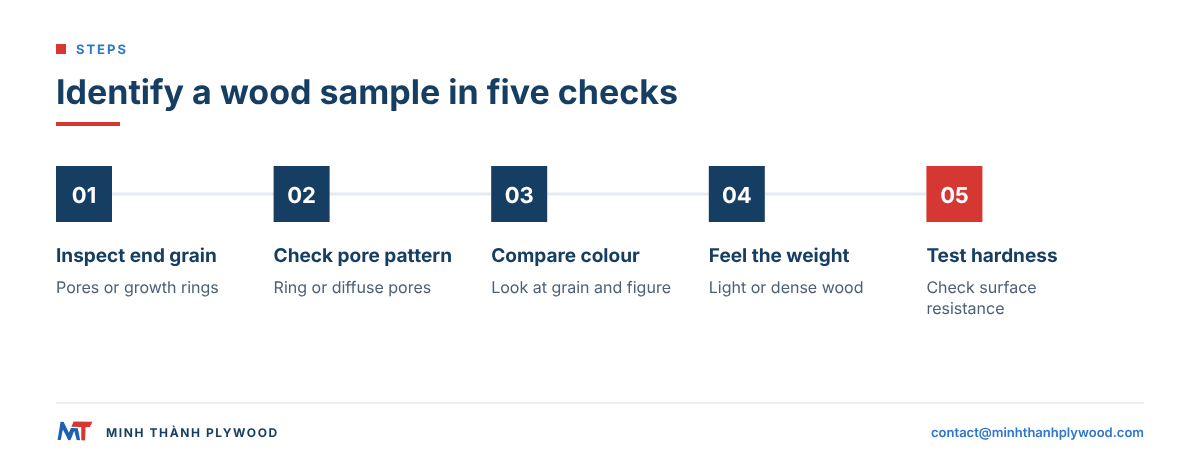
Identify a wood by its end grain, colour, figure, weight and hardness, checked in that order. Five quick checks sort most samples.
- End grain: cut a clean end. Pores mean hardwood; growth rings with no pores and a resin smell mean softwood.
- Ring-porous or diffuse-porous: large pores in rings point to oak, ash or elm; even small pores point to maple, birch or poplar.
- Colour and figure: walnut is chocolate brown, cherry pink-brown, maple creamy white, sapele shows ribbon stripes.
- Weight: a dense wood such as Eucalyptus feels heavy for its size; Styrax and poplar feel light.
- Hardness: a fingernail marks pine, poplar and okoume easily, oak and maple hardly at all.
For plywood, identify the face and the core separately. Look at the edge: the face is a thin veneer of one species, while the core plies below are usually a different, cheaper plantation wood.
How to choose between the types of woods
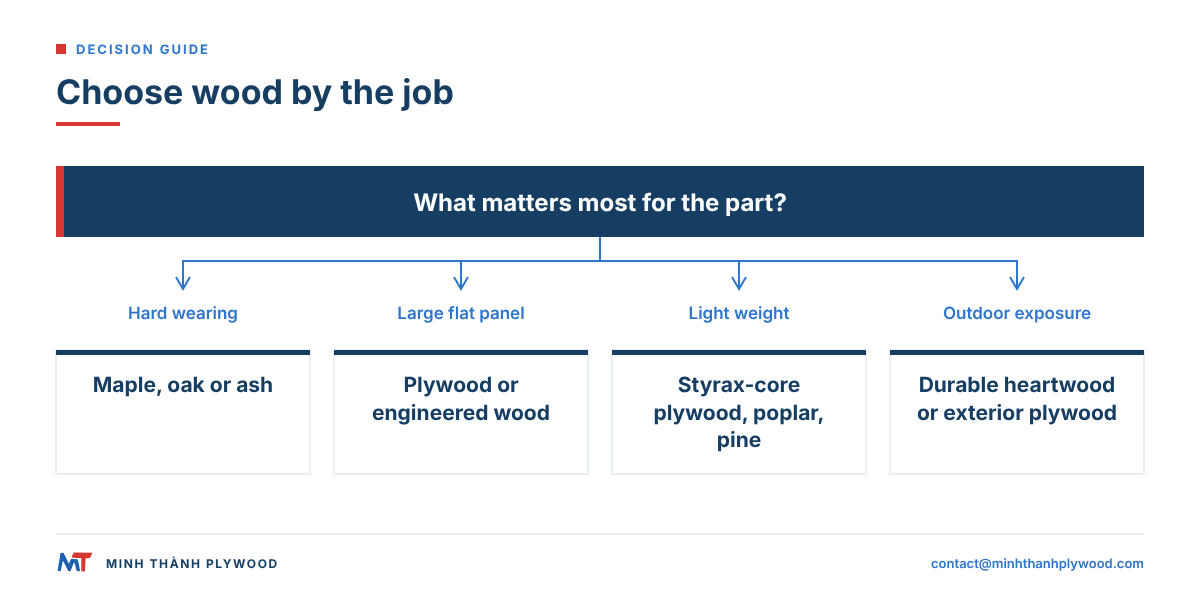
Choose wood by asking what the part must do: carry load, stay flat, resist water, look good or cost little. One answer usually rules out most species.
| Need | Choose | Avoid |
|---|---|---|
| Hard wearing surface | Maple, oak, ash | Pine, poplar |
| Large flat panel | Plywood or other engineered wood | Wide solid boards |
| Light weight | Styrax-core plywood, poplar, pine | Eucalyptus, oak |
| Outdoor exposure | Durable heartwood or exterior plywood | Untreated pine, UF-glued plywood |
| Painted finish | Poplar, poplar-faced plywood, MDF | Open-grain oak |
| Structural span | C24 softwood, glulam, LVL | Unrated boards |
| Tight budget | Pine, plantation hardwoods, plywood | Exotic species |
For sheet materials, the types of wood boards guide compares plywood, MDF, particle board, OSB and blockboard by use.
What this means for your order
If your product needs a wood panel rather than solid timber, specify the face and the core as separate woods. The face species sets the look; the core species sets the weight, stiffness and price.
Send these lines with your enquiry:
- Application: furniture, cabinets, interiors, formwork or packing.
- Core: white Styrax or Eucalyptus as standard; Acacia or Pine on order.
- Glue and emission: UF glue at E0 emission for interiors; melamine-fortified or phenolic WBP to your specification.
- Face and grade: for example Birch D+/D, Poplar A/B or EV matched to your sample.
- Size and thickness: 1220 × 2440 or 1250 × 2500 mm, 3–40 mm.
- Packing and quantity: from one 40HC, mixed specifications by agreement.
Minh Thanh Plywood makes furniture plywood on Vietnamese plantation cores with more than ten face veneers. Production takes 15–45 days after the deposit, free samples are available, and we reply within hours. Write to contact@minhthanhplywood.com or message us on WhatsApp. Browse every face on our products page or read the hardwood plywood guide.
Buyer questions, answered
How many types of wood are there?
Botanists count about 60,000 tree species, but wood is sorted into three types: hardwood, softwood and engineered wood. A few dozen species cover most furniture, building and panel work.
What are the 3 types of wood?
Hardwood from broadleaf trees such as oak, maple and walnut; softwood from conifers such as pine, spruce and fir; and engineered wood such as plywood, LVL, MDF and OSB, made from wood bonded with glue.
Is hardwood always harder than softwood?
No. The names describe the tree, not the hardness. Balsa is a hardwood and very soft; yew and longleaf pine are softwoods harder than many hardwoods. Compare Janka hardness instead.
What are the main types of wood used in US construction?
Softwood lumber in four species groups: SPF (spruce-pine-fir), southern yellow pine, Douglas fir-larch and hem-fir, graded No. 2 or Select Structural for studs, joists and rafters, plus plywood and OSB for sheathing. In the UK the equivalent is spruce and pine graded C16 and C24.
What types of wood are best for outdoor use?
In the US: western red cedar, redwood, pressure-treated southern yellow pine, white oak, ipe and teak. In the UK: oak, sweet chestnut, larch, iroko and western red cedar. For panels, use exterior plywood with phenolic WBP glue.
What types of wood do UK furniture makers use?
Oak above all, then ash, walnut, beech, cherry and maple for solid parts, with birch, poplar and oak-faced plywood for carcasses, drawers and panels.
What is the hardest common wood?
Among common furniture woods, hard maple at about 1,450 lbf Janka is one of the hardest. Tropical woods such as ebony are much harder but are rare and regulated.
What wood is plywood made of?
Vietnamese plywood uses plantation cores of white Styrax, Eucalyptus or Acacia, with faces such as birch, poplar, okoume, pine or engineered veneer. Rubberwood is a niche core from the south of Vietnam.
Which wood is lightest for furniture panels?
Among plywood cores, white Styrax is the lightest at a planning density of about 500 kg/m³, which is why many European furniture buyers choose it.
How can I tell what type of wood I have?
Look at the end grain, colour and figure, feel the weight, and press a fingernail into the surface. Pores visible on the end grain point to a hardwood; resin smell and growth rings without pores point to a softwood.