
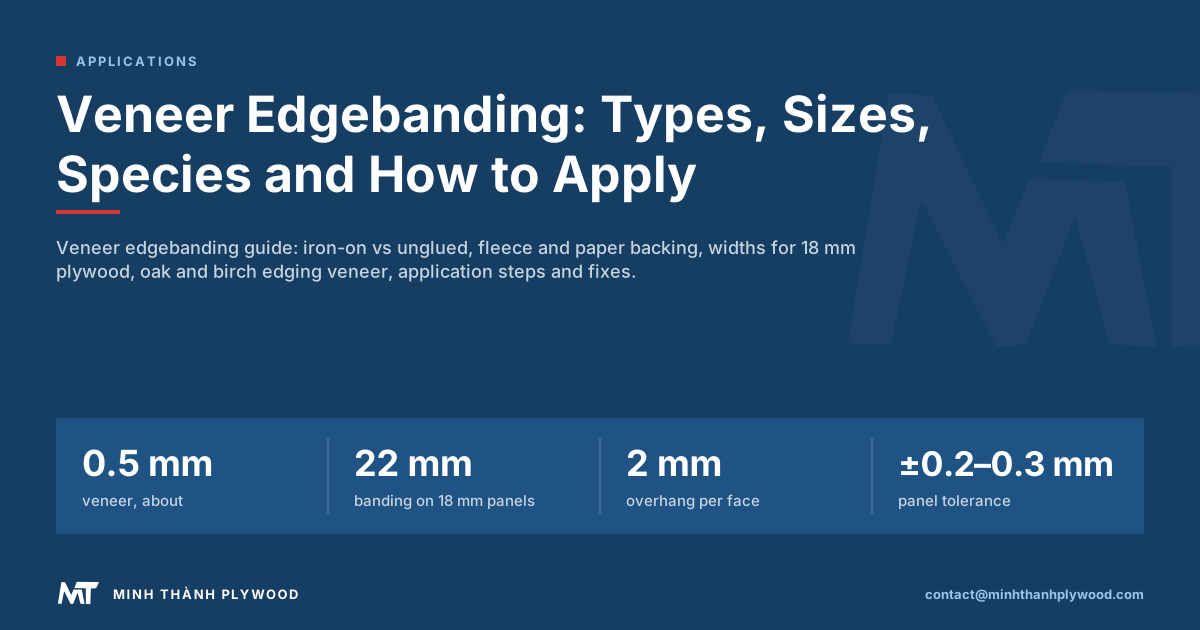
Veneer edgebanding is a thin strip of real wood veneer, sold in rolls, that covers the layered edge of plywood or MDF so a panel looks like solid wood. It comes pre-glued for an iron or plain for an edgebander, in widths a little wider than the panel. This guide covers types, sizes, species and application. Minh Thanh Plywood makes the calibrated plywood panels that the banding finishes.
What is veneer edgebanding?
Veneer edgebanding is a thin strip of real wood veneer, usually backed with paper or fleece and sold in rolls, that is glued to the cut edge of plywood or MDF to hide the core. Once trimmed and finished, the banded edge looks like the same wood as the face.
- Material: sliced wood veneer, often finger-jointed into long rolls.
- Backing: paper or fleece, which stops the veneer splitting along the grain.
- Adhesive: pre-applied hot-melt (iron-on) or none, for edgebanders and contact cement.
- Use: shelves, cabinet carcasses, doors, desk tops and any panel whose edge stays visible.
Edgebanding, edgeband veneer, edging veneer and veneer edge tape all describe the same product.
Types of veneer edgebanding
Veneer edgebanding comes in four main types: pre-glued iron-on, unglued for machine or contact cement, fleece-backed and wood-backed (two-ply). The type sets how it is applied and what edges it suits.
| Type | Adhesive | Applied with | Best for |
|---|---|---|---|
| Pre-glued (iron-on) | Hot-melt on the back | Household iron or hot-air tool | Small runs, repairs, workshops |
| Unglued, paper-backed | None | Edgebander or contact cement | Production, straight edges |
| Fleece-backed | Pre-glued or none | Iron, edgebander or contact cement | Curves, tight radii |
| Wood-backed (two-ply) | Usually none | Edgebander or contact cement | Stiffer, flatter edges, cross-grain backing |
Iron-on banding is the common choice for small workshops. Production plants use unglued rolls on an automatic edgebander that applies hot-melt, presses, trims and scrapes in one pass.
What size edgebanding for plywood?
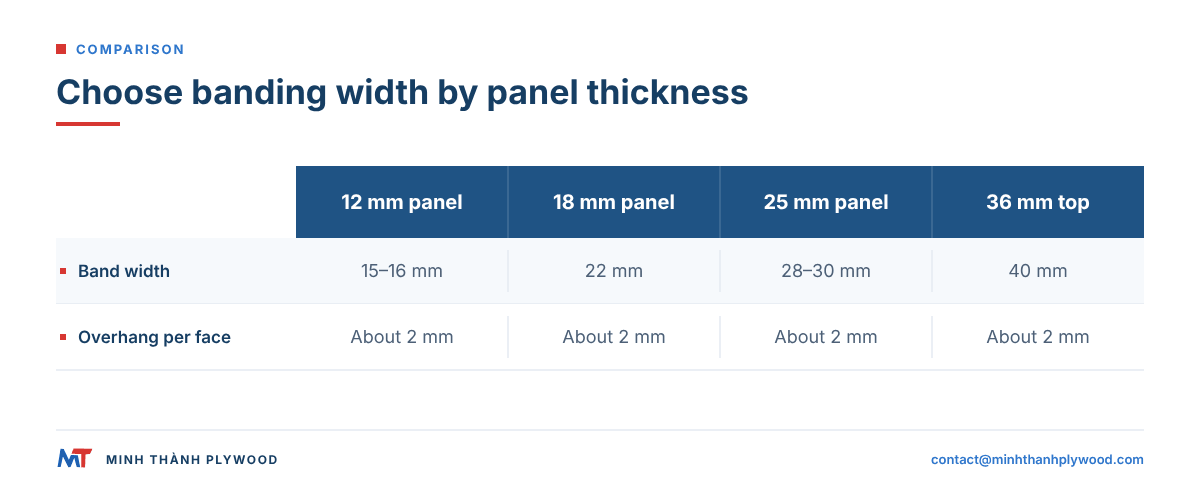
Standard veneer edgebanding is about 0.5 mm thick, and the width is chosen a few millimetres wider than the panel so it can be trimmed flush on both faces. Thicker wood edges are a different product: solid wood edgebanding or lipping.
| Panel thickness | Edgebanding width | Overhang per face |
|---|---|---|
| 12 mm | 15–16 mm | about 2 mm |
| 15 mm | 19 mm | about 2 mm |
| 18 mm | 22 mm | about 2 mm |
| 19 mm (3/4 inch) | 22–24 mm | about 2 mm |
| 25 mm | 28–30 mm | about 2 mm |
| 36 mm double-thickness top | 40 mm | about 2 mm |
Calibrated panels make the width choice simple: a sanded furniture panel that holds ±0.2–0.3 mm takes the same banding width across the whole order, and the trimmer cuts the same overhang on every part.
What are the US edgebanding sizes, roll lengths and thicknesses?
US suppliers sell veneer edgebanding in inch widths from 1/2 in to 3 in, with 7/8 in the common width for 3/4 in plywood, in rolls of 50 to 500 ft and thicknesses from 0.5 to 3 mm. The table converts the common widths to millimetres and says which panel each one covers. The conversion uses the exact definition of 1 inch = 25.4 mm (NIST).
| US width | Millimetres | Panel it covers |
|---|---|---|
| 5/8 in | 15.9 mm | 1/2 in plywood (15/32 in, 11.9 mm) |
| 13/16 in | 20.6 mm | 18 mm metric panels, about 1.3 mm overhang per face |
| 7/8 in | 22.2 mm | 3/4 in plywood (23/32 in, 18.3 mm), about 2 mm overhang per face |
| 15/16 in | 23.8 mm | 3/4 in or 19 mm panels with extra trimming allowance |
| 1 in and 1-1/8 in | 25.4 mm and 28.6 mm | 7/8 to 1 in thick shelves and doors |
| 1-5/16 in and 1-1/2 in | 33.3 mm and 38.1 mm | Laminated tops; select a width that leaves trimming allowance on both faces |
| 2 in | 50.8 mm | Thick tops and 1-3/4 in doors |
What the US suppliers list:
- Roll lengths: 50, 250 and 500 ft rolls (15.2 m, 76.2 m and 152.4 m) in 7/8 in from WiseWood Veneer, with 1, 1-1/2 and 2 in widths in 250 and 500 ft rolls; Charter Industries sells coils of 328 linear ft (100 m) for most species.
- Strips: maple and red oak also come as 8 ft strips.
- Thickness: 0.5 mm for standard paper- or fleece-backed veneer, and 1, 1.5, 2 and 3 mm for thicker edges; Charter lists 1, 1.6, 1.8 and 3 mm. Thicker strips need a slight concavity for a tight glue line.
- Widths: Frama-Tech slits most widths the same day; the most common are 5/8, 7/8, 15/16 and 1-5/16 in.
Check the banding’s quality before buying a roll: thickness tolerance, hot-melt adhesion strength, flexibility, surface finish and edge straightness are the quality parameters edgebanding makers test, by caliper, adhesion test and bend test. Ask the supplier for those results, and make the plywood edge worth banding: a calibrated panel at ±0.2–0.3 mm gives every part the same overhang.
Edging veneer species and how to match the face
The edging veneer should be the same species and cut as the face veneer of the panel, so both take stain and finish the same way. Matching is by species first, then colour and grain.
| Panel face | Edgebanding to use | Matching note |
|---|---|---|
| Birch | Birch veneer edging | Pale, fine grain; matches birch-faced plywood |
| Oak (natural or engineered) | Oak veneer edging, white or red oak | Match the colour and the ray figure of the face |
| Walnut look (EV) | Walnut veneer edging | Compare under the finish, not raw |
| Okoume | Okoume or mahogany-tone veneer | Warm reddish tone |
| Poplar | Poplar or birch veneer | Usually painted or stained |
| Pine | Pine veneer edging | Knots and colour vary |
EV (engineered veneer) faces are made to a uniform figure in oak, walnut and other looks. For an EV-faced panel, choose an edging veneer in the same species and test a finished sample, because the face and the edge can take colour differently.
Oak veneer edging and wood veneer edgebanding by species
Oak veneer edging is the best-selling wood veneer edgebanding, followed by walnut, maple, birch and cherry. Each species has its own handling points.
- White oak: open grain, takes stain evenly; match plain-sliced or rift faces.
- Red oak: pinker tone; do not mix with white oak on one piece.
- Walnut: dark and varied; sort rolls for colour on visible runs.
- Maple and birch: pale and fine; glue lines show if the edge is not clean.
- Cherry: darkens with light; band and finish together so both age the same.
Buy one roll lot for one project when colour matters. Veneer rolls from different logs can differ as much as two face veneers do.
Iron-on vs edgebander: how to apply veneer edgebanding
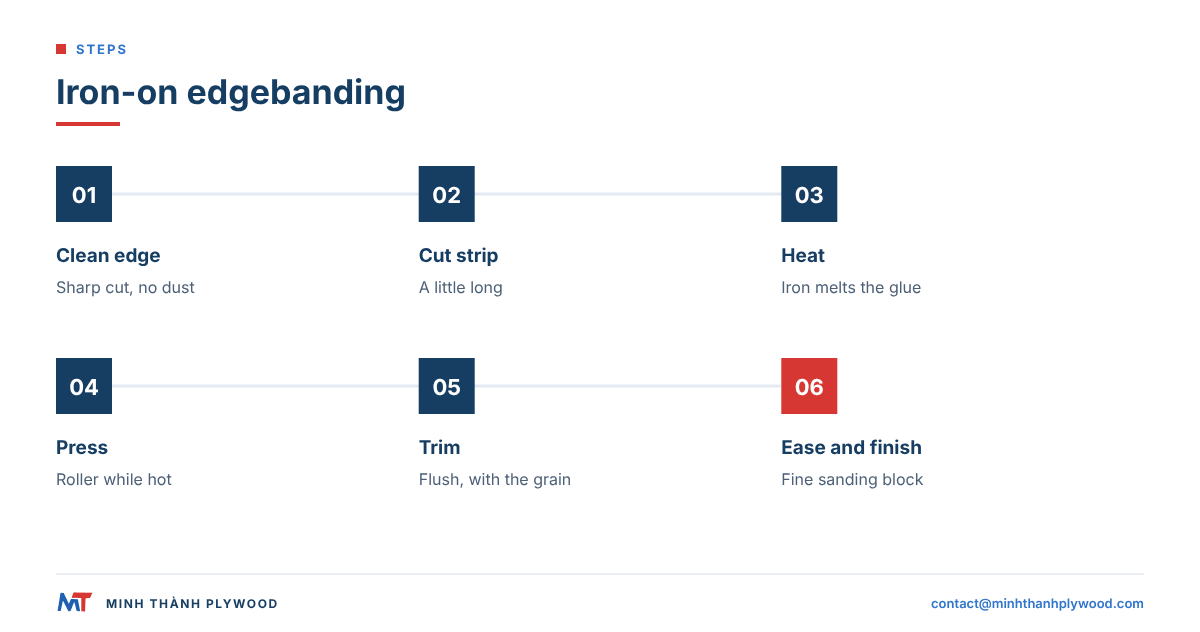
Iron-on veneer edgebanding is applied with heat and pressure: the iron melts the pre-applied glue, and a roller presses the strip while the glue cools. An edgebander does the same with hot-melt glue it applies itself.
- Cut the edge clean: a sharp saw or router; no chips, dust or glue.
- Cut the strip a little longer than the edge.
- Heat the strip with the iron, moving steadily so the glue melts along its length.
- Press with a roller or block while the glue is still hot.
- Let it cool, then trim the ends.
- Trim the overhang flush with an edge trimmer or a sharp chisel, working with the grain.
- Ease the arris with a fine sanding block, then finish.
Unglued banding is applied with contact cement on both surfaces or on an edgebander. Contact cement suits curves and long runs where an iron cannot keep an even temperature.
Preparing the plywood edge
The plywood edge is the substrate, and a banded edge is only as good as the edge under it. Voids, steps between plies and an uneven thickness all show through or break the bond.
- No core voids: a gap in the core leaves a hollow under the strip that dents and peels. Our core layers are stitched both horizontally and vertically, which closes gaps between core veneers.
- Even thickness: sanded furniture panels hold ±0.2–0.3 mm, down to ±0.2 mm, so the overhang is the same on both faces.
- Flat panel: our furniture panels are pressed twice, the core board first, then face and back, so the edge stays straight for the edgebander.
- Dry panel: panels at 8–12 % moisture content at dispatch bond well with hot-melt.
A clean, square edge without voids is what lets a 0.5 mm strip look like solid wood.
Veneer edgebanding vs PVC, ABS and solid lipping
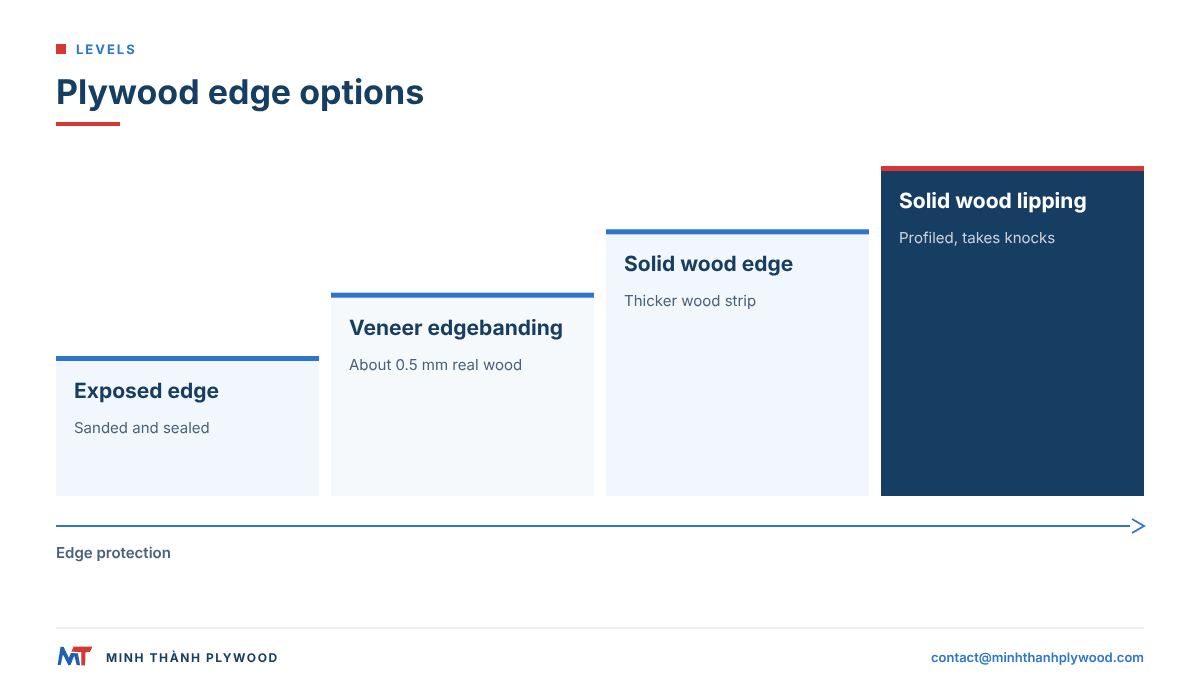
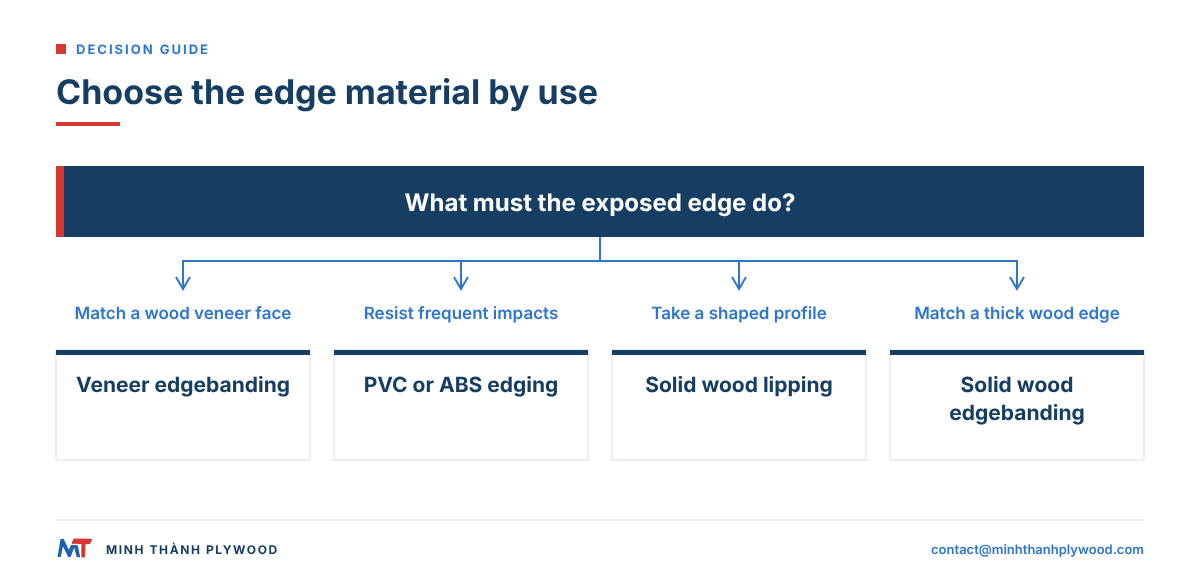
Veneer edgebanding is the right choice when the edge must look and finish like the wood face; PVC and ABS suit laminate and melamine panels and high-wear edges; solid wood lipping suits edges that take knocks or need a profile.
| Edge option | Look | Wear resistance | Finishing | Typical use |
|---|---|---|---|---|
| Veneer edgebanding | Real wood, matches the face | Low to medium | Stain and lacquer with the face | Veneered cabinets, shelves, doors |
| PVC edging | Solid colour or printed wood | High | Pre-finished, not stained | Melamine and laminate panels |
| ABS edging | Solid colour or printed wood | High, impact-resistant | Pre-finished, not stained | Office and kitchen furniture |
| Solid wood edgebanding | Real wood, thicker | Medium to high | Stain and lacquer | Better cabinets, small radius |
| Solid wood lipping | Real wood, profiled | High | Stain, lacquer, can be shaped | Table tops, worktops, door edges |
For a full comparison of edge methods on plywood, read plywood edge banding.
Which glue is best for veneer edgebanding?
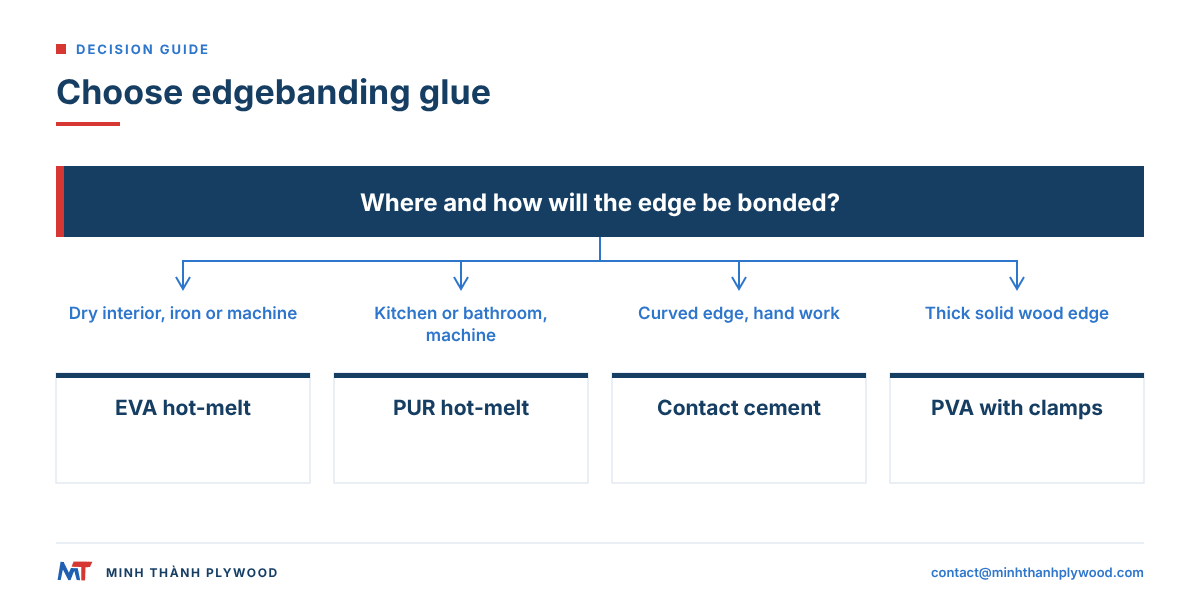
Veneer edgebanding is held by hot-melt glue, contact cement or a reactive polyurethane (PUR) hot-melt. The glue sets heat and moisture resistance at the edge.
| Glue | Applied by | Resistance | Use |
|---|---|---|---|
| EVA hot-melt (pre-glued or machine) | Iron, edgebander | Good indoors, softens with heat | Most furniture |
| PUR hot-melt | Edgebander | Moisture and heat resistant, thin glue line | Kitchens, bathrooms |
| Contact cement | Brush or spray, both surfaces | Good, flexible | Curves, hand work |
| PVA wood glue | Clamps or cauls | Good, slow | Thick solid wood edges |
For kitchen and bathroom cabinets, choose PUR hot-melt and a panel with a moisture-resistant bond: we make MR (melamine-fortified) and phenolic (WBP) bonds to the customer’s specification, and UF glue at E0 emission for interior furniture.
For US orders, the TSCA Title VI formaldehyde limit for veneer-core hardwood plywood is 0.05 ppm under EPA formaldehyde emission standards.
Finishing banded edges
A banded edge is finished together with the face so both take the same stain and lacquer. Sand lightly; veneer edging is thin and sands through quickly.
- Ease the edge with a fine block, never a power sander on the edge.
- Wipe off glue squeeze-out before it hardens, or scrape it after.
- Stain face and edge together with the same product.
- Seal and lacquer in the same coats.
Our sanded and polished faces are UV-ready on both sides, to the standard customers need to apply their own UV coating. UV-cured lacquer is used on flat faces; edges are often spray-lacquered.
Common edgebanding problems and fixes
Most edgebanding failures come from the glue temperature, a dirty or rough edge, or trimming against the grain. The table gives causes and fixes.
| Problem | Likely cause | Fix |
|---|---|---|
| Peeling at the ends | Glue cooled before pressing, ends not pressed | Reheat, roll the ends, trim after cooling |
| Visible glue line | Edge not square or glue too thick | Square the edge, use a thinner glue line |
| Gaps over the core | Core voids, rough edge | Use a void-free panel, fill and sand the edge |
| Split across the grain | Paper backing on a curve | Use fleece-backed banding |
| Tear-out on trimming | Trimming against the grain | Trim with the grain, use a sharp trimmer |
| Colour mismatch | Different species or roll lot | Match species, buy one lot, test the finish |
A panel that is flat, calibrated and free of voids removes three of the six causes before the banding goes on.
Edgebanding plywood in production
In production, plywood parts are edgebanded on an automatic edgebander that applies glue, presses the strip, cuts the ends, trims the overhang, scrapes and buffs in one pass. Panel quality decides how many parts pass without rework.
- Thickness tolerance: the trimming units are set once; panels outside tolerance leave overhang or cut into the face.
- Flatness: bowed panels lift from the conveyor and give uneven pressure.
- Edge density: plywood edges with tight plies hold glue better than open edges.
- Moisture: panels at a steady 8–12 % keep the bond and the size stable.
The US Forest Products Laboratory Wood Handbook explains how the moisture content of wood follows humidity and changes its size.
For cabinet plants, buying calibrated panels saves more time at the edgebander than any change of banding.
What this means for your order
We make the panels, not the edgebanding: order plywood with faces and tolerances that suit veneer edgebanding, and source banding in the same species. Send these lines with your request:
- Application: cabinet parts, shelves or doors to be veneer-edgebanded.
- Core: white Styrax or Eucalyptus, stitched and void-free.
- Glue and emission: UF glue at E0 emission; MR or phenolic (WBP) for wet rooms.
- Face and grade: EV in oak, walnut or other looks, birch D+/D, okoume or poplar, matched to an approved sample.
- Thickness and tolerance: for example 18 mm, sanded, ±0.2–0.3 mm.
- Size and quantity: 1220 × 2440 or 1250 × 2500 mm, or cut to size; from one 40HC.
Production takes 15–45 days after the deposit, and free samples are available, so you can test your banding and finish on our panel before ordering. See EV plywood and birch plywood, and read how to finish plywood edges. For a general background on the technique, see the edge banding entry (read 20 October 2026).
Buyer questions, answered
What size edgebanding for 3/4 inch plywood?
7/8 in (22.2 mm) wide edgebanding, which leaves about 2 mm of overhang per face on 3/4 in (23/32 in, 18.3 mm) plywood. Use 13/16 in (20.6 mm) for 18 mm metric panels, and trim flush after pressing.
What is veneer edgebanding?
Veneer edgebanding is a thin strip of real wood veneer, usually backed with paper or fleece and sold in rolls, that is glued to the edge of plywood or MDF to hide the core. It can be pre-glued with hot-melt adhesive or supplied plain.
What width edgebanding for 18 mm plywood?
Use 22 mm edgebanding on an 18 mm panel. The 4 mm overhang gives about 2 mm on each face for the trimmer to cut flush.
Is iron-on veneer edging any good?
Yes, for furniture that stays indoors and dry. Pre-glued iron-on veneer edging bonds well when the edge is clean, the iron is hot enough and the strip is pressed with a roller while the glue cools.
What is the difference between fleece-backed and paper-backed edgebanding?
Fleece-backed banding is more flexible and less likely to split across the grain on curves and tight radii. Paper-backed banding is stiffer and cheaper for straight edges.
Can you stain veneer edgebanding?
Yes. Real wood veneer takes stain and finish like the face veneer of the same species, so stain the banded edge together with the face for an even colour.
Why is my edgebanding peeling off?
Usually the glue did not reach full temperature, the edge was dusty or rough, or the strip was not pressed firmly while the glue cooled. Clean the edge, reheat and roll it down again.
Is veneer edgebanding better than PVC?
Veneer is better when the edge must look and finish like the wood face. PVC and ABS are better on melamine and laminate panels and on edges that take hard knocks or moisture.
What is oak veneer edging used for?
Oak veneer edging covers the edges of oak-veneered panels, including plywood and MDF with oak or oak-look faces, so the edge matches the face after finishing.
Can edgebanding be applied to curved plywood edges?
Yes. Use fleece-backed veneer for curves and an edgebander or contact adhesive suited to the radius. Paper-backed banding can crack across the grain on tight curves.
Should I use edgebanding or solid wood lipping on plywood?
Use edgebanding for cabinet parts and shelves where the edge takes little wear. Use solid wood lipping of a few millimetres or more on table tops and edges that take knocks or need a profile.