
Vietnamese plywood exporters ship to Canada, the United States, Europe, Japan, Korea, the Middle East and Africa, and each market buys a different mix: film-faced and birch-faced panels for Canada, furniture plywood for Europe, packing and LVL for Japan and Korea. Minh Thanh Plywood exports across the Americas, Europe, Asia and Africa from Hai Phong.
Which plywood manufacturers in Vietnam export to Canada?
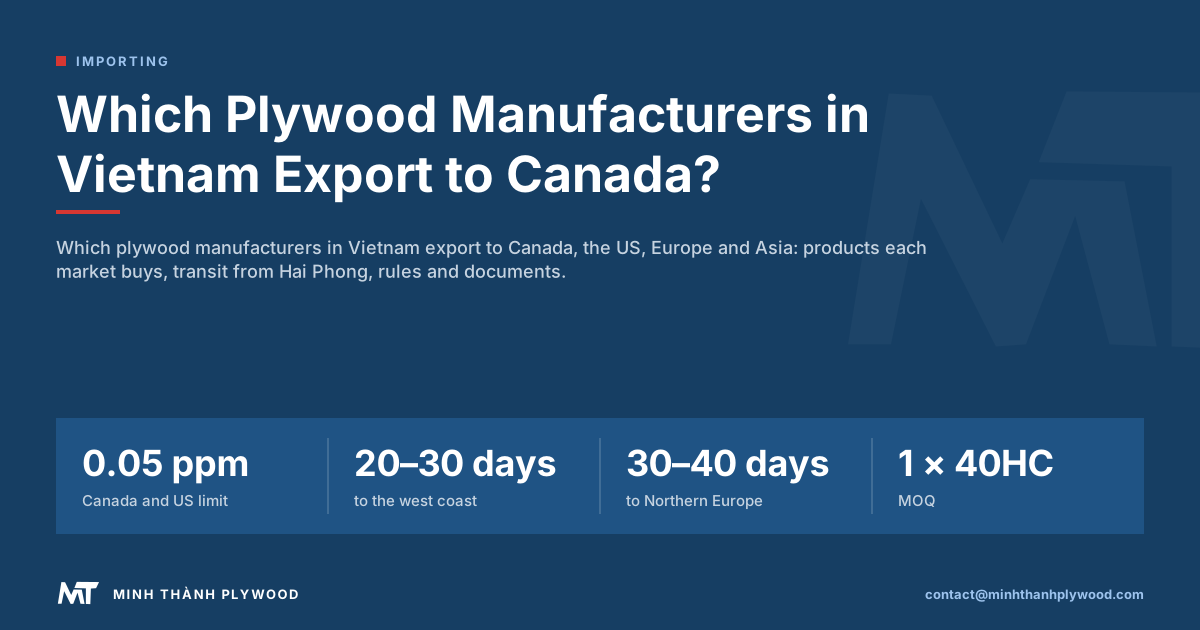
Several Vietnamese plywood mills export to Canada, mainly film-faced plywood for concrete forming and birch-faced or hardwood plywood for cabinets, furniture and millwork. The mills that do it well can show a Canadian compliance label, third-party certification to the 0.05 ppm hardwood plywood limit and loading records for North American orders.
Four Vietnamese manufacturers that publish North American export programmes show the range:
| Manufacturer | Where | Main lines for Canada | What it publishes |
|---|---|---|---|
| Minh Thanh Plywood | Ha Hoa, Phu Tho | Furniture and cabinet plywood (birch, poplar, EV faces), film-faced on order | 50,000+ m³ a year, CARB P2 / TSCA Title VI (ICTT mill no. 23024), six chamber tests at 0.014–0.032 ppm |
| Vinawood | Hanoi, since 1992 | Film-faced forming panels in MUF (EN 636-2) and phenolic (EN 636-3) grades | Canada market pages, CARB P2 / TSCA Title VI, EUDR |
| Tadex Ply | Tam Duong, Phu Tho | Film-faced, MDO/HDO, commercial, LVL | Canada and the US among 20+ countries, 1,500 containers exported in 2021, CARB P2 |
| TT Plywood (Truong Thinh) | Northern Vietnam | 18 mm 11-layer film-faced, okoume and bintangor commercial plywood | Exports to the US, EU, Japan, Korea and India; Vinacontrol and KOFPI certificates |
Minh Thanh is the furniture-grade choice in that group: a factory built for top-grade furniture and interior plywood with Europe as its main market, exporting across the Americas, Asia and Africa. At 50,000+ m³ a year its capacity equals about 940 containers of 18 mm panels. Its panels meet US requirements (UF glue at E0 emission, CARB P2 / TSCA Title VI), and the same certification route covers the Canadian limit for hardwood plywood.
Before shortlisting any exporter for Canada, ask three questions:
- Which product lines have you shipped to North America, and with which glue and emission class?
- Who is your third-party certifier, and what is your certification number?
- Can you show the label and the documents from a recent North American shipment, with buyer names removed?
A manufacturer answers all three in one reply. A seller who answers “we can do everything” without numbers is the one to drop.
Where do Vietnamese plywood exporters ship? Markets by region
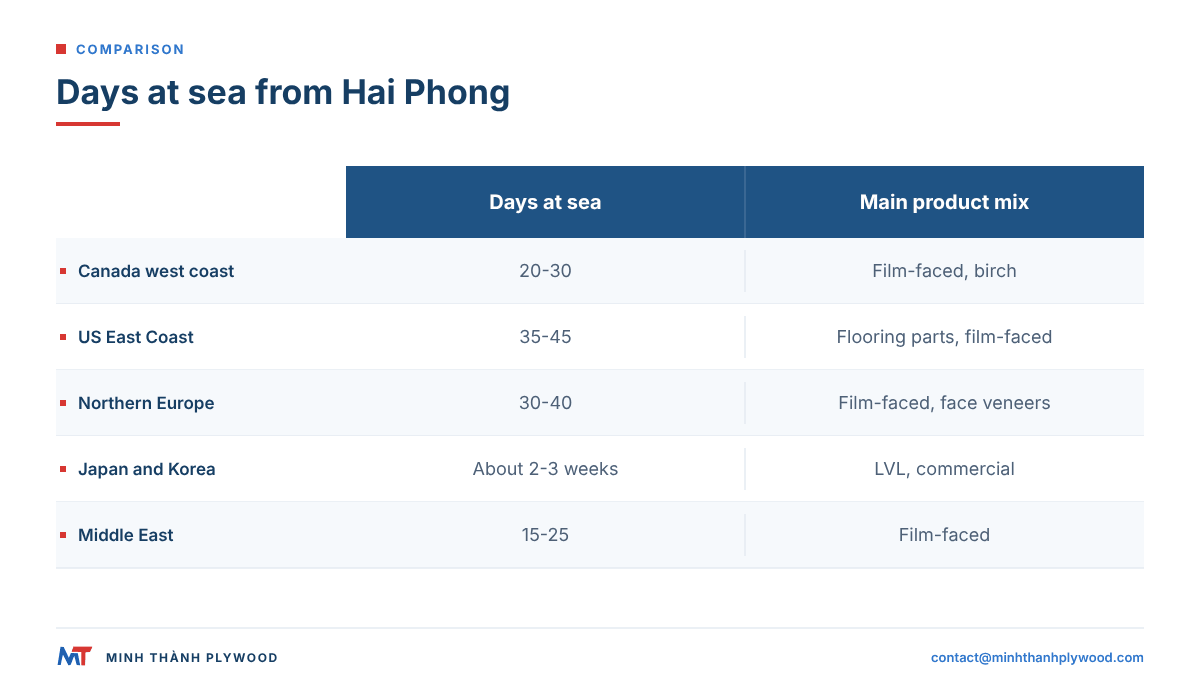
Vietnamese plywood exporters ship to every region, and the product mix changes by market. Asia buys mostly commercial, packing and LVL panels; North America and most of Europe buy film-faced plywood first, followed by face-veneer panels for furniture. The table is built from Vietnamese customs export data for HS 4412, read as product mix per market.
| Region | What the market buys most from Vietnam | Typical days at sea from Hai Phong | Documents buyers ask for |
|---|---|---|---|
| Canada | Film-faced, then birch-faced and flooring components | 20–30 days (west coast) | Canadian formaldehyde certification and label |
| United States | Flooring components and film-faced, then birch-faced | 20–30 days (West Coast), 35–45 days (East Coast) | TSCA Title VI label, Lacey Act species and origin |
| Northern Europe | Film-faced, then birch, eucalyptus and poplar faces | 30–40 days | EUDR dossier, EUR.1, CE for construction use |
| Mediterranean Europe | Poplar and furniture panels, film-faced, cut-to-size | 25–35 days | EUDR dossier, EUR.1, emission test on request |
| Japan and Korea | LVL, commercial and packing, bintangor | About 2–3 weeks | Emission grade, species and origin |
| South-East Asia | Commercial, film-faced, birch-faced | 5–12 days | Certificate of origin, phytosanitary |
| Middle East | Film-faced, commercial, okoume and bintangor | 15–25 days | Certificate of origin, fumigation |
| West Africa | Commercial and film-faced | 35–50 days | Certificate of origin, fumigation |
Transit times are typical sailing days by carrier and route, before clearance. Production comes first: 15–45 days after the deposit at Minh Thanh.
Europe is Minh Thanh’s strongest market, with repeat orders into Italy and cut-to-size panels shipped regularly to Italy and other European markets. The factory also exports across the Americas, Asia and Africa.
Which Vietnamese plywood exporters ship to Canada, and what do Canadian buyers order?
The Vietnamese plywood exporters that ship to Canada sell three product groups: film-faced plywood for concrete forming, face-veneer plywood (birch, poplar, hardwood faces) for cabinets and furniture, and flooring and component panels. Film-faced plywood carries a large share of the value in the customs data.
Canadian buyers fall into four types, and each orders differently:
- Forming contractors and distributors order film-faced plywood, 18 mm, 1220 × 2440 mm (4 × 8 ft), in full containers for gang forms and slab work.
- Cabinet and millwork shops order cabinet-grade face-veneer plywood: birch or poplar faces, UF glue at E0 emission, sanded to a tight tolerance, often at 18 mm.
- Furniture and fixture makers order cut-to-size parts and specific face grades matched to an approved sample.
- Building-supply distributors combine thicknesses and faces in one container.
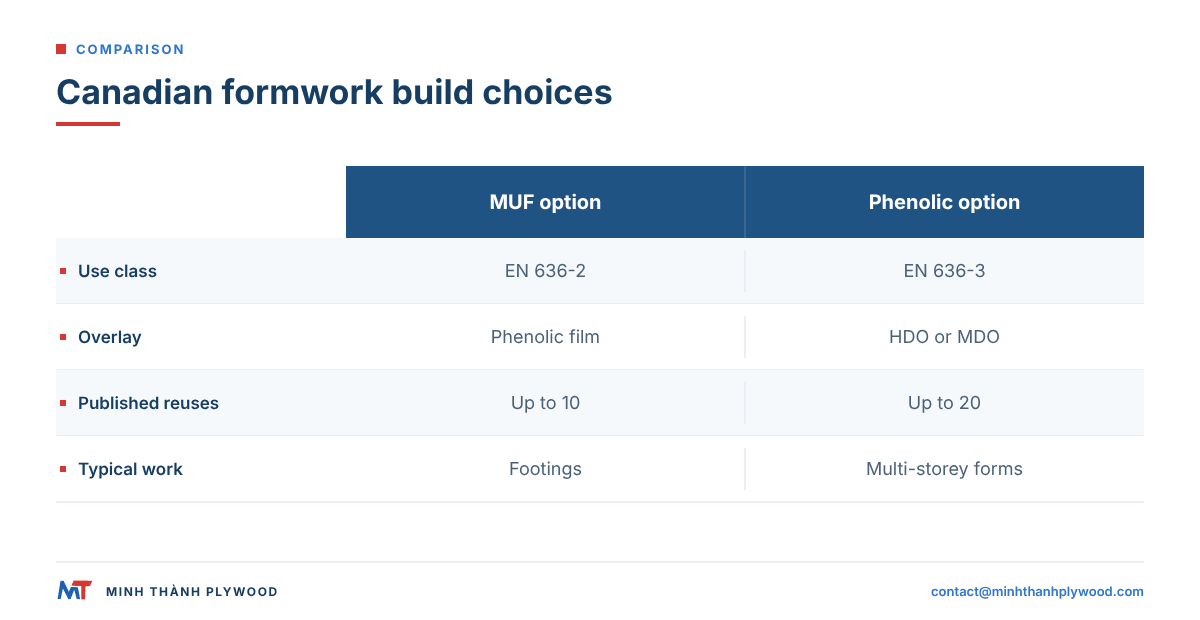
What a Canadian forming order must state. Film colour is not a specification; the bond class is. Write the glue and its class, the overlay and the reuse target on the RFQ:
| Line | Option A | Option B |
|---|---|---|
| Glue and bond class | MUF (melamine-urea), EN 636-2, humid use | Phenolic (PF / WBP), EN 636-3, EN 314-2 Class 3, exterior |
| Overlay | Phenolic film, stated in g/m² | HDO or MDO overlay for architectural concrete |
| Reuses published by Vietnamese mills | Up to 10 on MUF grades | Up to 20 on phenolic grades |
| Use | Footings, short programmes | Multi-storey gang forms in Toronto, Calgary or Montreal |
Reuse counts are makers’ figures for good site practice (Vinawood’s Canadian range, 2025); oiling, edge sealing and stripping care decide the real number. Minh Thanh quotes film-faced plywood on order with phenolic glue, ±0.5 mm thickness tolerance and sealed edges.
Duty and trade cases. Canada’s Customs Tariff lists plywood with hardwood outer plies (4412.33 and 4412.34) as free of duty at the MFN rate, so Vietnamese panels enter at 0% without needing a CPTPP certificate; GST applies on import. Canada’s one anti-dumping case on decorative and other non-structural plywood targeted China and ended without duties: the Canadian International Trade Tribunal found no injury on 19 February 2021. The US duty case on Vietnamese hardwood plywood does not apply to goods cleared in Canada.
Ports. Vancouver and Prince Rupert take West Coast sailings of about 20–30 days from Hai Phong; Montreal and Halifax are served on longer East Coast routings.
Structural sheathing in Canada is a separate market. Canadian softwood and Douglas fir plywood made to CSA O151 and CSA O121 dominates it, so Vietnamese panels go mostly into non-structural uses: cabinets, furniture, millwork, packaging and forming.
For a Canadian cabinet buyer, a typical Minh Thanh order reads: 18 mm poplar or birch-faced furniture plywood, white Styrax core, stitched and pressed twice, UF glue at E0 emission, 1220 × 2440 mm, tolerance down to ±0.2 mm, one 40HC.
What does Canada require for imported hardwood plywood?
Canada requires imported hardwood plywood to meet the Formaldehyde Emissions from Composite Wood Products Regulations (SOR/2021-148). The regulation has been in force since January 2023 and sets an emission limit of 0.05 ppm for hardwood plywood, certification by an accredited third-party certifier and a label stating compliance. The importer keeps the records.
The Canadian limit for hardwood plywood is the same 0.05 ppm that applies under TSCA Title VI, 40 CFR 770.10 in the United States. Mills certified for the US market therefore build to the Canadian number already; the label and the records must name the Canadian regulation.
Minh Thanh’s evidence for both markets:
- Certification: CARB P2 / TSCA Title VI, ICTT mill no. 23024, for hardwood plywood with a veneer core, 3–50 mm.
- Chamber tests: six ASTM D6007 tests between April 2025 and June 2026, on 9, 15 and 18 mm panels, averaged 0.014–0.032 ppm against the 0.05 ppm limit; three by Shanghai Hongjun, three by ICTT Vietnam.
- Glue: UF glue at E0 emission for furniture and interior panels.
Structural plywood in Canadian construction follows the CSA standards in the building code, not the formaldehyde rule alone; a structural application needs a CSA-certified panel.
What does the United States require from Vietnamese plywood exporters?
The United States requires TSCA Title VI certification and a label on every hardwood plywood panel, plus Lacey Act species and origin information for the import declaration. Minh Thanh’s US orders carry the TSCA Title VI label with producer, lot, certifier number TPC-43 and “TSCA Title VI compliant”.
US documents from the mill:
- Panel label: producer, lot, certifier TPC-43 and the TSCA Title VI statement.
- Commercial invoice and bill of lading stating TSCA Title VI compliance.
- Species and harvest origin of face and core, Vietnamese plantation timber, for the importer’s Lacey Act declaration.
- Test reports that identify UF resin at E0 grade.
Trade remedies: in 2026 the US Department of Commerce issued final antidumping and countervailing duty determinations on hardwood and decorative plywood from Vietnam (21 July 2026), and the US International Trade Commission voted affirmatively on injury on 19 August 2026 (published in the Federal Register on 9 September 2026). Structural PS 1 and PS 2 plywood and phenolic film-faced plyform fall outside that scope. A US importer checks the current order and its scope with its customs broker before booking.
What do Europe and the UK require?
Europe requires the EUDR compliance dossier for plywood placed on the EU market, a CE mark only for construction-use panels, and the emission level the furniture buyer specifies. The UK runs its own timber regulation with the same logic.
- EUDR. Under Regulation (EU) 2023/1115, operators must hold due diligence with geolocation of the harvest plots. Vietnam is classed low risk in Implementing Regulation (EU) 2025/1093. Minh Thanh supplies the EUDR compliance dossier, origin records and geolocation files, with orders.
- Origin. The certificate of origin EUR.1 supports preferential duty under the EU–Vietnam trade agreement.
- Construction use. Plywood for construction carries a declaration of performance and a CE mark to EN 13986. Minh Thanh’s CE is available*.
- Emission. Furniture buyers ask for low-emission panels; CARB P2 / TSCA Title VI certification and the chamber tests are the proof, and testing to EN 717-1 is arranged through SGS on request.
- Packaging. SGS tested Minh Thanh’s four packaging materials in September 2026 under the Packaging and Packaging Waste Regulation (PPWR), Regulation (EU) 2025/40: lead, cadmium, mercury and hexavalent chromium not detected, a pass against the 100 mg/kg limit.
*Supplied directly or through qualified partner mills.
What do Japan, Korea and the rest of Asia buy from Vietnam?
Korea, Malaysia and Japan are major plywood markets for Vietnam by value in the customs data; these markets buy mainly commercial and packing plywood, LVL and bintangor-faced panels. South-East Asian markets buy commercial, film-faced and birch-faced plywood at short distance.
What Asian buyers specify:
- Japan: LVL and commercial panels for construction and packaging, with the formaldehyde grade written on the order; Japanese buyers use their own F-star scale, with F☆☆☆☆ as the lowest-emission class.
- Korea: commercial and packing plywood, bintangor faces and film-faced panels, ordered by face species, glue and emission grade.
- Taiwan: birch and pine-faced panels and commercial plywood for furniture.
- South-East Asia: commercial, film-faced and birch-faced panels; transit from Hai Phong runs 5–12 days.
Japan and Korea sit about 2–3 weeks from Hai Phong by sea. Short transit lets Asian buyers order smaller, more frequent containers.
What do the Middle East and Africa buy from Vietnamese exporters?
The Middle East and Africa buy mainly film-faced plywood for construction, with commercial plywood and okoume or bintangor-faced panels for joinery. The UAE, Saudi Arabia, Oman, Israel and Morocco are the steadiest buyers of film-faced panels in the customs data.
Gulf buyers order film-faced plywood in 18 mm with phenolic glue for high-rise forming, and commercial plywood for fit-out and packing. Transit from Hai Phong to the Middle East is about 15–25 days; West Africa takes 35–50 days.
Buyers in these markets ask for the certificate of origin, phytosanitary and fumigation certificates, and a pre-loading inspection. Minh Thanh photographs and films every shipment before loading and sends the buyer the photos and video.
Vietnam vs China plywood: how do they compare for export?
Vietnam and China both export large volumes of plywood, and the right choice depends on the product and the documents your market needs. Vietnamese mills specialise in plantation-hardwood cores (Styrax, Eucalyptus, Acacia) with imported or local faces; Chinese mills offer a very wide range, including poplar cores and large formats.
| Point | Vietnam (furniture-grade mill such as Minh Thanh) | China |
|---|---|---|
| Core species | White Styrax, Eucalyptus; Acacia, pine on order | Poplar and mixed hardwood common |
| Face options | 10+ faces: EV, poplar, birch, okoume, pine, others on request | Very wide range |
| Furniture-grade build | Stitched core, pressed twice, ±0.2 mm | By mill and grade |
| Emission documents | CARB P2 / TSCA Title VI, chamber tests | By mill |
| EU timber due diligence | EUDR dossier; Vietnam classed low risk | By mill and origin |
| Origin preference | EU–Vietnam and UK–Vietnam trade agreements | Under general rules |
| Starting price | From US$350/m³ furniture, US$250/m³ commercial (October 2026) | By grade |
| Lead time | 15–45 days after deposit | By mill |
For a buyer who needs a documented hardwood core for European or North American furniture, a Vietnamese furniture-grade mill is a strong choice. For very large formats, check that the mill makes your size: Minh Thanh’s largest standard size is 1250 × 2500 mm.
How do you check which markets a Vietnamese exporter really ships to?
Check a Vietnamese exporter’s markets by asking for the documents each market requires from a recent shipment, with buyer names removed. A mill that ships to Canada, the US or Europe has those papers on file; a seller that does not, cannot produce them.
- Canada: the Canadian compliance label and the certifier’s name.
- United States: the TSCA Title VI label with the certifier number, and the invoice wording.
- European Union: an EUDR dossier sample with origin records and geolocation files.
- Any market: photos and video of a real loading, the certificate of origin and the packing list format.
- References: ask for a reference by role and country, such as “furniture importer, Italy”, rather than names.
Two further checks need no help from the seller. Customs-data services sold to importers show which exporters ship which HS codes to which country. Certification bodies confirm a mill number on request; Minh Thanh’s TSCA Title VI number is ICTT mill no. 23024.
What documents come with each export shipment?
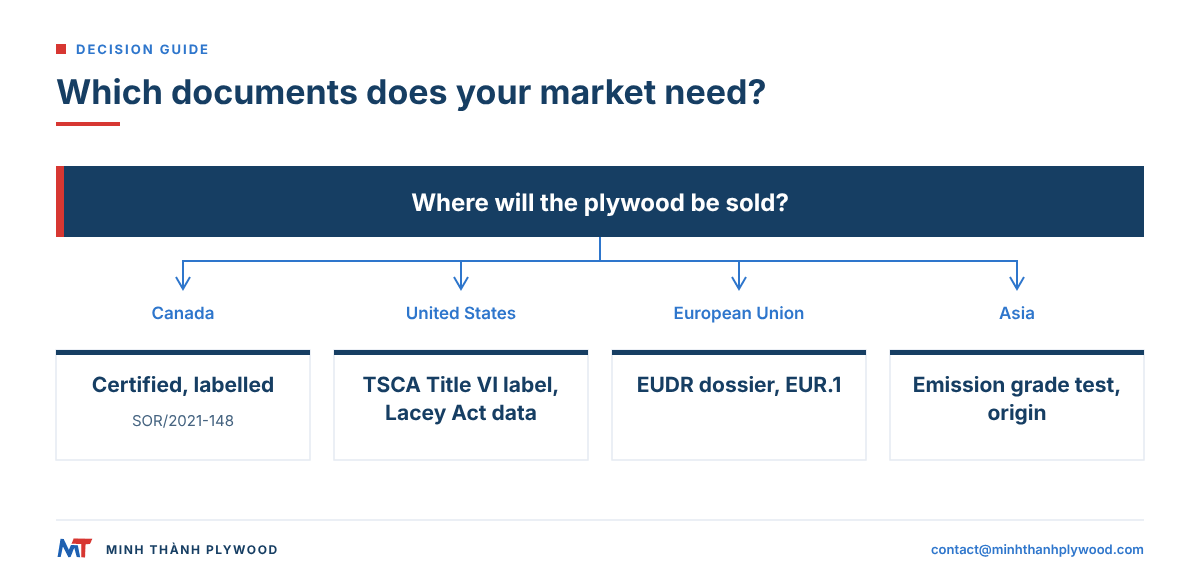
Every Minh Thanh export shipment carries the same core document set, and each market adds its own files on order. The core set is commercial invoice, packing list, bill of lading, certificate of origin, phytosanitary and fumigation certificates, and insurance under CIF.
| Market | Added on order |
|---|---|
| Canada | Certification and label per the Canadian formaldehyde regulation |
| United States | TSCA Title VI label (TPC-43), species and origin for Lacey Act |
| European Union | EUDR dossier, EUR.1, test reports, PPWR packaging test |
| United Kingdom | Species and origin for UK Timber Regulations due diligence |
| Japan and Korea | Emission grade test to the buyer’s method through SGS |
| All markets | Loading photos and video, CARB P2 / TSCA certificate files |
The balance of 70% is paid against the scanned bill of lading, so the documents are ready before the buyer releases the payment.
How do you order from a Vietnamese plywood exporter for Canada?
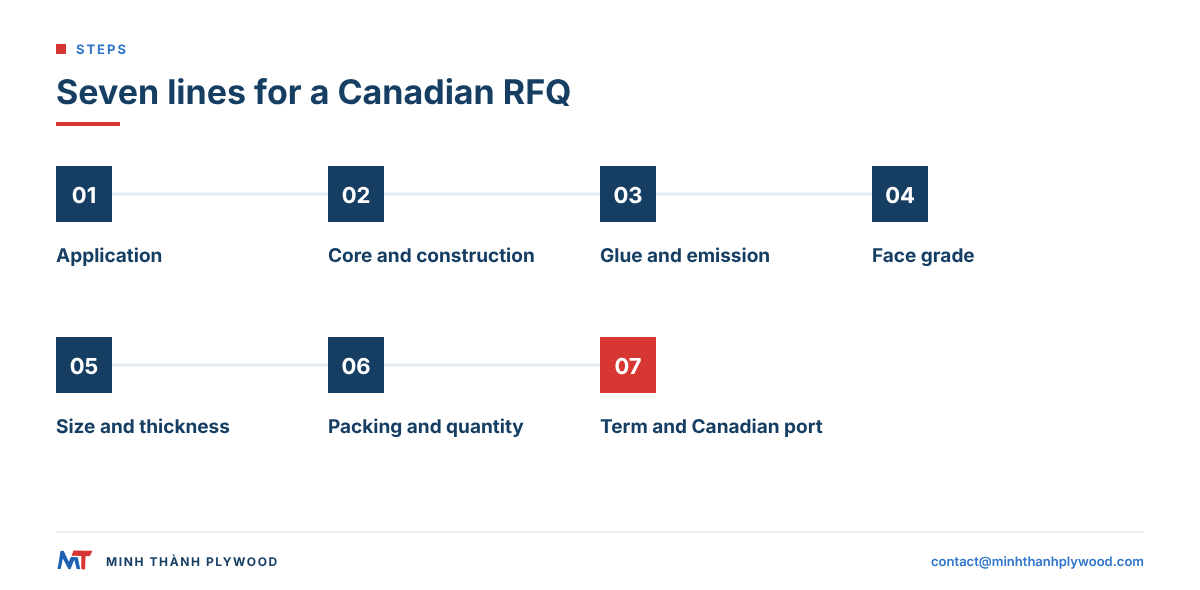
Order from a Vietnamese plywood exporter for Canada with seven lines in the first message: application, core, glue and emission, face, size and thickness, packing and quantity, and the delivery term with your Canadian port. With those, the mill quotes price, load plan and lead time in one reply.
- Application: kitchen cabinets, millwork, furniture, forming.
- Core: white Styrax or Eucalyptus; stitched, pressed twice for furniture grade.
- Glue and emission: UF glue at E0 emission, certified to the 0.05 ppm limit and labelled for Canada.
- Face: birch D+/D or D/E, poplar or EV A/B, matched to an approved sample.
- Size and thickness: for example 1220 × 2440 mm at 18 mm; cut-to-size on order.
- Packing and quantity: one 40HC holds 990 sheets of 18 mm on a Styrax core, about 53 m³; mixed specifications by agreement.
- Term: FOB Hai Phong, CFR or CIF to your Canadian port.
Payment is 30% deposit and 70% against the scanned bill of lading, or an irrevocable L/C at sight. Samples are free. Send your seven lines to contact@minhthanhplywood.com or WhatsApp +84 988 586 601, and see furniture plywood from Minh Thanh.
Buyer questions, answered
Which plywood manufacturers in Vietnam export to Canada?
Several Vietnamese mills ship to Canada, mainly film-faced, birch-faced and hardwood plywood for forming, cabinets and millwork. Minh Thanh Plywood exports across the Americas and builds Canadian orders to the Canadian formaldehyde regulation.
Where does Vietnam export most of its plywood?
Vietnam's largest plywood buyers are in Asia (Korea, Japan, Malaysia) and North America, followed by Europe. Asian buyers take mostly commercial, packing and LVL panels; Europe and North America buy more film-faced and face-veneer plywood.
Which Vietnamese plywood manufacturers export to Canada?
Vietnamese mills with North American programmes include Minh Thanh Plywood (furniture and cabinet plywood, CARB P2 / TSCA Title VI), Vinawood (film-faced forming panels), Tadex Ply (film-faced, MDO/HDO and LVL) and TT Plywood (film-faced and commercial plywood). Ask each for its certifier, label and a recent North American shipment record.
What is the import duty on plywood from Vietnam to Canada?
Hardwood-faced plywood under Canada's tariff items 4412.33 and 4412.34 is free of duty at the MFN rate, so Vietnamese panels enter at 0%. Canada's anti-dumping case on decorative plywood targeted China and ended without duties in February 2021.
What does Canada require for imported hardwood plywood?
Canada's Formaldehyde Emissions from Composite Wood Products Regulations (SOR/2021-148) set a 0.05 ppm limit for hardwood plywood, and require third-party certification and a compliance label. Structural sheathing follows CSA standards.
How long does plywood take to ship from Vietnam to Canada?
Canada's west-coast ports sit on the same transpacific routes as the US West Coast, about 20–30 days at sea from Hai Phong. Eastern Canada by sea runs on routes closer to the US East Coast, about 35–45 days.
Is Vietnamese plywood cheaper than Chinese plywood?
Prices are close for commercial grades; the difference is in specification and documents. Vietnamese furniture plywood starts from US$350/m³ (October 2026) and comes with CARB P2 / TSCA Title VI certification and an EUDR dossier for Europe.
Do Vietnamese plywood exporters supply the EUDR dossier for Europe?
Yes. Minh Thanh supplies the EUDR compliance dossier, origin records and geolocation files, with orders for the EU. Vietnam is classed low risk under Implementing Regulation (EU) 2025/1093.
Which Vietnamese plywood is sold to the United States?
The US buys film-faced, flooring components, birch-faced and hardwood plywood from Vietnam. Every panel must carry TSCA Title VI certification and a label from an EPA-recognised third-party certifier.
What documents does a Vietnamese plywood export shipment include?
Commercial invoice, packing list, bill of lading, certificate of origin, phytosanitary and fumigation certificates, and insurance under CIF. Certificate files such as CARB P2 / TSCA, test reports and the EUDR dossier come on order.
What is the minimum order from a Vietnamese plywood exporter?
Most mills quote by the full container. Minh Thanh's minimum is one 40HC, with mixed specifications by agreement.
How do I check that a Vietnamese exporter really ships to my country?
Ask for that market's documents from a recent order: the TSCA label for the US, the Canadian compliance label, the EUDR dossier for Europe. Then ask for photos and video of a real loading.