
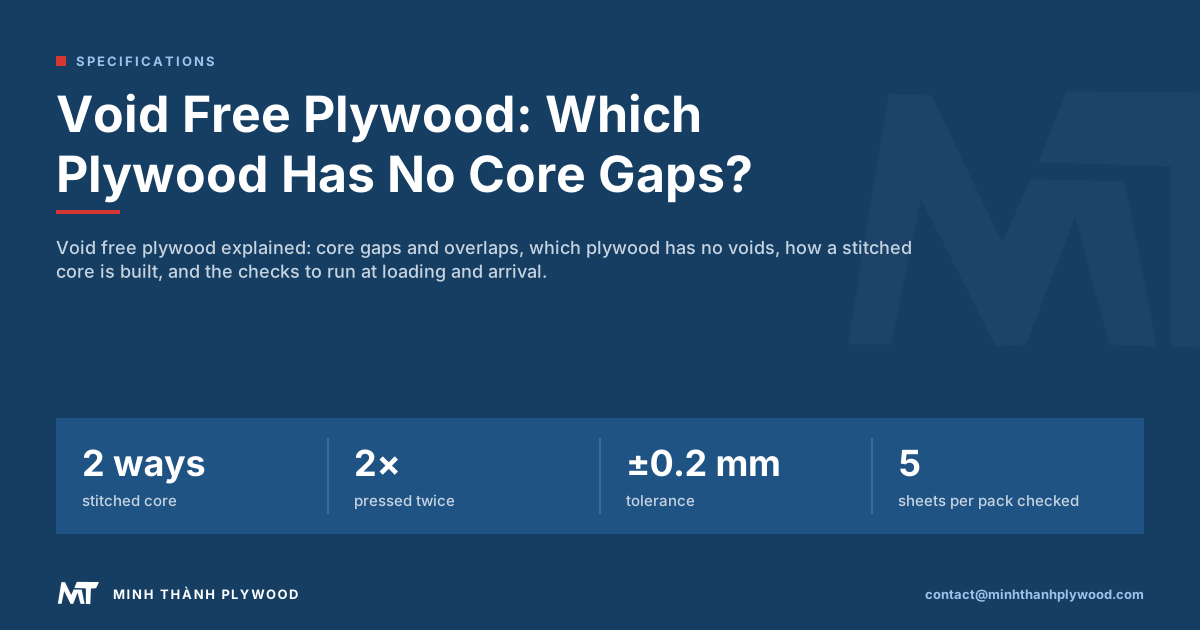
Void free plywood is plywood whose inner plies have no open gaps or overlapping veneer, so a cut edge, a router or a screw finds solid wood everywhere. All-birch, marine and calibrated furniture plywood are made that way. Minh Thanh Plywood stitches core layers horizontally and vertically and presses furniture panels twice; a cut edge on the first pack shows the result.
What is void free plywood?
Void free plywood is plywood with no open gaps and no overlapping veneers in its inner plies. Wherever you cut it, the edge shows solid wood in every layer, and a router, drill or screw meets wood and glue instead of air.
The word “void” covers two faults inside a panel:
- Core gaps: open spaces between two veneer pieces in the same ply.
- Core overlaps: two veneer pieces lying on top of each other where they should meet edge to edge.
Both are hidden under the faces. A sheet can have a perfect face and still carry gaps in its third or fifth ply, which is why void free plywood is a question about the core, not the face grade.
Voidless plywood, gap-free core and solid core are other names buyers use for the same thing. None of them is a standard grade, so a buyer who needs it writes the core build and an inspection rule on the order.
Which plywood has no voids?
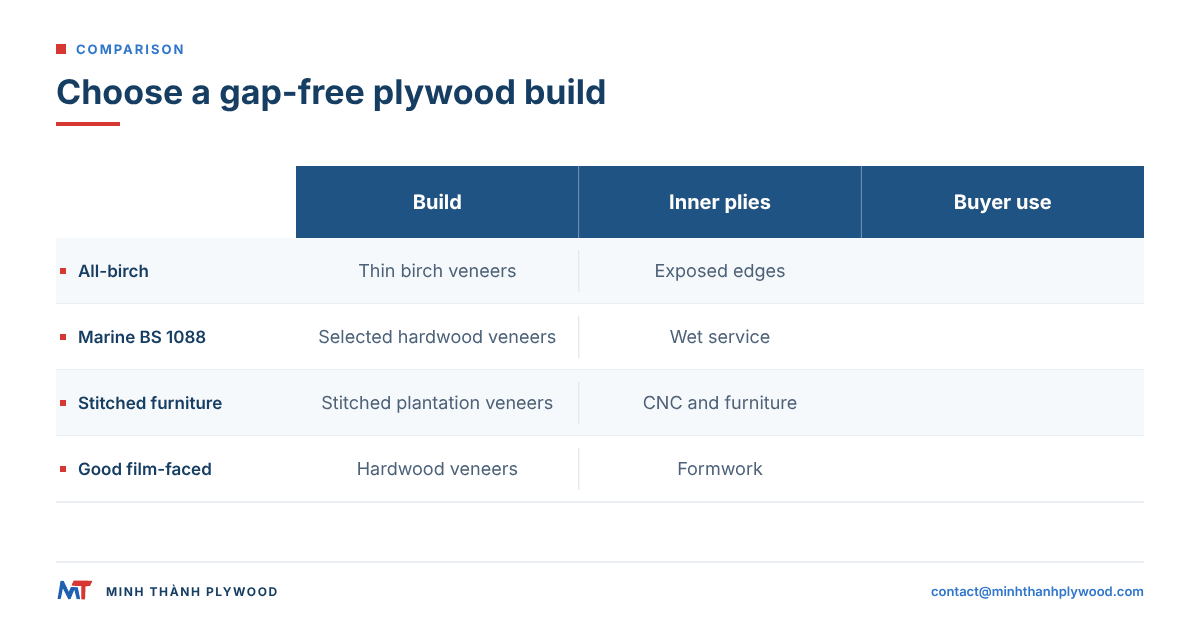
Plywood with no voids is plywood built from whole, even veneers that are joined or stitched before pressing. Four builds meet that description: all-birch, marine plywood to BS 1088, stitched-core furniture plywood and good-grade film-faced plywood. Construction grades with C or D inner plies usually do not.
| Plywood | Inner plies | Voids |
|---|---|---|
| Baltic and Finnish all-birch | Thin birch veneers, about 1.4 mm each | Gap-free core; the reference for exposed edges |
| Marine plywood to BS 1088 | Selected hardwood veneers, exterior glue | The standard sets strict core rules for wet service |
| Calibrated furniture plywood, stitched core | Plantation veneers stitched both ways | Gap-free core, flat and even for CNC and UV lines |
| Film-faced plywood, good grade | Hardwood veneers, water-resistant glue | Gap-free core, so water cannot enter at the edges |
| Construction plywood, C/D inner plies | Rotary veneers with splits and knot holes allowed | Gaps and knot holes are permitted by the grade |
BSI lists BS 1088:2018 for marine plywood in standard and lightweight classes, and BS EN 636:2012+A1:2015 for plywood used in dry, humid or exterior conditions.
For furniture and interior work, the practical choice is between all-birch and calibrated furniture plywood. All-birch gives the even multi-ply edge designers leave on show. Furniture plywood on a stitched white Styrax or Eucalyptus core gives a gap-free sheet at lower weight, for parts whose edges are banded, painted or hidden.
Void free plywood options and what they cost
Woodworkers searching for void free plywood want to know where to buy it and what a sheet costs. In Canada the trade names are “Baltic birch”, “cabinet grade” and “ACX” for outdoor jobs; the panel with the most plies per thickness is the all-birch one. The table compares the options at 3/4 in. (18 mm).
| Option | Plies at 3/4 in. (18 mm) | Void-free? | Typical price (October 2026) |
|---|---|---|---|
| All-birch Baltic or Finnish | 13 plies | Yes, the reference for exposed edges | Premium: US$136 for a 4 × 8 ft sheet at one US merchant; C$53 to C$141 for a 5 × 5 ft sheet across thicknesses at an Alberta yard |
| Marine plywood to BS 1088 | Set by the standard’s veneer rules | Yes, by core rules | Typically the most expensive sheet in the yard |
| Mil-spec aircraft basswood | 9 plies on a 3/4 in. panel | Yes | US$140 for a 2 × 4 ft sheet, about US$560 a 4 × 8 ft sheet |
| Lumber core, ash or oak | Solid strips under faces | Close to void-free, not completely | Cheaper than Baltic birch, per a yard quoted on a woodworking forum |
| MDF core | Fibre core under veneer faces | Yes | Low, but heavy and weak at screws |
| Minh Thanh stitched-core furniture plywood | Stitched core layers, set by the build | Yes, no gap or overlap rule on the order | From US$350/m³ FOB, about US$19 per 18 mm 4 × 8 ft sheet before freight (raw FOB example: 0.0536 m³ × US$350) |
The Minh Thanh row is a container price for importers, not a shelf price: freight, duty and the importer’s margin come on top, and a birch or other face adds a premium to the starting figure. It shows why a Canadian buyer who is paying Baltic birch shelf prices can still find a gap-free panel for far less by the container.
What are core gaps and core overlaps?
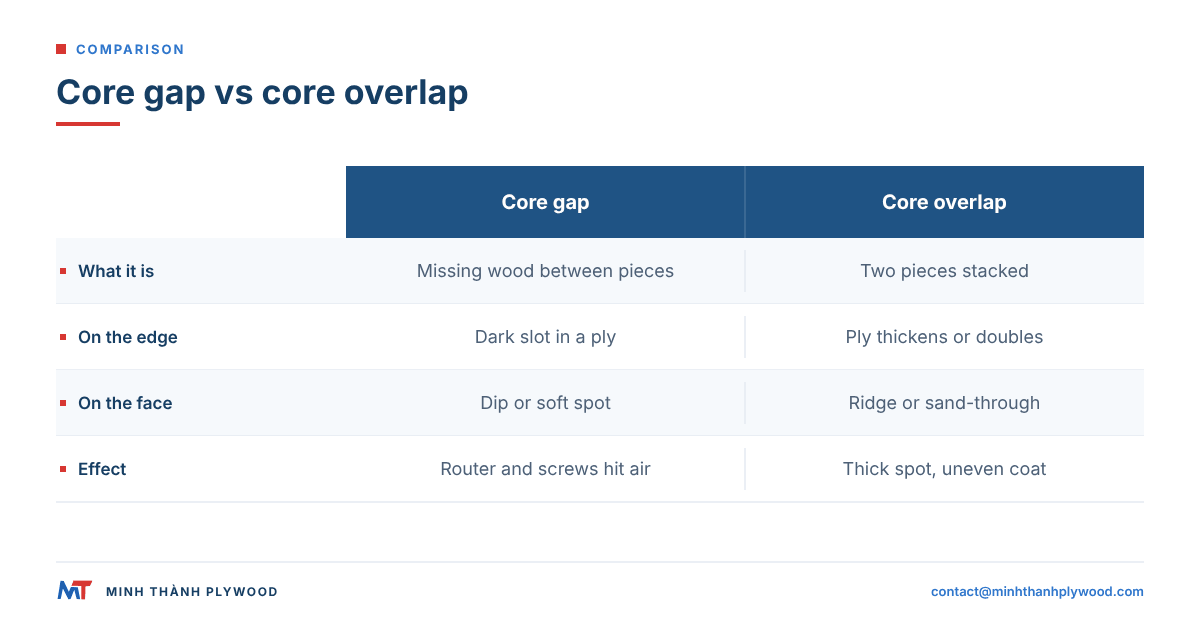
A core gap is an open space between two veneer pieces in one ply; a core overlap is two pieces lying one on top of the other. Both come from how the core veneers are laid up before the press.
| Core gap | Core overlap | |
|---|---|---|
| What it is | Missing wood between two core pieces | Two core pieces stacked where they should meet |
| On a cut edge | A dark slot inside a ply | A ply that thickens or doubles for a short run |
| On the face | A dip or soft spot, sometimes a crack line | A raised ridge, or a sand-through of the face |
| Effect on use | Router and screws meet air; water can enter | Thick spot, uneven lacquer, face breakthrough |
| Usual cause | Pieces laid apart, veneer shrink, missing piece | Pieces pushed together, poor joining |
Overlaps are the less obvious fault. The press squeezes the doubled area harder, so the sheet comes out with a slight hump. When the sheet is sanded to thickness, the sander takes the hump off the face, and in the worst case breaks through to the core.
A third fault often found with gaps is a split in a core veneer: a crack that opened in drying and was pressed in. Splits behave like narrow gaps and are checked the same way.
Why do voids matter for furniture, CNC and formwork?
Voids matter because the work done on plywood reaches inside it. Every cut, hole and profile exposes or loads the inner plies, and a hidden gap becomes a visible defect or a weak point at that moment.
- CNC nesting and edge profiles: a router that runs into a gap leaves a hole in the edge. On a banded edge the band sinks into it; on a profiled edge the part is scrap.
- Hinges, drawer runners and screws: a screw driven into a gap holds nothing. Cabinet hinges and runners need solid wood under the face.
- Thin faces and lacquer: a gap under a thin face shows through as a dip, and a UV or lacquer coat makes it more visible, not less.
- Laser cutting: a gap stops the beam’s cut line or leaves a burnt cavity in the edge.
- Film-faced formwork: a gap at the edge lets concrete water into the core; the core swells and the film lifts, which ends the panel’s reuse early.
- Flatness: gaps and overlaps unbalance the panel, so it can bow after the faces are pressed.
A furniture plant counts voids in lost parts and slower lines, not in the price of the sheet. A panel that is a little dearer and has a solid core is usually the cheaper panel once machining starts.
What causes voids in plywood cores?
Voids come from the core veneers and from how they are laid up. Most can be traced to one of five causes:
- Veneer shrinkage. Wet veneer laid tight shrinks as it dries in the press and opens into gaps. Veneers dried to the right moisture before lay-up do not move.
- Hand lay-up without joining. Loose core pieces laid by hand shift when the sheet is handled, opening gaps on one side and overlaps on the other.
- Split and broken veneer. Cracks from peeling or drying, and broken corners, leave gaps unless the piece is graded out.
- Knot holes. Loose knots fall out and leave holes, which construction grades allow and furniture grades do not.
- Missing pieces at the panel edge. Short core strips at the edge leave an open edge void that shows on the first trim cut.
The causes point to the controls: grade the core veneer, dry it, join or stitch the pieces so they cannot move, and inspect the edges after pressing.
How is a void-free core built? Steps at the mill
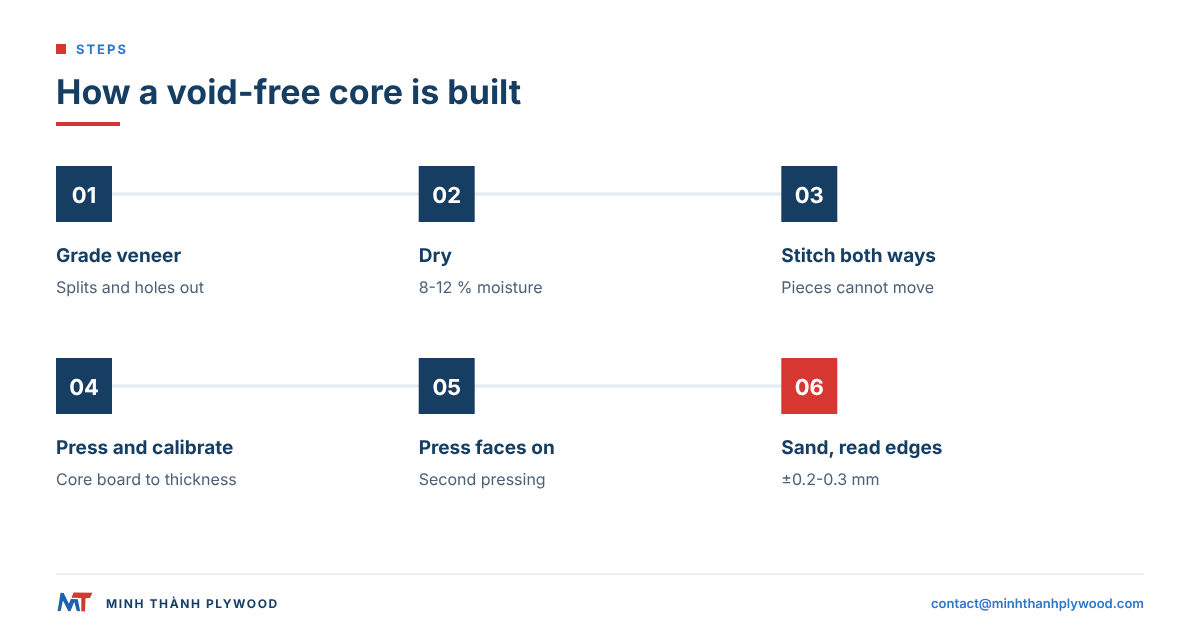
A void-free core is built in the steps before the press, not fixed after it. At Minh Thanh Plywood the furniture-grade build follows these steps:
- Grade the core veneer. Plantation veneers of white Styrax or Eucalyptus are graded; split, broken and knot-holed pieces go to lower-grade work.
- Dry to target moisture. Veneers and finished panels are dried to 8–12 % moisture content, so the pieces do not shrink open in the press.
- Stitch the specified core layers both ways. Core pieces are stitched horizontally and vertically into a whole layer. A stitched layer moves as one sheet, so pieces cannot drift apart into gaps or slide over each other into overlaps.
- Lay up cross-grain. Each stitched layer is laid at right angles to the one below, with glue spread on the layers between.
- Press and calibrate the core board. The core is pressed, then calibrated to thickness, so any small high spot is removed before the faces are added.
- Press the faces on. Face and back veneers go on in a second pressing. The furniture panel is pressed twice as standard.
- Sand and measure. Faces are sanded and polished; thickness is held to ±0.2–0.3 mm, down to ±0.2 mm.
- Read the edges. Trimmed edges are inspected before packing, which is where a gap or overlap would show.
Step 3 is the one that separates a gap-free core from a “usually good” one. Stitching in both directions holds the pieces in each stitched layer in place through glue spreading, lay-up and loading into the press. Step 5 is the second safeguard: calibrating the core board before the faces go on means the face is never sanded through to reach thickness.
Voidless plywood and voidless birch plywood: same thing?
Voidless plywood and void free plywood are the same request: a panel with solid inner plies. “Voidless” is the more common word in North America; “void free” in Europe and Asia.
Voidless birch plywood is a narrower term. It usually means Baltic or Finnish all-birch: every ply is a thin birch veneer, so the core is gap-free and the edge shows even pale lines. Many buyers ask for it for drawer boxes, jigs and laser parts.
Birch-faced plywood can also be gap-free, but its core is another species. At Minh Thanh it is a stitched white Styrax or Eucalyptus core under birch faces graded D+, D or E. On a banded or covered edge it does the same job as all-birch at lower weight: about 26.8 kg for an 18 mm sheet of 1220 × 2440 mm on a Styrax core.
When you order, name the build rather than the adjective: “all-birch” or “birch-faced, stitched Styrax core”. The core species and the stitching are what make the panel voidless, not the word on the label.
How do you check plywood for core voids at loading?
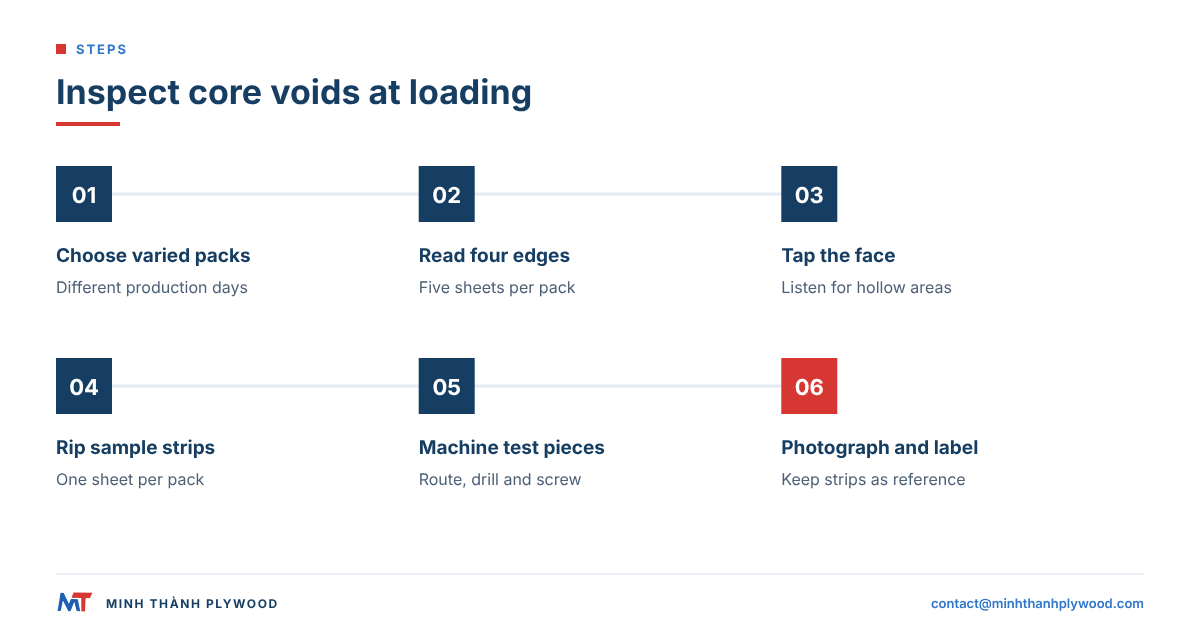
Check for core voids at loading by reading the edges of sheets from several packs and cutting one sample sheet into strips. A gap or overlap shows on a cut edge in seconds.
- Choose packs. Pick packs from different production days, not only the top of the stack.
- Read all four edges. On five sheets per pack, look along each trimmed edge for dark slots (gaps), doubled plies (overlaps) and open cracks (splits).
- Tap the face. A light knock across the face gives a dull, even sound over solid wood and a hollow sound over a void or a blister.
- Cut a sample sheet. Rip one sheet per pack into strips across and along the grain. Each new cut shows another section of the core; read every edge.
- Run your own machining. Route a profile, drill a hinge cup and drive the screws you use on the line, on the sample strips.
- Photograph and label. Photograph each cut edge beside the pack label and keep the strips as the reference.
Every Minh Thanh shipment is photographed and filmed before loading, and buyers receive the photos and video. A buyer who wants a third-party inspector at loading can send one, and the inspector runs the same cut-strip check.
How do you check core voids on arrival?
On arrival, repeat the edge check and the cut-strip check on packs from the front, middle and back of the container, before the panels go into production.
- Edges first: read the edges of five sheets in each opened pack, as at loading.
- One cut sheet per pack: rip it into strips and read every cut edge.
- Machining trial: run the first sheets through your real CNC program, edge bander and hinge drilling before releasing the batch.
- Compare with the loading record: match pack labels with the loading photos and video.
If a cut edge shows a gap, photograph it with the pack label and a ruler, note the sheet and the position, and send the photos with the pack number, so the mill looks at the same sheet you did.
What gap and overlap rule can you write into a purchase order?
Write the core rule as something an inspector can check on a cut edge, and tie it to the build. A clear purchase order rule has four lines:
- Build: “Furniture plywood, core layers stitched horizontally and vertically, pressed twice, core calibrated before facing.”
- Acceptance: “No open core gap and no core overlap visible on any trimmed or cut edge of inspected sheets; no hollow sound on tap test.”
- Sampling: “Five sheets per pack, edges read; one sheet per pack ripped into strips; packs from at least three production days.”
- Reference: “Approved sample retained by both parties; cut edges photographed with pack labels.”
This rule works because it describes what both sides can see. A rule with a gap width in millimetres needs a measuring method and a sampling plan to mean anything; “none visible on any cut edge of a stitched core” is checked in the same way at the mill, at loading and on arrival.
For marine work, the order names BS 1088 and its own core rules instead. Minh Thanh’s furniture plywood is not sold as marine plywood: for wet service we make panels with water-resistant phenolic (WBP) or melamine-fortified bonds to the customer’s specification.
Which core build for which use?
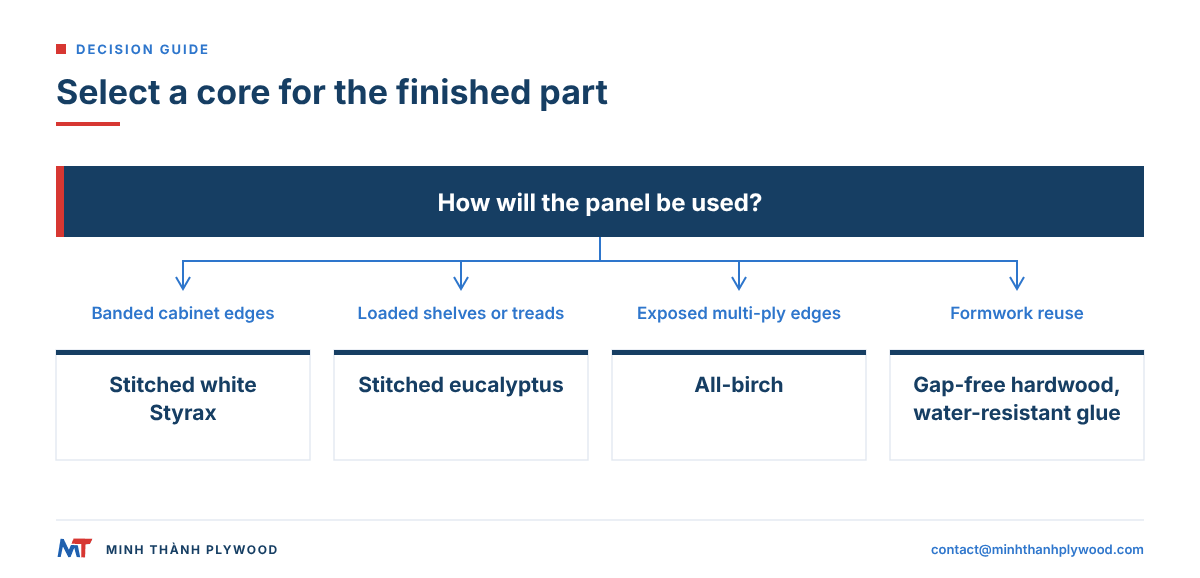
Choose the core by what the part does with its edges and holes. A gap-free core is standard for furniture-grade panels; the choice is the species.
| Use | Core to order | Why |
|---|---|---|
| Kitchen and bathroom carcasses, banded edges | Stitched white Styrax core | Gap-free and light; 26.8 kg per 18 mm sheet |
| Shelves, tabletops, stair treads | Stitched Eucalyptus core | Gap-free and stiffer; denser, heavier sheet |
| Exposed multi-ply edges, laser parts | All-birch | Even pale plies visible on the edge |
| UV-coated doors and panels | Stitched core, double pressed, ±0.2 mm | Flat face for roller coating; both faces UV-ready |
| Formwork reuse | Gap-free hardwood core, water-resistant glue | No path for water at the edge |
| Packing and crates | Commercial core | Strength over appearance; small voids tolerated |
Furniture and interior plywood from Minh Thanh starts from US$350/m³ (October 2026); commercial plywood for packing from US$250/m³. The price difference pays for the graded, stitched core and the second pressing.
How to order void free plywood from Minh Thanh
Send one specification line per panel, with the core rule written in. A complete line reads:
“Furniture plywood, birch faces, D+/D, white Styrax core stitched horizontally and vertically, pressed twice, UF glue at E0 emission, 18 mm ±0.2 mm sanded, 1220 × 2440 mm, no core gap or overlap on any cut edge, 990 sheets per 40HC.”
What comes with it:
- Documents: CARB P2 / TSCA Title VI certification (ICTT mill no. 23024), ISO 9001:2015 for plywood manufacturing (KAC25/0185), and the EUDR compliance dossier with origin records and geolocation files for EU orders. The US limit for hardwood plywood made with a veneer core or a composite core is 0.05 ppm under EPA’s TSCA Title VI requirements.
- Proof at loading: photos and video of every shipment before loading, and third-party inspection or SGS testing on request, so the buyer’s own customers can see the core before the doors close.
- For Canadian buyers: the same stitched-core build is sold there as cabinet-grade or Baltic-style plywood; state “no core gap or overlap on any cut edge” next to whichever name your market uses.
- Terms: one 40HC minimum with mixed specifications by agreement; production 15–45 days after the 30% deposit; balance 70% against the scanned B/L, or irrevocable L/C at sight; FOB Hai Phong, CFR or CIF.
- Samples: free samples, cut so you can read the edges and run your own machining.
Send the line to contact@minhthanhplywood.com or WhatsApp +84 988 586 601; Lisa replies within hours. For the full panel range see furniture plywood from Vietnam, and for the mill’s checks see quality control. Related guides as they are published: common plywood defects, how to check plywood quality before shipment and third-party plywood inspection in Vietnam.
Buyer questions, answered
How much does void free plywood cost?
Void free plywood costs more than construction grades. In October 2026 one US merchant lists 3/4 in. Baltic birch at $136 for a 4 × 8 ft sheet, and mil-spec basswood at $140 for a 2 × 4 ft sheet. A stitched-core furniture plywood from Vietnam starts from US$350/m³ FOB, about US$19 per 18 mm 4 × 8 ft sheet before freight.
Which plywood has no voids?
All-birch plywood, marine plywood made to BS 1088 and calibrated furniture plywood with stitched cores are built without open core gaps. Construction-grade plywood with C or D inner plies usually has some.
What is void free plywood?
Plywood whose inner veneers are laid edge to edge with no open gaps and no overlaps, so the core is solid wherever you cut, drill or rout it.
What is a core gap in plywood?
A core gap is an open space between two core veneer pieces inside the panel. It shows on a cut edge as a dark slot and leaves the faces unsupported above it.
What is core overlap in plywood?
Core overlap is where two core veneer pieces lie on top of each other instead of edge to edge. It makes a local hump that sanding can break through and a thick spot in the panel.
Is voidless plywood the same as void free plywood?
Yes. Voidless and void free are two names for the same thing: plywood with solid, gap-free inner plies. The words are trade terms, so the core build and an inspection rule still go on the order.
Is voidless birch plywood all birch?
Usually yes: voidless birch plywood normally means Baltic or Finnish all-birch. Birch-faced plywood on a stitched Styrax or Eucalyptus core is also gap-free, with a white or pinkish core between the birch faces.
How do I check plywood for voids without cutting every sheet?
Read the four edges of sheets from several packs, tap the faces for hollow sounds, and cut one sample sheet per pack into strips to see the inner plies.
Why are core gaps bad for furniture plywood?
A gap opens up when a CNC router or edge profile reaches it, leaves screws and hinges in air, and can show as a dent through a thin face or a lacquer coat.
Can you fill voids in plywood?
Edge voids can be filled with wood filler or banded over, but a gap inside the panel cannot be reached. The cheaper fix is to buy a stitched, gap-free core.
Is film-faced plywood void free?
Good film-faced plywood has a gap-free core, because a hidden gap lets water in at the edge and lifts the film. Ask for the core build and an edge cut before ordering.