
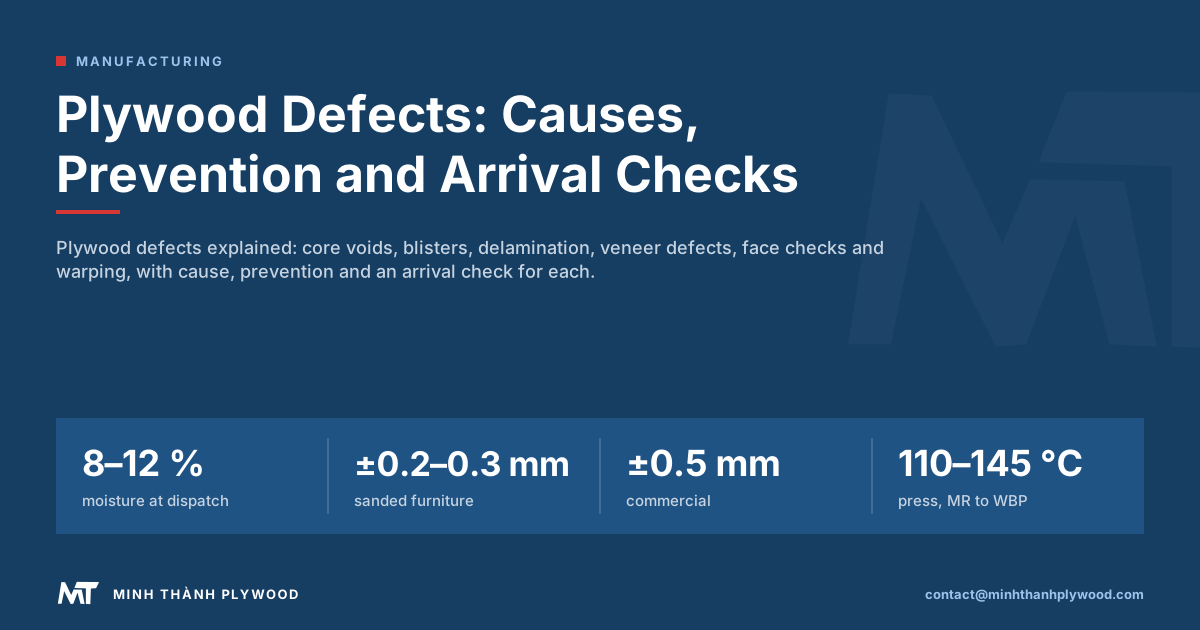
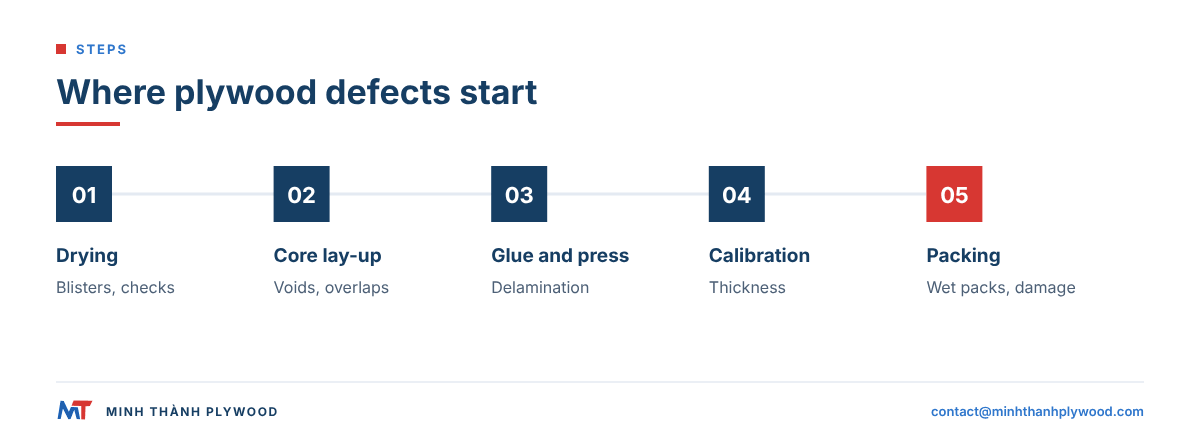
The plywood defects that cause most claims are core voids and overlaps, blisters, delamination, face veneer defects, face checks, warping and uneven thickness. Each starts at a known step: drying, core lay-up, glue spread, pressing or packing. Minh Thanh Plywood prevents them with stitched cores, twice-pressed furniture panels and calibrated sanding; this guide shows how to find each one on arrival.
What are the most common plywood defects?
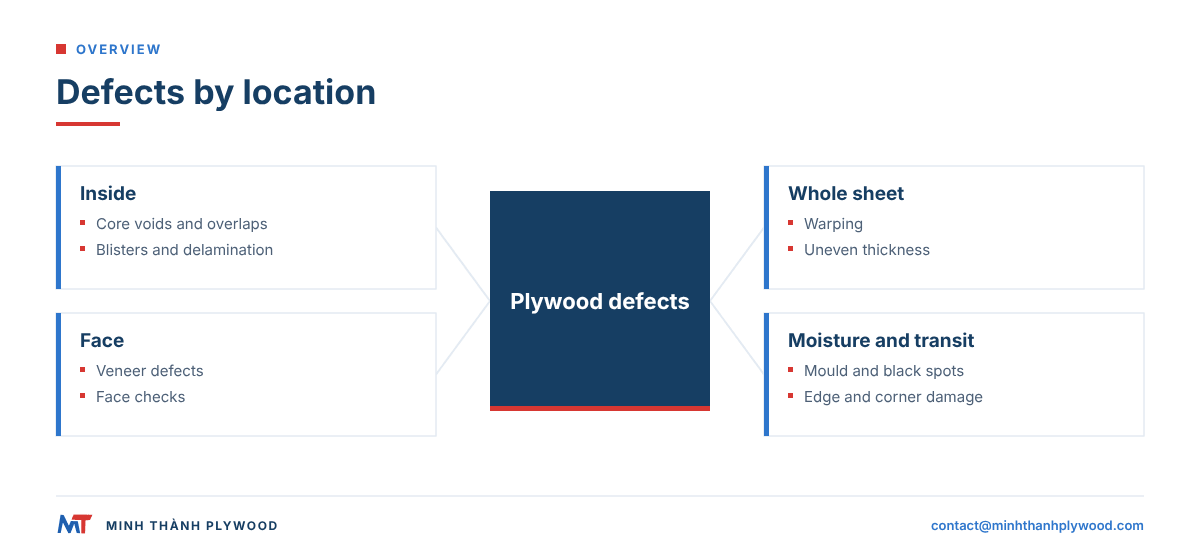
The most common plywood defects fall into three groups: inside the panel (core voids, overlaps, blisters, delamination), on the face (veneer defects and face checks) and in the whole sheet (warping, uneven thickness, moisture and transit damage). The table gives each defect, the step where it starts and the check that finds it.
| Defect | Where it starts | How to find it | Prevention at the mill |
|---|---|---|---|
| Core voids and gaps | Core lay-up | Look at all four edges; cut a sample | Stitched core veneers |
| Core overlaps | Core lay-up | Ridge or bump felt through the face; thick spots | Careful lay-up, calibrated core |
| Blisters and bubbles | Drying, glue spread, pressing | Knock test: hollow sound | Veneer dried to 8–12 %, full glue spread |
| Delamination | Glue spread, pressing, moisture | Layers parting on an edge; soak test | Correct glue, press time and temperature |
| Face veneer defects | Veneer grading and repair | Visual check against the sample | Grading and patching to the grade |
| Face checks | Peeling, over-drying | Hairline cracks along the face grain | Tight face up, correct drying |
| Warping | Unbalanced layers or moisture | Sheet on a flat floor | Balanced build, double pressing |
| Uneven thickness | Calibration, pressing | Caliper at corners and centre | Calibrated sanding |
| Mould, black spots | Damp veneer or packing | Visual check of faces | Drying, dry packing |
| Edge and corner damage | Handling, loading | Pack edges on unloading | Export packing, corner guards |
The sections below take each defect in turn: cause, how the mill prevents it and how you check it.
Core voids, gaps and overlaps
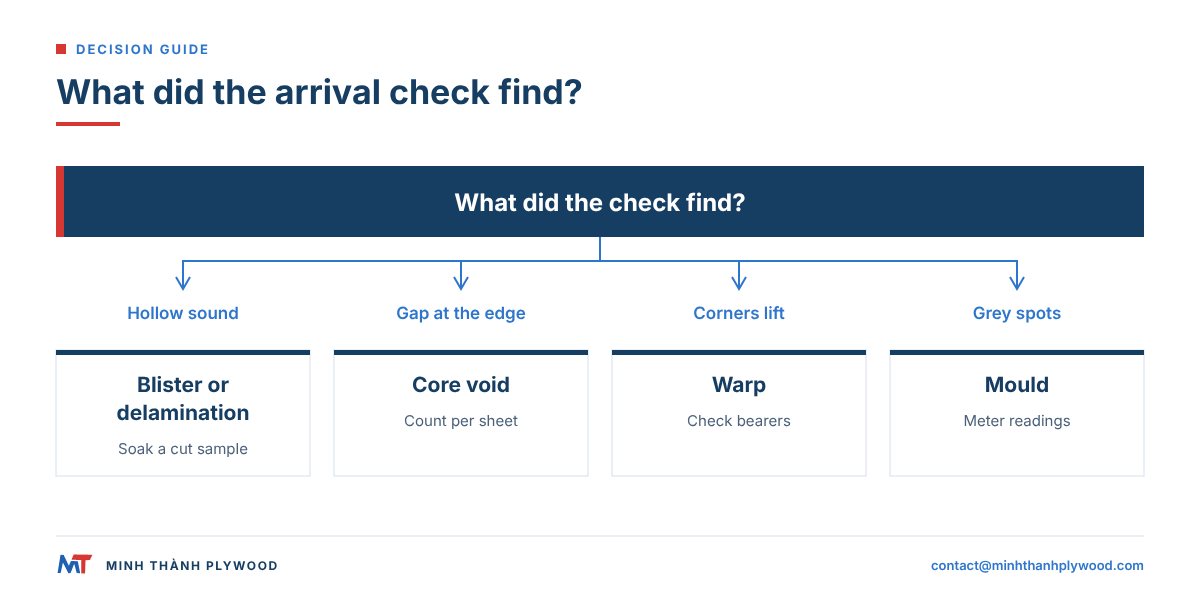
Core voids are empty spaces between core veneer pieces, and overlaps are places where two pieces lie on top of each other. Both come from the core lay-up: pieces laid loose, short pieces, or veneer that shrank after it was laid.
Why they matter. A void under the face sinks when pressed, telegraphs through thin laminates, and leaves a hollow where a screw or hinge should hold. An overlap makes a thick ridge that shows after sanding and lamination.
Prevention. Core veneers are jointed or stitched into full sheets before lay-up, so they cannot drift apart. Minh Thanh stitches core layers both horizontally and vertically, and presses furniture panels twice: the core board is pressed and calibrated first, so a void or overlap shows up before the face goes on.
Check on arrival.
- Look at all four edges of sheets from several packs; voids show as dark gaps between layers.
- Run a hand across the face for ridges.
- Cut one sample sheet into strips to see the inner layers, if the order allows.
For panels where no gap is acceptable, read void-free plywood.
Why does plywood blister or peel?
Plywood blisters when steam or air is trapped between the face and the core in the hot press, and it peels when a glue line that never cured fully gives way. The usual causes are wet veneer, a spot with no glue, contamination on the veneer, or a press opened before the steam escaped.
| Cause | What happens | Prevention |
|---|---|---|
| Veneer too wet | Water turns to steam and lifts the face | Veneer dried to 8–12 % |
| Glue missing in a spot | No bond under part of the face | Even glue spread, checked rollers |
| Dust, oil or resin on veneer | Glue cannot wet the wood | Clean veneer, clean lay-up |
| Press opened too fast | Steam bursts out under the face | Correct press time and pressure release |
| Overlap under the face | Pressure misses the area next to it | Clean core lay-up |
Check on arrival. Tap the face with a knuckle or a small hammer across the sheet. A sound panel gives a solid, even note; a blister sounds hollow and the area may feel raised. Mark hollow areas and count them per sheet.
Wet veneer is the most common root cause; the drying side is covered in veneer drying for plywood.
Delamination and weak glue lines
Delamination is the separation of plywood layers along a glue line, and it is the defect buyers fear most because it cannot be repaired. It starts with a glue line that cured badly: wrong glue for the use, too little glue, wet veneer, low press temperature or short press time.
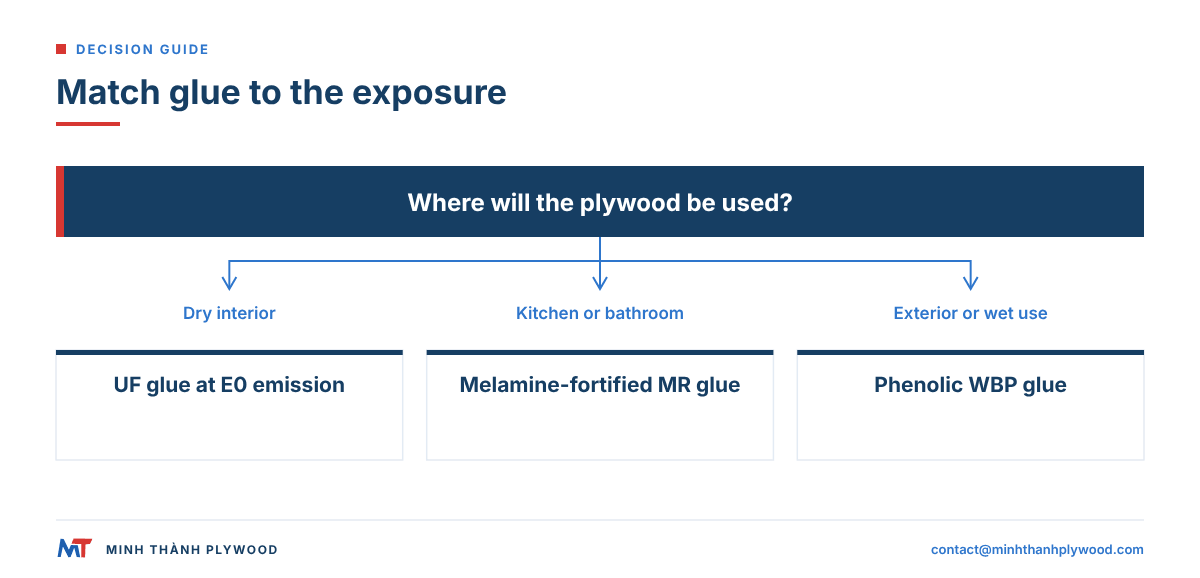
Glue must match the use. UF glue at E0 emission is the standard for dry-room furniture and interior panels. Melamine-fortified (MR) glue suits kitchens and bathrooms; phenolic (WBP) glue suits exterior and wet use. A UF-bonded interior panel used outdoors is not a manufacturing defect but a specification mistake.
Press conditions. MR glue is pressed at about 110–120 °C and phenolic WBP at 130–145 °C. Too cool or too short, and the glue does not cure through.
Check on arrival.
- Look at sheet edges for open glue lines.
- Cut small samples from several sheets.
- Soak them in water for the period agreed in the order, or use the buyer’s agreed boil or cyclic test for MR and WBP bonds.
- Try to split the layers with a chisel; a sound bond tears wood fibre rather than parting cleanly at the glue line.
Bond quality is tested to EN 314 in Europe and to the ISO 12466 series internationally. For the full topic, see plywood delamination.
Veneer defects on the face
Veneer defects are the visible faults in the face and back sheets: knots, splits, patches, open joints, colour streaks, rough grain and sanding through. Some are natural to the wood, some come from processing; the face grade decides how many of each a sheet may show.
| Veneer defect | Natural or process | Allowed in better faces? |
|---|---|---|
| Sound (tight) knots | Natural | Small and few |
| Open knots and holes | Natural | No; patched in middle grades |
| Patches (plugs) | Repair | Few, tight, colour-matched |
| Splits | Natural or drying | No in top grades; filled in lower grades |
| Open joints between face pieces | Process | No |
| Colour streaks and mineral marks | Natural | Limited, as on the sample |
| Rough or torn grain | Peeling | No on visible faces |
| Sanding through to the core | Process | No |
| Glue bleed-through | Process | No on visible faces |
Face grades are quoted as a face/back pair and fixed by the approved sample. At Minh Thanh, poplar and eucalyptus faces are quoted A/A, A/B or B/B; birch faces D+/D or D/E, where D+ is about the European birch grade B, D about BB and E about CP/C. In Europe, EN 635 appearance classes and the birch grades B, BB, CP and C list the limits per defect; Vietnamese mills match the buyer’s sample to the same ladder.
Veneer sorting before lay-up keeps a face grade consistent; see veneer grading at our factory.
Face checks: what are checks in timber and veneer?
Checks in timber are cracks along the grain that open as wood dries; in plywood, face checks are hairline splits in the face veneer. They often appear months later, after a panel is painted or sits in heated, dry air.
Why rotary veneer checks. When a lathe peels a log, the knife bends the veneer sharply, and tiny lathe checks open on one side of the sheet, the “loose side”. If the loose side ends up facing out, or the veneer is dried too hard, the checks widen into visible cracks.
Prevention.
- Lay face veneers tight side out.
- Dry face veneer to the band, not below it.
- Use a face thick enough for the finish; faces on furniture plywood are usually 0.2–0.5 mm, often 0.3 mm for European orders.
- Seal or prime the face soon after sanding when the panel is to be painted.
Check on arrival. Look at the face at a low angle against the light. Fine dark lines along the grain are checks. Wood checks are a cosmetic defect: they do not weaken the glue bond, but they matter on a visible face. The USDA Wood Handbook, chapter 13 (2010) explains how drying stresses open checks in wood.
Warping, bow and twist
Warping is any departure from flat: bow along the length, cup across the width, or twist from corner to corner. It comes from unbalanced construction, moisture that differs between layers or faces, or storage that bends the sheets.
| Warp cause | Where it starts | Prevention |
|---|---|---|
| Face and back of different thickness or species | Lay-up | Matched face and back |
| Veneer moisture differs between layers | Drying | All layers dried to one band |
| Panel stacked hot after pressing | Pressing | Cooling before stacking |
| Pack on uneven bearers | Storage, transit | Level bearers, flat storage |
| Panel exposed on one face to damp or heat | Use or storage | Seal both faces, store covered |
Minh Thanh presses furniture-grade panels twice: the core board is pressed and calibrated before the faces go on, so the finished panel starts from a flat, even base.
Check on arrival. Lay a sheet face up on a flat floor and look for corners that lift, then turn it over. For a measured check, lay a straightedge across the sheet and measure the largest gap.
Thickness variation and calibration
Uneven thickness within a sheet or between sheets is a defect when it goes beyond the tolerance of the product line. For laminating, CNC and flat-pack furniture it matters as much as the face.
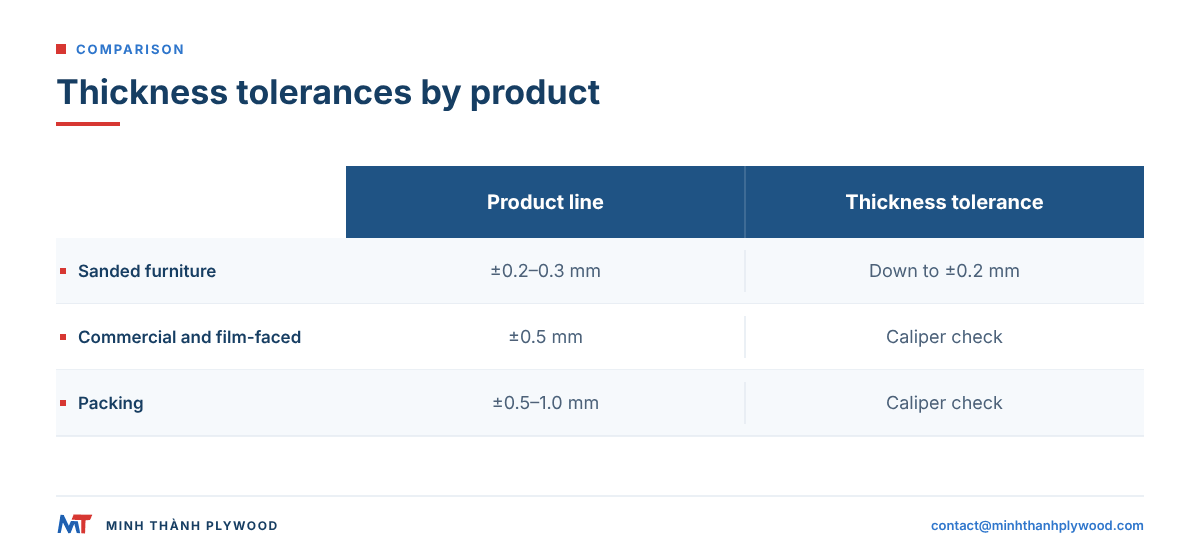
| Product line | Thickness tolerance at Minh Thanh |
|---|---|
| Sanded furniture panels | ±0.2–0.3 mm, down to ±0.2 mm |
| Commercial and film-faced | ±0.5 mm |
| Packing | ±0.5–1.0 mm |
| Length and width | ±2 mm |
Calibrated sanding on the core board, then again after the faces are pressed, keeps furniture panels in that band.
Check on arrival. Measure with a caliper at the four corners and the centre of sheets from several packs, and compare the spread with the tolerance in the order. Read more in calibrated plywood.
Moisture problems: mould, black spots and swelling
Moisture defects appear when veneer or panels hold too much water: grey or black mould spots, blue sap stain, swollen edges and a musty smell when a pack is opened. They start with veneer stored wet before drying, panels packed damp, or water reaching the pack in transit.
Prevention. Minh Thanh dries veneers and finished panels to 8–12 % moisture content at dispatch, the normal range for furniture plywood, and packs panels in wrapped export packs.
Check on arrival.
- Smell and look inside the first opened packs; mould shows first at the centre of tight stacks.
- Take moisture readings on sheets from several packs.
- Check the pack bottoms and container floor for water marks.
Spots and stain on faces are covered in black spots and blue stain on plywood.
Plywood damage in transit and storage
Plywood damage after the factory is handling damage: crushed edges and corners from forklifts and straps, broken sheets at the top or bottom of packs, wet packs from leaks or condensation, and sheets bent by bad stacking. Plywood broken in transit is a logistics claim, not a manufacturing defect, so record it before signing for the container.
How Minh Thanh packs. Panels travel in export packs built from four materials: cardboard, plywood pallet blocks, strapping band and wrapping film. Every shipment is photographed and filmed before loading; buyers receive the photos and video. See export packing and container loading.
On unloading:
- Photograph the container doors, seal number and load before unloading.
- Check pack corners and edges as each pack comes out.
- Note wet or damaged packs on the delivery receipt.
- Keep damaged sheets aside, with photos, for the claim.
Plywood manufacturing defects by process step
Plywood manufacturing defects can be traced to the process step where they begin, which is how a mill fixes them for good. The table runs through the line in order.
| Process step | Defects it can cause | Control at the mill |
|---|---|---|
| Peeling | Rough grain, thickness variation, lathe checks | Sharp knife, steady log turning |
| Drying | Blisters, checks, warping, mould | Dry to 8–12 %, measure each batch |
| Grading and jointing | Open joints, mixed grades | Sorting to the grade, stitched joints |
| Core lay-up | Voids, overlaps | Stitched cores, careful lay-up |
| Glue spread | Blisters, delamination | Even spread, right glue for the use |
| First pressing | Weak bond, thick spots | Press time, temperature, pressure |
| Calibration | Thickness variation | Calibrated sanding of the core board |
| Second pressing | Face blisters, open joints | Clean faces, even pressure |
| Sanding and grading | Sanding through, marks | Final sanding and inspection |
| Packing and loading | Edge damage, wet packs | Export packing, photos before loading |
How to check plywood for defects on arrival
Check plywood on arrival with a sampling plan, a few hand tools and the approved sample. These ten steps find almost every defect in this guide.
- Before unloading: photograph the seal, doors and load.
- Draw sheets: open packs from the door end, middle and nose of the container.
- Edges: look at all four edges for voids, overlaps and open glue lines.
- Knock test: tap across the face to find hollow spots.
- Face: compare faces with the approved sample in daylight; count patches, knots and splits.
- Thickness: caliper at corners and centre; compare with the tolerance.
- Flatness: lay sheets on a flat floor; look for lifted corners.
- Moisture: meter readings on several sheets; furniture panels leave the factory at 8–12 %.
- Bond: cut and soak a few small samples for the agreed time.
- Record: photos, readings and sheet counts per defect.
For inspection before the container leaves Vietnam, see how to check plywood quality before shipment and third-party plywood inspection in Vietnam.
Defect acceptance criteria to copy into your purchase order
A defect is only a claim if the order said what was allowed. Copy these lines into the purchase order and swap in your own grade and tolerance. Each limit can be measured on arrival with the checks above.
| Defect | Limit to write in the order | How it is verified |
|---|---|---|
| Core voids and overlaps | None open at the edges; no hollow spot under the face | Edge inspection, knock test, one cut sample |
| Blisters and delamination | 0 per sheet; no open glue line on any edge | Knock test, soak or boil test on cut samples |
| Face and back grade | A named pair (A/B, B/B, D+/D) matched to the approved sample | Daylight comparison with the sample |
| Thickness | ±0.2–0.3 mm for sanded furniture panels, ±0.5 mm for commercial grades, measured at 4–6 points per sheet (corners and centre) | Caliper on sheets from several packs |
| Moisture content | 8–12 % at dispatch, method per EN 322 | Meter readings, oven-dry check if disputed |
| Bond class | EN 314-2 class 1, 2 or 3 to match the use, with the test report | Report plus a soak or boil test on 1–2 sheets per batch |
| Sampling | A written AQL level (ISO 2859-1) and the number of packs opened | See plywood quality control with AQL |
What a defect costs in the price. Buyers who accept a lot with flaws usually negotiate a downgrade. One trade source puts minor cosmetic flaws at a 5–10 % cut in value and severe structural defects at 30 % or more (Sumec Building Material, plywood manufacturing defects, accessed 21 October 2026). That is the reason to fix the grade and the limits in writing before the container is loaded: a cosmetic issue then has an agreed price, and a structural one is a reject.
Which standards and grade letters apply: US, EU and Asia
The defect words are the same everywhere; the grade names differ by market, so name the standard in the order.
- United States. Plywood is graded to Voluntary Product Standard PS 1 (construction and industrial plywood). Face veneer grades run A, B, C and D, and APA PRP-108 sets the performance rules for structural panels. A hardwood furniture panel is usually bought on the face pair and a written sample instead.
- Europe. EN 635 gives the appearance classes for faces and EN 322 the moisture method. EN 636 sets the moisture-resistance classes, and EN 314-2 the bond classes. Structural and some interior panels also need a declaration of performance and CE marking under the Construction Products Regulation (EU) No 305/2011. Its replacement, Regulation (EU) 2024/3110, applies in stages from 8 January 2026, so ask for a traceable declaration of performance with each lot.
- India. IS 303 covers general-purpose plywood and IS 710 marine plywood.
Minh Thanh Plywood quotes against the buyer’s standard and sample, and supplies the test reports named in the order.
What this means for your order
Most plywood defects are prevented by writing the right lines into the order, because each line fixes a step where defects start. Put these in your specification:
- Core: species and construction, for example white Styrax core, stitched, pressed twice.
- Glue and emission: UF glue at E0 emission for dry interiors; MR or WBP for damp or exterior use.
- Face and back grade: a pair such as A/B or D+/D, matched to an approved sample.
- Thickness tolerance: ±0.2–0.3 mm for sanded furniture panels.
- Moisture content: 8–12 % at dispatch.
- Inspection: sampling plan and the checks above, with the mill’s quality and certificates record; AQL levels as in plywood quality control.
- Packing: wrapped export packs on pallet blocks; photos and video before loading.
Minh Thanh Plywood makes furniture and interior plywood in Ha Hoa, Phu Tho, Vietnam, with Europe as its main market. MOQ is one 40HC with mixed specifications by agreement; production takes 15–45 days after the 30% deposit; samples are free. Send your specification to contact@minhthanhplywood.com, or see furniture plywood from Minh Thanh.
Buyer questions, answered
What are the most common plywood defects?
Core voids and overlaps, blisters, delamination, face veneer defects (open knots, splits, patches, open joints), face checks, warping and uneven thickness. Most start in drying, core lay-up, glue spread or pressing; transport adds edge damage and wet packs.
Why does plywood blister or peel?
Blisters form when steam or air is trapped under the face in the hot press, usually because the veneer was too wet, glue was missing in a spot or the press opened too fast. Peeling is a weak glue line giving way, often after moisture reaches it.
How do I check plywood for defects on arrival?
Open several packs from different parts of the container. Look at every edge for gaps and overlaps, knock the face to find hollow spots, measure thickness at corners and centre, check flatness on a flat floor and take moisture readings. Soak-test a cut sample for bond.
Does a small patch on plywood face mean it is low quality?
No. Patches that replace a knot or split are normal in many face grades, as long as they are tight, flush and match the colour the grade allows. Count and size of patches belong to the grade and the approved sample, not to a reject.
What are face checks in plywood?
Face checks are fine cracks along the grain of the face veneer. They start as small lathe checks from peeling and open when the face dries out or the panel goes through dry heating. A tight face and correct drying keep them closed.
Can I order Grade A/B face on both sides?
A/B means an A-grade face and a B-grade back; order A/A when both sides need A-grade appearance. Minh Thanh quotes poplar and eucalyptus as A/A, A/B or B/B and birch as pairs such as D+/D or D/E, matched to the approved sample.
What do birch plywood grades B, BB and CP allow?
European birch grades step down from B (almost clear, few small repairs) through BB (patches allowed) and CP to C (open defects allowed). Minh Thanh grades birch faces D+, D and E: D+ is about B, D about BB and E about CP/C.
Is warped plywood a manufacturing defect?
It can be: unbalanced construction or uneven veneer moisture warps a panel from the press. It can also be storage: packs left on uneven bearers or in damp or very dry air bend after delivery. Check flatness on arrival and store packs flat.
What causes core voids in plywood?
Gaps between core veneer pieces that were laid loose, shrank after drying or were short. Stitching core veneers into full sheets closes the gaps; Minh Thanh stitches core layers both horizontally and vertically.
How do I check face quality before shipment?
Inspect against the approved sample under daylight, on sheets drawn from several packs. Look at knots, patches, splits, colour and sanding marks, and record findings with photos. Minh Thanh photographs and films every shipment before loading.
Are black spots on plywood a defect?
Black or grey spots are usually mould or sap stain from damp storage of veneer or panels. They are a surface defect, not a bond failure, but they are not acceptable on a visible face. Panels dried to 8–12 % and packed dry avoid them.
What defect limits should I put in a plywood purchase order?
Write the grade pair matched to a sample, no open voids or blisters, thickness ±0.2–0.3 mm for sanded panels, moisture 8–12 % at dispatch, the EN 314-2 bond class with a test report, and an AQL sampling level. Minor cosmetic flaws are usually settled with a price cut of 5–10 %; structural defects are a reject.