
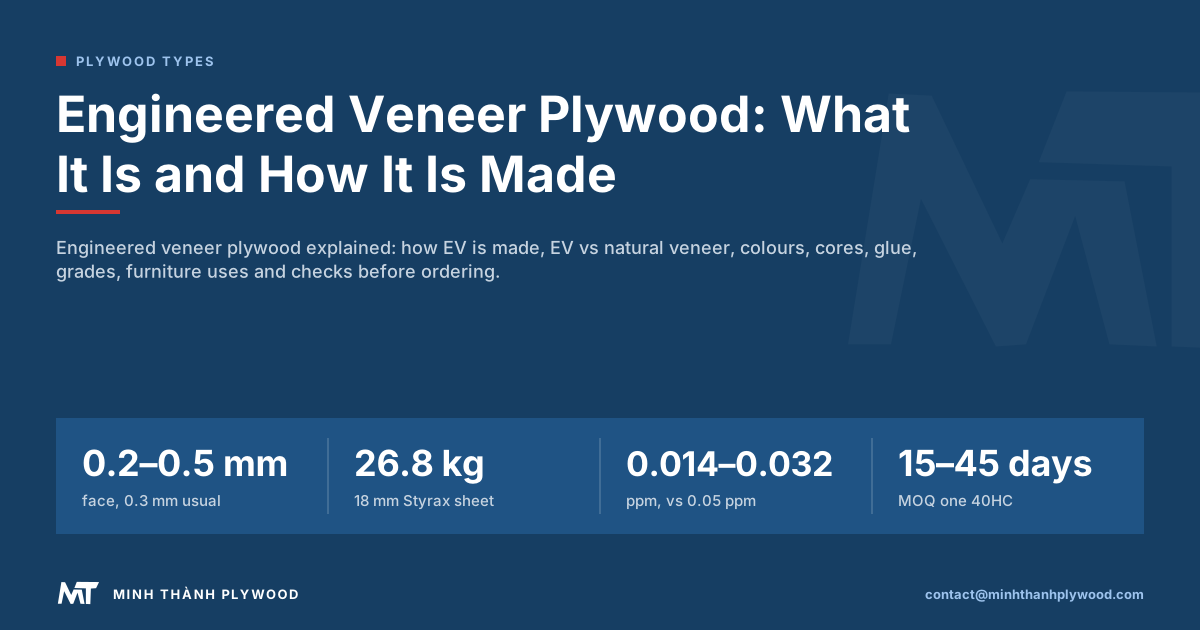
Engineered veneer plywood is plywood faced with engineered veneer: plantation wood that is peeled, dyed, glued into a block and re-sliced, so every sheet shows the same colour and grain. Furniture makers use it for kitchen runs, doors and wall panels that must match. Minh Thanh Plywood presses EV faces on white Styrax or Eucalyptus cores in Vietnam.
What is engineered veneer plywood?
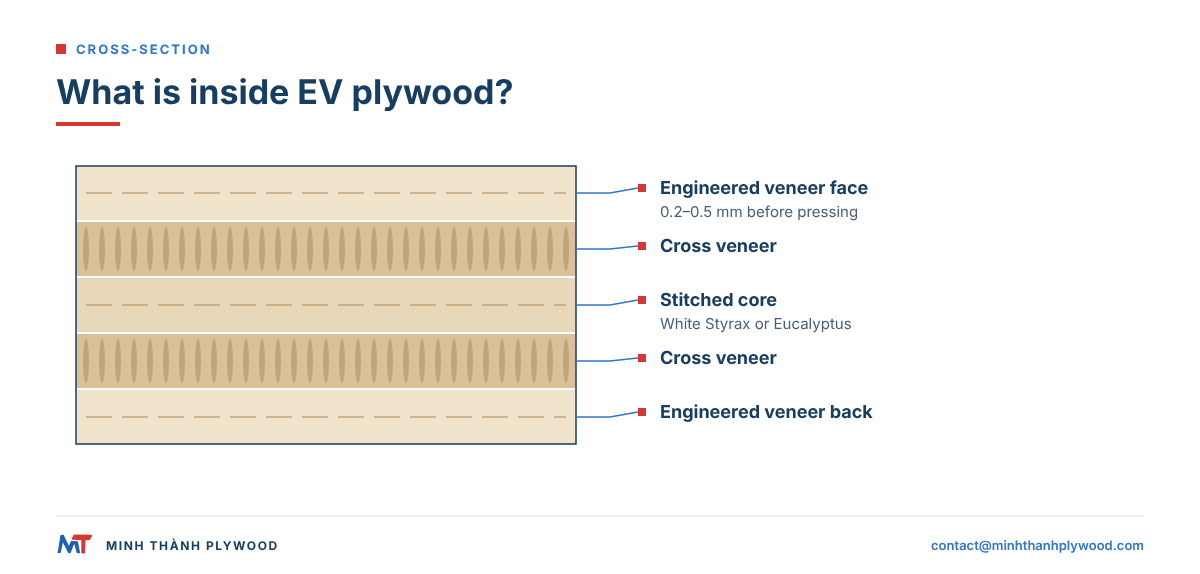
Engineered veneer plywood is a plywood panel whose face and back are engineered veneer, a wood veneer rebuilt from plantation timber to a fixed colour and grain pattern. The core underneath is ordinary cross-laminated plywood.
The face is real wood fibre. Fast-growing logs are peeled into thin sheets, dyed, glued into a block with the grain aligned and sliced again, so the pattern repeats from sheet to sheet. That repeatability is why furniture plants use it: a hundred doors from one order look like one set.
A Minh Thanh EV panel has three parts:
| Part | What it is | Typical choice |
|---|---|---|
| Face and back | Engineered veneer, 0.2–0.5 mm before pressing | 0.3 mm for European furniture |
| Core | Stitched plantation veneers, pressed and calibrated | White Styrax or Eucalyptus |
| Glue | Bond between all plies | UF glue at E0 emission, or MR or phenolic WBP to order |
What does EV plywood stand for?
EV plywood stands for engineered veneer plywood. The same panel has several trade names, and they all describe a face rebuilt from plantation wood:
- EV or engineered veneer: the usual English name.
- Recon veneer: short for reconstituted veneer.
- Recomposed veneer: common in European catalogues.
- Compensato EV: the Italian name; contreplaqué EV in French.
- Red EV, white EV, walnut EV: EV named by colour.
Our quotation names the pattern, colour, core, glue and grade, whichever trade name the buyer uses.
How is engineered veneer made?
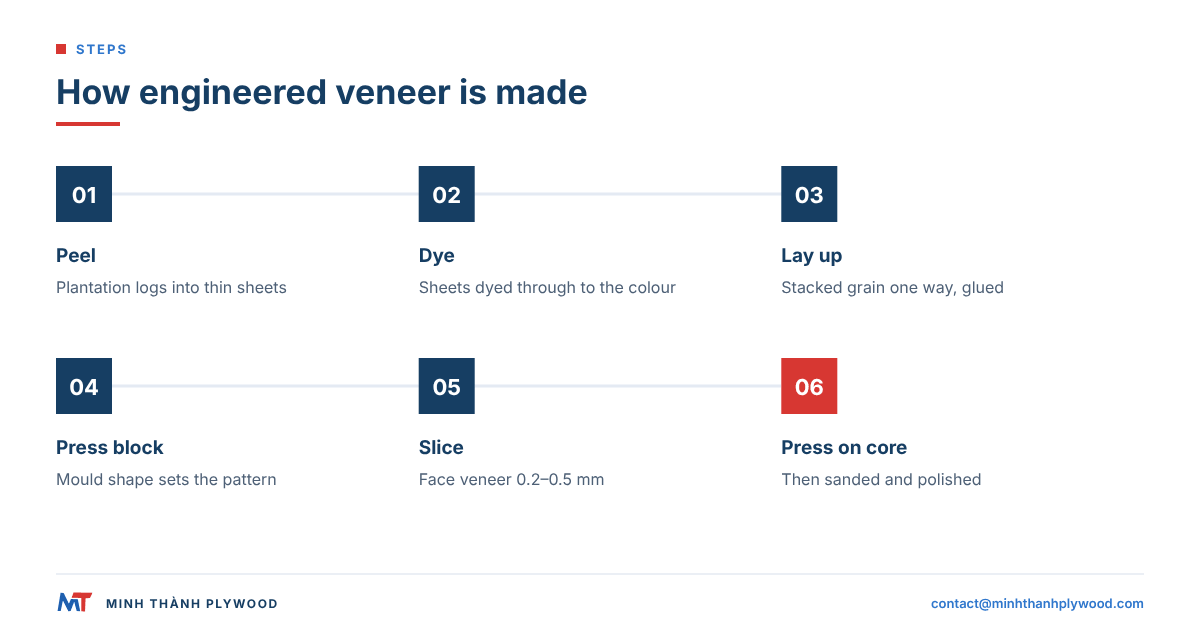
Engineered veneer is made in six steps, from plantation log to finished panel. The process turns many plain veneers into one designed face.
- Peel: fast-growing plantation logs are rotary-peeled into thin, plain veneer sheets.
- Dye: the sheets are dyed through to the target colour, such as pale, walnut, red or white.
- Lay up and glue: the dyed sheets are stacked with the grain in one direction and glued.
- Press into a block: the stack is pressed in a shaped mould; the mould shape sets the pattern, such as straight grain or crown.
- Slice: the cured block is sliced across its layers into face veneer 0.2–0.5 mm thick.
- Press onto plywood: the EV face and back are pressed onto a calibrated core, then sanded and polished.
At Minh Thanh the core is pressed and calibrated first, then the EV face and back are pressed on, so the decorative face lies on a flat, even base.
Is engineered veneer real wood or fake wood veneer?
Engineered veneer is real wood. “Fake wood veneer” and “faux wood veneer” are search terms for two different products, and only one of them is wood.
| Product | Material | Can it be stained and lacquered? |
|---|---|---|
| Engineered veneer (EV) | Real plantation wood, dyed and re-sliced | Yes, like natural veneer |
| Natural veneer | Real wood sliced from one log | Yes |
| Printed paper or melamine film | Paper with a printed wood picture, in resin | No, finished as supplied |
| PVC or vinyl wood film | Plastic film with a wood picture | No |
When a supplier quotes “fake wood veneer”, ask whether the face is engineered wood veneer or a printed film. The two differ in feel, in how they repair and in how they take a finish. The guide to laminated plywood covers melamine, HPL and PVC faces.
Engineered veneer vs natural veneer: what is the difference?
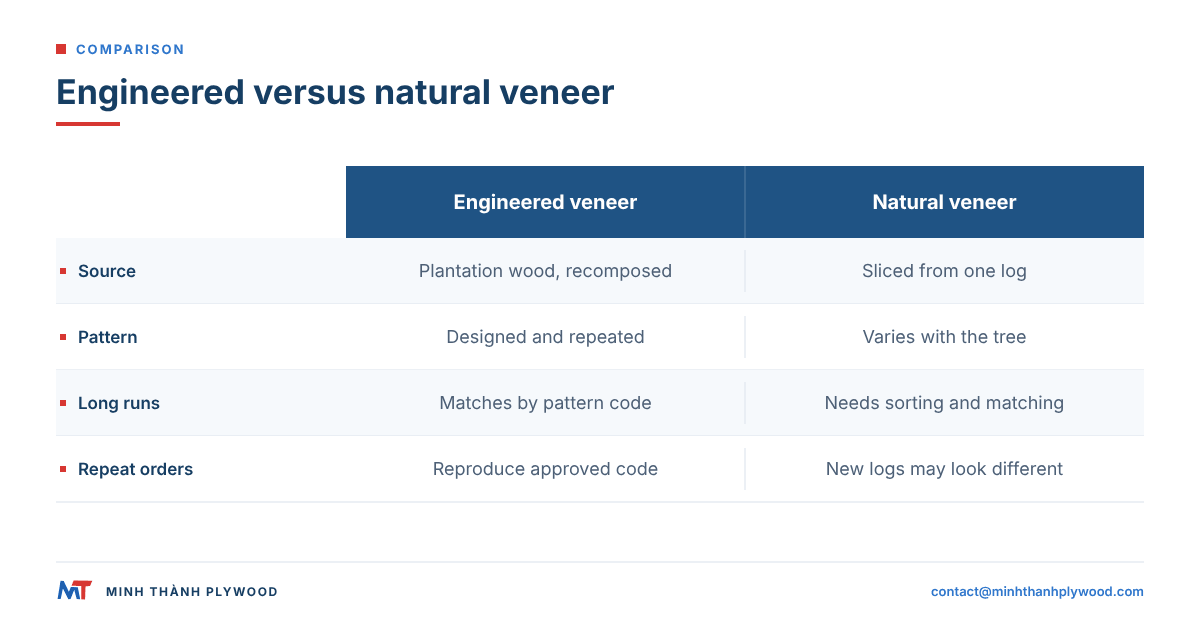
Engineered veneer gives the same colour and grain on every sheet; natural veneer gives the figure of one tree, with its knots, colour changes and character. Pick EV for matched runs and repeat orders, and natural veneer when the figure itself is the design.
| Metric | Engineered veneer | Natural veneer |
|---|---|---|
| Source | Plantation wood, rebuilt into a block | One log, sliced or peeled |
| Colour sheet to sheet | Identical | Varies by log and by sheet |
| Grain pattern | Designed: straight grain, crown, oak-look | Grown: depends on the tree and cut |
| Knots and mineral streaks | None | Allowed by grade |
| Matching a long run | No sorting needed | Sheets sorted and matched by hand |
| Repeat order months later | Same pattern code | New logs, new look |
| Waste in cutting | Low, no defects to cut around | Higher, defects cut out |
| Price | Lower than rare natural species | Higher for oak, walnut, rare figure |
Engineered veneer also makes oak, walnut or sapele looks from plantation species, which spares buyers from sourcing rare logs for a large interior job.
Does engineered veneer change colour? Colour stability compared
Engineered veneer holds its colour well indoors, because the dye goes through the veneer, not only on top. Like every wood face, its tone shifts under long, strong sunlight; a lacquer with UV absorbers keeps it stable.
- Indoors, away from windows: EV keeps its tone; natural veneer keeps darkening or lightening with age, depending on the species.
- Near windows or shop fronts: use a UV-absorbing lacquer on both EV and natural faces.
- Repeat orders: the EV pattern and colour code is reproduced from the approved sample, so new panels match earlier ones closely.
- Light sanding: the colour runs through the face, so a light pass with fine grit does not expose a different colour.
Approve a coated sample under the light of the final room. Both faces of Minh Thanh EV panels leave the mill sanded and polished, UV-ready for the buyer’s own coating line.
Red EV, white EV and other colours and patterns
EV faces come in straight grain, crown and oak-look patterns, in pale, walnut, red and white colours, and the buyer chooses one from a sample sheet before production. A buyer can also send a reference, and we quote the closest pattern and colour in the range.
- Red EV: a warm red tone, close to sapele or mahogany; doors, furniture and hotel interiors.
- White EV: a pale, even tone; Scandinavian furniture, white-oak looks and light interiors.
- Walnut EV: a dark brown tone; office furniture, sideboards and wall panels.
- Pale or natural EV: a light neutral tone that takes stain or a clear coat.
- Straight grain (quarter-cut look): parallel lines, calm and modern.
- Crown (flat-cut look): cathedral figure, a traditional wood look.
The approved sheet becomes the standard for the whole order.
Engineered veneer plywood for furniture: where is it used?
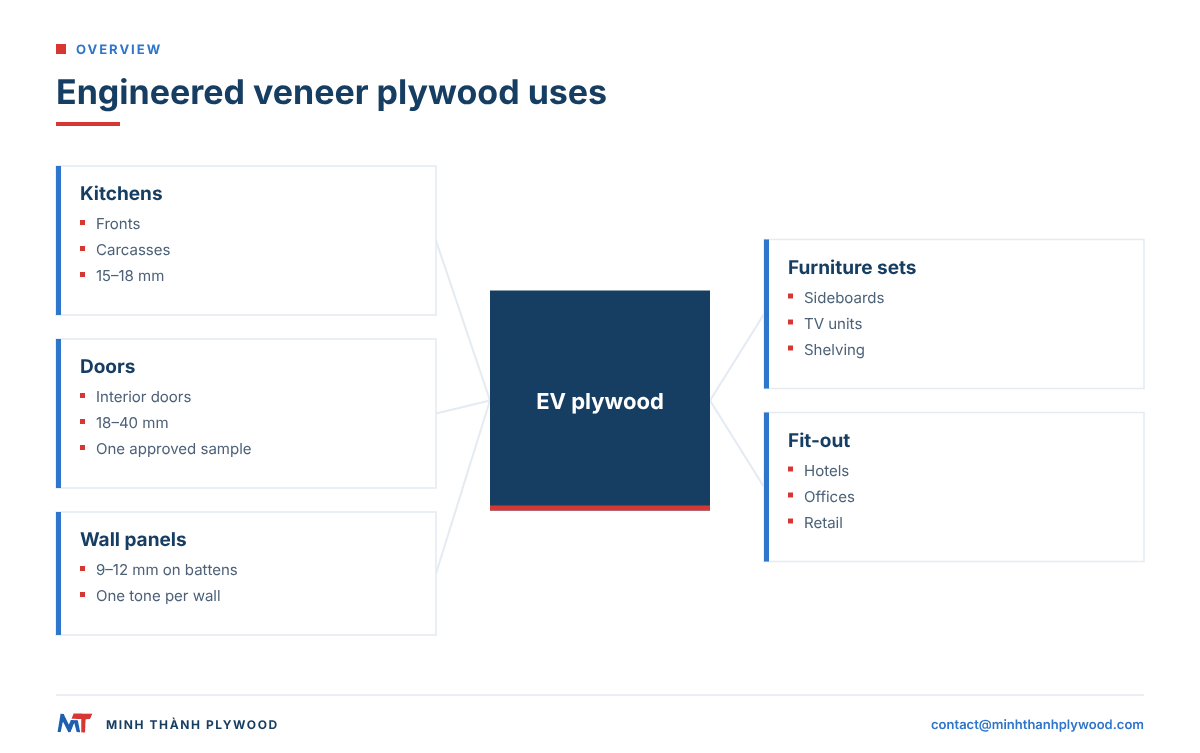
Engineered veneer plywood for furniture is used wherever many parts must look the same: kitchen and wardrobe runs, interior doors, wall panelling, sideboards and retail fit-out. The face does not vary, so parts cut from different sheets sit side by side without a colour jump.
| Use | Typical thickness | Why EV |
|---|---|---|
| Kitchen and wardrobe fronts and carcasses | 15–18 mm | Door-to-door colour match |
| Interior doors | 18–40 mm | A hall of doors reads as one set |
| Wall panelling | 9–12 mm on battens, 15 mm fixed to the wall | One tone across the whole wall |
| Sideboards, TV units, shelving | 15–18 mm | Matching look across a furniture set |
| Hotel, office and retail interiors | 12–18 mm | Repeatable over months and sites |
| Drawer bottoms and backs | 3–6 mm | Same face inside as outside |
Grade A faces go on visible fronts and grade B inside. Use melamine-fortified MR glue in kitchens and bathrooms. Our guide to plywood doors covers flush and panel doors in more detail.
Which core and glue does EV plywood use?
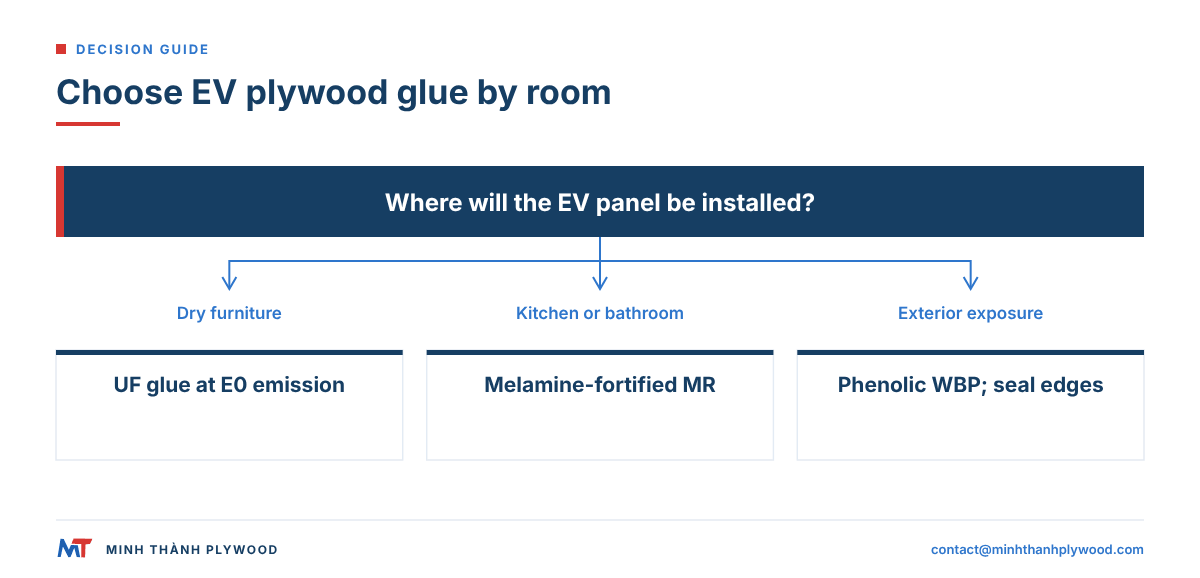
EV plywood at Minh Thanh uses a white Styrax or Eucalyptus core, stitched horizontally and vertically, with UF glue at E0 emission as standard. The face looks the same on either core, so the core is chosen for weight and screw holding.
- White Styrax core: about 500 kg/m³, a pale edge and the most sheets per container; 26.8 kg for a 1220 × 2440 × 18 mm sheet.
- Eucalyptus core: 650–750 kg/m³, a denser sheet that holds screws harder; 34.8 kg for the same sheet at 650 kg/m³.
- UF glue at E0 emission: dry interiors and furniture.
- Melamine-fortified MR glue: kitchens, bathrooms and humid rooms.
- Phenolic WBP glue: exterior exposure, with cut edges sealed.
Glue type and emission class are two separate lines on the order. The EV face does not keep water out; the glue line does.
What sizes, thicknesses and grades are available?
EV plywood comes in 1250 × 2500 mm and 1220 × 2440 mm sheets, in any thickness from 3 to 40 mm, with thickness tolerance down to ±0.2 mm. Custom formats such as 1220 × 2500 mm and 1220 × 2280 mm are pressed to order, and a panel can be cut into 4, 6 or 8 pieces.
| Grade pair | Face | Back | Typical use |
|---|---|---|---|
| A/A | Cleanest, most even | Same | Two visible faces: doors, open shelving |
| A/B | Cleanest | Slight tone change, small marks | One visible face: fronts, wall panels |
| B/B | Slight tone change | Same | Hidden parts, carcass sides |
Both grades are sanded, polished and uniform in pattern from sheet to sheet. Thin 3–5 mm EV panels are always 5-ply, which keeps backs and drawer bottoms flat.
Price and Australian sheet sizes
Minh Thanh’s starting price for furniture and interior plywood is from US$350/m³ FOB (October 2026), and EV is quoted by face code on top of it. One 1220 × 2440 × 18 mm sheet is 0.0536 m³, so the raw FOB example is about US$19 per sheet before the face premium, freight and duty. It is a container-price example, not a sheet quote.
Australian buyers compare against shelf prices and metric formats that differ from ours:
| Australian reference (October 2026) | Format | Price |
|---|---|---|
| Plyco engineered poplar plywood, E0 adhesive | 2440 × 1220 mm, 2 mm | A$48.47 |
| Plyco engineered poplar plywood, E0 adhesive | 2440 × 1220 mm, 3 mm | A$53.29 |
| Bord reconstituted veneer on plywood, sold G2S | 2400 × 1200 mm, 2700 × 1200 mm and 3000 × 1200 mm, 2.4 to 31 mm | priced per variant on the shop page |
G2S means good two sides, which matches an A/A grade pair; a single-sided panel matches A/B. Our standard sheets are 1220 × 2440 mm and 1250 × 2500 mm, and longer or Australian-metric formats such as 2400 × 1200 mm and 2700 × 1200 mm are custom formats, quoted and pressed to order on a container line. The low-emission label sold in Australia is E0; on the same panel we hold CARB P2 results (section below), and the emission class and the glue go on the order as two separate lines.
Is EV plywood suitable for European projects?
Yes. Minh Thanh’s EV panels meet the emission and quality requirements European furniture buyers ask for, and the proof is on file. The US limit for veneer-core hardwood plywood is 0.05 ppm under 40 CFR 770.10.
- CARB P2 / TSCA Title VI certification, ICTT mill number 23024.
- Six ASTM D6007 chamber tests on 9, 15 and 18 mm panels, April 2025 to June 2026, averaging 0.014–0.032 ppm against the 0.05 ppm limit; three by Shanghai Hongjun and three by ICTT Vietnam.
- Third-party testing to the buyer’s method, such as EN 717-1, through SGS on request.
- EUDR: we supply the EUDR compliance dossier (origin records and geolocation files) with orders, as Regulation (EU) 2023/1115 requires of operators.
- ISO 9001:2015 quality management and TCVN 11902:2017 certification for veneer-faced plywood.
- FSC and CE are available*. FSC is the Forest Stewardship Council certification of forest origin and chain of custody; CE marking is a legal requirement under the Construction Products Regulation (EU) No 305/2011 for products covered by a harmonised standard.
*Supplied directly or through qualified partner mills.
What should buyers check before ordering EV plywood?
Check seven points before an EV order, in this order. Each one is a line on the quotation or a check on the sample.
- Face: pattern, colour code and grade pair, against a physical sample sheet.
- Core: species and construction; ask whether it is stitched and pressed twice.
- Thickness tolerance: ±0.2–0.3 mm for sanded furniture panels.
- Glue and emission: UF at E0, MR or phenolic, as separate lines; ask for the chamber test reports.
- Moisture: 8–12 % moisture content at dispatch.
- Coating trial: lacquer, stain or UV coating on an offcut from the sample.
- Shipment proof: photos and video of the buyer’s own sheets before loading.
We grade every EV order against the signed-off sample: pattern and colour, caliper thickness, flatness, edge and core, and the number of packs.
Engineered veneer plywood manufacturers in Vietnam
Vietnam has a group of mills that press engineered veneer on their own lines for export; pick one that makes the panel itself, shows real production and holds emission certificates. Minh Thanh Plywood is one of the engineered veneer plywood manufacturers in Vietnam, in Ha Hoa, Phu Tho, with 50,000+ m³ of annual capacity.
- Own production: EV faces pressed on our own Styrax and Eucalyptus cores, with real factory photos and videos.
- Furniture focus: the factory is built for top-grade furniture and interior plywood, with Europe as its main market and repeat orders into Italy.
- Proof: CARB P2 / TSCA Title VI, ISO 9001:2015, TCVN 11902:2017 and the PPWR packaging test by SGS.
- Flexibility: 10+ face veneers, custom sizes, cut-to-size and mixed loads by agreement.
Other faces on the same cores include poplar plywood, birch and okoume, so one container can carry EV fronts and plain carcass panels.
How do you order engineered veneer plywood?
Send the specification in six lines, and Minh Thanh Plywood replies within hours with a quotation and a free sample offer.
- Application: kitchen fronts, doors, wall panels or furniture parts.
- Core: white Styrax for a light panel, Eucalyptus for a dense one.
- Glue and emission: UF glue at E0 emission, MR or phenolic WBP.
- Face and back: pattern, colour and grade pair, such as red EV crown A/B.
- Size and thickness: 1250 × 2500 mm or 1220 × 2440 mm, 3–40 mm, or cut-to-size.
- Packing and quantity: sheets per pack, total sheets or m³, and the destination port.
The minimum order is one 40HC; production takes 15–45 days after the 30% deposit, with the 70% balance against the scanned B/L. A 40HC carries up to 990 Styrax-core sheets of 18 mm. Send the lines to contact@minhthanhplywood.com or see EV plywood from Minh Thanh.
Buyer questions, answered
What does EV plywood stand for?
EV stands for engineered veneer. EV plywood is plywood faced with engineered veneer, also sold as recon, reconstituted or recomposed veneer plywood.
Is engineered veneer real wood?
Yes. Engineered veneer is made from real plantation wood that is peeled, dyed, glued into a block and sliced again. The wood is real; only the pattern is designed instead of grown.
What is red EV plywood?
Red EV plywood is engineered veneer plywood with a reddish face, made to look like sapele, mahogany or red meranti. It is used for doors, furniture and interior panels where a warm red tone must match across many sheets.
What is the difference between engineered veneer and natural veneer?
Natural veneer is sliced straight from one log and shows that tree's figure, knots and colour changes. Engineered veneer is rebuilt from plantation wood, so colour and grain are the same on every sheet.
Is engineered veneer the same as laminate?
No. Laminate is printed paper and resin; engineered veneer is real wood that can be sanded lightly, stained, oiled and lacquered like natural veneer.
Can EV plywood be customised for OEM orders?
Yes. Pattern, colour, core, glue, thickness, size, grade and packing are all order lines, and the approved sample sheet becomes the standard for the order.
Is EV plywood suitable for Europe?
Yes. Minh Thanh's EV panels meet the emission and quality requirements European furniture buyers ask for, with CARB P2 / TSCA Title VI certification and six chamber tests averaging 0.014–0.032 ppm as proof.
How thick is the engineered veneer face?
The EV face is 0.2–0.5 mm thick before pressing, and 0.3 mm is the usual European furniture choice. Sand lightly with fine grit so the face is not cut through.
Is fake wood veneer the same as engineered veneer?
Sellers use fake or faux wood veneer for two different things: printed paper or vinyl films with a wood picture, and engineered veneer, which is real wood. Ask which one is quoted.
What is EV plywood used for?
Kitchen and wardrobe runs, interior doors, wall panelling, sideboards, hotel and office interiors and retail fit-out: anywhere many parts must look the same.