
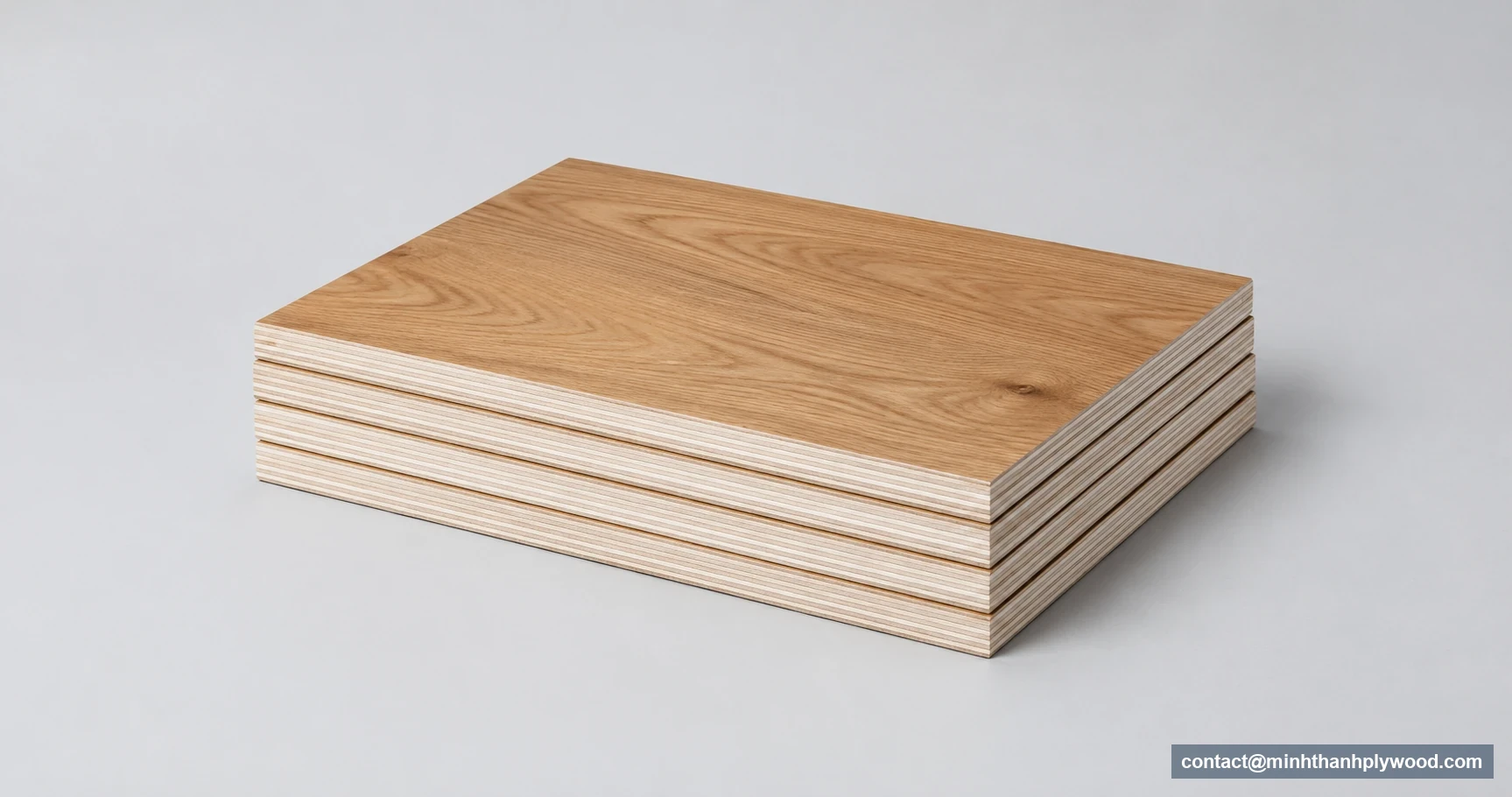
Plywood with hardwood veneer is a plywood panel whose face is a thin sheet of decorative hardwood, oak, walnut or sapele, glued over a cross-laminated core. Minh Thanh Plywood lays these faces on white Styrax or Eucalyptus cores, pressed twice and sanded UV-ready, with engineered oak-look veneer as the uniform alternative for large orders.
What is plywood with hardwood veneer?
Plywood with hardwood veneer is a plywood panel faced with a thin sheet of decorative hardwood over a cross-laminated core. And yes, the veneer is real wood: a thin slice cut from an oak, walnut or sapele log, not a print or a film.
The hardwood gives the look: the grain, the colour and the way it takes a clear lacquer. The core does the work: it keeps a wide door or a full-length gable flat, holds hinges and confirmat screws, and costs far less per square metre than solid hardwood.
Buyers search for it under many names: oak veneer plywood, oak veneered ply, oak-faced plywood, decorative plywood, fancy plywood. They all mean the same build: a decorative face on a plywood core. What changes from one order to the next is the species, the cut of the veneer, the grade of face and back, and the core under it.
How is a hardwood-veneered panel built?
An 18 mm hardwood-veneered furniture panel from Minh Thanh is built in this order:
- Core veneers are peeled from plantation logs, dried to 8–12 % moisture and graded.
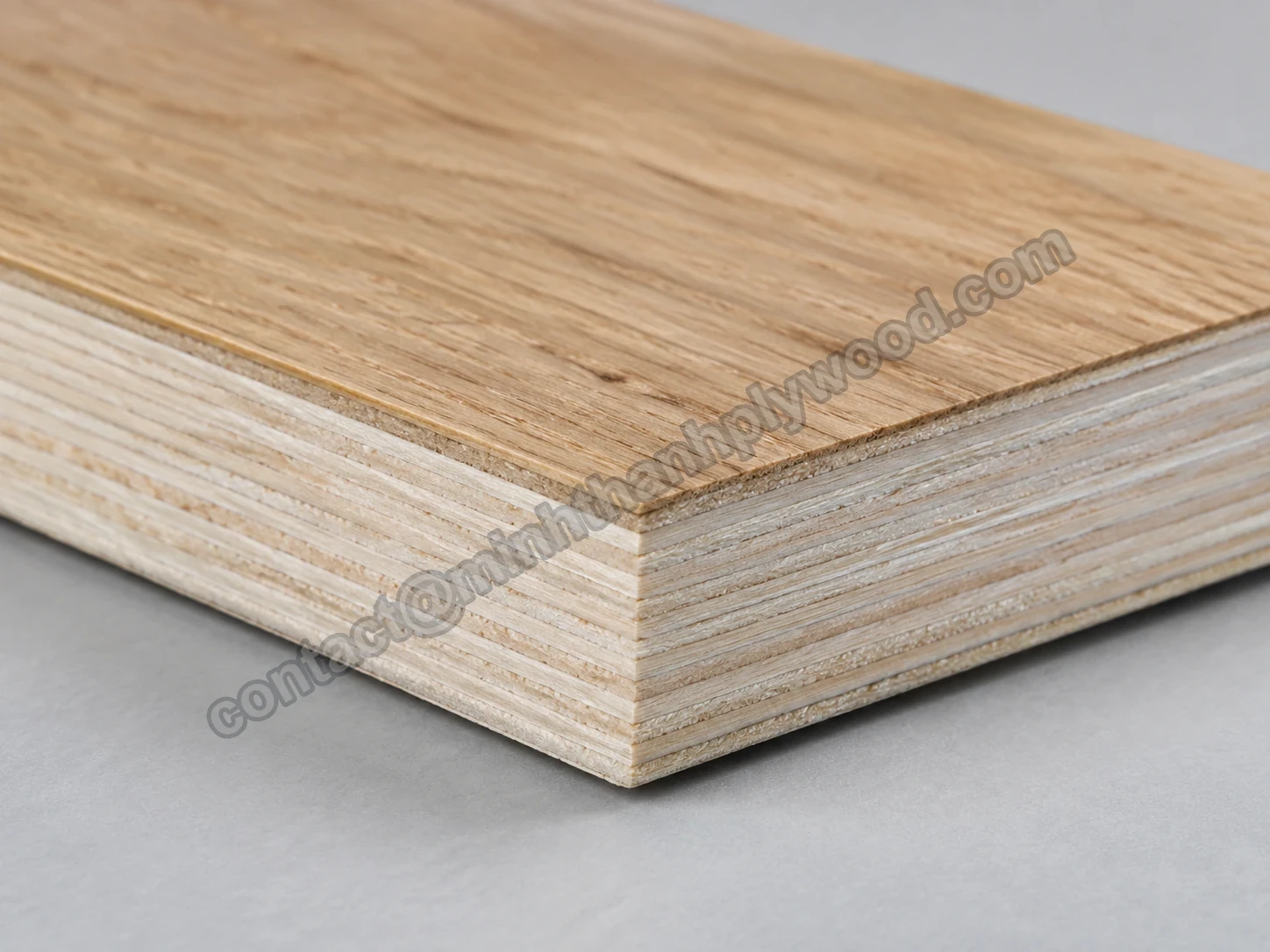
- The core is laid up with the grain of each layer across the next and stitched horizontally and vertically, so no joint opens under the face.
- The core board is pressed and calibrated to thickness.
- The decorative face and the back are pressed on in a second pressing, with UF glue at E0 emission.
- Both faces are sanded and polished, left UV-ready for your own lacquer or UV coat.
The second pressing matters more under a hardwood face than under any other: a thin oak veneer shows every dip and ridge of the core beneath it. Calibrating the core first is what lets the sheet hold ±0.2–0.3 mm across the face, so the lacquer line reads flat in raking light.
How thick is the hardwood face, and why does it matter?
Decorative face veneers on furniture plywood are thin: 0.2–0.5 mm, with 0.3 mm common for European furniture orders. A thicker face uses more of the expensive log for the same look, so the trade has settled on the thinnest face that still sands and finishes cleanly.
What a thin face means in your workshop:
- Sanding: one light pass with fine grit before lacquer. Heavy sanding or a wide-belt pass set for solid wood can cut through to the core.
- Machining: sharp, positive-hook blades with a scoring blade, so the bottom face does not chip. Rebates and grooves are cut into the core, not the face.
- Edges: the edge shows the core, so it is banded with a matching veneer or solid lipping, or left visible as a design feature.
Crown, quarter or rift: which cut of oak face should you order?
The same oak log gives three looks depending on how the veneer is cut from it:
| Cut | How it is sliced | Look | Where it fits |
|---|---|---|---|
| Crown cut (flat cut) | Through the log, parallel to its centre line | Cathedral arches in the middle, straight grain at the sides | Kitchen fronts, wardrobes, panelling with a classic oak look |
| Quarter cut | At right angles to the growth rings | Straight grain with ray flecks (“silver figure”) | Furniture with a calmer, architectural look |
| Rift cut | At a slight angle to the rays | The straightest, most even grain, few flecks | Large matched walls, modern cabinetry |
Rift and quarter cuts yield less veneer per log, so they cost more than crown cut. Leaves from the same log are laid in sequence for matching: book match (mirror image, every second leaf turned over) or slip match (leaves side by side in order). Name the cut and the match on the order, or the mill will use what it has.
Oak veneer plywood: natural oak or engineered oak-look?
For a large furniture order, the most important choice is not the cut but whether the face is natural hardwood or engineered veneer (EV).
| Natural oak veneer | Engineered oak-look veneer (EV) | |
|---|---|---|
| What it is | A slice of a real oak log | Fast-growing veneer, dyed and re-sliced into an oak-look grain |
| Grain and colour | Varies from log to log and leaf to leaf | Straight, repeatable, uniform colour |
| Matching across a large order | Needs sorting by log and bundle | Same look from the first sheet to the last |
| Defects | Knots, colour streaks, figure changes by grade | Very few, by design |
| Availability | Imported oak faces on request | One of the faces Minh Thanh produces most |
| Best for | Visible, high-end pieces where natural variation is wanted | Kitchens, hotels and retail fit-outs repeated in volume |
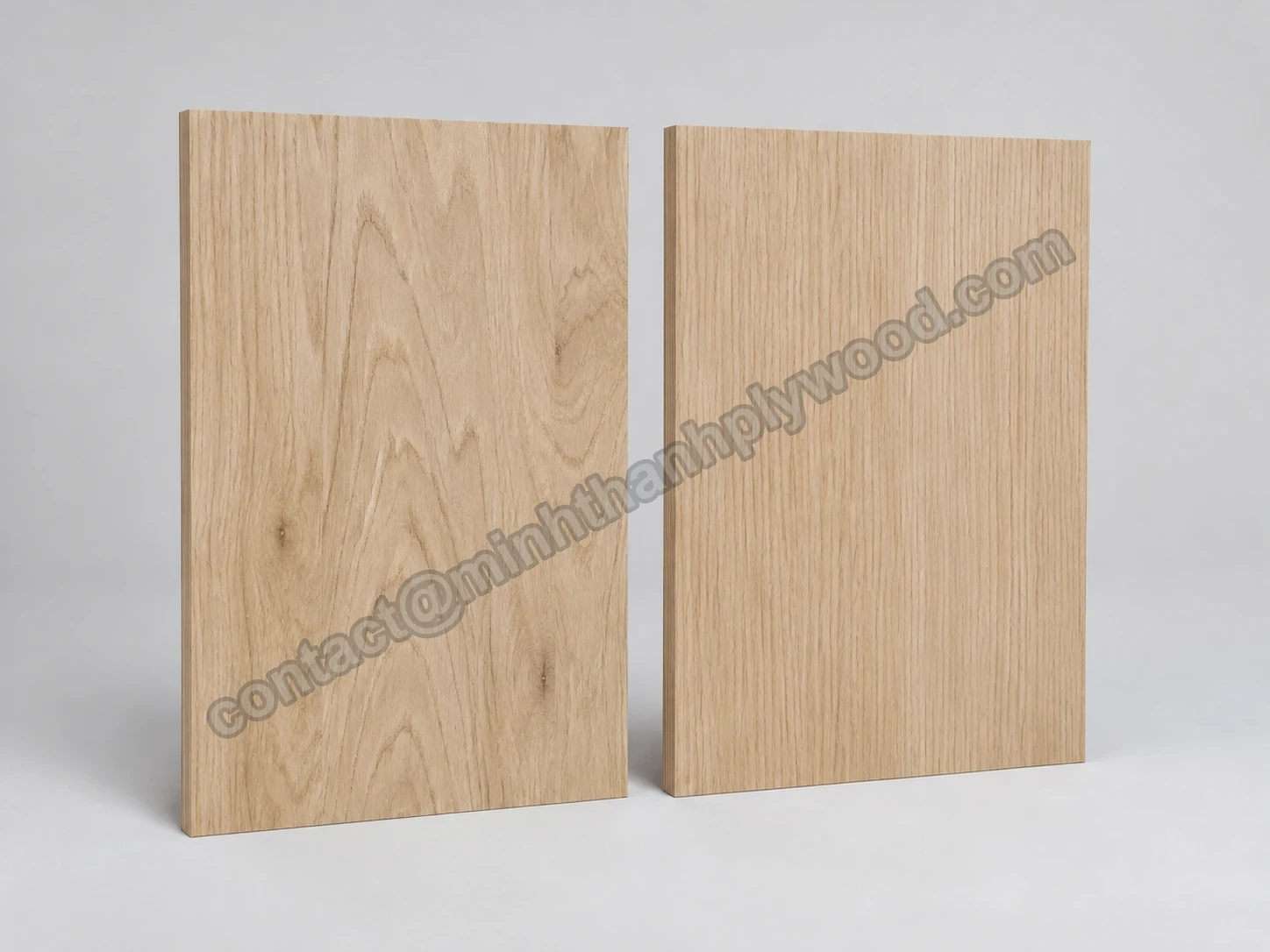
Engineered veneer is one of the faces Minh Thanh produces most, because it keeps a 40HC of carcass and door panels uniform. See engineered veneer plywood for colours and patterns. Natural oak, walnut and other hardwood faces are made on request.
Which hardwood faces can a Vietnamese mill lay?
Minh Thanh lays more than ten face veneers. The ones produced most are engineered veneer, poplar, birch, okoume and pine; bintangor, eucalyptus, gurjan, sapele and other hardwood faces such as natural oak are made on request.
- Oak (natural): light brown, cathedral or straight grain by cut; on request.
- Sapele: reddish-brown with a ribbon stripe; on request.
- Okoume: soft pinkish-beige, even and light; see okoume plywood.
- Birch: pale cream with a soft wavy figure, graded D+, D and E in Vietnam; see birch plywood.
- Engineered veneer: oak-look, walnut-look and other designs, uniform by design.
Faces are chosen for the look the buyer orders, including imported birch and okoume, and the approved sample fixes that look for every sheet in the order.
How are oak veneered ply faces graded?
Face and back are graded separately and quoted as a pair, face first. The trade quotes hardwood faces as face/back pairs, most often A/A, A/B and B/B, and the approved sample fixes what each grade means on your order:
| Grade pair | What it means | Typical parts |
|---|---|---|
| A/A | Decorative quality on both sides | Doors, open shelving, panels seen from both sides |
| A/B | Decorative face, sound back with small natural marks | Cabinet carcasses with one visible side, wardrobe gables |
| B/B | Sound faces with more natural marks | Painted parts, parts under laminate, inner shelves |
Grade describes appearance only. Core, glue, tolerance and thickness are separate lines on the order, and the approved sample is what every sheet is checked against.
Which core should go under a hardwood veneer?
Furniture panels at Minh Thanh use white Styrax or Eucalyptus cores as standard; Acacia and Pine cores are made on order.
| Core | Reference density | Weight per 1220 × 2440 × 18 mm sheet | Why choose it |
|---|---|---|---|
| Styrax (white) | 500 kg/m³ | about 26.8 kg | Light, pale clean edge under clear lacquer |
| Acacia | 580 kg/m³ | about 31.1 kg | Firmer, made on order |
| Eucalyptus | 650 kg/m³ | about 34.8 kg | Dense edge for many fixings close to the edge |
Weights are density × the sheet’s 0.0536 m³. A kitchen factory that moves tall panels by hand usually picks Styrax; an office-furniture maker drilling many connectors into the edge often prefers Eucalyptus.
Where is hardwood-veneered plywood used?
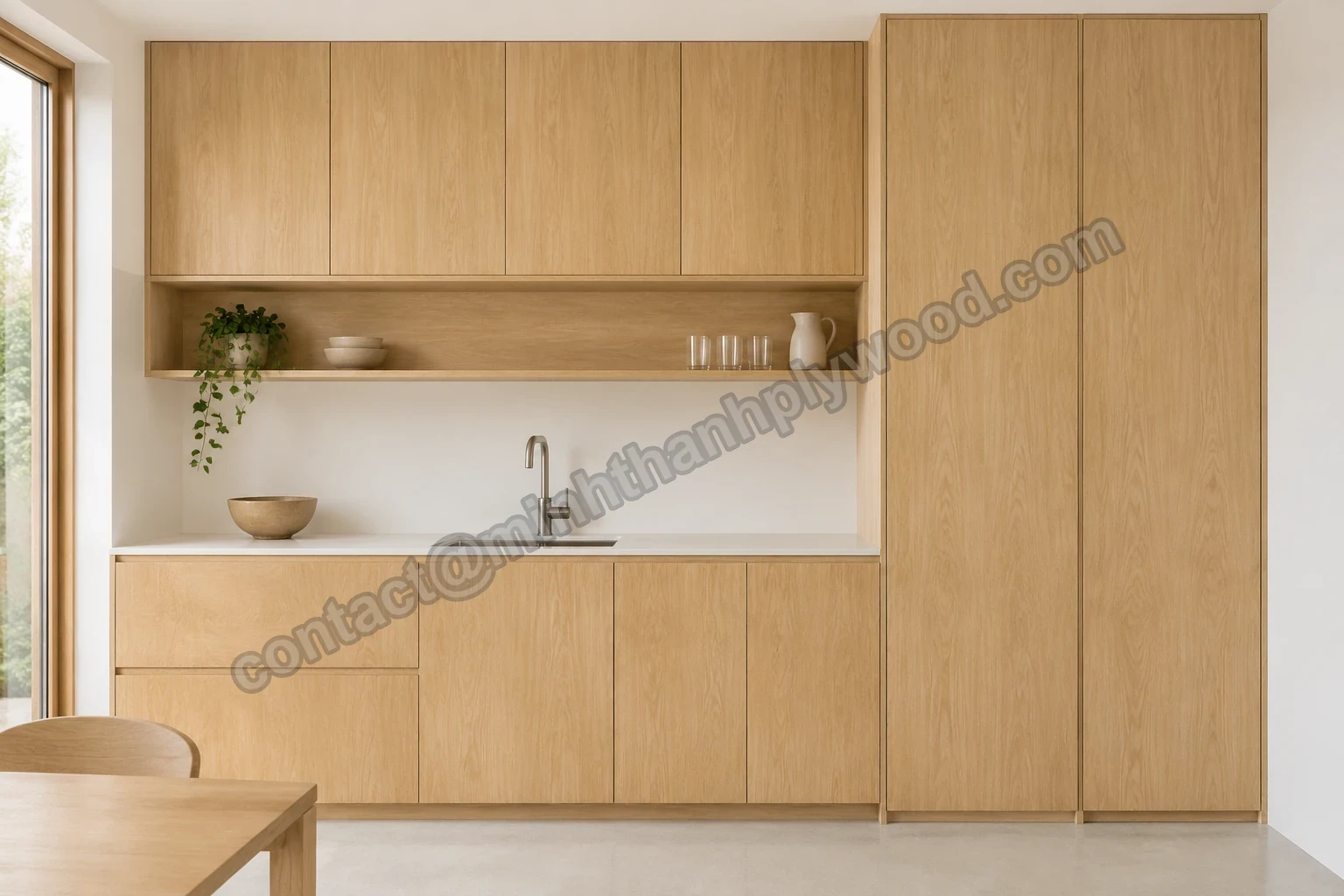
- Kitchen and bathroom cabinet fronts and carcasses, with the decorative face outside and a balanced back inside.
- Wardrobes and built-in storage, where tall gables must stay straight.
- Doors: flush door skins and solid-core doors, with A/A faces when both sides are seen. See plywood doors.
- Wall panelling and hotel or retail fit-outs, where matched leaves run across a whole wall.
- Office and contract furniture: desks, meeting tables, reception counters.
Veneer, laminate or paint: which surface for which part?
A hardwood veneer is one of three ways to finish a plywood part, and each has its place:
| Surface | Look | Durability | Choose it for |
|---|---|---|---|
| Hardwood veneer + lacquer | Real wood, can be refinished | Good; scratches can be sanded locally | Visible furniture, doors, panelling |
| Melamine or HPL laminate | Printed or solid colour, uniform | Very hard-wearing, not refinishable | Worktops, shop fittings, high-wear parts |
| Paint on a B/B or birch face | Solid colour | Depends on the paint system | Painted kitchens and furniture |
For laminated boards, see laminated plywood.
Why does the back veneer matter?
A plywood panel stays flat when it is balanced: the layers on each side of the centre mirror each other in thickness and grain direction. A decorative face pulls on the panel as it reacts to humidity, and the back veneer pulls the other way. That is why a hardwood-faced panel always has a back veneer of a similar thickness, even when the back is never seen.
- Same-thickness back: order the back veneer close to the face thickness; a thin oak face over a thick utility back can bow a large door.
- Finish both sides: lacquer or seal the back too, so both faces take up and lose moisture at the same rate.
- Grain direction: face and back run the same way on the panel; specify it when the grain must run vertically on tall doors.
How do you approve a hardwood face sample?
The approved sample is the reference every sheet of the order is checked against, so approve it the way your customer will see it:
- Ask for an A4 or larger sample of the exact face, cut and grade, on the core you will order.
- Look under the light of the room it is for: a kitchen under warm LEDs, a hotel corridor under daylight.
- Lacquer half of it with your own finish: natural oak darkens and warms under lacquer, engineered veneer changes less.
- Check the back against the grade pair you ordered.
- Sign and date the sample and keep a twin; we keep the other.
Samples are free, and a signed sample settles the look before a single sheet is pressed.
How should hardwood-veneered panels be stored and machined?
- Store flat on bearers, under cover and out of direct sun, which fades oak and yellows some lacquers.
- Acclimatise the packs to your workshop for a few days before machining large parts; panels leave the factory at 8–12 % moisture.
- Handle by the edges with clean gloves: oils from hands show through a clear lacquer on a light oak face.
- Cut face up on a table saw and face down on a track saw, with a scoring blade, so the visible face does not chip.
- Sand lightly: one pass with fine grit before lacquer, never through the thin face.
Glue, emission and the evidence behind them
Hardwood-veneered furniture panels from Minh Thanh are bonded with UF glue at E0 emission, and the evidence that travels with the order is:
- CARB P2 / TSCA Title VI certification, ICTT mill no. 23024, for veneer-core hardwood plywood 3–50 mm. The California Air Resources Board and the US EPA regulate formaldehyde emissions from composite wood products; the chamber results are on our CARB P2 / TSCA Title VI page.
- TCVN 11902:2017 certification for veneer-faced plywood (VietCert 141.1-VNC-HC) and ISO 9001:2015 quality management (KAC25/0185).
- SGS testing to your own method, such as EN 717-1, on request.
For the US, the formaldehyde limit for hardwood plywood with a veneer core is 0.05 ppm under EPA’s TSCA Title VI requirements.
What to send when you order plywood with hardwood veneer
One line per specification, for example:
18 mm furniture plywood, natural oak face crown cut, book matched, A/B, Styrax core, UF glue at E0, CARB P2 / TSCA Title VI, sanded UV-ready, 1220 × 2440 mm, ±0.3 mm, export packing, 1×40HC, CIF Valencia.
Or for a uniform volume order: 18 mm EV plywood, light oak-look, A/B, Eucalyptus core, UF glue at E0, 1250 × 2500 mm, ±0.3 mm, 1×40HC.
The fastest route to a quote is the spec line above plus a photo or a cut-off of the face you want matched. We send back a free sample in that face, cut and grade; once you sign it, it becomes the reference every sheet is graded against.
Buyer questions, answered
Is hardwood veneer real wood?
Yes. A natural hardwood veneer is a thin slice of the log itself, cut by slicing or peeling, so it has real grain, colour and figure. Engineered veneer is real wood too, re-sliced from dyed fast-growing veneer for a uniform look.
How thick is the hardwood face veneer on furniture plywood?
Decorative faces are thin, typically 0.2–0.5 mm, with 0.3 mm common for European furniture. That is enough for sanding and a clear lacquer, but not for heavy sanding or deep machining of the face.
What is the difference between oak veneer plywood and solid oak?
Oak veneer plywood is a thin oak face on a plywood core, so it stays flat in wide panels and costs far less than solid oak. Solid oak moves with humidity and is limited by board width.
Crown cut, quarter cut or rift cut: which oak face should I order?
Crown cut shows the cathedral figure most buyers picture as oak; quarter cut gives straight grain with ray flecks; rift cut gives the straightest, calmest grain. Rift and quarter cost more because they yield less veneer per log.
Is engineered oak-look veneer the same as natural oak veneer?
No. Engineered veneer is made from fast-growing veneer, dyed and re-sliced into a repeatable oak-look grain. It is uniform from the first sheet to the last; natural oak varies from log to log.
Which core is best under a hardwood veneer?
A white Styrax core keeps the panel light and pale at the edge; a Eucalyptus core is denser and holds edge fixings more firmly. Both are standard at Minh Thanh, stitched in both directions and calibrated before the faces go on.
Can I order a different veneer on the back?
Yes. Most cabinet orders take the decorative veneer on the face and a cheaper balanced back, for example A/B. Both sides decorative (A/A) is ordered for doors and open shelving seen from both sides.
What glue and emission class is used for hardwood-veneered furniture plywood?
UF glue at E0 emission as standard. Minh Thanh holds CARB P2 / TSCA Title VI certification (ICTT mill no. 23024); MR or WBP bonds are made to the buyer's specification.
What sizes are available with hardwood faces?
1220 × 2440 mm and 1250 × 2500 mm, plus custom sizes such as 1220 × 2500 and 1220 × 2280 mm, in thicknesses from 3 to 40 mm.
Can hardwood-veneered panels be cut to size before shipping?
Yes. One panel can be cut into 4, 6 or 8 pieces on order, a service shipped regularly to Italy and other European markets.