
Hardboard is a thin, dense fibreboard made by pressing wet wood fibre under heat until the fibres bond, mostly by their own lignin, into a sheet with a density of 900 kg/m³ or more. It is used for backs, drawer bottoms, pegboard and floor protection. Minh Thanh Plywood, which makes 3 mm plywood, compares the two panels for buyers choosing between them.
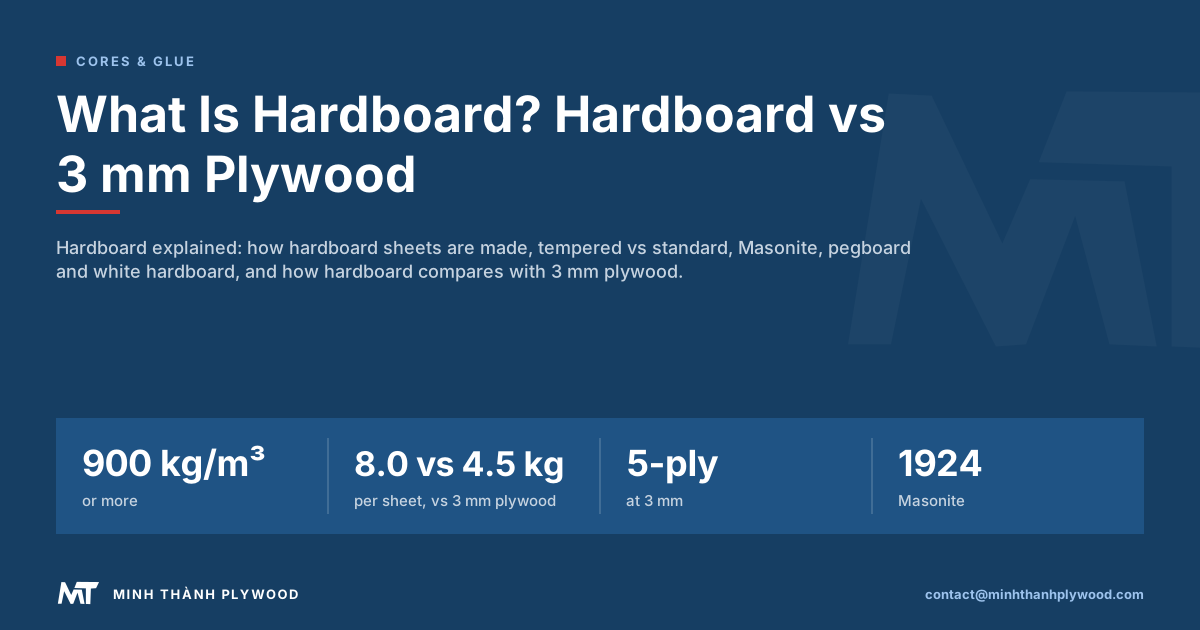
Hardboard is a thin, high-density fibreboard: wood fibre pressed hot into a sheet of 900 kg/m³ or more, smooth on one face and textured on the other. It is cheap, flat and hard on the surface, which is why it is used for cabinet backs, drawer bottoms, pegboard and floor protection.
Many buyers who ask about hardboard are choosing between it and thin plywood. This guide explains what hardboard is, its grades and trade names, and where a 3 mm plywood panel does the job better. It is written by Minh Thanh Plywood, a Vietnamese manufacturer of furniture and thin plywood from 3 to 6 mm; Minh Thanh does not make hardboard.
What is hardboard?
Hardboard is a wood-fibre panel pressed to a density of at least 900 kg/m³, the threshold the European classification EN 316 uses to separate hardboard from mediumboard and softboard. It is usually 2.5–6 mm thick, with one smooth face and, on wet-process boards, a screen pattern on the back.
The fibres come from wood chips that are steamed and refined into a pulp. In the classic wet process, the fibre mat is pressed hot and the fibres bond mostly through lignin, the natural glue of wood, with little or no added resin. The result is a hard, dense, flat sheet with no grain direction.
Hardboard is not plywood: it has no veneers and no cross-laminated layers. It is closest to HDF, a dry-process fibreboard made with resin. BS EN 316 provides the definitions, classification and symbols for these fibreboard types.
How hardboard is made: wet process and dry process
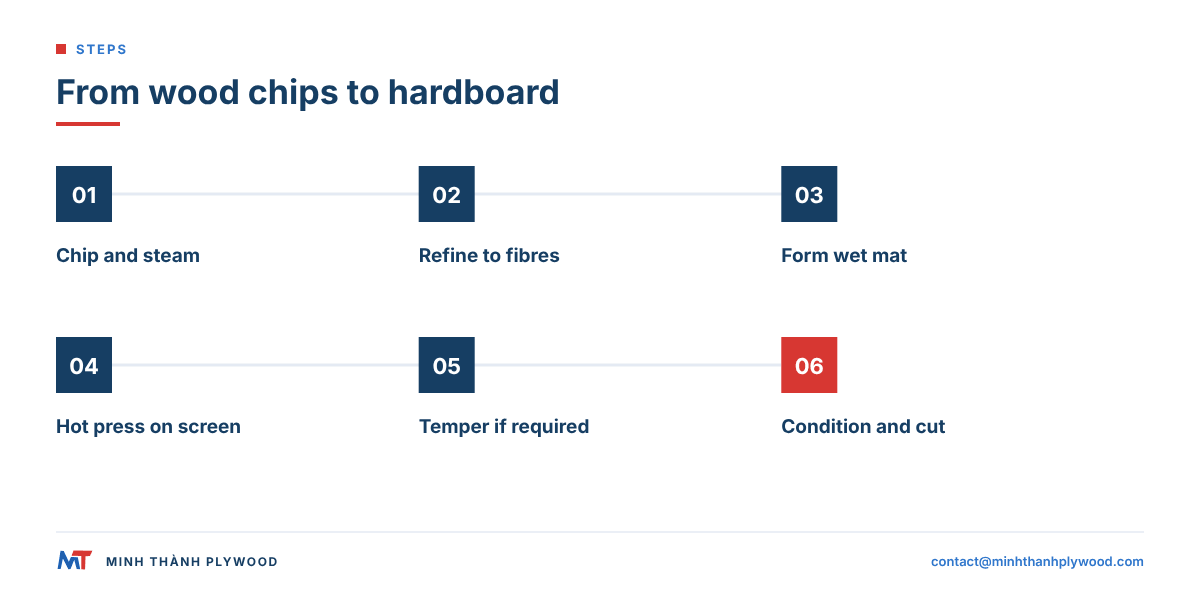
Hardboard is made by refining wood into fibre, forming a mat and pressing it under heat until it becomes a hard sheet. The steps in the wet process:
- Chip and steam. Wood chips are steamed to soften the lignin.
- Refine. A refiner separates the chips into fibres.
- Form. The fibre is mixed with water and laid on a screen as a wet mat; the water drains through.
- Press. The mat is hot-pressed against the screen, which leaves the pattern on the back face.
- Temper (optional). The board is impregnated with oil and baked to make tempered hardboard.
- Humidify and cut. The board is conditioned to stop warping and cut to size.
The dry process forms the mat in air with added resin and gives a board smooth on both sides (S2S); the wet process gives a board smooth on one side (S1S). The requirements for hardboards are in BS EN 622-2, the BSI listing consulted in October 2026.
Types of hardboard sheets: tempered, standard, S1S and S2S
Hardboard sheets come in two main grades, standard and tempered, and in one-sided or two-sided smooth versions. The differences buyers meet:
| Type | What it is | Strength and water | Typical use |
|---|---|---|---|
| Standard hardboard | Pressed fibre, no oil treatment | Lower; swells when wet | Cabinet backs, drawer bottoms, packing |
| Tempered hardboard | Oil-impregnated and heat-treated | Harder, stronger, more water-resistant | Pegboard, floor protection, signs, wet-area backing |
| S1S | Smooth one side, screen pattern on the back | As its grade | Backs where only one side shows |
| S2S | Smooth two sides | As its grade | Panels seen from both sides |
| White hardboard | Factory-painted or coated white face | As its grade | Wardrobe backs, display and white boards |
Hardboard sheets are sold mostly in 1220 × 2440 mm and in the US size of 8 × 4 ft, in thicknesses from about 2.5 to 6 mm.
Hardboard sheet sizes and price in the UK
A 3 mm hardboard sheet of 1220 × 2440 mm (8x4) costs about £13.50 to £17 including VAT as a single sheet at Wickes, and £5.50 plus VAT per sheet when a merchant sells a bulk pack of 150. UK merchants sell hardboard mainly in 3 mm and 3.2 mm, brown or white-faced, in six standard sizes; tempered and 6 mm boards cost more.
| Size | Weight at 3.2 mm and 900 kg/m³ |
|---|---|
| 1220 × 2440 mm (8x4) | 8.6 kg |
| 1220 × 1220 mm (4x4) | 4.3 kg |
| 1220 × 607 mm (4x2) | 2.1 kg |
| 1829 × 607 mm (6x2) | 3.2 kg |
| 610 × 610 mm (2x2) | 1.1 kg |
| 610 × 305 mm (2x1) | 0.5 kg |
Prices checked in October 2026: Wickes lists the 3 mm 8x4 general purpose sheet at £17 (Wickes). Builders Merchant lists 3.2 mm in five sizes from 8x4 to 2x1 ft, a bulk pack of 150 sheets at £5.50 plus VAT per 8x4 sheet, and custom cuts at £2.50 each (Builders Merchant); B&Q lists packs of 2, 5 and 10 and sizes down to 810 × 405 mm (B&Q). White-faced boards cost more than brown.
The plywood alternative, priced the same way, is a 3 mm white styrax-core sheet of 1220 × 2440 mm: 0.0089 m³, so at US$350/m³ the raw FOB example is about US$3.1 (£2.30) per sheet at £1 = US$1.337, plus freight, duty and 20% UK VAT. It weighs about 4.5 kg against 8.6 kg for 3.2 mm hardboard, and UK buyers compare it on landed cost per sheet. A raw FOB example is not a quoted sheet price; the quotation follows face, glue, quantity and delivery term.
| Panel, 1220 × 2440 mm | Weight | Standard and marking |
|---|---|---|
| Hardboard 3.2 mm | about 8.6 kg | EN 622-2 for hardboards; CE marking where the product is covered |
| 3 mm styrax-core plywood | about 4.5 kg | UF glue at E0 emission; EN 717-1 testing through SGS on request; CE or UKCA where a structural use requires it |
Masonite board: where the name comes from
Masonite board is the trade name of the first hardboard, invented by William H. Mason in 1924, and in North America “Masonite” is still used for any hardboard. Mason’s process exploded wood chips with steam and pressed the fibre into a board without added glue.
When a drawing or a shop calls for Masonite, it means hardboard, usually tempered, of 1/8 or 1/4 inch. The same panel is called hardboard in the UK and Europe and HDF or “hard fibreboard” in parts of Asia, although HDF is strictly the dry-process, resin-bonded board.
White hardboard and painted hardboard
White hardboard is a hardboard sheet with a factory-applied white face, painted or coated, so the visible side of a back panel or drawer bottom is finished on delivery. It is a low-cost choice for flat-pack furniture, where the back panel is thin, nailed or slotted in, and rarely touched.
Its limits come from the board underneath: the coated face scratches through to brown fibre, the edges are raw, and the board does not take screws close to an edge. Where a back panel carries load, holds a wall fixing or must look good from both sides, buyers move to thin plywood with a decorative face.
Pegboard wall: hardboard, wood pegboard and wooden pegboard panels
A pegboard wall is a panel drilled with a grid of holes for hooks and shelves, fixed on battens so the hooks can pass through. Classic pegboard is tempered hardboard of about 3.2 mm (1/8 inch) or 6.4 mm (1/4 inch); the thicker board with holes on 1-inch centres takes the standard hooks.
Wood pegboard, or wooden pegboard, is the same idea in plywood: a thin panel with a veneer face, drilled with the same grid. It is lighter, holds hooks without crumbling at the holes, and shows a real wood face for shops, kitchens and displays. Plywood pegboards are cut from thin panels such as 4–6 mm plywood, with the hole pattern drilled after pressing.
Fix any pegboard wall on battens about two centimetres thick, screw through the battens into the wall, and keep heavy tools on the lower rows.
Hardboard vs 3 mm plywood: one metric per row
Hardboard vs 3 mm plywood comes down to weight, bending, fixing and moisture; plywood wins on all four, hardboard on price and surface smoothness. The comparison for a 1220 × 2440 mm sheet:
| Metric | Hardboard, 3 mm | Plywood, 3 mm (Minh Thanh) |
|---|---|---|
| Material | Pressed wood fibre | 5 plies of veneer, cross-laminated |
| Density | 900 kg/m³ or more | about 500 kg/m³ on a Styrax core |
| Sheet weight | at least 8.0 kg | about 4.5 kg |
| Bending | Stiff, cracks when bent sharply | Bends without cracking |
| Staples and small screws | Weak near edges | Holds along the edge |
| Faces | One smooth face (S1S) or two (S2S) | Two veneer faces: poplar, birch, okoume, EV and others |
| Finish | Paint, coated white | Stain, lacquer, UV coating, paint |
| Water | Swells, edges first | Bond by glue choice; E0 UF for interiors |
| Grain direction | None | Face grain along the sheet |
| Price | Lower | Higher |
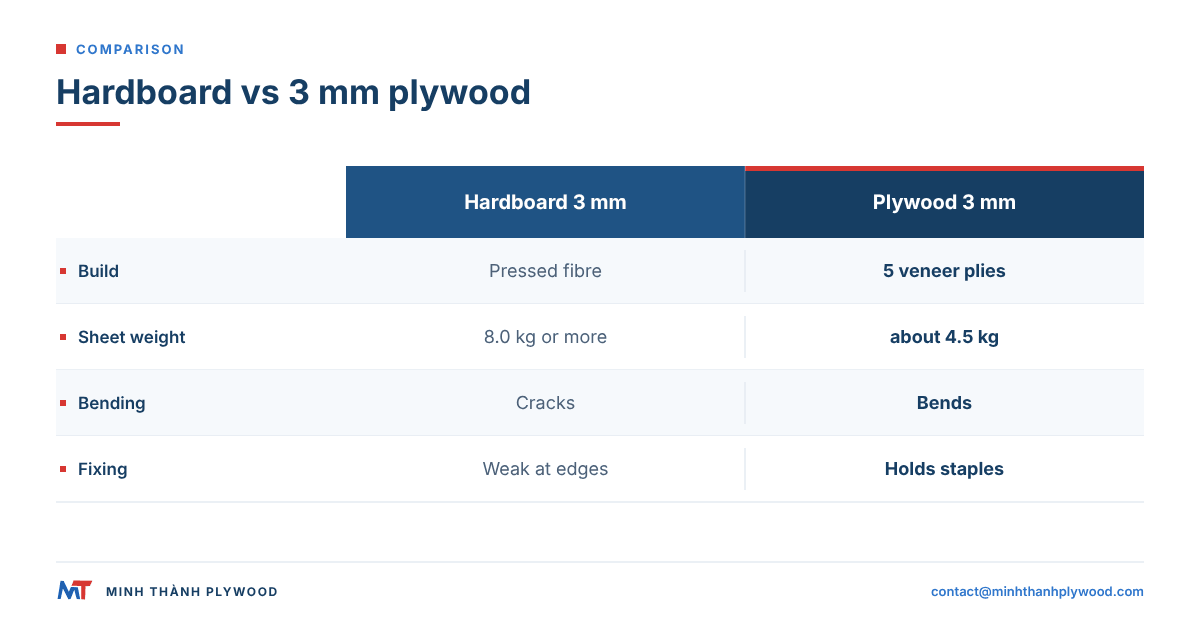
Verdict by use: hardboard for low-cost hidden backs, packing and temporary floor protection; 3 mm plywood where the panel is seen, carried, curved, stapled or exposed to humidity.
Hardboard vs MDF and HDF
Hardboard, MDF and HDF are all fibreboards, and they differ by density, process and thickness. MDF is dry-process fibre with resin, lighter, usually from 3 mm up to thick panels, and smooth on both sides; HDF is the high-density, resin-bonded version used for thin backs, door skins and laminate flooring cores. Hardboard is the wet-process board at 900 kg/m³ or more; EN 316 places mediumboard at 400–900 kg/m³ and softboard at 230–400 kg/m³ below it.
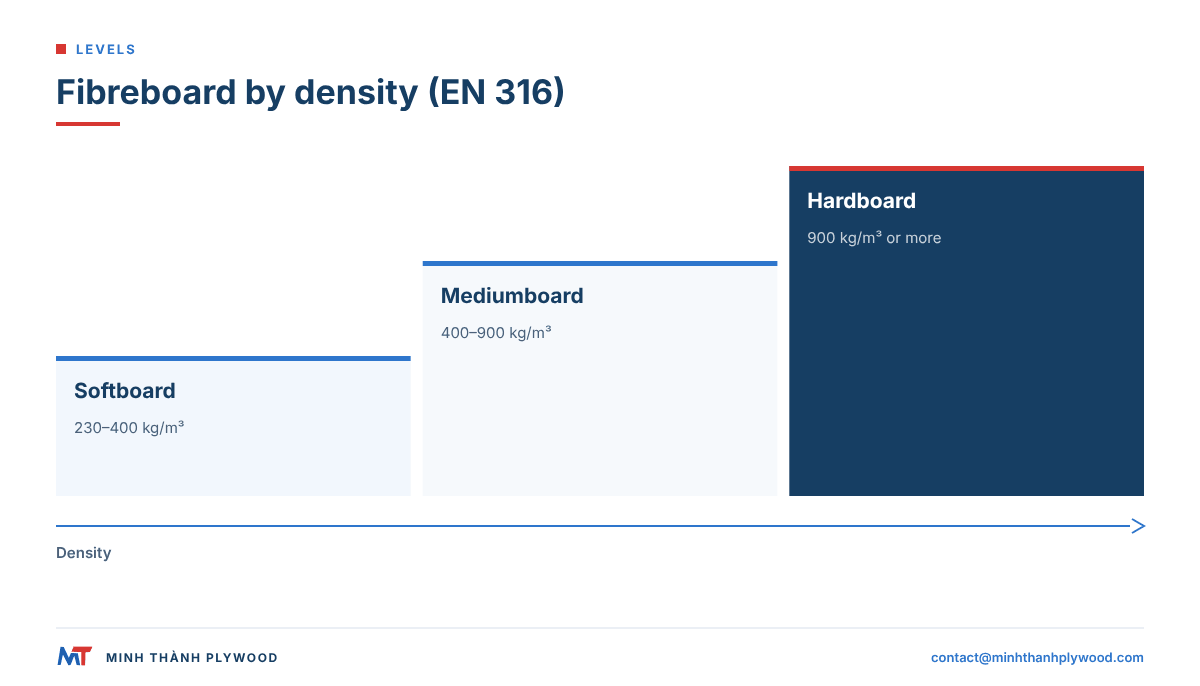
For backs and drawer bottoms the three behave alike; for machined edges MDF is better; for strength per kilogram none matches plywood. The coming guide to fibreboard covers softboard, MDF, HDF and hardboard together, and plywood vs MDF compares the two most common furniture panels.
For emissions, US TSCA Title VI standards apply to hardwood plywood with a veneer or composite core, medium-density fibreboard and particleboard. The EPA’s stakeholder guidance explicitly lists hardboard among the products not covered by the rule.
How 3 mm plywood is built
A 3 mm plywood panel at Minh Thanh is always 5-ply: one core veneer in the centre, two cross-band veneers and two face veneers. That cross-laminated build is what gives thin plywood its strength in both directions.
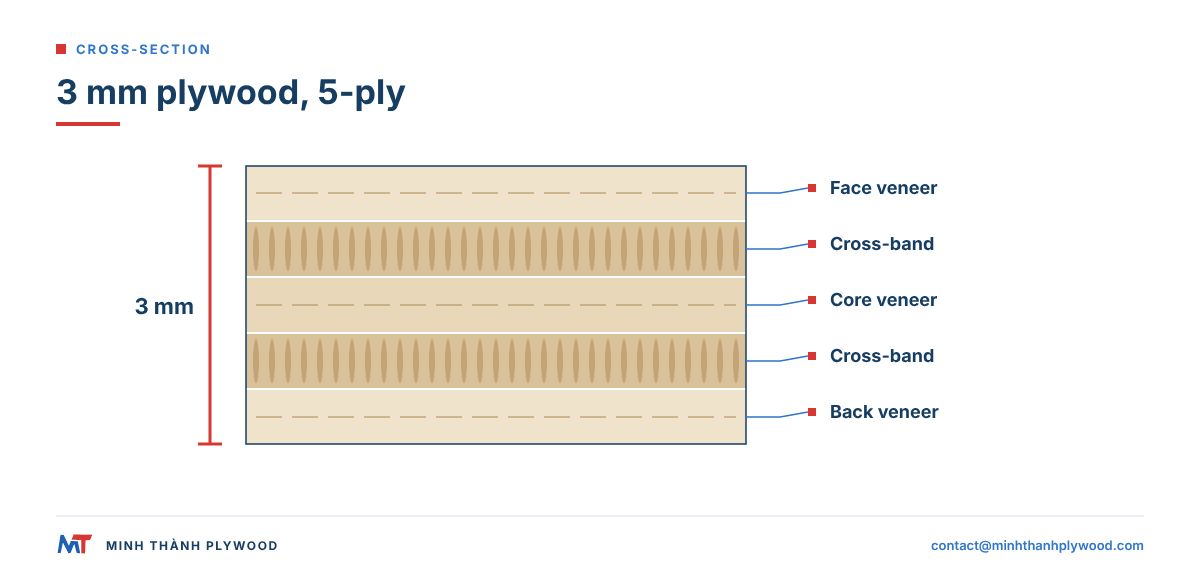
Panels of 4 and 5 mm use three core veneers and two faces, with the core veneer thickness adjusted to the panel, for example three 1.3 mm Styrax core veneers in a 4 mm furniture panel. Premium thin veneer is scarce, so 4 mm can take longer to make; the standard is not lowered to go faster. The faces are chosen for the look: poplar, birch, okoume, EV, pine and others, sanded and UV-ready.
Where hardboard is used, and where thin plywood replaces it
Hardboard is used where a flat, thin, cheap sheet is enough and nobody sees the back. Typical uses and the panel buyers switch to when the job asks more:
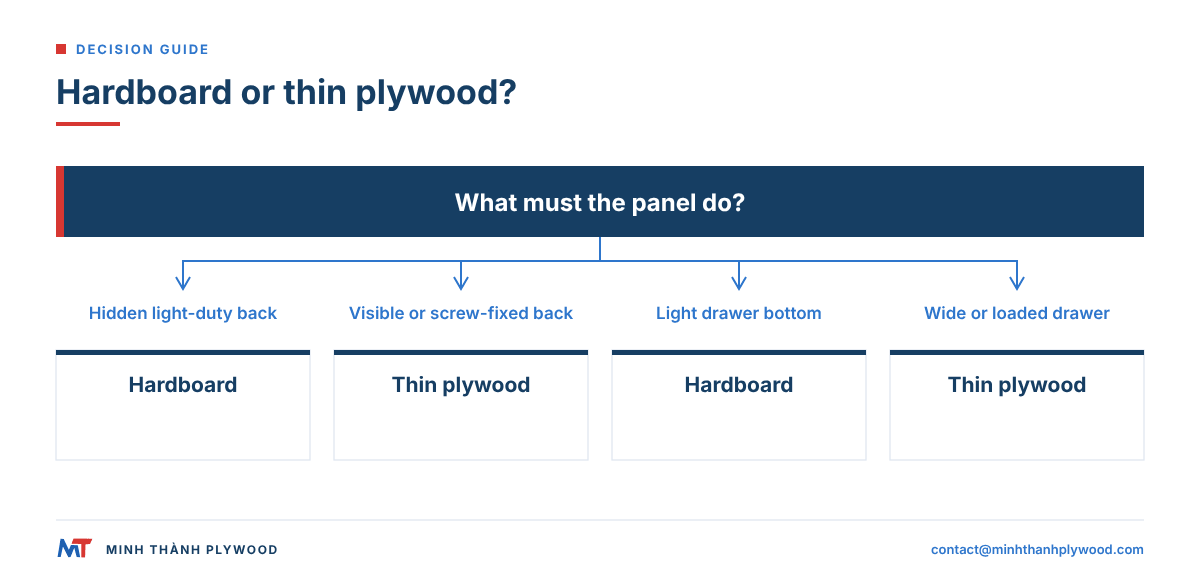
- Cabinet and wardrobe backs: hardboard or white hardboard; 3–4 mm plywood when the back is seen, takes screws or braces the carcass.
- Drawer bottoms: hardboard for light drawers; plywood for wide or heavily loaded ones, which do not sag.
- Pegboard: tempered hardboard; plywood pegboard for display and heavy tools.
- Floor protection on site: tempered hardboard sheets laid over finished floors.
- Underlay for vinyl and lino: hardboard sheets laid smooth side up; thin plywood where the subfloor is uneven or moves.
- Picture backs, signs and templates: hardboard; thin birch-faced plywood where the template is reused.
- Packing and crates: hardboard for light liners; packing plywood for load.
Underlay and backing: hardboard sheets or plywood?
For underlay and backing, hardboard sheets work on a dry, flat and stable base; plywood is the better choice when the base moves, the room is humid or the panel carries fixings. Hardboard is dense and smooth, so a thin floor finish lies flat over it, but its edges swell with moisture and the joints can show through vinyl.
Plywood keeps its shape across moisture changes because each layer is cross-laminated, and its two veneer faces take adhesive evenly. For furniture backs, a plywood back stiffens the cabinet and accepts screws, which a hardboard back does not.
What to order when you replace hardboard with plywood
Replacing hardboard with plywood is a specification change of four lines: thickness, face, glue and size. Minh Thanh makes thin plywood for backs, drawer bottoms and pegboard in the same container as thicker furniture panels:
- Thickness: 3, 4 or 5 mm, always 5-ply.
- Face: poplar, birch, okoume, EV, pine and others; white-paint-ready faces for painted backs.
- Glue and emission: UF glue at E0 emission as standard, CARB P2 / TSCA Title VI certified (ICTT mill no. 23024). The US limit for hardwood plywood made with a veneer core or a composite core is 0.05 ppm under 40 CFR 770.10.
- Size: 1220 × 2440 or 1250 × 2500 mm, or cut-to-size, one panel cut into 4, 6 or 8 pieces for drawer bottoms and backs.
Thin panels can share a 40HC with thicker furniture panels by agreement; production takes 15–45 days after the 30% deposit, FOB Hai Phong, CFR or CIF.
The specification line to send
Copy this line for a hardboard replacement and change what differs:
3 mm × 1220 × 2440 mm; 5-ply; face/back: poplar A/B; core: white Styrax; UF glue at E0 emission, CARB P2 / TSCA Title VI; sanded both faces; use: cabinet backs and drawer bottoms; mixed with 18 mm furniture panels in 1×40HC CIF your port.
Minh Thanh sends free samples of thin plywood so you can test it beside the hardboard you use now, and replies within hours: contact@minhthanhplywood.com or WhatsApp +84 988 586 601.
Buyer questions, answered
What is hardboard made of?
Hardboard is made of wood fibre, refined from chips and pressed hot into a thin sheet. In the wet process the fibres bond mainly through their own lignin, with little or no added resin; some boards add oil or wax.
What is the difference between hardboard and MDF?
Hardboard is thinner and denser, 900 kg/m³ or more, and usually smooth on one side only. MDF is made by a dry process with resin, is lighter and thicker, and machines cleanly on the edges.
Is hardboard the same as Masonite?
Masonite is the trade name of the first hardboard, invented by William H. Mason in 1924, and it became a common name for hardboard in North America. Masonite board and hardboard mean the same panel type.
What is tempered hardboard?
Tempered hardboard is impregnated with oil and heat-treated after pressing. It is harder, stronger and more water-resistant than standard hardboard and is used for pegboard, floor protection and wet-area backing.
Is hardboard waterproof?
No. Standard hardboard swells when wet, especially at the edges. Tempered hardboard resists water better but is still not an exterior panel; for wet locations, plywood with a phenolic bond is the right choice.
What is white hardboard?
White hardboard is hardboard with a factory-painted or coated white face. It is used for cabinet and wardrobe backs, display boards and drawer bottoms where the visible side should be white.
Is 3 mm plywood stronger than hardboard?
For its weight, yes. A 3 mm plywood panel is cross-laminated veneer, so it bends without cracking and holds staples well, and a 1220 × 2440 mm Styrax-core sheet weighs about 4.5 kg against at least 8.0 kg for hardboard.
What thickness does pegboard come in?
Pegboard is usually hardboard of about 3.2 mm (1/8 inch) or 6.4 mm (1/4 inch), the thicker board with holes on 1-inch centres for standard hooks. Plywood pegboard is made from drilled thin plywood.
Can hardboard be used for a pegboard wall?
Yes. Fix it on battens so the hooks have space behind the holes. For heavy tools a plywood pegboard holds hooks better and does not crumble at the holes.
Does Minh Thanh make hardboard?
No. Minh Thanh makes plywood, including 3–6 mm thin plywood that buyers use where they would otherwise use hardboard, such as backs, drawer bottoms and pegboard panels.