
Choose particleboard for a specified dry-interior laminated furniture system, and veneer-core plywood when its face, edge or selected core fits the component. Compare the actual grade, joints, exposure and finished result. Minh Thanh Plywood supplies furniture veneer-core panels with Styrax or Eucalyptus cores, double pressing and prepared faces.
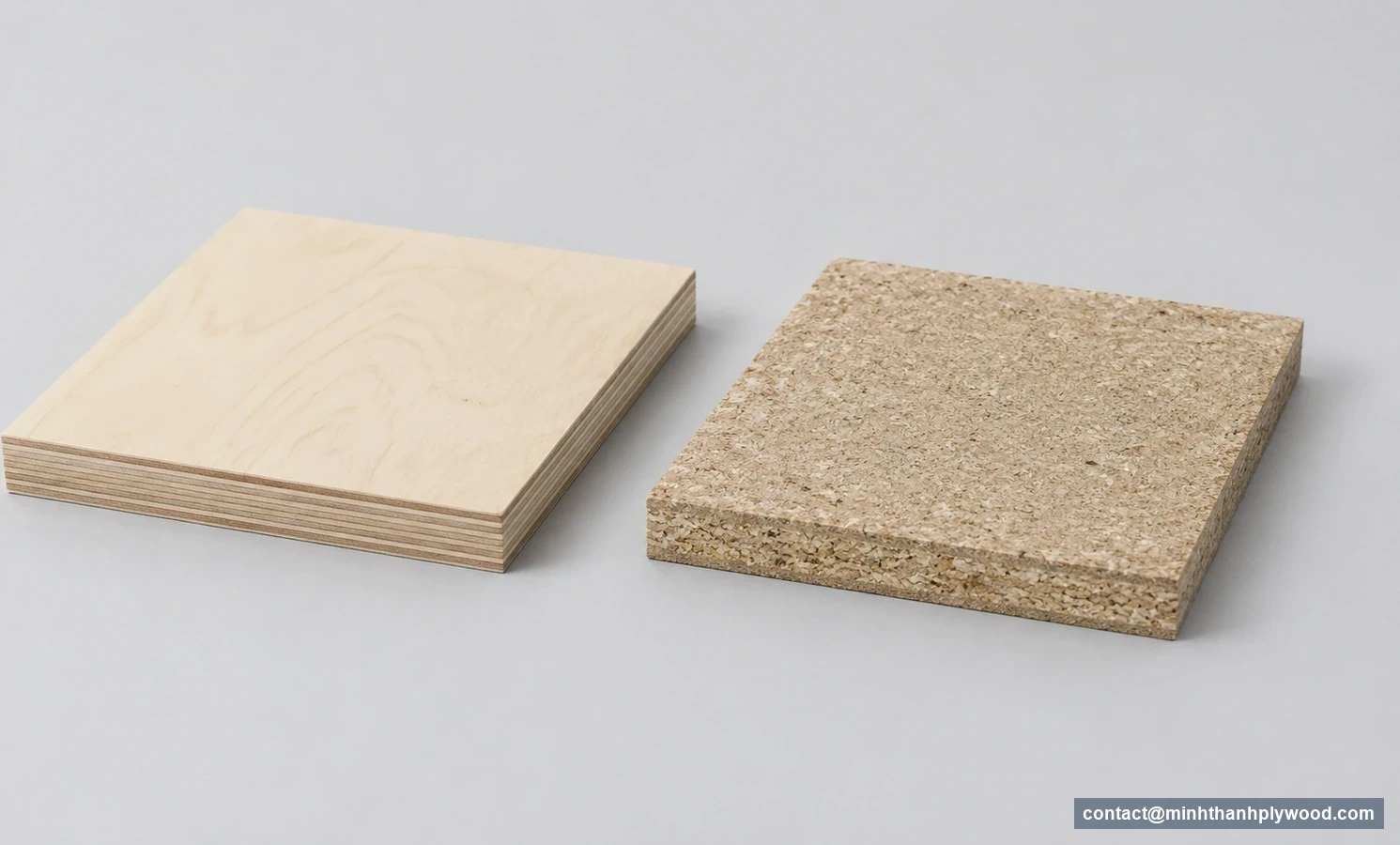
Particle board vs plywood: which material should you choose?
Choose particleboard for a dry-interior, laminated furniture programme whose board grade and hardware system meet the design. Choose veneer-core plywood when its layered edge, lower-mass core options or component construction suit the job. Particle board vs plywood is a comparison of complete products and finished components, rather than one universal winner.
Minh Thanh supplies furniture plywood with Styrax or Eucalyptus core, selected veneer faces, double pressing and calibrated surfaces. That construction suits buyers who want to choose the visible wood independently from the core. Particleboard is a separate particle-based product, with its own grades, coatings and compatible connector systems.
| Buying decision | Particleboard route | Veneer-core plywood route |
|---|---|---|
| Internal material | Bonded wood particles | Cross-laminated wood veneers |
| Visible surface | Prepared or laminated face | Natural/engineered veneer or selected covering |
| Exposed edge | Edge banding or designed protection | Layered edge, finished or covered |
| Cabinet connection | Specified connector and board grade | Specified hardware, core and joint trial |
| Moisture service | Appropriate board grade and detailing | Appropriate bond, coating and edge design |
| Weight | Supplier density and actual piece mass | Specified core density and actual piece mass |
For a cabinet programme, decide component by component. A door, shelf and concealed back have different surface, span and fixing requirements. The correct comparison keeps these requirements constant while changing the board construction. Use the sections below to turn the choice into a sample trial and a readable purchase specification.
What are particleboard and plywood made from?
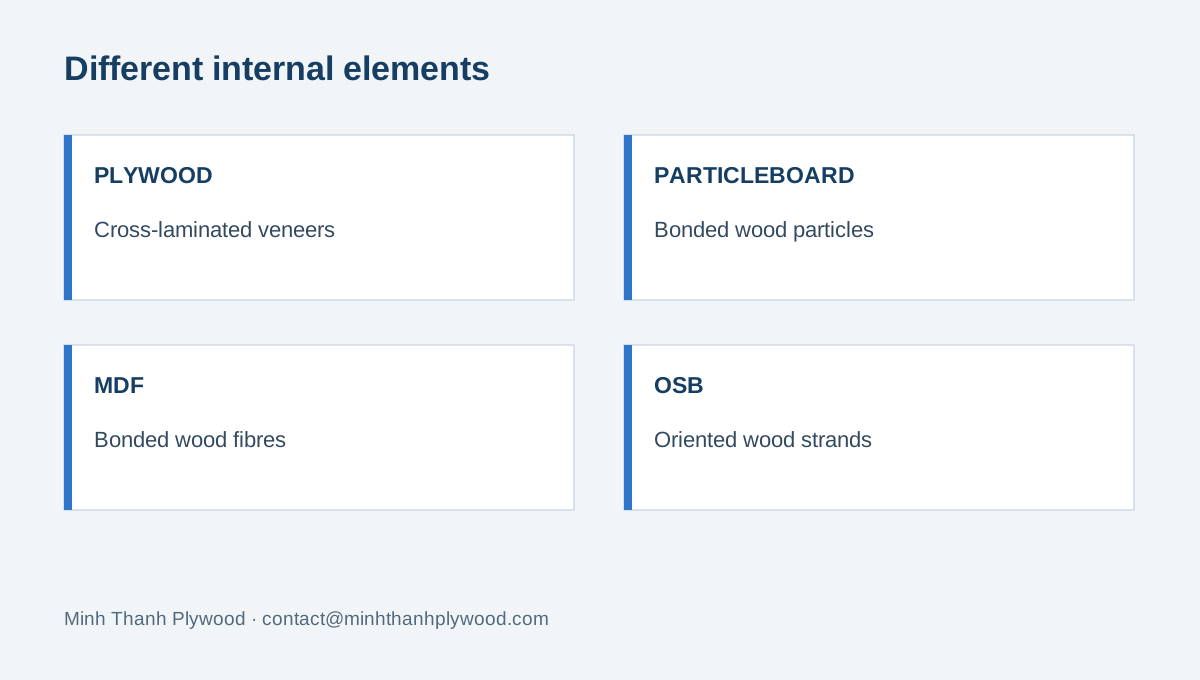
Particleboard bonds wood particles with resin into a pressed panel. Plywood bonds wood veneers with their grain arranged across adjoining layers. MDF uses fibres, and OSB uses oriented strands. All are engineered wood products, but their internal materials and manufacturing routes differ.
The USDA Wood Handbook, wood-based composites chapter, describes these material families and their manufacture; consulted 7 October 2026. Particle shape, veneer quality, resin, density and pressing are among the variables behind a finished product. One board-family name does not set every mechanical or moisture property.
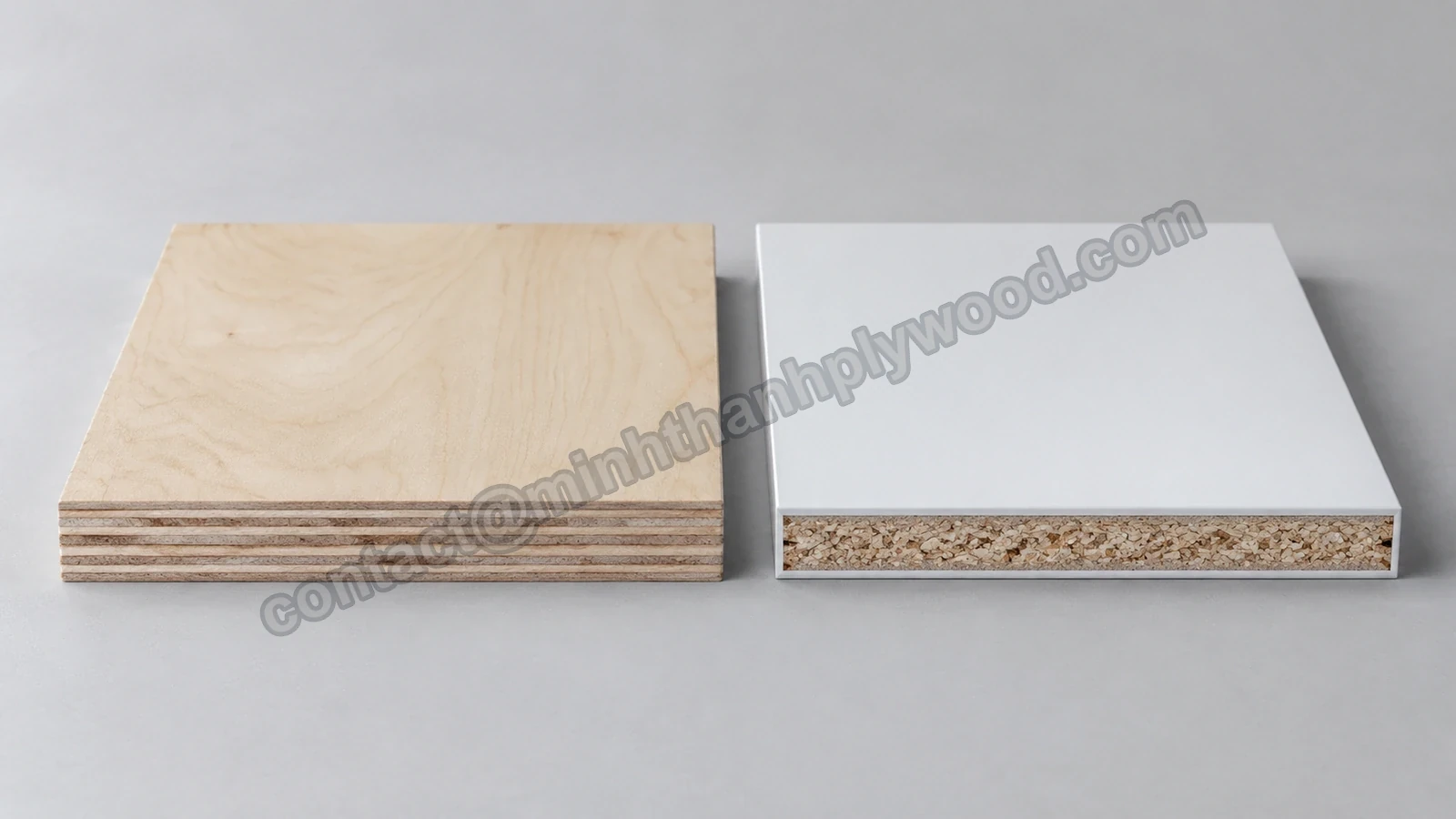
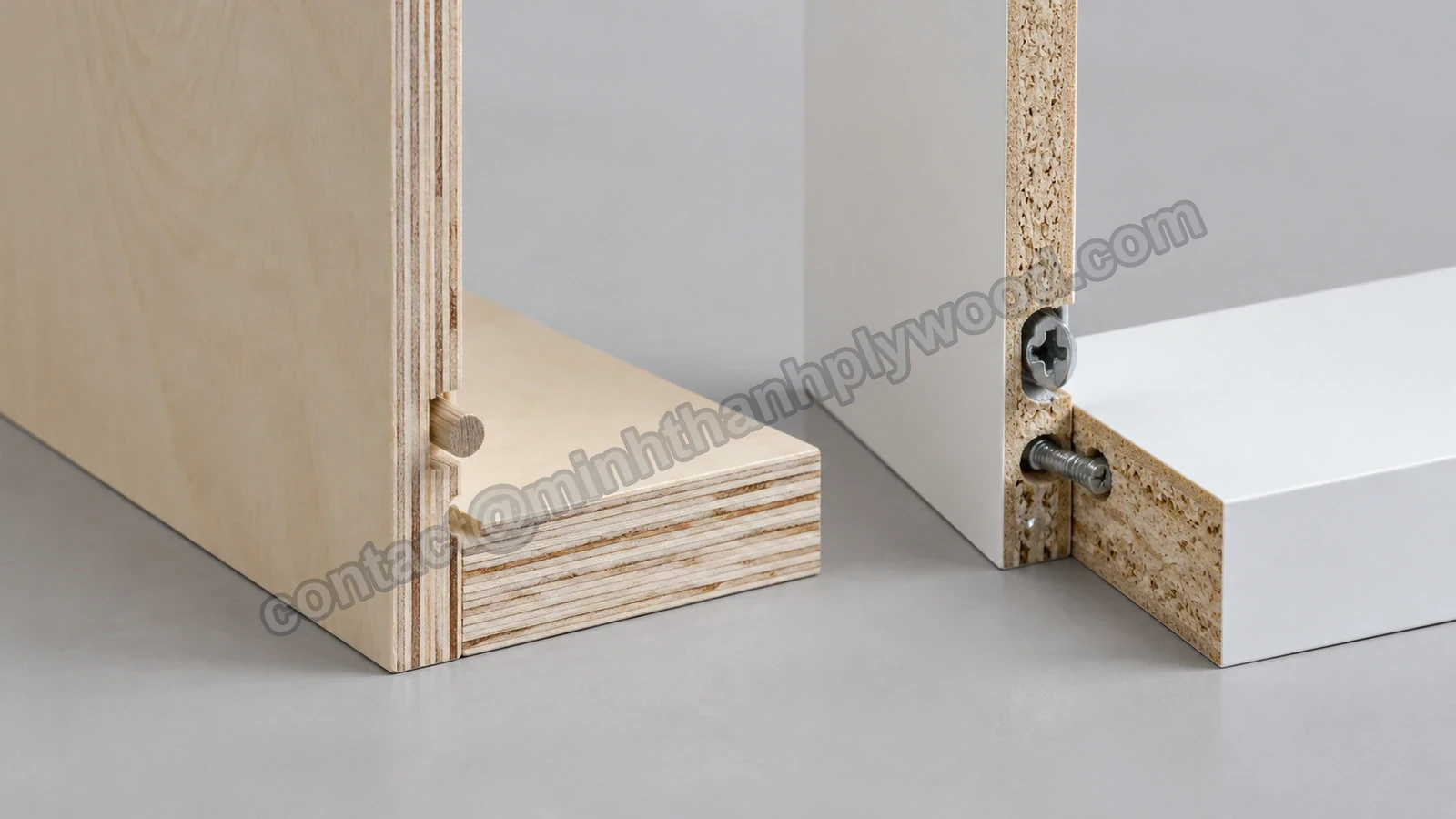
Particleboard often provides a flat substrate for decorative surfaces and furniture systems. A finished face can conceal the granular core completely. Veneer-core plywood exposes distinct layers at a sawn edge. Its face can be a different species from the internal veneers, which is why Birch-faced or Poplar-faced does not automatically identify the core.
Minh Thanh furniture cores are stitched horizontally and vertically, with the stitching scope stated in the construction. The core board is pressed and calibrated, then the face and back veneers are pressed onto it. Finished sanding prepares the furniture surface and controls thickness. These operations belong in the product description the buyer compares.
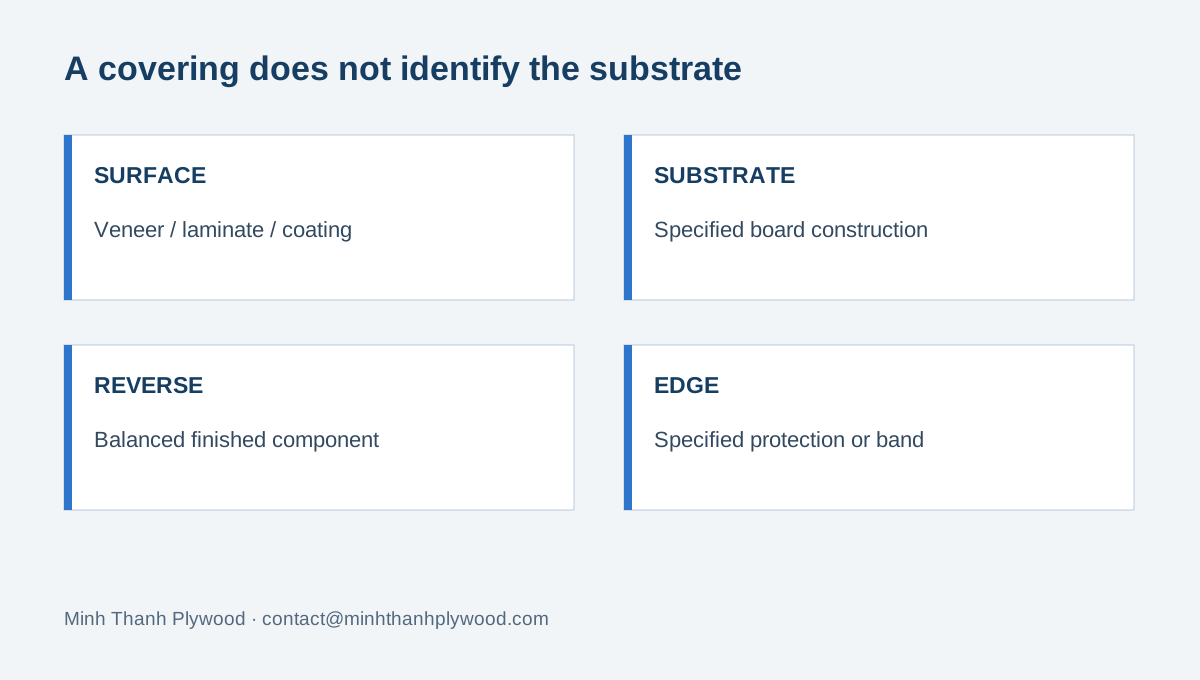
Identify what sits under a veneer or laminate before accepting a replacement material. A visually similar decorative face can cover particleboard, MDF or plywood. The edge photograph, supplier technical sheet and sample record establish the actual substrate, keeping the purchasing decision connected to machining and assembly.
Plywood vs particleboard: how do you identify the material?
Inspect an accessible unfinished edge: plywood shows veneer layers, while particleboard shows bonded particles. A natural veneer or laminate on the face cannot reliably identify the core. Use the product label and construction sheet to confirm the material when the edges are concealed.
A furniture buyer can request a representative sawn sample alongside the broad face sample. Keep the sample labelled with its product code and finish. The face answers an appearance question, while the cut edge answers a construction question. Do not rely on the top sheet of a pack to identify every specification in a mixed order.
Weight and a tapping sound are poor substitutes for an edge or technical record. Plywood density changes with the selected veneers, and particleboard density changes with the product grade. Coatings, panel thickness and moisture also change handling weight. A heavier panel is not automatically plywood, and a light-looking veneer does not establish a lightweight core.
Avoid damaging a finished cabinet with an improvised water test to identify its board. Check an existing opening, unbanded edge or supplied offcut instead. If the component is fully enclosed, the original specification or supplier record provides the appropriate answer. A surface colour change under a droplet says little about a hidden substrate’s identity.
For Minh Thanh enquiries, send a photograph of the existing edge and the panel’s technical sheet when replacing another source. Include the face appearance and intended use. This separates a change in decorative surface from a change in the internal material, allowing the factory to recommend an identifiable plywood construction.
Particle board vs plywood cabinets: which material fits each part?
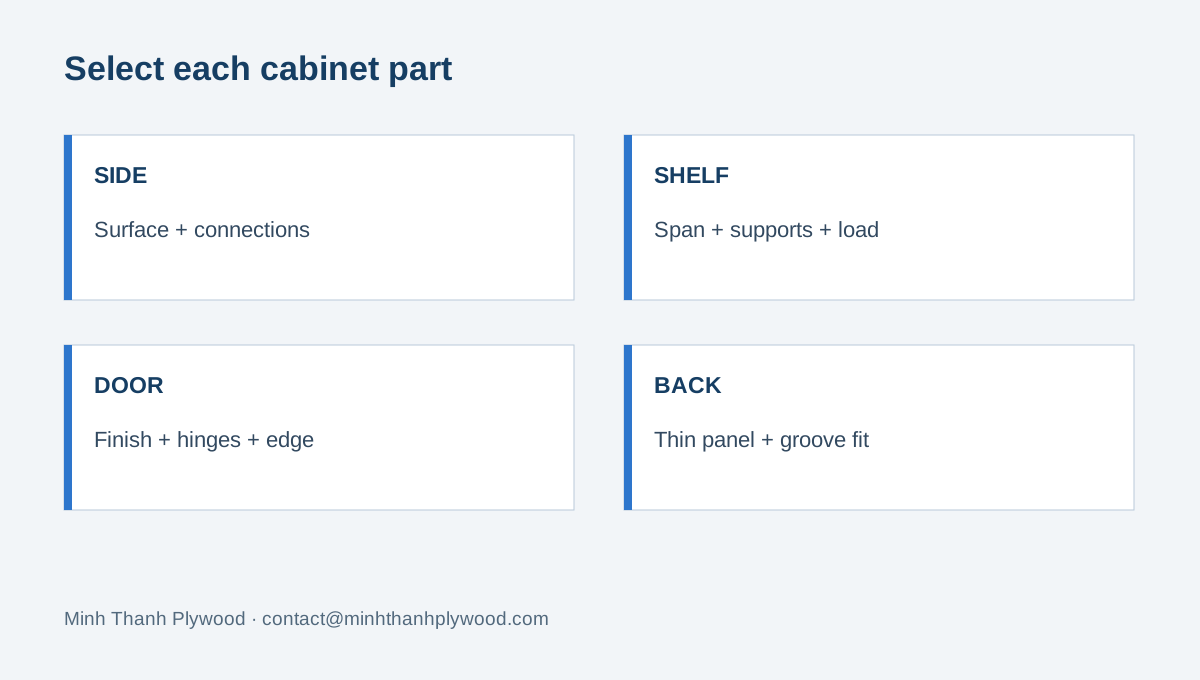
A cabinet can combine particleboard and plywood where each component’s construction, finish and hardware meet the design. Select the board for the component’s job rather than imposing one material name on the whole cabinet.
| Cabinet component | Particleboard evaluation | Plywood evaluation |
|---|---|---|
| Carcass side | Board grade, prepared face and compatible connectors | Core, thickness tolerance, face/back and hardware |
| Shelf | Published stiffness, supports and long-term deflection | Published construction properties, grain direction and supports |
| Door | Flatness, hardware and decorative finish | Face appearance, balance, hinge trial and edge finish |
| Back | Fixing/groove design and selected thin-board grade | Thin layup, groove fit and support arrangement |
| Sink-base part | Moisture-rated construction and sealed openings | Bond requirement, coating and edge/penetration protection |
Particleboard works in established dry-interior furniture systems with a selected board and connector arrangement. Decorative laminates can provide the required colour and surface. A supplier’s ordinary interior product should not be assumed to serve every humid or load-bearing application simply because the face is laminated.
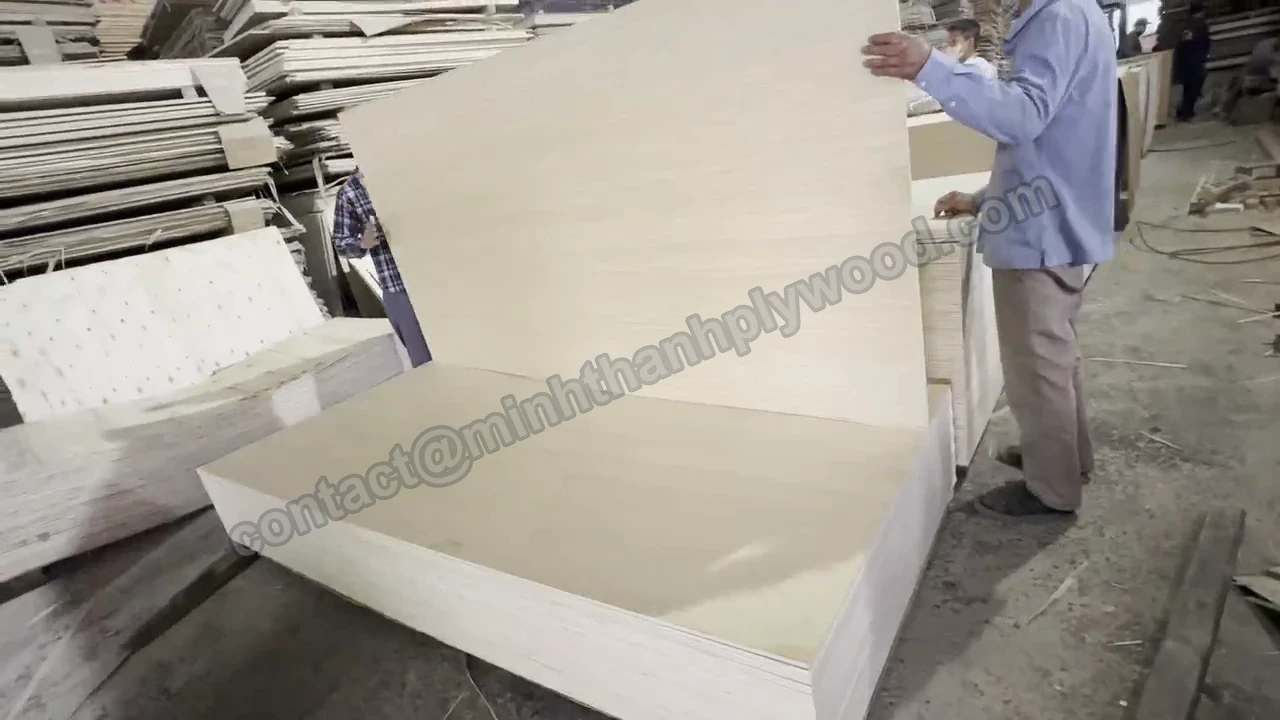
Plywood provides a veneer-core option where the natural face or layered edge matters. Minh Thanh supplies 3–40 mm furniture panels, including five-ply thin plywood at 3–6 mm. Choose the actual thickness from the component drawing, its support and hardware. A thin cabinet back and a shelf need separate product lines.
When replacing particleboard with plywood, check the tooling and connector instructions for the new substrate. The same outer dimensions do not establish that every pilot hole, connector or edge band can be kept unchanged. Trial the complete component before repeating its production quantity.
How do shelf strength, stiffness and sag compare?
Shelf performance depends on the board’s tested properties, thickness, span, support, load distribution and loading duration. Plywood construction often gives a useful strength-to-mass option, while furniture particleboard has its own published design data. Neither family name supplies a universal shelf load in kilograms.
Stiffness describes how much the shelf deflects under the specified load; bending strength addresses failure. Long-term deflection under sustained loading is another requirement. A shelf that feels rigid during a short hand check can still need evaluation for the way books, dishes or equipment load it over time.
For plywood, grain direction and layup matter. The APA plywood technical guidance distinguishes directional properties and panel design from appearance grades; consulted 7 October 2026. Structural-panel design data applies to the rated product and conditions it describes, and should not be assigned to an unrelated furniture construction.
For particleboard, use the selected product’s technical sheet and relevant grade. Moisture-rated and ordinary interior products can have different data. Compare them at the same actual thickness and component support arrangement. Do not apply a number from a board sold for another application or density range.
A cabinet sample trial should record unsupported span, shelf depth, edge detail, support spacing, load distribution, duration and acceptance criterion. An added support can change the design more efficiently than replacing every board with a thicker one. Keep the chosen arrangement in the drawing so the accepted sample and the production furniture use the same geometry.
How should you compare screws, hinges and furniture connectors?
Compare the actual joint with the specified board, hardware and assembly method. Screw withdrawal, hinge fixing, edge screws and cam-lock connections engage different parts of the substrate. A successful test of one connection does not establish a rating for all the cabinet hardware.
Particleboard furniture systems use connectors selected for their substrate and component design. Pilot-hole dimensions, drilling accuracy, edge distance and installation torque are part of that system. Treat the connector manufacturer’s instructions and the board technical sheet as the starting point instead of improvising a solid-wood fixing pattern.
Plywood hardware engages layers and can encounter a local core feature. Core preparation and the position of the fixing therefore matter alongside thickness. For Minh Thanh furniture panels, record Styrax or Eucalyptus core and the required stitching scope on the sample sheet. Trial the actual hinge cup, slide screw or edge joint the component will use.
| Hardware trial field | Keep constant between samples |
|---|---|
| Panel identity | Construction, actual thickness and conditioning |
| Fastener | Model, diameter, length and thread type |
| Drilling | Pilot-hole size/depth and hole position |
| Assembly | Specified torque or installation procedure |
| Evaluation | The required joint load, movement or repeated-use test |
Inspect for splitting, stripping, local edge damage and movement in the assembled joint. Photograph the issue with the sample reference. When a trial needs revision, distinguish a material change from a drilling or assembly change. That gives purchasing a reproducible construction rather than a broad claim that one board holds every screw better.
Which board is lighter, and how do you calculate its weight?
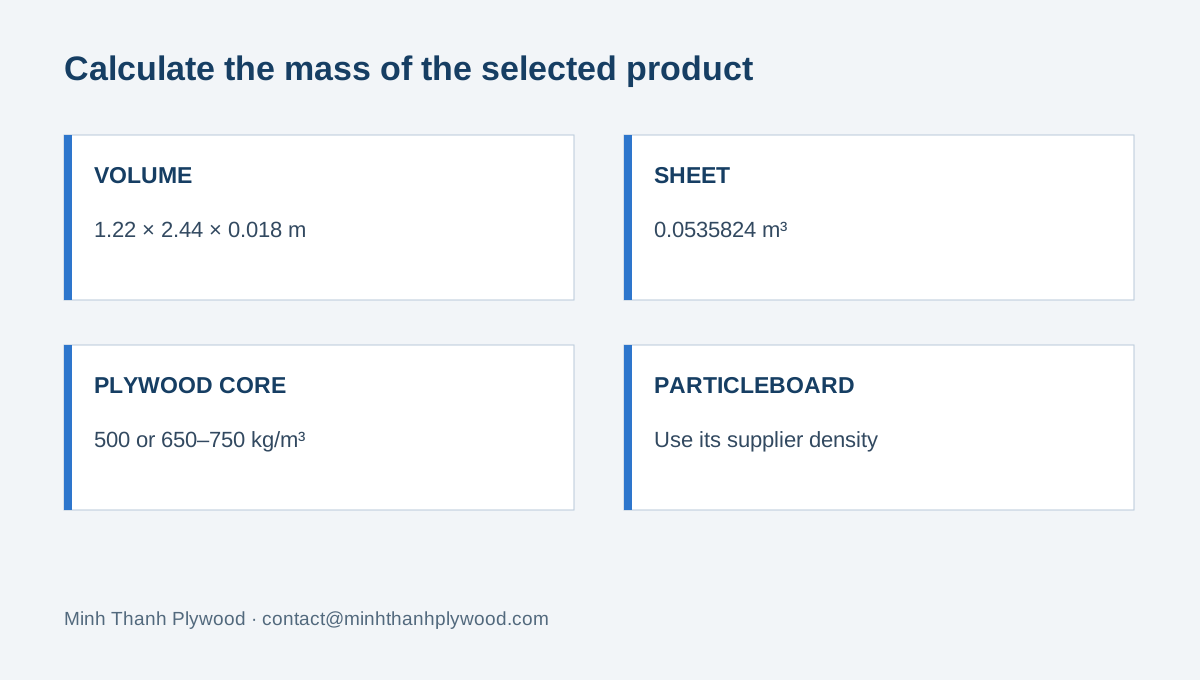
The lighter board is the one with lower finished density at the same dimensions. Particleboard is not automatically lighter than plywood, and plywood is not automatically heavier because it has visible layers. Use each supplier’s density or actual sample mass for the proposed construction.
A 1220 × 2440 × 18 mm sheet contains 0.0535824 m³, calculated as 1.22 × 2.44 × 0.018. Multiply that volume by the selected density in kg/m³. For Minh Thanh’s Styrax planning reference of 500 kg/m³, calculated board mass is about 26.8 kg. Eucalyptus at 650–750 kg/m³ gives about 34.8–40.2 kg.
Those plywood inputs describe the chosen construction; they are not particleboard density values. Take the particleboard supplier’s data and repeat the same calculation. Weigh representative production samples when handling mass determines the decision. Keep the dimensions and weighing conditions with the result so the comparison can be repeated.
For wall cabinets and movable furniture, the design includes board mass, hardware, contents and mounting conditions. A lower board mass can help the handling brief, but it does not supply a mounting capacity. The wall fixing and complete assembly need the design appropriate to those loads.
For shipment planning, add all panel lines, pallets, covers, straps and securing materials. Apply the booking and road limits to the complete cargo. The packing calculator uses the plywood construction and measured or declared planning inputs; a different core or actual mass needs a recalculated load.
How do moisture exposure and adhesive requirements differ?
Select the board grade and adhesive construction for the service environment, then protect the completed component as specified. Ordinary interior particleboard and dry-interior UF-bonded plywood are different from products designed for humid or exterior service. A coated face does not describe the hidden bond.
Particleboard exposed to moisture can swell at unprotected edges, holes and joints. Moisture-rated products are designed for a specified service class, and their technical sheet identifies the relevant scope. The cabinet design still needs compatible surfaces, edges and fittings. A moisture-resistant label does not make the assembled furniture immune to a plumbing leak.
Plywood bond performance is separate from the wood’s water uptake. Minh Thanh’s standard furniture construction uses UF glue at E0 emission; melamine-fortified or phenolic constructions address the customer’s specified bond requirement. Describe the exposure and test criterion before ordering the construction. A water-resistant joint does not make unfinished veneers maintenance-free outdoors.
For a kitchen, separate dry upper cabinets, ordinary carcasses and sink-base parts with possible wetting. Consider penetrations around pipes and fittings as well as broad faces. Put the surface and edge-protection details on the component drawing, so the sample trial covers the assembled condition.
The plywood water-exposure guide explains bond labels and detailing. Keep the resin, bond-test requirement and emission-test requirement on distinct lines. E0 describes emissions; it is neither an adhesive name nor a moisture-service classification.
Can both materials be laminated or veneered?
Both particleboard and plywood can act as substrates for decorative surfaces when the board and covering system are specified together. Laminate or veneer describes the face treatment; it does not change the substrate into another board family.
Particleboard commonly supports prepared decorative surfaces in cabinet programmes. The board’s face quality, thickness, moisture condition and compatible adhesive system affect the finished result. Select a substrate grade that suits the surfacing and assembly operation. Lamination should be evaluated as a complete system rather than a way to erase every limitation of an unsuitable core.
For plywood, face selection and core calibration support the decorative operation. Minh Thanh furniture panels receive a prepared core before face and back are pressed on. A selected natural veneer can be the visible finished surface; another construction can be prepared for the buyer’s coating or covering process. The face and reverse need their own requirements.
Balanced preparation matters when the finished component uses different surfaces on opposite sides. Include the reverse treatment and conditioning in the sample, especially for a large door or free-standing panel. Keep the surfacing system consistent between sample approval and the production run, so an appearance decision also represents the finished component.
Inspect the broad face, repair areas, edges and bond of the covering after the intended preparation. Keep the surface code with the substrate code on the sample record. This makes a change in laminate colour distinct from a change in core, adhesive or face preparation during a repeat purchase.
Which material is better for painting and routed profiles?
Choose the material using the finished coating and routed detail. A prepared plywood face can suit painted furniture; particleboard is commonly used with specified decorative coverings; MDF provides a fibre-based option for detailed routed and painted designs. Compare the finished part rather than only the unfinished face.
Plywood has a thin visible veneer over a layered core. Deep profiling or sanding can expose another layer, so the machining drawing and surface preparation need to preserve the intended face. A filled repair can behave differently from surrounding grain under an opaque coating. Trial those areas instead of painting only a clean sample corner.
Particleboard’s cut edge exposes particles and needs the preparation specified by the finish or edge-band system. A large flat decorative surface and a small routed moulding impose different requirements on that substrate. Evaluate the actual edge detail before selecting an uncoated particleboard component for a painted profile.
MDF uses fibres and often provides a useful uniform substrate for routed paintwork. It also needs the right grade, edge preparation and coating sequence. The plywood versus MDF guide develops that separate material decision. MDF is not a particleboard grade, even though both are manufactured from small wood elements.
For a trial, record primer, intermediate sanding, topcoat and curing process. Inspect face, reverse and typical repaired area under consistent light. For Minh Thanh Poplar-faced plywood, this test helps select the prepared face and grade pair that produce the finish the cabinet line needs.
How do cutting, drilling and edge banding affect finished parts?
Cutting and edge preparation reveal the substrate the furniture workshop will assemble. Compare candidate boards using the same finished dimensions and a recorded machining process. A clean decorative face can still require a different tool setup or edge treatment beneath it.
For particleboard, inspect chipped face edges, exposed particles and the prepared banding surface. For plywood, inspect face entry and exit, exposed veneer layers and any core feature at the cut. Match the tool and process to the actual board rather than treating the first rough crosscut as the completed result.
| Operation | What the trial should record | Finished-part acceptance |
|---|---|---|
| Sawing | Tool, feed, orientation and panel code | Dimensions and acceptable face/edge breakout |
| Routing | Profile, remaining face and exposed substrate | Clean feature and usable joint geometry |
| Drilling | Hole position, depth and hardware setup | Correct fit without unwanted local damage |
| Edge banding | Prepared edge, band and adhesive process | Bonded edge and accepted visible joint |
| Assembly | Component dimensions and connection method | Fit, appearance and specified function |
Record accepted parts and rework if processing cost drives the comparison. Do not infer a tool-life percentage or fixed cutting speed from the board family name. Those results depend on the selected panel and machining process.
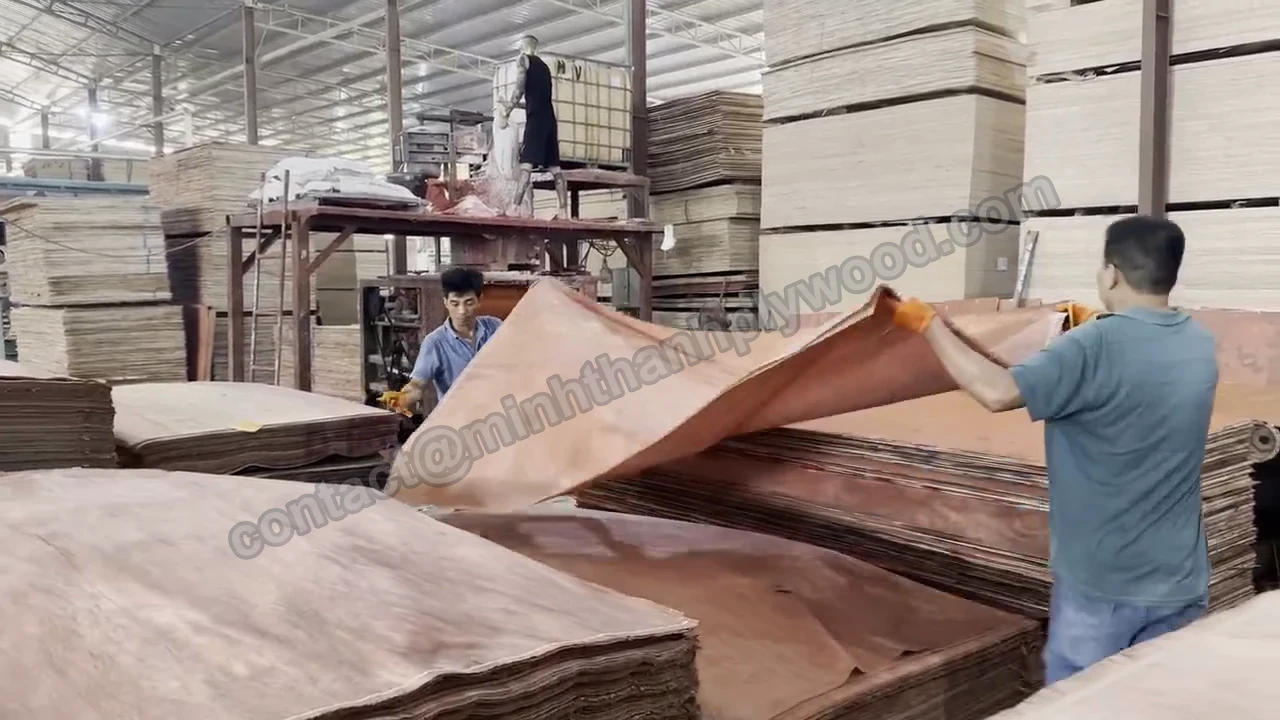
Minh Thanh can supply cut-to-size plywood from the agreed parent format. Send finished dimensions, grain direction and quantities. Include saw kerf, trimming and further machining allowance in the drawing. The cut-to-size range connects those instructions to the packing and receiving plan.
What thickness tolerance and moisture should the buyer specify?
Specify finished thickness, acceptance tolerance and the moisture condition relevant to the supplied panel. The same nominal thickness can represent different manufacturing tolerances, and furniture joints work with the actual panel rather than its catalogue name.
Minh Thanh sanded furniture panels use ±0.2–0.3 mm thickness tolerance, with tight specifications down to ±0.2 mm. A nominal 18 mm panel at ±0.2 mm has a finished acceptance band of 17.8–18.2 mm. Record the selected band rather than leaving the whole factory range on the purchase line.
Commercial plywood uses ±0.5 mm; packing panels use ±0.5–1.0 mm. These different references explain why the lowest quote for a familiar nominal thickness can still be a different product. The particleboard offer likewise needs its actual product tolerance and inspection basis. Compare like-for-like where a groove or hardware fit sets the acceptance.
Minh Thanh dispatch moisture is 8–12%. Keep the readings with the identified lot and measurement method. Store panels flat on supports and prepare them for the receiving workshop before machining. Moisture condition and panel thickness should be evaluated at the appropriate stage of the operation.
Use the plywood thickness guide when drawing a component schedule. State measurement positions and inspection method with the order or test plan. A note saying “accurate thickness” gives the receiving team less useful information than a nominal dimension, a defined tolerance and recorded sample readings.
What do emission classes and market requirements mean for both boards?
Both particleboard and hardwood plywood can fall within formaldehyde rules for composite wood products. Specify the applicable method, compliant product and supporting records rather than assuming that either material is automatically low-emission. MDF belongs in the same market-access discussion as a separate regulated product.
For US regulated panels, EPA’s composite-wood programme establishes product-specific requirements. Match the producer, certification scope and shipment records to the board being purchased. A particleboard certificate does not describe an unrelated plywood construction, and a furniture face grade does not establish emissions.
Minh Thanh holds CARB P2 / TSCA Title VI certification, ICTT mill no. 23024. Six ASTM D6007 reports on 9, 15 and 18 mm samples, April 2025–June 2026, give averages of 0.014–0.032 ppm against the 0.05 ppm veneer-core hardwood plywood limit. Three reports are from Shanghai Hongjun and three from ICTT Vietnam. The quality page identifies the evidence for those specimens.
For EU furniture and wood-based articles, REACH entry 77 applies a 0.062 mg/m³ limit from 6 August 2026 under Appendix 14 conditions, with exemptions including exclusively outdoor articles. Keep the required article test distinct from ASTM D6007 ppm results. SGS testing to the buyer’s method is arranged on request.
Sources consulted 7 October 2026. A label such as E0 should be accompanied by its method and relevant evidence; it does not name the adhesive. Put UF or another required resin/bond construction on its own line in the specification.
What should the buyer check about material origin and certification?
Ask for traceable wood constituents and the certification claim actually ordered. Particleboard can use recovered or industrial wood inputs, while plywood uses veneers; these descriptions alone do not establish environmental performance or timber legality. Use the selected producer’s evidence for the material in the purchase.
A general statement about recycled content needs its definition, measurement basis and applicable product scope. A forest-certification logo needs the relevant supplier and claim. An origin record needs the harvest source of the constituent wood rather than only the address where a board was manufactured. These are separate fields in a useful sourcing file.
Minh Thanh supplies the EUDR compliance dossier with origin records and geolocation files. Identify face, back and core species, harvest countries, production plots and production dates/time range in the supplied file. Imported decorative veneers remain part of the origin review alongside Vietnamese core wood.
The Commission’s July 2026 EUDR update states application from 30 December 2026 for large/medium operators and micro/small operators already covered by EUTR. Other micro/small operators follow from 30 June 2027. Vietnam is low risk under 2025/1093; simplified due diligence depends on all constituent origins. References consulted 7 October 2026.
FSC is available*. The official FSC search lets the buyer check the supplier’s product scope, while the agreed claim belongs in the order records. *Supplied directly or through qualified partner mills. The traceability guide explains the supplied plywood dossier.
Where do MDF and OSB belong in the comparison?
MDF and OSB are separate options with different internal structures and common uses. MDF provides a fibre substrate often evaluated for routed and painted furniture. OSB uses oriented strands and is commonly evaluated as a rated construction panel. Neither is simply another name for particleboard.
| Panel family | Internal element | Useful comparison question |
|---|---|---|
| Particleboard | Bonded particles | Does the selected grade and connector system fit the cabinet? |
| MDF | Bonded fibres | Does the routed edge and coating sequence fit the painted design? |
| Veneer-core plywood | Cross-laminated veneers | Does the chosen face/core construction fit weight, edges and assembly? |
| OSB | Oriented strands | Does the rated construction product fit the building design? |
A furniture comparison and a building-sheathing comparison need different acceptance criteria. A cabinet’s visible edge or hinge joint does not settle a roof panel’s rating, and a structural stamp does not select a decorative face. Keep product role, performance evidence and surface finish together when expanding the shortlist.
The types-of-plywood guide distinguishes veneer cores, composite cores and neighbouring engineered wood products. A veneered MDF or particle-core panel can look like a natural-wood surface while retaining its original substrate. Label that construction accurately in the comparison and packing file.
For Minh Thanh purchasing, start with the veneer-core furniture range and the required face. If MDF or particleboard remains an alternative for some components, trial those parts in the same assembly and finish. The result can support a mixed-material furniture design without turning one material’s data into a claim about all the others.
How should you compare price and cost per usable part?
Compare the complete material and processing scope, then calculate cost per accepted part. Particleboard is often selected for economical laminated furniture programmes; plywood pricing changes with core, face grade and preparation. A fixed percentage price advantage between the families would hide those choices.
Minh Thanh’s October 2026 starting prices are furniture/interior plywood from US$350/m³ and commercial plywood from US$250/m³. These are category entry prices, not a particleboard-versus-plywood price list. Obtain comparable quotations for the actual construction, quantities, finish and delivery basis.
| Cost field | Put into the comparison |
|---|---|
| Board purchase | Accepted quotation, exact dimensions and quantities |
| Surfacing | Required veneer, laminate or coating system |
| Machining | Cutting, drilling, routing and component preparation |
| Edges and hardware | Banding/protection and connectors suited to the substrate |
| Rework | Recorded rejected or repaired parts from the trial |
| Transport | Freight scope, packing and the usable quantity delivered |
Use cost per accepted part = relevant material and processing cost ÷ accepted parts. Keep the buyer’s actual quantities and costs in its worksheet. A larger sheet or a lower cubic-metre price does not lower component cost when the layout or finish produces fewer accepted parts.
For a repeat programme, retain the accepted construction while comparing a proposed alternative. Identify changed fields such as a concealed-back grade, core species or preparation stage. This lets the workshop evaluate the change and purchasing see where the quoted saving comes from, without inventing a universal lifetime or replacement-cost story.
How do you run a fair particleboard-versus-plywood trial?
Run the comparison on the same component drawing, finished appearance and functional acceptance criteria. Identify each candidate product and keep the process recorded. A fair trial compares completed parts the furniture line can use, rather than one board’s attractive face with another board’s unfinished edge.
- Define the component, environment, support and hardware requirements.
- Obtain identified samples of the actual quoted grades and construction.
- Record dimensions, actual thickness, mass and conditioning.
- Cut and machine the component with the documented suitable setup.
- Install the specified hardware using its recorded drilling and assembly instructions.
- Apply the intended edge treatment and coating or laminate system.
- Test the completed part for the agreed function and finish.
- Count accepted parts and rework, then retain the successful reference.
For a shelf, include the support and load conditions. For a door, include hinge and finish. For a drawer bottom, include the groove and supported area. A first trial can then answer a specific production decision instead of accumulating unrelated observations about boards.
Minh Thanh provides free plywood samples. Send the actual component requirement, including the face/back pair, core, thickness and intended finish. For a comparison against an existing particleboard part, add its specification and the performance the replacement must retain.
Keep changes visible during the trial. A different core, hole pattern or edge-band adhesive is a new variable. Record the revised construction or operation so the accepted result can be reproduced in the quotation, factory order and receiving inspection.
How do packing, receiving and repeat orders protect the choice?
Keep each accepted construction identifiable from the purchase line to the receiving warehouse. A decorative face can conceal different cores, so the bundle schedule and sample reference must carry the specification that the workshop approved.
For Minh Thanh plywood, list face/back grade, core, stitching scope, thickness and finished size on the construction sheet. Add sheet or piece quantities, pack identity and the required surface protection. Our standard MOQ is one 40HC with mixed specifications by agreement. Production takes 15–45 days after deposit; standard terms are 30% deposit and 70% against the scanned B/L, or irrevocable L/C at sight.
Invoice, packing list and B/L should reconcile the order’s products, quantities and packages. Keep product compliance and origin evidence connected to the same specification. FOB Hai Phong, CFR and CIF are available; the chosen named port and freight scope belong in the quotation.
On arrival, photograph unopened packs, count bundles and reconcile sheets by specification. Store panels flat on supports and preserve labels when the packs are divided. Compare the selected faces and construction with the retained sample before components are mixed into the production line.
For a repeat purchase, retain the accepted sample and construction revision. Change delivery date and quantity without silently changing face, core, adhesive or preparation. Send your furniture specification with the component drawing, existing material reference and destination to compare the plywood route. The furniture selection guide connects the accepted panel with the rest of the component schedule.
Buyer questions, answered
Is particleboard or plywood better for furniture?
Particleboard suits selected dry-interior laminated furniture systems with compatible board grades and connectors. Veneer-core plywood suits furniture needing its selected natural face, layered edge or core-weight choice; compare the completed component.
Is particleboard a type of plywood?
Particleboard uses bonded wood particles, while veneer-core plywood uses cross-laminated veneers. A decorative veneer on particleboard does not change the core into veneer plywood.
How can I identify particleboard and plywood?
An unfinished edge shows particles in particleboard and veneer layers in plywood. Confirm the construction with the product record when the edges are banded; weight or a tapping sound cannot reliably identify the substrate.
Which material is lighter?
Use finished density and dimensions, or actual sample mass. At 1220 × 2440 × 18 mm, Minh Thanh Styrax reference panels calculate to about 26.8 kg and Eucalyptus to 34.8–40.2 kg; particleboard needs its own supplier density.
Is particleboard waterproof?
An ordinary interior particleboard should not be treated as waterproof. Specify the required moisture-rated board, coating and protected edges for the service; a laminate face does not protect every hole or exposed edge.
Is plywood always waterproof?
Bond service and wood water uptake are separate. Specify the plywood bond and finished surface/edge design for the exposure; Minh Thanh standard furniture panels use UF glue at E0 emission for the selected interior construction.
Can particleboard be used for cabinets?
Yes, selected particleboard grades and compatible furniture connectors can serve dry-interior cabinet programmes. Evaluate the shelf, hardware and finished surface requirements component by component.
Can plywood and particleboard both be laminated?
Yes, with a specified substrate and compatible covering system. Include the reverse treatment, edge finish and conditioning in the sample to represent the completed component.
Does plywood always hold screws better?
Compare the actual panel, hardware, pilot holes and joint test. Face screws, edge screws, hinges and cam-lock connectors engage the substrate differently, so one result is not a universal fixing rating.
Is MDF the same as particleboard?
MDF uses wood fibres; particleboard uses particles. MDF is a separate material commonly evaluated for routed and painted components, with its own grades and finishing process.
How much does Minh Thanh furniture plywood cost?
Furniture/interior plywood starts from US$350/m³, and commercial plywood from US$250/m³, as of October 2026. The accepted quotation identifies construction, finish, quantity and delivery scope.
What should I send for a plywood replacement sample?
Send the existing material specification, component drawing, face/back appearance, core, dimensions, hardware and intended finish. Add functional acceptance criteria, quantities, packing and destination; samples are free.