
Vietnamese plywood is made from plantation hardwood grown in Vietnam for the core, mainly white Styrax, Eucalyptus and Acacia, with a face veneer chosen for the look: engineered veneer, poplar, birch, okoume, pine and others. Minh Thanh Plywood builds furniture panels on Styrax or Eucalyptus cores as standard and Acacia or Pine cores on order.
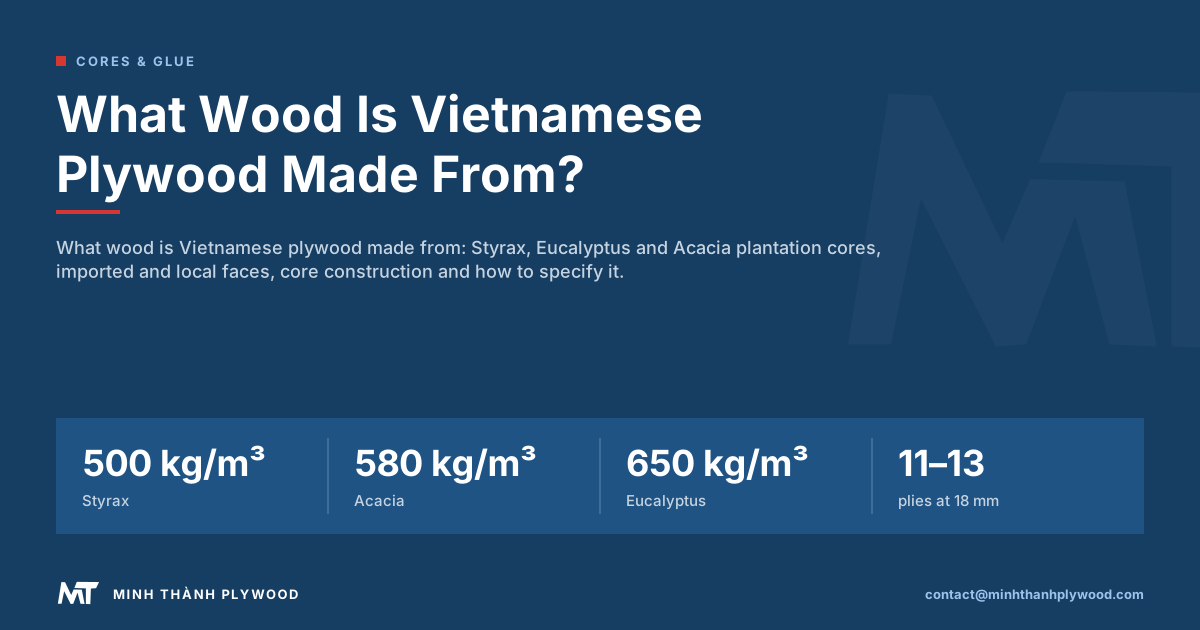
Vietnamese plywood is a cross-laminated panel whose core is peeled from Vietnamese plantation hardwood (white Styrax, Eucalyptus or Acacia) and whose face is a separate veneer chosen for appearance. The species in the core decides the weight, the hardness and the price per container; the face decides the look and the name the panel is sold under.
This guide lists the woods, shows how a panel is built from them, and gives the line to put in your RFQ. It is written from the floor of Minh Thanh Plywood, a Vietnamese manufacturer of furniture and interior plywood in Ha Hoa, Phu Tho, with Europe as its main market.
Woods used in Vietnamese plywood at a glance
Vietnamese plywood uses three plantation hardwoods as standard cores, white Styrax, Eucalyptus and Acacia, with pine on order and rubberwood as a niche core, and faces of imported birch, okoume and poplar. The table gives each wood’s role, density and Janka hardness, from public sources where one exists.
| Wood | Role in Vietnamese plywood | Density, kg/m³ | Janka hardness, lbf |
|---|---|---|---|
| White Styrax | Standard furniture core | 500 (Minh Thanh planning) | no public rating found |
| Eucalyptus | Standard furniture core; commercial and film-faced | 650 (Minh Thanh planning); E. grandis 640 | 1,260 (E. grandis) |
| Acacia | Core on order; commercial, film-faced, anti-slip | 580 (Minh Thanh planning); species range 360–690 | 1,360–1,820 as quoted by one Vietnamese furniture source |
| Pine (radiata) | Core or face on order | 515 | 710 |
| Rubberwood | Niche core from the south, not made at Minh Thanh | 595 | 960 |
| Poplar | Face only, in Vietnam | 450 (eastern cottonwood) | 430 |
| Birch | Imported face veneer | 690 (yellow birch) | 1,260 |
| Okoume | Imported face veneer | 430 | 400 |
Sources: Minh Thanh planning densities are its container-load figures; Wood Database for E. grandis, radiata pine, rubberwood, cottonwood, yellow birch and okoume (Wood Database, checked October 2026); the acacia density range and Janka figure are quoted by Rockhill Asia from Dang et al. (2020), which also gives 5–7 years from planting to harvest for fast-growing Vietnamese acacia. Density changes with species, age and moisture, so the Minh Thanh figures are for planning a load and real sheets are weighed.
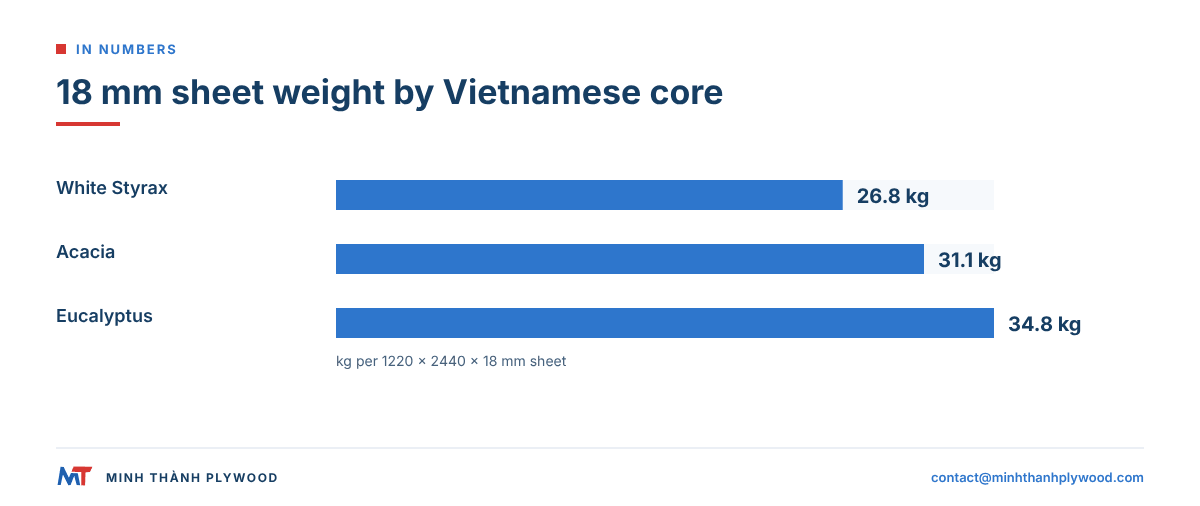
In US units, an 18 mm (about 23/32 in) sheet of 1220 × 2440 mm, which is 4 × 8 ft, weighs about 59 lb on a Styrax core and about 77 lb on Eucalyptus.
What wood is Vietnamese plywood made from?
Vietnamese plywood is made from three plantation hardwoods for the core, white Styrax, Eucalyptus and Acacia, plus a face veneer from a wider list that includes imported species. The core makes up almost all of the thickness: in an 18 mm panel, the face and back veneers together are less than a millimetre.
The woods split into two groups:
- Core woods, grown in Vietnam. Styrax, Eucalyptus and Acacia logs come from plantations and are rotary-peeled into core veneers. Mixed cores combine two of them. Rubberwood is a niche core from the south of the country and costs more.
- Face woods, chosen by the buyer. Engineered veneer (EV), poplar, birch, okoume and pine are the faces Minh Thanh produces most; bintangor, eucalyptus, gurjan and sapele are made on request. Birch and okoume faces are imported veneers.
Two woods buyers often expect are absent from Vietnamese cores: poplar and birch. Vietnamese mills do not grow or peel poplar or birch for cores, and gurjan, okoume and bintangor are only ever faces. A panel named after its face, such as birch plywood, is a birch-faced panel on a Vietnamese hardwood core.
What is the core of Vietnam plywood?
The core of Vietnam plywood is a stack of hardwood veneers, usually 1.4–2.0 mm thick each, peeled from Styrax, Eucalyptus or Acacia and laid with the grain of each layer at right angles to the next. That crossing gives the panel its stability and its strength in both directions.
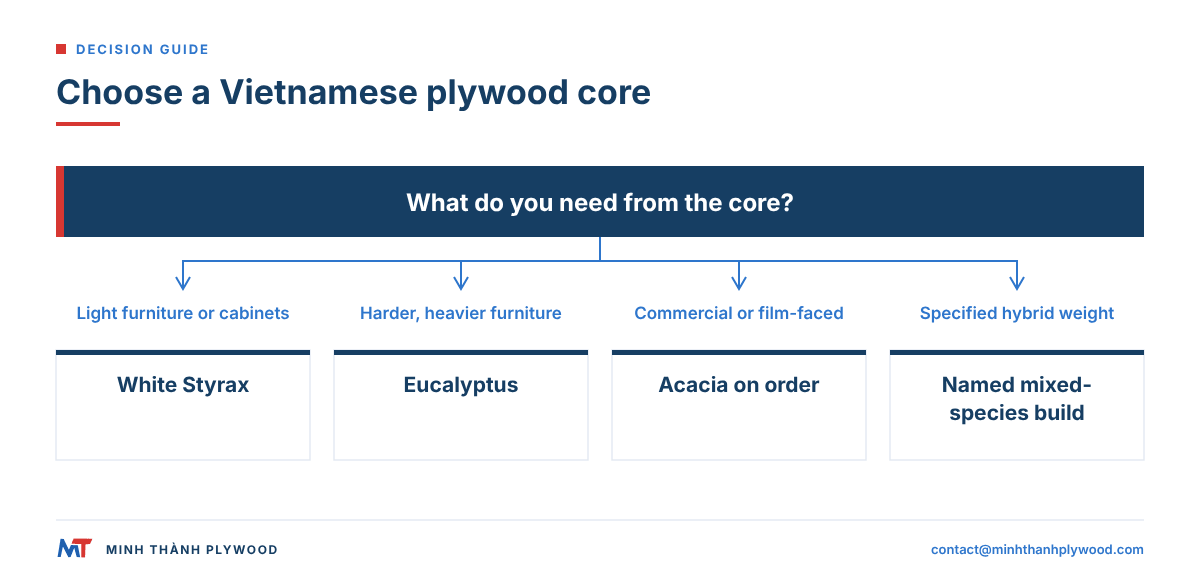
At Minh Thanh, furniture panels use a white Styrax or a Eucalyptus core as standard. Acacia and Pine cores are made on order. The choice is the buyer’s, and it follows the use:
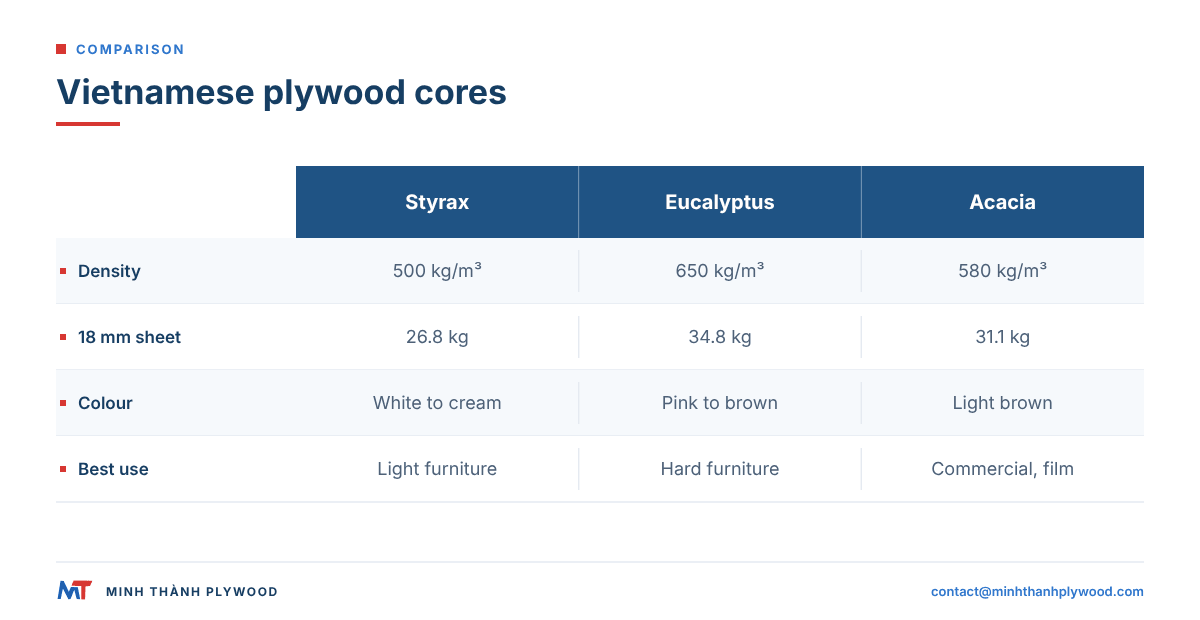
| Core | Reference density | 18 mm sheet, 1220 × 2440 mm | Colour | Best use |
|---|---|---|---|---|
| White Styrax | 500 kg/m³ | about 26.8 kg | White to cream | Furniture, cabinets, painted and UV-coated panels where weight matters |
| Eucalyptus | 650 kg/m³ (650–750 kg/m³ in practice) | about 34.8 kg | Pink to light brown | Furniture, shelving and panels that need a harder, heavier core |
| Acacia | 580 kg/m³ | about 31.1 kg | Light brown | Commercial, film-faced and anti-slip plywood, packing |
| Pine (on order) | by order | by order | Yellow-white | Softwood builds on request |
The reference densities are the planning figures Minh Thanh uses to build container loads; real sheets are weighed before a load is fixed. Many European furniture buyers choose the white Styrax core because it is light and gives an even bed under thin faces.
The species one by one: Styrax, Eucalyptus and Acacia
Each core species brings its own weight, colour and working behaviour, and a buyer who knows them can order the right one the first time.
White Styrax (bồ đề in Vietnamese) is a pale, light, fine-grained plantation hardwood grown in northern Vietnam. Its colour does not show through thin light faces, it machines cleanly, and at 500 kg/m³ it gives the lightest panel of the three. It is the core of choice for furniture and interior panels that will be painted, laminated or UV-coated by the buyer.
Eucalyptus is denser and harder. At 650 kg/m³ as a planning figure, and 650–750 kg/m³ in real sheets, it gives a heavier panel with firm screw holding and a hard edge. It is the second standard furniture core at Minh Thanh and a common core for commercial and film-faced panels across Vietnam. The full comparison is in eucalyptus core plywood.
Acacia sits between the two at 580 kg/m³. It is the workhorse core of Vietnamese commercial and construction plywood: film-faced and anti-slip panels in Vietnam use only Acacia or Eucalyptus cores. Minh Thanh makes Acacia cores on order. Read more on acacia plywood.
Mixed cores combine species, for example Eucalyptus near the faces and a lighter species in the centre. They are quoted as a named build, so the buyer knows which species is where.
Hardwood core plywood from Vietnam: why there is no poplar or birch inside
Hardwood core plywood is the normal Vietnamese product, because the plantation species that grow well in the country are all hardwoods. Poplar is the core species of Chinese and European commercial plywood, and birch is the core of Baltic and Russian birch plywood; neither is grown or peeled for cores in Vietnam.
This shapes what to order. A buyer used to a white poplar core gets the closest match from a white Styrax core, which is about as light and as pale. A buyer used to birch throughout gets a birch-faced panel on a Styrax or Eucalyptus core, pressed twice for a flat face. The poplar core plywood guide compares the two in detail.
It also helps with origin questions. If a panel sold as Vietnamese turns out to have a poplar core, the buyer has a clear reason to ask for the origin records.
Which face veneers go on Vietnamese plywood, and which are imported?
The face of Vietnamese plywood is a thin veneer, 0.2–0.5 mm and usually 0.3 mm for Europe, chosen for the look the buyer orders. Minh Thanh offers 10+ face veneers:
- Produced most often: engineered veneer (EV), poplar, birch, okoume and pine.
- On request: bintangor, eucalyptus, gurjan, sapele and others.
- Imported: birch and okoume face veneers are imported and pressed on Vietnamese cores.
Face grades follow the face. Birch faces are graded D+, D and E in Vietnam and quoted as face/back pairs such as D+/D or D/E, comparable to the European birch ladder (D+/D is close to B/BB). Poplar and eucalyptus faces are quoted as A/A, A/B and B/B, and every order is matched to the buyer’s approved sample.
The product name comes from the face: birch plywood, okoume plywood, EV plywood. The core is a separate line on the specification.
How is plywood made in Vietnam? Step by step
Vietnamese plywood is made by peeling plantation logs into veneers, drying them, gluing them in cross layers and pressing the stack under heat. For furniture grade, Minh Thanh presses twice. The steps:
- Peel. Plantation logs of Styrax, Eucalyptus or Acacia are soaked and rotary-peeled into continuous core veneer, 1.4–2.0 mm thick.
- Dry. Veneers are dried to 8–12 % moisture content, the normal range for furniture plywood, so the glue cures evenly and the panel stays flat.
- Grade and joint. Core veneers are sorted, defects are cut out, and pieces are jointed into full-width sheets.
- Spread glue. UF glue at E0 emission for furniture and interior panels; melamine-fortified (MR) or phenolic (WBP) bonds to the buyer’s specification.
- Lay up. Veneers are stacked with the grain of each layer at right angles to the next; an 18 mm panel usually has 11 to 13 plies.
- Stitch. Core layers are stitched horizontally and vertically, so the core stays closed with no gaps or overlaps.
- First press. The core board is cold pre-pressed, then hot-pressed: about 110–120 °C for MR glue and 130–145 °C for WBP.
- Calibrate. The core board is sanded to an even thickness, which sets the tolerance of the finished panel.
- Second press. Face and back veneers are pressed onto the calibrated core.
- Trim, sand, polish. Edges are cut to 1220 × 2440 or 1250 × 2500 mm (or a custom size), and both faces are sanded and polished to a UV-ready finish.
- Inspect and pack. Thickness is checked against ±0.2–0.3 mm for sanded furniture panels, faces are graded against the sample, and the packs are strapped and photographed before loading.
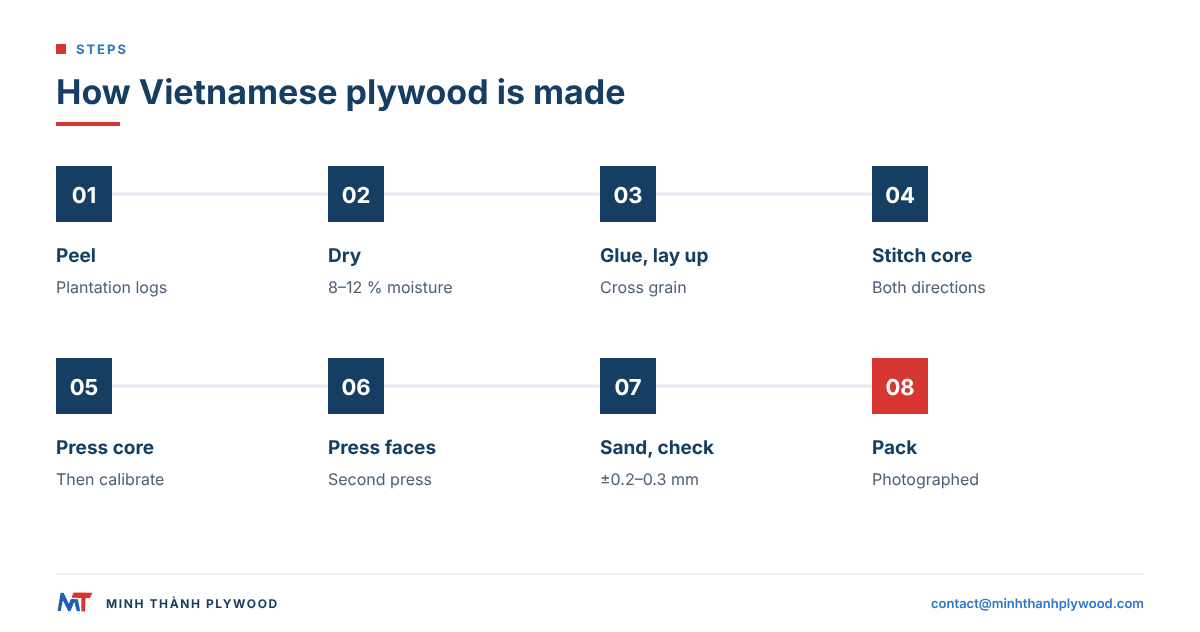
The two-press build is what separates furniture grade from commercial grade. A single press bonds face and core in one go; pressing the calibrated core first leaves no core unevenness under the face.
Plywood core construction in Vietnam: plies, stitching and double pressing
Plywood core construction in Vietnam means how the core veneers are graded, joined and pressed, and it differs by product line more than by mill. The build a buyer gets by line:
| Line | Core grade and build | Thickness tolerance | Surface |
|---|---|---|---|
| Furniture and interior | A-grade core veneers, stitched horizontally and vertically, pressed twice | ±0.2–0.3 mm, down to ±0.2 mm | Sanded and polished, UV-ready both faces |
| Commercial | AB core veneers, loose or jointed | ±0.5 mm | Light sanding or none |
| Film-faced | Acacia or Eucalyptus core | ±0.5 mm | Phenolic film |
| Packing | AB core veneers, laid loose | ±0.5–1.0 mm | Unsanded |
An 18 mm furniture panel on a Styrax core is built like this, top to bottom: face veneer, then nine core and cross-band layers with the grain turning 90° at each layer, then the back veneer, for 11 plies in total. Thin panels follow their own rule: 3–5 mm panels are always 5-ply, and a 3 mm panel is one core veneer, two cross-band veneers and two faces.
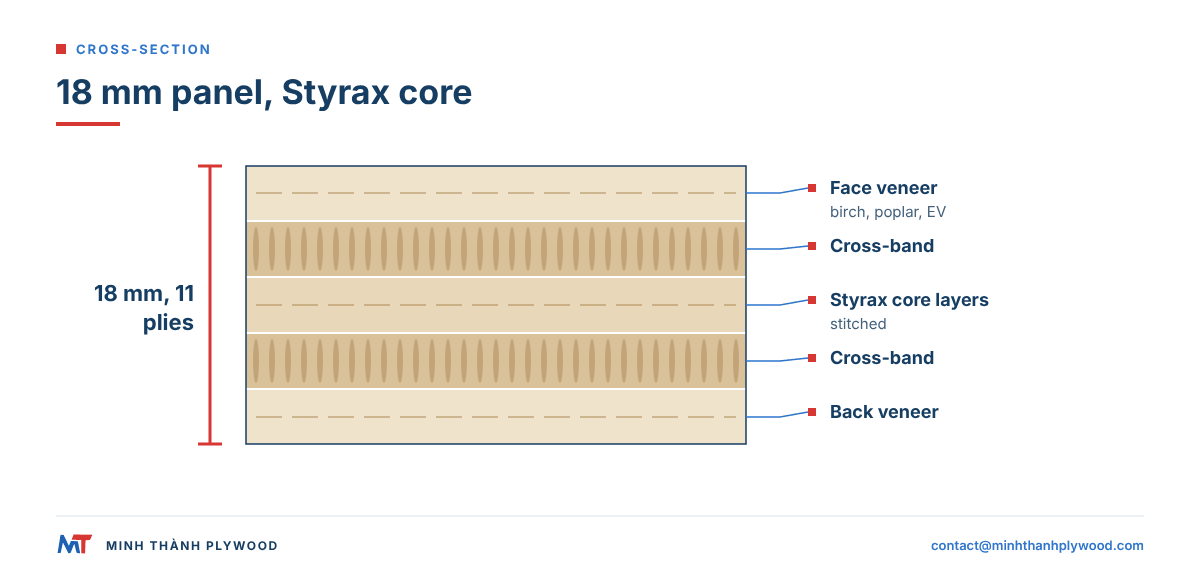
Stitching and double pressing are where furniture panels earn their price. The stitch line keeps core pieces from opening during pressing; the calibrated first press gives the face an even bed, which is why a thin face does not telegraph core joints.
Plywood core types in Vietnam by product line
Plywood core types in Vietnam are named by species and by build. A buyer reading a quotation meets these combinations:
- Full Styrax core: white, light; furniture, cabinets, painted panels.
- Full Eucalyptus core: harder and heavier; furniture, shelving, commercial and film-faced panels.
- Full Acacia core: commercial, film-faced and anti-slip plywood, packing.
- Mixed hardwood core: two species in a named order, often Eucalyptus or Acacia outside and a lighter species inside, to balance weight and hardness.
- Pine core: a softwood build made on order.
- LVL: a separate product with all veneers in the same grain direction, for beams, frames and shelving parts, not a plywood core.
For the core types outside Vietnamese practice (poplar, birch, combi, blockboard, MDF and particle cores), see the coming guide to plywood core types.
Mixed hardwood core plywood from Vietnam
Mixed hardwood core plywood from Vietnam combines two plantation species in one core, and it is a buyer’s tool for hitting a weight or a price without changing the face. The usual reason is weight: a panel with harder Eucalyptus near the faces and lighter veneers in the centre keeps surface hardness and screw holding where they matter and loses kilograms in the middle.
Specify a mixed core by naming the species and their position, for example “Eucalyptus outer core layers, Styrax centre”. A quotation that says only “mixed hardwood” leaves the build to the mill, and two shipments can then weigh differently. Minh Thanh writes the build into the quotation and matches every order to the approved sample.
Which Vietnamese company makes custom-core plywood?
Custom core plywood from Vietnam is a panel whose core species, build and glue are set by the buyer rather than the mill’s default. At Minh Thanh a custom core order can fix:
- Species: Styrax or Eucalyptus as standard; Acacia or Pine on order; a named mixed build.
- Ply count: within 11 to 13 plies for 18 mm, or a set count for another thickness from 3 to 40 mm.
- Stitching: horizontal and vertical stitching of the core, standard on furniture panels.
- Glue and emission: UF glue at E0 emission as standard; melamine-fortified or phenolic bonds to specification.
- Thickness tolerance: down to ±0.2 mm on sanded furniture panels.
- Size: 1220 × 2440 or 1250 × 2500 mm, custom sizes such as 1220 × 2500 or 1220 × 2280 mm, and cut-to-size, one panel cut into 4, 6 or 8 pieces.
- Face: any of 10+ face veneers.
Every custom core starts with a free sample of the build, which then becomes the reference for the order.
How the core species changes weight, container load and landed cost
The core species changes the landed cost more than the FOB price suggests, because a heavier core means fewer sheets per container and more freight per sheet. Minh Thanh’s 40HC plan for 1220 × 2440 mm, 18 mm panels, with packs about one metre high and a planning payload of 28,000 kg:
| Core | Packs per 40HC | Sheets per pack | Sheets per 40HC | Volume | Sheet weight |
|---|---|---|---|---|---|
| Styrax | 18 (16 lying + 2 upright) | 55 | 990 | about 53 m³ | 26.8 kg |
| Acacia | 16 | 55 | 880 | about 47 m³ | 31.1 kg |
| Eucalyptus | 15 | 53 | 795 | about 43 m³ | 34.8 kg |
A Styrax-core load carries 195 more sheets than a Eucalyptus-core load of the same thickness. Spread the same freight over 990 sheets instead of 795 and the freight per sheet falls by about a fifth. Weight is calculated from size × density, plus packing, and capped by the booking; when the booking is lower than 28,000 kg, the sheet count falls with it. The plywood weight calculator gives other thicknesses.
Pros and cons of plywood made in Vietnam
Plywood made in Vietnam offers plantation hardwood cores grown near the mills, a choice of 10+ faces and the documents European and US buyers ask for; the trade-offs are in weight and in matching species to use.
Strengths a buyer can use:
- Local plantation timber. Ha Hoa sits among plantations that supply the core veneers, which keeps cost down at the same grade, and the mill’s capacity is 50,000+ m³ per year, more than 4,100 m³ a month.
- Light white core. Styrax gives a furniture core close to poplar in colour and weight.
- Demanding builds as routine. Stitched cores, double pressing, ±0.2 mm, UV-ready faces.
- Documents. CARB P2 / TSCA Title VI certification (ICTT mill no. 23024), an EUDR compliance dossier with origin records and geolocation files, and a certificate of origin per shipment.
Choices to make on purpose:
- Weight. Eucalyptus is harder but heavier; choose Styrax when handling and freight matter more than hardness.
- Face. Birch and okoume faces are imported veneers on a Vietnamese core; order “birch-faced” and name the core.
- Glue. Interior UF glue at E0 emission is the furniture standard; outdoor or humid use calls for a melamine-fortified or phenolic bond.
How to check the origin of Vietnamese plywood: EUDR and Lacey Act records
The origin of Vietnamese plywood is proven with paper, not by looking at the core. Minh Thanh supplies the EUDR compliance dossier, with origin records and geolocation files, with orders for the EU. Regulation (EU) 2023/1115 requires operators placing plywood on the EU market to hold the geolocation of the plots where the wood was harvested (EUR-Lex, Regulation (EU) 2023/1115, checked October 2026). Vietnam is listed as a low-risk country in Implementing Regulation (EU) 2025/1093.
For the US, Minh Thanh supplies the face and core species and their Vietnamese harvest origin for the importer’s Lacey Act declaration, and panels for US orders carry the TSCA Title VI label (EPA, formaldehyde emission standards for composite wood products, checked October 2026). Every shipment travels with a commercial invoice, packing list, B/L, certificate of origin (EUR.1 for the EU), phytosanitary and fumigation certificates. The EUDR traceability page explains the dossier.
Under the 2023 US circumvention rulings, panels finished in Vietnam with Chinese core components (core platforms or core veneers, with or without Chinese faces) are treated as Chinese for duty, so Vietnamese-grown cores and faces with origin records matter at the border. The species list on these documents is the same one used in this guide: the core species and the face species, named separately.
What this means for your order
The wood inside Vietnamese plywood is a specification line, and naming it removes most surprises on arrival. Put these in the request:
- Core species: Styrax, Eucalyptus, Acacia, Pine or a named mixed build.
- Face and grade: for example birch D+/D, poplar A/B, okoume or EV, against an approved sample.
- Build: ply count, stitched core, pressed twice for furniture grade.
- Glue and emission: UF glue at E0 emission, CARB P2 / TSCA Title VI, or a melamine-fortified or phenolic bond.
- Thickness and tolerance: for example 18 mm ±0.2 mm.
- Size, packing and quantity: 1220 × 2440 mm, export packs, 1×40HC, mixed specifications by agreement.
Production takes 15–45 days after the 30% deposit, with the 70% balance against the scanned B/L, FOB Hai Phong, CFR or CIF. Indicative starting prices in October 2026: furniture and interior plywood from US$350/m³, commercial plywood from US$250/m³.
The specification line to send
Copy this line and change what differs, so the quotation names the wood in every layer:
18 mm × 1220 × 2440 mm; face/back: birch D+/D (imported veneer); core: white Styrax, 11 plies, stitched, pressed twice; UF glue at E0 emission, CARB P2 / TSCA Title VI; thickness ±0.2 mm; sanded and polished, UV-ready both faces; EUDR dossier; 1×40HC CIF your port.
Minh Thanh sends free samples of the specified build and replies within hours: contact@minhthanhplywood.com or WhatsApp +84 988 586 601. The furniture plywood page lists every face and core in one place, and the plywood catalogue has the full range.
Buyer questions, answered
What wood is Vietnamese plywood made from?
The core is Vietnamese plantation hardwood: white Styrax, Eucalyptus and Acacia, sometimes mixed. The face is a separate veneer chosen for the look, such as engineered veneer, poplar, birch, okoume or pine.
What is the core of Vietnam plywood?
Most Vietnamese plywood has an Eucalyptus, Acacia or white Styrax veneer core, or a mix of them. Rubberwood is a niche core. Vietnamese mills do not use poplar or birch cores.
Is Vietnamese plywood hardwood or softwood?
The standard cores are hardwood: Styrax, Eucalyptus and Acacia are all broadleaf plantation species. A pine core is made on order and is the softwood option.
Is birch plywood from Vietnam real birch?
It is birch-faced plywood: imported birch face and back veneers pressed on a Vietnamese hardwood core. Ask for birch-faced plywood with the core named, never full birch.
How many plies does 18 mm Vietnamese plywood have?
An 18 mm panel usually has 11 to 13 plies, most often 11. Thin panels from 3 to 5 mm are always built with 5 plies at Minh Thanh.
Which core is lightest?
White Styrax, at a reference density of 500 kg/m³. An 18 mm sheet of 1220 × 2440 mm weighs about 26.8 kg on a Styrax core and about 34.8 kg on Eucalyptus.
Does the core species change the price per container?
Yes. A 40HC holds 990 sheets of 18 mm on a Styrax core, 880 on Acacia and 795 on Eucalyptus, because heavier cores reach the payload sooner. That changes the freight cost per sheet.
Is Vietnamese plywood really made in Vietnam?
A panel from a Vietnamese mill is built on cores peeled from Vietnamese plantation logs. Minh Thanh supplies the EUDR compliance dossier with origin records and geolocation files, and the certificate of origin with every shipment.
Can I order a custom core?
Yes. Choose Styrax or Eucalyptus as standard, or Acacia or Pine on order, and specify the face, glue, thickness and stitching. Minh Thanh builds the core to the approved sample.
Which Vietnamese company makes custom-core plywood?
Minh Thanh Plywood in Ha Hoa, Phu Tho, makes furniture, commercial, packing and film-faced plywood with Styrax, Eucalyptus, Acacia or Pine cores and 10+ face veneers, from one 40HC.