
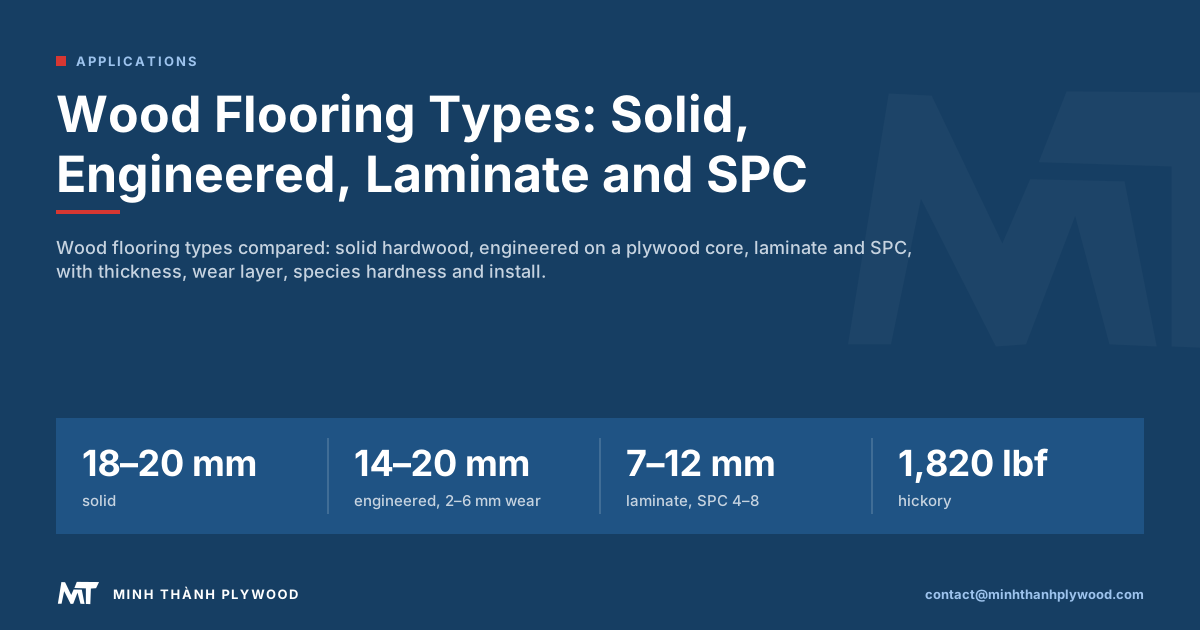
The main wood flooring types are solid hardwood, engineered wood on a plywood core, and the wood-look floors laminate and SPC vinyl. Solid boards are one piece of timber about 18–20 mm thick; engineered boards carry a 2–6 mm hardwood wear layer on a cross-laminated plywood base. Minh Thanh Plywood makes calibrated plywood in Vietnam, and explains here how each type is built and which suits which room.
What are the main wood flooring types?
The main wood flooring types are solid hardwood, engineered wood and parquet built from either, plus two wood-look floors: laminate and SPC (stone plastic composite) vinyl. Only solid and engineered floors have a real wood surface that can be sanded and refinished.
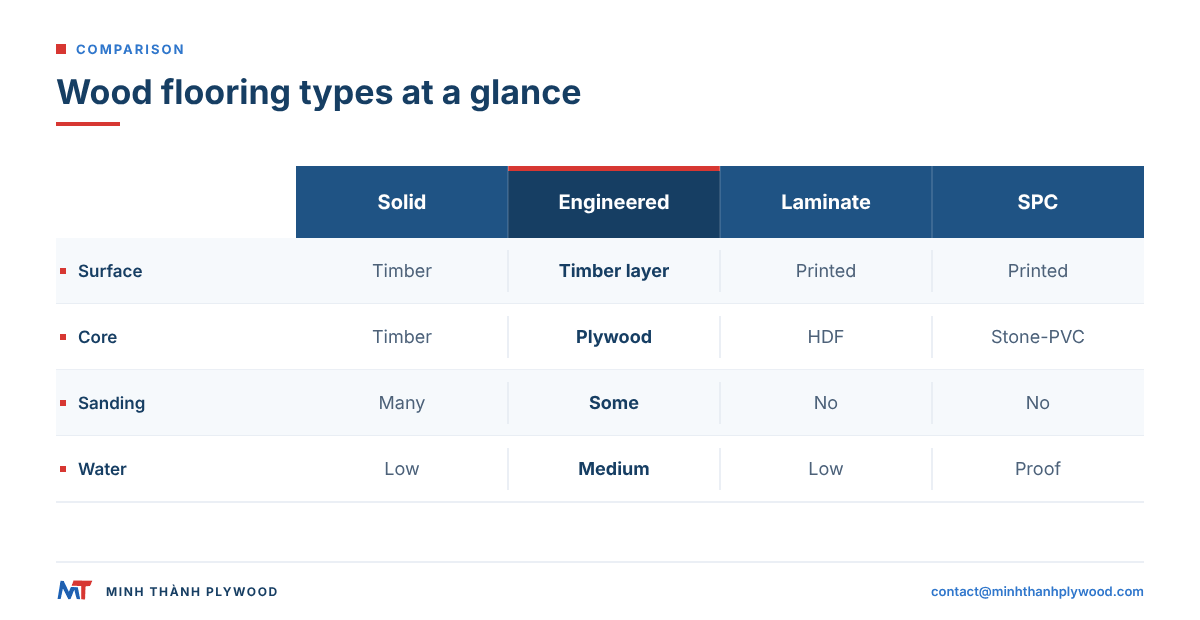
Each type is defined by how the board is built, much as the types of plywood are defined by their veneers and glue. A solid board is one piece of timber. An engineered board is a hardwood top layer glued to a cross-laminated base, usually plywood. Laminate is a photograph of wood under a hard melamine layer on fibreboard. SPC is a printed vinyl film on a rigid limestone and PVC core.
| Type | Top surface | Core | Typical total thickness | Real wood face |
|---|---|---|---|---|
| Solid hardwood | Solid timber | Same timber | 18–20 mm | Yes |
| Engineered wood | Hardwood wear layer, 2–6 mm | Plywood or softwood | 10–20 mm | Yes |
| Laminate | Melamine over printed decor | High-density fibreboard | 7–12 mm | No |
| SPC vinyl | PVC wear layer over printed film | Stone plastic composite | 4–8 mm | No |
What is solid hardwood flooring?
Solid hardwood flooring is made of boards milled from a single piece of timber, usually 18–20 mm thick with tongue-and-groove edges. It is nailed or glued to a wooden subfloor and can be sanded and refinished many times over a life measured in decades.
Its strength is depth: almost the whole thickness above the tongue can be sanded away over the years. Its weakness is movement. A solid board swells and shrinks across its width as room humidity changes, so wide boards cup and gap more. That is why solid floors are usually narrower and avoided over underfloor heating and on damp concrete.
What is engineered wood flooring?
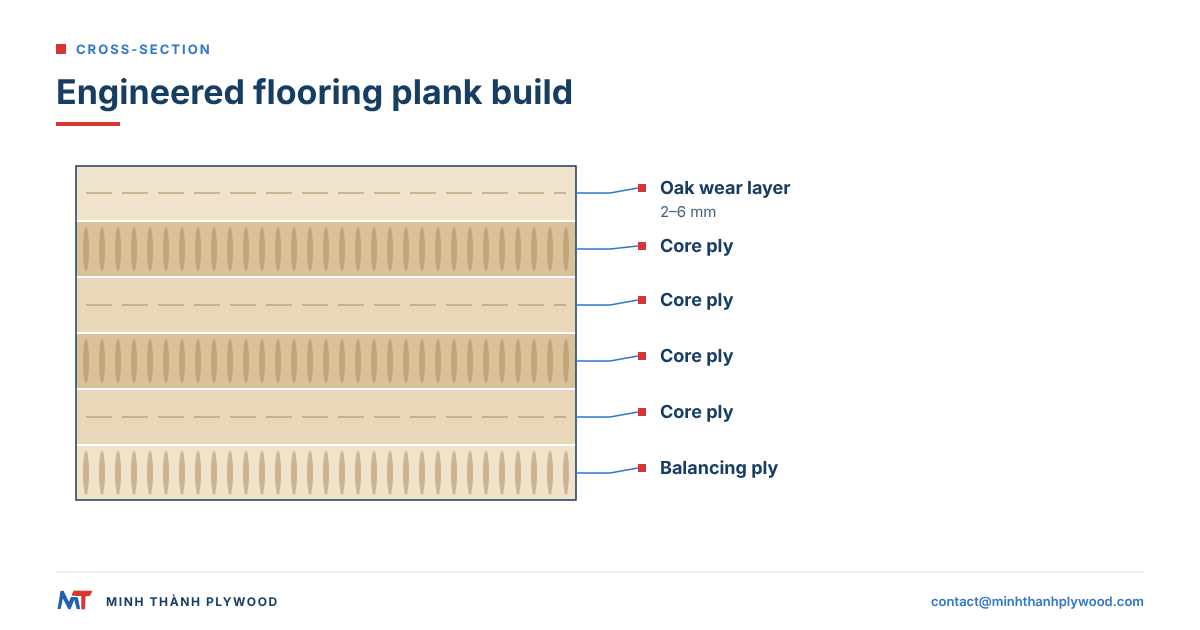
Engineered wood flooring is a board with a real hardwood wear layer, typically 2–6 mm, glued on a cross-laminated base of plywood or softwood. The base layers run at right angles, so the board moves far less with humidity than a solid board of the same species.
That stability opens uses solid wood cannot handle: wide planks, underfloor heating, floating installs over concrete and basements above grade. From the top it looks the same as solid wood, because it is the same timber. The wear layer sets how often it can be sanded; the core sets how flat and stable it stays.
Total thickness for residential boards runs about 10–20 mm, and one flooring maker’s environmental declaration lists 13.5–19.5 mm across its range. The core is where most of the quality differences hide.
How is plywood used as the core of engineered flooring?
Plywood is the most common core for quality engineered flooring: cross-laid veneers pressed into a calibrated, flat base, onto which the hardwood lamella is glued and the tongue and groove are milled. A good plywood base is thicker than the wear layer and has an odd number of plies so it stays balanced.
A flooring plant buys that base to a tight specification. It needs even thickness so the lamella presses flat, a sanded face so the glue line is consistent, low moisture so the boards do not move after milling, and a core without gaps so the tongue does not break.
Minh Thanh Plywood makes calibrated panels on white Styrax or Eucalyptus cores, double pressed as standard: the core board is pressed and calibrated, then face and back go on. Sanded panels hold thickness to ±0.2–0.3 mm, and veneers and panels are dried to 8–12 % moisture content at dispatch. Core layers are stitched both horizontally and vertically.
What is laminate flooring, and is it wood?
Laminate flooring is not real wood: it is a printed decor paper under a clear melamine wear layer, pressed onto a high-density fibreboard (HDF) core with a click profile. It looks like wood and resists scratches well, but it cannot be sanded.
Laminate is graded by its abrasion class under the European standard EN 13329, from AC1 for light domestic use to AC5 for heavy commercial traffic; AC3 suits most homes. Planks are usually 7–12 mm thick. The HDF core swells if water stands on the joints, so laminate suits dry rooms.
What are SPC and vinyl wood-look floors?
SPC flooring is a rigid plank with a core of limestone powder and PVC, a printed wood film and a clear PVC wear layer, usually 0.3–0.5 mm thick. It is waterproof, thin at about 4–8 mm and clicks together over most flat floors.
Traditional vinyl (LVT) is softer and thinner, glued down or loose-laid. Both are wood-look floors rather than wood flooring types, and both suit bathrooms, kitchens and commercial spaces where water is a risk. The wear layer thickness, not the total thickness, decides how long the surface lasts.
How do the timber flooring types compare?
Solid wood lasts longest and can be refinished most, engineered wood is the most stable real-wood floor, laminate is the cheapest hard-wearing look, and SPC is the only waterproof option. The table compares them on the points buyers ask about.
| Point | Solid hardwood | Engineered wood | Laminate | SPC vinyl |
|---|---|---|---|---|
| Wear layer | Most of the board above the tongue | 2–6 mm hardwood | Melamine, AC rated | 0.3–0.5 mm PVC |
| Sanding | Many times | 1 to several times | Never | Never |
| Moisture tolerance | Low | Medium | Low (HDF core) | Waterproof |
| Underfloor heating | Not usually | Yes, with suitable glue | Yes, with underlay | Yes, within maker’s limit |
| Install | Nail or glue to wood subfloor | Float, glue or nail | Float (click) | Float (click) |
| Relative cost | Highest | High to medium | Low | Low to medium |
Flooring hardwood types: which species are used?
European oak leads UK and European floors, followed by ash, walnut, maple and beech; hickory and red oak are North American choices. Hardness is measured on the Janka scale, in newtons (N) in Europe and pounds-force (lbf) in the US, where 1 lbf is 4.448 N. The National Wood Flooring Association species gallery is the industry reference for colour and grain.
| Species | Janka hardness (N) | Janka hardness (lbf) | Look |
|---|---|---|---|
| European (English) oak | 5,000 | 1,125 | Light to mid brown, open grain, takes stain and oil well |
| European ash | 6,580 | 1,480 | Pale, strong grain, tough |
| Hard maple | 6,450 | 1,450 | Pale, fine, even grain |
| Black walnut | 4,500 | 1,010 | Dark chocolate brown, softer |
| American white oak | 6,050 | 1,360 | Light brown, similar to European oak |
| Hickory | 8,100 | 1,820 | Strong grain, high colour variation |
The Janka test measures the force needed to press a 11.28 mm steel ball halfway into the wood. A higher number dents less under heels and furniture. Oak dominates because it balances hardness, stability and stain. Published Janka figures vary by source and sample, so read them as a ranking, not a guarantee.
Boards are also sold by grade, usually Prime, Select, Natural and Rustic, from clean, even-coloured faces to boards with knots, sapwood and colour variation. Grade names differ by mill, so a buyer asks for the written grading rules.
What thickness is wood flooring?
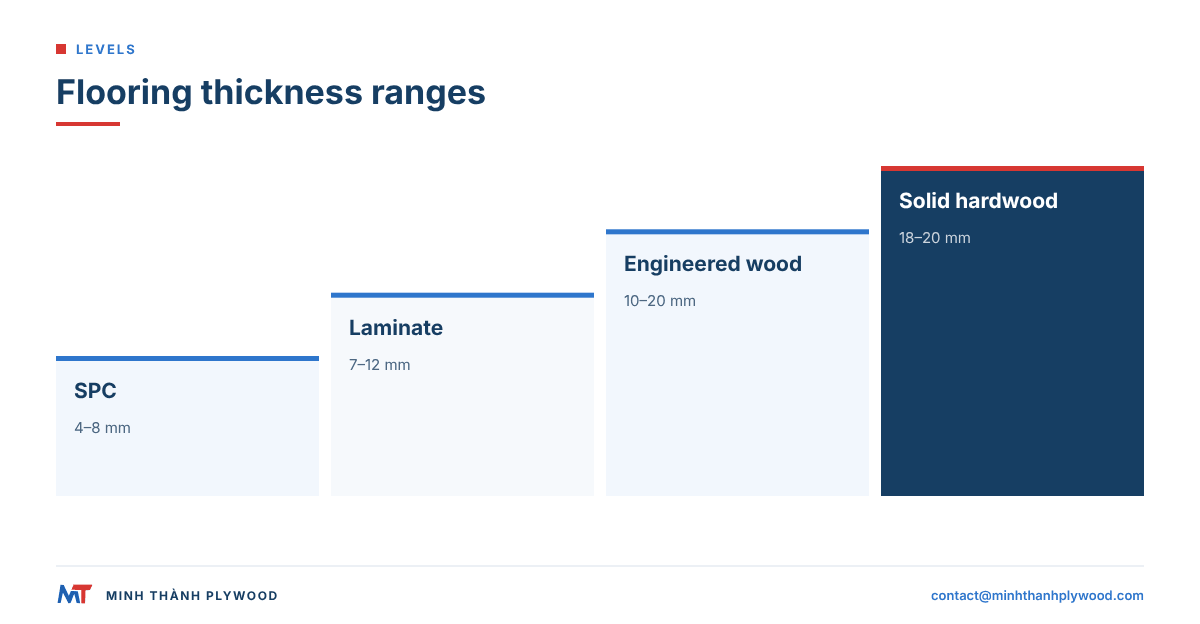
Wood flooring thickness runs from about 18–20 mm for solid hardwood to 10–20 mm for engineered boards, 7–12 mm for laminate and 4–8 mm for SPC. For real wood, the wear layer matters more than the total.
| Type | Total thickness | Usable layer | Sandings |
|---|---|---|---|
| Solid hardwood | 18–20 mm | Wood above the tongue | Many |
| Engineered, 2 mm wear layer | 10–14 mm | 2 mm | About one |
| Engineered, 4–6 mm wear layer | 15–20 mm | 4–6 mm | Several |
| Laminate | 7–12 mm | Melamine surface | None |
| SPC | 4–8 mm | 0.3–0.5 mm PVC | None |
A thicker engineered board also spans subfloor flaws better and sounds more solid underfoot. The plywood thickness guide shows how core panels are calibrated.
How much do wood flooring types cost in the UK?
UK cost guides put laminate lowest, SPC and LVT next, then engineered oak, with solid oak highest. Fitted prices run roughly £22 to £65 per m² for laminate, £40 to £100 for SPC or LVT, £50 to £135 for engineered oak and £85 to £190 for solid oak (read 21/10/2026). Sources differ widely, and London and the South East price higher; add 10 % for wastage, plus underlay and trims.
| Type | Fitted price, UK guides |
|---|---|
| Laminate | £22 to £65 per m² |
| SPC or LVT | £40 to £100 per m² |
| Engineered oak | £50 to £135 per m² |
| Solid oak | £85 to £190 per m² |
The price gap between engineered and solid oak is mostly the wear layer: a 4 mm oak lamella on a plywood base uses a fraction of the oak in an 18 mm solid board.
Which UK and EU standards apply to wood flooring?
Wood flooring sold in Great Britain and the EU is described by EN 14342, which covers the characteristics and CE or UKCA marking of wood flooring; multilayer parquet (engineered boards) follows EN 13489, laminate is rated under EN 13329, and installation follows BS 8201, the British code of practice for flooring of wood and wood-based panels. Formaldehyde is tested to EN 717-1, where E1 is the standard European emission class.
Plank, strip or parquet: which format?
Wood flooring comes in three formats: strip (narrow boards), plank (wide boards) and parquet (small blocks in patterns such as herringbone and chevron). Engineered construction makes wide planks and patterned parquet more stable than solid wood.
Wide planks show the grain and suit open rooms, but in solid wood they cup more as humidity changes. Herringbone and chevron parquet suit hallways and period homes; engineered parquet blocks click or glue into place without the old tar adhesives. Strip flooring suits small rooms and traditional houses.
Which finishes are used on wood floors?
Wood floors are finished with lacquer (often UV-cured at the factory), hardwax oil or natural oil. Lacquer resists spills and needs least care; oil looks more natural and can be spot-repaired without sanding the whole room.
Prefinished boards arrive coated from the factory and can be walked on the day they are laid. Unfinished boards are sanded and coated on site, which gives a continuous surface over the joints. The finish also affects indoor air: ask for the emission result of the finished, coated board, not only the raw material.
How is wood flooring installed?
Wood flooring is installed in three ways: nailed or stapled to a wooden subfloor, glued down to a flat subfloor or slab, or floated as a click system over an underlay. The board type limits the choice.
- Nail-down suits solid and thicker engineered boards over plywood subfloors and joists.
- Glue-down suits engineered boards on concrete slabs and over underfloor heating.
- Floating suits click engineered, laminate and SPC boards over almost any flat floor.
The subfloor decides much of the result. A plywood subfloor at the right thickness for the joist spacing keeps a nailed floor flat and quiet; the subfloor plywood guide sets out the grades and thicknesses.
How does moisture affect each flooring type?
Moisture moves real wood: boards swell across their width in humid seasons and shrink in dry ones. Solid floors gap and cup most, engineered floors move least among real-wood floors, laminate cores swell at wet joints, and SPC does not react to water.
Let wood flooring acclimatise in the room before laying, check the subfloor moisture, and keep indoor humidity steady. Engineered boards suit basements and slabs with a moisture barrier. The is plywood waterproof guide explains how a plywood core’s glue line behaves when wet.
Which wood flooring type suits which room?
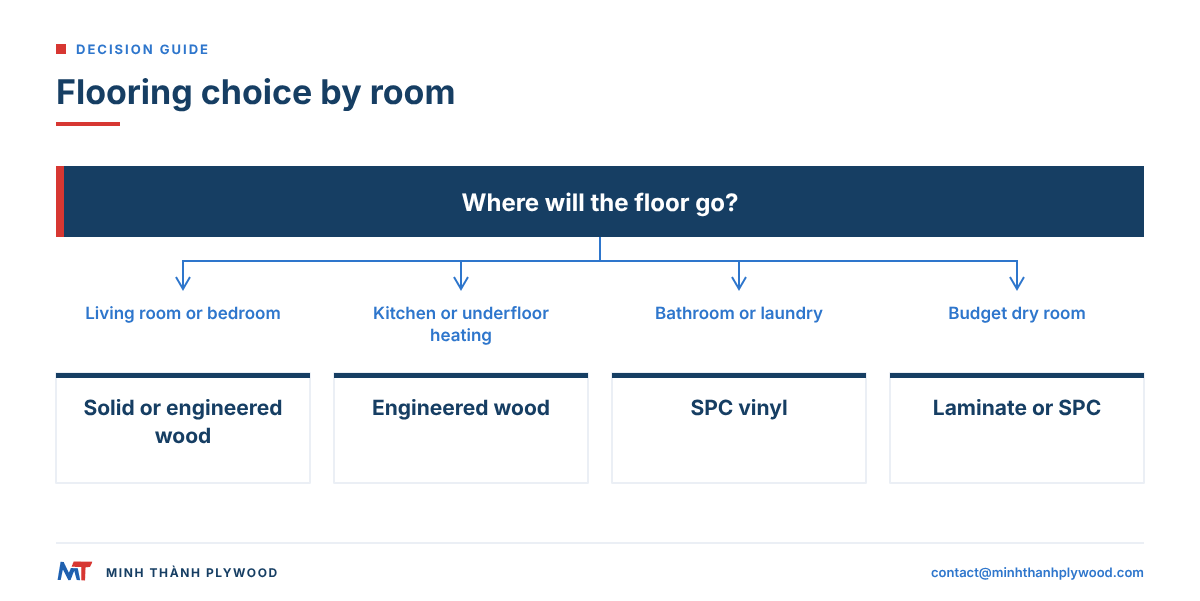
Choose solid hardwood for living rooms and bedrooms with steady humidity and a long-term plan to refinish; engineered wood for kitchens, slabs, underfloor heating and wide planks; laminate for budget dry rooms; and SPC for bathrooms, laundries and wet commercial floors.
| Room | Best type | Reason |
|---|---|---|
| Living room, bedroom | Solid or engineered | Real wood, refinishable |
| Kitchen | Engineered, lacquered | Stable core, wipeable finish |
| Over underfloor heating | Engineered | Low movement |
| Basement or slab | Engineered or SPC | Moisture barrier, stable |
| Bathroom, laundry | SPC | Waterproof |
| Rental or budget room | Laminate or SPC | Low cost, hard surface |
What should you ask a hardwood flooring supplier?
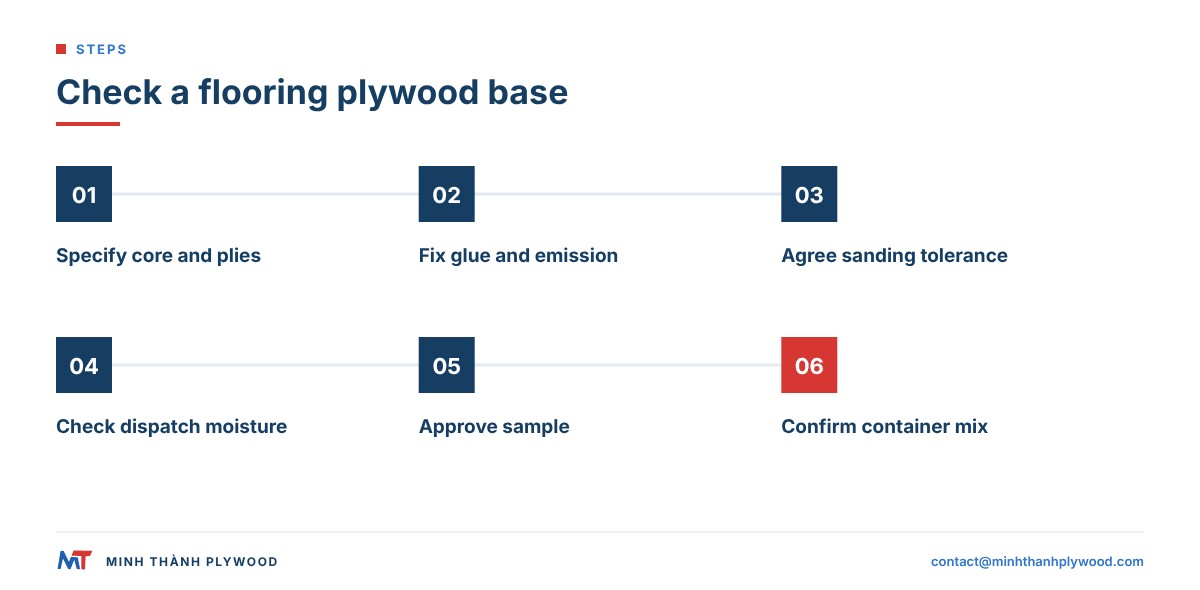
Ask a hardwood flooring supplier for the species and grade, the board dimensions, wear layer and core build, finish, moisture content at dispatch, installation method and the emission result of the finished board. Those lines separate a well-built board from a look-alike.
Wooden flooring suppliers range from mills that make the whole board to traders who relabel it. For engineered flooring, ask who makes the plywood base, how many plies it has and what its thickness tolerance is. A base pressed flat, calibrated and dry is what keeps the floor level after installation.
What do engineered flooring plants order from a plywood mill?
Engineered flooring plants order plywood bases by thickness, ply count, core species, glue and emission class, face preparation, tolerance, moisture content and size. A typical line reads: “Flooring base plywood, Eucalyptus core, 12 mm ±0.2–0.3 mm, sanded both faces, UF glue at E0 emission, 8–12 % moisture, 1220 × 2440 mm.”
Minh Thanh Plywood makes such panels in 3–40 mm on 1220 × 2440 mm and 1250 × 2500 mm sheets, with custom sizes and cut-to-size parts to the order list. Six ASTM D6007 chamber tests between April 2025 and June 2026 on 9, 15 and 18 mm panels averaged 0.014–0.032 ppm. The limit is set by CARB Phase 2 and TSCA Title VI; for veneer-core hardwood plywood it is 0.05 ppm under 40 CFR 770.10. European buyers accept the CARB P2 / TSCA Title VI certificate and chamber reports as evidence; testing to EN 717-1 or REACH Appendix 14 is arranged through SGS on request.
Minimum order is one 40HC with mixed specifications by agreement; production takes 15–45 days after the 30% deposit. A 40HC of 18 mm Eucalyptus-core panels carries 795 sheets at 34.8 kg each. Free samples go out before the order.
Buyer questions, answered
What are the types of wood flooring?
The types of wood flooring are solid hardwood, engineered wood with a real hardwood top layer on a plywood base, and parquet made from either. Laminate and SPC vinyl look like wood but carry a printed image, not timber.
What thickness is wood flooring?
Solid hardwood flooring is usually 18–20 mm thick, the 3/4 in. board. Engineered wood flooring is typically 10–20 mm in total (thin 2 mm wear-layer boards 10–14 mm, most boards 14–20 mm) with a 2–6 mm wear layer; laminate runs 7–12 mm and SPC 4–8 mm.
Which is better, solid or engineered wood flooring?
Engineered wood is better over underfloor heating, on concrete slabs and in rooms with changing humidity, because its plywood base moves less. Solid wood is better where the floor must be sanded many times over a long life.
What is the core of engineered wood flooring?
The core is usually multi-ply plywood made of cross-laid veneers, or a softwood or HDF core in cheaper lines. Plywood cores move least across the board width.
What is the hardest wood for flooring?
Among common species, hickory is the hardest at about 1,820 lbf on the Janka scale, ahead of hard maple at 1,450 and white oak at 1,360. Tropical species such as jatoba rate higher still.
Is laminate flooring real wood?
No. Laminate is a printed decor paper under a melamine wear layer on a high-density fibreboard core. It looks like wood but cannot be sanded, and its core swells if water stands on it.
Can engineered wood flooring be sanded?
Yes, if the wear layer allows it. A 2 mm wear layer allows about one light sanding, while a 4 to 6 mm layer can be sanded several times over the floor's life.
Which wood flooring is best for kitchens?
Engineered wood with a sealed lacquer finish suits most kitchens, because its plywood core stays flat as humidity changes. Wipe spills at once; for wet floors, SPC is the waterproof wood-look option.
Can you put wood flooring on concrete?
Yes. Engineered wood floats over an underlay or glues down to a dry, flat slab with a moisture barrier. Solid wood on concrete needs a plywood subfloor or battens.
What should I ask a hardwood flooring supplier?
Ask for the species and grade, board size, wear layer, core build, finish, moisture content at dispatch, the installation method it suits and the emission test for the finished board.