
Real wood veneer is a thin sheet of natural timber, sliced or peeled from a log and glued onto a panel so the surface is real wood while the core stays stable and economical. Minh Thanh Plywood lays veneer faces on Styrax and Eucalyptus cores every day; this guide explains the cuts, thicknesses, backings, species and grades a buyer meets, and how to write a veneered panel onto an order.
What is real wood veneer?
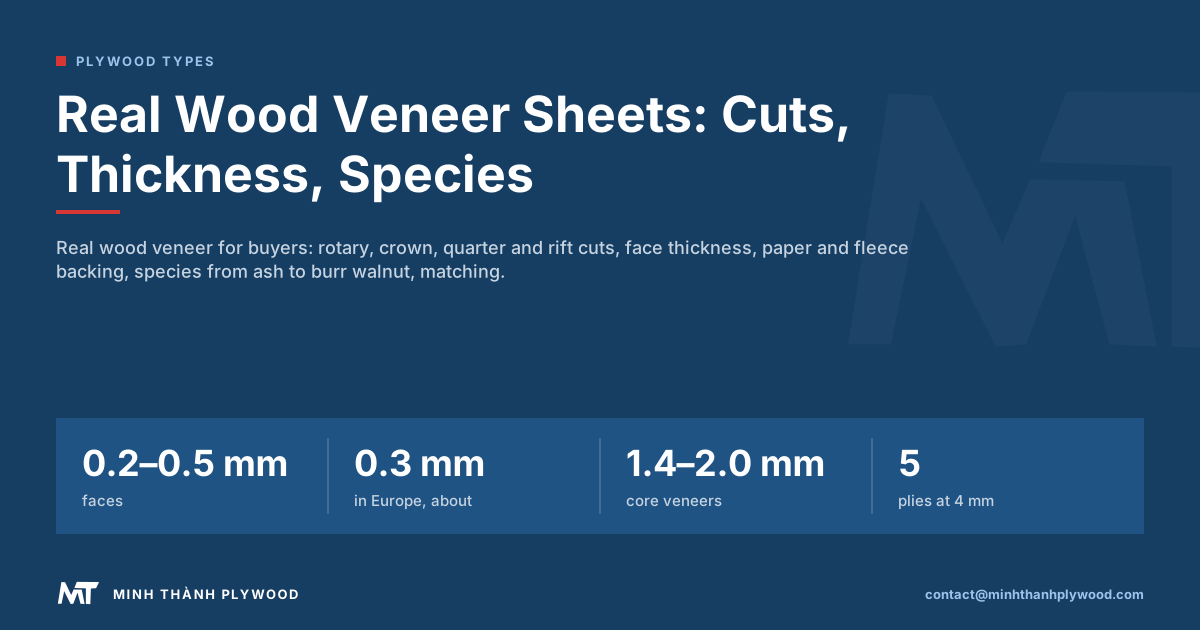
Real wood veneer is a thin sheet of natural timber, peeled or sliced from a log, that is glued onto a core panel to give it a real wood surface. Decorative face veneers are usually 0.2–0.5 mm thick, so one log covers many square metres of furniture, doors and wall panels.
The core does the structural work. In plywood the core is more veneer, laid in crossed layers; in other panels it is MDF or particleboard. The face is what you see and touch: it carries the species, the grain figure and the colour, and it is finished like solid wood with stain, oil or lacquer.
Three things separate real wood veneer from look-alikes. It has a grain that runs through its thickness, so a scratch shows wood, not a printed paper. It moves a little with humidity, like any timber. And no two sheets from different logs are identical, which is why veneer is sold and specified by species, cut, grade and sample.
Real wood veneer vs engineered veneer, laminate and foil
Real wood veneer, engineered veneer and laminate are three different surfaces, and only the first two are wood. Engineered veneer (EV, also called recon or reconstituted veneer) starts as real peeled veneer of a fast-growing species, which is dyed, glued into a block and sliced again to produce a repeatable figure.
| Surface | What it is | Sanding and repair | Sheet-to-sheet match | Typical use |
|---|---|---|---|---|
| Natural sliced veneer | One slice of one log, in log order | Can be sanded lightly and refinished | Varies by log and flitch | Premium furniture, doors, wall panels |
| Natural rotary veneer | Continuous sheet peeled on a lathe | Can be sanded lightly | Varies, wide sheets | Birch, poplar, okoume plywood faces |
| Engineered veneer (EV) | Real veneer, dyed, re-glued and re-sliced | Can be sanded lightly | Repeats closely | Furniture and interior panels in volume |
| High-pressure laminate (HPL) | Printed paper in cured resin, pressed | Cannot be refinished | Identical | Worktops, wet areas, counters |
| Melamine paper or foil | Resin-soaked paper or plastic film | Cannot be refinished | Identical | Carcasses, shelves, budget furniture |
For a furniture buyer the choice is usually between natural veneer and EV. Natural veneer gives the character of the species; EV gives the same face on panel one and panel one thousand, which matters for kitchen fronts and hotel fit-outs. Minh Thanh’s EV plywood is one of its most produced faces for that reason.
How veneer is cut: rotary, crown cut, quarter cut and rift
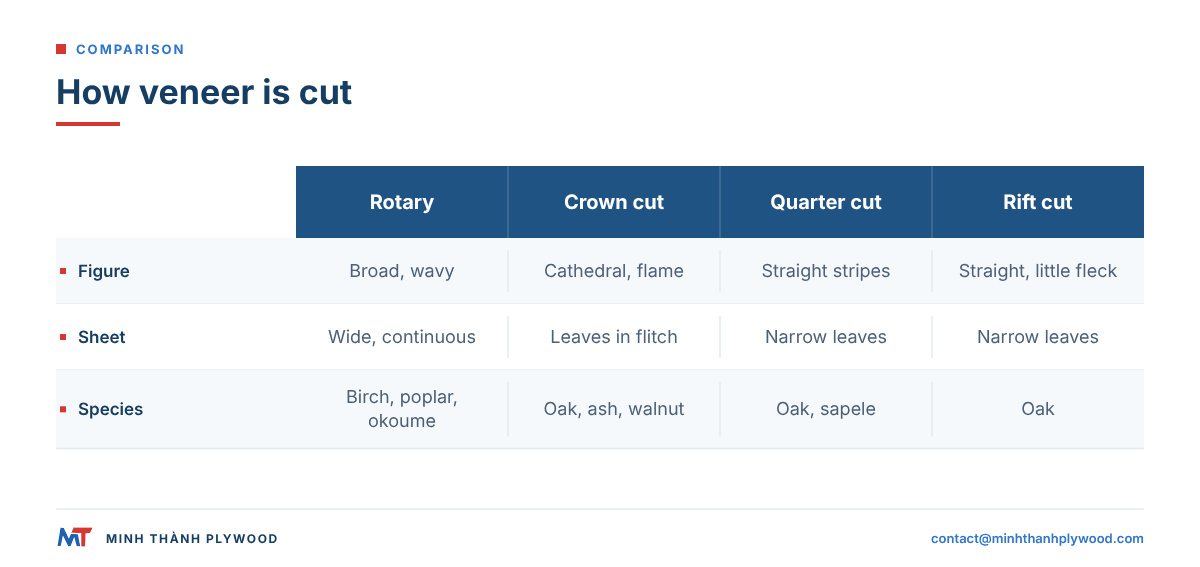
The way a log is cut sets the figure on the veneer more than the species does. The same oak log gives a flame figure when crown cut and straight stripes when quarter cut. There are four cuts a buyer needs to know.
- Rotary cut. The whole log turns on a lathe against a long knife and the veneer comes off in one continuous sheet, like paper from a roll. The figure is broad and wavy, the sheets are wide and the yield is high. Birch, poplar, okoume and every core veneer are rotary cut.
- Crown cut (plain sliced, flat cut). A half log is sliced parallel to its centre line. The growth rings show as a cathedral or flame figure in the middle of the sheet with straighter grain at the edges. Veneer crown cut is the most common figure on oak, ash and walnut furniture.
- Quarter cut. A quartered log is sliced at right angles to the growth rings. The grain shows as straight, even stripes, and in oak the medullary rays show as silvery flakes called ray fleck.
- Rift cut. Used mainly for oak: the quarter log is sliced at a small angle to the rays, which keeps the straight stripe and removes most of the fleck.
Half-round slicing, where the log is set off-centre on the lathe, sits between rotary and crown cut and gives wide sheets with a crown-like figure. Sliced veneers stay in the order they came off the log, called a flitch, so a buyer can match leaves from the same flitch across a cabinet or a wall.
Veneer thickness: from 0.2 mm faces to thick core veneers
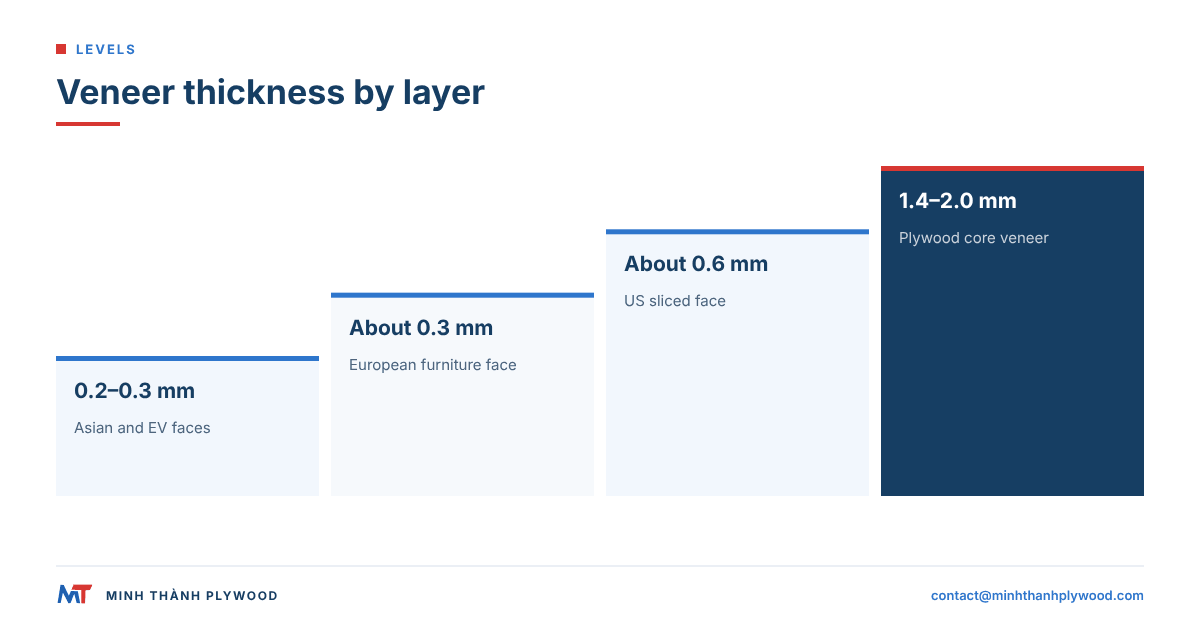
Decorative face veneer is thin. Faces on plywood are usually 0.2–0.5 mm, and European furniture panels most often carry about 0.3 mm. US sliced veneer is traditionally cut to 1/42 inch, about 0.6 mm. Inside the panel, core veneers are far thicker, usually 1.4–2.0 mm, because they carry the strength.
| Layer | Usual thickness | Why it matters |
|---|---|---|
| Decorative face, Asian and EV | 0.2–0.3 mm | Light sanding only; thin faces cost less per m² |
| Decorative face, European furniture | about 0.3 mm | Standard for lacquered furniture fronts |
| Sliced face, US practice | about 0.6 mm | More margin for sanding and refinishing |
| Core veneer in plywood | 1.4–2.0 mm | Sets the ply count and the strength |
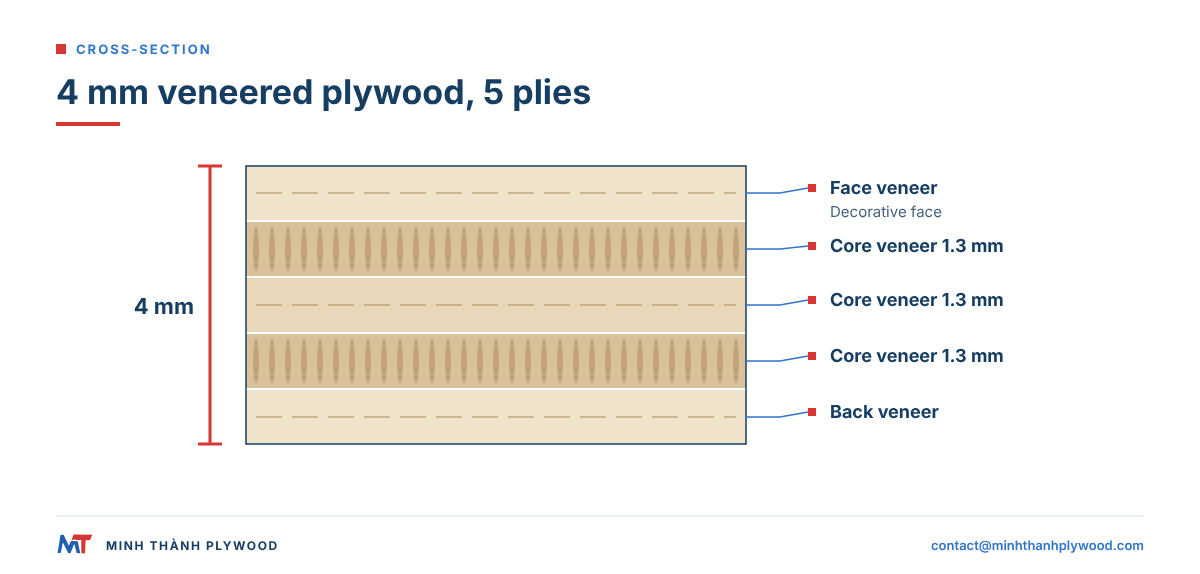
| Core veneer in 4 mm thin plywood | 1.3 mm | Three core veneers plus two faces |
Thickness changes how a face behaves. A 0.2 mm face is economical and lays flat, but it will sand through at an edge if the finisher is not careful. A 0.5 mm or 0.6 mm face gives more room for sanding, light repairs and deeper stain. When an order matters for appearance, write the face thickness in millimetres next to the species.
Minh Thanh sands and calibrates its furniture panels to a thickness tolerance of ±0.2–0.3 mm, down to ±0.2 mm, so a thin face is not cut through to reach a flat panel.
Paper-backed, fleece-backed and raw veneer sheets
Loose veneer sheets are sold raw or with a backing. A backing holds a thin veneer together so it can be bent, cut with a knife and glued with contact adhesive without splitting along the grain. On a plywood press, faces go on raw.
- Raw (unbacked) veneer comes as leaves in flitch bundles. It needs a press or a vacuum bag and a glue such as urea resin or PVA. Factories and panel makers use it.
- Paper-backed veneer has a kraft paper backing, sometimes two layers. It wraps curved parts and edges and is glued with contact cement. Cabinet shops and shopfitters use it.
- Fleece-backed veneer has a non-woven textile backing that stays more flexible than paper and suits tight curves and columns.
- Wood-on-wood (2-ply) veneer has a second, cross-grain veneer as backing. It is the stiffest backed sheet and resists checking on flat panels.
- Peel-and-stick veneer adds a pressure-sensitive adhesive on the backing for small jobs; it is not a furniture-plant material.
Real wood veneer edging is the same idea in a roll: a strip of veneer, often fleece-backed or pre-glued with hot-melt, applied to the cut edge of a panel. Order it in the same species and cut as the face so the edge matches.
Species index: birch veneer, ash veneer, oak, walnut and others
Each species brings its own colour, grain and price. Birch veneer and poplar are pale and fine; ash veneer and oak have open, strong grain; walnut is dark and costly. The table lists the species buyers ask for most and how they are usually cut.
| Species | Colour and grain | Usual cut | Where it is used |
|---|---|---|---|
| Birch | Pale cream, fine and even | Rotary | Furniture plywood, toys, shopfitting |
| Poplar | Pale, light and plain | Rotary | Furniture and painted panels, EV base veneer |
| Okoume | Pink-brown, even | Rotary | Interior and marine-style faces |
| Pine | Yellow with knots and strong figure | Rotary | Interior walls, rustic furniture |
| Ash | Pale with bold open grain, like oak but lighter | Crown and quarter | Furniture fronts, stained and bleached finishes |
| Oak, white and red | Light to mid brown, open grain, ray fleck | Crown, quarter, rift | Cabinets, doors, wall panels |
| Walnut | Dark brown with purple tones | Crown, quarter, burl | High-end furniture and interiors |
| Sapele | Red-brown, striped ribbon | Quarter | Doors and furniture |
| Bintangor | Red-brown, close grain | Rotary | Commercial and interior plywood faces |
Minh Thanh’s most produced faces are EV, Poplar, Birch, Okoume and Pine, with Bintangor, Eucalyptus, Gurjan, Sapele and others on request. Birch faces are imported veneer laid on Vietnamese cores, so the panel is sold as birch-faced plywood. See birch-faced plywood and okoume-faced plywood for the panel specifications.
Bleached veneer and black veneer sheets
Bleached veneer and black veneer are real veneers whose colour has been changed on purpose. Bleaching lightens a species such as oak or ash to a pale, almost white tone for Scandinavian-style interiors. Black veneer sheets are dyed through, or fumed and stained, so the grain still shows under a deep black colour.
Dyed and bleached veneers belong to the same family as EV: the colour is in the wood, not in a paint layer, so a light scratch does not show a different colour. Fumed oak, darkened with ammonia gas, is a traditional way to reach smoked and grey tones without stain.
For an order, name the colour by a physical sample, not a word. “Black” covers dyed ash, ebonised oak and black EV, each with a different grain. A pale bleached face also shows glue lines and sanding marks more than a natural face, so it needs a well-sanded substrate.
Burl veneer and burr walnut veneer
Burl veneer (burr in British English) is sliced from a rounded growth on the trunk or root of a tree, where the grain swirls around many small dormant buds. The figure is dense and irregular, and no two sheets look alike. Wood veneer burl is sold by the leaf, often in sheets well under a metre long.
Burr walnut veneer is the classic, used for car dashboards, small boxes, inlays and the panels of high-end furniture. Elm, maple, poplar and redwood burls are also traded. Because burl leaves are small, brittle and full of small holes, they are usually backed, filled and pressed on a flat stable core in a workshop rather than in a plywood press.
For a large run of panels, a burl look is more often reached with an engineered veneer or a printed surface. Real burl is best kept for the parts a customer touches and sees up close.
Veneer matching: book match, slip match and random
Veneer matching is how leaves are laid side by side to make one face wider than a single leaf. The match decides whether a cabinet or a wall reads as one surface or as a set of strips.
- Book match. Every second leaf is turned over like the pages of a book, so neighbouring leaves mirror each other at the joint. It is the most common match for crown cut faces.
- Slip match. Leaves are slid along without turning, so the figure repeats across the panel. It suits quarter cut and rift faces.
- Random match. Leaves are laid without order for a planked, rustic look.
- Balance and centre match. Leaves are trimmed to equal widths across the panel, with a joint or a leaf on the centre line.
Rotary faces such as birch and poplar usually come as one whole piece or with a few joints, because the lathe gives wide sheets. Sliced species are almost always jointed, so name the match on the order.
Real wood veneer on plywood: what a veneered panel is made of
A veneered plywood panel is a stack of crossed veneers with the decorative face and back on the outside. Grain direction alternates from layer to layer, which keeps the panel stable and stops it splitting. An 18 mm panel usually has 11–13 plies, most often 11.
At Minh Thanh, furniture panels are pressed twice as standard. The core board is pressed first and sanded flat to thickness, then the face and back veneers are pressed on. Pressing the face on a calibrated core gives a flat surface for a thin veneer and less telegraphing of core joints. Core layers are stitched both horizontally and vertically before pressing.
Thin panels follow a fixed build. Plywood of 3–5 mm is always 5-ply: a 4 mm furniture panel, for example, has three 1.3 mm Styrax core veneers and two faces.
Veneers and finished panels are dried to 8–12 % moisture content at dispatch, the normal range for furniture plywood. Furniture panels use UF glue at E0 emission; the plant’s CARB P2 / TSCA Title VI certification (ICTT mill no. 23024) covers hardwood plywood with a veneer core. The US limit for hardwood plywood with a veneer core is 0.05 ppm under the EPA formaldehyde emission standards.
How veneer faces on plywood are graded
Face veneers are graded by what the eye sees: colour, knots, patches, splits and joints. A grade is always quoted as a face/back pair, because the back of a cabinet side is seen less than the front.
| Face | Grades used at Minh Thanh | How the pair is read |
|---|---|---|
| Birch | D+, D and E (low to high: E, D, D+) | D+/D is close to European B/BB |
| Poplar | A/A, A/B and B/B | Also ordered by Chinese codes B/BB, BB/CC and CP |
| Pine | A/A, A/B and B/B, B/C for utility parts | Comparable to European classes I to IV |
| Eucalyptus | A/A, A/B and B/B | A/A for two visible faces, B/B for paint or overlay |
Every grade is matched to the buyer’s approved sample, which is the real reference when two buyers mean different things by the same letters. The veneer grading page shows how faces are sorted before pressing.
Which veneer face for which part?
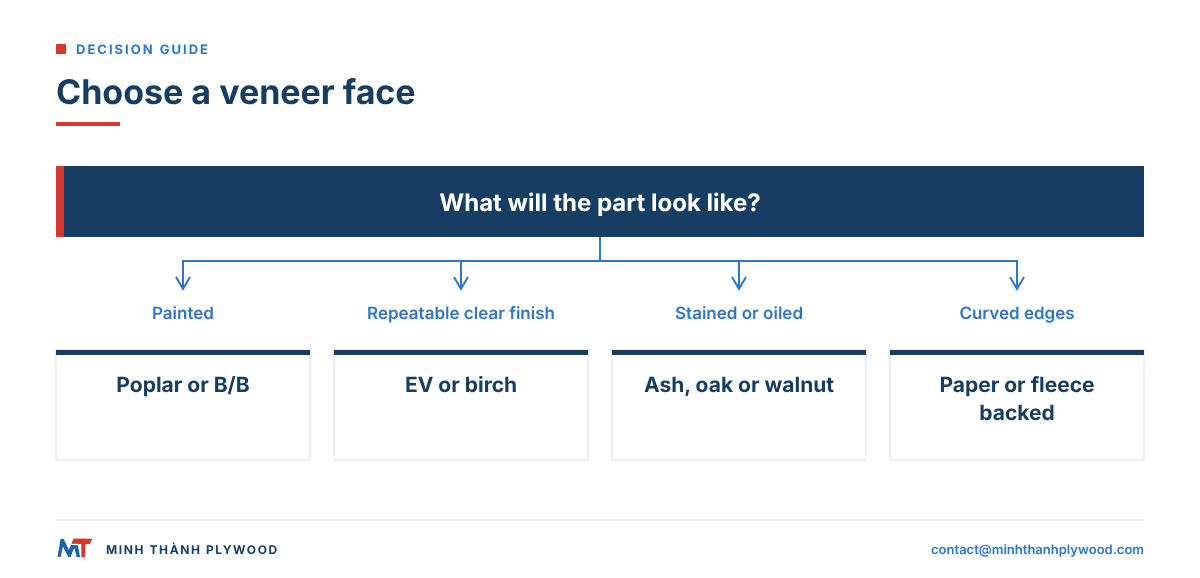
Choose the face by what the part has to do and how it will be finished. A painted door does not need a premium species; a lacquered wall panel in a hotel lobby does.
- Painted fronts and carcasses: poplar or a B/B face, sanded smooth; the species does not show under paint.
- Clear-lacquered furniture in volume: EV or birch, for faces that repeat from panel to panel.
- Stained or oiled furniture: ash, oak or walnut sliced veneer, at about 0.5 mm or more if the finisher sands between coats.
- Wall panelling and ceilings: book-matched crown cut or quarter cut faces, ordered from the same flitch for one wall.
- Curved parts and edges: paper-backed or fleece-backed veneer in the same species as the face.
- Small premium parts: burl or figured veneer, pressed in a workshop.
When appearance matters on both sides, as on a shelf or a door, order A/A or a matching back. One visible side takes A/B, which saves cost on the back.
How to store and handle veneer sheets
Store veneer flat, wrapped, out of direct sunlight and in a room with steady humidity. Veneer is thin, so it gains and loses moisture quickly: dry air makes the ends split, damp air makes the sheet cockle so it will not lie flat under glue.
- Keep bundles in their original order and wrapping until they are used.
- Lay them on a flat board, never on edge or against a wall.
- Let veneer sit in the workshop for a few days before pressing so it reaches room conditions.
- Handle long leaves with two people and support them along their length.
- Keep sunlight off pale species such as maple and ash and off dark species such as walnut and cherry, which change colour in light.
Veneered panels need the same care. Keep them flat in their packs, with the top sheet protected, until they are cut.
Iron-on (pre-glued) veneer sheets: how to apply
Iron-on veneer is real wood veneer with a hot-melt glue layer already on the back, sold in strips of 2500 × 300 mm and 1240 × 300 mm for small jobs such as a table top, a door skin or a shelf. UK shops such as Veneersonline sell it in walnut, cherry, white oak, ash, beech, sapele and pine. Apply it in six steps:
- Prepare the panel. It must be clean, dry and flat; damp panels let the glue release.
- Cut the veneer oversize, with a small overhang on all sides, and let it settle in the room for a day.
- Position it and iron through a cloth, working from the centre outward along the grain with firm pressure. Test the iron’s heat on a scrap first, because irons differ and too much heat cracks the wood.
- Press the veneer down while the glue is hot by rubbing a small wood block along the grain from end to end.
- Tap for hollow spots and re-iron any that sound loose.
- Trim the overhang with a sharp blade after the glue has cooled, then sand the edge lightly.
Iron-on strips suit one-off repairs. A workshop faces many sheets with veneered plywood instead, where the face is already pressed on a calibrated core.
Real wood veneer sheet sizes and prices in the UK
UK shops sell real wood veneer as loose leaves, pre-glued iron-on sheets and edging rolls, and the price per pack runs from about £16 to £134 ex VAT depending on species and format (October 2026).
| Format | Size | UK price (ex VAT) |
|---|---|---|
| Loose decorative veneer leaf, 0.6 mm | 8–12 ft (about 2.4–3.7 m) long, 4–30 in (10–76 cm) wide, by species | £15.95 to £134.25 per pack (Original Marquetry) |
| Pre-glued iron-on sheet | 2500 × 300 mm or 1240 × 300 mm | By species, from Veneersonline |
| Pre-glued edging roll, 7.5 m | 15–50 mm wide | £9.96 (birch, 15 mm) to £19.96 (oak, 50 mm) (Realwoodwork) |
| Pre-glued edging roll, 50 m | 15–50 mm wide | £19.13 (red oak, 15 mm) to £37.46 (birch, 50 mm) |
| Unglued trade roll, 100 m | up to 135 mm wide | £124.96 (oak, 135 mm) |
Loose veneer is a hobby and repair price: the buyer still pays for glue, a press or a vacuum bag and labour, and the leaf is 0.6 mm thick, so it is laid on an existing panel.
A veneered plywood panel from a mill arrives pressed and calibrated. As a raw FOB example, not a sheet price, plywood from US$350/m³ (October 2026) works out at about US$6.30 per m² for an 18 mm panel (0.0536 m³ per 2.98 m² sheet) before the face upgrade, which is why a workshop making a hundred doors buys veneered panels by the container and not leaves by the pack.
Where to buy wood veneer sheets and veneered plywood
Buy loose veneer sheets from specialist veneer merchants and buy veneered panels from a panel mill or its distributors. The two are different trades. Merchants in Canada, Ireland and the UK sell flitches, backed sheets and edging to cabinet shops; panel buyers who need hundreds of sheets of one face buy plywood by the container.
The UK price table above shows what a leaf, an iron-on sheet and an edging roll cost. UK importers bringing in veneer sheets or veneered panels follow the GOV.UK guidance on importing wood, wood products or bark. EU importers of wood products need origin data under Regulation (EU) 2023/1115.
For a veneer shop, check that sliced leaves come in flitch order, that the backing type is stated and that samples match the bundle. For a panel order, check the face species and cut, the face grade pair, the core, the glue and the emission class, as in the next section.
Minh Thanh supplies veneered plywood by the container: MOQ is one 40HC with mixed specifications by agreement, production takes 15–45 days after the 30% deposit, and shipping is FOB Hai Phong, CFR or CIF. Free samples are sent before an order.
What to write on a veneered plywood order
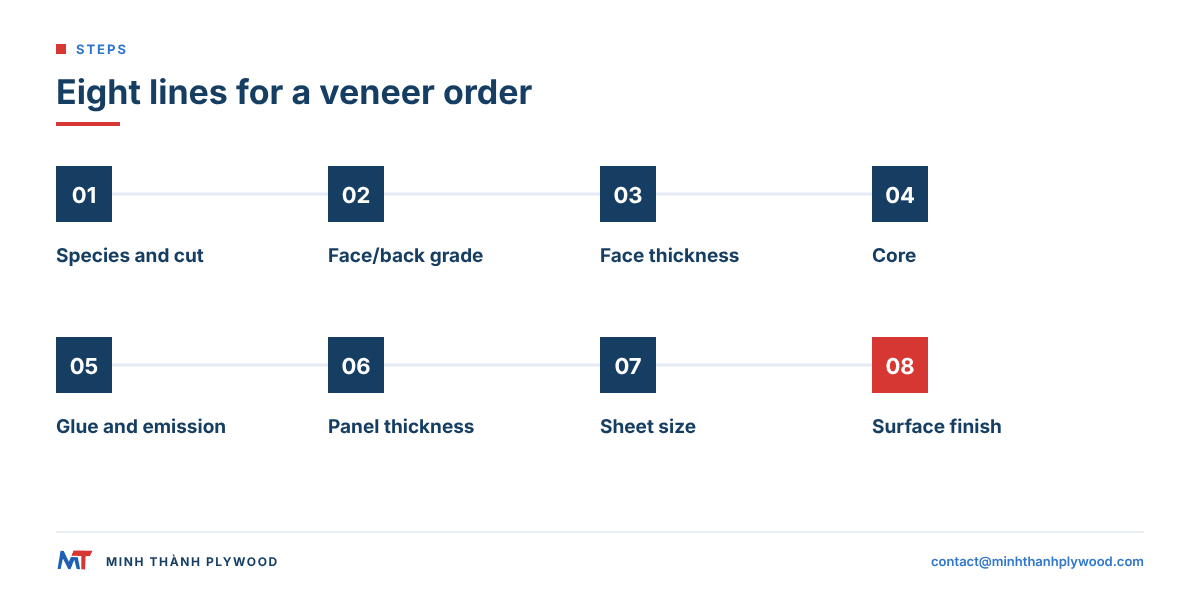
A veneered panel order needs eight lines. Leaving one out is how two quotations end up for two different panels.
- Face species and cut: for example “birch, rotary” or “oak, crown cut, book match”.
- Face and back grade: a pair such as A/B or D+/D, matched to an approved sample.
- Face thickness: in millimetres, for example 0.3 mm.
- Core: Styrax or Eucalyptus as standard, Acacia or Pine on order.
- Glue and emission: UF at E0 for interior furniture, or MR or phenolic (WBP) if the panel needs water resistance.
- Thickness and tolerance: for example 18 mm, ±0.2–0.3 mm sanded.
- Size: 1220 × 2440 mm or 1250 × 2500 mm, or custom such as 1220 × 2500 mm, or cut-to-size.
- Surface: sanded, polished or UV-ready for your own coating line.
A complete line reads: 18 mm birch-faced plywood, rotary birch face D+/D, Styrax core, UF glue at E0, sanded ±0.2 mm, 1220 × 2440 mm, UV-ready both faces, 1×40HC. Send it to contact@minhthanhplywood.com or ask for a quotation, and request free samples of the face before you confirm.
Buyer questions, answered
What is real wood veneer?
Real wood veneer is a thin slice of natural timber, usually 0.2–0.6 mm thick for decorative faces, glued onto a plywood, MDF or particleboard core. The surface is real wood with its own grain, so it can be sanded, stained and lacquered like solid timber.
Is real wood veneer better than laminate?
For furniture that should look and feel like timber, yes: veneer can be sanded, stained and repaired, while laminate is a printed paper under resin. Laminate wins on scratch and stain resistance for worktops and wet areas.
How thick is real wood veneer?
Decorative face veneer is usually 0.2–0.5 mm, with about 0.3 mm common in European furniture panels and about 0.6 mm in US sliced veneer. Core veneers inside plywood are much thicker, 1.4–2.0 mm.
What is the difference between crown cut and quarter cut veneer?
Crown cut veneer is sliced parallel to the centre of the log and shows a cathedral or flame figure. Quarter cut veneer is sliced across the growth rings and shows straight, even stripes, with ray fleck in oak.
What is paper-backed veneer?
Paper-backed veneer is a veneer sheet laminated to a kraft paper backing so it bends without cracking and can be glued with contact adhesive. Fleece-backed veneer uses a non-woven textile backing for the same purpose.
Is engineered veneer real wood?
Yes. Engineered veneer (EV, also called recon veneer) is made from real peeled veneers that are dyed, glued into a block and sliced again, so every sheet repeats the same grain and colour.
What is burl veneer?
Burl or burr veneer is sliced from a growth on the trunk where the grain swirls around many small knots. Burr walnut is the best-known example, used for small panels, car dashboards and inlays because burl sheets are small and brittle.
Can real wood veneer be stained?
Yes. A sanded veneer face takes stain, oil and lacquer like solid wood. Sand lightly with a fine grit, because a 0.3 mm face can be sanded through.
Can I order plywood with a specific veneer face from Vietnam?
Yes. Minh Thanh Plywood lays more than ten face veneers on its cores, mostly EV, Poplar, Birch, Okoume and Pine, with Bintangor, Eucalyptus, Gurjan, Sapele and others on request, from one 40HC container with mixed specifications by agreement.
How should veneer sheets be stored?
Flat, out of direct sun, in a room with steady humidity, wrapped in the bundle they came in. Veneer that dries out cracks at the ends; veneer that picks up moisture cockles and will not glue flat.