
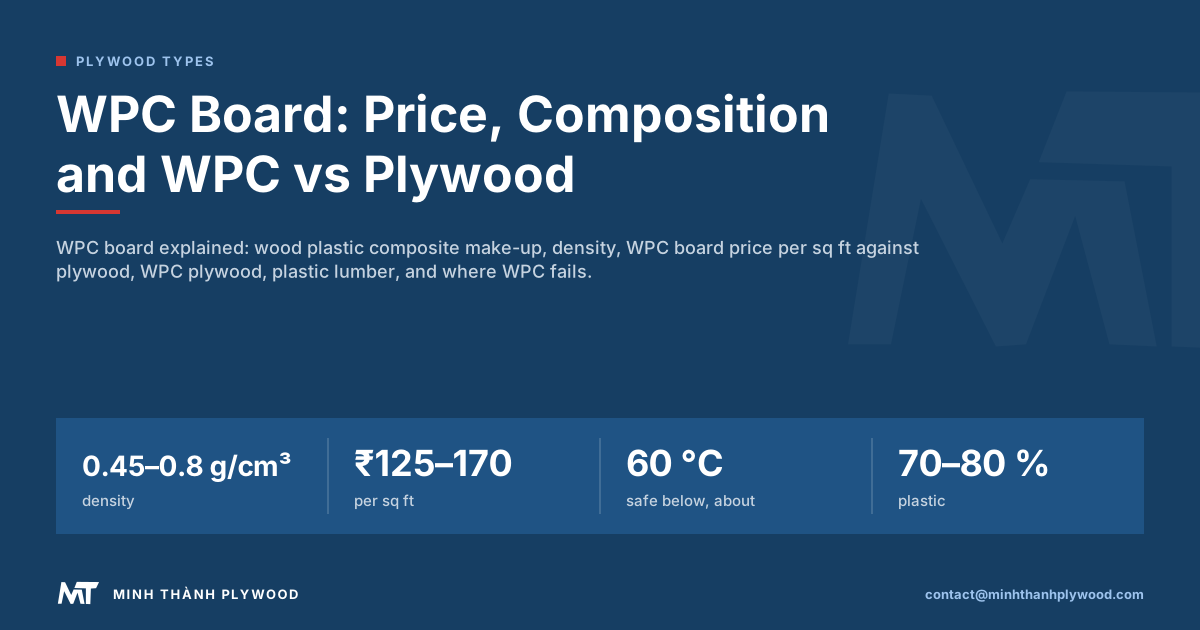
WPC board is a foamed sheet of wood plastic composite: PVC with wood flour, about 0.45–0.8 g/cm³, sold in 8 × 4 ft sheets. It ignores water and termites, but 18 mm WPC board costs about as much as BWP plywood, can weigh more, softens near 60 °C and holds edge screws less firmly. Minh Thanh Plywood makes plywood; here is where each board wins.
What is the full form of WPC board?
WPC board is a flat sheet of wood plastic composite (WPC): a plastic, usually PVC, mixed with wood flour or fine wood fibre, foamed and extruded into panels. The plastic gives it water and termite resistance; the wood flour makes it stiffer than plain PVC foam and lets it cut, nail and screw more like wood.
WPC stands for wood plastic composite, also written wood polymer composite. The same material appears in three forms: WPC board (furniture and interior sheets), WPC decking and cladding profiles, and WPC wall panels.
What is WPC board made of?
WPC board is made of a thermoplastic resin, wood flour or fibre, a foaming agent, stabilisers and pigment. For furniture boards the resin is usually PVC; for decking it is more often polyethylene (HDPE) or polypropylene (PP).
| Ingredient | Typical share or type | Job in the board |
|---|---|---|
| Plastic | PVC for boards; HDPE or PP for decking | Matrix; water and termite resistance |
| Wood flour or fibre | About 20–30 % in many foamed boards; more in decking | Stiffness, wood-like working |
| Foaming agent | Closed cells | Lowers density |
| Stabiliser | Calcium-zinc in lead-free boards | Protects PVC in extrusion |
| Pigment and UV additives | Colour and fade resistance | Look outdoors |
The wood-to-plastic ratio is not standardised; one maker’s 18 mm board can be a very different product from another’s. Ask for the ratio and the density on the datasheet.
How is WPC board made?
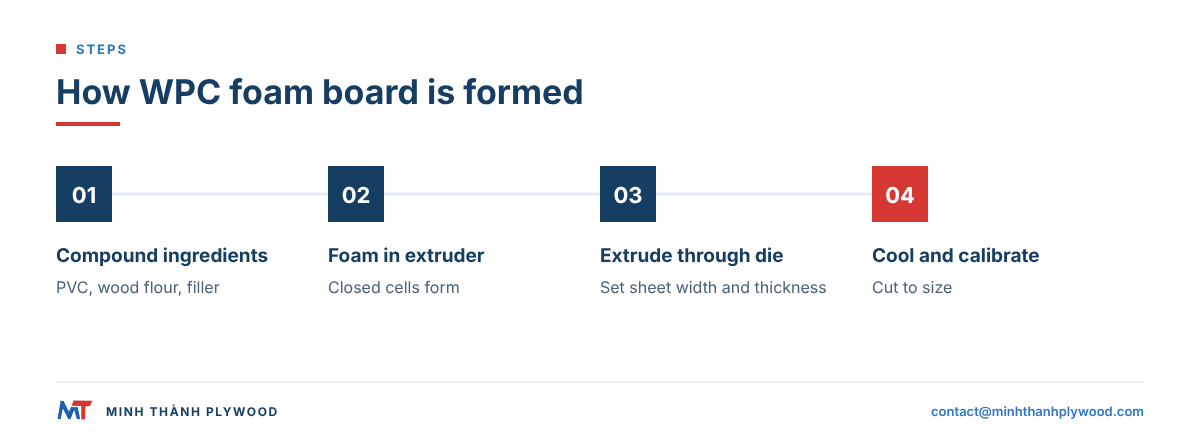
WPC foam board is made in four steps: compounding, foaming, extrusion and cooling. PVC resin is mixed with wood flour, a stabiliser, a calcium-carbonate filler and a foaming agent; the mix is melted in an extruder, where the foaming agent makes closed cells; the melt is pushed through a flat die to set the thickness and width; and the sheet is cooled, calibrated and cut to size.
Co-extruded boards add a second extruder that lays a dense skin over each face of a foamed core, which gives a harder, smoother surface and a higher weight. The three types sold are low-density foam, high-density and co-extruded board.
WPC board vs WPC decking vs plastic lumber
WPC board, WPC decking and plastic lumber are three different products sold under similar names. WPC board is a foamed PVC-and-wood sheet for furniture and interiors; WPC decking is a solid or hollow profile of HDPE or PP with a higher wood share; plastic lumber is solid plastic with no wood at all.
| Product | Make-up | Form | Main use |
|---|---|---|---|
| WPC board | PVC foam with wood flour | 8 × 4 ft sheets, about 6–25 mm | Cabinets, doors, partitions |
| WPC decking and cladding | HDPE or PP with wood fibre | Hollow or solid profiles | Decks, fences, facades |
| WPC wall and siding panels | Vinyl-and-wood-composite boards, for example a 106 × 6.1 × 0.83 in set sold at Home Depot | Long narrow planks, sold in sets of 4 | Exterior wall cladding, fences |
| Plastic lumber | Plastic only, often recycled HDPE | Solid planks and posts | Benches, marine posts, landscaping |
| Recycled plastic lumber | Post-consumer plastic | Planks, boards | Outdoor furniture, boardwalks |
For sheet goods in a kitchen or wardrobe, only WPC board competes with plywood. Decking profiles and plastic lumber compete with timber outdoors, not with plywood.
What is WPC plywood?
WPC plywood is a market name for WPC board sold next to plywood; it is not plywood. There are no veneers and no plies, only a foamed composite core, often with a harder co-extruded skin on both faces.
Some boards are labelled “WPC plywood” because they replace plywood in the same jobs: modular kitchen carcasses, bathroom vanities and doors. Ask two questions before comparing a WPC plywood quote with real plywood: what is the density, and is the board a single foam layer or three co-extruded layers? A three-layer board with dense skins holds screws and resists dents better.
WPC board specifications: density, thickness and weight
WPC board is usually 0.45–0.8 g/cm³ in density, 6–25 mm thick, in 1220 × 2440 mm (8 × 4 ft) sheets. Makers list a wider range: thickness from 3 to 30 mm, with stock thicknesses of 5, 8, 10, 12, 15, 17 and 18 mm, and sheet sizes of 1220 × 2440 mm, 915 × 1830 mm, 1000 × 2000 mm and 1220 × 5800 mm (Onsun WPC, read 21 October 2026). Solid foamed boards sit at the low end; co-extruded three-layer boards sit near 0.8 g/cm³.
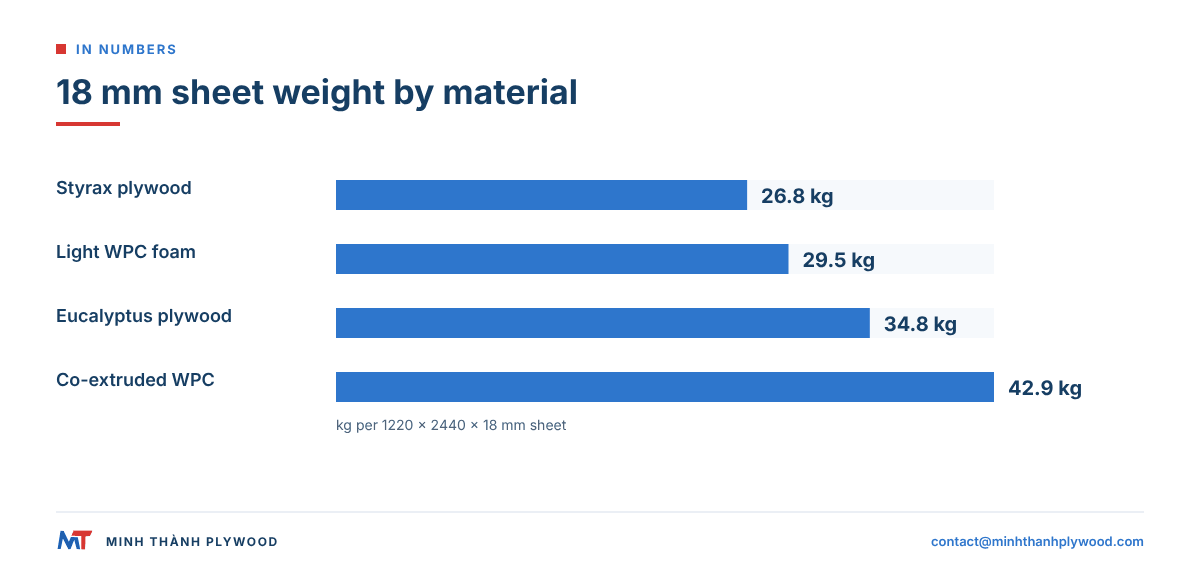
Weight follows density. A 1220 × 2440 × 18 mm sheet is 0.0536 m³, so:
| Board, 18 mm, 1220 × 2440 mm | Density | Weight per sheet |
|---|---|---|
| WPC board, light foam | 0.55 g/cm³ | About 29.5 kg |
| WPC board, co-extruded | 0.8 g/cm³ | About 42.9 kg |
| Our plywood, Styrax core | 500 kg/m³ | 26.8 kg |
| Our plywood, Eucalyptus core | 650 kg/m³ | 34.8 kg |
A dense WPC board is about a quarter heavier than Eucalyptus-core plywood and over half again heavier than Styrax-core plywood of the same size.
WPC board price: what does it cost against plywood?
WPC board price in the US is set mostly by imports: US retailers list few cabinet-grade 18 mm sheets, and the usual route is a container from Asia. Export listings in October 2026 quote WPC foam board at about US$0.6–0.7 per kg ex-works from China with minimum orders (Alibaba and Zhanjiang Kingstar listings).
At the weights in the table below that is about US$18–30 for an 18 mm 1220 × 2440 mm sheet, or US$0.55–0.94 per sq ft of the 32 sq ft sheet, and a thin 5 mm sheet lists at US$8.5–8.8 at a 200-sheet minimum.
Those are indicative wholesale ranges, not US shelf prices; freight, duty and importer margin come on top, and a US shelf price runs well above them.
The weights are listed after the specifications; our own 18 mm furniture plywood works out at about US$18.8 per sheet as a raw FOB example at US$350/m³.
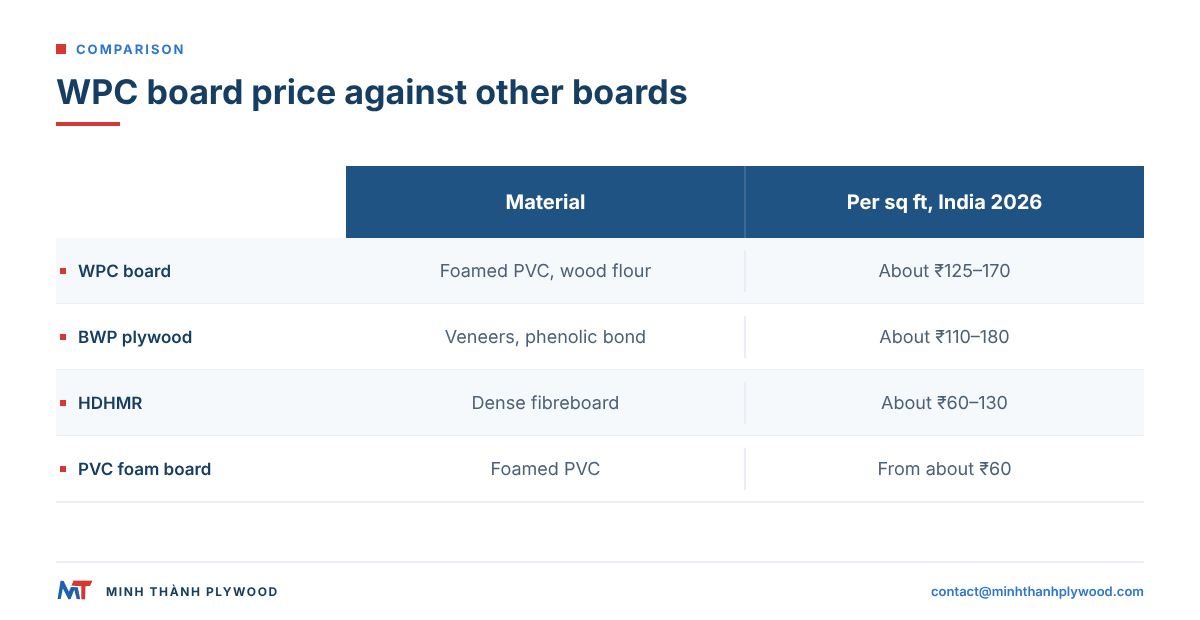
India is a second market with public retail listings. WPC board price in India in 2026 is about ₹125–170 per sq ft for 18 mm boards in maker and dealer listings, or about ₹4,000–5,400 for an 8 × 4 ft sheet before tax. That places WPC board close to BWP plywood and above MR plywood of the same thickness.
| Board, 18 mm | Indicative price per sq ft (India, 2026) |
|---|---|
| WPC board | About ₹125–170 |
| BWP plywood | About ₹110–180 |
| HDHMR board | About ₹60–130 |
| PVC foam board | From about ₹60 |
The figures are dealer and maker listings and editorial guides read in October 2026, not quotes. What moves WPC board price:
| Price driver | Effect |
|---|---|
| Density | Denser boards cost more per sheet |
| Co-extruded skins | Three-layer boards cost more than single foam |
| Thickness | Price rises with thickness |
| Lead-free stabiliser | Small premium |
| Laminate or print | Adds a decorative layer |
Is WPC cheaper than plywood?
WPC is usually not cheaper than plywood. At ₹125–170 per sq ft for 18 mm, WPC board costs about the same as BWP plywood and more than MR plywood, and higher-density grades add freight weight per sheet.
WPC can still cost less over the life of a part in one case: a cabinet that is wet every day. There, a WPC board that never swells avoids the replacement that a poorly sealed board would need. For dry units, plywood costs less and does the job better.
For importers buying plywood by the container, Minh Thanh Plywood’s indicative prices in October 2026 start from US$250/m³ for commercial plywood and from US$350/m³ for furniture and interior plywood; face, core, glue, thickness, size and quantity set the final price.
Which is better, WPC or plywood?
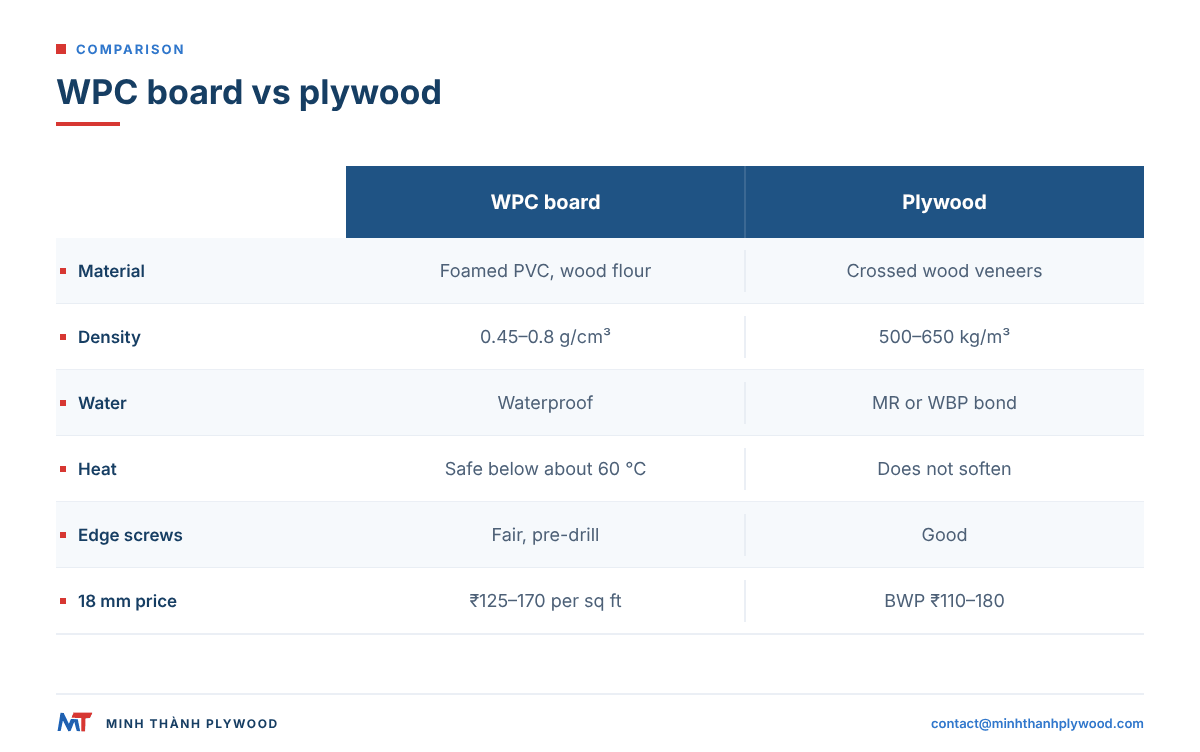
Plywood is better for most furniture and building work; WPC is better where water or termites are constant. Plywood is lighter for its stiffness, holds screws at the edges and does not soften with heat. WPC board does not swell, rot or attract termites.
| Metric | WPC board | Plywood |
|---|---|---|
| Material | Foamed PVC with wood flour | Cross-laminated wood veneers |
| Density | 0.45–0.8 g/cm³ | 500–650 kg/m³ (our cores) |
| Water | Waterproof, no swelling | MR bond for interiors; WBP bond survives boiling |
| Termites | Not attacked | Treated on order |
| Stiffness per kilogram | Lower | Higher |
| Edge screws | Fair; pre-drill | Good |
| Heat | Safe below about 60 °C | Does not soften |
| Surface | Smooth; laminate, paint or print | Sanded wood veneer; laminate, veneer or UV coating |
| Repair | Plastic welding or replace | Fill, sand, re-drill |
| Price, 18 mm | Close to BWP plywood | MR lower, BWP similar |
Verdict by part: WPC for sink units, bathroom vanities and laundry cabinets; plywood for wall units, drawers, wardrobes, beds, shelving and doors. The 60 °C figure is a WPC maker’s stated upper limit for safe working temperature (read October 2026).
Is WPC board better than plywood for kitchens and bathrooms?
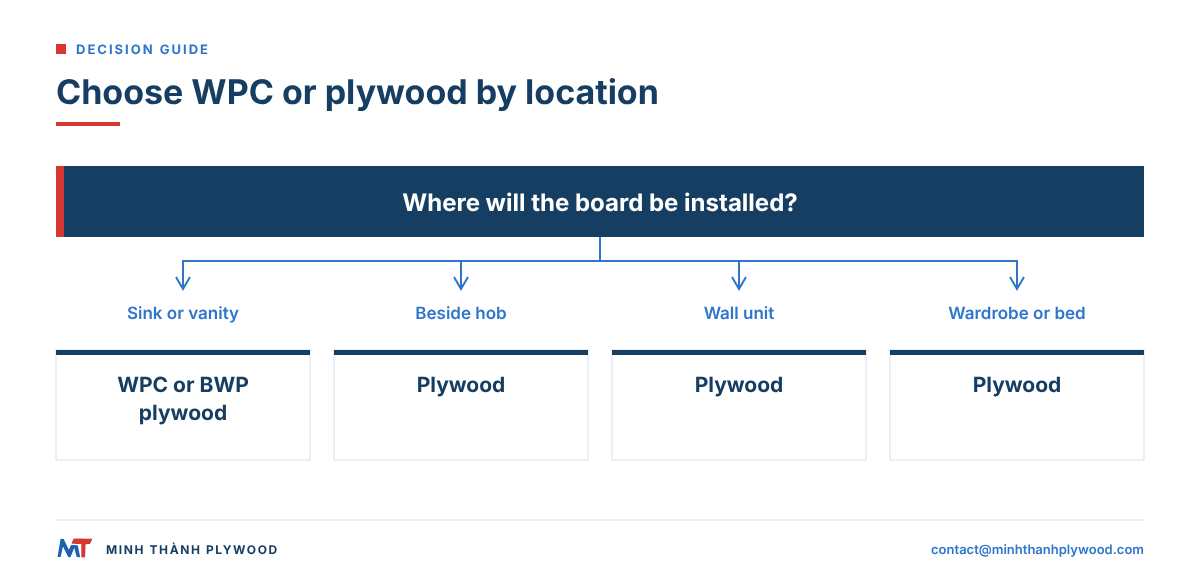
WPC board is better than plywood only in the wettest parts of a kitchen or bathroom. Under the sink, beside the washing machine and in bathroom vanities, it shrugs off water that would swell an unsealed board. In the rest of the kitchen, plywood is stiffer, lighter and better with hinge screws.
| Location | Better choice |
|---|---|
| Kitchen sink unit | WPC board or BWP plywood |
| Base units beside the hob | Plywood |
| Wall units | Plywood |
| Bathroom vanity | WPC board |
| Wardrobes and beds | Plywood |
| Doors | Plywood, or WPC doors for bathrooms |
Seal plywood edges with banding in any wet zone. For bond classes, see is plywood waterproof.
How do you cut, fix and finish WPC board?
WPC board is cut, drilled and screwed with ordinary woodworking tools, but it is joined and finished like a plastic. Carbide saw blades give clean edges; the wood flour dulls steel tools faster than plywood does.
Workshop rules for WPC board:
- Cutting: carbide blades at normal wood speeds; slow down if the edge starts to melt.
- Screws: stainless, coarse thread, in pre-drilled holes; use inserts for hinges on heavy doors.
- Gluing: PVC solvent cement or polyurethane adhesive; ordinary white wood glue does not bond the plastic.
- Edges: PVC edge banding with a hot-melt glue suited to plastics.
- Finishing: laminate both faces, or prime with a primer made for PVC before paint.
- Expansion: leave a few millimetres of gap at the ends of long panels on walls.
Plywood uses the wood glues, screws and finishes every carpenter already has, and a damaged area can be filled, sanded and refinished in place.
Where does WPC fail?
WPC fails under heat, long spans and repeated screwing. As a thermoplastic it softens as it warms, it creeps under constant load, and foamed board gives screw threads less to grip than wood fibre.
Common failures and their cause:
- Sagging shelves: low stiffness; keep spans short or use plywood.
- Bowing on sunny walls: heat above about 60 °C and thermal expansion; leave gaps and avoid dark colours in direct sun.
- Loose hinges: edge screws strip; use inserts or through-fixings.
- Dents: soft foam under a thin skin; choose co-extruded boards for doors.
- Fading outdoors: UV breaks down the surface; use UV-stabilised profiles outside.
Plywood fails in a different way: water at an unsealed edge, or the wrong bond class. Order a phenolic (WBP) bond for wet use and band every edge.
WPC vs plywood in a hot, humid climate: Cambodia and South-East Asia
In a hot, humid climate such as Cambodia, WPC suits permanently wet indoor spots and plywood suits the rest. High humidity and termites favour WPC in bathrooms and under sinks; heat and sun count against it on west-facing walls, roofs and dark exterior panels.
Practical split for builders in Phnom Penh and the region:
- Bathrooms, laundries, sink units: WPC board.
- Furniture, wardrobes, ceilings indoors: plywood, termite-treated on order.
- Covered outdoor work: phenolic-bonded (WBP) exterior plywood, sealed and painted.
- Concrete formwork: film-faced plywood.
Plywood from Vietnam reaches South-East Asian ports in about 5–12 days at sea from Hai Phong. Our exterior plywood uses melamine-fortified or phenolic (WBP) glue for stair treads and wall sheathing.
Is WPC board the greener choice?
WPC board uses wood flour, often a by-product of sawmills, and can be recycled as a thermoplastic, so it reuses material that would otherwise be waste. The non-wood fraction includes plastic, mineral filler and additives; ask the manufacturer for the full composition and stabiliser system.
Plywood answers the same question with documents. We supply the EUDR compliance dossier (origin records and geolocation files) with orders for the EU. The importer is the operator under Regulation (EU) 2023/1115, and the European Commission gives 30 December 2026 as the application date for large and medium operators (checked on 20 October 2026).
Our CARB P2 / TSCA Title VI certification (ICTT mill no. 23024) covers formaldehyde emission. The US limit for veneer-core hardwood plywood is 0.05 ppm under EPA’s TSCA Title VI standards.
When is plywood the better buy?
Plywood is the better buy for every part that carries load, takes edge screws, sits near heat or must look like wood. That covers most of a kitchen, all wardrobes and beds, shelving, ceilings and most building work.
What our plywood brings to those parts:
- White Styrax or Eucalyptus cores, with core layers stitched both horizontally and vertically.
- Furniture-grade panels pressed twice: core pressed and calibrated, then face and back.
- Thickness 3–40 mm; sanded furniture panels to ±0.2–0.3 mm, down to ±0.2 mm.
- UF glue at E0 emission as standard; MR/melamine-fortified or phenolic (WBP) to the buyer’s specification.
- Veneers and finished panels dried to 8–12 % moisture content.
We do not make WPC board. Buyers who use WPC for bathrooms order it locally and the furniture board from us.
What should a WPC board or plywood order say?
A WPC board order should state density, layer build, thickness, size and stabiliser; a plywood order should state core, glue, face, thickness and size. Without density, two WPC quotes at the same price can be very different boards.
For WPC board:
- Density: 0.7 g/cm³ or above for cabinets and doors.
- Build: three-layer co-extruded, with hard skins.
- Thickness and size: 18 mm, 1220 × 2440 mm.
- Stabiliser: lead-free (calcium-zinc).
For the plywood we quote:
- Application: furniture, wardrobes or covered outdoor work.
- Core: white Styrax or Eucalyptus.
- Glue and emission: UF glue at E0 emission; phenolic (WBP) for wet or outdoor use.
- Face/back: to an approved sample, sanded and ready for laminate.
- Thickness and size: 18 mm ±0.2 mm, 1220 × 2440 mm.
- Quantity and terms: one 40HC (MOQ), FOB Hai Phong, CFR or CIF.
Free samples are available. Send the spec to contact@minhthanhplywood.com, or compare the plastic option without wood in PVC board vs plywood.
Buyer questions, answered
What is the full form of WPC board?
WPC stands for wood plastic composite, also called wood polymer composite. A WPC board is a sheet of plastic, usually foamed PVC, mixed with wood flour or fibre.
Is WPC board better than plywood?
Only in constant wet or termite-prone conditions. Plywood is lighter for its stiffness, holds edge screws better, tolerates heat and costs about the same or less.
What is WPC plywood?
WPC plywood is a trade name for WPC board sold beside plywood. It has no wood veneers or plies; it is a foamed wood plastic composite sheet.
Is WPC cheaper than plywood?
Usually not. In Indian listings read in 2026, 18 mm WPC board sat at about ₹125–170 per sq ft, close to BWP plywood and above MR plywood.
What is the WPC board price per sheet?
At ₹125–170 per sq ft, an 18 mm 8 × 4 ft WPC board (32 sq ft) costs about ₹4,000–5,400 before tax. Thinner and lower-density sheets cost less.
Is WPC waterproof?
Yes. WPC board does not swell or rot in water and termites do not eat it, so it suits bathrooms, kitchens under the sink and humid climates.
What is the difference between WPC and plastic lumber?
WPC contains wood flour or fibre in a plastic matrix; plastic lumber, often recycled plastic lumber, is solid plastic such as recycled HDPE with no wood.
Is WPC board good for kitchen cabinets?
It works for sink units and wet base units. For wall units, drawers and units near the hob, plywood is better because it is stiffer, holds hinge screws and does not soften with heat.
How long does WPC board last?
Indoors, WPC board does not rot or swell, so it lasts as long as its fixings and finish. Outdoors in sun, UV fades the surface and heat can bow unsupported panels.
Which is better in a hot, humid climate such as Cambodia, WPC or plywood?
WPC for permanently wet indoor spots such as bathrooms; phenolic-bonded (WBP) plywood for furniture, ceilings and covered outdoor work. Keep WPC out of direct sun on dark walls.