
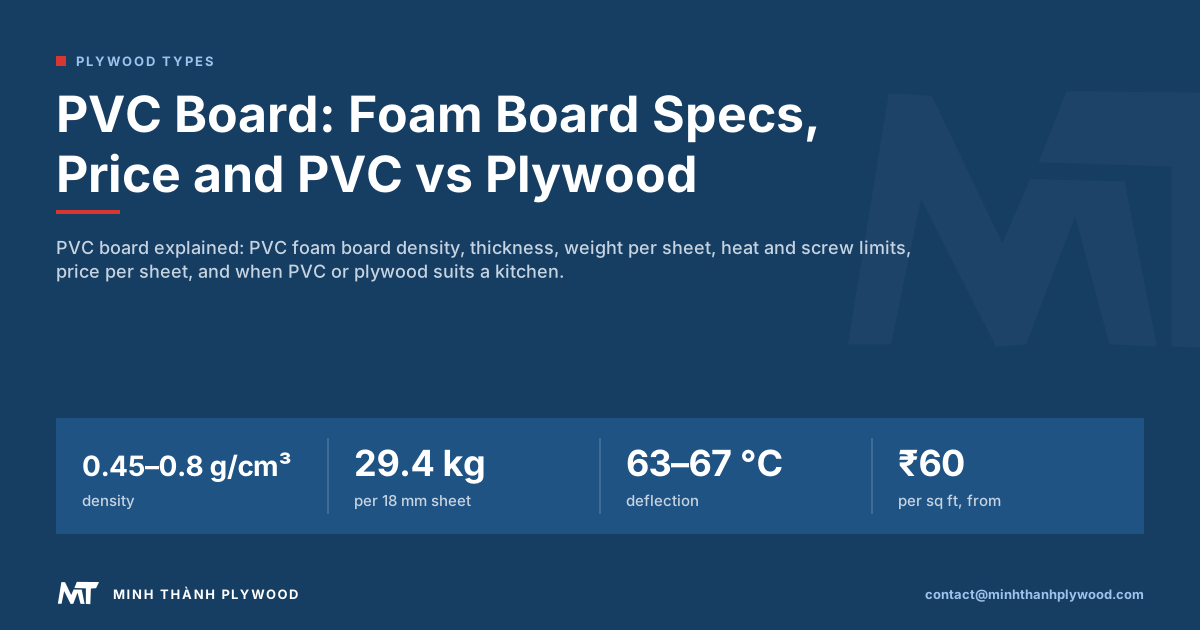
PVC board is a rigid sheet of foamed polyvinyl chloride, usually 0.45–0.8 g/cm³, sold in 1220 × 2440 mm sheets for wet-area cabinets, signs and wall panels. It does not swell or rot in water, but it is less stiff than plywood, softens with heat and holds screws less firmly. Minh Thanh Plywood makes furniture plywood and explains here where each board belongs.
PVC trim board sizes in the US: nominal and actual
In the US, “PVC board” most often means cellular PVC trim board sold at home centres for exterior trim, fascia, corner boards and window surrounds. It is sold by nominal size, and the actual board is smaller, the same as lumber. Home Depot’s PVC board category lists the sizes below (read 21 October 2026).
| Nominal size | Actual thickness × width | Lengths sold |
|---|---|---|
| 1 × 2 | 3/4 × 1-1/2 in | 8 ft |
| 1 × 4 | 3/4 × 3-1/2 in | 8, 12 ft |
| 1 × 6 | 3/4 × 5-1/2 in | 8, 12 ft |
| 1 × 8 | 3/4 × 7-1/4 in | 8, 12 ft |
| 1 × 10 | 3/4 × 9-1/4 in | 8, 12 ft |
| 1 × 12 | 3/4 × 11-1/4 in | 8, 12, 18 ft |
| 1 in thick boards | 1 × 9-1/4 and 1 × 12 in | 8, 18 ft |
| Beaded ceiling and wall board | 1/2 × 5-1/8 in | 8 ft |
Boards come smooth or woodgrain, and reversible boards give two usable faces. The retailer sells cellular white PVC trim by the board, in 2, 3 and 6 packs. Cellular PVC trim is a foamed sheet like the PVC foam board in the rest of this guide, extruded as dimensioned boards with a hard skin.
How does PVC trim compare with wood and plywood trim?
PVC trim never rots, is not eaten by termites and holds paint without priming, so it suits wet exterior joints that wood trim fails at. Paint it with a light, vinyl-safe colour, because dark paint raises board temperature and movement. It moves with heat: allow about 1/8 in of gap for every 18 ft of board, install in cool weather, glue and fasten joints, and use stainless steel screws or coil nails, not plain steel.
Wood and exterior plywood trim need priming on every face and edge, and rot first at the cut ends. For cabinets, shelves and panels where stiffness and screw holding matter, plywood is the better material, as the sections below explain.
The sections after this one cover PVC foam sheet in 1220 × 2440 mm, sold for kitchen cabinets, signs and wall panels, with sizes in mm.
What is PVC board?
PVC board is a rigid sheet of foamed polyvinyl chloride (PVC): the resin is mixed with a blowing agent that fills it with fine closed cells, then extruded into flat panels. Because the cells are closed and the material is plastic, PVC board does not absorb water, rot or attract termites.
The trade uses three names for the same product: PVC board, PVC foam board and PVC foam sheet. Thin grades of 1–10 mm are mostly sign and display boards; furniture grades run thicker and denser.
What is PVC board made of?
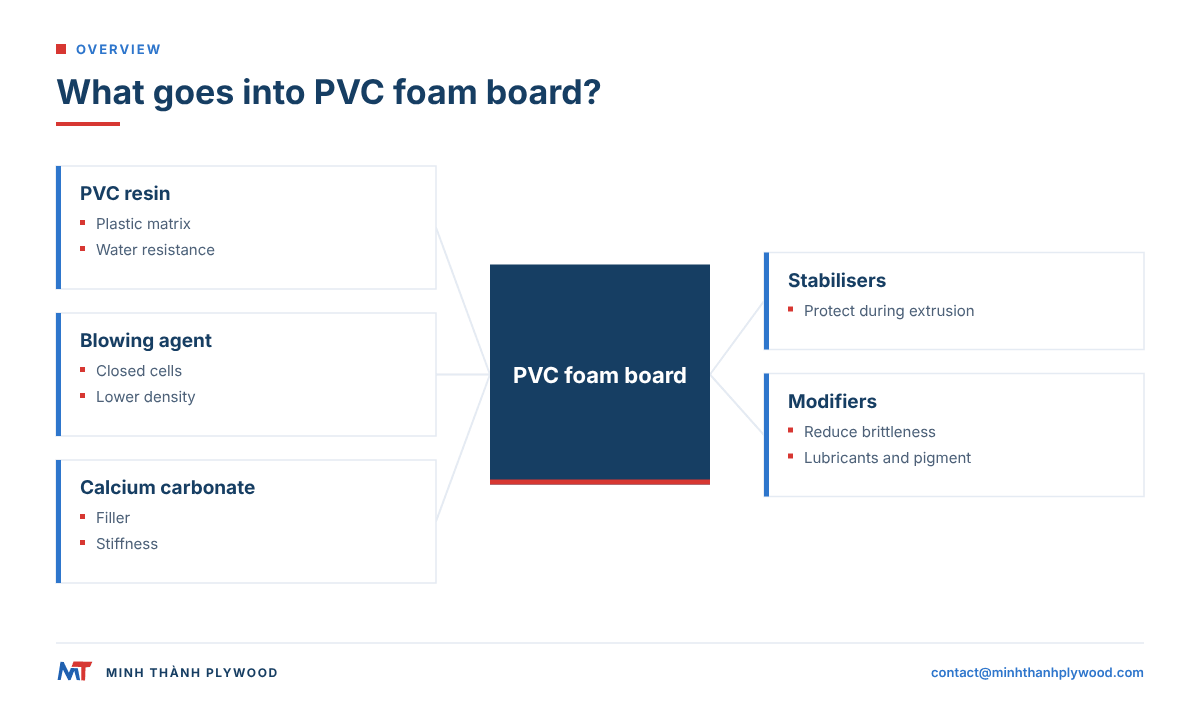
PVC board is made of PVC resin, a blowing agent, calcium carbonate filler, heat stabilisers, impact modifiers and lubricants. The resin gives the board its chemical and water resistance; the filler adds weight and stiffness at a lower cost; the stabiliser protects the PVC during extrusion.
| Ingredient | Job in the board |
|---|---|
| PVC resin | The plastic matrix; water and chemical resistance |
| Blowing agent | Fills the board with closed cells, lowers density |
| Calcium carbonate | Filler; adds stiffness and lowers cost |
| Heat stabiliser | Stops PVC breaking down during extrusion; calcium-zinc types replace lead |
| Impact modifier | Reduces brittleness |
| Lubricants and pigment | Smooth extrusion and colour, usually white |
Ask for a lead-free stabiliser when the board goes into kitchens or children’s furniture. In the EU, lead and its compounds in PVC are restricted by Regulation (EU) 2023/923. Indian makers advertise lead-free PVC boards for furniture.
PVC foam board types: Celuka and free foam
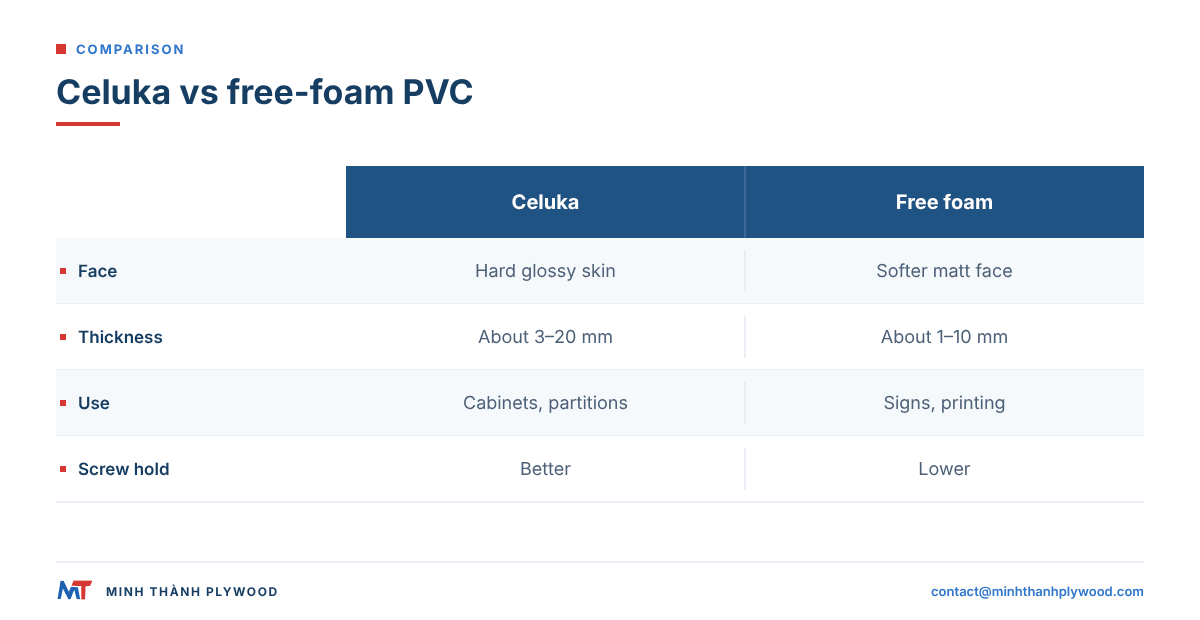
PVC foam board is made by two processes. Celuka boards are extruded so the outer skin cools fast and stays dense and hard while the inside foams; free-foam boards foam evenly through the thickness, with a softer, matt face.
| Property | Celuka PVC foam board | Free-foam PVC board |
|---|---|---|
| Surface | Hard, glossy skin | Softer, matt |
| Typical thickness | About 3–20 mm | About 1–10 mm |
| Typical use | Cabinets, furniture, partitions | Signs, displays, printing |
| Screw holding | Better (dense skin) | Lower |
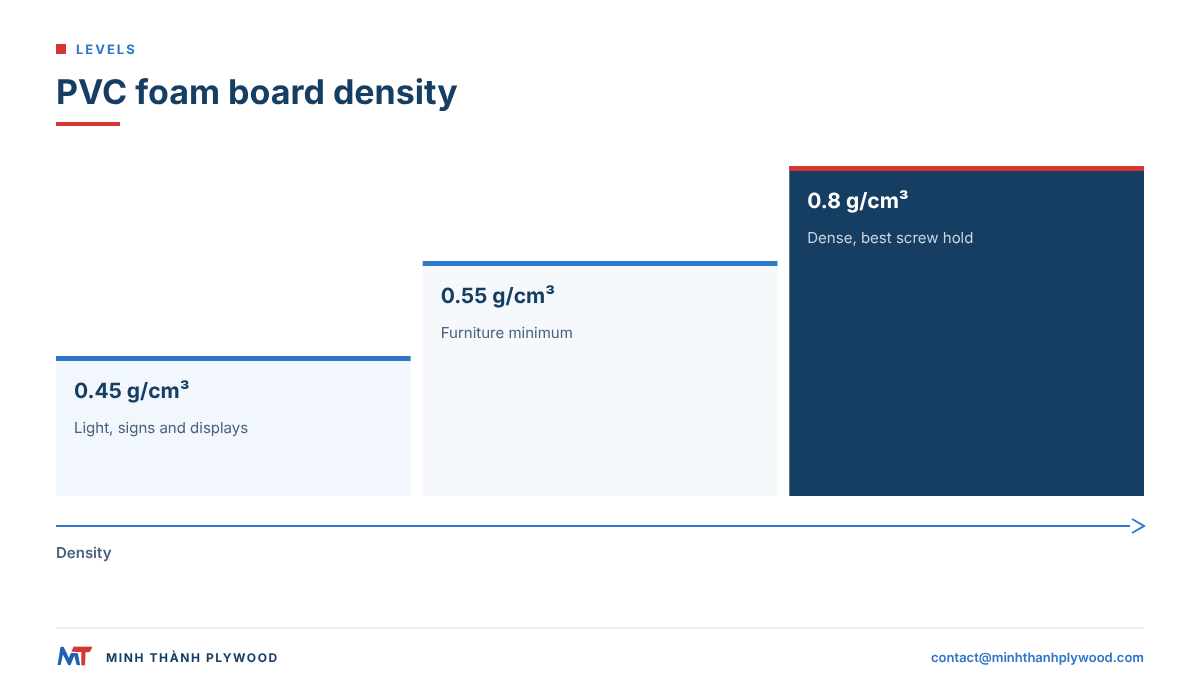
For cabinets, ask for a Celuka (crust) board at 0.55 g/cm³ or above. Low-density free-foam sheet sold for signs sags and loses screws quickly in furniture.
PVC board specifications: density, thickness and weight
PVC board for furniture is usually 0.45–0.8 g/cm³ in density and 5–25 mm thick, in 1220 × 2440 mm (8 × 4 ft) sheets. Higher density means a harder face, better screw holding and more weight.
Weights per 1220 × 2440 mm sheet published by a Vietnamese supplier of PVC foam sheet (October 2026):
| Thickness | Weight per sheet | Density from the weight |
|---|---|---|
| 5 mm | 8.2 kg | About 0.55 g/cm³ |
| 8 mm | 13 kg | About 0.55 g/cm³ |
| 12 mm | 19.6 kg | About 0.55 g/cm³ |
| 15 mm | 24.5 kg | About 0.55 g/cm³ |
| 18 mm | 29.4 kg | About 0.55 g/cm³ |
Density = weight ÷ (1.22 × 2.44 × thickness); for 18 mm, 29.4 kg ÷ 0.0536 m³ ≈ 549 kg/m³, or 0.55 g/cm³. Our 18 mm furniture plywood weighs 26.8 kg on a Styrax core and 34.8 kg on a Eucalyptus core, so a PVC board of the same thickness sits between them.
Is PVC board waterproof?
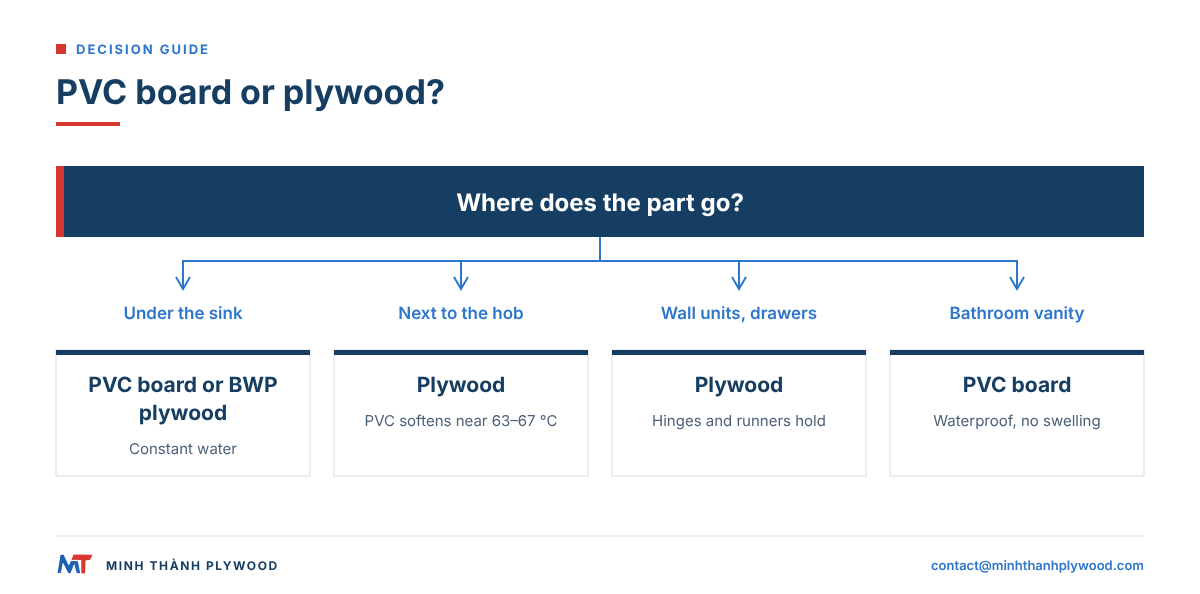
Yes, PVC board is waterproof: the closed-cell plastic does not absorb water, swell or delaminate, and it does not grow mould, even under constant splashes. This is the main reason buyers choose it for sink units, bathroom vanities, laundry cabinets and boat interiors.
Two things still fail in wet areas:
- Hardware: use stainless or coated hinges and screws; the board will outlast plain steel fittings.
- Joints: edge-glued joints in PVC need PVC solvent cement or a polyurethane glue; ordinary wood glue does not bond PVC.
Plywood can also be built for water. A phenolic (WBP) bond survives boiling, and film-faced plywood sheds water on both faces. See is plywood waterproof for the bond classes.
PVC board vs plywood: the comparison table
PVC board vs plywood is water against strength. PVC board wins in constant wet conditions and against termites; plywood is stiffer per kilogram, holds screws better, tolerates heat and costs less in most markets.
| Metric | PVC foam board | Plywood (furniture grade) |
|---|---|---|
| Material | Foamed PVC with mineral filler | Cross-laminated wood veneers |
| Density | 0.45–0.8 g/cm³ | 500–650 kg/m³ (our cores) |
| 18 mm sheet, 1220 × 2440 mm | 29.4 kg at 0.55 g/cm³ | 26.8 kg (Styrax) to 34.8 kg (Eucalyptus) |
| Water | Waterproof, no swelling | MR bond for dry rooms; WBP bond survives boiling |
| Stiffness | Low; shelves sag | High in both directions |
| Screw holding | Fair in face, weak at edge | Good in face and edge |
| Heat | Softens at about 63–67 °C | Chars, does not soften |
| Termites | Not attacked | Treated on order |
| Surface | White, smooth; laminate or paint | Sanded wood veneer; laminate, veneer or UV coating |
| Fire | Self-extinguishing; chlorinated smoke | Burns; fire-retardant grades exist |
The heat figure is the deflection temperature of PVC foam products under the ASTM D648 test. The 66 and 264 psi loads and the values come from manufacturer datasheets read in October 2026.
Which is best for a modular kitchen, PVC or plywood?
For a modular kitchen, use plywood for most units and PVC board only for the sink unit and other wet base units. Plywood carries countertop loads, holds hinge screws through years of door use and does not soften near the hob; PVC board takes the water under the sink that would swell a poorly sealed board.
| Kitchen part | Better choice | Why |
|---|---|---|
| Sink base unit | PVC board or BWP plywood | Constant splashes and leaks |
| Other base units | Plywood | Carries the worktop and drawers |
| Units next to the hob or oven | Plywood | PVC softens with heat |
| Wall units | Plywood | Light, hinge screws hold |
| Drawer boxes | Plywood | Edge joints and runners hold |
| Tall pantry units | Plywood | Stiffness over height |
| Shutters | Either; plywood laminated or PVC with foil | Look and budget decide |
For a whole-kitchen plywood plan, see kitchen cabinet plywood.
Which furniture is best, PVC or plywood?
Plywood is best for most furniture. Beds, wardrobes, tables, bookshelves, desks and anything that carries load need stiffness and screw holding, which plywood has and PVC board lacks. PVC board is best only where water is constant: bathroom vanities, under-sink cabinets, laundry and balcony storage.
Signs a part should not be PVC board:
- It spans a long distance without support (a shelf, a bed slat, a desk top).
- Hinges, runners or handles screw into its edge.
- It sits near a heat source above roughly 60 °C.
- It must take a natural wood finish.
How well does PVC board hold screws and loads?
PVC board holds screws fairly well in the face and poorly at the edge, and it creeps under constant load. One furniture-grade supplier states a screw-holding strength above 800 N for its foam board, but foam PVC has no fibres to grip a thread, so screws that are loosened and re-tightened strip quickly.
Rules for screws in PVC board:
- Use coarse-thread, stainless screws and pre-drill.
- Use through-bolts or inserts for hinges on heavy doors.
- Keep shelf spans short and add a front edge strip to stop sag.
- Do not overtighten; the foam crushes under the screw head.
Plywood keeps long wood fibres in every layer, so hinges and runners stay tight after years of use.
How does heat affect PVC board?
Heat softens PVC board: foam PVC products are rated at a deflection temperature of about 63–67 °C, and the supplier listings put the Vicat softening point at 70 °C or above. Above that, panels bow, and hot pans, hobs, ovens and dishwasher steam can mark or warp them.
PVC also expands with heat several times more than wood does along the grain. Long PVC panels need expansion gaps at their ends, and laminate glued to one face can bow the board when the kitchen warms up. Plywood does not soften; at very high heat it chars, and its dimensions move little with temperature.
What is PVC plywood or PVC ply board?
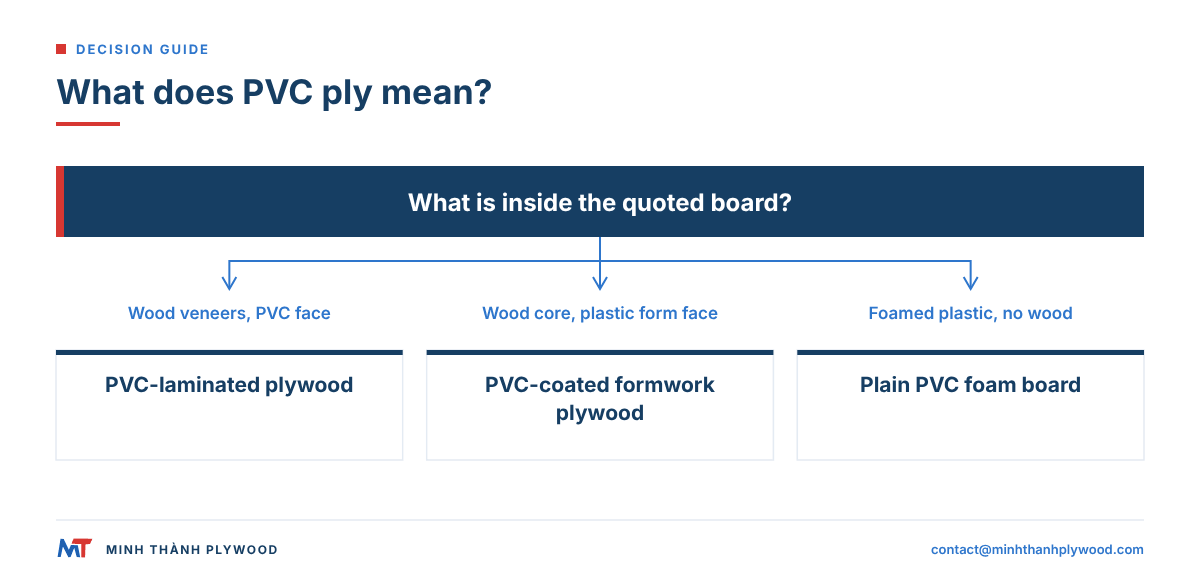
PVC plywood, also sold as PVC ply board, is plywood with a PVC film or PVC laminate pressed onto its face. It is not a PVC board; the core is still wood veneers, so it keeps plywood’s stiffness and screw holding and gains a washable plastic face.
Three products share the name:
| Product | What it is | Where it is used |
|---|---|---|
| PVC-laminated plywood | Plywood with a decorative PVC film or sheet | Furniture, wall panels |
| PVC-coated formwork plywood | Plywood with a thick plastic face for concrete | Formwork, reused many times |
| Plain PVC foam board sold as “PVC ply” | Foam board, no wood | Wet-area cabinets |
When a quote says “PVC ply”, ask whether there is wood inside. For concrete forms, film-faced plywood with a phenolic film does the same job; see our film-faced plywood.
PVC board price per sheet
PVC board price per sheet depends on density, thickness and face. In India in 2026, furniture-grade PVC board list prices start around ₹60 per sq ft before tax; an 18 mm 8 × 4 ft sheet (32 sq ft) at that rate is about ₹1,900. High-density and laminated boards cost more.
| Price driver | Effect on price |
|---|---|
| Density | 0.75 g/cm³ costs more than 0.5 g/cm³ for the same thickness |
| Thickness | Price rises roughly with thickness |
| Celuka vs free foam | Celuka furniture boards cost more |
| Stabiliser | Lead-free boards cost a little more |
| Laminated face | Adds the laminate and pressing cost |
For an importer, plywood is priced per cubic metre. Minh Thanh Plywood’s indicative starting prices in October 2026 are from US$250/m³ for commercial plywood and from US$350/m³ for furniture and interior plywood; face, core, glue, thickness, size and quantity set the final price.
Where is PVC board made and sold?
PVC board is made by plastic extruders in China, India, Vietnam, Thailand and other markets, and sold through plywood and hardware dealers next to plywood. In Vietnam and South-East Asia, plywood suppliers often list PVC foam sheet in 1220 × 2440 mm at 5–20 mm.
PVC board travels well: it is light for its volume and unaffected by humidity at sea. Shipping from Hai Phong to South-East Asian ports takes about 5–12 days at sea. Ask the extruder for a density certificate, the stabiliser type and a sample before ordering; low-density boards look the same in a photo.
When is plywood the better buy?
Plywood is the better buy whenever a part carries load, takes edge screws, sits near heat or needs a wood face. That covers most furniture and most of a kitchen, which is why many makers use PVC board only for the sink unit.
Minh Thanh Plywood makes furniture plywood for these parts:
- White Styrax or Eucalyptus cores, core layers stitched both horizontally and vertically.
- Furniture-grade panels pressed twice, sanded to ±0.2–0.3 mm, down to ±0.2 mm.
- UF glue at E0 emission as standard; MR/melamine-fortified or phenolic (WBP) bonds to the buyer’s specification.
- CARB P2 / TSCA Title VI certification (ICTT mill no. 23024). The limit for veneer-core hardwood plywood is 0.05 ppm under EPA’s TSCA Title VI requirements.
We do not make PVC board. Buyers who want a PVC sink unit order it locally and the rest of the kitchen in plywood.
What should a PVC board or plywood order say?
A PVC board order should state density, process, thickness, size and stabiliser; a plywood order should state core, glue, face, thickness and size. Without density on the order, a PVC quote can be for a soft sign board.
For PVC board:
- Density: 0.55 g/cm³ or above for furniture.
- Process: Celuka (crust) face.
- Thickness and size: 18 mm, 1220 × 2440 mm.
- Stabiliser: calcium-zinc, lead-free.
For the plywood we quote:
- Application: kitchen or furniture carcasses.
- Core: white Styrax or Eucalyptus.
- Glue and emission: UF glue at E0 emission; phenolic (WBP) bond for wet units.
- Face/back: sanded, ready for laminate, to an approved sample.
- Thickness and size: 18 mm ±0.2 mm, 1220 × 2440 mm.
- Quantity: one 40HC (MOQ), FOB Hai Phong, CFR or CIF.
Free samples are available. Send the spec to contact@minhthanhplywood.com, or compare another plastic board in WPC board vs plywood.
Buyer questions, answered
What is PVC board made of?
PVC board is made of polyvinyl chloride resin foamed with a blowing agent, plus calcium carbonate filler, heat stabilisers and lubricants. Better boards use calcium-zinc stabilisers instead of lead.
Is PVC board waterproof?
Yes. PVC foam board does not absorb water, swell, rot or grow mould, so it suits sink units, bathroom vanities and laundry cabinets. Hinges and screws in it still need corrosion-resistant hardware.
Which is best for a modular kitchen, PVC or plywood?
Use PVC board for the sink unit and other wet base units, and plywood for wall units, drawers, tall units and shelves. Plywood is stiffer, holds hinge screws better and does not soften near the hob.
Which furniture is best, PVC or plywood?
Plywood is better for most furniture: beds, wardrobes, tables, shelving and anything that carries load. PVC board is better only where water is constant, such as bathroom and under-sink cabinets.
What is the PVC board price per sheet?
In India in 2026, PVC board list prices start around ₹60 per sq ft, so an 18 mm 8 × 4 ft sheet is about ₹1,900 before tax. Density, thickness and lamination move the price most.
What is PVC plywood?
PVC plywood usually means plywood with a PVC film or PVC laminate pressed on its face. It is still plywood inside; the PVC layer adds a washable, decorative or water-shedding face.
Is PVC board better than plywood?
Only in constant wet conditions. Plywood is stiffer per kilogram, holds screws better and tolerates heat, while PVC board wins on water and termites.
Is PVC board termite proof?
Yes. Termites and borers do not eat PVC, so foam board needs no treatment. Plywood can be ordered with a preservative treatment for the same purpose.
What is the difference between PVC foam board and WPC board?
PVC foam board is foamed PVC with mineral filler. WPC board is foamed PVC mixed with wood flour, so it is a little denser and stiffer and cuts more like wood.
How much heat can PVC board take?
PVC foam board starts to soften at about 63–67 °C under load (ASTM D648), so keep it away from hobs, ovens and dishwasher steam vents.