
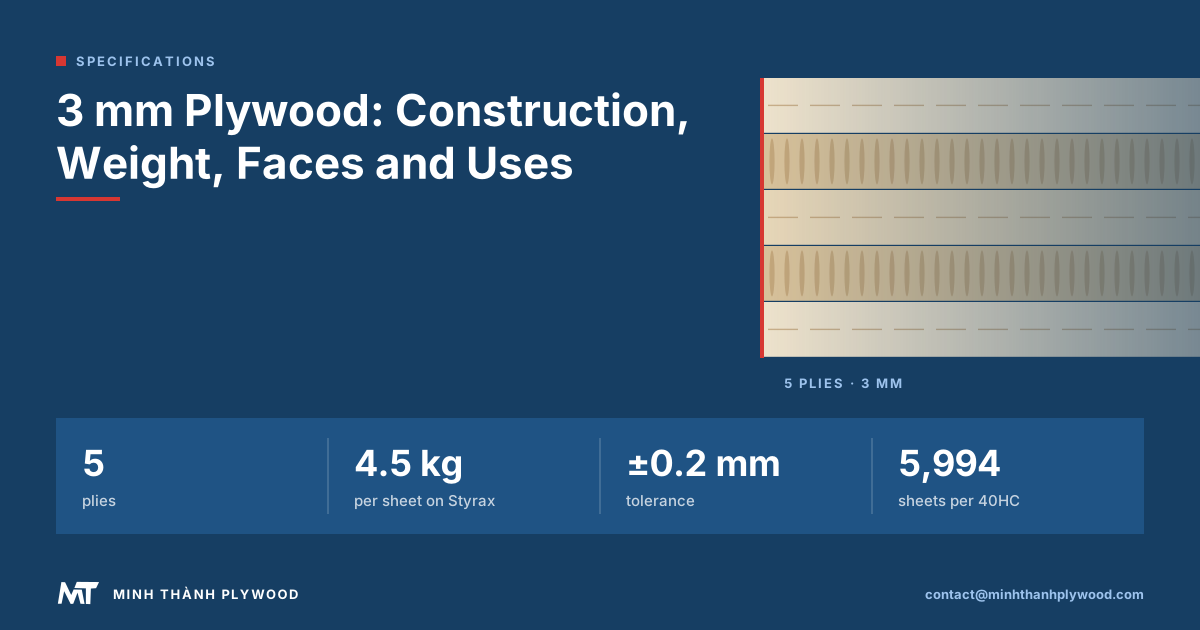
3 mm plywood is a thin veneer panel, and every 3 mm sheet Minh Thanh Plywood makes has five plies: two faces, two cross-bands and one centre veneer. A 1220 × 2440 mm sheet weighs about 4.5 kg on a white Styrax core and 5.8 kg on Eucalyptus. It suits cabinet backs, drawer bottoms and interior skins held in a groove or frame.
What sizes does 3 mm plywood come in, and what does a sheet cost?
Using the broad furniture/interior starting-price reference of US$350/m³ (October 2026), a 1220 × 2440 × 3 mm sheet calculates to about US$3.13 in a raw FOB example. This is calculated panel value before freight, duty and margin; the selected 3 mm construction needs its own quotation.
| 3 mm sheet | Volume | Raw FOB panel at US$350/m³ | In pounds |
|---|---|---|---|
| 1220 × 2440 mm | 0.00893 m³ | US$3.13 | about £2.34 |
| 1250 × 2500 mm | 0.00937 m³ | US$3.28 | about £2.46 |
| 1220 × 1220 mm | 0.00447 m³ | US$1.56 | about £1.17 |
| 607 × 1220 mm | 0.00222 m³ | US$0.78 | about £0.58 |
| 607 × 1829 mm | 0.00333 m³ | US$1.17 | about £0.87 |
UK shops sell thin plywood as 3.6 mm, not 3 mm: it is the common metric sheet, and the same eucalyptus-faced hardwood panel appears at 2440 × 1220, 1220 × 1220, 607 × 1220 and 607 × 1829 mm. Selco lists 3.6 mm plywood in these sheet sizes (Selco). Read on 21 October 2026, the 8x4 sheet was £12.04 ex VAT and a 1829 × 607 mm board £10.35 ex VAT. If your drawing says 3.6 mm, read our 3.6 mm plywood guide. The pound figures use US$1.3345 to £1 (exchangerates.org.uk, 20 October 2026).
What is 3 mm plywood?
3 mm plywood is a thin veneer panel with a nominal thickness of 3 mm, made by gluing thin wood veneers with their grain crossed so the sheet stays flat and resists splitting. At Minh Thanh Plywood it is the thinnest panel in our 3–40 mm range and part of our thin plywood range of 3–6 mm.
Buyers search for it as “plywood 3 mm”, “3 mm plywood sheet” or “1/8 plywood”, and they usually want the same thing: a light, flat, sanded panel that carries a finish and fits a groove. It is a furniture and interior panel. It is not a structural sheet, and it does not span gaps on its own.
The three things that decide whether one 3 mm sheet is better than another are the build (how many plies and which core), the face (species and grade) and the bond (glue and emission class). This guide covers each, then gives weights, a packing plan and the spec line to send.
How is 3 mm plywood built: 3-ply or 5-ply?
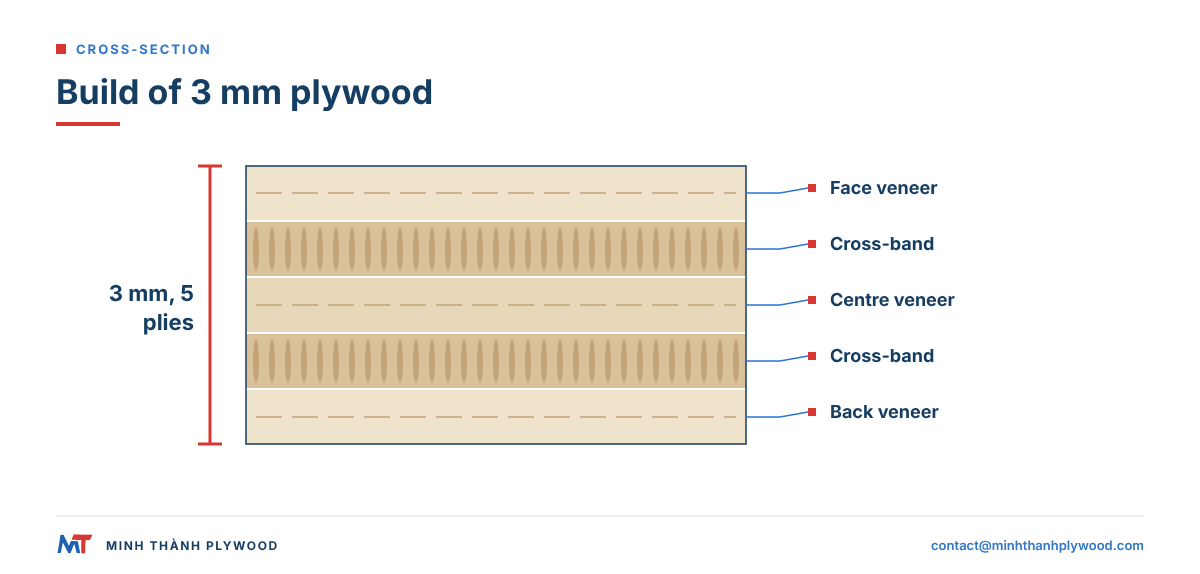
Every 3 mm sheet we make is 5-ply: a face veneer, a cross-band, one centre veneer, a second cross-band and a back veneer. The face, centre and back run along the length; the two cross-bands run across it. That layout puts the same build on both sides of the centre line, which is what keeps a thin panel flat.
A 3-ply 3 mm sheet uses three thicker veneers instead of five thinner ones. It is quicker to lay up and it is sold in many markets. The difference shows when the panel is grooved, cut into narrow strips or coated on one face: with only three plies, each veneer carries more of the load, and a defect in the centre veneer goes straight through to the face.
| Layer, top to bottom | Grain direction | What it does |
|---|---|---|
| Face veneer | Along the length | The visible surface: species and grade you order |
| Cross-band | Across | Stops splitting along the grain, holds the face flat |
| Centre veneer | Along the length | Gives length-wise stiffness |
| Cross-band | Across | Mirrors the upper cross-band |
| Back veneer | Along the length | Balances the face; grade to the order |
The cross-bands are why our 3 mm panel can be routed for a groove or cut into narrow strips without a long crack opening along the grain. Write “5-ply” on the purchase order; a quote that only says “3 mm” leaves the build open.
3mm plywood 2400 x 1200 and other sheet sizes
3 mm plywood comes in 1220 × 2440 mm (4 × 8 ft) and 1250 × 2500 mm as standard, and a 3mm plywood 2400 x 1200 sheet is the 1220 × 2440 mm format cut to size. We also press custom parent sizes such as 1220 × 2500 and 1220 × 2280 mm, and cut sheets into 4, 6 or 8 pieces for furniture parts.
UK and European buyers often list 2400 × 1200 mm because it is the common metric sheet size there. Writing that size on the order gets a sheet trimmed to 2400 × 1200 mm with length and width held to ±2 mm, so the panel drops into the same saw stops as local stock. If the 20 mm and 40 mm trim strips matter for your yield, order the parent size that fits your cutting list instead.
How much does a 3 mm plywood sheet weigh?
A 1220 × 2440 mm sheet of 3 mm plywood weighs about 4.5 kg on a white Styrax core and about 5.8 kg on a Eucalyptus core. The sheet holds 0.0089304 m³ of wood (1.22 m × 2.44 m × 0.003 m), and weight is that volume multiplied by the panel density.
| Core | Planning density | Weight per 1220 × 2440 × 3 mm sheet | Sheets per m³ |
|---|---|---|---|
| White Styrax | 500 kg/m³ | about 4.5 kg | 111 |
| Eucalyptus | 650 kg/m³ | about 5.8 kg | 111 |
Choose Styrax when the panel will be handled by hand, shipped as flat-pack furniture or loaded by weight. Choose Eucalyptus when you want a denser, harder panel that holds a small screw or staple better. The finished weight also depends on the face species and moisture, so the loading plan for an order uses weighed packs.
Which face veneers and grades are available on 3 mm plywood?
The face is chosen for the finish you will apply. We lay more than ten face veneers; the ones ordered most on 3 mm panels are engineered veneer (EV), poplar, birch, okoume and pine, with bintangor, eucalyptus, gurjan and sapele on request.
- Birch faces are graded D+, D and E in Vietnam (E is the lowest, D+ the highest) and quoted as face/back pairs such as D+/D or D/E. As a buying comparison, D+ is close to European birch grade B, D to BB and E to CP/C, so D+/D reads as roughly B/BB. See the birch plywood page for the full ladder.
- Poplar and eucalyptus faces are quoted as A/A, A/B or B/B. A/A suits two visible faces, A/B one visible face, B/B a painted or laminated part.
- EV gives a repeatable colour and grain from sheet to sheet, which suits furniture lines that need matching doors and backs.
On a 3 mm sheet the face is a large share of the thickness, so a thin or patched face shows quickly through paint. The approved sample fixes the look: every production sheet is matched to it, and the grade pair goes on the order line.
What is 3 mm plywood used for?
3 mm plywood is used where a thin, flat, finished panel is held by something else: a groove, a rebate, a frame or glue. It is a skin, a back or a bottom, not a shelf or a structural panel, so check what supports it before you order.
- Cabinet and wardrobe backs. Captured in a rebate or groove, a 3 mm back closes the carcass and squares it. Choose the face for the inside colour of the cabinet.
- Drawer bottoms in small drawers. Held in grooves on all four sides, 3 mm carries light contents such as clothing or stationery.
- Door and frame panels. Floating in a frame-and-panel door, the thin sheet takes stain or paint like the frame.
- Interior skins. Glued over a light frame for curved or flat furniture fronts, display units and shop fittings.
- Laser and CNC parts. Models, signage blanks, templates and small boxes, where a flat, even sheet cuts cleanly.
- Packaging inserts. Light dividers and box liners where a sanded face is not needed.
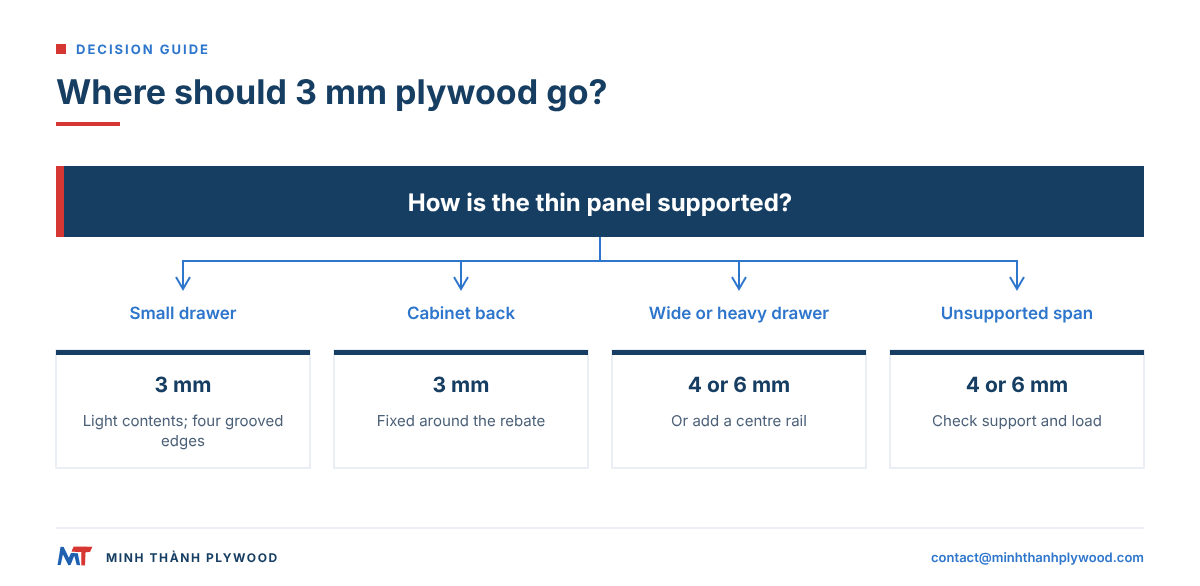
If the part spans more than a hand’s width without support, or carries weight in the middle, look at 4 mm or 6 mm plywood first.
Is 3 mm plywood strong enough for drawer bottoms and backs?
Yes for small drawers and cabinet backs, as long as the panel is supported on its edges. A 3 mm bottom held in grooves on all four sides works with the drawer box to carry light contents; a back held in a rebate stiffens the whole carcass.
The thin sheet is the weak point when it spans a wide opening unsupported. For a drawer wider than about a hand span or for heavy contents such as tools and cutlery, choose 4 or 6 mm, or add a centre rail under the bottom. Our drawer bottom guide walks through the thickness choice by drawer size.
For backs, the strength that matters is racking: the back keeps the cabinet square. A 5-ply 3 mm sheet fixed along a rebate on all four edges does that job in most flat-pack and assembled cabinets. Run a load trial on the assembled unit before fixing the production design.
What thickness tolerance does 3 mm plywood hold?
Our sanded furniture panels are held to ±0.2–0.3 mm on thickness, down to ±0.2 mm when the order needs it, and ±2 mm on length and width. On a 3 mm sheet, ±0.2 mm means a real thickness of 2.8 to 3.2 mm.
That matters because thin panels go into grooves. A groove cut at 3.2 mm for a sheet that arrives at 2.7 mm rattles; one cut at 3.0 mm for a sheet at 3.3 mm will not close. Write the tolerance on the order and measure incoming sheets with a caliper at the corners and the middle of each edge.
The tolerance comes from the press and the sander. We press the panel, calibrate it and sand both faces, then check thickness across the sheet before packing. Ask for the caliper readings of the sample with your quote.
How is 3 mm plywood made at our mill?
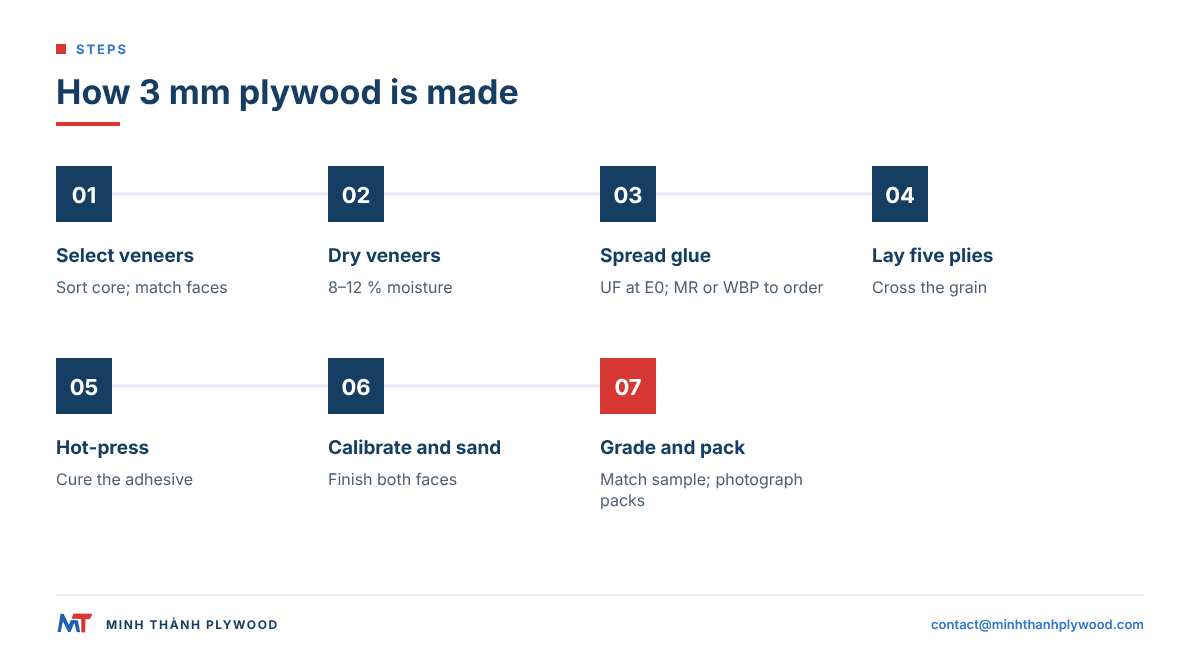
Thin panels follow the same steps as our furniture plywood, with tighter control on the veneers.
- Veneer selection. Centre and cross-band veneers are sorted for even thickness and no open defects; face veneers are matched to the approved sample.
- Drying. Veneers are dried to 8–12 % moisture content, the normal range for furniture plywood.
- Glue spreading. UF glue at E0 emission for furniture and interior orders; melamine-fortified or phenolic (WBP) to order.
- Lay-up. Five plies laid with grain crossed: face, cross-band, centre, cross-band, back.
- Hot pressing. The stack is pressed under heat until the glue cures.
- Calibration and sanding. Both faces sanded and polished to the ordered thickness.
- Grading and packing. Each sheet graded against the sample, counted into packs and photographed before loading.
Premium thin veneer is scarce, so we buy face veneer for thin orders early. We do not lower the face standard to shorten the schedule.
Which glue and emission class should 3 mm plywood have?
For furniture and interior use, specify UF glue at E0 emission; for humid places, specify a melamine-fortified or phenolic (WBP) bond. Glue type and emission class are two separate lines on the order: UF, MR or WBP describes the bond; E0, E1 or CARB P2 describes formaldehyde emission.
UK and EU buyers name the bond by class: EN 314-2 Class 2 for humid interiors and Class 3 for exterior use, with the panel type on EN 636-2 (humid) or EN 636-3 (exterior). The bonding-quality requirements are set in EN 314-2. Jewson, for example, lists its marine plywood as BS 1088 and EN 314-2 Class 3 with E1 emission (Jewson). Write the class you need on the order and we press to the bond it names. FSC is a separate line on the order, and SGS tests to the buyer’s method on request.
Our furniture panels meet the emission and quality requirements European and US furniture buyers ask for, and our CARB P2 / TSCA Title VI certification (ICTT mill no. 23024, hardwood plywood veneer core, 3–50 mm) is the proof. Six third-party chamber tests to ASTM D6007 between April 2025 and June 2026, on 9, 15 and 18 mm panels, averaged 0.014–0.032 ppm against the 0.05 ppm limit for veneer-core hardwood plywood.
The limit is set by the California Air Resources Board composite wood rule and the US EPA TSCA Title VI rule. The same UF resin at E0 grade goes into our 3–6 mm panels, and E0 testing runs every three months. For a European order, SGS tests the ordered thickness to EN 717-1 on request.
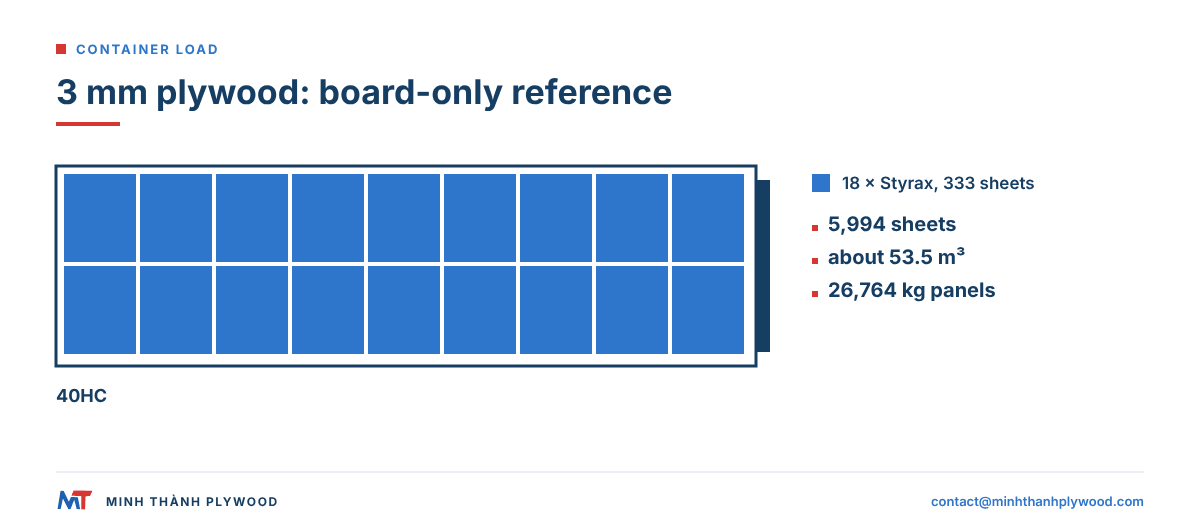
How many 3 mm sheets fit in a 40HC container?
Determine the count from the booked payload, weighed pack mass and container layout. The factory’s sheet and pack references are board-only planning inputs; the shipped quantity must include bases, covers, wrapping, straps and other packing material within the booking limit.
For a uniform line, subtract any other cargo from the booked payload, divide the remaining allowance by the weighed gross mass per pack and round down to whole packs. Multiply by the agreed sheets per pack, then check the pack layout. For a mixed load, add the gross mass of every proposed pack and keep the total within the booking limit.
Use the packing calculator with the actual order and packing inputs. The final quantity follows the completed pack weights and booking, not the geometric sheet count alone.
A thin-sheet container is often mixed: one 40HC can carry 3, 4 and 6 mm panels together by agreement, in whole packs.
How do 3 mm, 4 mm and 6 mm plywood compare?
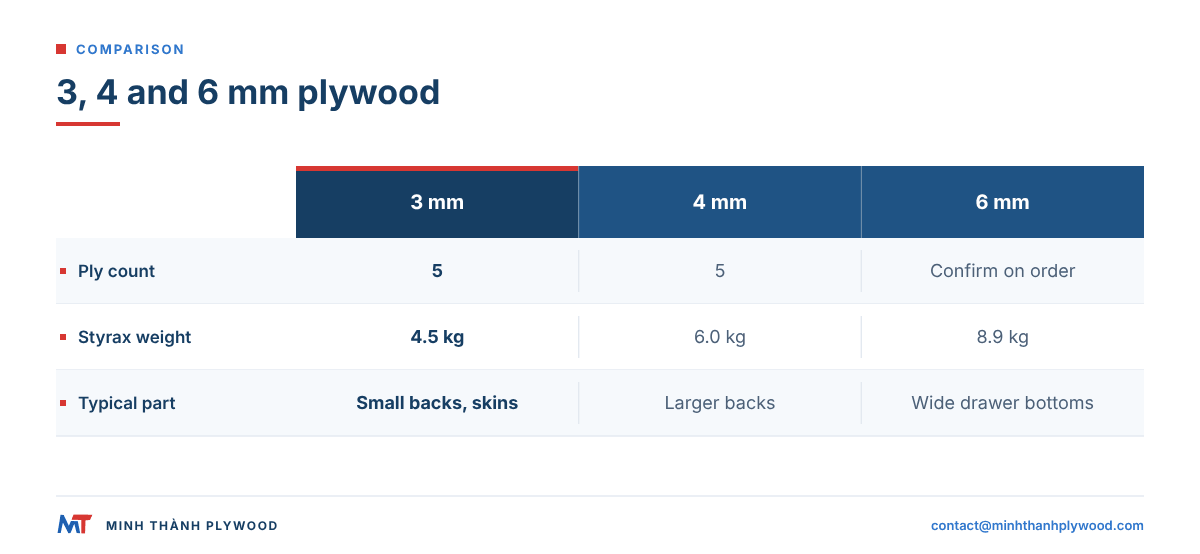
Pick the thinnest panel that the part’s support allows. The 3 mm and 4 mm panels are always 5-ply at our mill and the 6 mm ply count is confirmed with the order; what changes most is stiffness, weight and price per sheet.
| Thickness | Build | Weight per sheet, Styrax core | Typical part |
|---|---|---|---|
| 3 mm | Face, 2 cross-bands, 1 centre veneer, back | about 4.5 kg | Cabinet backs, small drawer bottoms, skins |
| 4 mm | Face, 3 core veneers, back | about 6.0 kg | Drawer bottoms, backs on larger units |
| 6 mm | Ply count confirmed with the order | about 8.9 kg | Wide drawer bottoms, panels that span more |
The 4 mm plywood guide covers the next step up in detail. Thinner than 3 mm, such as 2.7 mm “1/8 inch” or 2 mm sheets, is a separate product used mainly for models and crafts; see the 1/8 inch plywood guide.
Is 3 mm plywood better than hardboard or MDF for cabinet backs?
For a back that is screwed, stapled or grooved and must survive transport, 3 mm plywood is the stronger choice; hardboard and thin MDF win only on the lowest cost per sheet. Plywood’s crossed veneers resist splitting at a staple line and bending at a corner, and a 5-ply sheet stays in one piece if a flat-pack carton is dropped.
| Point to compare | 3 mm plywood, 5-ply | 3 mm hardboard or thin MDF |
|---|---|---|
| Edge and staple holding | Crossed veneers grip fixings near the edge | Fibre edge crumbles more easily near fixings |
| Weight per 1220 × 2440 mm sheet | about 4.5 kg on Styrax | heavier for the same thickness at fibreboard densities |
| Response to damp | Bond chosen by use: UF, MR or WBP | Swells at cut edges unless the board is moisture-resistant |
| Visible face | Real veneer that takes stain | Paper, paint or foil finish |
| Bending without breaking | Flexes and recovers | Cracks more readily |
Plywood also lets the back match the cabinet: a birch or poplar face inside a wardrobe can be stained or lacquered with the carcass. A full comparison with costs is in our cabinet back panels guide.
What is 3 mm flexible plywood, and is it the same as flat 3 mm ply?
No. Flexible (“bendy”) 3 mm plywood is a separate product whose face grain runs along the sheet so it curls to a tight radius, about 30 mm on the Sheet Materials Wholesale panel. That panel sold at £17.59 ex VAT for 2440 × 1220 mm on 21 October 2026. Our flat 3 mm sheet is five cross-laid plies, built to stay flat and take a finish, and it is not made for bending. For a curved part, ask for a flexible panel or laminate several thin plies over a former.
How should 3 mm plywood be stored and finished so it stays flat?
Store thin plywood flat on a level stack of bearers, keep the packs wrapped until use, and finish both faces the same way. A 3 mm sheet bends under its own weight if it is stood on edge or laid across two far-apart bearers, and it can take that shape permanently.
Our 3 mm sheets leave the mill dried to 8–12 % moisture content, packed flat on a pallet base with top and bottom covers and steel straps. On arrival, let the packs settle in the workshop climate before cutting, and open only the pack you are using.
Finishing is the other half. A coat of lacquer or a laminate on one face only pulls the sheet toward that face as the coating cures. Seal the back with a balancing coat, or fix the panel into its groove or rebate before coating so the frame holds it flat.
Most complaints of “warped” thin plywood trace back to one of three causes: one-sided coating, storage on edge, or a damp site. A balanced 5-ply build removes the fourth cause, a panel that is unbalanced from the press.
What does 3 mm plywood cost?
Furniture and interior plywood from Minh Thanh starts from US$350/m³ (October 2026), and one cubic metre is 111 sheets of 1220 × 2440 × 3 mm. The final price depends on the face species and grade, the core, the glue and emission class, the size, the quantity and the delivery term.
Thin panels cost more per cubic metre than thick ones because a cubic metre of 3 mm sheets takes six times as many face veneers and sanding passes as a cubic metre of 18 mm. Compare quotes per sheet as well as per cubic metre, and check that every quote names the same ply count, face grade and tolerance. Our guide to comparing plywood quotations gives the full line-by-line method.
What should you write on a 3 mm plywood order?
A complete 3 mm order line names seven things, and each one closes a question a supplier would otherwise answer for you.
- Application: for example “cabinet back, captured in 8 mm rebate”.
- Build and core: “3 mm, 5-ply, white Styrax core”.
- Glue and emission: “UF glue at E0 emission, CARB P2 / TSCA Title VI”.
- Face and back: “birch D+/D” or “poplar A/B”, matched to the approved sample.
- Size and tolerance: “1220 × 2440 mm, thickness ±0.2 mm, sanded both sides”.
- Packing and quantity: sheets per pack, total sheets, mixed with other thicknesses or not.
- Destination port and Incoterm: FOB Hai Phong, CFR or CIF.
Production runs 15–45 days after the 30 % deposit, with the 70 % balance against the scanned B/L or an irrevocable L/C at sight. The minimum order is one 40HC, and mixed thicknesses are accepted by agreement. Free samples are available before the order.
Buyer questions, answered
How many plies does 3 mm plywood have?
Minh Thanh 3 mm plywood has five plies: a face, a cross-band, a centre veneer, a second cross-band and a back. Some markets also sell 3-ply 3 mm sheets made with thicker veneers; ask any supplier to write the ply count on the quote.
How much does a 3 mm plywood sheet weigh?
A 1220 × 2440 mm sheet of 3 mm plywood holds 0.0089 m³ of wood. At 500 kg/m³ for a white Styrax core it weighs about 4.5 kg; at 650 kg/m³ for Eucalyptus it weighs about 5.8 kg.
What is 3 mm plywood used for?
It is used for cabinet and wardrobe backs, drawer bottoms in small drawers, interior skins on frames, door panels in a frame, model and display parts, and laser or CNC cut parts. It works best captured in a groove or fixed to a frame.
Is 3 mm plywood the same as 1/8 inch plywood?
Close, but not the same. 1/8 inch is 3.175 mm, and many sheets sold as 1/8 inch measure 2.7 to 3.2 mm. Order by the metric thickness and the tolerance you need, not by the fraction.
What sizes does 3 mm plywood come in?
The standard sizes are 1220 × 2440 mm (4 × 8 ft) and 1250 × 2500 mm. Minh Thanh also makes custom parent sizes such as 1220 × 2500 mm and cuts sheets into 4, 6 or 8 pieces for furniture parts.
Can I get 3 mm plywood in 2400 × 1200 mm?
Yes. A 2400 × 1200 mm sheet is cut to size from the 1220 × 2440 mm format, with length and width held to ±2 mm, or made as a custom parent size within a container order.
How many 3 mm plywood sheets fit in a 40 ft container?
Calculate the count from weighed packed units and the booked payload, then check the container layout. At the planning densities, a 1220 × 2440 × 3 mm sheet contains about 4.5 kg of Styrax-core panel or 5.8 kg of Eucalyptus-core panel before packaging.
Is 3 mm plywood strong enough for a drawer bottom?
For small, light drawers with the bottom captured in grooves on all four sides, yes. For wider drawers or heavier contents, step up to 4 or 6 mm, or add a centre rail.
Does 3 mm plywood warp?
A balanced 5-ply sheet dried to 8–12 % moisture stays flat when it is stored flat and finished on both faces. Warping usually comes from one-sided coating, uneven storage or a damp site.
What glue is used in 3 mm furniture plywood?
UF glue at E0 emission is our standard for furniture and interior 3 mm panels. Melamine-fortified or phenolic (WBP) bonds are made to order for humid uses.