
Hexagonal face
Repeating honeycomb texture in phenolic film around 220 g/m².
Application brief
Pick it for foot traffic from every direction, stages and wet or washdown floors: the open cells drain and clean out.
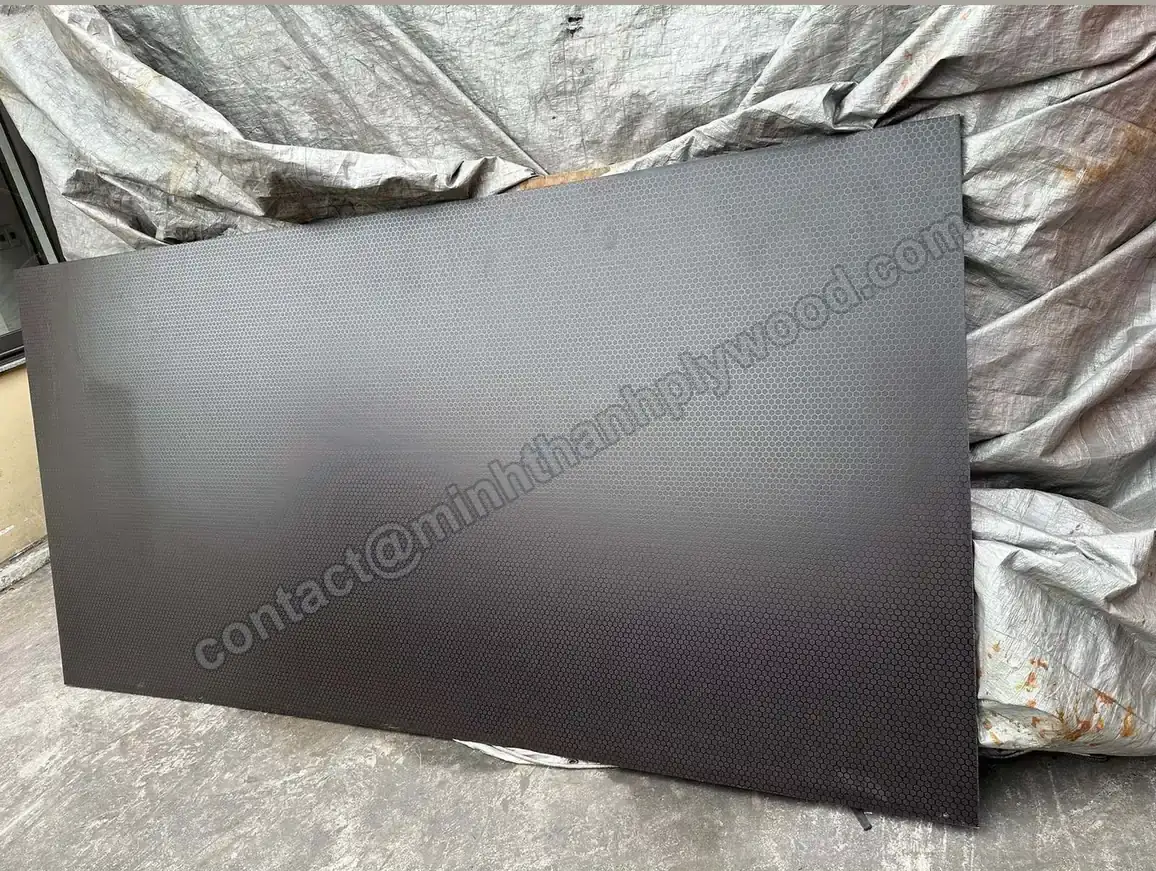
Textured panels supplied to order
In short
Minh Thanh Plywood accepts anti slip plywood on order with hexagonal or rice/mesh phenolic film around 220 g/m², a smooth film back and an Eucalyptus or Acacia core. Panels are 12–21 mm with ±0.5 mm thickness tolerance, in 1220 × 2440 or 1250 × 2500 mm sheets for flooring and access components.
Video
Watch the key decisions for an anti-slip order: the surface pattern, working side, core, bond, flooring drawing, testing and care in service.
Real Panels
Real hexagonal and rice-pattern sheets show the working texture across the face, with close views of the surface and edges. Choose from the sample that matches your floor.
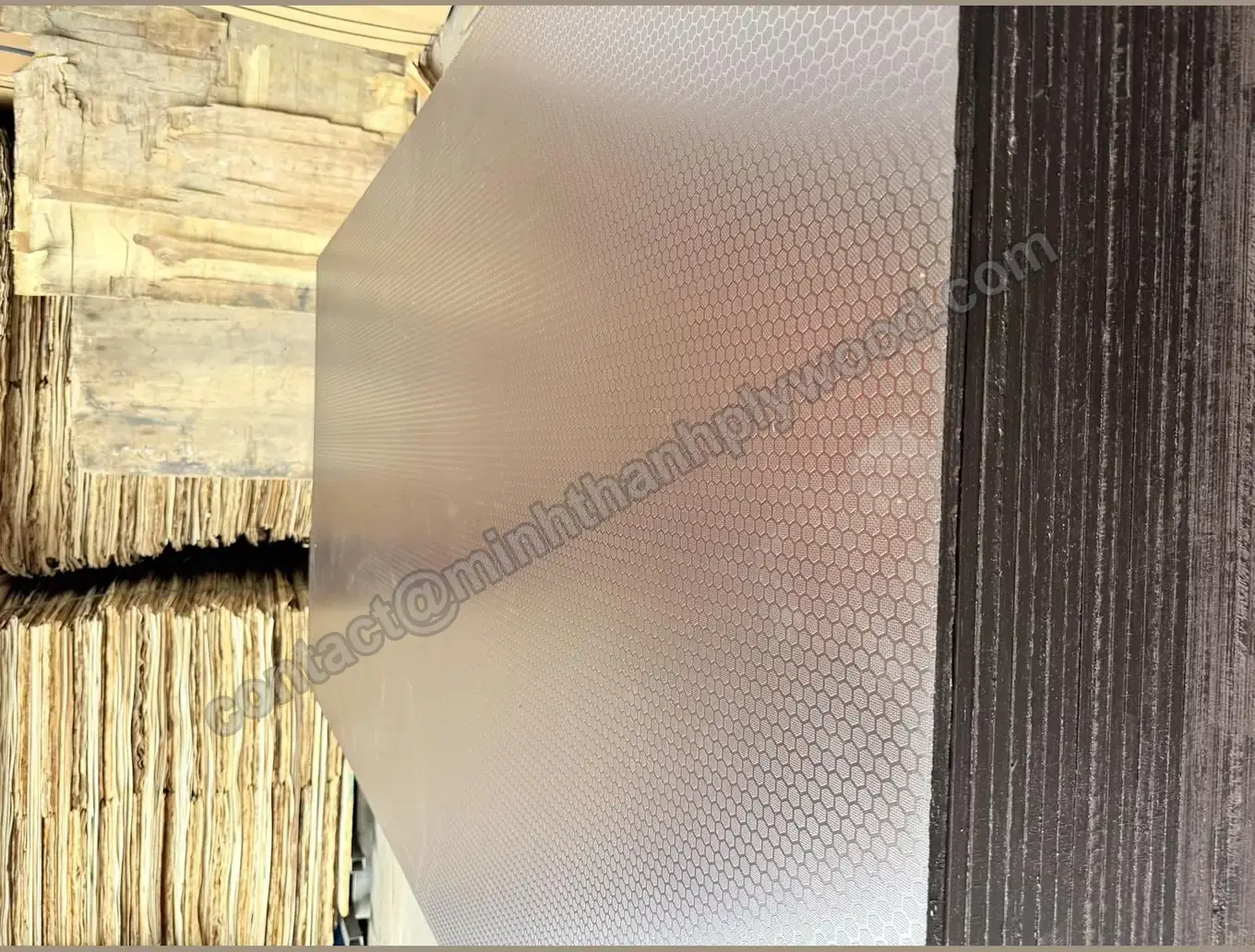
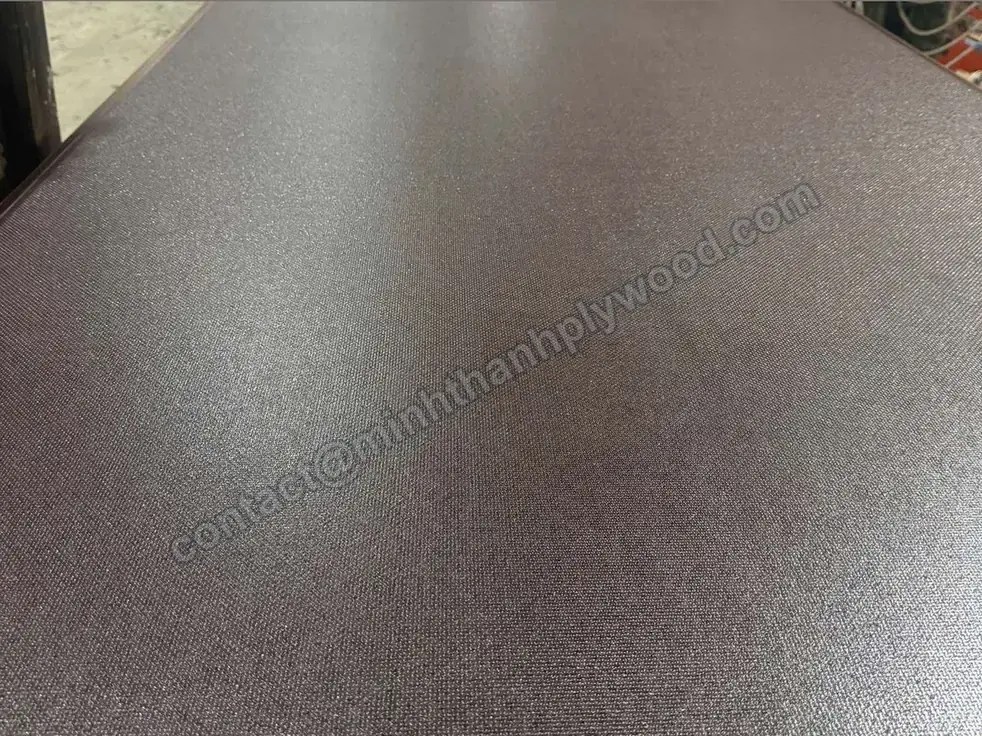
We send product photographs, dimension checks and loading photos and video for the panels on your order.
We check pattern depth, film adhesion and sealed edges on every sheet and measure thickness to ±0.5 mm before packing. A visit or live inspection can follow the panels from the production area to the marked export bundles.
Specs
Our anti-slip build uses a textured phenolic film face around 220 g/m², a smooth back, Eucalyptus or Acacia core, water-resistant glue and sealed edges.
| Face film | About 220 g/m² phenolic film; hexagonal or rice/mesh pattern |
|---|---|
| Back | Smooth film; colour and brand matched to the order |
| Core | Eucalyptus or Acacia plantation hardwood |
| Density | Eucalyptus 650–750 kg/m³; Acacia about 580 kg/m³ |
| Glue | Melamine-fortified or phenolic WBP |
| Emission | E0 or E1, specified separately from the adhesive |
| Thickness | 12, 15, 18 and 21 mm |
| Thickness tolerance | ±0.5 mm |
| Sheet sizes | 1220 × 2440 mm; 1250 × 2500 mm |
| Length/width tolerance | ±2 mm |
| Moisture | 8–12% at dispatch |
| Edge treatment | Sealed perimeter; cut edges and holes resealed before wet use |
The standard working face is textured and the reverse smooth. For a reversible deck, specify texture on both sides and match the fixing and edge details to the floor component.
A sample fixes the surface pattern while the quotation records film mass, core and glue. Keep these references on the cutting list and bundle labels for repeat floor orders.
Grades
Choose hexagonal plywood for a honeycomb working texture, or rice/mesh for a fine raised pattern. Both use phenolic film around 220 g/m², normally with a smooth film back.
Hexagonal face
Repeating honeycomb texture in phenolic film around 220 g/m².
Application brief
Pick it for foot traffic from every direction, stages and wet or washdown floors: the open cells drain and clean out.
Rice / mesh face
Fine raised pattern in phenolic film around 220 g/m².
Application brief
Pick it for wheeled traffic, trailer and van floors and oily or gritty loads: the fine pattern grips tyres and does not trap debris.
Smooth reverse
Smooth black or brown film beneath the working face.
Application brief
Normal back treatment for a panel fitted over a supporting frame.
Texture on both sides
Specified textured film on the two faces.
Application brief
Pick it for reversible decks: flip the panel when one face wears.
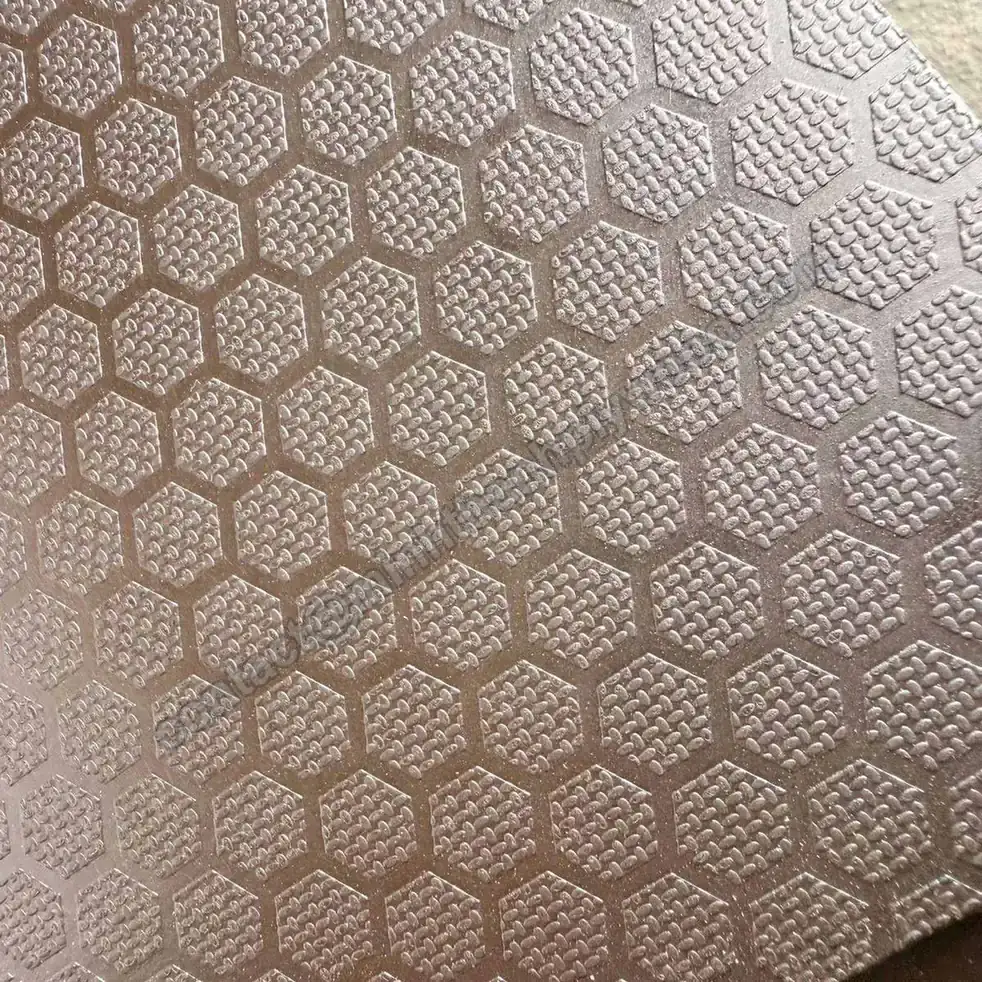
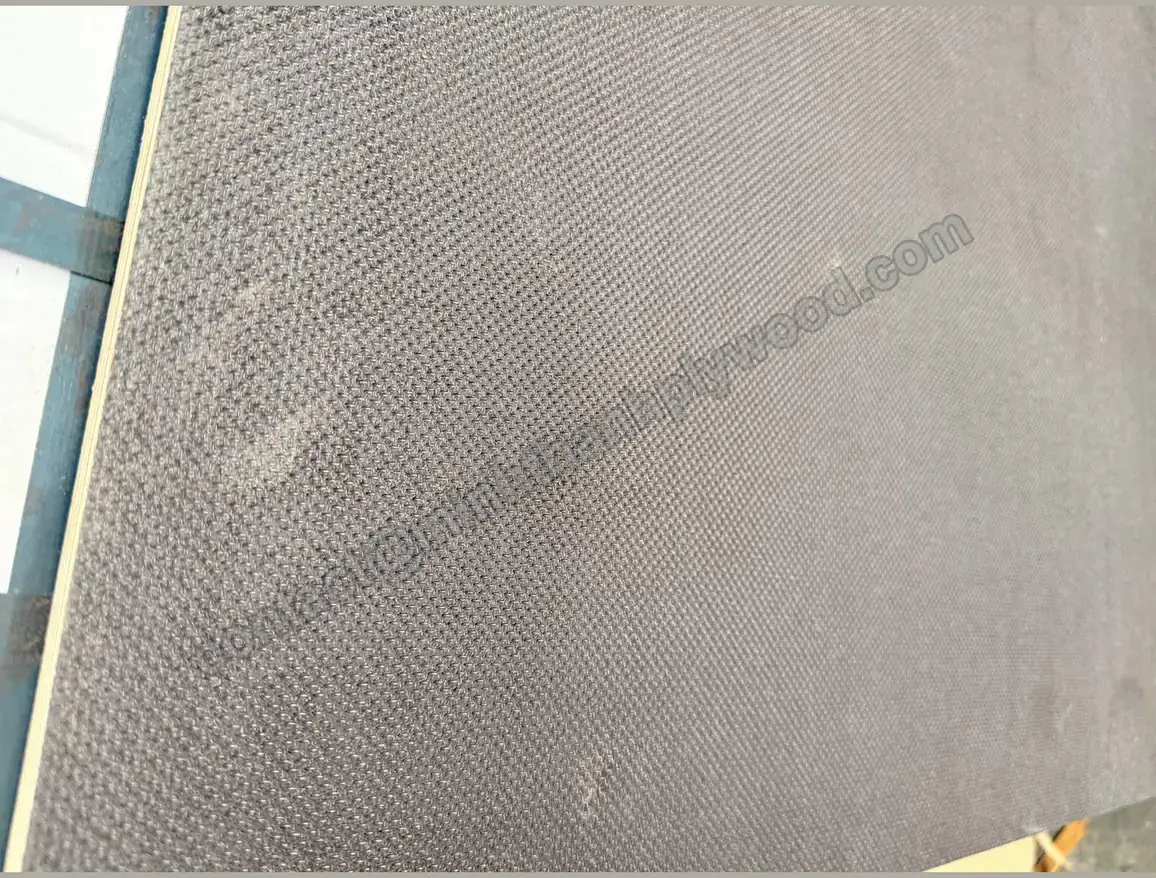
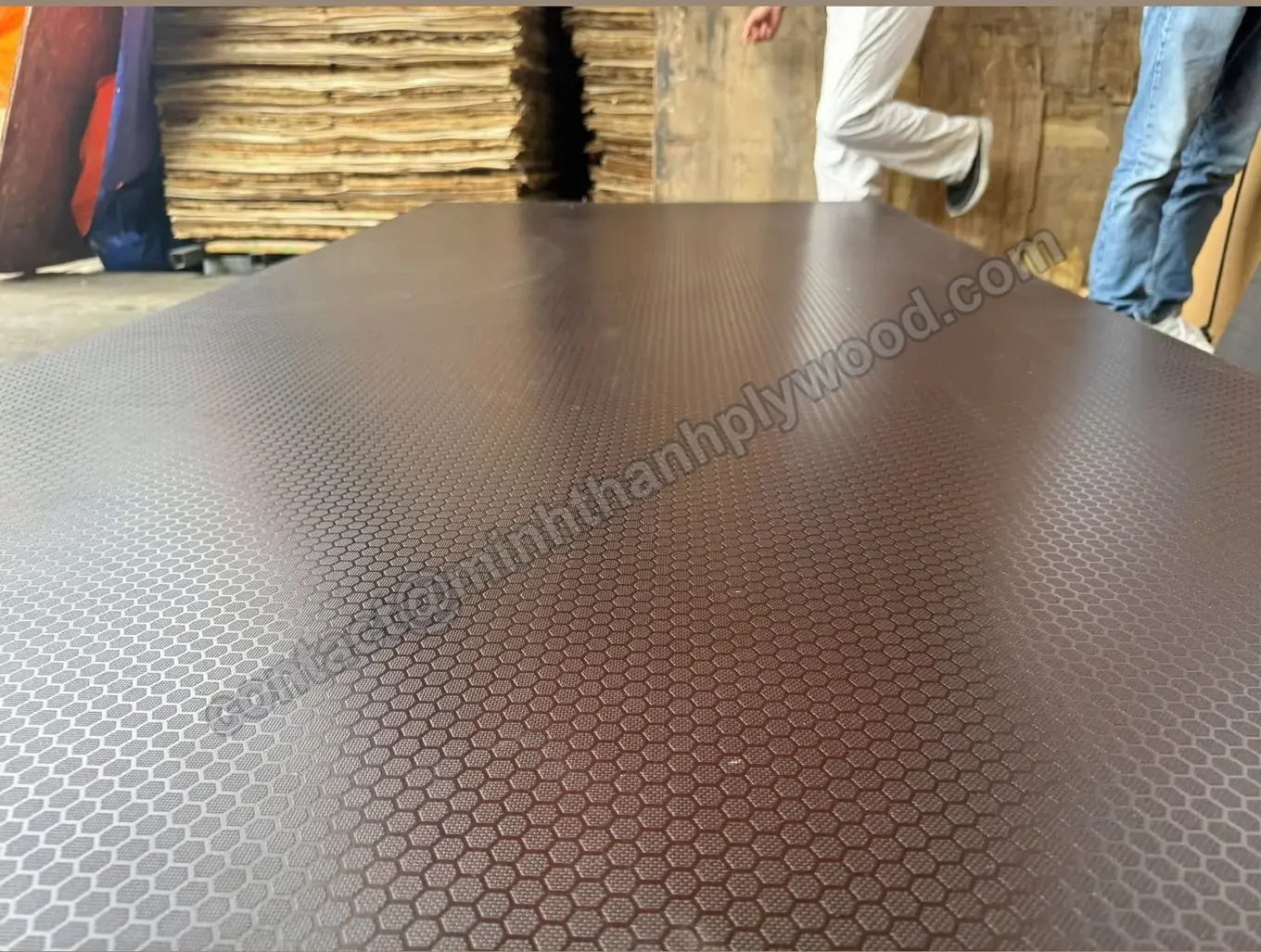
Compare the full sheet and a close-up before approving the sample. The texture, film and cleaning method work together in the finished floor.
For reversible components, request texture on both sides and include the edge profile and fixing detail in the drawing. We quote each face separately, including film colour and mass.
Rule of thumb: hexagonal for people, rice/mesh for wheels. Send the slip test method your specification names and we test the construction we ship.
Core
Choose Acacia at about 580 kg/m³ when deck weight matters, or the denser Eucalyptus option at 650–750 kg/m³. Both cores are supplied with the film and bond selected for the floor.
| Core | Density | 18 mm sheet, 1220 × 2440 mm | Buyer benefit |
|---|---|---|---|
| Eucalyptus | 650–750 kg/m³ | About 34.8–40.2 kg | Dense core for demanding panel specifications |
| Acacia | About 580 kg/m³ | About 31.1 kg | Lower handling and freight weight |
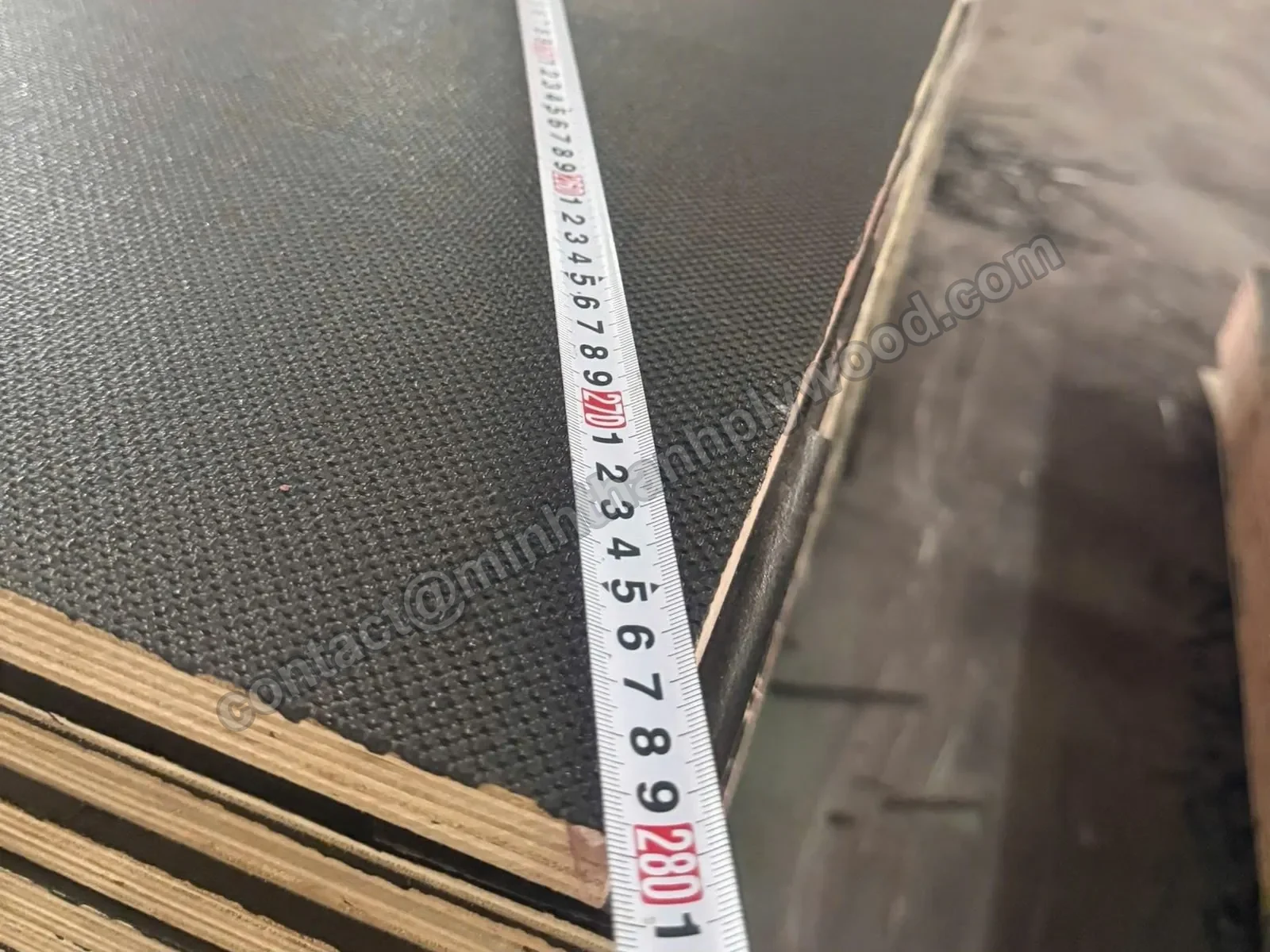
For vehicle-floor planning, an 18 mm sheet measuring 1220 × 2440 mm is about 31.1 kg on Acacia and 34.8–40.2 kg on Eucalyptus. Use that weight in the vehicle tare and manual-handling plan as well as the container calculation.
The cross-laid veneer core supports the textured working face. The flooring drawing identifies joists or cross-members, wheel paths and fixing lines; the selected panel properties complete that design.
The raised film texture is formed during pressing. Inspect it across the whole face, then check veneer edges and the smooth reverse before fitting the component. Seal machined edges and holes as part of the installation.
Glue
Phenolic WBP is the common bond for trailer floors exposed to repeated rain or washdown. Melamine-fortified glue serves the agreed moisture requirement for sheltered and other flooring jobs.
| Flooring requirement | What the quotation names | What you get |
|---|---|---|
| Adhesive family | Phenolic or melamine-fortified veneer adhesive | Phenolic WBP bond for wet and outdoor floors; melamine-fortified for covered floors |
| Wet-service bond | EN 314-2 / EN 636 class named on the order | Boil-resistant phenolic glue line, tested to the method you name |
| Enclosed-space emission | E0 or E1 | Chamber results (Shanghai Hongjun and ICTT Vietnam) 0.014–0.032 ppm (ASTM D6007) on our UF-bonded plywood |
| Textured overlay | Hexagon phenolic film on the working face | Wear-resistant grip face with a smooth film back |
Select the adhesive with the floor’s weather and cleaning exposure. We keep the glue family separate from the phenolic surface film on the order, so both the bond and wear surface are clear.
Six ASTM D6007 chamber tests (three by Shanghai Hongjun, three by ICTT Vietnam) on our 9, 15 and 18 mm UF-bonded plywood averaged 0.014–0.032 ppm using ASTM D6007. E0 and E1 emission options are available alongside the selected water-resistant bond.
Where a floor specification calls for EN 636 or EN 314-2, include that designation and test method. The bond report covers veneer adhesion; the surface test covers grip under its stated conditions.
Sizes
Common anti-slip orders are 12–15 mm for supported light walkways and van-floor liners, 18 mm for stage and platform decks, and 18–21 mm for trailer floors. The floor drawing sets the support and fastening details.
| 12 mm | Supported light walkways and van-floor liners |
|---|---|
| 15 mm | Van floors and light modular decks |
| 18 mm | Stage, access and vehicle floor panels |
| 21 mm | Trailer floors and heavier-duty deck components |
| Regular formats | 1220 × 2440 mm; 1250 × 2500 mm |
| Finished tolerance | Thickness ±0.5 mm; length and width ±2 mm |
Full sheets come in 1220 × 2440 and 1250 × 2500 mm. Cut-to-size orders can align the textured face with trailer-floor sections or repeated deck modules.
Applications
We supply textured plywood for vehicle floors, stage decks and access panels: 12–15 mm for van liners and light walkways, 18 mm for decks and platforms, 18–21 mm for trailers.
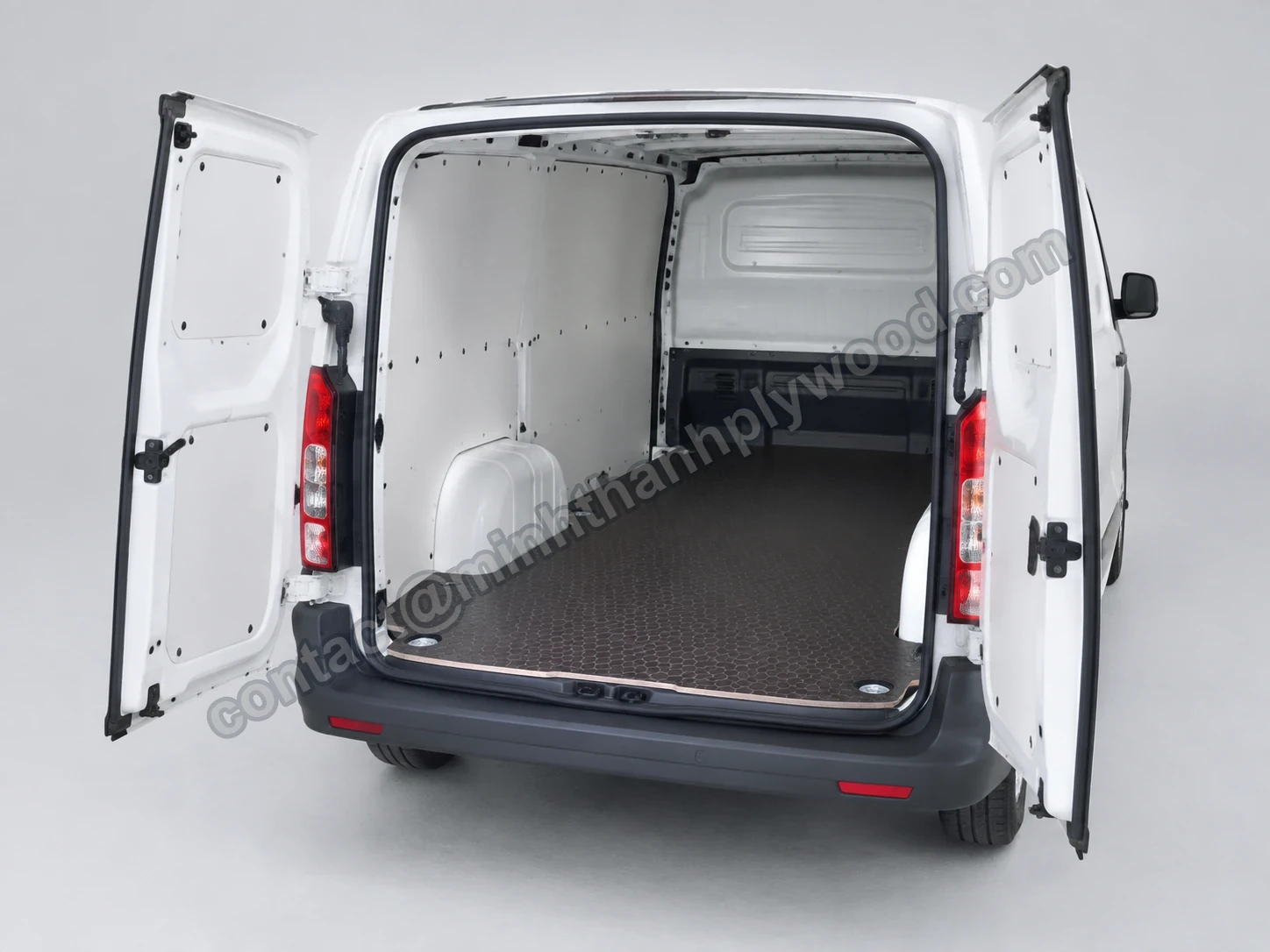
12–15 mm with a rice/mesh or hexagonal face and a smooth back. We cut around wheel arches and door openings from your drawing, so the liner drops straight in.
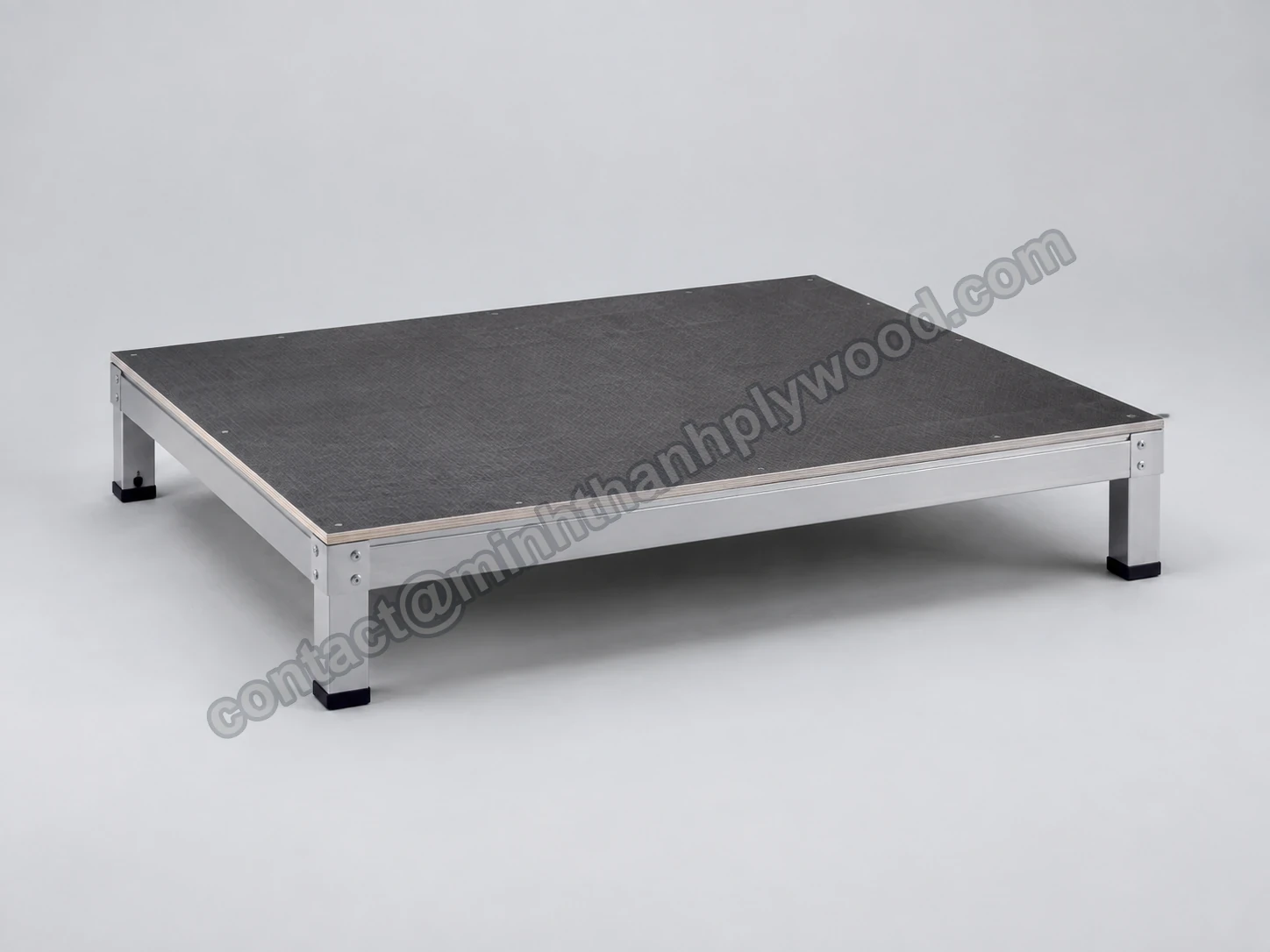
18 mm with a hexagonal face and sealed edges, cut to repeat module sizes so every deck in the set is interchangeable.
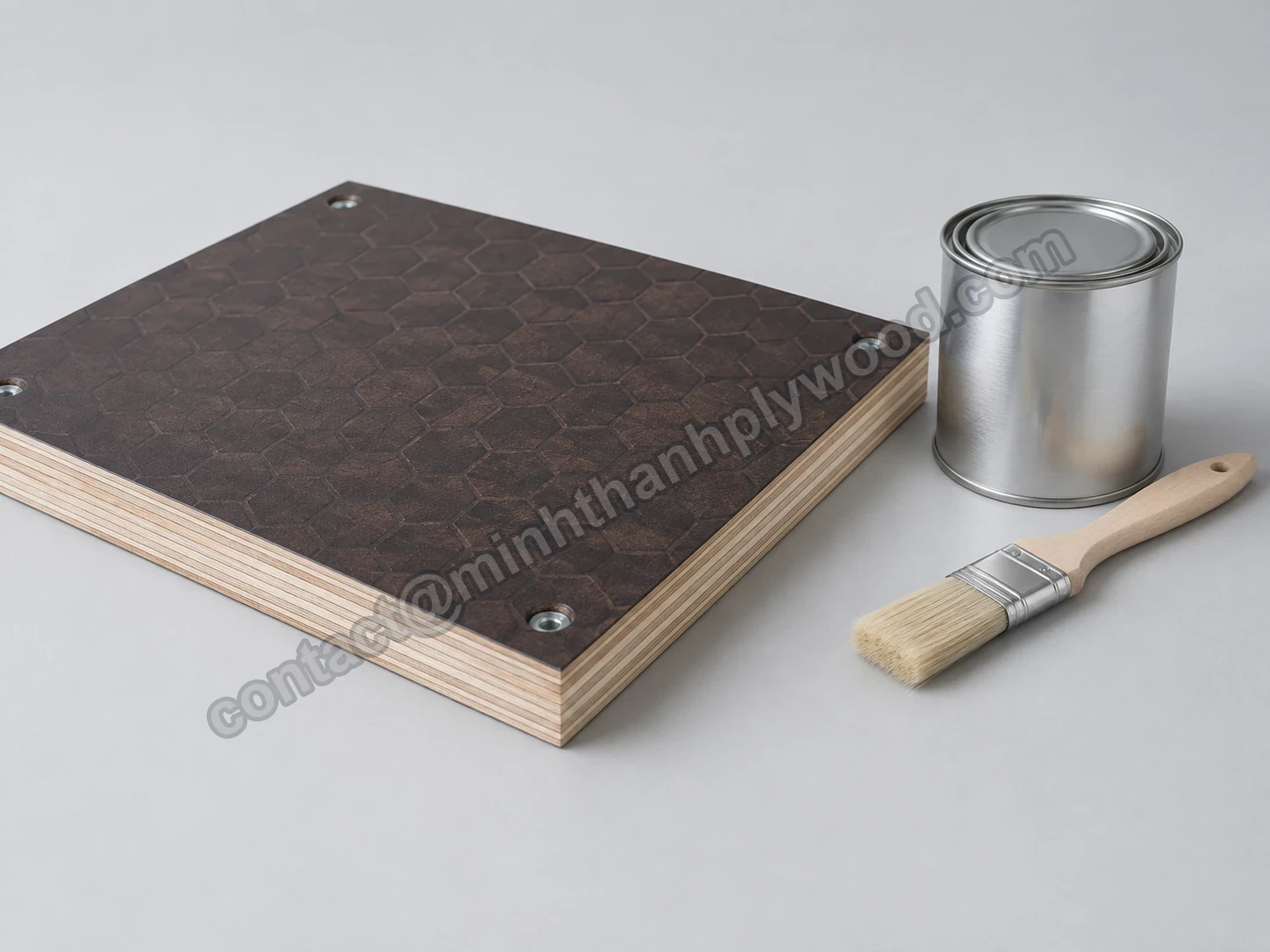
18 mm panels cut to the opening, with the face direction marked on the back and edges sealed, so removed panels go back the right way round.
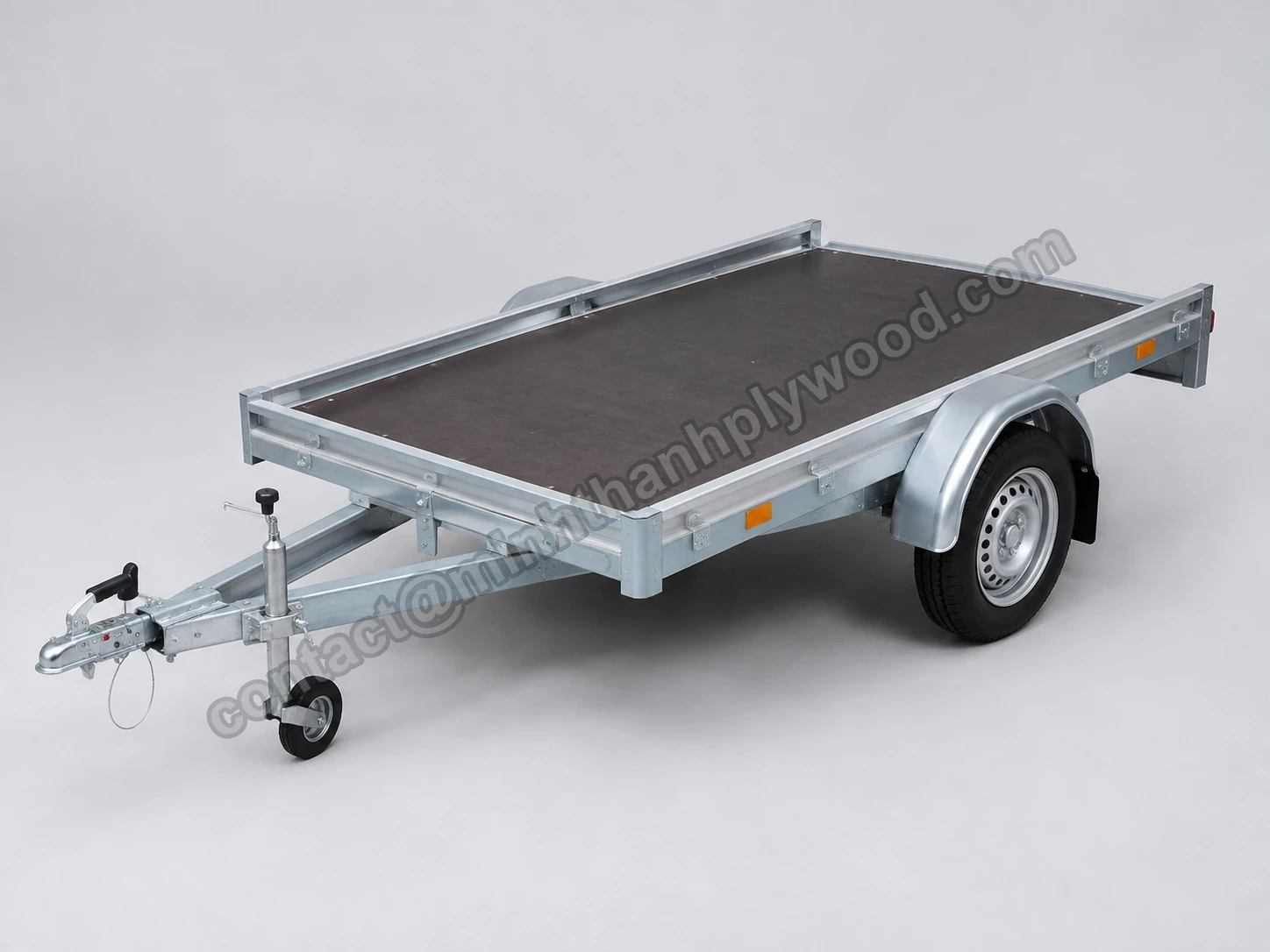
Trailer floors commonly use 18–21 mm Eucalyptus- or Acacia-core anti-slip plywood with phenolic WBP glue for outdoor wet service. The 220 g/m² textured face sits over the vehicle’s designed supports; seal cut edges and holes before fixing.
Send the floor drawing and we cut every panel to it, with the textured face on the walking side and edges sealed before packing.
Scaffold bays and platform decks take 18 mm with phenolic WBP glue; container and van liners take 12–15 mm with a rice/mesh face.
Comparison
Compare the entire installed floor when choosing between textured plywood, smooth film, metal tread plate, grip coatings and mats. Each option places different demands on support, cleaning, fixing and replacement.
| Option | Working surface | Weight and installation | Service and replacement |
|---|---|---|---|
| Textured plywood | Embossed phenolic film over a veneer core | 18 mm: about 10.4 kg/m² on Acacia (580 kg/m³), 11.7–13.5 kg/m² on Eucalyptus (650–750 kg/m³); screws to timber or steel frames | No corrosion, quiet underfoot; grip is pressed into the film, so no re-coating; replace single worn panels |
| Smooth film plywood | Plain phenolic film | Same mass and fixing as textured plywood | Little grip when wet; built for formwork contact, not walking surfaces |
| Metal tread plate | Raised steel or aluminium pattern | 3 mm steel: about 24 kg/m² (7,850 kg/m³) before the raised pattern; welded or bolted by a fabricator | Steel rusts once paint wears; loud under feet and wheels; handles heat and impact on steps |
| Grip coating | Grit coating over a substrate | Light, but needs surface preparation and curing on site | Re-coat when wheel paths polish smooth; floor is out of service while it cures |
| Rubber mat | Loose resilient layer | Lays over any surface, no fixings | Edges lift and trap water and dirt; lift to clean beneath; quick to swap |
Smooth film-faced plywood is designed around a smooth contact surface, commonly for formwork. A textured working face is a separate requirement. If a design uses the smooth reverse of a textured panel for another purpose, specify that dual use explicitly and assess each face against its own duty.
Steel chequer plate and aluminium tread plate have different mass and fabrication requirements from plywood. Compare the actual thickness, support system and fastening method rather than assuming that a visible tread pattern proves a slip result. Include corrosion or finish maintenance in the operating plan.
A paint-on grip coating is a surface system applied over a substrate. A mat is another removable layer with its own retention and edge details. When comparing costs, include preparation, cleaning, replacement and the condition of the supporting surface underneath.
Verdict: textured plywood wins for vehicle floors, stages and walkways on timber or steel frames. Tread plate wins for steps and heat. Mats win for temporary covers.
Quality control
We check pattern depth, film adhesion and sealed edges on every sheet, measure thickness to ±0.5 mm and send photos and loading records; SGS slip or bond tests on request.
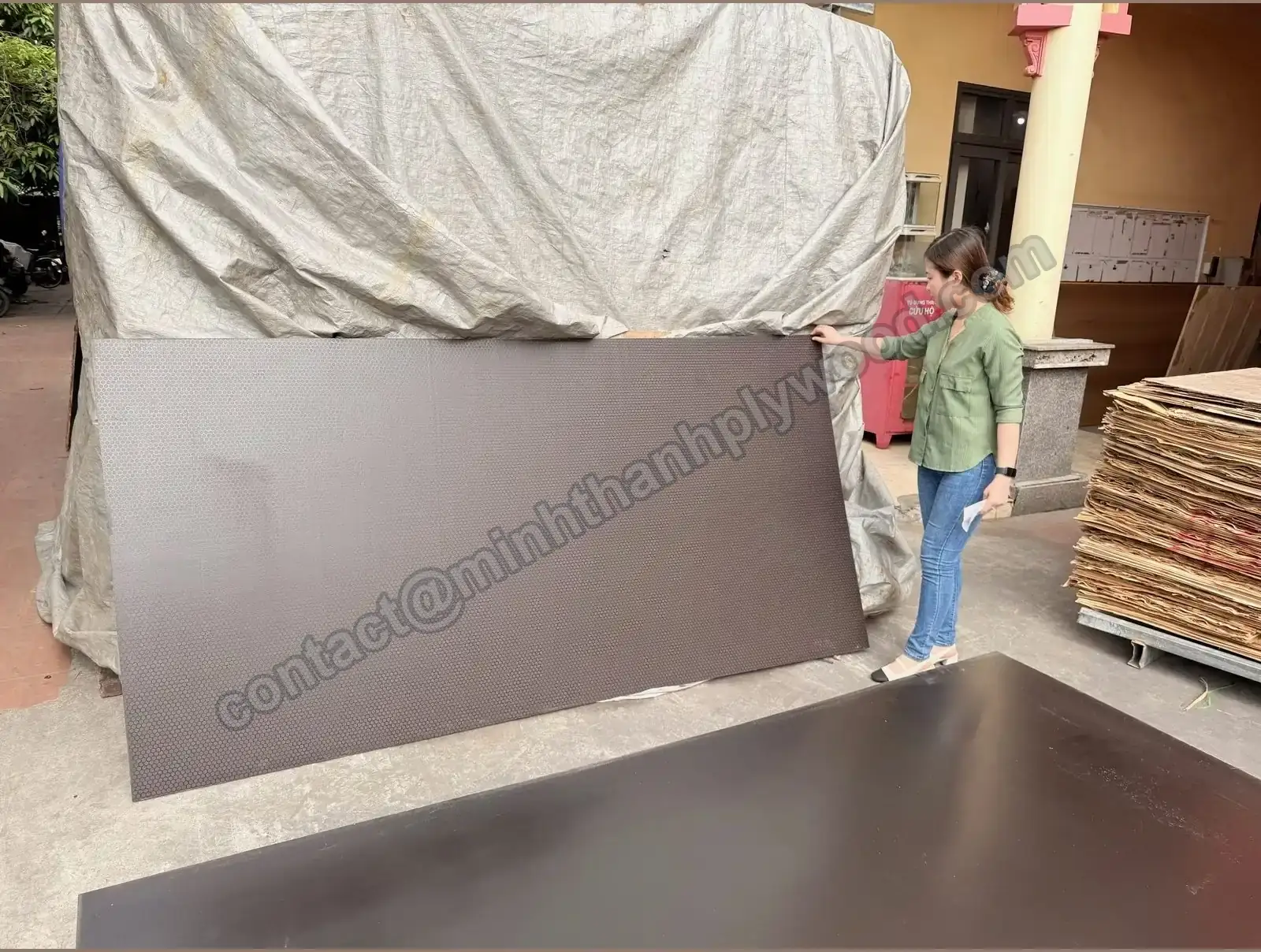
Film mass and pattern matched to the approved sample, about 220 g/m².
Even pattern depth across the face and film adhesion at all four edges.
Thickness to ±0.5 mm; length and width to ±2 mm.
Moisture 8–12% at dispatch.
Edges sealed and every bundle marked with its item reference.
Every container photographed and filmed before loading; you get the photos and video.
Every anti-slip sheet is checked for full, even pattern depth across the face, film adhesion at the edges and sealed edges before packing. The hexagon pattern is pressed in the same hot-press cycle as the film, so the grip is part of the surface, not a coating.
Trial samples let your team check machining, cleaning and fitting before repeat supply.
Related: HSE flooring guidance.
Certificates and documents
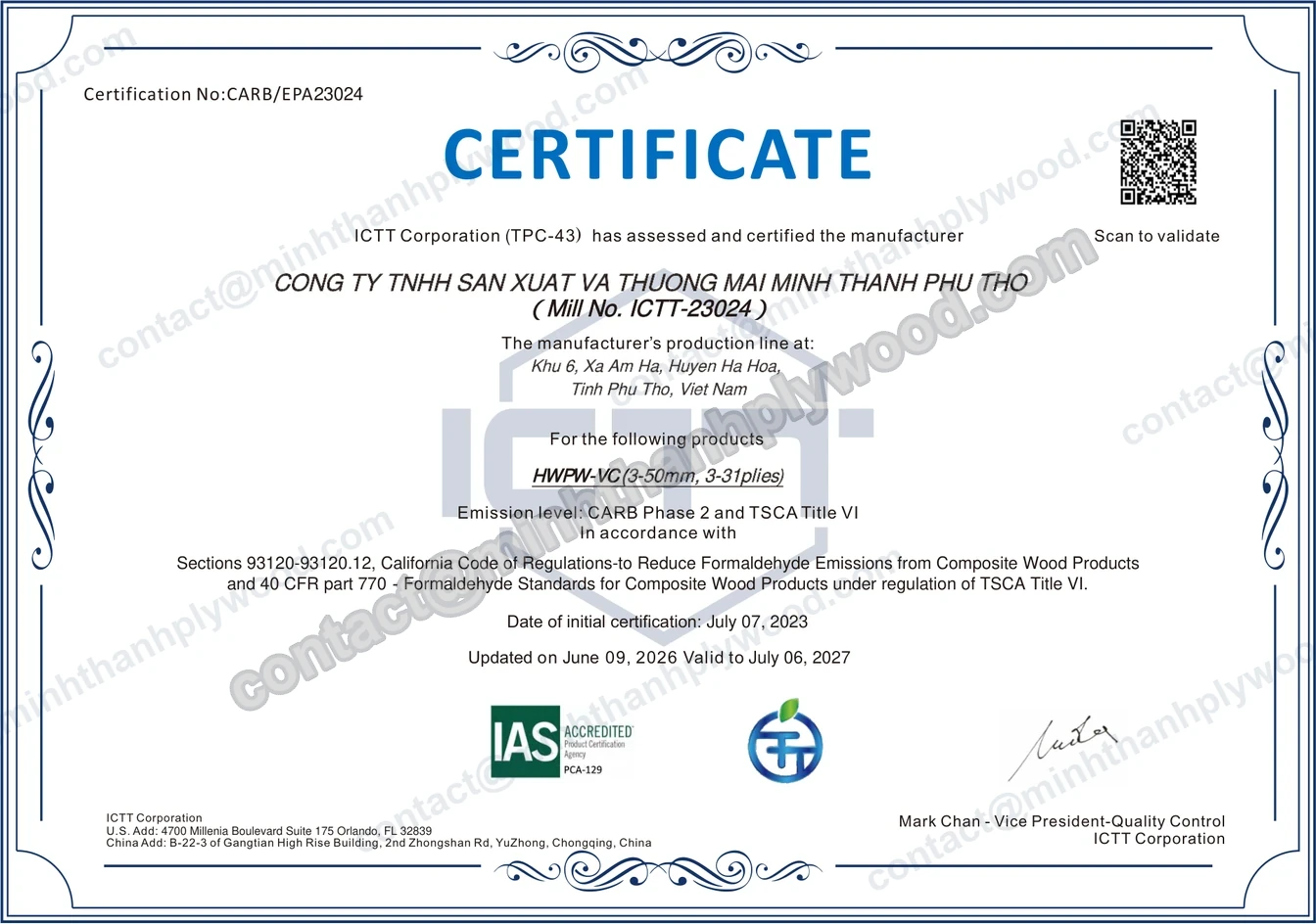
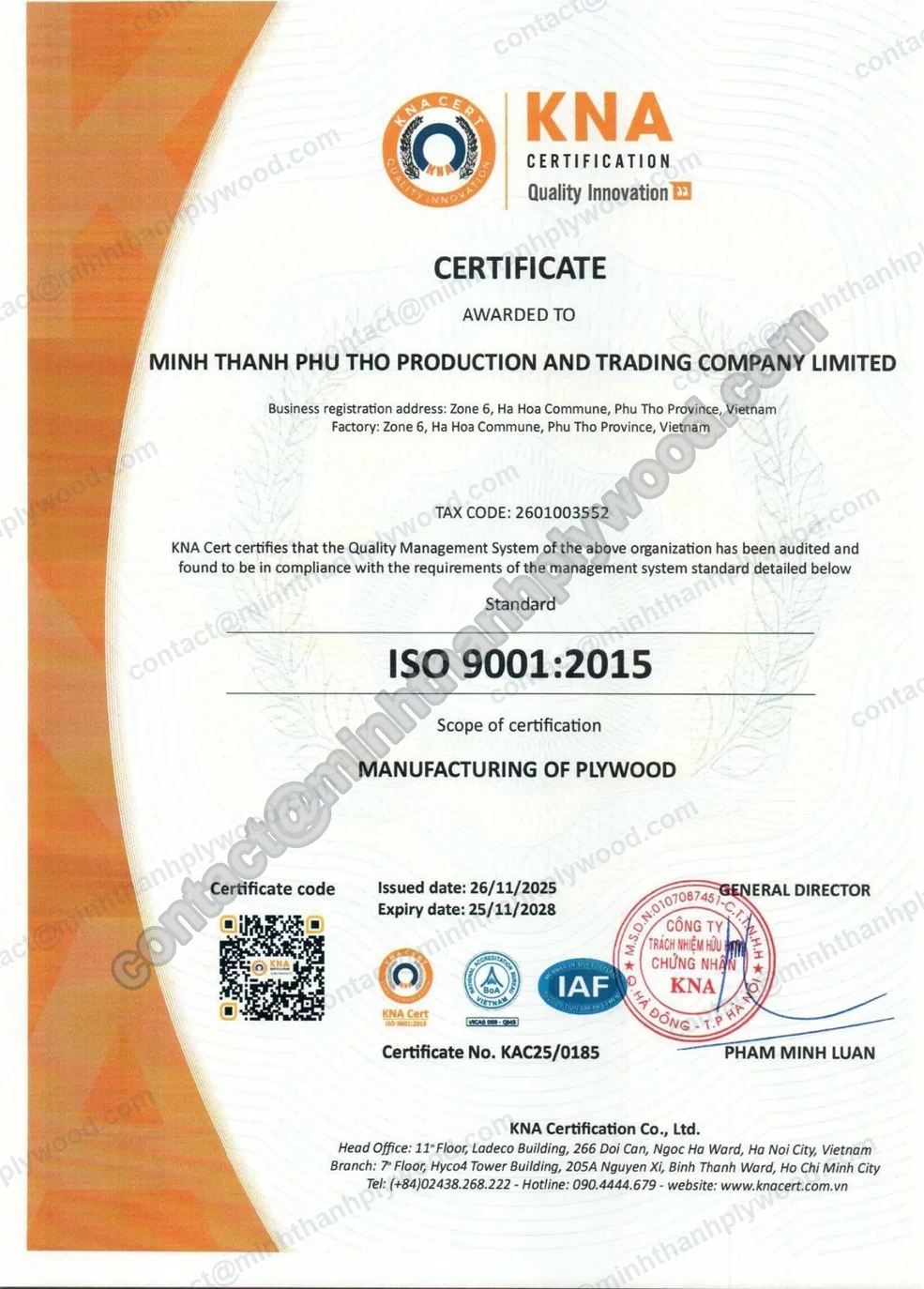
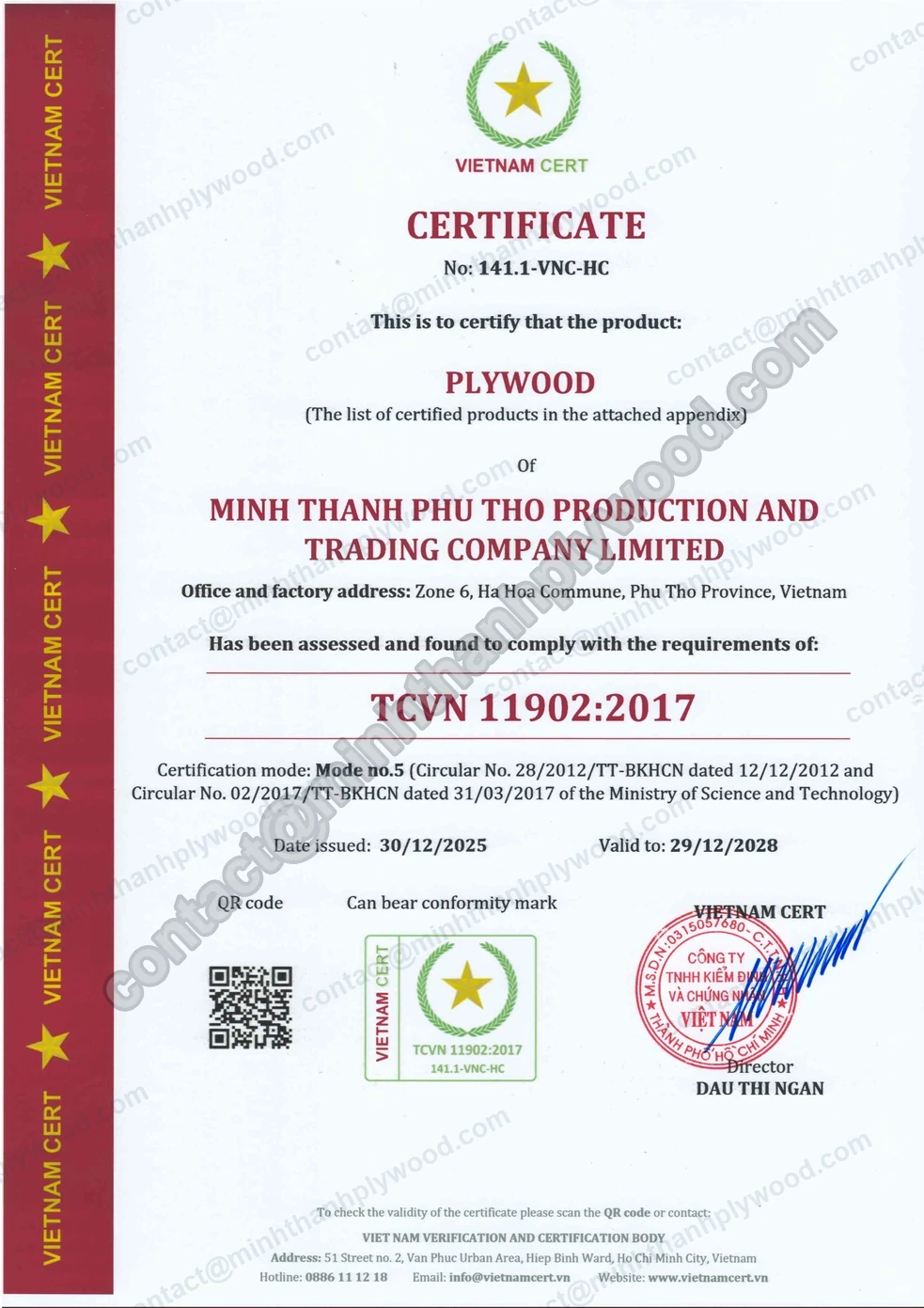
Minh Thanh Plywood holds CARB P2 / TSCA Title VI (ICTT mill no. 23024), ISO 9001:2015 and TCVN 11902:2017; we supply the EUDR compliance dossier (origin records and geolocation files) and SGS packaging report. FSC and CE are available*. See our quality documents.
ASTM D6007, Shanghai Hongjun / ICTT Vietnam
Six chamber tests, April 2025–June 2026: 0.014–0.032 ppm on 9, 15 and 18 mm UF-bonded panels
View document →Every shipment
Commercial invoice, packing list, B/L, certificate of origin (EUR.1 for the EU), phytosanitary and fumigation certificates, insurance with CIF
Every shipment: commercial invoice, packing list, B/L, certificate of origin (EUR.1 for the EU), phytosanitary and fumigation certificates, insurance with CIF.
Check a CARB or TSCA claim by the mill number. Ours, 23024, is printed on the certificate issued by ICTT. ISO and TCVN certificates carry their numbers as issued.
*Supplied directly or through qualified partner mills.
Packing
We bundle anti-slip sheets by texture and thickness, with protected faces and marked item codes, and plan each 40HC to 28,000 kg of panels.
| Thickness | Eucalyptus sheet mass | Eucalyptus sheets / 40HC (15 packs) | Acacia sheet mass | Acacia sheets / 40HC (16 packs) |
|---|---|---|---|---|
| 12 mm | 23.2 kg | 1,200 | 20.7 kg | 1,328 |
| 15 mm | 29.0 kg | 960 | 25.9 kg | 1,056 |
| 18 mm | 34.8 kg | 795 | 31.1 kg | 880 |
| 21 mm | 40.6 kg | 675 | 36.3 kg | 752 |
Keep the textured face clear of sharp straps and sliding contact. Corner protection and supports preserve the film and sealed edges during forklift handling; the packing list repeats the floor-panel references.
The reference 40HC layout for coated panels is about 43 m³ with Eucalyptus or 47 m³ with Acacia. In this table the cargo allowance is our standard 28,000 kg of panels, so weight sets the final calculated sheet count.
The 18 mm example loads 795 Eucalyptus sheets at 34.8 kg each (15 bundles of 53) or 880 Acacia sheets at 31.1 kg (16 bundles of 55). Packaging is added on top for the payload check. Actual panel and packaging weights are checked against the vessel booking before loading.
40HC example for 1220 × 2440 mm sheets: up to 28,000 kg of panels; the payload check, including packing, uses your booking. Calculated sheet mass uses 650 kg/m³ Eucalyptus or 580 kg/m³ Acacia. Whole-sheet counts round down and stay within the 15/16-bundle layouts.
Terms
A substantial textured film, a wet-service bond and sealed edges help anti-slip panels withstand repeated traffic. Maintain the texture and perimeter together: both affect the floor’s useful service life.
| Minimum order | 1×40HC; mixed configurations by agreement |
|---|---|
| Production time | 15–45 days after deposit; sea transit additional |
| Payment | 30% deposit and 70% against scanned B/L |
| Methods | T/T or irrevocable L/C at sight |
| Shipping basis | FOB Hai Phong, CFR or CIF |
| Samples | Free samples |
| Replies | Within hours, Vietnam business hours |
Use phenolic WBP for repeated outdoor wetting, keep cut edges sealed and clean grit from the working face. Film around 220 g/m² provides the specified wear surface; inspection follows the actual wheel paths and pedestrian traffic.
Polished texture, broken film and damage around fixings signal areas needing attention. Inspect these during routine maintenance, replace worn floor components and preserve the supporting structure.
Store spare sheets flat and protected, with the pattern and thickness marked. Prepare replacement panels to the same cutting and edge-sealing detail as the original installation.
Order Steps
Send the flooring requirement, select a surface sample and agree the complete panel specification before production. Keep each configuration and its required evidence together through quotation, inspection and delivery.
Describe traffic, exposure and the flooring system; attach the drawing.
Request the texture, film, core, bond, dimensions and required tests.
Review the quotation and free samples with your installation requirements.
Approve the written item references, packing plan and payment arrangement.
Review inspection records and the evidence specified for the order.
Check documents, marked bundles and received panels against the accepted specification.
Your enquiry should name the pattern, textured side or sides, reverse face, film mass and colour, core species, adhesive and bond requirement. Add thickness, dimensions, edge treatment, quantity and destination. Attach the floor drawing and any specified surface or mechanical test requirements.
Use the free sample to assess texture, reverse finish and edge construction. Review cleaning, machining and fitting with the installation team, then include the agreed details in the repeat-order specification.
Faq
These answers explain what belongs on an order for textured flooring panels, from pattern selection to test evidence and care.
Anti slip plywood is a veneer-core plywood panel with a textured film working face. Hexagonal and mesh-style surfaces are common requests for flooring and access components. The complete specification includes the core, adhesive, dimensions and relevant performance evidence. Minh Thanh Plywood accepts anti-slip panels on order alongside its main furniture and commercial range.
Anti slip film faced plywood has a textured phenolic-film working face, usually around 220 g/m², while smooth film gives the contact surface used for concrete formwork. Our textured panels use an Eucalyptus or Acacia core with a smooth back; the adhesive and emission class are separate quotation lines.
Hexagonal plywood is anti-slip plywood with a hexagon pattern pressed into the phenolic film on the working face. The raised pattern gives grip on trailer floors, stages, walkways and platforms, while the smooth back keeps the panel easy to clean. We make it in 12–21 mm on Eucalyptus or Acacia cores, and samples ship with the quotation.
Neither wins everywhere. Hexagonal is the better choice for multi-direction foot traffic, stages and wet or washdown floors, because the open six-sided cells drain and clean out. Rice/mesh is better for wheeled traffic, trailer and van floors and oily or gritty loads. For reversible decks, order texture on both sides. Both come with film around 220 g/m².
Floor specifications name either a pendulum test (EN 13036-4 / BS 7976) or the ramp test behind the German R-rating (DIN 51130). Our hexagon film is the standard grip face buyers order for trailer and stage floors. Tell us the method your specification names, and we arrange SGS testing on the construction we ship.
Common orders are 12–15 mm for supported van-floor liners and 18–21 mm for trailer floors. For an outdoor trailer, choose phenolic WBP glue, a 220 g/m² hexagonal or rice/mesh face and sealed edges. The vehicle drawing sets support spacing, wheel-load requirements and fixing positions.
Yes, request the pattern and film on both faces for a reversible component. Specify each face’s colour and film mass, then show the edge profile and fixing arrangement on the drawing. We quote the two-sided build separately from the normal textured-face/smooth-back panel.
Yes for outdoor wet service when ordered with phenolic WBP glue: the phenolic film sheds water and sealed edges keep it out of the core; melamine-fortified suits covered floors. Seal every cut edge and drilled hole before installation.
Years of floor service. The 220 g/m² film is heavier than the 120–135 g/m² film on formwork panels, and with phenolic WBP glue and sealed edges the core stays dry. When a wheel path wears smooth, turn a reversible panel over or replace that one panel.
Yes. Supply a cutting list with finished dimensions, thickness, quantity, working face and part reference. Add openings and the floor support detail to the drawing. Include saw allowance when nesting parts, and define the sealing of cut edges and drilled holes so machining and finishing are included in the order plan.
Store unused sheets flat, off the ground and under cover, on aligned supports. Clean installed panels with water and a stiff brush, scrape grit out of the cells and keep solvents off the film. Reseal any cut edge or drilled hole you make on site.
Send the application, traffic and exposure, pattern, textured sides, film requirement, core, bond, thickness, size and quantity. Include the drawing, required test evidence and destination port. MOQ is one 40HC and production is 15–45 days after deposit, with sea transit added. Free samples are available; Lisa replies within hours.
For trailer floors, 18–21 mm Eucalyptus- or Acacia-core plywood with phenolic WBP glue is a common order. Specify the 220 g/m² hexagonal or rice/mesh face, smooth back and sealed edges. Add the vehicle drawing and wheel loads so the sheet sizes, joints and fasteners match the floor design.
Rfq
Tell us the floor application, texture and construction requirements. We will work from the drawing and specified evidence to prepare your quotation and free sample offer.
Attach up to 3 drawings or specification files, including the pattern, film, core, bond, thickness, sheet sizes, quantity and destination port. Contact [email protected] or WhatsApp Lisa on +84 988 586 601.
[email protected]